Proceedings of VarDial, pages 209–213 209
Experiments in Cuneiform Language Identification
Gustavo Henrique Paetzold1, Marcos Zampieri2
1Universidade Tecnol´ogica Federal do Paran´a, Toledo-PR, Brazil 2University of Wolverhampton, Wolverhampton, United Kingdom
Abstract
This paper presents methods to discriminate between languages and dialects written in Cuneiform script, one of the first writing sys-tems in the world. We report the results ob-tained by thePZteam in the Cuneiform Lan-guage Identification (CLI) shared task orga-nized within the scope of the VarDial Evalu-ation Campaign 2019. The task included two languages, Sumerian and Akkadian. The lat-ter is divided into six dialects: Old Babylo-nian, Middle Babylonian peripheral, Standard Babylonian, Neo Babylonian, Late Babylo-nian, and Neo Assyrian. We approach the task using a meta-classifier trained on various SVM models and we show the effectiveness of the system for this task. Our submission achieved 0.738 F1 score in discriminating between the seven languages and dialects and it was ranked fourth in the competition among eight teams.
1 Introduction
As discussed in a recent survey (Jauhiainen et al.,
2018), discriminating between similar languages, national language varieties, and dialects is an im-portant challenge faced by state-of-the-art lan-guage identification systems. The topic has at-tracted more and more attention from the CL/NLP community in recent years with publications on similar languages of the Iberian peninsula (
Zu-biaga et al., 2016), and varieties and dialects
of several languages such as Greek (Sababa and
Stassopoulou,2018) and Romanian (Ciobanu and
Dinu,2016) to name a few.
As evidenced in Section 2, the focus of most of these studies is the identification of languages and dialects using contemporary data. A few ex-ceptions include the work by Trieschnigg et al.
(2012) who applied language identification meth-ods to historical varieties of Dutch and the work
by Jauhiainen et al. (2019) on languages
writ-ten in cuneiform script: Sumerian and Akkadian.
Cuneiform is an ancient writing system invented by the Sumerians for more than three millennia.
In this paper we describe computational ap-proaches to language identification on texts writ-ten in cuneiform script. For this purpose we use the dataset made available by Jauhiainen et al.
(2019) to participants of the Cuneiform Language Identification (CLI) shared task organized at Var-Dial 2019 (Zampieri et al., 2019). Our submis-sion, under the team name PZ, is an adaptation of an n-gram-based meta-classifier system which showed very good performance in previous lan-guage identification shared tasks (Malmasi and
Zampieri, 2017b,a). Furthermore, we compare
the performance of the meta-classifier to the sub-missions to the CLI shared task and, in partic-ular, to a deep learning approach submitted by the team ghpaetzold. It has been shown in pre-vious language identification studies (Medvedeva
et al.,2017; Kroon et al., 2018) that deep
learn-ing approaches do not outperform n-gram-based methods and we were interested in investigating whether this is also true for the languages and di-alects included in CLI.
2 Related Work
Since its first edition in 2014, shared tasks on sim-ilar language and dialect identification have been organized together with the VarDial workshop co-located with international conferences such as COLING, EACL, and NAACL. The first and most well-attended of these competitions was the Discrminating between Similar Languages (DSL) shared task which has been organized between 2014 and 2017 (Malmasi et al.,2016b;Zampieri
et al.,2014,2015,2017). The DSL provided the
Col-Language or Dialect Code Texts Lines Signs
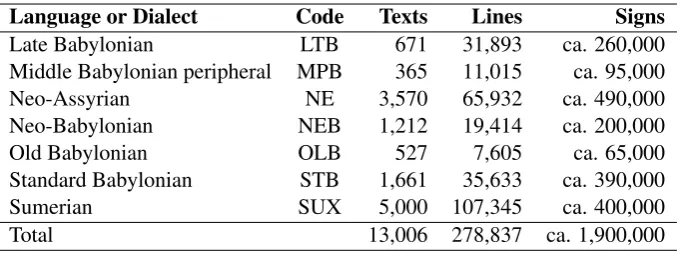
[image:2.595.130.471.61.188.2]Late Babylonian LTB 671 31,893 ca. 260,000 Middle Babylonian peripheral MPB 365 11,015 ca. 95,000 Neo-Assyrian NE 3,570 65,932 ca. 490,000 Neo-Babylonian NEB 1,212 19,414 ca. 200,000 Old Babylonian OLB 527 7,605 ca. 65,000 Standard Babylonian STB 1,661 35,633 ca. 390,000 Sumerian SUX 5,000 107,345 ca. 400,000 Total 13,006 278,837 ca. 1,900,000
Table 1: Number of texts, lines, and signs in each of the seven languages and dialects in the dataset ofJauhiainen et al.(2019), from which the instances of the CLI datasets were taken.
lection (DSLCC) (Tan et al.,2014), a multilingual benchmarked dataset compiled for this purpose. In 2017 and 2018, VarDial featured evaluation cam-paigns with multiple shared tasks not only on lan-guage and dialect identification but also on other NLP tasks related to language and dialect variation (e.g. morphosyntactic tagging, and cross-lingual dependency parsing). With the exception of the DSL, the language and dialect identification com-petitions organized at VarDial focused on groups of dialects from the same language such as Arabic (ADI shared task) and German (GDI shared task).
The focus of the aforementioned language and dialect identification competitions was diatopic variation and thus the data made available in these competitions was synchronic contemporary cor-pora. In the 2019 edition of the workshop, for the first time, a task including historical languages was organized. The CLI shared task provided par-ticipants with a dataset containing languages and dialects written in cuneiform script: Sumerian and Akkadian. Akkadian is divided into six dialects in the dataset: Old Babylonian, Middle Babylo-nian peripheral, Standard BabyloBabylo-nian, Neo Baby-lonian, Late BabyBaby-lonian, and Neo Assyrian (
Jauhi-ainen et al.,2019).
The CLI shared task is an innovative initiative that opens new perspectives in the computational processing of languages written in cuneiform script. There have been a number of studies apply-ing computational methods to process these lan-guages (e.g. Sumerian (Chiarcos et al.,2018)), but with the exception of Jauhiainen et al.(2019), to the best of our knowledge, no language identifica-tion studies have been published. CLI is the first competition organized on cuneiform script texts in particular and in historical language identification in general.
3 Methodology and Data
The dataset used in the CLI shared task is de-scribed in detail in Jauhiainen et al.(2019). All of the data included in the dataset was collected from the Open Richly Annotated Cuneiform Cor-pus (Oracc)1 which contains transliterated texts.
Jauhiainen et al.(2019) created a tool to transform
the texts back to the cuneiform script. The dataset features texts from seven languages and dialects amounting to a little over 13,000 texts. The list of languages and dialects is presented in Table1.
3.1 System Description
Our submission to the CLI shared task is a system based on a meta-classifier trained on several SVM models. Meta-classifiers (Giraud-Carrier et al.,
2004) and ensemble learning methods have proved to deliver competitive performance not only in language identification (Malmasi and Zampieri,
2017b,a) but also in many other text classification
tasks (Malmasi et al.,2016a;Sulea et al.,2017). The meta-classifier is an adaptation of previous submissions to VarDial shared tasks described in
(Malmasi and Zampieri, 2017a). It is essentially
a bagging ensemble trained on the outputs of lin-ear SVM classifiers. As features, the system uses the following character n-gram and character skip-gram features:
• charactern-grams of order1–5;
• 1-skip character bigrams and trigrams;
• 2-skip character bigrams and trigrams;
• 3-skip character bigrams and trigrams.
Each feature class is used to train a single lin-ear SVM classifier using LIBLINEAR (Fan et al.,
2008). The outputs of these SVM classifiers on the training data are then used to train the meta-classifier.
4 Results
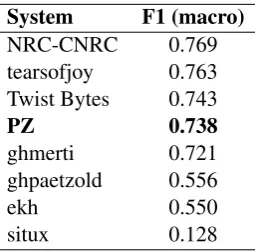
Table2showcases the results obtained by our team (PZin bold) and the best submission by each of the eight teams which participating in the CLI shared task. Even though the competition allowed the use of other datasets (open submission), we have used only the dataset provided by the shared task orga-nizers to train our model.
Our submission was ranked 4th in the shared task, only a few percentage points below the top-3 systems: NRC-CNRC, tearsofjoy, and
Twist Bytes. The meta-classifier achieved much higher performance at distinguishing between these Mesopotamian languages and dialects than the neural model byghpaetzold, which ranked 6th in the competition. We present this neural model in more detail comparing its performance to our meta-classifier in Section4.1.
System F1 (macro)
NRC-CNRC 0.769 tearsofjoy 0.763 Twist Bytes 0.743
PZ 0.738
ghmerti 0.721 ghpaetzold 0.556
ekh 0.550
[image:3.595.118.246.381.507.2]situx 0.128
Table 2: Results for the CLI task obtained by the team
PZ (in bold) in comparison to the the best entries of each of the eight teams in the shared task. Results re-ported in terms of F1 (macro).
4.1 Comparison to a Neural Model
We take the opportunity to compare the perfor-mance of our system with an entirely different type of model submitted by teamghpaetzold. This comparison was motivated by the lower perfor-mance obtained by the neural models in compari-son to traditional machine learning models in pre-vious VarDial shared tasks (Zampieri et al.,2018). It was made possible due to the collaboration be-tween theghpaetzoldteam and ours.2
2One of the
ghpaetzoldteam members was also a member of thePZteam.
As demonstrated byLing et al.(2015), compo-sitional recurrent neural networks can offer very reliable performance on a variety of NLP tasks. Previous language identification and dialect stud-ies (Medvedeva et al., 2017;Kroon et al., 2018;
Butnaru and Ionescu, 2019) and the results of
the previous shared tasks organized at VarDial
(Zampieri et al., 2017, 2018), however, showed
that deep learning approaches do not outperform more linear n-gram-based methods so we were in-terested in comparing the performance of a neural model to the meta-classifier for this dataset.
A compositional network is commonly de-scribed as a model that builds numerical represen-tations of words based on the sequence of charac-ters that compose them. They are inherently more time-consuming to train than typical neural mod-els that use traditional word vectors because of the added parameters, but they compensate by be-ing able to handle any conceivable word passed as input with very impressive robustness (Paetzold,
2018,2019).
The model takes as input a sentence and pro-duces a corresponding label as output. First, the model vectorizes each character of each word in the sentence using a typical character embedding layer. It then passes the sequence of vectors through a set of 2 layers of Gated Recurrent Units (GRUs) and produces a numerical representation for each word as a whole. This set of represen-tations is then passed through another 2-layer set of GRUs to produce a final vector for the sen-tence as a whole, and then a dense layer is used to produce a softmax distribution over the label set. The model uses 25 dimensions for character em-beddings, 30 nodes for each GRU layer and 50% dropout. A version of each model was saved af-ter each epoch so that the team could choose the one with the lowest error on the development set as their submission.
LTB MPB NEA NEB OLB STB SUX
Predicted label LTB
MPB
NEA
NEB
OLB
STB
SUX
True label
941 16 4 1 19 4
4 800 71 15 16 31 48 3 6 909 25 3 19 20 23 31 309 489 4 102 27 21 33 92 13 720 36 70 13 20 270 97 18 457 110 1 9 53 7 43 77 795
Confusion Matrix
[image:4.595.305.514.66.252.2]0.0 0.2 0.4 0.6 0.8
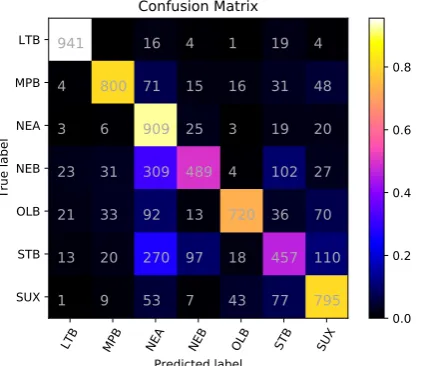
Figure 1: Confusion matrix for the meta-classifier.
LTB MPB NEA NEB OLB STB SUX
Predicted label LTB
MPB
NEA
NEB
OLB
STB
SUX
True label
883 1 28 6 7 44 16
5 708 111 13 21 52 75 4 13 860 21 6 40 41 53 56 417 247 11 137 64 75 105 200 17 193 121 274 26 35 292 77 27 386 142 5 13 62 6 33 123 743
Confusion Matrix
0.0 0.1 0.2 0.3 0.4 0.5 0.6 0.7 0.8
Figure 2: Confusion matrix for the neural model.
5 Conclusion and Future Work
In this paper we presented a meta-classifier sys-tem submitted by the team PZ to the Cuneiform Language Identification shared task organized at VarDial 2019. Our submission is an adaptation of a sophisticated meta-classifier which achieved high performance in previous language and di-alect identification shared tasks at VarDial (
Mal-masi and Zampieri, 2017a). The meta-classifier
combines the output of multiple SVM classifers trained on character-based features. The meta-classifier ranked 4th in the competition among eight teams only a few percentage points below the top-3 systems in the competition.
Finally, we compared the performance of the meta-classifier with a compositional RNN model that uses only the text from the instance as in-put trained on the same dataset. The compari-son shows that, while the neural model does of-fer competitive performance against some of the systems submitted to the shared task, the more elaborate features used by the meta-classifier al-lows it to much more proficiently distinguish be-tween very similar language pairs, such as Neo Babylonian and Neo Assyrian, leading to a per-formance gain of 18.2% F-score and 2 positions in the shared task rankings. The results obtained by the meta-classifier in comparison to the neural model corroborate the findings of previous stud-ies (Medvedeva et al.,2017) in the last two Var-Dial evaluation campaigns (Zampieri et al.,2017,
2018).
In the future we would like to analyze the results obtained by the highest performing teams in the
CLI shared task. The top team achieved the best performance in the competition using a neural-based method. This is, to the best of our knowl-edge, the first time in which a deep learning ap-proach outperforms traditional machine learning methods in one of the VarDial shared tasks. The great performance obtained by the NRC-CNRC team might be explained by the use of more suit-able deep learning methods such as BERT (Devlin
et al.,2018).
Acknowledgements
We would like to thank Shervin Malmasi for his valuable suggestions and feedback. We further thank the CLI shared task organizer, Tommi Jauhi-ainen, for organizing this interesting shared task.
We gratefully acknowledge the support of NVIDIA Corporation with the donation of the Ti-tan V GPU used for this research.
References
Andrei Butnaru and Radu Tudor Ionescu. 2019. MO-ROCO: The Moldavian and Romanian Dialectal Corpus. arXiv preprint arXiv:1901.06543.
Christian Chiarcos, ´Emilie Pag´e-Perron, Ilya Khait, Niko Schenk, and Lucas Reckling. 2018. Towards a Linked Open Data Edition of Sumerian Corpora. InProceedings of LREC.
Alina Maria Ciobanu and Liviu P Dinu. 2016. A com-putational perspective on the romanian dialects. In
Proceedings of LREC.
[image:4.595.77.288.67.250.2]Deep Bidirectional Transformers for Language Un-derstanding. arXiv preprint arXiv:1810.04805.
Rong-En Fan, Kai-Wei Chang, Cho-Jui Hsieh, Xiang-Rui Wang, and Chih-Jen Lin. 2008. LIBLINEAR: A Library for Large Linear Classification. Journal of Machine Learning Research, 9(Aug):1871–1874.
Christophe Giraud-Carrier, Ricardo Vilalta, and Pavel Brazdil. 2004. Introduction to the Special Issue on Meta-learning. Machine learning, 54(3):187–193.
Tommi Jauhiainen, Heidi Jauhiainen, Tero Alstola, and Krister Lind´en. 2019. Language and Dialect Identi-fication of Cuneiform Texts. InProceedings of Var-Dial.
Tommi Jauhiainen, Marco Lui, Marcos Zampieri, Tim-othy Baldwin, and Krister Lind´en. 2018. Automatic language identification in texts: A survey. arXiv preprint arXiv:1804.08186.
Martin Kroon, Masha Medvedeva, and Barbara Plank. 2018. When Simple N-gram Models Outper-form Syntactic Approaches: Discriminating be-tween Dutch and Flemish. In Proceedings of Var-Dial.
Wang Ling, Tiago Lu´ıs, Lu´ıs Marujo, Ram´on Fernan-dez Astudillo, Silvio Amir, Chris Dyer, Alan W Black, and Isabel Trancoso. 2015. Finding function in form: Compositional character models for open vocabulary word representation. arXiv preprint arXiv:1508.02096.
Shervin Malmasi and Marcos Zampieri. 2017a. Arabic Dialect Identification Using iVectors and ASR Tran-scripts. InProceedings of VarDial.
Shervin Malmasi and Marcos Zampieri. 2017b. Ger-man Dialect Identification in Interview Transcrip-tions. InProceedings of VarDial.
Shervin Malmasi, Marcos Zampieri, and Mark Dras. 2016a. Predicting Post Severity in Mental Health Forums. InProceedings of CLPsych.
Shervin Malmasi, Marcos Zampieri, Nikola Ljubeˇsi´c, Preslav Nakov, Ahmed Ali, and J¨org Tiedemann. 2016b. Discriminating between Similar Languages and Arabic Dialect Identification: A Report on the Third DSL Shared Task. InProceedings of VarDial.
Maria Medvedeva, Martin Kroon, and Barbara Plank. 2017. When Sparse Traditional Models Outperform Dense Neural Networks: The Curious Case of Dis-criminating between Similar Languages. In Pro-ceedings of VarDial.
Gustavo Paetzold. 2018. UTFPR at IEST 2018: Ex-ploring Character-to-Word Composition for Emo-tion Analysis. InProceedings of WASSA.
Gustavo Paetzold. 2019. UTFPR at SemEval-2019 Task 6: Relying on Compositionality to Find Of-fense. InProceedings of SemEval.
Hanna Sababa and Athena Stassopoulou. 2018. A Classifier to Distinguish Between Cypriot Greek and Standard Modern Greek. InProceedings of SNAMS.
Octavia-Maria Sulea, Marcos Zampieri, Shervin Mal-masi, Mihaela Vela, Liviu P Dinu, and Josef van Genabith. 2017. Exploring the use of Text Classifi-cation in the Legal Domain. Proceedings of ASAIL.
Liling Tan, Marcos Zampieri, Nikola Ljubeˇsi´c, and J¨org Tiedemann. 2014. Merging Comparable Data Sources for the Discrimination of Similar Lan-guages: The DSL Corpus Collection. In Proceed-ings BUCC.
Dolf Trieschnigg, Djoerd Hiemstra, Mari¨et Theune, Franciska Jong, and Theo Meder. 2012. An Ex-ploration of Language Identification Techniques in the Dutch Folktale Database. In Proceedings of the Workshop on Adaptation of Language Resources and Tools for Processing Cultural Heritage.
Marcos Zampieri, Shervin Malmasi, Nikola Ljubeˇsi´c, Preslav Nakov, Ahmed Ali, J¨org Tiedemann, Yves Scherrer, and No¨emi Aepli. 2017. Findings of the VarDial Evaluation Campaign 2017. InProceedings of VarDial.
Marcos Zampieri, Shervin Malmasi, Preslav Nakov, Ahmed Ali, Suwon Shuon, James Glass, Yves Scherrer, Tanja Samardˇzi´c, Nikola Ljubeˇsi´c, J¨org Tiedemann, Chris van der Lee, Stefan Grondelaers, Nelleke Oostdijk, Antal van den Bosch, Ritesh Ku-mar, Bornini Lahiri, and Mayank Jain. 2018. Lan-guage Identification and Morphosyntactic Tagging: The Second VarDial Evaluation Campaign. In Pro-ceedings of VarDial.
Marcos Zampieri, Shervin Malmasi, Yves Scherrer, Tanja Samardˇzi´c, Francis Tyers, Miikka Silfverberg, Natalia Klyueva, Tung-Le Pan, Chu-Ren Huang, Radu Tudor Ionescu, Andrei Butnaru, and Tommi Jauhiainen. 2019. A Report on the Third VarDial Evaluation Campaign. InProceedings of VarDial.
Marcos Zampieri, Liling Tan, Nikola Ljubeˇsi´c, and J¨org Tiedemann. 2014. A report on the DSL shared task 2014. InProceedings of VarDial.
Marcos Zampieri, Liling Tan, Nikola Ljubeˇsi´c, J¨org Tiedemann, and Preslav Nakov. 2015. Overview of the dsl shared task 2015. In Proceedings of LT4VarDial.