1
Neural Vector Conceptualization for Word Vector Space Interpretation
Robert Schwarzenberg*, Lisa Raithel*, David Harbecke
German Research Center for Artificial Intelligence (DFKI), Berlin, Germany
{firstname.lastname}@dfki.de
Abstract
Distributed word vector spaces are consid-ered hard to interpret which hinders the under-standing of natural language processing (NLP) models. In this work, we introduce a new method to interpret arbitrary samples from a word vector space. To this end, we train a neural model to conceptualize word vectors, which means that it activates higher order con-cepts it recognizes in a given vector. Contrary to prior approaches, our model operates in the original vector space and is capable of learning non-linear relations between word vectors and concepts. Furthermore, we show that it pro-duces considerably less entropic concept acti-vation profiles than the popular cosine similar-ity.
1 Introduction
In the vast majority of state-of-the-art NLP mod-els, as for instance in translation models (
Bo-jar et al., 2018) or text classifiers (Howard and
Ruder, 2018), language is represented in
dis-tributed vector spaces. Using disdis-tributed represen-tations comes at the price of low interpretability as they are generally considered uninterpretable, without further means (Levy and Goldberg,2014;
Montavon et al., 2018). In this work, we address
this lack of interpretability withneural vector con-ceptualization (NVC), a neural mapping from a word vector space to a concept space (e.g. “chair” should activate the concept “furniture”).
Using concepts to interpret distributed vec-tor representations of language is inspired by the finding that “humans understand languages through multi-step cognitive processes which in-volves building rich models of the world and mak-ing multi-level generalizations from the input text”
(Shalaby and Zadrozny, 2019). We are not the
first, however, to utilize concepts for this purpose.
* Shared first authorship.
Koc¸ et al. (2018), for instance, modify the
objective function of GloVe (Pennington et al.,
2014) to align semantic concepts with word vector dimensions to create an interpretable space. Their method does not, however, offer an interpretation of vectors in the original space.
Senel et al. (2018), in contrast, do offer an
in-terpretation of the original space: They propose a mapping of word vector dimensions to cepts. This mapping, however, is linear and con-sequently, their method is incapable of modeling non-linear relations.
Our method offers an interpretation of the orig-inal space and is capable of modeling non-linear relations between the word and the concept space. Furthermore, arguably, we interpret vectors sim-ilar to how a neural NLP model would, because a neural NLP model lies at the heart of our method. In addition, by design, our model is able to conceptualize random continuous samples, drawn from the word vector space.
This is particularly important as word vectors are sparse in their vector space and vectors without a word representative do not have intrinsic mean-ing. This hinders adapting methods from vision, such as activation maximization (Simonyan et al.,
2013) or generative adversarial networks (
Good-fellow et al.,2014), as in NLP these methods
po-tentially produce vectors without word representa-tions.
2 Method
For NVC, we propose to train a neural model to map word vectors onto associated concepts. More formally, the model should learn a meaningful mapping
f : IRd→IR|C| (1)
where d denotes the number of word vector di-mensions andC is a set of concepts. The training objective should be a multi-label classification to account for instances that belong to more than one concept (e.g. “chair” should also activate “seat”).
For the training, we need to make two basic choices:
1. We need a ground truth concept knowledge base that provides the concepts a training in-stance should activate and
2. we need to choose a model architecture ap-propriate for the task.
In the following, we motivate our choices.
2.1 Ground Truth Concept Knowledgebase
As a ground truth concept knowledge base we chose the Microsoft Concept Graph (MCG), which is built on top of Probase, for the follow-ing reasons:
1. Wu et al.(2012) convincingly argue that with
Probase they built a universal taxonomy that is more comprehensive than other existing candidates, such as for example, Freebase
(Bollacker et al.,2008).
2. Furthermore, Probase is huge. The core tax-onomy contains about 5.38 million concepts, 12.5 million unique instances, and 85.1 mil-lion isArelations. This allows our model to illuminate the word vector space from many angles.
3. Instance-concept relations are probabilistic in the MCG: For (instance, concept) tuples a
rep score can be retrieved. The rep score describes the “representativeness” of an in-stance for a concept, and vice versa. Accord-ing to the MCG, for example, the instance “chair” is a few thousand times more repre-sentative for the concept “furniture” than is the instance “car.” During training, we ex-ploit therepscores to retrieve representative target concepts for a training instance.
The scores are based on the notion of Basic Level Concepts (BLC) which were first introduced
by Rosch et al.(1976), as part of Prototype
The-ory. A basic level concept is a concept on which all people of the same culture consciously or un-consciously agree. For instance, according to Pro-totype Theory, most humans would categorize a “wood frog” simply as a “frog.” “Wood frog” is a representative instance of the concept “frog.”
Aiming to provide an approach to the computa-tion of the BLC of an instanceiin the MCG,Wang
et al. (2015) combine pointwise mutual
informa-tion (PMI) with co-occurrence counts of concept
cand instancei. The authors compute the “repre-sentativeness” of an instanceifor a conceptcas
rep(i, c) =P(c|i)·P(i|c). (2)
By taking the logarithm of therepscore, we can isolate the involvement of PMI:
log rep(i, c)−log P(i, c) =P M I(i, c). (3)
In doing so, the authors boost concepts in the mid-dle of the taxonomy (the basic level concepts) while reducing extreme values leading to super-or subsuper-ordinate concepts. To find the BLC of a sin-gle instance,Wang et al.(2015) maximize over the
repvalue of all concepts associated withi. To train our model, for a training instancei, we collect all concepts for which rep(i, c)1 is above a certain threshold and use them as the target la-bels fori. We discard concepts that have very few instances above a thresholdrepvalue in the graph.
2.2 Model
During training, the model repeatedly receives a word vector instance as input and a multi-hot vec-tor retrieved from the MCG as the target concept vector. Thus, it must identify concepts encoded in the word vector.
We do not see any sequentiality or recurrence in this task which is why we discarded recurrent and Transformer candidate models. Concerning convolutional networks, we disregard small recep-tive fields because dimensional adjacency is se-mantically irrelevant in word vectors. However, any convolutional network with a receptive field over the whole input vector is equivalent to a fully-connected (FC) feed-forward network. Thus, we ultimately trained an FC feed-forward network to conceptualize vectors.
1
Concepts
Activations
(Our
s)
Activations
(Cos)
0.16
0.14
0.12
0.10
0.08
0.06
0.04
0.02
0.00
0.00 0.10
-0.10
-0.20 0.20 0.40 0.50
0.30
sound
song
track
verb comment stimulus record musical
instrument
apps
tune
sound song
music
band
musicia n
speaker album
tune folk
[image:3.595.120.471.61.440.2]phone
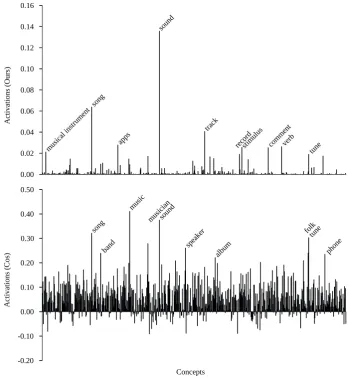
Figure 1: Vector interpretations of the word vector of “listening” with 637 concepts. Top: Neural vector conceptu-alization (our method, 10 highest activations labelled). Bottom: Cosine similarity (baseline, 10 highest activations labelled). Both activation profiles are unnormalized.
3 Experiments
For a proof of concept, we chose the word-2vec embedding (Mikolov et al., 2013) as the word vector space to interpret. Recently, contex-tualized representations, likeELMo (Peters et al.,
2018) andBERT(Devlin et al.,2019), received in-creased attention. Nevertheless, well-established global representations, such as word2vec re-main highly relevant: ELMo still benefits from using global embeddings as additional input and
BERT trains its own global token embedding space.
Theword2vecmodel and the MCG are based on different corpora. As a consequence of using data from two different sources, we sometimes needed to modify MCG instances to match the
word2vecvocabulary.
We filtered the MCG for concepts that have at
least 100 instances with a rep value of at least
−10. This leaves 637 concepts with an average of 184 instances per concept and gives a class im-balance of 524 negative samples for every positive sample.
With the obtained data, we trained a three-layer FC network to map word vectors onto their con-cepts in the MCG. The model returns independent sigmoid activations for each concept. We trained with categorical cross entropy and applied weights regularization with a factor of10−7. For all exper-iments, we optimized parameters with the ADAM optimizer (Kingma and Ba,2015).2
To estimate task complexity, Table 1 lists the precision, recall and F1 scores that our model
achieved on a fixed, randomly sampled test set that
2
Cosine NVC
NVC
Activat
ions
Cosine
Activat
[image:4.595.72.521.62.337.2]ions
Figure 2: Concept activations for the instance “listening.” Upper left: Top 25 concepts according to cosine simi-larity. Bottom left: NVC activations of the same cosine top 25 concepts. Upper right: Top 25 concepts according to NVC. Bottom right: Cosine activations of the same NVC top 25 concepts.
contained 10 % of the data. The table contains the weighted average scores accomplished for all concepts as well as the scores the model achieved for selected individual concepts, grouped semanti-cally.
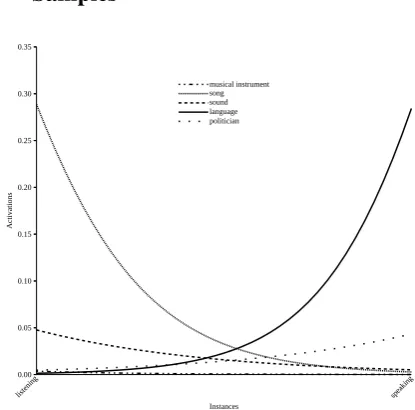
Fig.1juxtaposes the NVC and the baseline ac-tivation profile of the word vector of “listening”, which was not encountered during training. Sev-eral other NVCs can be found in the appendix (see Figs.3, 4and5) as well as selected concept acti-vations of continuous samples (see Fig.6).
While Fig.1 shows a global perspective of the activation profiles, Fig.2zooms in on the top 25 concepts, activated by the baseline method (first column) and our method (second column).
4 Discussion
The weighted classificationF1score is0.22which
suggests that the task is complex, probably due to the highly imbalanced data set. According to Ta-ble1, however,F1 scores vary significantly along
individual concepts. While we observe a high score forprovince, our model has difficulties clas-sifying locations, for instance. The same trend can be observed forchoreographers andlegends. What we see reflected in this table is the sharpness
P R F S
all concepts 0.43 0.16 0.22 9766
province 0.81 0.81 0.81 36
district 0.79 0.62 0.69 78
island 0.96 0.38 0.54 64
locality 0.5 0.03 0.06 29
location 0 0 0 14
choreographer 0.85 0.69 0.76 16
composer 0.8 0.66 0.72 61
artist 0.57 0.36 0.44 70
legend 0 0 0 33
dish 0 0 0 34
meal 0 0 0 17
delicacy 0 0 0 11
salad 0 0 0 9
Table 1: Precision (P), recall (R),F1 Score (F), and
support (S) for all 637 concepts (F1Score weighted by
support) and selected individual concepts. Class mem-bership was determined by an activation threshold of 0.5.
[image:4.595.314.519.402.608.2]the higher the classification performance tends to be. We cannot, however, offer an explanation for the poor classification performance on some other concepts, such as the last ones in Table1.
Fig. 1 (top) shows the NVC of “listening” with the top ten peaks labelled. For Table 1, a class membership was determined by an activa-tion threshold of0.5of the relevant output neuron. Fig. 1 (top), however, illustrates that the model activates many meaningful concepts beneath this threshold and thus0.5might not be appropriate to determine class membership.
Some of the peaks are also reflected in the bot-tom plot of Fig. 1, which depicts the activation profile of the cosine similarity baseline method. The most notable difference between our method and the baseline is that the latter produces much more entropic activation profiles. It is less selec-tive than NVC as NVC deactivates many concepts. Fig.2(first column) shows that NVC indeed de-activates unrelated concepts, such as personality, finding, filling,great, andworkthat, according to cosine similarity, are close to the instance “listen-ing.” Speaker,phone, andorganarguably are rea-sonable concepts and yet deactivated by NVC but NVC replaces them with more meaningful con-cepts, as can be seen in the upper right plot in Fig. 2. Note that, contrary to NVC, the baseline method is not able to deactivate concepts that have close vectors in the word vector space, nor is it able to activate concepts that have vectors that are far from the input vector. Overall, a manual anal-ysis suggests that the top 25 NVC concepts are more fitting than the top 25 cosine concepts.
5 Related Work
Concept knowledge bases such as the MCG ex-ist because concepts are powerful abstractions of natural language instances that have been used for many downstream tasks, such as text classification
(Song et al.,2011), ad-query similarity and query
similarity (Kim et al.,2013), document similarity
(Song and Roth,2015), and semantic relatedness
(Bekkali and Lachkar, 2019). The approaches
mentioned above all implement some form of text conceptualization (TC).
TC models the probability P(c|I)of a concept
cbeing reflected in a set of observed natural lan-guage instancesI (Shalaby and Zadrozny, 2019;
Song et al.,2011). This is also the objective
func-tion of the model we train and our interpretability
method can thus be understood as an implementa-tion of TC.
Furthermore, besides the methods already dis-cussed in the introduction, there is more research into the interpretability of language representa-tions.Adi et al.(2017), for instance, also use aux-iliary prediction tasks to analyse vector represen-tations. However, they work on sentence level, not word level. Moreover, instead of retrieving con-cepts, they probe sentence length, word content conservation and word order conservation in the representation.
An approach similar to ours was introduced by
Sommerauer and Fokkens (2018). The authors
investigate the kind of semantic information en-coded in word vectors. To this end, they train a classifier that recognizes whether word vectors carry specific semantic properties, some of which can be regarded as concepts.
6 Conclusion & Future Work
We introduced neural vector conceptualization as a means of interpreting continuous samples from a word vector space. We demonstrated that our method produces considerably less entropic con-cept activation profiles than the cosine similarity measure. For an input word vector, NVC acti-vated meaningful concepts and deactiacti-vated unre-lated ones, even if they were close in the word vector space.
Contrary to prior methods, by design, NVC op-erates in the original language space and is capa-ble of modeling non-linear relations between lan-guage instances and concepts. Furthermore, our method is flexible: At the heart of it lies a neural NLP model that we trained on an instance-concept ground truth that could be replaced by another one. In the future, we would like to extend NVC to contextualized representations. We consider this non-trivial because it may not be possible to di-rectly apply the current instance-concept ground truth to contextualized instances, in particular if they are represented by sub-word embeddings.
Acknowledgements
References
Yossi Adi, Einat Kermany, Yonatan Belinkov, Ofer Lavi, and Yoav Goldberg. 2017. Fine-grained anal-ysis of sentence embeddings using auxiliary predic-tion tasks. InInternational Conference of Learning Representations (ICLR).
Mohammed Bekkali and Abdelmonaime Lachkar. 2019. An effective short text conceptualization based on new short text similarity. Social Network Analysis and Mining, 9(1):1.
Ondˇrej Bojar, Christian Federmann, Mark Fishel, Yvette Graham, Barry Haddow, Philipp Koehn, and Christof Monz. 2018. Findings of the 2018 Con-ference on Machine Translation (WMT18). In Pro-ceedings of the Third Conference on Machine Trans-lation: Shared Task Papers, pages 272–303. Associ-ation for ComputAssoci-ational Linguistics.
Kurt Bollacker, Colin Evans, Praveen Paritosh, Tim Sturge, and Jamie Taylor. 2008. Freebase: a collab-oratively created graph database for structuring hu-man knowledge. In Proceedings of the 2008 ACM SIGMOD international conference on Management of data, pages 1247–1250. AcM.
Jacob Devlin, Ming-Wei Chang, Kenton Lee, and Kristina Toutanova. 2019. BERT: Pre-training of Deep Bidirectional Transformers for Language Un-derstanding. Proceedings of the 2019 Conference of the North American Chapter of the Association for Computational Linguistics: Human Language Tech-nologies.
Ian Goodfellow, Jean Pouget-Abadie, Mehdi Mirza, Bing Xu, David Warde-Farley, Sherjil Ozair, Aaron Courville, and Yoshua Bengio. 2014. Generative Adversarial Nets. In Advances in neural informa-tion processing systems, pages 2672–2680.
Jeremy Howard and Sebastian Ruder. 2018. Universal language model fine-tuning for text classification. In
Proceedings of the 56th Annual Meeting of the As-sociation for Computational Linguistics (Volume 1: Long Papers), volume 1, pages 328–339.
Dongwoo Kim, Haixun Wang, and Alice Oh. 2013. Context-dependent conceptualization. In Twenty-Third International Joint Conference on Artificial Intelligence.
Diederick P. Kingma and Jimmy Ba. 2015. Adam: A Method for Stochastic Optimization. In Inter-national Conference on Learning Representations (ICLR).
Aykut Koc¸, Lutfi Kerem Senel, ˙Ihsan Utlu, and Hal-dun M. Ozaktas. 2018. Imparting Interpretability to Word Embeddings while Preserving Semantic Struc-ture. arXiv:1807.07279.
Omer Levy and Yoav Goldberg. 2014. Dependency-Based Word Embeddings. In Proceedings of the
52nd Annual Meeting of the Association for Compu-tational Linguistics (Volume 2: Short Papers), pages 302–308. Association for Computational Linguis-tics.
Tomas Mikolov, Kai Chen, Greg Corrado, and Jeffrey Dean. 2013. Efficient Estimation of Word Represen-tations in Vector Space. arXiv:1301.3781.
Gr´egoire Montavon, Wojciech Samek, and Klaus-Robert M¨uller. 2018. Methods for interpreting and understanding deep neural networks. Digital Signal Processing, 73:1–15.
Jeffrey Pennington, Richard Socher, and Christopher Manning. 2014. Glove: Global Vectors for Word Representation. In Proceedings of the 2014 Con-ference on Empirical Methods in Natural Language Processing (EMNLP), pages 1532–1543. Associa-tion for ComputaAssocia-tional Linguistics.
Matthew Peters, Mark Neumann, Mohit Iyyer, Matt Gardner, Christopher Clark, Kenton Lee, and Luke Zettlemoyer. 2018. Deep contextualized word repre-sentations. InProceedings of the 2018 Conference of the North American Chapter of the Association for Computational Linguistics: Human Language Technologies, pages 2227–2237.
Eleanor Rosch, Carolyn B. Mervis, Wayne D. Gray, David M. Johnson, and Penny Boyes-Braem. 1976. Basic objects in natural categories. Cognitive Psy-chology, 8(3):382 – 439.
Tobias Schnabel, Igor Labutov, David Mimno, and Thorsten Joachims. 2015. Evaluation methods for unsupervised word embeddings. InProceedings of the 2015 Conference on Empirical Methods in Nat-ural Language Processing, pages 298–307. Associ-ation for ComputAssoci-ational Linguistics.
Lutfi Kerem Senel, Ihsan Utlu, Veysel Yucesoy, Aykut Koc, and Tolga Cukur. 2018. Semantic Structure and Interpretability of Word Embeddings.
IEEE/ACM Transactions on Audio, Speech, and Language Processing, 26(10):1769–1779.
Walid Shalaby and Wlodek Zadrozny. 2019. Learning concept embeddings for dataless classification via efficient bag-of-concepts densification. Knowledge and Information Systems, pages 1–24.
Karen Simonyan, Andrea Vedaldi, and Andrew Zis-serman. 2013. Deep Inside Convolutional Net-works: Visualising Image Classification Models and Saliency Maps. arXiv:1312.6034.
Yangqiu Song and Dan Roth. 2015. Unsupervised sparse vector densification for short text similarity. InProceedings of the 2015 Conference of the North American Chapter of the Association for Compu-tational Linguistics: Human Language Technolo-gies, pages 1275–1280. Association for Computa-tional Linguistics.
Yangqiu Song, Haixun Wang, Zhongyuan Wang, Hongsong Li, and Weizhu Chen. 2011. Short text conceptualization using a probabilistic knowledge-base. InTwenty-Second International Joint Confer-ence on Artificial IntelligConfer-ence, pages 2330–2336.
Zhongyuan Wang, Haixun Wang, Ji-Rong Wen, and Yanghua Xiao. 2015. An Inference Approach to Ba-sic Level of Categorization. InProceedings of the 24th ACM International on Conference on Informa-tion and Knowledge Management - CIKM ’15, pages 653–662. ACM Press.
Wentao Wu, Hongsong Li, Haixun Wang, and Kenny Q. Zhu. 2012. Probase: A Probabilistic Tax-onomy for Text Understanding. In Proceedings of the 2012 ACM SIGMOD International Conference on Management of Data, SIGMOD ’12, pages 481– 492. ACM.
A NVCs
0.01
0.00 0.02 0.03 0.05 0.06 0.07 0.08
0.04
villain
actor film
suspect
nickname character
song friend bandlabel
Activations
[image:7.595.313.516.63.179.2]Concepts
Figure 3: NVC of the word vector for “mafioso” (the instance was not encountered during training).
0.06
0.04 0.08 0.10 0.14 0.16
0.12
0.02
0.00
feeling
emotion
band song
behavior
disordersign trait novel
symptom
Activations
Concepts
Figure 4: NVC of the word vector for “Jealousy” (the instance was not encountered during training).
0.30 0.20 0.40 0.50 0.70 0.80 0.90 1.00
0.60
0.10 0.00
museum sight
centre municipal
ity
tourist attract ion city
airport
festival university
town
Activations
[image:7.595.311.519.256.461.2]Concepts
Figure 5: NVC of the word vector for “Berlin” (the instance was not encountered during training).
B Concept Activations for Continuous Samples
[image:7.595.74.281.373.512.2] [image:7.595.78.285.567.686.2]