Synchronized Mediawiki based analyzer
dictionary development
Jack Rueter
University of Helsinki
Department of Modern Languages
[email protected]
Mika Hämäläinen
University of Helsinki
Department of Computer Science
[email protected]
Abstract
Open-source analyzer dictionary development is being implemented for Skolt Sami, Ingrian, Moksha-Mordvin, etc. in the Helsinki CSC infrastructure; home of the Finnish Kielipankki ’Language Bank’ and Termipankki ’Term Bank’. The proximity of minority-language corpora in need of annotation and the multiple usage of controlled wikimedia-type dictionaries make CSC an attractive site for synchronized transducer dictionary development. The open-source FST develop-ment of Uralic and other minority languages at Giellatekno-Divvun in Tromsø demonstrates a vast potential for reusage of FST-s, only augmented by open-source work in OmorFi, Apertium and Universal Dependency <http://univer-saldependencies.org/#language-urj>. The initial idea is to allow synchronized editing of Giellatekno XML and CSC Wiki structures via github. In addition to allowing for simple lexc LEMMA:STEM CONTINUATION_LEXICON ”TRANS-LATION” ; line exports, the parallel dictionaries will provide for documentation of derivation, morpho-syntactic information on valency and government, seman-tics and etymology.
1 Introduction
Open-source finite-state transducer development and application as we know it today in the Giellatekno infrastructure1at Tromsø, Norway dates back to the early 1990s. It
begins with the morphological description of different Sami languages, grammatical analysis and syntax. Morphological and morphosyntactic description lays the foun-dation for tool building, such as Divvun2, and working solutions attract soft coding
for the application of research and tools to other languages. Open-source compilers from HFST3in Helsinki, are gradually worked into the infrastructure after 2008. With
the growth of the research community and tool building diversity comes the practical-ity of reusable resources, descriptions and testing formalisms. As things improve the number of uses and users also increases. One resource, in particular, is the four-fold combination of lemma, stem, pos/continuation lexicon and gloss, afforded by many of the language projects at Giellatekno in lexc code.
Lexc code containing multiple nodes of information can be stored in XML files for xsl transformation and project-specific transducer construction. The need for tiple transducers presents itself when tagging strategies are not shared by the mul-tiple projects of a given language. Although the two-level model may be sufficient for all projects, normative labeling, morphosyntactic information and semantic tag needs will vary for TTS, MT, ICALL, spellcheckers and other morphological analyzer projects. The Giellatekno-Divvun strategy has been to utilize one lexc and twolc in all North Sami projects with filters for selecting the necessary code. For this multiple and iterated use of resources, on the contrary, the solution presents itself in XML-format analyzer dictionaries with multiple xsl transformations and the possibility to keep up with semantic wiki strategies being adopted in open wikimedia projects4.
At CSC in Helsinki, Finland, a sanat-server has been put into operation and pro-vides access, initially, to the Kielipankki5(Finnish Language Bank) wordnet and
Lu-dic Lu-dictionary development. The LuLu-dic Lu-dictionary provides for Finnish-LuLu-dic and Russian-Ludic documentation of the Ludic language in a Wikimedia environment. The Wikimedia environment is a sibling of what is used for facilitating Termipankki6
(the Finnish Term Bank); domains and subdomains can be established for administrat-ing access and editadministrat-ing rights. This type of environment is desirable for synchronic editing strategies involving XML and php input. Unlike wiktionary and wikipedia
1http://giellatekno.uit.no/ 2http://divvun.no/
3http://www.ling.helsinki.fi/kieliteknologia/tutkimus/hfst/
Lene Antonsen (p.c. 2016)
4https://en.wiktionary.org/wiki/Wiktionary:Semantic_relations/ 5https://www.kielipankki.fi/
instances, however, a wikimedia environment at CSC might be afforded better con-trol of vital inflection-type data and allow for concon-trolled levels of editing and citizen science.
2 XML Dictionaries
XML analyzer dictionaries initially consist of the three bare necessities for the lexc files. They contain lemma, stem and continuation class information. Additional se-mantic tags, as well as usage and POS information is also stored in the xml. The structure of the Skolt Sami XML dictionary at Giellatekno, in fact, goes much further but has yet to reach a level of consistency, which is due to multiple contributions from various projects. The Skolt Sami dictionary contains many fields of information and references. There are external references to audiofiles, Swadesh list instances7
and etymological databases8, while at the same time there are internal references to
derivation, compounding, government and semantics; both ICALL and multilingual translation resources.
By integrating morphology, morphosyntax and semantics into one system, a di-rect link can be drawn to research dictionaries and syntactic contexts available in pub-lished fieldwork research. Utilization of research results leads of modeling XML struc-ture after the derivation-oriented nastruc-ture of research dictionaries. It directs develop-ment toward semi-automated derivation and compounding docudevelop-mentation. Research-language definitions (Russian, German and Finnish) provide new dimensions for tan-dem development of multilingual resources wherein the semantics provided by word-net mapping9of majority languages can be utilized in the prediction and
implementa-tion of semantic alignment in minority languages. Synchronized tandem development presupposes multi-input strategies for different projects at the single or multiple-language level, as well as an opportunity for citizen-science contribution.
At present the XML element structure contains a two-way division: one lemma-Group <lg/> and one or more morphosyntacticlemma-Groups <mg/>. The <lg/> is associ-ated with lemma, stem, inflection type, audio files, etymology links and derivational
Tommi Pirinen, p.c. 2015
7http://dla.library.upenn.edu/dla/olac/search.html?fq=subject_language_facet%3A”Skolt Sami”/ 8http://kaino.kotus.fi/algu/index.php?t=etusivu&kkieli=en
In the spring of 2016, the Finno-Ugrian Society decided to make many of its early publications in field-work and research searchable, among other things this meant the OCR of 8 volumes of Mordvin Folklore, consisting of transcriptions with parallel German and possibly Russian translations, as well as a 2703-page dialect dictionary for the two literary languages.
9
or compounding data. The <mg/>, however, is associated with semantics, dependen-cies and argument structure, as well as translations and contextual examples. There is also room for source information in many of the elements as will be noted in the sanat.csc.fi/wiki/Luokka:Sms/ entries.
3 The XML-Wiki Synchronization System and its
Ar-chitecture
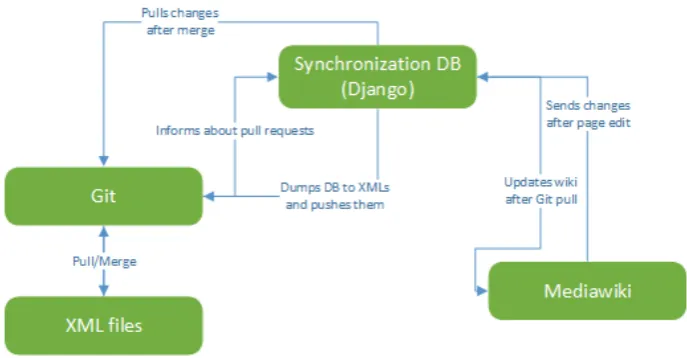
[image:4.595.124.468.396.575.2]Because dictionary development can be done on both XML and Wiki side simulta-neously, a database system is needed in between through which the latest changes on both sides can be synchronized so that the people editing the XML files have the same version as the people modifying the Mediawiki dictionary. Furthermore, data can come to the dictionary from different XML files, all of them having a slightly dif-ferent structure. For instance, in the case of Skolt Sami, there are three difdif-ferent kinds of XML files that all need to be synchronized with the system.
Figure 1: System architecture
done. Mediawiki is directly linked to the Django service, so that all the changes will be reflected to both systems directly.
A problem arising from this architecture is how conflicts are resolved. That is why only the Mediawiki side is directly linked to the Django service. The XML files need to be updated through Git. The work flow for the people working with the XML files is the following: they make modifications to the XML files in their own branches and once they are ready to release the changes to the Mediawiki side, they will create a pull request for that branch. What it means is that they want to merge their edits to the master branch which contains the production data. At this point, an automatic Travis script is executed and what it essentially does, is that it makes the Django service dump its database into XML format to the Git project, commit the possible changes and push them to the master branch. If the dictionary has been modified in the Mediawiki side, the person developing the XML files has to resolve the conflicts using Git. Because resolving conflicts is what Git is really good at, leaving the conflict resolution to that system makes our system easier to develop and maintain as we can safely assume that Git is stable enough. Once the pull request is finished and all the conflicts are resolved, the Django based system will be notified about the changes in the master branch and it will start to update its own database and Mediawiki.
Another challenge for this system is the different data structures used. XMLs have their own formatting, the Django services internal database uses Mongo which is essentially a JSON based data structure and finally Mediawiki shows its pages using its own Wiki syntax. The Django services data structure cannot be identical with the XMLs for two different reasons: first of all, even Skolt Sami has multiple different XMLs with different structures and secondly we aim to support multiple languages and make the process of integrating new languages an easy one. As a result of our architecture choice, what is mostly needed for a new language to be added to the system is an XML to/from JSON conversion script. This way we can reuse the existing Mediawiki to/from JSON conversion code, so that the Mediawiki and Django service sides can communicate with each other already when a new language with XML files is added. Thus far, this has seemed to work well when the Ingrian XML files were added to the system.
platform can display the dictionary entry correctly. The same Java Script is used by the Django service when it updates the pages on Mediawiki.
4 Wiki Dictionary
The Wiki-based dictionary is hosted on CSC’s servers (https://sanat.csc.fi). Before this project their Mediawiki platform already had one dictionary, Ludic, and the Finnish WordNet. In addition to that, the Institute for the Languages in Finland (http://www.ko-tus.fi/en) has expressed their interest in adding their own dictionaries and word lists to the same Mediawiki platform. Since multiple parties are interested in the same platform, it only makes sense for us to use it as well. This opens the possibility of in-terlinking dictionaries from different providers to enhance the quality of all of them. From the point of view of our project, the Mediawiki dictionary serves two pur-poses. People with editing rights can edit the dictionary easily online and other peo-ple can access an up-to-date dictionary for Uralic languages for free. The Mediawiki infrastructure also allows for variation in the extent of editing rights. This means that, while there are two different kinds of user groups whose needs have to be taken into account, there is also a possibility for monitored editing by a larger and larger contributing group of users.
For the editors, the system gives more information about each word in the page edit mode. This includes all sorts of metadata that is useful for researchers but not so useful for normal dictionary users. The reason why such information is not presented to everyone is that having too much irrelevant information would only confuse the normal dictionary users. They are probably using the dictionary to find what a certain word means in another language and they are not so interested in, let’s say, the source from which a word came to the dictionary.
Currently, regular users are presented with lemma’s part-of-speech, translation to different languages, semantic information and etymology. In the future we would like to include morphological transducers in the dictionary so that the user could see with a click of a button all the possible inflections of a word. Also we would like to link audio files and add example sentences to the entries of the dictionary.
5 Conclusions
efforts to a bold extreme.
The challenge is allowing for documentation of information already available from research. We are providing for input from multiple environments, and thus render-ing collaboration with a lower threshold. The establishment of a platform for direct documentation of new and old results and data means we are essentially pointing the way in future open-source work in the field.
We are finding our niche by drawing on documentational structuring from mul-tiple language research projects and documentational needs. We recognize that our development must be available for work being done in other areas, as we will be pro-viding an intermediate point linking transducer development, semantics, etymology and corpora annotation.