Annotating Errors in Student Texts: First Experiences and Experiments
Sara Stymne, Eva Pettersson, Be´ata Megyesi
Linguistics and Philology Uppsala University
first name.last [email protected]
Anne Palm´er
Scandinavian Languages Uppsala University
Abstract
We describe the creation of an annotation layer for word-based writing errors for a corpus of student writings. The texts are written in Swedish by students between 9 and 19 years old. Our main purpose is to identify errors regarding spelling, split compounds and merged words. In addi-tion, we also identify simple word-based grammatical errors, including morpholog-ical errors and extra words. In this paper we describe the corpus and the annotation process, including detailed descriptions of the error types and guidelines. We find that we can perform this annotation with a sub-stantial inter-annotator agreement, but that there are still some remaining issues with the annotation. We also report results on two pilot experiments regarding spelling correction and the consistency of down-stream NLP tools, to exemplify the useful-ness of the annotated corpus.
1 Introduction
The use of automatic tools for the detection and correction of writing errors is not new, and there are many tools that can accurately correct errors in standard texts in many languages, including Swedish. However, most of the existing tools are not freely available and usually do not provide any information on the error type. Automatic gram-matical correction of texts written by language learners, especially second language learners is even more problematic with various types of er-rors.
In order to investigate language learning pro-cesses, to give students feedback, and to develop
This work is licenced under a Creative Commons At-tribution 4.0 International Licence. Licence details: http: //creativecommons.org/licenses/by/4.0/
computer-assisted language learning and teaching applications (ICALL) by using NLP tools like tag-gers and parsers for automatic analysis of non-standard texts, it is important to be able to iden-tify and classify various types of grammatical er-rors. Data collection and analysis by creating a corpus on learner language with annotation on var-ious linguistic layers from part-of-speech (POS) to syntactic analysis is a first step. In parallel to cor-pus creation, tools can be developed for the auto-matic processing of learner data which can be used for analysis of new texts.
In this paper we present the development of a corpus on learner language of Swedish, the Upp-sala Corpus of Student Writings (Megyesi et al., 2016) by creating a normalization layer identify-ing erroneous constructions on top of an already existing automatic linguistic annotation. In this work humans annotate word-based errors focus-ing on spellfocus-ing, split compounds, merged words, and simple grammatical errors. The original cor-pus includes 2,500 student writings from different age groups and grades, written by students who study Swedish (L1) or Swedish as a second lan-guage (L2). The group of students who study Swedish as a school language consists both of na-tive Swedish speakers, and non-nana-tive speakers who have a good command of Swedish, and those essays thus contain texts written both by L1 and L2 speakers. We describe the creation of the an-notation layer for normalization for a subset of this corpus and perform two initial experiments, exem-plifying how this corpus can be used.
possibly also adapting the models to different age groups, levels, and for students of Swedish as L1 or L2. Being able to correct errors is also im-portant in order to achieve good performance on downstream tasks like tagging and parsing. From a writing development perspective, the normal-ized corpus can allow analysis of writing skills de-velopment during school years in Swedish as L1 or L2. The error identification accomplished in this corpus is also interesting from an assessment and grading perspective, and can contribute to the development of advanced computer-assisted lan-guage learning and teaching applications.
2 Related Work
In research on student writing, correctness of the text is considered as one of several aspects mea-suring writing development and text quality. How-ever, there is not a simple relationship between correctness and writing development. In second language writing, for example, it is well known that correctness and complexity of language are balancing factors. When focusing on correctness the student may write a less complex text, and a text with a more complex language — showing a higher level of linguistic development — may con-tain more errors, see e.g. Axelsson and Magnus-son (2012) or AbrahamsMagnus-son and Bergman (2014)). Learner corpora allowing research studies on language learning have been available for several languages, e.g for English (Hawkins and Buttery, 2010), Norwegian (Tenfjord et al., 2004), Ital-ian, German and Czech (Hana et al., 2004) and (Abel et al., 2014), as well as for Swedish, such as ASU (Hammarberg, 2005), CrossCheck (Lind-berg and Eriksson, 2004), Swedish EALA (Sax-ena and Borin, 2002), and SweLL (Volodina et al., 2016). While there are hundreds of learner cor-pora today for various languages, only a few of them are annotated with error types along with lin-guistic analysis. ASK – the Norwegian Second Language Corpus (Tenfjord et al., 2004) is one important Scandinavian source including 10 dif-ferent native languages, annotated for errors and partly parsed. Nicholls (2003) describes the error coding and performs an analysis of the annotation of the Cambridge Learner Corpus, consisting of texts written in English by learners. She describes a scheme for inline annotations of a comprehen-sive set of errors. Like us, they aim to preserve both the original text and to have a corrected
ver-sion. A part of this corpus has been manually annotated with POS-tags and dependency struc-tures, and was recently released as the Treebank of Learner English (Berzak et al., 2016).
In the spell checking and grammar checking lit-erature, e.g. Brill and Moore (2000) or Carlberger et al. (2005), corpora with annotated errors are of-ten used for evaluation. However, little is usually written about these annotations.
3 Corpus Data
3.1 The Uppsala Corpus of Student Writings
Megyesi et al. (2016) presented the Uppsala Cor-pus of Student Writings (UCSW), which consists of essays written as part of Swedish national tests for schools in the subjects Swedish and Swedish as a second language. The corpus contains essays written by students in different grades, ranging from year three in primary school (at age nine) to year three in upper secondary school (at age nine-teen). The tests have been collected since 1996. The texts are digitized versions either of hand-written essays, or of printed essays that have been scanned. The full corpus consists of 2,500 essays containing more than 1.5 million tokens today but the corpus is intended to be a monitor corpus, ex-tended with new, analyzed tests.
The texts in UCSW are annotated automati-cally in a pipeline using SweGram (N¨asman et al., 2017), an online tool for automatic analysis of Swedish texts. The tool includes tokenization, normalization to correct spelling errors and split compounds, part-of-speech tagging, and depen-dency parsing. First tokenization is performed to separate sentences and tokens, using the Svanno-tate tool (Nivre et al., 2008). Then spelling er-rors are corrected by using a simple unweighted Levenshtein distance, with threshold 1 on all un-known words (Pettersson et al., 2013). Split com-pounds are addressed by using a set of a few rules ( ¨Ohrman, 1998). Part-of-speech tagging and mor-phological analysis are carried out using efselab ( ¨Ostling, 2016) and dependency parsing is per-formed using MaltParser (Nivre et al., 2006). The analysis tools achieve state-of-the-art accuracy on standard texts with the exception of the normal-izer. The corrections of spelling errors and split compounds are very noisy and far from human quality, thus necessitating work on these issues.
Training Test
Level Age Essays (Sw) Essays (SwSL) Tokens Essays (Sw) Essays (SwSL) Tokens
C-3 9 50 50 13,624 36 19 4,831
C-5 11 – – – 29 12 6,962
C-6 12 50 49 37,718 17 7 8,554
C-9 15 49 52 54,970 30 10 17,143
US-1 16 0 50 25,087 15 4 7,719
US-3 18 – – – 12 4 13,493
[image:3.595.101.497.43.135.2]Total 149 201 131,399 139 56 58,702
Table 1: Distribution of texts by year and Sw/SwSL.
dependency project to represent part-of-speech, morphological information and dependency rela-tions across languages (Nivre et al., 2016). The CoNLL-U format shows one token per line, with sentences separated by a blank line. For each to-ken, it contains text and word IDs, the toto-ken, its lemma, part-of-speech tags, and dependency la-bel plus head. For USCW, the CoNLL-U format is extended to also handle misspellings, for which an extra column is inserted, containing the correct spelling of the original tokens.
3.2 Data Used for Error Annotation
In this work we provide an added layer of hu-man annotation on top of UCSW. In this layer we correct errors due to spelling, split compounds, merged words, and simple grammatical errors.
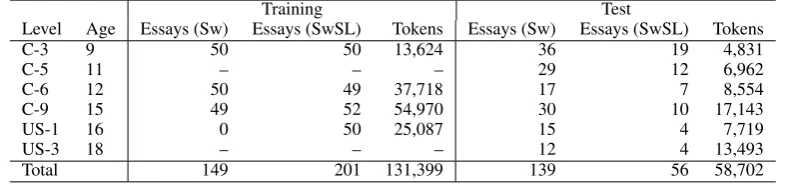
For this layer we sampled texts from the full UCSW corpus. We divide the data into two parts, one larger part that we intend to use as training data for NLP tools and for analysis of errors, and a smaller part intended to be used as test data. For the training data we aimed for texts that could be expected to have many errors, in particular texts from younger students, and texts written for Swedish as a second language. The main purpose for this decision was that we wanted to have a high number of errors in the data set in order to be able to train models for error correction. For the test data we aimed at a wider and more representative selection containing student texts that have been used as benchmarks in the national tests, illustrat-ing different levels of achievement. Table 1 de-scribes the data in the training and test sets. C refers to compulsory school, which comprises pri-mary and lower secondary school. US refers to up-per secondary school, which is not compulsory but attended by a large majority of Swedish youths.
4 Annotation
In this section we describe the error categories that were used in the manual annotation, the annotation
process, and the guidelines used. We also present inter-annotator agreement for the annotators and give a summary of the identified errors.
4.1 Error Categories
The main goal of this annotation project was to find errors due to spelling, split compounds, and merged words. When we started the work we real-ized that it was easy to annotate simple grammati-cal errors at the same time. As a starting point, we decided to identify grammatical errors that only affected single words. This mainly included mor-phological errors and extra words.
back flipp→back flip.
We also include as spelling errors cases where a word has the wrong casing, for instance for proper names: carolina→Carolina, or at the be-ginning of sentences, and errors with punctuation within words as in abbreviations: tex→t.ex. (e.g.) or hyphenated compounds: sand-l˚ada→sandl˚ada (’sand box’). For the purpose of analysis we di-vide the spelling errors into two groups,casing er-rors, which only concern upper/lower case of let-ters, and all other spelling errors.
Split compounds are cases where words that should have been written as a closed compound has instead been written as two words: j¨atte bra→j¨attebra (’very good’). For words that belong to a compound but that are also mis-spelled or have the wrong form, we correct the spelling of each part as well. In this category we also include words that are not strictly com-pounds, but that needs to be merged to become correct words, like f¨or svar→f¨orsvar (’defense’) andk¨ampa de→k¨ampade(’struggled’) or hyphen-ated cases like schim- pans→schimpans (’chim-panzee’).
Merged wordsare in some sense an opposite to split compounds, involving cases where two words that are supposed to be written as individual words have instead been written as one word. Examples are tillexempel→till exempel (’for instance’) and i˚ar→i ˚ar(’this year’).
Simple grammatical errors are in this work a grouping of some different errors that concerns in-dividual words. We view this part of the anno-tation as work in progress, and do not have sub-categories for these errors in the annotation; we only mark them as belonging to the group of sim-ple grammatical errors. We restrict ourselves to one-word errors to start with. The most com-mon type of grammatical errors are morpholog-ical errors, such as agreement errors det ¨ar vik-tig→det ¨ar viktigt (’it is important’) and wrong form of wordsen lite by→en liten by(’a small vil-lage’). When two words have been confused, we annotate a switch of words: bryr som om→bryr sig om (’cares about’). Words that have been prolonged or otherwise marked for some kind of effect are changed into their canonical version: s˚a˚a˚a˚a˚a˚a→s˚a (’so’). While it can be debated if these cases are real errors, they are problematic for automatic tools like taggers and parsers, and thus we annotate them. Finally, we annotate extra
words in the text, by removing them. This could both be due to erroneous repetition: det var ig˚ar han han klev→det var ig˚ar han klev(’it was yes-terday he stepped’) or be wrong for grammatical reasons: ¨ar en d˚alig p˚a att simma→¨ar d˚alig p˚a att simma(’is bad at swimming’). This category of errors is quite diverse, and we view this annota-tion as preliminary. We believe there will be the need of further sub-classification at a later stage of the annotation project, which we intend to base on already existing error annotation schemes.
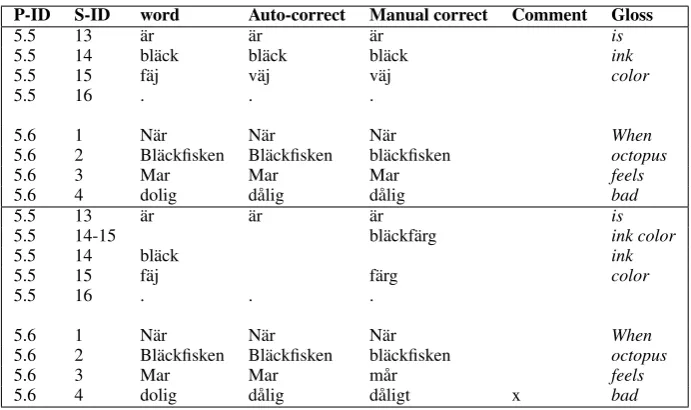
There are cases where an error has more than one type. In Figure 1, the last word has both a spelling error and a morphological error, and the split compound has a misspelling of one of its components. While all types of errors are cor-rected in these cases, for brevity and clarity of the analysis in this paper, we will mainly count each error as one type, given preference to split com-pounds, merged words, and simple grammatical errors in that order.
4.2 Guidelines and Problematic Cases
To aid annotation, guidelines were put together, detailing the error categories described above, and how to annotate them. The guidelines also con-tained numerous examples of annotations, and dis-cussion of some borderline cases. In this section we will give some examples of problematic cases and how we choose to annotate them, in order to give some insight into this process.
The borderline between a morphological er-ror and a spelling erer-ror is not always completely clear. As an example we have verb forms like hon to→hon tog(’she took’), where the verb has a form to, which does not coincide with another verb form, but rather is the informal spoken pro-nunciation of the past verb form tog. For cases like this we use the strategy to annotate this as a spelling error if the student’s spelling does not co-incide with another verb form, and it is not clearly a misspelled erroneous verb form. A related case is the spelling of regular past verb forms, in the informal spoken form, which coincides with in-finitive: Jag svara→Jag svarade (’I answered’). In this case, we annotate it as a simple grammat-ical error, since the verb form is wrong, not the spelling.
P-ID S-ID word Auto-correct Manual correct Comment Gloss
5.5 13 ¨ar ¨ar ¨ar is
5.5 14 bl¨ack bl¨ack bl¨ack ink
5.5 15 f¨aj v¨aj v¨aj color
5.5 16 . . .
5.6 1 N¨ar N¨ar N¨ar When
5.6 2 Bl¨ackfisken Bl¨ackfisken bl¨ackfisken octopus
5.6 3 Mar Mar Mar feels
5.6 4 dolig d˚alig d˚alig bad
5.5 13 ¨ar ¨ar ¨ar is
5.5 14-15 bl¨ackf¨arg ink color
5.5 14 bl¨ack ink
5.5 15 f¨aj f¨arg color
5.5 16 . . .
5.6 1 N¨ar N¨ar N¨ar When
5.6 2 Bl¨ackfisken Bl¨ackfisken bl¨ackfisken octopus
5.6 3 Mar Mar m˚ar feels
[image:5.595.125.471.40.245.2]5.6 4 dolig d˚alig d˚aligt x bad
Figure 1: Sample of the format used for annotation:. . . ¨ar bl¨ack f¨aj. N¨ar Bl¨ackfisken Mar dolig . . . (’. . . is ink color. When the octopus feels bad . . . ’). Top: before annotation, bottom: after annotation.
with, if there are other errors or strange formu-lations nearby. In Example (1), it is quite clear that the prepositionavis wrong, and that it should be exchanged to genom. In Example (2), how-ever, the preposition upp seems wrong, but it is not clear what it should be changed to, rather the whole phrase needs to be rephrased. In such ex-amples we do not annotate anything, since that is beyond the scope of the current project.
(1) s˚a so
f¨orsvarar defends
dom them
sig themselves
av of
(genom) (by)
att to sv¨alja
swallow vatten water
’so they defend themselves by swallowing water’
(2) N¨ar When
den it
sener (k¨anner) feels
sig itself
hotad threatened
s˚a so sveljer (sv¨aljer)
swollows
upp up
(?) (?)
vatten water
’When it feels threatened it swollows up [sic] water’
Another issue is morphological errors that re-quire some kind of long-distance information to be resolved. We decided that these should be an-notated as well, if they are clear from the context, even if far away. An example is shown in (3). However, when we change these types of errors it could lead to other errors, that were originally correct in the context, as shown in (4), where a correction of the co-referring pronoun from plural to singular, means that the adjectiveskr¨amdawill have the incorrect form, whereas it was correct in
the original text. In such cases we correct the ad-jective as well, but mark it as a grammatical error that is a consequence of the other corrections.
(3) N¨ar When
bl¨ackfisken octopus.DEF
blir becomes
r¨add scared
s˚a so sprutar
sprays dom them
(den) (it)
bl¨ack. ink.
’When the octopus becomes scared, it sprays ink.’
(4) Bl¨ackfisken Octopus.DEF
¨ar is
bl˚a blue
och and
de they
(den) (it)
blir become ofta
often
skr¨amda scared.WEAK
(skr¨amd)
(scared.STRONG)
’The octopus is blue and it often becomes scared’
4.3 Annotation process
P-ID S-ID word Auto-correct Manual correct Comment Gloss
2.1 8 ihela hela hela in+whole
2.1 9 kroppen kroppen kroppen body
2.1 10 . . .
2.1 8.1 i in
2.1 8.2 hela whole
2.1 8 ihela in+whole
2.1 9 kroppen kroppen kroppen body
[image:6.595.133.464.42.134.2]2.1 10 . . .
Figure 2: Sample of the format used for annotation: . . . ihela kroppen. (’. . . in the whole body.’). Top: before annotation, bottom: after annotation.
After a second small pilot phase, where the now three annotators discussed some issues and prob-lematic examples, the main annotation work could start with finalized guidelines. At this stage the re-maining original annotator re-annotated the texts from the pilot stage, according to the new guide-lines, in addition to all annotators annotating new texts from scratch. Each text is annotated by one annotator, except for the essays used for investi-gating inter-annotator agreement.
The annotators are given texts in a tab-separated format with one word per line, and a newline to indicate a new sentence. For each word there is a paragraph, sentence, and word number, and then the word as written by the student, and automat-ically corrected by the SweGram tools (Megyesi et al., 2016). The automatic annotation is also copied to a new column, where the human anno-tators modify it to add their correct annotation. In addition we insert an empty column where com-ments can be added, mainly used for marking the simple grammatical error category with an x, to tell them apart from spelling errors. The automatic corrections were given as an aid for the annotators, but they were very noisy. An example of the anno-tation format is shown in Figure 1, the top part be-fore annotation, the bottom part after annotation. As can be seen, all the automatic corrections are wrong in this excerpt. Spelling errors and gram-matical errors are changed in the fifth column, and grammatical errors are also marked. Split com-pounds are treated by inserting a new line giving the line numbers of the sub parts, and the full pound. In case of misspellings within the com-pound, these are also added as corrections to the individual parts, as forf¨aj→f¨arg(’color’). A simi-lar procedure is used for merged words, where new lines are inserted for the sub words in the merged word. An example is shown in Figure 2. The an-notators used either Microsoft Excel or a text edi-tor to do the annotation work.
All −correct Agree Kappa Agree Kappa
A1/A2 .97 .96 .72 .65
A1/A3 .97 .96 .70 .62
A2/A3 .97 .97 .72 .66
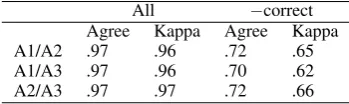
Table 2: Inter-annotator agreement and kappa for the 6-way classification between error types or correct, including and excluding the cases where both annotators judged a word as correct.
Our annotation thus contains both the origi-nal text as written by the student, with potential spelling errors, split compounds etc, and the cor-rected version of that text, with respect to our error categories. After the human annotation, we per-formed automatic POS-tagging and dependency parsing of the two versions of the text, both with the original tokens, and with the corrected tokens.
4.4 Inter-Annotator Agreement
In this section we present results on inter-annotator agreement between the three inter-annotators that took part in the final annotation process. In or-der to do this analysis, a sample of 2–3 texts each from level C-3, C-5, C-6, C-9 and US-1 were cho-sen, with a mix of Swedish and Swedish as a sec-ond language. In total there were 11 texts with 2923 tokens. The three annotators annotated this text independently with access to the guidelines.
[image:6.595.327.502.187.239.2]Co Spe Gr Spl Me Ca
Correct (Co) 2,138 23 2
Spelling (Spe) 2 73 3 Grammar (Gr) 15 4 65
Split (Spl) 3 13
Merged (Me) 1 7
[image:7.595.338.494.39.155.2]Casing (Ca) 17 23
Table 3: Confusion matrix for annotations by an-notators A1 and A2, empty cells means no such confusions.
marked by one annotator vs no error marked by another. To exemplify this, Table 3 gives the con-fusion matrix for annotator 1 and 2. The picture is similar for the other pairs of annotators. We see that the biggest source of confusion is where one of the annotators have considered a word as a sim-ple grammatical error, whereas the other annotator has considered it correct. We can also see that an-notator 1 has identified errors related to casing to a much larger extent than annotator 2. For the other categories the number of confusions is relatively small. For the cases where both annotators have marked a word as being either a grammatical or spelling error, the agreement of the correction is over 93% in all cases.
Overall we find the agreement satisfactory, and believe that the guidelines together with the initial discussions among the annotators were sufficient for this project.
4.5 Error Statistics
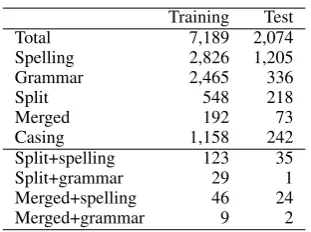
Table 4 shows the number of each error type in the training and test data. The lower part of the table shows how many spelling and grammar er-rors there are for components of split compounds and merged words, e.g, the split compound jete smart/j¨attesmart(’very clever’) contains a spelling error of the first component. When doing this anal-ysis we realized that our current annotations do not identify cases where a word has both a spelling and grammatical error, as for the worddolig/d˚aligt (’bad’) in Figure 1.
Overall we see that spelling errors are the most common errors in both data sets. Grammar er-rors are nearly as common in the training set, but far less common in the test set, which could be at least parly expected, since we have more texts from young children and Swedish as a second lan-guage in the training data than in the test data. Overall we find the number of errors in both data sets sufficient for doing further research.
Training Test
Total 7,189 2,074
Spelling 2,826 1,205
Grammar 2,465 336
Split 548 218
Merged 192 73
Casing 1,158 242
Split+spelling 123 35
Split+grammar 29 1
Merged+spelling 46 24
[image:7.595.78.287.41.113.2]Merged+grammar 9 2
Table 4: Different error types in the annotated data.
5 Pilot Experiments
In this section we will describe two pilot experi-ments that shows the usefulness of the human er-ror annotation layer of UCSW. In the first experi-ment we show how the training data can be used for training a simple spell checker targeting stu-dent texts. In the second experiment we show how much the errors in the corpus affects automatic NLP tools, exemplified by a tagger and parser.
5.1 Spelling Correction
We can take advantage of the human annotations of student texts, in order to train tools for solv-ing challenges like spellsolv-ing correction. In this sec-tion we describe experiments on spell checking us-ing a relatively simple approach. First we investi-gate how our training data impacts performance of spell checking, then we compare the performance for different student groups.
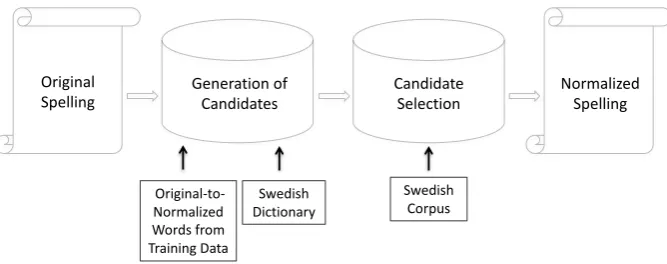
One of the most widely explored algorithms for spelling correction is to measure theedit distance between an unknown word and words present in a dictionary. In our spelling correction experiments, we use a simple weighted Levenshtein edit dis-tance approach aiming to correct misspellings in the input text. The Levenshtein distance gives an indication of the similarity between two strings, by computing the minimum number of characters that need to be inserted, deleted or substituted in order to transform one string into the other string (Levenshtein, 1966). Our approach is based on the method originally presented by Pettersson et al. (2013) for the similar task of spelling normal-ization of historical text, and is illustrated in Fig-ure 3. By using a weighted Levenshtein distance, we can take advantage of the training data in the human annotation layer of UCSW.
charac-Original Spelling
Generation of Candidates
Candidate Selection
Normalized Spelling
Original-to-Normalized Words from Training Data
Swedish Corpus Swedish
[image:8.595.132.466.50.182.2]Dictionary
Figure 3: Flowchart for the spelling normalization procedure
teristics of the word. If the word contains only one letter, or contains digits, the word is left un-changed. Likewise, to avoid normalization of proper nouns, words with an initial uppercase let-ter are also left unchanged, unless they occur in sentence-initial position. One example from the test data is the string Texten om Kissie, skriven av Malin Ekman i Expressen 10/6 2010 (’The text about Kissie, written by Malin Ekman in [the newspaper] Expressen 10/6 2010’). In this string, the proper nouns Kissie, Malin, Ekman and Ex-pressenwill be left unchanged due to their initial uppercase letters. However, the word formTexten (’The text’) would be considered for normaliza-tion despite the uppercase first letter, since it is in sentence-initial position. The word form i (’in’) will not be normalized due to its short length, and the date10/6 2010will not be normalized either, since it consists of digits.
For all word forms that do not meet these re-quirements, the first task is to find appropriate can-didates for normalization. This is done by compar-ing each word form towards two lexical resources:
1. The training part of the UCSW corpus, with mappings of the students’ original word forms to their manually corrected spellings.
2. The SALDO dictionary (version 2.0), a lexi-cal resource developed for present-day writ-ten Swedish, containing approximately 1,1 million word forms (Borin et al., 2008).
If the word form is present in the SALDO dictio-nary, or if it occurs without having been changed in the manually normalized training part of the UCSW corpus, the word form is considered to have a correct spelling and is thus left unchanged
during normalization. Else, if the word form is present in the training corpus with a normalized spelling that is different from the original spelling, this previously normalized spelling is chosen as normalization candidate. For example, the word form henes is not present in the dictionary. It has, however, been normalized into hennes (cor-rect spelling of the pronoun ’her’) in the training data. Thus,hennes will be chosen as normaliza-tion candidate for the word formhenes.
If the word form is found neither in the training corpus nor in the dictionary, edit distance calcula-tions are performed, comparing the word form to all word forms present in the dictionary. If there are dictionary entries with a Levenshtein distance of maximally one from the original word form, these entries are chosen as normalization candi-dates. The reason for choosing one as the max-imum edit distance allowed, is that previous cor-pus studies have shown that misspellings usually do not differ from the intended word form with more than one edit (Kukich, 1992).
training corpus are then weighted based on their relative frequency in the tuning corpus.
One example from the corpus of student writ-ings is the replacement ofoby ˚a, which is given the weight 0.87, meaning that it is more likely that the system will choose to replaceoby the phono-logically similar ˚a, than to replace it by for ex-amplep. Weights for sequences of two characters on the source and/or target side are also included, mainly resulting in weights for transforming dou-ble consonants (such asmm) into a single occur-rence of the same consonant (m), or the other way around.
Once the normalization candidates have been generated, a final normalization is to be chosen. This is done based on corpus statistics, in this case based on the Stockholm Ume˚a Corpus (SUC, ver-sion 2.0) of text representative of the Swedish lan-guage in the 1990s (Ejerhed and K¨allgren, 1997), containing approximately 1,2 million words. If several normalization candidates share the same minimum edit distance to the original word form, the word form with the highest frequency in the corpus is chosen. If several candidates are equally frequent in the corpus, or if none of the candidates occur in the corpus, the final normalization candi-date is randomly chosen.
The above described method presupposes ac-cess to training data in the form of manually nor-malized student writings. If no such training data is available, spelling correction using Levenshtein calculations is still possible. In this case, the only lexical resource available during the generation of normalization candidates is a Swedish dictionary. Furthermore, traditional, unweighted Levenshtein calculations are then performed, where each edit has the cost of 1.
We present results both for the case where no training data is available (basic), and for the fined, weighted model (refined). We report re-sults in terms of precision, recall and normal-ization accuracy, when running the Levenshtein-based spelling correction approach on the evalua-tion part of the UCSW corpus. In this evaluaevalua-tion setting, precision and recall are calculated for the identificationof misspellings, that is the instances where the algorithm has correctly identified that some kind of normalization should be performed. Normalization accuracy on the other hand refers to thecorrectionof misspellings, and is calculated as the percentage of correct normalizations for the
Precision Recall Accuracy
basic 84.9 57.6 70.9
refined 80.9 63.5 78.2
Table 5: Spelling correction results.
true positives.
5.1.1 Results on All Data
Table 5 shows the results for the spell check-ing. The refined method, not surprisingly, yields a higher recall, meaning that there are fewer in-stances of misspellings that have been left un-changed. Furthermore, normalization accuracy also increases when weights are included in the process, meaning that a larger proportion of the misspellings get an adequate correction by the refined approach. However, precision drops to some extent for the refined method. A closer look at the false positives that are unique for the re-fined method as compared to the basic method shows that this is almost exclusively due to real word errors in the training data. For example, the training data contains the correction of the mis-spellingknakadeinto the correctly spelled knack-ade (’knocked’). This means that for the re-fined method, having access to mappings of mis-spellings to their corrected forms, whenever the word form knakade occurs, it will be automati-cally changed intoknackade. The problem is that knakadecould also be a perfectly correct Swedish word meaning ’creaked’, which results in a poten-tialreal word error.
Analyzing the refined correction approach fur-ther, the results table shows that about 64% of the misspellings are identified and normalized by the system. Among the false negatives, real word er-rors such asvaran(’the product’) vsvarann(’each other’) ands¨att(’manner’) vssett(’seen’) are very common. To deal with these, one would need to include context- or grammar-aware spelling correction techniques. Another common reason for false negatives to appear is that the original word form has an edit distance larger than one to the intended word form, such asballetdans¨oz vs balettdans¨os(’ballet-dancer’) andpiamasvs pyja-mas(’pyjamas’). One way to handle these would be to experiment on different thresholds for the maximum edit distance allowed, possibly normal-izing the threshold by word length.
normal-ized by the system even though they shouldn’t have been, about a fourth of these (47 out of 181 in total) are proper nouns in sentence-initial position. Thus, more sophisticated named entity recognition would be very useful. There are also some in-consistencies in the manual normalization of the training and test corpora, which affects the num-ber of false positives. For example, in the train-ing part of the corpus, the word formsej(informal spelling of ’oneself’) has been manually corrected into the more formal spellingsigof the same word form, which is in conflict with our guidelines. This means that system will always choosesigas nor-malization for the word formsej. However, in the evaluation part of the corpus, the informal spelling has been left unchanged in the manual normaliza-tion process. The same goes for the ampersand sign (&) and the abbreviated formo, which have been mapped to the word formoch(’and’) in the training part of the corpus, but have been kept un-changed in the evaluation part of the corpus. An-other aspect leading to an increase in the number of false positives is the occurrence of English text within the otherwise Swedish text, which is not recognized by the system.
If these instances are ignored, about two thirds of the false positives remain as words incorrectly defined as misspellings by the system (120 in-stances out of 181), mainly due to a lack of cover-age in the dictionary for example for compounds such as sn¨oh¨ast (’snow horse’) and elefantben (’elephant bones’).
5.1.2 Results for Different Groups
The UCSW corpus contains texts written by dif-ferent kinds of writers; younger and older students (from the age of 9 up to the age of 19), and writ-ers studying Swedish or Swedish as a second lan-guage as school subjects. To be able to study fur-ther the kinds of errors made by the different types of writers, the training and evaluation corpora have been divided into four subcorpora:
1. Writers of all ages, studying Swedish as a school subject
2. Writers of all ages, studying Swedish as a second language
3. Younger students: from the age of 9 to the age of 12
4. Older students: from the age of 15 to the age of 19
Prec Recall Acc Swedish
in-domain data 82.1 62.0 75.4 all data 77.9 64.2 80.7 Swedish as a second language
in-domain data 86.2 61.9 72.0 all data 86.3 62.6 73.3 Younger students
in-domain data 91.0 64.9 76.0 all data 87.4 65.2 76.9 Older students
[image:10.595.329.501.40.182.2]in-domain data 72.8 59.5 82.8 all data 70.0 60.2 84.6 All texts 80.9 63.5 78.2
Table 6: Spelling correction results for subparts of the evaluation corpus. Prec = Precision. Acc = Normalization Accuracy.
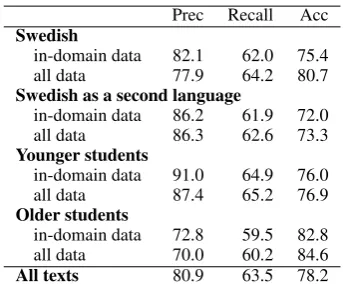
Table 6 shows the spelling normalization results for the different types of writers in the corpus, where experiments have been performed for train-ing on the traintrain-ing corpus as a whole (referred to as ’all data’ in the table) and for training on the spe-cific subcorpus only, for example only second lan-guage training data for second lanlan-guage test texts (referred to as ’in-domain data’ in the table).
As seen from the results, using only in-domain training data generally leads to a higher precision, due to a lower quantity of correctly spelled word forms being erroneously normalized (false posi-tives). This is, however, at the cost of slightly lower recall and normalization accuracy, since the system then has access to less examples of cor-rectly spelled word forms to choose from, both in the mapping of original word forms to correctly spelled word forms, and when generating normal-ization candidates.
It could also be noted that the system has both the highest precision and the highest recall for de-tecting errors in texts written by young children (age 9 to 12). Studying the misspellings in this group closer, one could see that the younger chil-dren often make errors that do not result in real word errors, and are thus recognized by the sys-tem as misspellings, such as:
• writing one consonant instead of the intended duplicated consonant, as in fladderm¨os in-stead offladderm¨oss(’bat’) and ¨overaskning instead of¨overraskning(’surprise’)
• writing duplicate consonants instead of the intended single one, as in t¨annka instead of t¨anka (’to think’) and hellikopter instead of
• confusing phonetically similar spellings, as inbeta˚ng instead ofbetong(’concrete’) and scoterinstead ofskoter(’scooter’)
• writing words the way they think they sound, as inskriskor instead ofskridskor (’skates’) and sovenirer instead of souvenirer (’sou-venirs’)
The young students also tend to use frequently oc-curring, common words that are often found in the dictionary when spelled correctly, resulting in rel-atively few instances of false positives.
The older students on the other hand (age 15 to 19 typically use less frequent and more complex word forms, that are often not found in the dictio-nary, such as:
• compounds, such as regeringskritik (’crit-icism against the government’) and still¨os (’lacking style’)
• words that have (rather) recently entered the language, such aschattar(’chat groups’) and surfplatta(’tablet device’)
• slang, such asocoolt(’not cool’)
• abbreviated word forms, such asoinstead of och (’and’) andiafinstead of i alla fall (’in any case’)
Interestingly though, for the word forms that have correctly been identified as misspellings, the sys-tem is better at correcting (i.e., has a higher nor-malization accuracy for) the texts written by older students. One reason for this is that since the older students often write less frequent and longer words, there are typically only one word in the dic-tionary with an edit distance of one to the original word form. For texts written by younger students on the other hand, shorter words are often used, where there are several entries to choose from as normalization candidates in the dictionary. To im-prove accuracy for these cases, it could be helpful to add knowledge about phonetics to the normal-ization algorithm (Toutanova and Moore, 2002), so that the system becomes aware that it is more likely that for examplecyckelnshould be normal-ized into cykeln (’the bike’), rather than nyckeln (’the key’), even if the two candidates both are within one edit distance from the original word form. Another reason that the texts written by the younger students are harder to correct is that the
younger students, more often than the older stu-dents, make several mistakes for the same word form, for example when writingjikinstead ofgick (’walked’). Here,jshould be replaced bygandk byck. Since the generated weights for frequently observed edits are not as low as 0.5, misspellings requiring more than one edit to be corrected into the intended word form are out of the scope for the current setting.
The second language learners seem to make similar mistakes as the younger children, such as confusing phonetically similar spellings (such as slengde instead of sl¨angde (’threw away’)) and writing single consonants instead of dupli-cate ones or the other way around (such as hot-teletinstead ofhotellet(’the hotel’)). One differ-ence is, however, that the second language learners in this corpus tend to make more mistakes related to inflection, such as writing t˚agarinstead oft˚ag (’trains’), where the-arending is a more common pattern for plural inflection than the null inflection that is correct for this particular noun. This should have been annotated as a grammar error, however.
5.2 Quality of Tagging and Parsing
In this section we describe a small experiment where we compare the part-of-speech tags and de-pendencies automatically assigned to each word before and after the manual annotation. For this experiment we use the training corpus. We used the SweGram pipeline (N¨asman et al., 2017), per-forming tagging using efselab ( ¨Ostling, 2016) and dependency parsing using MaltParser (Nivre et al., 2006). The tag sets used are the universal depen-dency sets both for POS and dependencies (Nivre et al., 2016). The purpose is to investigate the in-fluence of error correction on tagging and parsing quality. Note that we do not have a gold standard for tagging and parsing, we only note how the tags change between the two conditions, not if they are correct in either case. We suspect that the tags are more correct after human error annotation, how-ever, and this is supported by a small manual in-spection.
POS Labels Heads Correct 447 (.4) 2,989 (2) 9,551 (8) Spelling 942 (34) 994 (36) 887 (32) Grammar 434 (16) 726 (26) 749 (27) Split 109 (20) 247 (45) 316 (58) Merged 108 (57) 144 (75) 139 (73) Casing 96 (9) 138 (12) 209 (19)
Table 7: Number (percent) of confused POS-tags dependency labels and dependency heads for dif-ferent error types and correct words in the training data.
of a simplification, it can still give some idea of the influence on tagging and parsing. Table 7 shows the results. There are overall many confusions for both tools, indicating that errors indeed do cause problems for these tools. We can see that in all cases parsing is more influenced than tagging, al-ways for predicting the correct label and mostly for predicting the head of each word. This can in part be caused by the size of the tag sets, since there are 17 universal POS-tags and 37 universal dependency labels. For spelling errors the differ-ence between the number of tagging and parsing errors is quite small, whereas it is large for all other types. While the erroneous words are af-fected more than the correct words, also correct words are affected by error correction, especially for parsing. Split compounds and merged words have a very high number of confusions, which can partly be explained by our simplifying assumption of heads, but it also seems that these error types are difficult to handle for automatic tools.
Table 8 shows the most common confusions, across all error types and correct words, for POS-tags and dependency labels. The most common cases are confusions between nouns and verbs, and between subjects and objects. These are dis-tinctions that are vital for a correct interpretation of a sentence, which again stresses the importance of good tools for error correction. There are also a high number of dependency errors involving the root of the sentence, which is also problematic. All in all the error types are quite mixed, and there is also a long tail of less common confusions.
6 Discussion and Future Work
We think the described error annotation layer is useful, but there are also some remaining issues. The spelling, split compound and merged word annotation seems to be quite sufficient, except for consistency issues with the annotation of casing.
POS-tag Dependency label VERB-NOUN 170 nsubj-dobj 130 ADV-NOUN 152 dobj-nsubj 108 PRON-DET 90 nmod-dobj 105
ADV-ADJ 90 dobj-nmod 91
AUX-VERB 88 nsubj-nmod 72 PROPN-NOUN 85 root-advcl 70 ADJ-NOUN 81 root-nsubj 66
[image:12.595.89.275.42.114.2]VERB-ADJ 81 nsubj-det 61
Table 8: The most commonly confused POS-tags and dependency labels before and after error cor-rection.
The grammatical error classification, on the other hand, would need a further sub-classification to be largely useful. In future work we also wish to han-dle more complicated types of grammatical errors, such as word order errors and missing words. In order to handle these errors we also need to update the format used in the corpus. It would be desir-able that these annotations are consistent with pre-vious error annotations carried out for other lan-guages to allow cross-lingual studies.
We aim to have a single annotation scheme that covers both Swedish as a school subject and Swedish as a second language. This facilitates fu-ture comparative studies and the creation of tools for error correction. However, it is possible, espe-cially if the scheme is extended to more complex error types in the future, that we need to have spe-cific error types for the two variants of Swedish, since L2 language can both be expected to have more deviations from the standard norm, and have more cases with different possible interpretations of an error. Additionally we do not consider either the cause of errors, or how serious the errors are in the current annotation scheme. These are also issues that would be interesting to investigate.
human annotation work.
This paper describes ongoing work, and we plan to annotate more texts in the future. Specifically we wish to have a more even distribution of texts also in the training data, which would allow us to do more comparative studies.
In this paper we described an experiment on spell checking. The approach was relatively sim-ple, however, and we plan to use more sophisti-cated techniques in the future, and also to address real word spell checking. In addition we have al-ready started work on improving the identification and correction of split compounds, and we also plan to address merged words in the future.
7 Conclusion
In this paper we have described an effort of hu-man annotation of word-based writing errors in student texts. We described the annotation pro-cess and guidelines used in the annotation. We found that we could have a relatively high inter-annotator agreement using these guidelines. How-ever, our analysis shows that there are still some inconsistencies in the corpora, that needs to be ad-dressed in future work. We described a small ex-periment on spelling correction, to show the use-fulness of the annotated corpus both for develop-ing NLP tools like spell checkers, and for analyz-ing errors performed by different student groups. We also showed that errors have a large effect on POS-tagging and dependency parsing.
Acknowledgement
We would like to thank Malin Mark for proof reading and annotation work, Caroline Warnqvist for annotation work, and Jesper N¨asman for Swe-Gram tool support. We also want to thank the two reviewers for their insightful comments. This work was supported by SWE-CLARIN, a Swedish consortium in Common Language Resources and Technology Infrastructure (CLARIN) financed by the Swedish Research Council 2014–2018, and SweLL financed by The Swedish Foundation of Humanities and Social Sciences 2017-2020 (IN16-0464:1).
References
Andrea Abel, Katrin Wisniewski, Lionel Nicolas, Adri-ane Boyd, Jirka Hana, and Detmar Meurers. 2014.
A trilingual learner corpus illustrating European ref-erence levels. RiCOGNIZIONI. Rivista di lingue, letterature e cultura moderne, 2(1):111–126.
Tua Abrahamsson and Pirko Bergman. 2014.
Tankarna springer f¨ore: att bed¨oma ett andraspr˚ak i utveckling. Liber, Stockholm, Sweden.
Monica Axelsson and Ulrika Magnusson. 2012.
Forskning om flerspr˚akighet och kunskapsutveck-ling under skol˚aren. InFlerspr˚akighet: en forskn-ings¨oversikt. Vetenskapsr˚adet, Stockholm, Sweden.
Yevgeni Berzak, Jessica Kenney, Carolyn Spadine, Jing Xian Wang, Lucia Lam, Keiko Sophie Mori, Sebastian Garza, and Boris Katz. 2016. Universal dependencies for learner English. InProceedings of the 54th Annual Meeting of the ACL, pages 737–746, Berlin, Germany.
Lars Borin, Markus Forsberg, and Lennart L¨onngren. 2008. SALDO 1.0 (Svenskt associationslexikon version 2). Spr˚akbanken, University of Gothenburg.
Eric Brill and Robert C. Moore. 2000. An improved error model for noisy channel spelling correction. In Proceedings of the 38th Annual Meeting of the ACL, pages 286–293, Hong Kong.
Johan Carlberger, Rickard Domeij, Viggo Kann, and Ola Knutsson. 2005. The development and perfor-mance of a grammar checker for Swedish: A lan-guage engineering perspective. In Ola Knutsson. 2005. Developing and Evaluating Language Tools for Writers and Learners of Swedish. Ph.D. thesis, Royal Institute of Technology (KTH), Stockholm, Sweden.
Jean Carletta. 1996. Assessing agreement on classi-fication tasks: The kappa statistic. Computational Linguistics, 22(2):249–254.
Eva Ejerhed and Gunnel K¨allgren. 1997. Stockholm Ume˚a Corpus. Version 1.0. Produced by ment of Linguistics, Ume˚a University and Depart-ment of Linguistics, Stockholm University.
Bj¨orn Hammarberg. 2005. Introduktion till ASU– korpusen, en longitudinell muntlig och skriftlig textkorpus av vuxna inl¨arares svenska med en motsvarande del fr˚an inf¨odda svenskar. Institutio-nen for lingvistik, Stockholms universitet, Sweden.
Jirka Hana, Alexandr Rosen, Svatava ˇSkodov´a, and Barbora ˇStindlov´a. 2004. Error-tagged learner cor-pus of Czech. InProceedings of the Fourth Linguis-tic Annotation Workshop, Uppsala, Sweden.
John A. Hawkins and Paula Buttery. 2010. Criterial features in learner corpora: Theory and illustrations. English Profile Journal, 1(01):1–23.
J. Richard Landis and Gary G. Koch. 1977. The mea-surement of observer agreement for categorical data. Biometrics, 33(1):159–174.
Vladimir Iosifovich Levenshtein. 1966. Binary codes capable of correcting deletions, insertions and rever-sals. Soviet Physics Doklady, 10(8):707–710.
Janne Lindberg and Gunnar Eriksson. 2004.
Crosscheck-korpusen – en elektronisk svensk inl¨ararkorpus. InProceedings of the ASLA Confer-ence 2004.
Be´ata Megyesi, Jesper N¨asman, and Anne Palm´er. 2016. The Uppsala Corpus of Student Writings -corpus creation, annotation, and analysis. In Pro-ceedings of the 8th International Conference on Language Resources and Evaluation (LREC’16), Portoroˇz, Slovenia.
Diane Nicholls. 2003. The Cambridge Learner Cor-pus: Error coding and analysis for lexicography and ELT. InProceedings of the Corpus Linguistics 2003 conference, pages 572–581, Lancaster, UK.
Joakim Nivre, Johan Hall, and Jens Nilsson. 2006. MaltParser: A data-driven parser-generator for de-pendency parsing. In Proceedings of the 5th In-ternational Conference on Language Resources and Evaluation (LREC’06), pages 2216–2219, Genoa, Italy.
Joakim Nivre, Be´ata Megyesi, Sofia Gustafson-Capkov´a, Filip Salomonsson, and Bengt Dahlqvist. 2008. Cultivating a Swedish treebank. In Resource-ful Language Technology: Festschrift in Honor of Anna S˚agvall Hein, pages 111–120. Acta Universi-tatis Upsaliensis, Uppsala, Sweden.
Joakim Nivre, Marie-Catherine de Marneffe, Filip Gin-ter, Yoav Goldberg, Jan Haji´c, Christopher D. Man-ning, Ryan McDonald, Slav Petrov, Sampo Pyysalo, Natalia Silveira, Reut Tsafarty, and Daniel Zeman. 2016. Universal dependencies v1: A multilingual treebank collection. In Proceedings of the 8th In-ternational Conference on Language Resources and Evaluation (LREC’16), Portoroˇz, Slovenia.
Jesper N¨asman, Be´ata Megyesi, and Anne Palm´er. 2017. Swegram – a web-based tool for automatic annotation and analysis of Swedish texts. In Pro-ceedings of the 21st Nordic Conference on Compu-tational Linguistics (NODALIDA’17), Gothenburg, Sweden.
Lena ¨Ohrman. 1998. Felaktigt s¨arskrivna sam-mans¨attningar. Bachelor thesis, Stockholm Univer-sity, Stockholm, Sweden.
Robert ¨Ostling. 2016. Shallow learning for sequence tagging. Presented at The 6th Swedish Language Technology Conference (SLTC16), Ume˚a, Sweden.
Eva Pettersson, Be´ata Megyesi, and Joakim Nivre. 2013. Normalisation of historical text using context-sensitive weighted Levenshtein distance and com-pound splitting. InProceedings of the 19th Nordic
Conference on Computational Linguistics (NODAL-IDA’13), Oslo, Norway.
Anju Saxena and Lars Borin. 2002. Locating and reusing sundry NLP flotsam in an e-learning appli-cation. In Proceedings of the Workshop on Cus-tomizing knowledge in NLP applications: strategies, issues, and evaluation (LREC12), Las Palmas, Ca-nary Islands, Spain.
Svenska Akademiens ordlista. 2006. 13th edition. Svenska Akademien, Stockholm, Sweden.
Svenska Akademiens ordlista. 2015. 14th edition. Svenska Akademien, Stockholm, Sweden.
Kari Tenfjord, Paul Meurer, and Knut Hofland. 2004. The ask-corpus - a language learner corpus of Nor-wegian as a second language. In Proceedings of the 4th International Conference on Language Re-sources and Evaluation (LREC’04), Lisbon, Portu-gal.
Kristina Toutanova and Robert Moore. 2002. Pro-nunciation modeling for improved spelling correc-tion. InProceedings of the 40th Annual Meeting of the ACL, pages 144–151, Philadelphia, Pennsylva-nia, USA.