Modeling Quantification with Polysemous Nouns
Laura Kallmeyer
Heinrich-Heine-Universität Düsseldorf [email protected]
Rainer Osswald
Heinrich-Heine-Universität Düsseldorf [email protected]
1
Introduction
Babonnaud et al. (2016) introduce a framework for modeling systematic polysemy that combines Lexi-calized Tree Adjoining Grammar (LTAG) with frame semantics and Hybrid Logic (HL). The components of the syntax-semantics interface are elementary LTAG trees paired with frame descriptions that are ex-pressed by possibly underspecified HL formulas. A brief review of this framework will be given in Section 2 below. In Babonnaud et al. (2016), an inherently polysemous noun such as ‘book’, which provides referential access to both a physical and an informational object, is assumed to refer to entities of typephys(ical)-obj(ect)which have an attribute CONTENTwhose value is of typeinformation. That is, the semantic type of ‘book’ is a subtype of the complex type phys-obj∧ hCONTENTiinformationor
info(rmation)-carrierfor short (cf. Section 3 below). The physical aspect and the informational aspect are then addressed in different ways in contexts such as ‘read the book’, ‘carry the book’, ‘master the book’ or ‘a heavy book on magic’. The verb ‘read’, for instance, is analyzed as denoting a complex event that consists of two components, the perception of the physical aspect and the comprehension of the in-formational aspect (following Pustejovsky 1998), and thus combines with both aspects of ‘book’. By comparison, the verb ‘master’ calls for a grammatical object that denotes an entity of typeinformation
orinfo-carrierand semantically selects only the informational aspect in the latter case.
Treating books as physical information carriers in this way gives rise to the following “quantification puzzle” as noted in Asher and Pustejovsky (2005, 2006); see also Asher (2011). While (1a) poses no problem since the domain of quantification consists of physical entities, it not obvious how to cope with (1b), which is naturally interpreted as quantifying over all contents of the books in the library.
(1) a. John carried off every book in the library. b. John read every book in the library.
Since the library may own more than one copy of a book, there is not necessarily a one-to-one corre-spondence between the physical books in the library and the book contents. It is not even necessary that John used a copy from the library at all. The solution proposed in Section 4 retains the idea that a book basically denotes a physical object which has informational content associated to it. To this end, this basic representation will be embedded in an underspecified representation which allows the referential index of the NP to refer to the physical or to the informational component of the basic structure.
2
LTAG, Frames and Hybrid Logic
n0
motion
n1
man
path walking
n2
house
AGENT
MOVER
PATH MANNER
[image:2.595.125.476.72.143.2]ENDP part-of AT-REGION GOAL
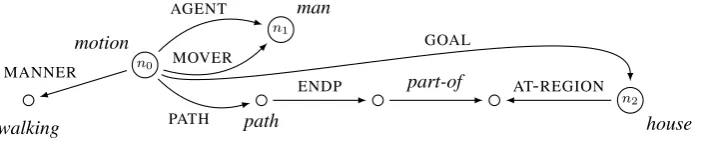
Figure 1: Frame for ‘the man walked to the house’ (adapted from Kallmeyer and Osswald (2013))
and specified as models of a suitable logical language (Kallmeyer and Osswald, 2013). In order to en-able quantification over entities or events, Kallmeyer et al. (2016) propose to use Hybrid Logic (HL), an extension of modal logic. HL formulas have the following syntax: LetRel =Func∪PropRelbe a set of functional and non-functionalrelation symbols, Typea set of type symbols,Noma set of nomi-nals (node names), and Nvara set of node variables, withNode = Nom∪Nvar. Thenformulas are defined as Forms ::= > | p | n| ¬φ| φ1 ∧φ2 | hRiφ | E φ |@nφ| ↓x.φ| ∃x.φ, withp ∈ Type,
n∈Node,x∈Nvar,R ∈Relandφ, φ1, φ2 ∈Forms. Moreover,
A
φ≡ ¬ E (¬φ),φ→ψ≡ ¬(φ∧ ¬ψ)
and φ∨ ψ ≡ ¬(¬φ∧ ¬ψ), as usual. A model is a triple hM,(RM)R∈Rel, Vi where M is a
non-empty set (of “nodes”), eachRM is a binary relation on M, andV is a function (thevaluation) from
Type∪Nomto ℘(M) such thatV(i)is a singleton for every nominal i. An assignmentg is a func-tion fromNvar toM; the assignmentgx
v differs from gat most onx, andgvx(x) = v. The following examples illustrate the notions of satisfaction and truth with reference to the frame structure in Fig. 1; see Kallmeyer et al. (2015, 2016) for more details and a formal definition. The formulamotion, a type symbol, is true at the node denoted by the nominal n0 in the structure of Fig. 1. Formula hRiφ is true at a node if the relation RM holds between that node and a node at whichφis true. For example,
hAGENTiman∧hMANNERiwalking∧hPATHihENDPi>is true atn0. (Notice that since HL does not distin-guish between functional and non-functional edge labels, functionality has to be enforced by additional constraints.) There are different ways to express existential quantification in HL, namely E φand∃x.φ. Formula E φis true at nodevif there exists a nodev0 at whichφholds. For instance, E houseis true at all nodes of the example structure. Formula∃x.φis true atvif there is av0 such thatφis true atvunder an assignment of x tov0. E.g.,∃x.hPATHihENDPihpart-ofi(x∧region) ∧ E (house∧ hAT-REGIONix)
is true atn0. Besides quantification, HL also allows us to use nominals or variables to refer to nodes via the @ operator: @nφ is true at a node if φ is true at n. The ↓ operator allows us to assign the current node to a variable: ↓x.φ is true at v if φ is true at v under the assignment gvx. E.g.,
hPATHihENDPihpart-ofi(↓x.region∧ E (house∧ hAT-REGIONix))is true atn0.
A Lexicalized Tree Adjoining Grammar (LTAG; Joshi and Schabes 1997; Abeillé and Rambow 2000) consists of a finite set ofelementary trees. Larger trees are derived viasubstitution(replacing a leaf with a tree) andadjunction(replacing an internal node with a tree). An adjoining tree has a uniquefoot node
(marked with an asterisk), which is a non-terminal leaf labeled with the same category as the root of the tree. When adjoining such a tree to some nodenof another tree, in the resulting tree, the subtree with root nfrom the original tree is attached at the foot node of the adjoining tree. Non-terminal nodes in LTAG are usually enriched with feature structures (Vijay-Shanker and Joshi, 1988): Each node has a top and a bottom feature structure (except substitution nodes, which have only a top). Features can be shared within elementary trees. In a substitution step, the top of the root of the new tree unifies with the top of the substitution node; in an adjunction, the top of the root of the adjoining tree unifies with the top of the adjunction site and the bottom of the foot of the adjoining tree unifies with the bottom of the adjunction site. Furthermore, in the final derived tree, top and bottom unify in all nodes.
NP[I=i]
‘John’
@i(person
∧hNAMEiJohn)
S
VP
NP[I=2,MINS=l1]
V
‘ate’ NP[I=1,MINS=l1]
l1: E eating
∧ hAGENTi1
∧ hTHEMEi2
NP[I=x,MINS=4]
‘pizza’
E
[image:3.595.122.481.75.164.2](↓x.pizza∧3),3∗ 4
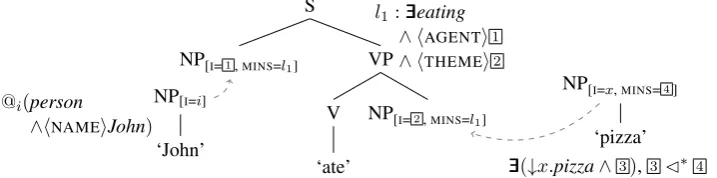
Figure 2: Derivation of ‘John ate pizza’
in the ‘ate’ tree. The interface features I on the NP nodes make sure that the contributions of the two arguments feed into the AGENT and THEME nodes of the frame structure. Furthermore, an interface feature MINSis used for providing the label of the E (eating...) formula as minimal scope to a possible quantifier. The feature unifications on the syntactic tree lead to 1 =i, 2 =xand 4 = l1. As a result, when collecting all formulas, we obtain the underspecified representation (2a).
(2) a. @i(person∧ hNAMEiJohn), l1: E (eating∧ hAGENTii∧ hTHEMEix), E (↓x.pizza∧3), 3 ∗l1
b. @i(person∧ hNAMEiJohn), E (↓x.pizza∧ E (eating∧ hAGENTii∧ hTHEMEix))
The relation∗links holes to labels: h∗lsignifies that the formula labeledlis a subformula ofh. In (2a), the E (eating...)formula, labeledl1, has to be part of the nuclear scope of the quantifier (hole 3). Disambiguating such underspecified representations consists of “plugging” the labeled formulas into the holes while respecting the given constraints. (2a) has a unique disambiguation, namely 3 → l1. This leads to (2b), which is then interpreted conjunctively.
3
Basic analysis of polysemous nouns
We will now sketch the analysis of Babonnaud et al. (2016) of inherently polysemous nouns such as ‘book’ and their composition with verbs such as read. The noun ‘book’ carries two meaning aspects in that it can denote a physical object (‘the book is heavy’) or an informational content (‘the book is interesting’). Babonnaud et al. (2016) assume that the semantic frame associated with ‘book’ contains two nodes of type informationandphys-obj, respectively, with an explicit relation between them: The physical aspect of the frame is taken to be its referential node, which is linked via a CONTENTattribute to the information it carries. The typebookis a subtype of info-carrier, which in turn is a subtype of
phys-objand which has ahCONTENTiattribute whose value is of typeinformation.
The verb ‘read’ allows for the direct selection of the dot objectbookas complement (cf. Pustejovsky, 1998) but also enables coercion of its complement from type information(‘read the story’) as well as from type phys-obj (‘read the blackboard’). Babonnaud et al. (2016) assume an event node of type
reading with attributes PERC(EPTUAL)-COMP(ONENT) and MENT(AL)-COMP(ONENT), whose values are respectively of typeperceptionandcomprehension. These nodes represent the decomposition of the activity of reading into two subevents, the action of looking at a physical object (the perception) and the action of processing the provided information (the comprehension). Moreover, theperceptionnode has an attributeSTIMULUSof typeinfo-carrier, and thecomprehensionnode has an attributeCONTENT whose value is the information being read, which coincides with the value ofCONTENTattribute of the
info-carriernode. The fact that the argument contributed by the object can be either the stimulus of the perception (phys-obj) or its content is captured by a disjunction.
S
NP[I= 0,MINS=l0] VP
V
‘read’
NP[I= 1,MINS=l0]
NP[I=i]
‘John’ NP
[I=z,MINS= 2 ]
Det
‘the’
NP∗
[P= 3 ]
NP[P=l1]
N
‘book’ l0:∃x.∃y. E (reading∧ hAGENTi0
∧ hPERC-COMPihSTIMULUSix∧ hMENT-COMPihCONTENTiy
∧@x(phys-obj∧ hCONTENTi(information∧y))
∧(1 ↔x∨1 ↔y))
l1:book
∧ hCONTENTiinformation
@i(person
∧ hNAMEiJohn)
E
[image:4.595.106.495.86.238.2](↓z.4∧5),4 ∗ 3,5 ∗ 2
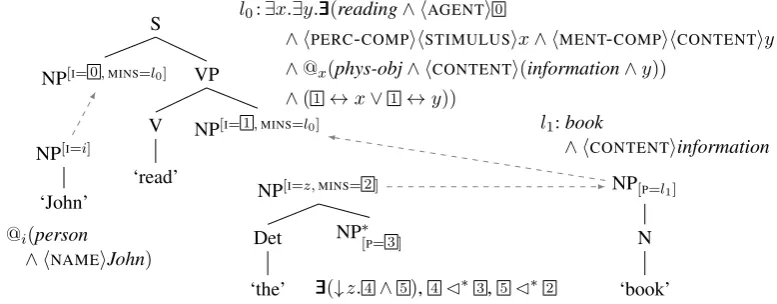
Figure 3: Derivation for ‘John read the book’
adjunctions lead to the unifications 0 = i, 1 = z, 2 = l0 and 3 = l1 on the interface features. The result is the underspecified representation in (3), which has to be disambiguated by the mapping 4 7→l1, 5 7→l0. Sinceinformationandphys-objare incompatible, it follows thatz↔xand¬(z↔y).
(3) @i(person∧ hNAMEiJohn), E (↓z.4 ∧ 5),
l0:∃x.∃y. E (reading∧ hAGENTii
∧hPERC-COMPihSTIMULUSix∧ hMENT-COMPihCONTENTiy
∧@x(phys-obj∧ hCONTENTi(information∧y))∧(z↔x∨z↔y)),
l1:book∧ hCONTENTiinformation, 4 ∗l1, 5 ∗l0
4
Polysemous nouns and quantification
A problem of the approach described above concerns the decision to provide thephys-obj node of the book frame as an argument in a predicate argument structure. As explained in the introduction, this is problematic in examples like (1b) (‘John read every book in the library’) where the noun interacts with a quantifier in such a way that the quantifier’s restriction concerns specific pairs of physical objects and associated information content but the predicate the quantifier scopes over applies only to the latter. The natural reading of (1b) is that for every book in the library, John read a (possibly different) copy of that book, i.e., John read some book with the content of that book. Simply changing the nodes provided for predicate-argument composition to the information content does not work either, as shown in (1a) (‘John carried off every book in the library’) where ‘carried off’ applies to the physical objects.
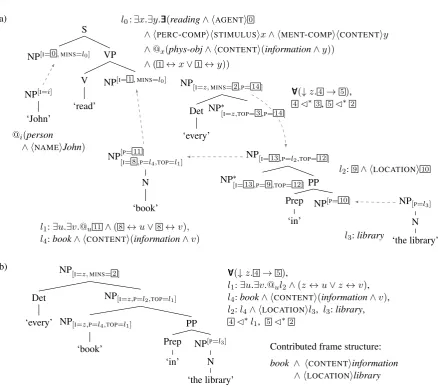
As a solution, we revise the entry of ‘book’ such that it explicitly provides an underspecifiedIfeature at the syntax-semantics interface (I= 8 in Fig. 4a)) and the value of this feature can either be a variable referring to thephys-objnode or a variable referring to theinformationnode (expressed by the disjunction 8 ↔ u ∨ 8 ↔ v). The restriction of the adjoining quantifier (variable 4) has to embed the entire formula contributed by the ‘book’ tree (i.e., the formula labeledl1), while the formula that characterizes the book frame (label l4) has to be provided as well for further modification, for instance by ‘in the library’ (interface feature P). This latter formula is embedded under the formula labeledl1 (constraint 11 ∗l4). The derivation of (1b) is given in Fig. 4a). The result of combining the trees for the complex NP ‘every book in the library’ is shown in Fig. 4b). It is underspecified with respect to whether the variable z introduced by the quantifier refers to thebooknode or to theinformation node. The frame structure contributed by the NP is, however, still the phys-obj node with aCONTENT attribute of type
a)
S
NP[I= 0,MINS=l0] VP
V
‘read’
NP[I= 1,MINS=l0]
NP[I=i]
‘John’
NP[I=z,MINS= 2,P= 14 ]
Det
‘every’ NP∗
[I=z,TOP= 3,P= 14 ]
NP[P= 11 ]
[I= 8,P=l4,TOP=l1]
N
‘book’
NP[I= 13,P=l
2,TOP= 12 ]
NP∗
[I= 13,P= 9,TOP= 12 ] PP
Prep
‘in’
NP[P= 10 ] NP[P=l3]
N
‘the library’ l0:∃x.∃y. E (reading∧ hAGENTi0
∧ hPERC-COMPihSTIMULUSix∧ hMENT-COMPihCONTENTiy
∧@x(phys-obj∧ hCONTENTi(information∧y))
∧(1 ↔x∨1 ↔y))
l1:∃u.∃v.@u11 ∧(8 ↔u∨8 ↔v),
l4:book∧ hCONTENTi(information∧v)
@i(person
∧ hNAMEiJohn)
A
(↓z.4 → 5),
4∗3, 5∗ 2
l2: 9∧ hLOCATIONi10
l3:library
b) NP
[I=z,MINS= 2 ]
Det
‘every’
NP[I=z,P=l2,TOP=l1]
NP[I=z,P=l4,TOP=l1]
‘book’
PP
Prep
‘in’
NP[P=l3]
N
‘the library’
A
(↓z.4 → 5),
l1:∃u.∃v.@ul2∧(z↔u∨z↔v),
l4:book∧ hCONTENTi(information∧v), l2:l4∧ hLOCATIONil3, l3:library,
4∗l1, 5∗ 2
Contributed frame structure:
book ∧ hCONTENTiinformation
∧ hLOCATIONilibrary
Figure 4: (a) Derivation for (1b); (b) result of deriving ‘every book in the library’
able to disambiguate between quantification over the physical objects (optionz↔xwhich would imply
z ↔ u) on the one hand and information content (z ↔ y andz ↔ v) on the other hand, since ‘read’ allows for both argument types. In a case like (1a), a disambiguation towards the first option takes place.
(4) A (↓z.4 → 5),
l1:∃u.∃v.@u(book∧ hCONTENTi(information∧v)∧ hLOCATIONilibrary)
∧(z↔u∨z↔v),
l0: ∃x.∃y. E (reading∧ hAGENTii∧ hPERC-COMPihSTIMULUSix∧ hMENT-COMPihCONTENTiy
∧@x(phys-obj∧ hCONTENTi(information∧y))
∧(z↔x∨z↔y)),
@i(person∧ hNAMEiJohn), 4 ∗l1, 5 ∗l0
5
Copredication and quantification
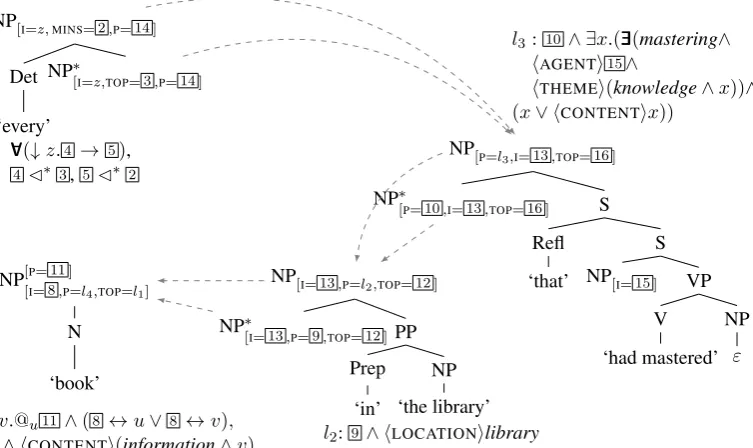
A crucial property of the proposed analysis is that we do not assume separate nodes for dot objects. In a quantificational NP involvingbook, we therefore have to quantify either over the physical objects or over the information contents. This might pose problems for cases of copredication as in (5).
[image:5.595.75.514.71.458.2]NP[I=z,MINS= 2,P= 14 ]
Det
‘every’ NP∗
[I=z,TOP= 3,P= 14 ]
NP[P= 11 ]
[I= 8,P=l4,TOP=l1]
N
‘book’
NP[I= 13,P=l2,TOP= 12 ]
NP∗
[I= 13,P= 9,TOP= 12 ] PP
Prep
‘in’
NP
‘the library’ NP[P=l
3,I= 13,TOP= 16 ]
NP∗
[P= 10,I= 13,TOP= 16 ] S
Refl
‘that’
S
NP[I= 15 ] VP
V
‘had mastered’ NP
ε
l1:∃u.∃v.@u11 ∧(8 ↔u∨8 ↔v),
l4:book∧ hCONTENTi(information∧v)
A
(↓z.4 → 5),
4∗3, 5∗2
l3: 10 ∧ ∃x.( E (mastering∧
hAGENTi15∧
hTHEMEi(knowledge∧x))∧ (x∨ hCONTENTix))
[image:6.595.112.489.82.306.2]l2: 9∧ hLOCATIONilibrary
Figure 5: Derivation forevery book in the library that _ had mastered
b. John mastered and then destroyed every book in the library. c. Mary mastered every bookiin the library before John destroyed iti.
Note that the analyses of coordination as in (5b) and also of anaphoric reference as in (5c) are still open questions in LTAG. Concerning (5a), the predicatedestroyclearly is a predication over the physical objects while the predicate master takes the informational content as argument. In the following, we will detail the analysis of (5a) in order to show that disambiguating towards one of the two options in the context of one predication does not necessarily exclude predicating in a different place over the other component.
Fig. 5 gives the derivation ofevery book in the library that _ had mastered. As in the examples in the preceding sections, we have featuresPandTOPon the NP nodes. The value ofPis the label of the frame description contributed by the (complex) noun without considering the case of quantification. The value of TOP gives the label of the formula that characterizes the possible “entry points” into this frame (in our case the physical object node and the information node). Once these formulas are introduced via the noun, any further predication can access the frame itself via thePfeature and extend its description. This is the case forin the library(as already in Fig. 4), and the predication that Mary had mastered works similarly (see the tree-frame pair on the right of Fig. 5). In other words, the relative clause headed by
mastered adjoins to the NP above thein the libraryPP and simply adds another conjunct to the frame description that holds at the physical object node of thebookframe.
6
Futher issues
As Asher (2011) points out, the relation from books as physical objects to books as informational units is not necessarily functional because of omnibus editions. Likewise, the content of a single novel can be spread over several physical volumes. For this reason, Asher posits dot objects as entities of their own right which are related to their physical and informational aspects by appropriate elaboration relations. However, the problem just mentioned is more complicated since it can happen with multi-volume editions of collected works that one novel is distributed over two volumes and that the second volume contains another novel in addition to the final part of the first novel. This means that if we want to quantify over books understood as novels, which may have once been published as single volumes, the only way to cope with situations like the one just described is to quantify over the elements of an appropriate segmentation of a (mereological) sum of theCONTENTvalues of the (physical) books in the library.
A related topic concerns the interaction of copredication and counting as illustrated in the examples in (6), which are taken from Gotham (2017).
(6) Three informative books are heavy.
In order to be true, sentence (6) seems to require three different copies of books with different infor-mational contents. That is, an appropriate representation of (6) must be able to encode the constraints that the three books have different informational content and that they are different physical objects. We leave the analysis of such examples within our framework for future work.
Another interesting issue arises in examples like (7), which make explicit that reading a book does not necessarily require to stick to a single copy. In general, it is possible to switch between different physical copies including instantiations on electronic devices such as ebook readers and the like.
(7) Mary read the heavy book on magic. She read part of it on her ebook reader for convenience.
If we want to build the variability of the physical carrier into our approach while preserving the idea that reading consists of a perception and a comprehension component, we need to zoom into the course of the reading event and describe it as consisting of different subevents, each of which is bound to a certain physical information carrier. To this end, we need to extend our model by some version of the homomorphic event-to-object relation that comes with incremental themes.
Our analysis of copredication described in Section 5 assumes that copredication is flexible in the sense that picking an attribute as argument (for instance theCONTENT) does not mean that the original root node is no longer accessible. In many cases, this makes the right predictions. However, there seem to be cases where a predication over one aspect blocks the other meaning aspects for further access; compare, for instance, the examples in (8) taken from Retoré (2014):
(8) a. Liverpool is spread out and voted (last Sunday). b. #Liverpool voted and won (last Sunday).
References
Abeillé, A. and O. Rambow (2000). Tree Adjoining Grammar: An Overview. In A. Abeillé and O. Ram-bow (Eds.),Tree Adjoining Grammars: Formalisms, Linguistic Analysis and Processing, pp. 1–68. CSLI.
Areces, C. and B. ten Cate (2007). Hybrid logics. In P. Blackburn, J. V. Benthem, and F. Wolter (Eds.),
Handbook of Modal Logic, Volume 3 ofStudies in Logic and Practical Reasoning, Chapter 14, pp. 821–868. Elsevier.
Asher, N. (2011). Lexical Meaning in Context. A Web of Words. Cambridge: Cambridge University Press.
Asher, N. and J. Pustejovsky (2005). Word meaning and commonsense metaphysics. Manuscript, avail-able at semanticsarchive.net/Archive/TgxMDNkM/.
Asher, N. and J. Pustejovsky (2006). A type composition logic for generative lexicon. Journal of Cognitive Science 6, 1–38.
Babonnaud, W., L. Kallmeyer, and R. Osswald (2016). Polysemy and coercion – a frame-based approach using LTAG and Hybrid Logic. In M. Amblard, P. de Groote, S. Pogodalla, and C. Retoré (Eds.), Log-ical Aspects of Computational Linguistics, 9th International Conference, Lecture Notes in Artificial Intelligence 10054, pp. 18–33. Berlin: Springer.
Bos, J. (1995). Predicate logic unplugged. In P. Dekker and M. Stokhof (Eds.),Proceedings of the 10th Amsterdam Colloquium, pp. 133–142.
Gardent, C. and L. Kallmeyer (2003). Semantic Construction in FTAG. InProceedings of EACL 2003, Budapest, pp. 123–130.
Gotham, M. (2017). Composing criteria of individuation in copredication. Journal of Semantics 34, 333–371.
Joshi, A. K. and Y. Schabes (1997). Tree-Adjoning Grammars. In G. Rozenberg and A. Salomaa (Eds.),
Handbook of Formal Languages, pp. 69–123. Berlin: Springer.
Kallmeyer, L., T. Lichte, R. Osswald, S. Pogodalla, and C. Wurm (2015, August). Quantification in Frame Semantics with Hybrid Logic. In R. Cooper and C. Retoré (Eds.),Type Theory and Lexical Semantics, ESSLLI 2015, Barcelona, Spain.
Kallmeyer, L. and R. Osswald (2013). Syntax-driven semantic frame composition in Lexicalized Tree Adjoining Grammars.Journal of Language Modelling 1(2), 267–330.
Kallmeyer, L., R. Osswald, and S. Pogodalla (2016). For-adverbials and aspectual interpretation: An LTAG analysis using hybrid logic and frame semantics. In C. Pi˜nón (Ed.),Empirical Issues in Syntax and Semantics EISS, Volume 11.
Kallmeyer, L. and M. Romero (2008). Scope and situation binding in LTAG using semantic unification.
Research on Language and Computation 6(1), 3–52.
Mery, B., C. Bassac, and C. Retoré (2007). A montagovian generative lexicon. In L. Kallmeyer, P. Monachesi, G. Penn, and G. Satta (Eds.),12th conference on Formal Grammar (FG 2007), Dublin, Ireland. CSLI Publications.
Retoré, C. (2014). The Montagovian Generative LexiconΛT yn: a type theoretical framework for natural language semantics. In TYPES: International Workshop on Types and Proofs for Programs, April 2013, Toulouse, France, pp. 202–229.