Evaluating Natural Language Understanding Services
for Conversational Question Answering Systems
Daniel Braun Adrian Hernandez Mendez Technical University of Munich
Department of Informatics
{daniel.braun,adrian.hernandez,matthes} @tum.de
Florian Matthes Manfred Langen Siemens AG Corporate Technology
manfred.langen @siemens.com
Abstract
Conversational interfaces recently gained a lot of attention. One of the reasons for the current hype is the fact that chat-bots (one particularly popular form of con-versational interfaces) nowadays can be created without any programming knowl-edge, thanks to different toolkits and so-called Natural Language Understanding (NLU) services. While these NLU ser-vices are already widely used in both, in-dustry and science, so far, they have not been analysed systematically. In this pa-per, we present a method to evaluate the classification performance of NLU ser-vices. Moreover, we present two new cor-pora, one consisting of annotated ques-tions and one consisting of annotated questions with the corresponding answers. Based on these corpora, we conduct an evaluation of some of the most popular NLU services. Thereby we want to enable both, researchers and companies to make more educated decisions about which ser-vice they should use.
1 Introduction
Long before the terms conversational interface
orchatbot were coined, Turing(1950) described them as the ultimate test for artificial intelligence. Despite their long history, there is a recent hype about chatbots in both, the scientific community (cf. e.g. Ferrara et al.(2016)) and industry ( Gart-ner, 2016). While there are many related rea-sons for this development, we think that three key changes were particularly important:
• Rise of universal chat platforms (like Tele-gram, Facebook Messenger, Slack, etc.)
• Advances in machine learning (ML)
• Natural Language Understanding (NLU) as a service
In this paper, we focus on the latter. As we will show in Section2, NLU services are already used by a number of researchers for building con-versational interfaces. However, due to the lack of a systematic evaluation of theses services, the decision why one services was prefered over an-other, is usually not well justified. With this paper, we want to bridge this gap and enable both, re-searchers and companies, to make more educated decisions about which service they should use. We describe the functioning of NLU services and their role within the general architecture of chatbots. We explain, how NLU services can be evaluated and conduct an evaluation, based on two different corpora consisting of nearly 500 annotated ques-tions, of the most popular services.
2 Related Work
Recent publications have discussed the usage of NLU services in different domains and for differ-ent purposes, e.g. question answering for localized search (McTear et al.,2016), form-driven dialogue systems (Stoyanchev et al.,2016), dialogue man-agement (Schnelle-Walka et al.,2016), and the in-ternet of things (Kar and Haldar,2016).
However, none of these publications explicitly discuss, why they choose one particular NLU ser-vice over another and how this decision may have influenced the performance of their system and hence their results. Moreover, to the best of our knowledge, so far there exists no systematic evalu-ation of a particular NLU service, let alone a com-parison of multiple services.
Dale (2015) lists five NLP cloud services and describes their capabilities, but without conduct-ing an evaluation. In the domain of spoken dialog
systems, similar evaluations have been conducted for automatic speech recognizer services, e.g. by
Twiefel et al.(2014) andMorbini et al.(2013). Speaking about chatbots in general,Shawar and Atwell(2007) present an approach to conduct end-to-end evaluations, however, they do not take into account the single elements of a system. Resnik and Lin(2010) provide a good overview and eval-uation of Natural Language Processing (NLP) sys-tems in general. Many of the principals they apply for their evaluation (e.g. inter-annotator agreement and partitioning of data) play an impor-tant role in our evaluation too. A comprehensive and extensive survey of question answering tech-nologies was presented byKolomiyets and Moens
(2011). However, there has been a lot of progress since 2011, including the here presented NLU ser-vices.
One of our two corpora was labelled using Amazon Mechanical Turk (AMT, cf. Section
5.2), while there have been long discussions about whether or not AMT can replace the work of ex-perts for labelling linguistic data, the recent con-sensus is that, given enough annotators, crowd-sourced labels from AMT are as reliable as ex-pert data. (Snow et al.,2008;Munro et al.,2010;
Callison-Burch,2009)
3 Chatbot Architecture
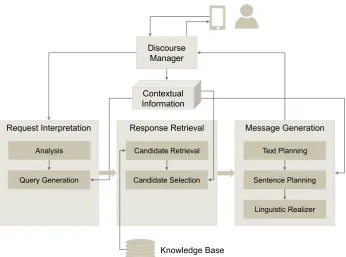
In order to understand the role of NLU services for chatbots, one first has to look at the general ar-chitecture of chatbots. While there exist different documented chatbot architectures for concrete use cases, no universal model of how a chatbot should be designed has emerged yet. Our proposal for a universal chatbot architecture is shown in Figure
1. It consists of three main parts: Request Inter-pretation, Response Retrieval and Message Gener-ation. The Message Generation follows the classi-cal Natural Language Generation (NLG) pipeline described byReiter and Dale(2000). In the con-text of Request Interpretation, a “request” is not necessarily a question, but can also be any user in-put like “My name is John”. Equally, a “response” to this input could e.g. be “What a nice name”.
4 NLU Services
The general goal of NLU services is the extraction of structured, semantic information from unstruc-tured natural language input, e.g. chat messages. They mainly do this by attaching user-defined
la-bels to messages or parts of messages. At the time of writing, among the most popular NLU services are:
• LUIS1
• Watson Conversation2
• API.ai3
• wit.ai4
• Amazon Lex5
Moreover, there is a popular open source alter-native which is called RASA6. RASA offers the same functionality, while lacking the advantages of cloud-based solutions (managed hosting, scal-ability, etc). On the other hand, it offers the typi-cal advantages of self-hosted open source software (adaptability, data control, etc).
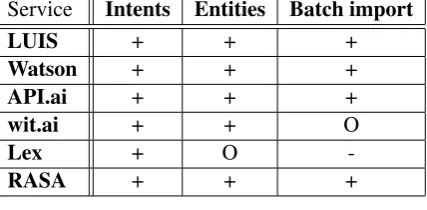
Table1 shows a comparison of the basic func-tionality offered by the different services. All of them, except for Amazon Lex, share the same basic concept: Based on example data, the user can train a classifier to classify so-called intents (which represent the intent of the whole message and are not bound to a certain position within the message) and entities (which can consist of a sin-gle or multiple characters).
Service Intents Entities Batch import
LUIS + + +
Watson + + +
API.ai + + +
wit.ai + + O
Lex + O
-RASA + + +
Table 1: Comparison basic functionality of NLU services
Figure2shows a labelled sentence in the LUIS web interface. The intent of this sentence was classified as FindConnection, with a confidence of 97%. The labelled entities are: (next, Criterion), (train, Vehicle), (Universit¨at, StationStart), (Max-Weber-Platz, StationDest). Amazon Lex shares
1https://www.luis.ai
2https://www.ibm.com/watson/
developercloud/conversation.html
3https://www.api.ai 4https://www.wit.ai
[image:2.595.311.525.454.559.2]Discourse Manager
Request Interpretation Response Retrieval Message Generation
Knowledge Base Contextual
Information
Analysis
Query Generation
Candidate Retrieval
Candidate Selection
Text Planning
Sentence Planning
[image:3.595.130.477.78.335.2]Linguistic Realizer
Figure 1: General Architecture for Chatbots
the concept of intents with the other services, but instead of entities, Lex is using so-called slots, which are not trained by concrete examples, but example patterns like “When is the {Criterion} {Vehicle} to {StationDest}”. Moreover, all ser-vices, except for Amazon Lex, also offer an export and import functionality which uses a json-format to export and import the training data. While wit.ai offers this functionality, as of today, it only works reliably for creating backups and restoring them, but not importing new data7.
Figure 2: Labelled sentence with intent and enti-ties in Microsoft LUIS
When it comes to the core of the services, the machine learning algorithms and the data on which they are initially trained, all services are very secretive. None of them gives specific infor-mation about the used technologies and datasets.
7cf. e.g. https://github.com/wit-ai/wit/
issues?q=is%3Aopen+is%3Aissue+label% 3Aimport
The exception in this case is, of course, RASA, which can either use MITIE (Geyer et al., 2016) or spaCy (Choi et al.,2015) as ML backend.
5 Data Corpus
Our evaluation is based on two very different data corpora. The Chatbot Corpus (cf. Sec-tion 5.1) is based on questions gathered by a
Telegram chatbot in production use, answering questions about public transport connections. The StackExchange Corpus (cf. Section 5.2) is based on data from two StackExchange8 platforms: ask ubuntu9 and Web Applications10. Both corpora are available on GitHub under the Creative Commons CC BY-SA 3.0 license11:
https://github.com/sebischair/ NLU-Evaluation-Corpora.
5.1 Chatbot Corpus
The Chatbot Corpus consists of 206 questions, which were manually labelled by the authors. There are two different intents (Departure Time,
8https://www.stackexchange.com 9https://www.askubuntu.com
10https://webapps.stackexchange.com 11https://creativecommons.org/licenses/
[image:3.595.77.290.560.607.2]Find Connection) in the corpus and five different entity types (StationStart, StationDest, Criterion, Vehicle, Line). The general language of the ques-tions was English, however, mixed with German street and station names. Example entries from the corpus can be found in Appendix A.1. For the evaluation, the corpus was split into a train-ing dataset with 100 entries and a test dataset with 106 entries.
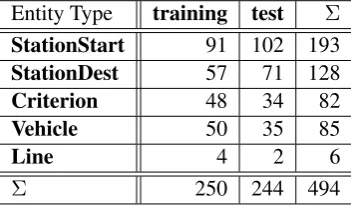
43% of the questions in the training dataset be-long to the intent Departure Time and 57% to Find Connection. The distribution for the test dataset is 33% (Departure Time) and 67% (Find Connec-tion). Table2shows how the different entity types are distributed among the two datasets. While some entity types occur very often, like Station-Start, some occur very rarely, especially Line. We do this differentiation to evaluate, if some services handle very common, or very rare, entity types better than others.
While in this corpus, there are more tagged enti-ties in the training dataset than in the test dataset, it is the other way round in the other corpus, which will be introduced in the next section. Although one might expect that this leads to better results, the evaluation in Section7 shows that this is not necessarily the case.
Entity Type training test Σ
StationStart 91 102 193
StationDest 57 71 128
Criterion 48 34 82
Vehicle 50 35 85
Line 4 2 6
[image:4.595.93.269.442.546.2]Σ 250 244 494
Table 2: Entity types within the chatbot corpus
5.2 StackExchange Corpus
For the generation of the StackExchange corpus, we used the StackExchange Data Explorer12. We choose the most popular questions (i.e. questions with the highest scores and most views), from the two StackExchange platformsask ubuntuandWeb Applications, because they are likely to have a bet-ter linguistic quality and a higher relevance, com-pared to less popular questions. Additionally, we used only questions with an accepted, i.e. correct, answer. Although we did not use the answers in
12https://data.stackexchange.com
our evaluation, we included them in our corpus, in order to create a corpus that is not only useful for this particular evaluation, but also for research on question answering in general. In this way, we gathered 290 questions and answers in total, 100 fromWeb Applicationsand 190 fromask ubuntu.
The corpus was labelled with intents and enti-ties using Amazon Mechanical Turk (AMT). Each question was labelled by five different workers, summing up to nearly 1,500 datapoints.
For each platform, we created a list of can-didates for intents, which were extracted from the labels (i.e. tags) assigned to the questions by StackExchange users. For each question, the AMT workers were asked to chose one of these intents or “None”, if they think no candidate is fit-ting.
For ask ubuntu, the possible intents were: “Make Update”, “Setup Printer”, “Shutdown Computer”, and “Software Recommendation”.
For Web Applications, the candidates were: “Change Password”, “Delete Account”, “Down-load Video”, “Export Data”, “Filter Spam”, “Find Alternative”, and “Sync Accounts”.
Similarly, a set of entity typecandidates were given. By marking parts of the questions with the mouse, workers could assign these entity types to words (or characters) within the ques-tion. For Web Applications the possible entity types were: “WebService”, “OperatingSystem” and “Browser”. Forask ubuntu, they were: “Soft-wareName”, “Printer”, and “UbuntuVersion”.
Moreover, workers were asked to state how con-fident they are in their assessment: very concon-fident, somewhat confident, undecided, somewhat uncon-fident, or very unconfident.
For the generation of the annotated, final cor-pus, only submissions with a confidence level of “undecided” or higher were taken into account. A label, no matter if intent or entity, was only added to the corpus if the inter-annotator agree-ment among those confident annotators was 60% or higher. If no intent could be found for a ques-tion, satisfying these criteria, this question was not added to the corpus. The final corpus was also checked for false positives by two experts, but non were found. Therefore the final corpus consists of 251 entries, 162 fromask ubuntuand 89 fromWeb Applications. Example entries from the corpus are shown in AppendixA.2.
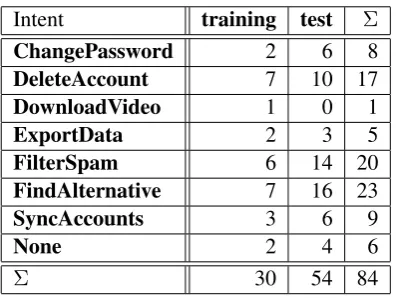
Four datasets were separated, one for training and one for testing, for each platform. The distribution of intents among these datasets is shown in Table
3, the distribution of entity types is shown in Ta-ble4. Again, we do this differentiation to compare the classification results for frequently and rarely occurring intents and entity types.
Intent training test Σ
ChangePassword 2 6 8
DeleteAccount 7 10 17
DownloadVideo 1 0 1
ExportData 2 3 5
FilterSpam 6 14 20
FindAlternative 7 16 23
SyncAccounts 3 6 9
None 2 4 6
Σ 30 54 84
(a)Web Applicationsdatasets
Intent training test Σ
MakeUpdate 10 37 47
SetupPrinter 10 13 23
ShutdownComputer 13 14 27
S.Recommendation 17 40 57
None 3 5 8
Σ 53 109 162
[image:5.595.83.282.165.314.2](b)ask ubuntudatasets
Table 3: Intents within StackExchange corpus
dataset Entity Type training test Σ
web apps
WebService 33 64 97
OS 1 0 1
Browser 1 0 1
Σ 35 64 99
ubuntu
Printer 8 12 20
Software 3 4 7
Version 24 78 102
[image:5.595.72.293.521.648.2]Σ 35 94 129
Table 4: Entity types within the StackExchange corpus
6 Experimental Design
In order to compare the performance of the differ-ent NLU services, we used the corpora described in Section 5. We used the respective training
datasets to train the NLU services LUIS, Watson Conversation, API.ai, and RASA. Amazon Lex was not included in this comparison because, as mentioned in Section4, it does not offer a batch import functionality, which is crucial in order to effectively train all services with the exact same data. For the same reason, wit.ai was also ex-cluded from the experiment. While it does offer an import option, currently, it only works reliable for data which was created through the wit.ai webin-terface and not altered, or even created, manually. Afterwards, the test datasets were sent to the NLU services and the labels created by the ser-vices were compared against our human created gold standard. For training, we used the batch im-port interfaces, offered by all compared services, in this way it was not only possible to train all dif-ferent services relatively fast, despite many hun-dred individual labels, it also guaranteed, that all services are fed with exactly the same data. Since the data format differs from service to service, we used a Python script to automatically convert the training datasets from the format shown in the Ap-pendix to the respective data format of the ser-vices. For retrieving the results for the test datasets from the NLU services, their respective REST-APIs were used.
In order to evaluate the results, we calculated true positives, false positives, and false negatives, based on exact matches. Based on this data, we computed precision and recall as well as F-score for single intents, entity types, and corpora, as well as overall results. We will say one service is better than another if it has a higher F-score.
6.1 Hypotheses
Before the conduction of the experiment, we had three main hypotheses:
1. The performance varies between services: Although it might sound obvious, it is worth mentioning that one of the reasons for this evaluation is the fact that we think, there is a difference between the compared NLU ser-vices. Despite their very similar concepts and “look and feel”, we expect differences when it comes to annotation quality (i.e. F-scores), which should be taken into account when de-ciding for one or another service.
The initial language model of RASA, which comes with MITIE, is about 300 MB of data. The commercial services, on the other hand, are fed with data by hundreds, if not thou-sands, of users every day. We, therefore, as-sume, that the commercial products will per-form better in the evaluation, especially when the training data is sparse.
3. The quality of the labels is influenced by the domain:
We assume that, depending on the used algorithms and models, individual services will perform differently in different domains. Therefore, we think it is not unlikely that a service which performs well on the more technical corpus from StackExchange will perform considerably worse on the chatbot corpus, which has a focus on spatial and time data, and vice versa.
6.2 Limitations
One important limitation of this evaluation is the fact that the results will not be representative for other domains. On the opposite, as already men-tioned in Hypothesis 3, we do believe that there are important differences in performance between different domains. Therefore our final conclusion can not be that one service is absolutely better than the others, but rather that on the given corpus, one service performed better than the others. However, we believe that the here presented approach will help developers to conduct evaluations of NLU services for their domain and thus empower them to make better-informed decisions.
With regard to the used corpora, we made an effort to make them as naturally as possible by us-ing only real data from real users. However, when analysing the results, one should keep in mind that the Chatbot Corpus consists of questions which were asked by users, which were aware of com-municating with a chatbot. It is, therefore, con-ceivable that they formulated their questions in a way which they expect to be more understandable for a chatbot.
Finally, NLU services, like all other services, can change over time (and hopefully improve). While it is easy to track these changes for locally installed software, changes on cloud-based ser-vices may happen without any notice to the user. Conducting the very same experiment, described in this paper, in six months time, might, therefore,
lead to different results. This evaluation can there-fore only be a snapshot of the current state of the compared services. While this might decrease the reproducibility of our experiment, it is also a good argument for a formalized, repeatable evaluation process, as we describe it in this paper.
7 Evaluation
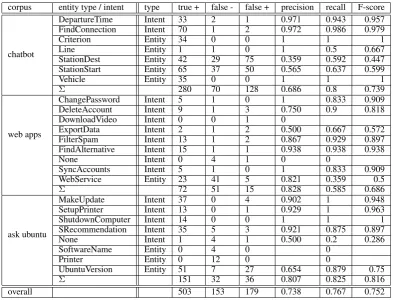
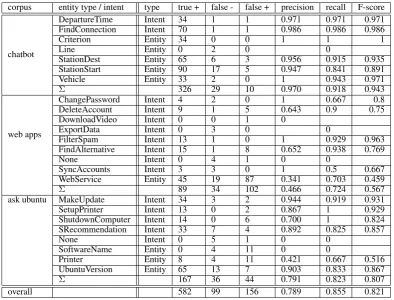
The detailed results of the evaluation, broken down on single intents, entity types, corpora, and overall, are shown in Table 5 to 8. Each table shows the result from a different NLU service. Within the tables, each row represents one partic-ular entity type or intent.
For each row, the corpus, type (intent/entity), and true positives, false negatives, and false pos-itives are given. From these values, precision, re-call, and F-score have been calculated. The en-tity types and intents are also sorted by the corpus they appear in. For each corpus, there is a sum-mary row, which shows precision, recall, and F-score for the whole corpus. At the bottom of each table, there is also an overall summary.
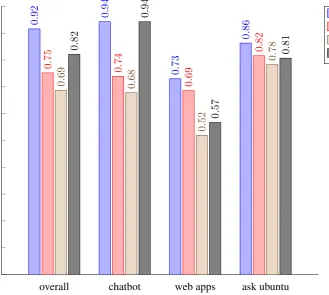
From a high-level perspective, LUIS performed best with an F-score of 0.916, followed by RASA (0.821), Watson Conversation (0.752), and API.ai (0.687). LUIS also performed best on each in-dividual dataset: chatbot, web apps, and ask ubuntu. Similarly, API.ai performed worst on ev-ery dataset, while the second place changes be-tween RASA and Watson Conversation (cf. Figure
3).
Based on this data, the second hypothesis can be rejected. Although the best performance was in-deed shown by a commercial product, RASA eas-ily competes with the other commercial products.
The first hypothesis is supported by our find-ings. We can see a difference between the ser-vices, with the F-score of LUIS being nearly 0.3 higher than the F-score of API.ai. However, a conducted two-way ANOVA analysis with the F-score as dependent variable and the NLU service and the entity type/intent as fixed factors does not show a significance at the level ofp < 0.05
(p= 0.234, df = 3). An even larger corpus might be necessary to get quantitatively more robust re-sults.
overall chatbot web apps ask ubuntu
0
.
92 0.94
0
.
73
0
.
86
0
.
75
0
.
74
0
.
69
0
.
82
0
.
69
0
.
68
0
.
52
0
.
78
0
.
82
0
.
94
0
.
57
0
.
81
LUIS
Watson Conversation API.ai
[image:7.595.83.413.68.363.2]RASA
Figure 3: F-scores for the different NLU services, grouped by corpus
much influenced. LUIS always performs best, in-dependent from the domain, API.ai always worst, also independent from the domain, merely the sec-ond and third place changes. Therefore, although the domain influences the results, it is not clear whether or not it should also influence the deci-sion which service should be used.
On a more detailed level, we also see differ-ences between entities and intents. Especially API.ai seems to have big troubles identifying enti-ties. On the web apps corpus, for example, API.ai did not identify a single occurrence of the entity type WebService, which occurred 64 times in the dataset. If we calculate the F-score for this dataset only based on the intents, it would increase from 0.519 to 0.803. The overall results of API.ai were therefore heavily influenced by its shortcomings regarding entity detection.
If we look at intents and entity types with sparse training data, like Line, ChangePassword, and Ex-portData, other than we expected, we do not see a significantly better performance of commercial services.
8 Conclusion
The evaluation of the NLU services LUIS, Wat-son Conversation, API.ai, and RASA, based on the two corpora we presented in Section5, has shown that the quality of the annotations differs between the different services. Before using an NLU ser-vice, no matter if for commercial or scientific pur-poses, one should therefore compare the different services with domain specific data.
For our two corpora, LUIS showed the best re-sults, however, the open source alternative RASA could achieve similar results. Given the advan-tages of open source solutions (mainly adaptabil-ity), it might well be possible to achieve an even better results with RASA, after some customiza-tion.
corpus entity type / intent type true + false - false + precision recall F-score
chatbot
DepartureTime Intent 34 1 1 0.971 0.971 0.971
FindConnection Intent 70 1 1 0.986 0.986 0.986
Criterion Entity 34 0 0 1 1 1
Line Entity 0 2 0 0
StationDest Entity 65 6 3 0.956 0.915 0.935
StationStart Entity 90 17 5 0.947 0.841 0.891
Vehicle Entity 33 2 0 1 0.943 0.971
Σ 326 29 10 0.970 0.918 0.943
web apps
ChangePassword Intent 3 3 0 1 0.5 0.667
DeleteAccount Intent 8 2 0 1 0.8 0.889
DownloadVideo Intent 0 0 0
ExportData Intent 3 0 1 0.75 1 0.857
FilterSpam Intent 12 2 0 1 0.857 0.923
FindAlternative Intent 14 2 2 0.875 0.875 0.875
None Intent 3 1 8 0.273 0.75 0.4
SyncAccounts Intent 5 1 0 1 0.833 0.909
WebService Entity 29 30 5 0.853 0.492 0.624
Σ 77 41 16 0.828 0.653 0.73
ask ubuntu
MakeUpdate Intent 36 1 4 0.900 0.973 0.935
SetupPrinter Intent 12 1 2 0.857 0.923 0.889
ShutdownComputer Intent 14 0 0 1 1 1
SRecommendation Intent 36 4 5 0.878 0.9 0.889
None Intent 0 5 0 0
SoftwareName Entity 0 4 0 0
Printer Entity 5 7 0 1 0.417 0.589
UbuntuVersion Entity 67 10 11 0.859 0.87 0.864
Σ 170 32 22 0.885 0.842 0.863
[image:8.595.102.496.76.372.2]overall 820 102 48 0.945 0.889 0.916
Table 5: Results LUIS
corpus entity type / intent type true + false - false + precision recall F-score
chatbot
DepartureTime Intent 33 2 1 0.971 0.943 0.957
FindConnection Intent 70 1 2 0.972 0.986 0.979
Criterion Entity 34 0 0 1 1 1
Line Entity 1 1 0 1 0.5 0.667
StationDest Entity 42 29 75 0.359 0.592 0.447
StationStart Entity 65 37 50 0.565 0.637 0.599
Vehicle Entity 35 0 0 1 1 1
Σ 280 70 128 0.686 0.8 0.739
web apps
ChangePassword Intent 5 1 0 1 0.833 0.909
DeleteAccount Intent 9 1 3 0.750 0.9 0.818
DownloadVideo Intent 0 0 1 0
ExportData Intent 2 1 2 0.500 0.667 0.572
FilterSpam Intent 13 1 2 0.867 0.929 0.897
FindAlternative Intent 15 1 1 0.938 0.938 0.938
None Intent 0 4 1 0 0
SyncAccounts Intent 5 1 0 1 0.833 0.909
WebService Entity 23 41 5 0.821 0.359 0.5
Σ 72 51 15 0.828 0.585 0.686
ask ubuntu
MakeUpdate Intent 37 0 4 0.902 1 0.948
SetupPrinter Intent 13 0 1 0.929 1 0.963
ShutdownComputer Intent 14 0 0 1 1 1
SRecommendation Intent 35 5 3 0.921 0.875 0.897
None Intent 1 4 1 0.500 0.2 0.286
SoftwareName Entity 0 4 0 0
Printer Entity 0 12 0 0
UbuntuVersion Entity 51 7 27 0.654 0.879 0.75
Σ 151 32 36 0.807 0.825 0.816
overall 503 153 179 0.738 0.767 0.752
[image:8.595.102.496.428.728.2]corpus entity type / intent type true + false - false + precision recall F-score
chatbot
DepartureTime Intent 35 0 4 0.897 1 0.946
FindConnection Intent 60 11 0 1 0.845 0.916
Criterion Entity 31 3 0 1 0.912 0.954
Line Entity 1 1 0 1 0.5 0.667
StationDest Entity 0 71 0 0
StationStart Entity 28 79 4 0.875 0.262 0.403
Vehicle Entity 34 1 5 0.872 0.971 0.919
Σ 189 166 13 0.936 0.532 0.678
web apps
ChangePassword Intent 4 2 1 0.800 0.667 0.727
DeleteAccount Intent 10 0 2 0.833 1 0.909
DownloadVideo Intent 0 0 0
ExportData Intent 1 2 2 0.333 0.333 0.333
FilterSpam Intent 10 4 3 0.769 0.714 0.74
FindAlternative Intent 16 0 2 0.889 1 0.941
None Intent 2 2 1 0.667 0.5 0.572
SyncAccounts Intent 4 2 0 1 0.667 0.8
WebService Entity 0 64 0 0
Σ 47 76 11 0.810 0.382 0.519
ask ubuntu
MakeUpdate Intent 36 1 3 0.923 0.973 0.947
SetupPrinter Intent 13 0 1 0.929 1 0.963
ShutdownComputer Intent 14 0 2 0.875 1 0.933
SRecommendation Intent 28 12 2 0.933 0.7 0.8
None Intent 2 3 8 0.200 0.4 0.267
SoftwareName Entity 0 4 0 0
Printer Entity 0 12 0 0
UbuntuVersion Entity 48 30 0 1 0.615 0.762
Σ 141 46 32 0.815 0.754 0.783
[image:9.595.102.496.76.372.2]overall 377 288 56 0.871 0.567 0.687
Table 7: Results API.ai
corpus entity type / intent type true + false - false + precision recall F-score
chatbot
DepartureTime Intent 34 1 1 0.971 0.971 0.971
FindConnection Intent 70 1 1 0.986 0.986 0.986
Criterion Entity 34 0 0 1 1 1
Line Entity 0 2 0 0
StationDest Entity 65 6 3 0.956 0.915 0.935
StationStart Entity 90 17 5 0.947 0.841 0.891
Vehicle Entity 33 2 0 1 0.943 0.971
Σ 326 29 10 0.970 0.918 0.943
web apps
ChangePassword Intent 4 2 0 1 0.667 0.8
DeleteAccount Intent 9 1 5 0.643 0.9 0.75
DownloadVideo Intent 0 0 1 0
ExportData Intent 0 3 0 0
FilterSpam Intent 13 1 0 1 0.929 0.963
FindAlternative Intent 15 1 8 0.652 0.938 0.769
None Intent 0 4 1 0 0
SyncAccounts Intent 3 3 0 1 0.5 0.667
WebService Entity 45 19 87 0.341 0.703 0.459
Σ 89 34 102 0.466 0.724 0.567
ask ubuntu MakeUpdate Intent 34 3 2 0.944 0.919 0.931
SetupPrinter Intent 13 0 2 0.867 1 0.929
ShutdownComputer Intent 14 0 6 0.700 1 0.824
SRecommendation Intent 33 7 4 0.892 0.825 0.857
None Intent 0 5 1 0 0
SoftwareName Entity 0 4 11 0 0
Printer Entity 8 4 11 0.421 0.667 0.516
UbuntuVersion Entity 65 13 7 0.903 0.833 0.867
Σ 167 36 44 0.791 0.823 0.807
overall 582 99 156 0.789 0.855 0.821
[image:9.595.102.497.428.728.2]References
Chris Callison-Burch. 2009. Fast, cheap, and creative: evaluating translation quality using amazon’s
me-chanical turk. In Proceedings of the 2009
Confer-ence on Empirical Methods in Natural Language Processing: Volume 1-Volume 1. Association for Computational Linguistics, pages 286–295.
Jinho D. Choi, Joel R. Tetreault, and Amanda Stent.
2015. It depends: Dependency parser comparison
using A web-based evaluation tool. In Proceed-ings of the 53rd Annual Meeting of the Associa-tion for ComputaAssocia-tional Linguistics and the 7th In-ternational Joint Conference on Natural Language Processing of the Asian Federation of Natural Lan-guage Processing, ACL 2015, July 26-31, 2015, Bei-jing, China, Volume 1: Long Papers. pages 387–396.
http://aclweb.org/anthology/P/P15/P15-1038.pdf.
Robert Dale. 2015. Nlp meets the cloud.
Nat-ural Language Engineering 21(4):653–659.
https://doi.org/10.1017/S1351324915000200.
Emilio Ferrara, Onur Varol, Clayton Davis, Filippo Menczer, and Alessandro Flammini. 2016. The
rise of social bots. Communications of the ACM
59(7):96–104.
Gartner. 2016. Hype cycle for emerging
technologies, 2016. Technical report.
http://www.gartner.com/document/3383817. Kelly Geyer, Kara Greenfield, Alyssa Mensch, and
Olga Simek. 2016. Named entity recognition in 140
characters or less. In6th Workshop on Making Sense
of Microposts (#Microposts2016). pages 78–79.
Rohan Kar and Rishin Haldar. 2016. Applying
chatbots to the internet of things:
Opportuni-ties and architectural elements. arXiv preprint
arXiv:1611.03799.
Oleksandr Kolomiyets and Marie-Francine
Moens. 2011. A survey on question
answer-ing technology from an information retrieval perspective. Inf. Sci. 181(24):5412–5434.
https://doi.org/10.1016/j.ins.2011.07.047.
Michael McTear, Zoraida Callejas, and David Griol.
2016. The Conversational Interface: Talking to
Smart Devices, Springer International Publishing, Cham, chapter Implementing Spoken Language Un-derstanding, pages 187–208.
Fabrizio Morbini, Kartik Audhkhasi, Kenji Sagae, Ron Artstein, Dogan Can, Panayiotis Georgiou, Shri Narayanan, Anton Leuski, and David Traum. 2013. Which asr should i choose for my dialogue system.
InProceedings of the 14th annual SIGdial Meeting
on Discourse and Dialogue. pages 394–403. Robert Munro, Steven Bethard, Victor Kuperman,
Vicky Tzuyin Lai, Robin Melnick, Christopher Potts, Tyler Schnoebelen, and Harry Tily. 2010.
Crowdsourcing and language studies: the new
gen-eration of linguistic data. In Proceedings of the
NAACL HLT 2010 workshop on creating speech and language data with Amazon’s Mechanical Turk. As-sociation for Computational Linguistics, pages 122– 130.
Ehud Reiter and Robert Dale. 2000. Building Natural
Language Generation Systems. Studies in Natural Language Processing. Cambridge University Press. Philip Resnik and Jimmy Lin. 2010. Evaluation of nlp
systems. The handbook of computational linguistics
and natural language processing57.
Dirk Schnelle-Walka, Stefan Radomski, Benjamin Milde, Chris Biemann, and Max M¨uhlh¨auser. 2016.
Nlu vs. dialog management: To whom am i
speak-ing? In Joint Workshop on Smart Connected
and Wearable Things (SCWT’2016), co-located with IUI.https://doi.org/10.13140/RG.2.1.1928.4247.
Bayan Abu Shawar and Eric Atwell. 2007.
Differ-ent measuremDiffer-ents metrics to evaluate a chatbot system. In Proceedings of the Workshop on
Bridging the Gap: Academic and Industrial
Research in Dialog Technologies. Association
for Computational Linguistics, Stroudsburg,
PA, USA, NAACL-HLT-Dialog ’07, pages 89–96.
http://dl.acm.org/citation.cfm?id=1556328.1556341. Rion Snow, Brendan O’Connor, Daniel
Juraf-sky, and Andrew Y. Ng. 2008. Cheap and
fast—but is it good?: Evaluating non-expert annotations for natural language tasks. In Proceedings of the Conference on Empirical Methods in Natural Language Processing. Asso-ciation for Computational Linguistics, Strouds-burg, PA, USA, EMNLP ’08, pages 254–263.
http://dl.acm.org/citation.cfm?id=1613715.1613751. Svetlana Stoyanchev, Pierre Lison, and Srinivas
Bangalore. 2016. Rapid prototyping of
form-driven dialogue systems using an open-source framework. In Proceedings of the 17th Annual Meeting of the Special Interest Group on Dis-course and Dialogue. Association for Computa-tional Linguistics, Los Angeles, pages 216–219.
http://www.aclweb.org/anthology/W16-3626. Alan M Turing. 1950. Computing machinery and
in-telligence.Mind59(236):433–460.
Johannes Twiefel, Timo Baumann, Stefan Heinrich, and Stefan Wermter. 2014. Improving domain-independent cloud-based speech recognition with
domain-dependent phonetic post-processing. In
A Supplemental Material A.1 Examples Chatbot Corpus
{
"text": "what is the cheapest
,→ connection between
,→ quiddestraße and
,→ hauptbahnhof?",
"intent": "FindConnection",
"entities": [ {
"entity": "Criterion",
"start": 3,
"stop": 3
}, {
"entity": "StationStart",
"start": 6,
"stop": 6
}, {
"entity": "StationDest",
"start": 8,
"stop": 8
} ] }, {
"text": "when is the next u6
,→ leaving from garching?",
"intent": "DepartureTime",
"entities": [ {
"entity": "Line",
"start": 4,
"stop": 4
}, {
"entity": "StationStart",
"start": 7,
"stop": 7
} ] }
A.2 Examples StackExchange Corpus A.2.1 Web Applications Dataset
{
"text": "How can I delete my
,→ Twitter account?",
"url": "http://
,→ webapps.stackexchange.com
,→
/questions/57/how-can-i-,→ delete-my-twitter-account
,→ ",
"author": "Jared Harley",
"answer": {
"text": "[...]",
"author": "Ken Pespisa"
},
"intent": "Delete Account",
"entities": [ {
"text": "Twitter",
"stop": 5,
"start": 5,
"entity": "WebService"
} ] }, {
"text": "Is it possible to
,→ export my data from
,→ Trello to back it up?",
"url": "http://
,→ webapps.stackexchange.com
,→
/questions/18975/is-it-,→
possible-to-export-my-,→
data-from-trello-to-back-,→ it-up",
"author": "Clare Macrae",
"answer": {
"text": "[...]",
"author": "Daniel LeCheminant
,→ "
},
"intent": "Export Data",
"entities": [ {
"text": "Trello",
"stop": 8,
"start": 8,
"entity": "WebService"
} ] }
A.2.2 Ask Ubuntu Dataset
{
"text": "How do I install the
,→ HP F4280 printer?",
,→
questions/24073/how-do-i-,→
install-the-hp-f4280-,→ printer",
"author": "ok comp",
"answer": {
"text": "[...]",
"author": "nejode"
},
"intent": "Setup Printer",
"entities": [ {
"text": "HP F4280",
"stop": 6,
"start": 5,
"entity": "Printer"
} ] }, {
"text": "What is a good MongoDB
,→ GUI client?",
"url": "http://askubuntu.com/
,→
questions/196136/what-is-,→ a-good-mongodb-gui-client
,→ ",
"author": "Eyal",
"answer": {
"text": "[...]",
"author": "Eyal"
},
"intent": "Software
,→ Recommendation",
"entities": [ {
"text": "MongoDB",
"stop": 4,
"start": 4,
"entity": "SoftwareName"