Classifying Languages by Dependency Structure
Typologies of Delexicalized Universal Dependency Treebanks
Xinying Chen
School of International Studies
Xi’an Jiaotong University, China
Department of Czech Language
University of Ostrava, Czech Republic
Kim Gerdes
LPP (CNRS)
Sorbonne Nouvelle
France
Abstract
This paper shows how the current Universal Dependency treebanks can be used for cluster-ing structural global lcluster-inguistic features of the treebanks to reveal a purely structural syntac-tic typology of languages. Different uni- and multi-dimensional data extraction methods are explored and tested in order to assess both the coherence of the underlying syntactic data and the quality of the clustering methods them-selves.
1
Introduction
Language universality and language differences are a pair of questions, if not two sides of one question, that relate to most of modern linguistic research, both theoretically and empirically. This is even more true for research in language typol-ogy.
Modern language typology research (Croft 2002; Song 2001), mostly based on Greenberg (1963), focuses less on lexical similarity and re-lies rather on various linguistics indices for lan-guage classification, and generally puts much emphasis on the syntactic order (word order), in particular of the principal components in relation to their governing verb (Haspelmath et al. 2005).
However, just as individual constructions can display varying degrees of syntheticity and ana-lyticality (Ledgeway 2011), different syntactic orders can also be found in the very same lan-guage. Reality seems to be messier than we would like it to be. Therefore, probabilities or quantitative approaches, which allow gradual transitions and blurred borderlines, could make some unique contributions on this matter (Liu & Xu, 2012). Moreover, empirical studies based on authentic language data can bring richer details,
and then corroborate or improve our knowledge of language classification. By relying on quanti-tative empirical measures we do no longer expect a categorical answer of grouping languages into fixed language groups, but rather tendencies of structural proximity between languages.
Although such efforts have already been made in a few studies (Liu 2010; Liu & Xu 2012), it is not until now, with the appearance of Universal Dependencies, that we can conduct an empirical language classification study based on treebanks of different languages that share the same depen-dency annotation framework.
1.1 Universal Dependencies
Universal Dependencies (UD) is a project of de-veloping a cross-linguistically consistent tree-bank annotation scheme for many languages, with the goal of facilitating multilingual parser development, cross-lingual learning, and parsing research from a language typology perspective. The annotation scheme is based on an evolution of (universal) Stanford dependencies (de Marn-effe et al., 2014), Google universal part-of-speech tags (Petrov et al., 2012), and the Interset interlingua for morphosyntactic tagsets (Zeman, 2008). The general philosophy is to provide a universal inventory of categories and guidelines to facilitate consistent annotation of similar con-structions across languages, while allowing lan-guage-specific extensions when necessary.
There are two notable advantages of using this data set for language classification studies. Firstly, it is the sheer size of the data set: It in-cludes 70 treebanks of 50 languages, 63 of which have more than 10,000 tokens. And secondly, and most importantly, all UD treebanks use the same annotation scheme. The few previous stud-ies of empirical language classification based on
treebank data (Liu 2010; Liu & Xu 2011, 2012) still had to rely on much fewer treebanks with heterogeneous annotation schemes. Although al-ready relatively satisfying results were obtained, the question of identifying the source of the ob-served language variations remains unsolved: They could be actual structural differences be-tween languages or simply annotation schema re-lated differences (or even genre rere-lated differ-ences, of course – and thus being due to the un-derlying text). UD can, to a certain extent, reduce this problem by providing a unique framework for all languages.
However, the drawbacks of the UD 2.0 scheme are also rather obvious. The Universal Dependencies (UD) project is still at an early stage of development and many problems of UD have not been solved appropriately, the most im-portant points being:
1. Many treebanks are a result of multiple transformations of previous phrase-structure and dependency treebanks, therefore often multiplying already existing annotation or even parse errors where no manual correc-tion is available.
2. The UD textual data stems from very differ-ent sources and was not conceived as a paral-lel corpus.1 Thus, we can never exclude that any observed difference is actually due to genre differences between the texts.
3. The current UD annotation guides are still highly underspecified resulting in low inter-annotator, and more importantly inter-corpus agreement (the authors, submitted). This is particularly true for a series of constructions (cleft, dislocations, disfluencies, …). Also, the attempt to annotate semantic non-compo-sitionality of multi-word expressions in the (syntactic) annotation scheme without actu-ally providing the semantic criteria, necessar-ily leads to incomparable annotations (Gerdes & Kahane 2016).
4. Most importantly, with the goal of possibly simplifying parsing and other NLP tasks, the basic idea underlying the UD annotation scheme is to make languages look as “similar as possible” based on semantic features, the most prominent of which being to put “con-tent words” higher in the tree. However, the status of content word is a semantic distinc-tion. This results in the infamous “Turkish” analysis of English prepositions (Chris
Man-1 With the exception of the ParTUT treebanks (San-guinetti & Bosco 2011).
ning, 2016, personal communication).2 The forced similarity of structurally different lan-guages, like for example Turkish and Eng-lish, makes the data less valuable for our study of empirical structural language classi-fication: We cannot measure what has been suppressed.
1.2 What to measure?
In typological studies on word order, Greenberg (1963) proposed 45 linguistic universals, 28 of which are related to the order or position of grammatical units, for instance, the order of sub-ject, obsub-ject, and verb. According to Dryer’s (1992) study of detailed word order correlations based on a sample of 625 languages, there are 17 correlation pairs and 5 non-correlation pairs be-tween a verb and its object.3 Although the impor-tance of linear order of grammatical units has been addressed for quite a while, more recently statistical investigations of word order also play an increasingly central role in empirical studies, some of which are based on treebanks. Liu (2010) looked through the directional distribu-tions of three pairs of grammatical units, namely, S-V/V-S, V-O/O-V, and Adj-N/N-Adj, in tree-banks of 20 languages. He quantified the depen-dency directions by computing the percentages of positive (head-final) and negative (head-ini-tial) dependencies, thus transforming the sen-tence internal dependency link into global tures of the treebank. He found that these fea-tures are relatively efficient for the language classification task, thus being able to dig out hu-man language universals from authentic data.
2 Contrary to all previous analyses of prepositions in Indo-European languages that we are aware of which see the prepositions as governors of the fol-lowing noun (giving a PP its name), UD annotates prepositions as case markers of the noun, indepen-dently of whether it is sub-categorized by the verb (talk to) or semantically full (sleep under). This leads to a greater structural similarity between English and Turkish than typologically expected and also for example to competing annotations of complex prepositions (on top of) in the current treebanks (with top as the head of the PP or as a dependent of the embedded noun).
Subsequent empirical studies of language classification have confirmed that combined measures on all dependency links, not only on the verbal and nominal arguments, provides bet-ter typological indicators than one or several spe-cific word order measures, which may lead to conflicting conclusions (Liu & Xu 2012). In ad-dition, macroscopic indexes, such as network pa-rameters of dependency treebanks based on lan-guage networks, have been shown to perform even better than global measures of word order (Liu & Li 2010; Abramov & Mehler 2011; Liu & Xu 2011, 2012; Liu & Cong 2013). One way of extracting global structural language features is to fuse all equal lexical nodes, resulting in one big syntactic network where every lexical node appears only once (Ferrer-i-Cancho 2001, Chen et al. 2015). In the present work, we completely strip the treebank of the lexical nodes, taking into account only the categories as well as the fre-quency and directions of the dependency rela-tions.
Although word order is clearly an important index for capturing the typological features of languages, we suspect that it is possible to refine the index by combining it with additional infor-mation or to conceive indeces that are better adapted to the classification task, such as net-work parameters. In the present net-work, we pro-pose two means of modifying the word order (dependency direction) index for language classi-fication task. To the quantitative measure of the dependency directions, we add the length of the syntactic relations (Liu 2008; Liu et al. 2009), i.e. we compute the Directional Dependency Distances (DDD) for each syntactic function with positive/negative values corresponding to the dependency direction. This DDD measure appears to be a straightforward choice of quanti-tative values that map directly to the dependency direction index.
Although our method follows the same ‘quan-titative’ principle as Liu (2010) and Lu & Xu (2012), it contains different information. Instead of using the distribution percentages of the de-pendency directions to quantify them, we add the distance information into it and thus create a more integrated value rather than a pure direction index. The second novelty of this work is a more fine-grained dependency direction measurement: Instead of computing an overall value (the aver-age distance or the percentaver-age of positive rela-tions for a whole treebank), the unified annota-tion scheme of UD allows us to break down the frequency, direction, and length of the links by
dependency relationship. Common clustering techniques will allow analyzing and visualizing language similarities.
1.3 Outline
Following the idea of investigating the typologi-cal structural universality and diversity of lan-guages based on authentic treebank data, the present work specifically focuses on whether and how the UD treebank set allows us to recognize language families based on purely empirical structural data. The question can be decomposed into various sections:
The following section will describe the dataset used in this study and the principal measures that we apply. In section 3 we start with a global uni-dimensional measure that imposes a natural order on the set of treebanks. We compare the measure we propose to existing work. Given the above-mentioned series of problems of the underlying treebank data, we then move on to assessing whether the current UD data is actually good enough to measure structural differences, the most evident method being whether different treebanks of the same language are actually structurally more similar to each other than to treebanks of other languages. For this, we apply our ranking to the individual treebanks as well as to the data combined by language.
We then make use of the common annotation scheme of the UD treebanks which allows us to split up the measures per syntactic functions. This multi-dimensional dataset can be used for common clustering techniques, whose results we present and discuss. We will conclude with a dis-cussion of the results, problems, and future plans of dependency-based typology.
Our images contain very small fonts but the image resolution allows zooming in. For the PCA images, the color zones, which we describe in the text, are generally sufficient for the under-standing of the clusters. Since we compute data on close to 50 languages, 70 treebanks, and 30 dependency relations, we cannot provide all nu-merical data in the Annex of this paper. All scripts, data, and images are freely available on https://gerdes.fr/papiers/2017/dependencyTypol-ogy/ thus allowing reproducing our results, in particular as the underlying UD treebank target is a fast moving target.
2
Methods
determina-tion and extracdetermina-tion of the parameters to investi-gate, 3) quantitative description of the parame-ters, 4) clustering analysis based on measure-ments of step 3.
In step 1, we remove the relatively sparse lan-guages, namely treebanks with less than 10,000 tokens, from the dataset. We also only kept syn-tagmatic core relations, removing fixed, flat,
conj, and root relations from our distance mea-sures as their direction and length are universally fixed in the annotation guide and don’t indicate any interesting difference between languages.4 Different treebanks of the same language are firstly kept separate for consistency measures and secondly combined for the main classifica-tion tasks.
In step 2, we extract dependency function dis-tribution, direction, and distance measures from the combined treebanks. More specifically, we compute the relative frequency distributions of dependency functions and the Directional De-pendency Distance (DDD), which we define as the product of the dependency distance and the direction, thus including negative values. We ob-tain three different central observations, as shown in Table 1, which we will also compare to other frequency measures.
Observations Distributions (frequency)
Directional de-pendency
dis-tance (DDD)
1 √ ×
2 × √
[image:4.595.307.528.453.633.2]3 √ √
Table 1: 3 observations based on 2 parameters
For Observation 1, we only look at the distri-butions of dependency functions of different lan-guages. For the observation 2, we compute the
DDD per syntactic function by computing the difference of the node index and the governor in-dex for each node, adding those values up and
di-4 Fixed and flat are used for multi-word expres-sions, conj for coordinations. These three depen-dency relations have arbitrarily been assigned to a left-right bouquet structure (all subsequent to-kens depend on the first token). See Gerdes & Ka-hane 2016 for a description and for alternatives to this choice. The root link is often thought of and drawn as a line straight up from the root node but it is encoded in CoNLL as a link to the zero node. Taking the root “length” into account would artifi-cially add left-right relations to mainly head-final language (and the way around), thus lowering the average distance measures.
viding by the number of links5. The DDD of a dependency relation R is thus defined as follows:
In the third measure, we quantify this average
DDD by means of the relative frequency of the UD functions by multiplying DDD with the rela-tive frequency of the corresponding function.
At step 3, we conduct clustering analyses based on the data of the observations. We com-pare the results of these three observations to each other as well as to previous language classi-fication studies to see whether they can distin-guish different known language families in order to assess which observations provide the best re-sult.
3
Unidimensional measures
To start, let us first look at the simple measures, where we get a unique numerical value per tree-bank or language.
We computed the DDD of all dependency lations combined. The DDD takes head-final re-lations as negative values and head-initial rela-tions as positive values. Languages that have an equal number of left-spanning and right-span-ning links of similar average length, will have a value close to zero.
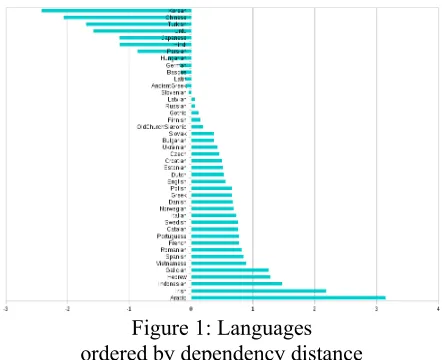
This graph gives a good idea of what kind of insights we want to gain from dependency
mea-5 This means that we do not take into account the variance of these links, e.g. a language that has symmetric links around each governor will have a zero distance, independently of the length of these dependency links. We also computed the standard deviation of each relation and included this value in the clustering, but this did not significantly im-prove the result.
Figure 1: Languages ordered by dependency distance DDD(R)=
∑
r∈Rdistance(r)
sures: It comes as no surprise to find Korean at the top of the list of the most centripetal (Tes-nière’s term for head-final6) languages, and, in-versely, Arabic at the bottom of the list, being the most centrifugal of the analyzed languages. The appearance of Chinese, however, between Korean and Turkish at the second place affirms how strictly head-final Chinese actually is – a fact that does not really show when classifying languages in the discrete categories of SVO, SOV etc. We see how the numerical analysis al-lows for new empirically-based groupings and ordering of languages that are hard to perceive on purely categorical classifications.
The Germanic language group is spread across the spectrum, starting from the negatively dis-tanced German to the highly positively disdis-tanced Swedish. The Romance languages, however, are all very well clustered around an average dis-tance of about 0.8.
Compare this with a measure that does not take into account the actual length of the depen-dencies but only the direction percentages (pro-posed by Liu (2010)):
Although the two extremes (Korean and Ara-bic) are the same, the results correspond less to well-known language classifications. Observe how Japanese finds its natural position close to Korean, Turkish and Hungarian in the DDD measure, whereas the direction percentage mea-sure places it right next to Arabic, presumably because of the high number of (postpositional) particles.7
6 Tesnière’s language classification terminology (1959) precedes Greenberg’s by 4 years but was not cited by the latter.
7 Although functionally analogous, equivalent post-positions are traditionally seen as morphological case-marking in Korean. This leads to quite di-verse treebanks for structurally similar languages,
3.1 Corpus or Language differences? A basic coherence measure of our data can be done by comparing not languages as a whole but treebanks which have usually been created by different groups of developers. If we encounter strong differences among treebanks of the same language that genre differences cannot account for, then this points to underspecification of guidelines – or possibly to systematic errors in one treebank.
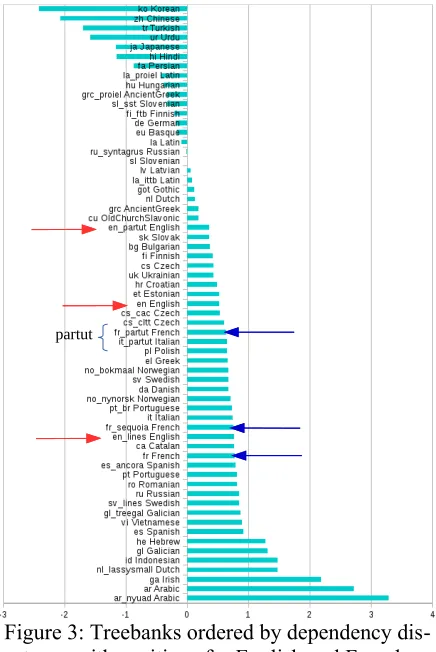
The separation of our data by treebank gener-ally puts languages at similar positions indepen-dently of the treebank. Nevertheless, this also re-veals some of the aforementioned incoherences of the current state of the annotations – and thus also the limits of our approach. The following figure indicates the different places taken by the English (left side, red arrows) and the French (right side, blue arrows) treebanks of UD 2.0. Al-though the absolute values are not as extremely different as the position suggests (en: 0.4, 0.5, 0.8; fr: 0.6, 0.8, 0.8), any derived typological
[image:5.595.311.529.209.535.2]calling for a more precise tokenization specifica-tion.
Figure 3: Treebanks ordered by dependency dis-tance with positions for English and French. The language names are preceded by the ISO
lan-guage code and the complete treebank name if there is more than one treebank per language.
[image:5.595.57.292.374.566.2]partut
classification seems to remain quite treebank de-pendent at the current state of UD. Note also that the treebanks from the ParTUT team coherently have a lower dependency direction than their counterparts for English, French, and Italian. It is tempting to attribute this difference to differ-ences in the guidelines used by different teams in the annotation process, but for Italian, the other Italian treebank has also been created by the Par-TUT team. So maybe the difference is rather due to the syntactic structure of “Translationese”, that has shorter dependency links for the mostly head-initial languages included in ParTUT.
More generally, this shows how these methods also allow for detecting common ground and out-liers in the process of treebank development. They can be used for error-mining the treebank.
4
Multi-dimensional clustering
Measures on our set of treebanks that distinguish dependency relations give rise to multi-dimen-sional vectors. The clustering analysis can be done by the usual Principal Component (PCA8) and the Hierarchical Cluster Analysis (HCA9).
UD allows the introduction of idiosyncratic sub-classes of syntactic functions. English, for example has the nmod:poss function, the posses-sive subclass of nominal modifiers used for the
8 The PCAs are performed with the decomposition package of the scikit-learn project. See github. com/scikit-learn/scikit-learn
9 The HCA in this paper are conducted by Origin-Pro 9 (Cluster Method: Nearest neighbor, Distance Type: Euclidean).
annotation of genitives. To make the values com-parable, we are measuring the direction and dis-tribution of simple functions, i.e. function names stripped of what follows the colon.
4.1 Directional Dependency Distance (DDD) by syntactic function
Instead of comparing the single DDD value, we can use the whole vector of DDDs, one for each of the 33 syntactic functions. Contrarily to what we have seen for the global DDD, the multi-di-mensional HCA clustering of Figure 4 groups relatively correctly: the Slavic language family (red, except Russian), Romance (yellow, without Galician) and Germanic (green, without German and Dutch).
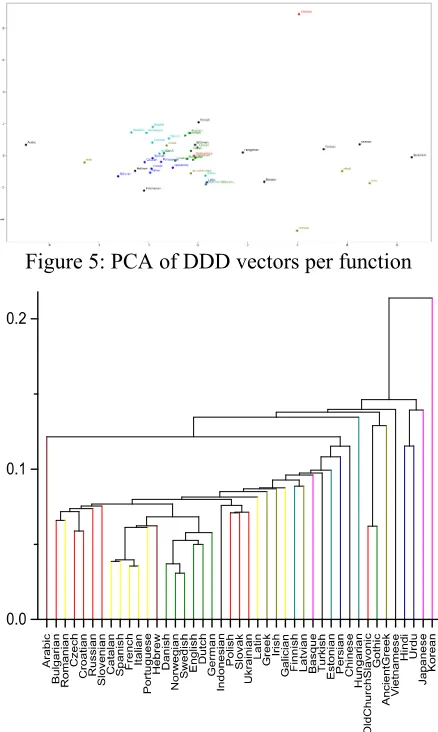
[image:6.595.306.525.278.644.2]The PCA of the same data provides clustering of comparable quality, cf. Figure 5: Romance in blue, Germanic in turquoise, and, less clearly clustered, Slavic in green. Note also the rectangle containing Altaic languages in the following or-der but quite fare from one another: Hungarian, Turkish, Korean, and Japanese.
Figure 4: Dendrogram of DDD vectors per func-tion
Figure 5: PCA of DDD vectors per function
[image:6.595.69.288.295.544.2]4.2 Clustering relative frequency distribu-tions
Do we actually need to take into account the length and direction of the dependency relation to obtain correct language families? Or will the simple frequency of dependency relation labels do? Figure 6, another clustering analysis, only on the relative frequency of each dependency label, shows that the analysis successfully distinguishes Indo-European languages and also obtains rather good results for three big sub-groups, namely the Germanic branch (in green color), Italic branch (in yellow color), and the Slavic branch (in red color). Although some intermingling of these three branches still exists, the result is slightly better than the result that we obtain based on simple dependency directions.
It is noteworthy that we cannot further sim-plify the underlying data and dispense with the tree structure altogether. If for example we only use relative POS frequencies, we obtain an PCA analysis where language groups are not coherent clusters (Figure 7).
Inversely, complexifying the features gives sparse data and unrecognizable results. If, for ex-ample, we combine function and category and measure the frequencies of function-category couples, one couple being for example (nsubj→NOUN), we obtain the following unin-terpretable graph (Figure 8). Although many of UD’s syntactic functions are actually redundant (nsubj contains the information that the depen-dent is a NOUN), the higher-dimensional space projects less clearly into two-dimensional space (~500 dimensions), presumably because of data sparsity. This experiment could be redone when some UD treebanks will have attained a signifi-cantly greater size.
Note that in both the pure POS and the func-tion-POS analysis, the two ancient languages Gothic and Old Church Slavonic are strong out-liers (on the right of the graph), not far from An-cient Greek and Latin. This suggests that the
POS annotations of these languages has been done by the same team or at least has been under mutual influence.
This shows that all measures are not created equal. The actual structural information of the treebank is crucial to obtain satisfying language groups.
4.3 DDD multiplied by relative frequency
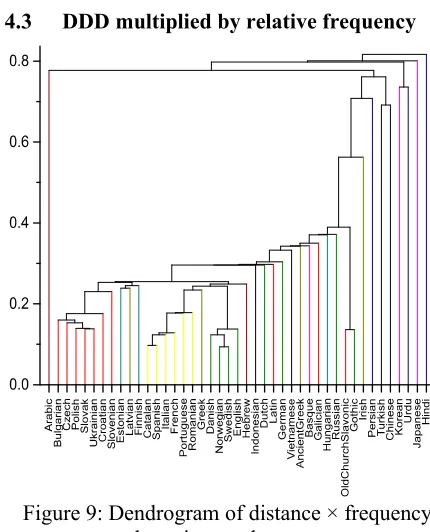
[image:7.595.309.530.74.204.2]Both the pure frequency measures and the direc-tional dependency measures (DDD) measures give interesting results. When combining these two measures by multiplying the DDD by the relative frequencies, we obtain even more satis-fying results: Figure 9 shows a first red subtree corresponding to Slavic langugaes, only Latvian, Russian, and Old Slavonic being outliers. The next yellow subtree hosts Romance language with Latin and Galician later following alone. The green sub-tree shows the proximity of the Germanic languages Danish, Norwegian, Swedish, and English – with Dutch and German following separately. As in the PCA analysis, Old Slavonic and Gothic form again a close sub-Figure 7: PCA of POS frequencies
[image:7.595.304.519.305.571.2]Figure 9: Dendrogram of distance × frequency clustering per language
[image:7.595.76.293.373.504.2]group – presumably due to a common annotation process.
Even when grouping by treebanks and not by languages, the subtrees cut neatly into the set of languages. In Figure 9, the red subtree on the left groups together nearly all Slavic languages, the yellow subtree contains nearly all Romance lan-guages, and the green subtree most Germanic languages (see the Annex for the names of the language codes). Then there is another separate green subtree for German and Dutch and two more Germanic outliers: Gothic and another Dutch corpus. If this is not a genre difference, we can suppose that this Dutch Lassymal UD tree-bank follows different annotation guidelines. Note also how close are Finnish and Estonian (small light brown subtree). This subtree then groups together with Latvian, a language consid-ered coming from a different group of languages. This structural similarity mimicking geographic proximity is an interesting result suggesting cross-language-group influences not only on the lexicon but also on the syntactic structure itself.
Similarly, note that the distance × frequency measures consistently cluster Romanian in the Romance language group, but simple relative frequency measures show Romanian close to Bulgarian and other Slavic languages. In a sense, the simple frequency captured some features of language groups better than DDD and the multi-plied values. We have to leave it to further re-search to determine which kind of proximity is better captured by which measure.
We can see that a well-chosen measure, here the combined frequency and distance measure, can abstract away from the many annotation er-rors and incoherences of the current UD.
Even using PCA on the language treebank data (Figure 11), we see that the right hand side of the PCA diagram contains the same languages as the most independent languages of the dendro-gram: Japanese (black dot to the right) Chinese (red on top), Hindi, Korean, and Urdu stand out the furthest from the crowd in both projections, showing the relative robustness of the data con-cerning the actual choice of the clustering tech-nique.
5
Conclusion
The various data extraction and clustering tech-niques that we have carried out, only the most emblematic of which we could present in this pa-per, show that the UD treebanks succeed rather well for language classification even if we solely base our study on the delexicalized tree struc-tures. The coherent cross-language annotation scheme makes it possible to split up the measures by dependency functions. Although modern lan-guage typology studies are mainly focused on word order, the different measures and methods we proposed show that the classical word order classification alone is no longer sufficient to classify languages based on authentic clustering data, which is a similar result to Liu (2012). Usu-ally we get better results if we consider the actual dependency relations, no matter under which for-mat: relative distribution, network, and network variations. For single parameters alone, the de-pendency relationship distribution is performing better than the dependency direction. However, combining the criteria provides us with the best language clustering results attainable on the sole basis of syntactic treebanks.
[image:8.595.305.526.199.353.2]Meanwhile, it is necessary to further assess in future research the robustness of our clustering approach to typology across different annotation schemes, for instance by comparing the UD tree-banks with data that can be obtained from crosslingual parsers (Ammar et al. 2016; Guo et al. 2016).
Figure 11: PCA of distance × frequency
[image:8.595.68.290.365.556.2]Since the distribution of dependency relation-ships is very uneven and the majority of links consists of a small subset of all types, it seems possible that the most frequent relations are suf-ficient for classifying languages. If they are, then some functions may have different effects on the clustering process. The decisive functions in the clustering represent language diversity, the oth-ers have a more univoth-ersal character. This process transforms the categorical opposition between principles and parameters into a gradual scale where syntactic features and constructions can be positioned based on empirical data from tree-banks.
A basic epistemological question arises from two types of results that we can obtain in our ap-proach: We have measures that group languages according to well-known classes, and measures that show new groupings and relationships. Both results are interesting, the latter requiring further explorations and explanations – and, as in any truly empirical approach, it requires returning to the data to ascertain the actual causes of the ob-served distances between treebanks.
Here we encounter the difficulty of assessing the nature of the results: Are they possibly due to annotation errors and incoherences? Are they due to genre differences of the underlying texts? The methodology we propose will grow and improve with the coherence of the UD treebanks. – Or possibly with the emergence of other more syn-tactically oriented treebank collections, in partic-ular if they are conceived as parallel treebanks, with identical genres. This would dispel any doubts on clustering results, as each cluster would solely and directly express an empirical typological relation.
References
Abramov, Olga, and Alexander Mehler. “Automatic language classification by means of syntactic de-pendency networks.” Journal of Quantitative Lin-guistics, 18.4 (2011): 291-336.
Chen, Xinying, Haitao Liu, and Kim Gerdes. “Classi-fying Syntactic Categories in the Chinese Depen-dency Network.” Depling 2015 (2015): 74.
Croft, William. Typology and universals. Cambridge University Press, 2002.
De Marneffe, Marie-Catherine, et al. “Universal Stan-ford dependencies: A cross-linguistic typology.” LREC. Vol. 14. 2014.
Dryer, Matthew S. “The Greenbergian word order correlations.” Language, (1992): 81-138.
Ferrer-i-Cancho, Ramon, and Richard V. Solé. “The small world of human language.” Proceedings of the Royal Society of London B: Biological Sci-ences, 268.1482 (2001): 2261-2265.
Gerdes, Kim, and Sylvain Kahane. “Dependency An-notation Choices: Assessing Theoretical and Practi-cal Issues of Universal Dependencies.” LAW X (2016)
Greenberg, Joseph H. “Some universals of grammar with particular reference to the order of meaningful elements.” Universals of language, 2 (1963): 73-113.
Haspelmath, Martin. The world atlas of language structures. Vol. 1. Oxford University Press, 2005. Ledgeway, Adam. “Syntactic and morphosyntactic
ty-pology and change.” The Cambridge history of the Romance languages, 1 (2011): 382-471.
Liu, Haitao. “Dependency distance as a metric of lan-guage comprehension difficulty.” Journal of Cog-nitive Science, 9. 2 (2008): 159-191.
Liu, Haitao. “Dependency direction as a means of word-order typology: A method based on depen-dency treebanks.” Lingua, 120.6 (2010): 1567-1578.
Liu, Haitao, and Chunshan Xu. “Can syntactic net-works indicate morphological complexity of a lan-guage?.” EPL (Europhysics Letters), 93.2 (2011): 28005.
Liu, Haitao, and Chunshan Xu. “Quantitative typolog-ical analysis of Romance languages.” Poznań Stud-ies in Contemporary Linguistics PsiCL, 48 (2012): 597-625.
Liu, Haitao, and Jin Cong. “Language clustering with word co-occurrence networks based on parallel texts.” Chinese Science Bulletin, 58.10 (2013): 1139-1144.
Liu, Haitao, Richard Hudson, and Zhiwei Feng. “Us-ing a Chinese treebank to measure dependency dis-tance.” Corpus Linguistics and Linguistic Theory, 5.2 (2009): 161-174.
Liu, Haitao, and Wenwen Li. “Language clusters based on linguistic complex networks.” Chinese Science Bulletin, 55.30 (2010): 3458-3465.
Lucien Tesnière. 1959. Éléments de syntaxe struc-turale. Klincksieck, Paris.
Petrov, Slav, Dipanjan Das, and Ryan McDonald. “A universal part-of-speech tagset.” arXiv preprint arXiv:1104.2086, (2011).
Song, Jae Jung. Linguistic typology: Morphology and syntax. Routledge, 2014.
Zeman, Daniel. “Reusable Tagset Conversion Using Tagset Drivers.” LREC. 2008.
Appendix A.
Selected Language Data
Our study is based on the UD 2.0 treebanks of 43 languages combining 67 corpora.
As an example, we provide a table with the (al-phabetically) first functions of rounded DDD data per language:
name acl advcl advmod amod appos aux
Arabic 3,37 9,87 3,42 1,39 3,43 -1,05 Bulgarian 5,07 2,73 -1,33 -1,09 2,58 -1,32 Catalan 5,51 7,41 -1,24 0,89 5,26 -1,45 Czech 5,58 1,72 -1,22 -0,97 4,83 -2,14 Old Church
Slavonic 2,37 0,02 -0,97 0,66 1,63 0,79 Danish 5,42 5,15 -0,24 -0,63 2,59 -2,31 German 9,9 7,47 -1,84 -1,17 2,29 -4,54 Greek 4,25 4,01 -1,04 -1,08 5,67 -1,14 English 3,48 2,4 -0,93 -1,16 4,07 -1,58 Spanish 4,94 6,11 -1,16 0,7 3,45 -1,5 Estonian 2,07 3,39 -0,63 -1,04 2,84 -1,98
Basque -1,83 -0,03 -1,93 0,43 4 0,78 Persian 7,81 -4,98 -5,66 0,95 2,81 -1,64 Finnish 1,4 2,24 -0,56 -1,19 2,96 -1,66 French 3,72 4,59 -1,17 0,65 3,2 -1,46 Irish 3,13 8,37 1,88 1,3 4,59 0 Galician 4,33 5,07 -1,06 0,78 5,14 -1,31
Gothic 3,35 1,04 -1,09 0,17 2,34 0,96 Ancient Greek 4,6 -0,52 -1,91 0,37 3,66 -1,73 Hebrew 4,53 2,83 -0,33 1,8 4,15 -1,96 Hindi 3,73 -5,67 -2,35 -1,32 0 1 Croatian 4,55 2,99 -1,48 -1,2 2,34 -1,54 Hungarian 8,67 4,22 -2,26 -1,39 3,67 0 Indonesian 3,81 4,65 -1,15 1,25 3,7 -1,33
Italian 3,84 2,46 -1,51 0,53 4,98 -1,32 Japanese -6,35 0 -8,99 -1,43 0 1,76 Korean -1,55 -5,22 -3,26 -1,08 -6,52 0
Latin 3,55 0,85 -2,33 0,1 3,5 0,55 Latvian 3,41 1,52 -1,5 -1,42 5,67 -1,11 Dutch 5 4,39 -1,67 -1,07 2,27 -2,62 Norwegian 3,77 3,71 -0,67 -0,94 4,79 -1,77 Polish 4,7 1,85 -1,13 -0,34 1,7 0,05 Portuguese 4,37 3,76 -1,29 0,46 3,68 -1,43 Romanian 4,13 3,37 -1,21 1 4,95 -1,21 Russian 4,19 3,07 -1,17 -1,05 2,31 -0,89 Slovak 4,57 1,73 -1,14 -1,06 3,68 -0,64 Slovenian 5,77 1,04 -1,28 -1,17 3,35 -2,35 Swedish 3,66 3,06 -0,64 -1,07 5,6 -1,95 Turkish -2,46 0 -1,05 -1,9 2,11 1,35 Ukrainian 4,06 2,15 -1,28 -1,19 2,22 -0,65 Urdu 5,84 -3,73 -6,4 -1,43 0 1 Vietnamese 0 -3,61 -0,66 1,18 3,83 -0,77
Chinese -4,88 -8,17 -2,5 -2,18 1,5 -2,67
The unabridged data used in this paper is avail-able on https://gerdes.fr/papiers/2017/dependen-cyTypology/
code Language tokens
ar Arabic 233, 712
ar_nyuad Arabic 670, 612 bg Bulgarian 123, 178
ca Catalan 417, 453
cs Czech 1, 174, 076
cs_cac Czech 426, 274 cs_cltt Czech 22, 000
cu Old Church Slavonic 39, 394
da Danish 80, 351
de German 245, 524
el Greek 47, 343
en English 194, 428
en_lines English 58, 223 en_partut English 34, 195
es Spanish 377, 020
es_ancora Spanish 443, 951
et Estonian 29, 051
eu Basque 82, 516
fa Persian 113, 699
fi Finnish 152, 583
fi_ftb Finnish 118, 747
fr French 349, 973
fr_partut French 16, 328 fr_sequoia French 53, 635
ga Irish 11, 627
gl Galician 105, 844 gl_treegal Galician 13, 819
got Gothic 37, 931
grc Ancient Greek 161, 184 grc_proiel Ancient Greek 171, 524
he Hebrew 127, 018
hi Hindi 262, 007
hr Croatian 161, 533 hu Hungarian 27, 607 id Indonesian 82, 588
it Italian 254, 058
it_partut Italian 38, 768 ja Japanese 149, 147
ko Korean 43, 921
la Latin 15, 978
la_ittb Latin 254, 683 la_proiel Latin 134, 030
lv Latvian 38, 476
code Language tokens
nl Dutch 170, 665
nl_lassysmall Dutch 73, 373 no_bokmaal Norwegian 243, 529 no_nynorsk Norwegian 240, 917
pl Polish 63, 236
pt Portuguese 196, 032 pt_br Portuguese 260, 983 ro Romanian 177, 755
ru Russian 78, 025
ru_syntagrus Russian 872, 362
sk Slovak 79, 704
sl Slovenian 113, 498 sl_sst Slovenian 16, 389
sv Swedish 65, 954
sv_lines Swedish 56, 661
tr Turkish 37, 167
uk Ukrainian 11, 312
ur Urdu 99, 024
vi Vietnamese 25, 979