Core Arguments in Universal Dependencies
Daniel Zeman Charles University
Faculty of Mathematics and Physics Institute of Formal and Applied Linguistics
Prague, Czechia
Abstract
We investigate how core arguments are coded in case-marking Indo-European lan-guages. Core arguments are a central con-cept in Universal Dependencies, yet it is sometimes difficult to match against ter-minologies traditionally used for individ-ual languages. We review the methodol-ogy described in (Andrews, 2007), and in-clude brief definitions of some basic terms. Statistics from 26 UD treebanks show that not all treebank providers define the core-oblique boundary the same way. There-fore we propose some refinement and par-ticularization of the guidelines that would improve cross-treebank consistency on the one hand, and be more sensitive to the tra-ditional grammar on the other.
1 Introduction
The opposition of core vs. oblique dependents is one of the central concepts in Universal Dependen-cies (Nivre et al., 2016); this distinction is inten-tionally preferred to the argument/adjunct distinc-tion. However, difficulties in recognizing core ar-guments in individual languages, combined with often incompatible traditional terminology, have led to confusion and data inconsistency. UD doc-umentation has greatly improved since its version 1 and provides now a list of potential criteria that may help to draw the core vs. oblique borderline; however, it is still just a set of hints, not a defi-nition. The English UD uses a relatively simple rule: as soon as a preposition is involved, the noun phrase cannot be analyzed as a core argument. Un-fortunately, there are many languages where the situation is more complex. In the present work we are particularly interested in languages that use both case morphology and prepositions to mark ar-guments.
We review one possible universal methodology to identify coding of core arguments, and show how it applies to these languages. Terms like ar-gument, transitive verb or indirect object are of-ten taken for known and granted (both in the UD guidelines and in the literature) but the problem is that their definition may differ by language or by author, and it is not easy to see how they work across languages. Therefore we briefly define the necessary terms as well.
2 Core Arguments in Language Typology
In this section we provide a brief definition of core arguments; for a much more detailed discussion see (Andrews, 2007), which is our primary source.
2.1 Arguments and Adjuncts
Arguments are noun phrases that fulfill semantic roles determined by verbs, or more generally by predicates. Depending on language, the verb may also specify requirements on the position of the in-dividual arguments and on their form, such as mor-phological case marking or preposition.
In contrast, adjuncts are noun phrases that spec-ify additional circumstances such as location, time and manner. Neither their form nor their meaning is determined by the verb. They can accompany any predicate; some collocations may be difficult to interpret semantically but they are not ungram-matical. Likewise, the form of the adjuncts is de-termined by their meaning rather than by the verb. Hence, the phrase marked by the prepositionon is an argument inI rely on himor inI will act on the matter, but it is an adjunct in I will work on Saturday orI live on an island. These examples are relatively easy to understand; however, in gen-eral the argument-adjunct distinction is not always trivial, and UD avoids it (from the guidelines: “We take the distinction to be sufficiently subtle (and its existence as a categorical distinction sufficiently questionable) that the best practical solution is to
eliminate it.”) Nevertheless, we will see that even for the distinction between core and oblique argu-ments, it is sometimes necessary to make sure that the noun phrase is actually an argument and not an adjunct. Whenever we say ‘argument’ in the rest of the paper, we think of it as defined in the begin-ning of this section.
2.2 Transitive Verbs
The most reliable means of distinguishing be-tween core and oblique arguments are the encod-ing strategies such as word order, adpositions and morphological case. However, the strategies are always specific to a language and cannot be used in a cross-linguistically applicable definition. There-fore we start with semantic roles to identify proto-typical core arguments, then we observe the strate-gies that the language uses to mark them, and fi-nally generalize to other arguments using the same strategy, despite their semantic roles being differ-ent from the prototypical core argumdiffer-ents.
The prototypical core can be observed with pri-mary transitive verbs,i.e. verbs that take two argu-ments whose semantic roles areagentandpatient, respectively. The agent, typically an animate en-tity, is responsible for an action, and the patient is directly affected by the action. To killis an exam-ple of a primary transitive verb: inGeorge killed the dragon,George is the agent who did the killing (note that it is not necessary for an agent to act willingly; it could also be an accident). Without any doubt, the dragon is the entity most affected by the killing, and the killing caused a change of the dragon’s state. Hence the dragon qualifies as the patient.
Languages differ in how they make clear who killed whom. In English, it is the position of the arguments relative to the verb. In Czech, the agent would be in its nominative form, and the patient in the accusative.1 However, in good many lan-guages the same coding strategy is also used with verbs whose two arguments have other semantic roles. For instance, to lovetakes two arguments but it is not aprimarytransitive verb because the roles of the arguments are better described as “ex-periencer” and “goal” rather than “agent” and “pa-tient”. Nevertheless, the verb is transitive in both English and Czech because the two arguments are marked in these languages in exactly the same way as the arguments ofto kill.
1Unless the verb is in its passive form.
Following (Andrews, 2007), if a noun phrase is serving as an argument of a two-argument verb, and receiving a morphological and syntactic treat-ment normally accorded to an agent of a primary transitive verb, it has thegrammatical function A; analogically, an argument receiving treatment normally accorded to a patient of a primary transi-tive verb has the grammatical functionP.2
2.3 Intransitive Verbs
If a verb takes just a single argument, the verb is calledintransitiveand its argument has the gram-matical functionS. Depending on language (and in some languages depending on individual verbs), the S argument of intransitive verbs may conform to the same grammatical rules as the A argument of transitive verbs, or as the P argument, or it can be different from both A and P.
2.4 Core and Oblique Arguments in UD
S, A and P are considered core grammatical func-tions (Andrews, 2007, p. 164). As UD refers to Andrews,3 we can project to UD: Arguments that have one of theS/A/P functions are core argu-ments. Nominals whose grammatical function is A or S are calledsubjectsand their dependency re-lation to the verb isnsubj. Nominals whose gram-matical function is P are called (direct)objectsand their dependency relation to the verb isobj. Both subject and object are consideredcore arguments. In addition, UD uses a special relation iobj for what it callsindirect objects; we will investigate them in Section 4.
Using the concepts defined so far, it is now pos-sible to lay down rules for core arguments in in-dividual languages. For instance, in English, if a bare noun phrase (i.e. without a preposition) is an argument of a verb, it is a core argument; if it oc-curs in a simple declarative clause and precedes the verb, it is its subject; if it follows the verb, it is an object. Note the important conditionif it is an ar-gument, not adjunct. While adjuncts usually take prepositions in English, they occasionally appear as bare noun phrases too; as an example, consider
2Note that some authors use the termsagentandpatientto refer to what we call A and P here, rather than to the semantic roles; cf. the functors on the t-layer of the Prague Dependency Treebank (Hajič et al., 2006). It is important not to confuse that terminology with ours: for example, the two arguments ofto lovewould then be agent and patient, while we argue that they are not.
3http://universaldependencies.org/u/
the temporal adjunctthis weekinI am not working this week.
On the other hand, verbs in many languages have arguments that are marked by coding strate-gies that are also used by adjuncts, but that are different from strategies used by core arguments. Such arguments are calledoblique. For instance, the second argument ofactinI will act on the mat-teris marked by the prepositionon. Since core ar-guments in English do not take prepositions, this is an oblique argument. In UD, both oblique argu-ments and adjuncts are attached to the verb via an oblrelation (if they are noun phrases).
Note that the methodology described in this sec-tion is not the only possible. (Dixon, 2012, vol. 1 sec. 3.2 and vol. 2 sec. 13) defines core arguments as those that “must be either stated or understood from the context;” the opposite of core are pe-ripheral arguments. Dixon’s core arguments are in spirit similar to those of Andrews, but his defi-nition does not guarantee that no verbs have their core arguments marked by “oblique” strategies.
3 Languages with Case-Marking Morphology
A number of Indo-European languages have the morphological category of case. In these lan-guages, the most typical coding of core argu-ments is the nominative case (subject) and the ac-cusative case (object). However, there are usu-ally more cases than these two, and the question arises whether arguments in other morphological cases count as core arguments. (Andrews, 2007) gives an example from German: the verbhelfen (“to help”) takes two arguments, one in nomina-tive and the other in danomina-tive. We can say thathelfen is a primary transitive verb because the roles of the two arguments are agent and patient. It can also be passivized, which is a typical property of transi-tive verbs; however, unlike verbs with accusatransi-tive objects, the dative argument ofhelfenstays in the dative and does not become subject when the verb appears in the passive voice. We thus have an ar-gument whose grammatical behavior is not iden-tical with the more typical accusative object, yet it is sufficiently similar to qualify as a core argu-ment. In consequence, all arguments that are bare nominals in dative are core arguments in German.4
4Note that this finding is not without controversy. Some authors classify the German dative as an oblique case,
al-A similar observation can be made in Slavic languages. In fact everything that we just said about the German verbhelfenalso applies to the Czech verbpomoci(“to help”). However, Czech has more cases than German, and there are two-argument verbs whose second two-argument is neither accusative nor dative. Bare genitives and instru-mentals may act as arguments too; moreover, there are prepositional arguments in genitive, dative, ac-cusative, locative or instrumental. Many of these verbs can be passivized in the same way as po-moci. For example, the verb hýbat (“to move”) takes an instrumental patient-object: in Martin hýbá nábytkem“Martin moves the furniture”, the noun nábytek (“furniture”) takes its instrumental form. When passivized, the agent disappears and the patient stays in instrumental: Nábytkem bylo hýbáno“The furniture has been moved.”
A somewhat different example is the verb dot-knout se(“to touch”). This verb is inherently flexive, i.e. obligatorily accompanied by the re-flexive pronounse.5 It takes two arguments: the agent is in nominative as usual, and the patient is in genitive. According to the semantic roles we could argue that it is a primary transitive verb. However, reflexive verbs cannot be passivized in Czech: *Bylo se ho dotknuto(“He has been touched”) is not grammatical. Thus we have a two-argument verb whose arguments pass the tests on coreness laid out in Section 2, yet it does not permit pas-sivization, an operation usually associated with transitive verbs (note however that passivization is not universal and cannot be added as a requirement for transitive verbs).
So we have three types of transitive verbs w.r.t. passivization (1. accusative; 2. non-accusative non-reflexive; 3. reflexive). We can also observe varying degree of coreness. The largest proportion of primary transitive verbs will indisputably be found among verbs with accusative objects. Verbs taking objects in genitive, dative and instrumental often select roles quite different from the (proto-) patient; only a handful can be regarded as primary transitive verbs. Even harder to find are patients among prepositional arguments, but some of them would deserve to be at least considered as
candi-though they do not specify what are the properties their clas-sification is based on (Foley, 2007, p. 377).
dates. At the same time, bare accusative is very rarely used for adjuncts, which are slightly more common among other bare noun phrases, and the majority of them are prepositional phrases.
Strictly following the tests from Section 2 and from (Andrews, 2007), all Czech arguments would be core and none of them would be oblique. While this “classification” aligns with the notion of ob-jects in the Czech grammar (see Section 5), it is of no benefit. It does not make sense to delimit the core of a set if it comprises the entire set; further-more, the identification of core arguments would now be reduced to the argument-adjunct distinc-tion, which UD wanted to eliminate.
So, is there a way to interpret Section 2 with less extreme results? There is one word that may pro-vide the remedy. In 2.2 we say that the P func-tion is recognized by treatmentnormallyaccorded to a patient of a primary transitive verb. Now we showed that bare accusative is the “most normal” coding strategy and prepositional phrases are still possible, but arguably “least normal” for patients. Out of the three possible coding strategies (bare ac-cusatives, bare non-accusatives and prepositional phrases), we could decide that one or two are not normal enough. Our cross-linguistic detection of core arguments will become a bit less deterministic but more flexible; it may be the right compromise to use.
4 Ditransitive Verbs and Indirect Objects
Predicates may define more than two roles. In the Czech sentence Firma mu zvýšila plat z dvaceti na třicet tisíc korun lit. “Company him raised salary from twenty to thirty thousand crowns” (Lopatková et al., 2016) the verb zvýšit (“raise”) has four or five arguments.6 With an extreme in-terpretation of Section 2 we could even claim that all of them are core arguments. It is usually not assumed that languages have that many core ar-guments; nevertheless, it is accepted that some verbs in some languages have three. Such verbs are calledditransitive.
Verbs of giving, taking and related concepts (e.g. teaching = giving knowledge) are prototypi-cal examples in many languages. Their arguments correspond to the semantic roles of agent, theme (or patient) and recipient (Dryer, 2007). In terms of grammatical relations they correspond to
sub-6Depending on whether the beneficiaryhimis accepted as argument rather than adjunct.
ject, direct and indirect object. There is a confu-sion potential though. Some grammars will de-fine indirect object as the argument with the recip-ient role. However, this argument is not necessar-ily a core argument by our definition: in English inJohn gave Mary a flower, the recipient(Mary) is a core argument; but in John gave a flower to Mary, the recipient is oblique. When we restrict ourselves to core arguments, there are clearly lan-guages and verbs with two objects but it is less clear whether (and why) one of them deserves a special term. (Andrews, 2007) notes that “the sta-tus of the notion of ‘indirect object’ is problematic and difficult to sort out. The top priority is to work out what properties recipients and themes do and do not share with P arguments of primary transitive verbs.”
In Universal Dependencies, the v2 guidelines say that “The indirect object of a verb is any nom-inal phrase that is a core argument of the verb but is not its subject or (direct) object.” Such a defi-nition is not sufficient for us—any core argument that is not a subject is an object. The UD guide-lines “define” the (direct) object as the second most core argument after subject. They do not provide means to quantify coreness, though. For our group of languages, we could use the observation from Section 3 that there are three coding strategies or-dered by decreasing convincingness of their core status. However, UD also assumes that the relation iobjis only used with predicates that have more than one object, i.e., the indirect object cannot ex-ist without a direct one. This rule would have to be changed, otherwise we cannot say that all bare dative arguments areiobj. For example, the Ger-man verbhelfendoes not have any accusative ob-ject that could be labeledobj.
5 Traditional Terminology
Traditional grammars in good many languages use less restrictive definitions of object than UD. It is not unusual to encounter non-accusative and even prepositional objects, no matter of their status as core or oblique arguments.
Nom Acc Dat Gen Abl Loc Ins Voc None be 36/0 20/8 2/1 7/8 0/12 3/3
bg 9/1 14/1 3/0 46/27
cs 29/0 29/5 5/2 3/7 0/12 3/3 2/1
cs2 27/0 31/6 4/2 3/7 0/12 4/3 1/0
cs3 32/0 27/4 1/3 2/10 0/12 5/2 1/0
cu 26/0 21/9 15/4 7/4 0/7 2/2 2/0
de 35/0 19/6 3/20 0/1 6/11
el 35/0 29/29 1/2 1/0 2/1
got 28/0 26/6 15/20 2/1 1/0
grc 26/0 34/7 14/5 6/6 2/0
grc2 23/0 31/11 14/6 5/8 1/0 1/0
hr 32/0 30/7 3/0 4/7 0/10 2/2
la 24/0 33/8 8/0 16/9 1/0
la2 36/0 19/15 5/0 5/19 1/0 0/1
la3 24/0 31/11 9/0 1/0 9/13 1/0 1/0
lt 33/0 22/6 5/0 11/5 7/0 7/1 2/1
lv 37/0 21/6 8/5 2/4 15/0 1/0
pl 29/0 20/7 4/0 5/8 0/10 3/3 10/0
pt 1/0 6/0 1/0 57/35
ru 29/0 15/8 3/4 5/8 0/19 6/3 ru2 34/0 20/7 3/3 5/7 0/11 6/3
sa 43/0 30/0 1/0 4/0 3/0 6/0 9/0 3/0 1/0 sk 27/0 24/6 6/2 1/6 0/9 2/3 14/0 sl 22/0 24/8 6/1 6/4 0/14 0/6 10/0 sl2 25/1 25/7 6/0 6/3 0/10 0/4 14/0
[image:5.595.135.464.58.443.2]uk 33/0 22/9 4/0 4/10 0/10 4/3
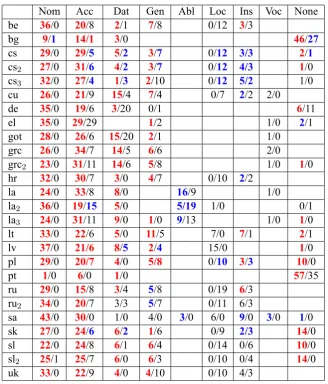
Table 1: Distribution (percentage) of morphological cases found at nominal dependents of verbs. Both occurrences with / without adposition are counted. Only Indo-European languages with three or more cases in UD 2.0 are shown. Languages are identified by their ISO 639 codes; when there are multiple treebanks per language, numerical indices are used instead of identifiers for brevity. Highlight red= mostly core relations (includingexpl).Highlight blue= mostly oblique, but significant (10% or more) amount of core also present.
for the dative argument of ditransitives. Textbooks use a question test to distinguish objects from non-objects. If a dependent of the verb can be queried by an interrogative adverb(where, when, how), or by one of a few additional expressions such asfor what purpose, it is an adverbial modifier—even if realized as a noun phrase! If we must use an in-terrogative pronoun(who, what)it is either a sub-ject (if the pronoun is in nominative) or an obsub-ject (otherwise). Thus in spoléhám na kamarády (“I rely on friends”), the prepositional phrase is object because the only plausible question is with a pro-noun: Na koho spoléhám? (“Who do I rely on?”). In contrast, the prepositional phrase inpojedu na Slovensko(“I will go to Slovakia”) is not normally queried by*Na co pojedu? “What will I go to?”
Instead, we use an adverb and ask Kam pojedu? “Where will I go?” Thus this phrase is not an ob-ject. If objects are defined this way, then most objects are arguments and most adverbials are ad-juncts; the notion of core arguments does not play a role.
objects are always core arguments and they belong to the most core-like subset. Indirect objects may or may not be core arguments depending on how strictly we follow the principles from Section 2.
Such a perspective is not specific to Czech; it is rather dominant in European linguistics.
In their comparative grammar of Slavic lan-guages, (Sussex and Cubberley, 2006, p. 339, 351– 352) use the termtransitive verbfor verbs whose object is a bare noun phrase in any case; verbs with prepositional objects are neither transitive nor intransitive. Direct object is a synonym for bare accusative; other objects are referred to as non-accusative objectsandprepositional objects. Indi-rect objectseems to be used just for the semantic role of recipient (expressed by bare dative), proba-bly assuming that the English readership will find the term familiar.
Another example, this time outside the Slavic group, is the cannonical grammar of German. (Helbig and Buscha, 1998, p. 53 and 545) distin-guish accusative object, dative object, genitive ob-ject and prepositional obob-ject. Adjunct-like noun phrases are considered adverbial modifiers. Tran-sitive verbs are those that take an accusative ob-ject and this obob-ject can become subob-ject in a pas-sive clause. Verbs that take an accusative ob-ject but cannot be passivized (enthalten“contain,” bekommen“get” etc.) are calledmedial verbs (Mit-telverben). Intransitive verbs are those that do not take an accusative object, regardless whether they take a non-accusative object, prepositional object, obligatory adverbial or nothing at all.
It is neither prohibited nor unusual that the UD terminology diverges from the “traditional” one. Partly because there are many traditions, inconsis-tent with each other. However, it would be nice to at least preserve the distinctions expected in tra-ditional grammar, and to be able to map the UD data to whatever annotation is expected by vari-ous communities. Even if UD does not aim at dis-tinguishing arguments from adjuncts universally, the distinction is obviously important in grammars of many languages and there should be standard-ized means to capture it on the language-particular level.
6 Current UD Annotation
Let us now examine how the core-oblique distinc-tion is dealt with in the current release (2.0) of Uni-versal Dependencies. In order to stay focused on
the issues discussed in the previous sections, we limit ourselves to Indo-European languages with case morphology. Table 1 gives an overview. In total, there are 26 UD treebanks (19 languages). Verb-dependent nominals in the data take from 3 to 8 different case forms (including the vocative, which marks a special type of dependent); some nominals are “caseless” (meaning that their anno-tation does not include the case feature, i.e. either the word does not inflect, or the annotation is in-complete).
Bulgarian and Portuguese represent a larger group of languages where the case system has been reduced to personal pronouns; but only in these two languages the actual numbers for each case surpassed 0.5% of examined nodes. Otherwise, there are all Balto-Slavic languages, all classical Indo-European languages (Ancient Greek, Latin, Gothic, Sanskrit), Modern Greek and German. Some languages have two or three treebanks pro-vided by different groups. Case distribution dif-fers across these treebank sets, but the difference is usually not dramatic. The largest gap can be ob-served between la2 and the other two Latin
tree-banks; besides domain differences, the likely rea-son is that la and la3contain classical Latin while
la2is from the 13thcentury.
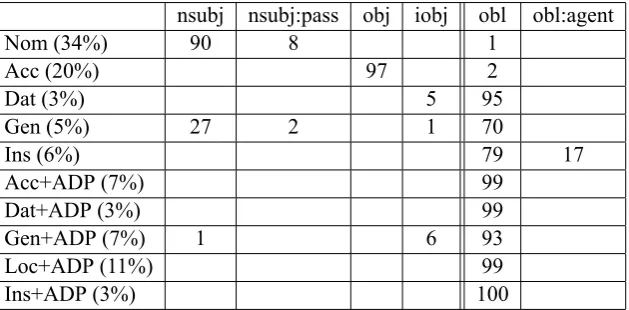
The differences are more significant when we investigate for each case form whether and how often it occurs with a core dependency relation. Bare nominatives and accusatives are almost al-ways core arguments. Bare datives and geni-tives also appear as core arguments in convinc-ing numbers. Then the codconvinc-ing seems to be more and more oblique across the ablative, instrumental and locative down to prepositions. Most treebank providers seem to have simply adopted the English rule that oblique are those arguments with preposi-tions. Occurrences of theoblrelation among bare noun phrases might as well just mean that these phrases are adjuncts; however, since UD does not distinguish oblique arguments from adjuncts, we cannot verify this hypothesis.
Table 2 is a zoom-in view of cases vs. relations in UD Czech 2.0. The annotation is ported from the Prague Dependency Treebank, which uses the traditional definition where object = argument; that is why the core relations appear in all nomi-nal forms including those with prepositions.
En-glish rule for obliqueness, the first release (1.3), di-rectly converted from the original SynTagRus an-notation, was much closer to what we see in Czech. In the 1.3 release,nmodunder verbs (now labeled obl), marked only nominals that are not traditional objects, i.e. adjuncts. In 2.0, these can be no longer distinguished from prepositional objects. Even if it is correct to assume that prepositional arguments are oblique in Russian, there is arguably a sub-stantial amount of information that is important in Russian grammar and was available in the original data, but it is lost in the current UD release.
7 Refined Definition of Objects
Let us now summarize the issues identified in the preceding sections and propose refined guidelines that will hopefully address the issues better (at least in the studied subset of Indo-European languages). There are three groups of arguments that are tra-ditionally called objects and could be considered as object candidates in UD, ordered by decreas-ing strength of evidence of their coreness: bare ac-cusatives, bare non-accusatives and prepositional phrases. UD assumes the core-oblique boundary to be clear-cut but it isn’t, because identification of primary transitive verbs is not always trivial, and their distribution among the above groups is un-balanced. Nevertheless, drawing the line between bare nominals and prepositional phrases (which is what the majority of treebanks already adopts) seems a reasonable compromise.
In order to preserve the important distinction between prepositional objects and adjuncts, we propose to annotate prepositional objects by the language-specific relationobl:arg(except for de-moted subjects in passive constructions, which should use obl:agent, a practice already estab-lished in several UD treebanks).
Bare non-accusatives can be considered core arguments in languages where there are reason-able examples of primary transitive verbs using these cases. (We have shown examples from Ger-man and Czech but we have not proved that all cases in all languages from Table 1 meet the cri-teria. We do believe though that the criteria are met for dative, genitive and instrumental in Slavic languages.) It might be useful to mark them by a language-specific label obj:nacc, although it would be just a shortcut: one can obtain the case information from the morphological features.
As for indirect objects, their current UD defi-nition is problematic. It seems appealing to define them as core arguments that are mostly object-like, but grammatical rules applying to them are some-what different from those used with the prevail-ing type of objects (i.e. the type that covers the largest group of primary transitive verbs). That is, instead of obj:naccproposed above, we would useiobj for non-accusative objects (cf. (Karlík et al., 2016)). However, it would also wipe out indirect objects from English, which is a bit unfor-tunate, given that English seems to be responsible for introducing the very concept of iobj in UD. Hence the new guideline should perhaps provide more freedom for language-specific rules, saying that it is possible to mark a subclass of objects as secondary/indirect on language-specific grounds. In the long term, the relation should probably be-come a language-specific subtype of obj.
8 A Note on Subjects
In comparison to the various types of objects, iden-tifying nominal subjects is relatively straightfor-ward in our group of languages. They can be easily recognized by the nominative case and by cross-referencing on the verb (person, number and gen-der); they can hardly ever be confused with ad-juncts. Occasional confusion with objects may stem from morphological ambiguity: in the Czech sentence Krávy štípou mouchy, both the nouns krávy “cows” and mouchy “flies” are in a form shared by nominative and accusative; the (prob-able) English meaning is “Flies sting cows” but since word order is flexible in Czech, it could also mean “Cows sting flies.”
Tables 2 to 4 reveal that a significant subset of subjects in Slavic languages have a genitive form. However, these genitives are caused by numer-als in quantified phrases, not by the verb. Un-der certain conditions, Slavic numerals and quan-tifiers require that the counted noun takes the gen-itive form.7 The numeral itself has its nomina-tive/accusative form, and the entire phrase (nu-meral + noun) behaves like nominative/accusative singular neuter (gender and number are cross-referenced on the verb). Hence inPřišlo jen pět dětí “Only five children came,” the verb přišlo “came” has a singular neuter form, the numeral
nsubj nsubj:pass obj iobj expl:pv expl:pass obl discourse
Nom (29%) 95 4
Acc (29%) 69 21 7 2
Dat (5%) 1 36 33 15 14 1
Gen (3%) 23 1 60 2 14
Ins (3%) 26 4 69
Acc+ADP (5%) 37 9 54
Dat+ADP (2%) 31 3 66
Gen+ADP (7%) 1 7 2 89
Loc+ADP (12%) 10 2 88
Ins+ADP (3%) 28 5 66
None (2%) 58 1 19 6 12
[image:8.595.91.514.68.252.2]None+ADP (1%) 1 13 3 83
Table 2: UD Czech. Distribution of core and oblique relations for individual case forms. Numbers indicate how many % of the nominals in the given case got the given relation. ADP indicates a preposition.
nsubj nsubjpass dobj iobj nmod nmod:agent
Nom (27%) 85 13 1
Acc (17%) 97 2
Dat (2%) 36 64
Gen (4%) 30 4 51 2 13
Ins (5%) 32 51 16
Acc+ADP (7%) 31 69
Dat+ADP (3%) 29 70
Gen+ADP (7%) 1 24 17 57
Loc+ADP (11%) 98
Ins+ADP (3%) 27 73
None (12%) 60 3 26 10 1
[image:8.595.129.471.303.488.2]None+ADP (2%) 30 7 63
Table 3: UD Russian SynTagRus 1.3. Distribution of core and oblique relations for individual case forms. Numbers indicate how many % of the nominals in the given case got the given relation. ADP indicates a preposition.
nsubj nsubj:pass obj iobj obl obl:agent
Nom (34%) 90 8 1
Acc (20%) 97 2
Dat (3%) 5 95
Gen (5%) 27 2 1 70
Ins (6%) 79 17
Acc+ADP (7%) 99
Dat+ADP (3%) 99
Gen+ADP (7%) 1 6 93
Loc+ADP (11%) 99
Ins+ADP (3%) 100
[image:8.595.144.459.554.709.2]pět“five” is in nominative and the noundětí “chil-dren” is in genitive. Counted phrases are headed by nouns in UD, thus the genitive noun is attached directly to the verb; but a language-specific rela-tion between the noun and the numeral preserves the information about who governs the case.
It has also been discussed8whether certain con-structions in Slavic languages sanction subjects in the dative. An example (Russian) is Мне было холодно / Mne bylo holodno lit. “To-me it-was cold,” meaning “I was cold.” The dative argument мнеis called logical subject by some grammari-ans. However, under the UD guidelines it will be subject only if it receives the treatment normally accorded to the single argument of a one-argument predicate in Russian. This “normal treatment” in-cludes nominative case marking, but not only that. Its gender and number should be cross-referenced on the predicate, butбыло холодноis neuter singu-lar regardless of the referent ofмне. And finally, if the clause is converted to infinitive and comple-ments another predicate, the infinitive should in-herit the subject from the matrix clause. However, the dative pronoun cannot be removed and make room for an inherited subject. We still have it in “he will stop to be cold”: ему перестанет быть холодно/emu perestanet byt’ holodno. The verb “to stop” takes a normal nominative subject but if we provide it, the sentence becomes ungrammat-ical: *он перестанет быть холодно. Thus the dative argument failed on all three accounts; on the other hand, the treatment it receives is not un-like the dative objects in Russian. Note that we are not saying that all subjects in all Indo-European languages must be nominative.9 The point is that there usually is some typical treatment of subjects in the given language; the said dative argument does not receive the treatment typical in Russian, thus it is not subject.
9 Conclusion
We have reviewed the methodology proposed by (Andrews, 2007) for distinguishing core/oblique arguments; in particular, we have shown how it ap-plies to the case morphology observed in a number of Indo-European languages. While UD focuses on core arguments in order to avoid distinguish-ing arguments from adjuncts, we observe that the
8http://github.com/UniversalDependencies/
docs/issues/248
9In fact, (Andrews, 2007) gives an example of a dative subject in Icelandic.
distinction is needed (to some extent) to recognize core arguments. Similarly, UD does not label se-mantic roles but we still must consider them in or-der to recognize primary transitive verbs. Overall we found the method very useful (actually the only practically usable approach that has been proposed so far in the context of UD) but it has to be applied carefully and it does not provide absolute criteria (probably nothing does). If the properties of core arguments in all UD languages are defined follow-ing the principles we showed for German, Czech and Russian, the UD annotation will become much more consistent cross-linguistically than it is now. We have also shown that defining objects in terms of core arguments conflicts with the tradi-tional view in some languages, where all argu-ments are objects. We do not want to reject the core-oblique perspective; nevertheless, we pro-pose to use theobl:argrelation and preserve the argument-adjunct distinction in UD if it is avail-able.
Acknowledgments
The work was supported by the grant 15-10472S of the Czech Science Foundation.
References
Avery D. Andrews. 2007. The major functions of
the noun phrase. In Timothy Shopen, editor, Lan-guage Typology and Syntactic Description. Volume I: Clause Structure. Second edition, pages 132–223. Cambridge University Press, Cambridge, UK.
Robert M. W. Dixon. 2012. Basic Linguistic Theory. Oxford University Press, Oxford, UK.
Matthew S. Dryer. 2007. Clause types. In Timothy Shopen, editor, Language Typology and Syntactic Description. Volume I: Clause Structure, pages 224– 275. Cambridge University Press, Cambridge, UK.
William A. Foley. 2007. A typology of information packaging in the clause. In Timothy Shopen, editor, Language Typology and Syntactic Description. Vol-ume I: Clause Structure, pages 362–446. Cambridge University Press, Cambridge, UK.
Jan Hajič, Jarmila Panevová, Eva Hajičová, Petr Sgall, Petr Pajas, Jan Štěpánek, Jiří Havelka, Marie Mikulová, Zdeněk Žabokrtský, and Magda Ševčíková-Razímová. 2006. Prague Dependency Treebank 2.0. CD-ROM, Linguistic Data Consor-tium, LDC Catalog No.: LDC2006T01, Philadel-phia.
Gerhard Helbig and Joachim Buscha. 1998. Deutsche Grammatik. Ein Handbuch für den Ausländerunter-richt (18. Auflage). Langenscheidt, Leipzig, Ger-many.
Petr Karlík, Marek Nekula, Jana Pleskalová, et al. 2016. Nový encyklopedický slovník češtiny. Nakla-datelství Lidové noviny, Praha, Czechia.
Markéta Lopatková, Václava Kettnerová, Eduard Be-jček, Anna Vernerová, and Zdeněk Žabokrtský. 2016. Valenční slovník českých sloves VALLEX. Karolinum, Praha, Czechia.
Joakim Nivre, Marie-Catherine de Marneffe, Filip Gin-ter, Yoav Goldberg, Jan Hajič, Christopher Man-ning, Ryan McDonald, Slav Petrov, Sampo Pyysalo, Natalia Silveira, Reut Tsarfaty, and Daniel Zeman. 2016. Universal Dependencies v1: A multilingual treebank collection. In Proceedings of the 10th In-ternational Conference on Language Resources and Evaluation (LREC 2016), pages 1659–1666, Por-torož, Slovenia. European Language Resources As-sociation.
Roland Sussex and Paul Cubberley. 2006. The Slavic
Languages. Cambridge University Press,
Cam-bridge, UK.
AppendixA.CzechExamples
(1)
Jiří zabil draka
Nom Acc
George killed dragon nsubj obj
(2)
Drak byl zabit Jiřím
Nom Ins
Dragon was killed by-George nsubj:pass
aux:pass obl:agent
(3)
Karel pomohl Jiřímu
Nom Dat
Charles helped George nsubj obj:nacc
(4)
Jiřímu bylo pomoženo Dat
George was helped obj:nacc
aux:pass
(5)
Karel se dotkl draka mečem
Nom Gen Ins
Charles touched dragon with-sword nsubj
expl:pv
obl obj:nacc
(6)
Jiří se obešel bez meče
Nom Gen
George got-along without sword nsubj
expl:pv
obl:arg case
(7)
Karel zabránil drakovi v útěku
Nom Dat Loc
Charles prevented dragon from escape nsubj obj:nacc
obl:arg
case
(8)
Drak pohnul skálou
Nom Ins
Dragon moved rock nsubj obj:nacc
(9)
Drak se vrací každý rok
Nom Acc Acc
Dragon returns every year nsubj
expl:pv
obl det
(10)
Král dal Jiřímu zlato
Nom Dat Acc
King gave George gold nsubj
obj iobj
(11)
Zlato bylo Jiřímu dáno králem
Nom Dat Ins
Gold was George given by-king nsubj:pass
aux:pass
iobj obl:agent
(12)
Král odměnil Jiřího zlatem
Nom Acc Ins
King rewarded George with-gold nsubj
obl/obj:nacc? obj
(13)
Karel učil Jiřího etiketu
Nom Acc Acc
Charles taught George etiquette nsubj