Original Article
Catechol-O-methyl transferase SNP rs4680
influence risk of mood disorder: a meta-analysis
Jianbo Liu1*, Junduan Wu1*, Guanghui Nie1, Wenjing Zeng2,3, Meng Zhang1, Lina Tan1, Peipei Fu1, Li Yang1
1School of Public Health, Guangxi Medical University, Nanning 530000, China; 2Department of Clinical Clinical
Pharmacology, Xiangya Hospital, Central South University, Changsha 410008, China; 3Institute of Clinical
Pharmacology, Central South University; Hunan Key Laboratory of Pharmacogenetics, Changsha 410078, China.
*Equal contributors.
Received November 3, 2015; Accepted January 31, 2016; Epub March 15, 2016; Published March 30, 2016
Abstract: Background: The association between Val158Met (rs4680) polymorphism in the catechol-O-methyl trans-ferase (COMT) gene and mood disorder (MD) risk remains controversial and inconclusive. Therefore, a meta-analysis involving latest relevant studies was performed to assess the quality reevaluation of their association. Methods: Six major public databases (Medline, Embase, Cochrane Library, China National Knowledge Infrastructure, Wangfang
and CBM) were searched for eligible studies. Pooled odds ratios (OR) with 95% confidence intervals were calcu -lated to estimate the association between COMT Val158Met mutation and mood disorder risk. Results: Our meta-analysis results indicate that the COMT rs4680 Met carrier was associated with increased risks of bipolar disorder (BPD) and major depressive disorder (MDD). Similarly, a subgroup analysis based on ethnicity suggests that COMT
rs4680 polymorphism only influenced BPD risk in the Asian subgroup, and increased MDD risk in both the Asian and Caucasian subgroups. However, the influence of COMT rs4680 gene polymorphism on BPD and MDD risks
varied in other subgroups. Limitations: Our results should be treated with caution due to the lack of data to perform gene-gene and gene-environment interactions. In addition, some subgroups lack a more in-depth meta-analysis. Conclusions: This meta-analysis study indicates that COMT rs4680 polymorphism may play a role in BPD and MDD development.
Keywords: Catechol-O-methyl transferase, meta-analysis, mood disorder, SNP
Introduction
Mood disorders (MDs) include all types of depressions and bipolar disorders (BPDs). As
described in the classification system of the
Diagnostic and Statistical Manual of Mental Disorders, MD affects thoughts, emotions and behavior; which appears to be the most pro- minent causes of disability and disease bur- den [1, 2]. According to the World Health Organization, unipolar disorder accounts for the loss of 65.5 million disability-adjusted life years (DALYs) and ranks third among the lead-ing causes of global disease burden. More
spe-cifically, major depressive disorder (MDD) has
been believed to be one of the major factors that contributes to DALYs [3-5]. A number of studies have revealed that MD is a multifacto-rial disease, and that genetic factors play an important role in its pathogenesis. The
herita-bility of bipolar disorder is estimated at 90%, while unipolar disorder is approximately 40% [6, 7].
Molecular genetic studies have identified a
number of gene variants that appeared to affect mood disorders [8]. In particular, genes involved in dopaminergic pathways have re- ceived broad attention. Among them, the cate-chol-O-methyl-transferase (COMT) gene has been extensively investigated. The COMT gene inactivates dopamine and norepinephrine by catalyzing the transfer of a methyl group from S-adenosyl-methionine. It is located in human chromosome 22 and mapped at the 22q11.1-q11.2 position [9, 10]. The size of this gene is approximately 27 kb, and approximately 345
different polymorphisms have been identified
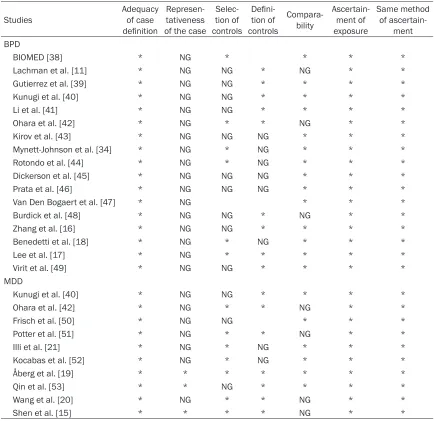
Table 1. Methodological quality of included studies according to the newcastle-ottawa scale
Studies Adequacy of case
definition
Represen-tativeness of the case
Selec-tion of controls
Defini -tion of controls
Compara-bility
Ascertain-ment of exposure
Same method of
ascertain-ment BPD
BIOMED [38] * NG * * * *
Lachman et al. [11] * NG NG * NG * *
Gutierrez et al. [39] * NG NG * * * *
Kunugi et al. [40] * NG NG * * * *
Li et al. [41] * NG NG * * * *
Ohara et al. [42] * NG * * NG * *
Kirov et al. [43] * NG NG NG * * *
Mynett-Johnson et al. [34] * NG * NG * * *
Rotondo et al. [44] * NG * NG * * *
Dickerson et al. [45] * NG NG NG * * *
Prata et al. [46] * NG NG NG * * *
Van Den Bogaert et al. [47] * NG * * *
Burdick et al. [48] * NG NG * NG * *
Zhang et al. [16] * NG NG * * * *
Benedetti et al. [18] * NG * NG * * *
Lee et al. [17] * NG * * * * *
Virit et al. [49] * NG NG * * * *
MDD
Kunugi et al. [40] * NG NG * * * *
Ohara et al. [42] * NG * * NG * *
Frisch et al. [50] * NG NG * * *
Potter et al. [51] * NG * * NG * *
Illi et al. [21] * NG * NG * * *
Kocabas et al. [52] * NG * NG * * *
Åberg et al. [19] * * * * * * *
Qin et al. [53] * * NG * * * *
Wang et al. [20] * NG * * NG * *
Shen et al. [15] * * * * NG * *
*: Given; NG: Not given.
widely studied. This polymorphism is due to the mutation of nucleotide G to A at codon 158 of this gene, which results in the substitution of amino acid valine to methionine [11]. This mutation impairs the functional ability of the enzyme to catabolize dopamine [12]. To date, rs4680 has been the most extensively studied variant within this gene. Nevertheless, some studies have also highlighted the role of other variants within the COMT gene in modulating the functional ability of this enzyme or its expression in the brain [13, 14].
In the past few years, a number of studies have investigated the association of COMT polymor-phisms with depression and BPD [15, 16]. A
meta-analysis study carried out by Zhang and
his colleagues revealed a significant associa
-tion between rs4680 and BPD [16]. However, they only included studies up to 2008 and did not consider relevant articles published in Chinese databases. Since 2008, some new studies that evaluated the association of COMT rs4680 polymorphism with BPD have been published; and these studies analyzed an addi-tional 1,301 subjects (773 cases and 528 con-trols) [17, 18]. Surprisingly, some of these stud-ies did not show a positive association between COMT rs4680 polymorphism and BPD [17].
Thus, these conflicting reports and lack of addi
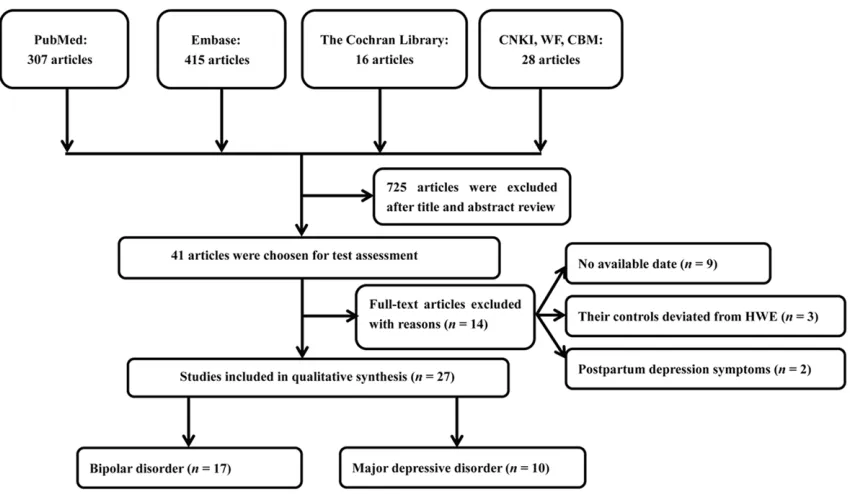
investi-Figure 1. Flowchart depicting the detailed screening process for identifying studies.
gate whether the association between COMT
rs4680 polymorphism and BPD remains signifi
-cant. In the present study, we performed a meta-analysis of all studies published from 1997 to November 2014 to validate the asso-ciation between COMT rs4680 polymorphism and BPD. These data were further analyzed on the basis of ethnicity, gender, BPD type and
first episode of BPD.
Similarly, COMT rs4680 polymorphism has also been linked as a predisposing factor for MDD.
However, results were again conflicting and
inconclusive. Some studies reported a signifi
-cant association between COMT rs4680 poly-morphism and MDD risk [15, 19], while other
studies did not find any significant difference in
allele or genotype frequency for COMT rs4680 polymorphism [20, 21]. The inconsistency in
these published findings could be due to differ
-ent factors such as: (a) differ-ent ethnicities of the studied populations, or (b) quality and sta-tistical power of these primary studies. Since there has been neither a systematic review nor meta-analysis on the association between COMT rs4680 polymorphism and MDD, we per-formed a systematic review and a meta-analy-sis of all available studies that suggested an association between COMT rs4680 gene poly-morphism and MDD.
Materials and methods Search strategy
Articles regarding the association between COMT rs4680 polymorphism and MD risk were searched up to November 8, 2014 in the follow-ing databases: Medline by PubMed, Embase by Ovid, The Cochrane Library, China National Knowledge Infrastructure (CNKI), Wangfang and CBM. The following keywords were used for the search: MD or depression or mood disorder or affective disorder or depressive disorder or bipolar disorder or unipolar disorder or manic or major depressive disorders or major depres-sion and COMT or catechol-O-methyl transfer-ase or rs4680 or Val158Met and polymorphism or polymorphisms or SNP or variation. In order to identify relevant publications, cross-refer-ences of the searched articles were also screened.
Inclusion and exclusion criteria
[image:3.612.95.523.71.318.2]control subjects satisfy the Hardy-Weinberg equilibrium (HWE). Moreover, all relevant stud-ies published in English or Chinese languages were included. Studies were excluded based on the following: (a) studies that were only abstracts, comments, reviews, or an editorial
article; (b) studies that have no sufficient data;
and (c) MD patients in the study have both alcohol-dependent and post-traumatic stress disorders.
The quality of included studies was assessed using the Newcastle-Ottawa Scale (Table 1) for case-control studies [22]. The quality of non-randomized studies was assessed based on three broad categories: (1) patient selection, (2) comparability of study groups, and (3) assess-ment of outcome.
Data were analyzed using STATA software ver-sion 12.0 (Stata Corp, College Station, TX,
USA). Results of the meta-analysis are ex-
pressed as odds ratios (ORs) with 95% confi
-dence interval (CI). Begg’s funnel plot, Egger’s test and sensitivity analysis were calculated to assess for publication bias and the stability of this meta-analysis study.
Results
Study characteristics
A total of 766 studies were initially identified
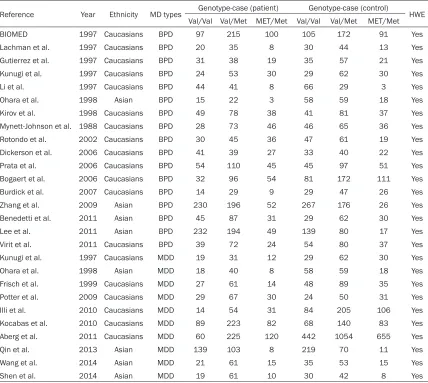
based on the search criteria. Among these studies, 41 studies were selected for more detailed evaluation after screening the ab- stracts. Full-text review led to the exclusion of 14 studies due to the following reasons: nine studies lack the required data based on inclu-sion criteria [23-30]; three studies had their controls deviated from HWE (P<0.05) [31]; and two studies were related to postpartum depres-Table 2. Study characteristics included in meta-analysis
Reference Year Ethnicity MD types Genotype-case (patient) Genotype-case (control) HWE
Val/Val Val/Met MET/Met Val/Val Val/Met MET/Met
BIOMED 1997 Caucasians BPD 97 215 100 105 172 91 Yes
Lachman et al. 1997 Caucasians BPD 20 35 8 30 44 13 Yes
Gutierrez et al. 1997 Caucasians BPD 31 38 19 35 57 21 Yes
Kunugi et al. 1997 Caucasians BPD 24 53 30 29 62 30 Yes
Li et al. 1997 Caucasians BPD 44 41 8 66 29 3 Yes
Ohara et al. 1998 Asian BPD 15 22 3 58 59 18 Yes
Kirov et al. 1998 Caucasians BPD 49 78 38 41 81 37 Yes
Mynett-Johnson et al. 1988 Caucasians BPD 28 73 46 46 65 36 Yes
Rotondo et al. 2002 Caucasians BPD 30 45 36 47 61 19 Yes
Dickerson et al. 2006 Caucasians BPD 41 39 27 33 40 22 Yes
Prata et al. 2006 Caucasians BPD 54 110 45 45 97 51 Yes
Bogaert et al. 2006 Caucasians BPD 32 96 54 81 172 111 Yes
Burdick et al. 2007 Caucasians BPD 14 29 9 29 47 26 Yes
Zhang et al. 2009 Asian BPD 230 196 52 267 176 26 Yes
Benedetti et al. 2011 Asian BPD 45 87 31 29 62 30 Yes
Lee et al. 2011 Asian BPD 232 194 49 139 80 17 Yes
Virit et al. 2011 Caucasians BPD 39 72 24 54 80 37 Yes
Kunugi et al. 1997 Caucasians MDD 19 31 12 29 62 30 Yes
Ohara et al. 1998 Asian MDD 18 40 8 58 59 18 Yes
Frisch et al. 1999 Caucasians MDD 27 61 14 48 89 35 Yes
Potter et al. 2009 Caucasians MDD 29 67 30 24 50 31 Yes
Illi et al. 2010 Caucasians MDD 14 54 31 84 205 106 Yes
Kocabas et al. 2010 Caucasians MDD 89 223 82 68 140 83 Yes
Aberg et al. 2011 Caucasians MDD 60 225 120 442 1054 655 Yes
Qin et al. 2013 Asian MDD 139 103 8 219 70 11 Yes
Wang et al. 2014 Asian MDD 21 61 15 35 53 15 Yes
[image:4.612.93.521.84.467.2]sion symptom susceptibility [32, 33]. The com-plete screening process is shown in Figure 1. Finally, 27 case-control studies were selected for further analysis (BPD, n=17; and MDD, n=10). All included patients and healthy con-trols were either Caucasians or Asians (Table 2).
Quantitative data synthesis
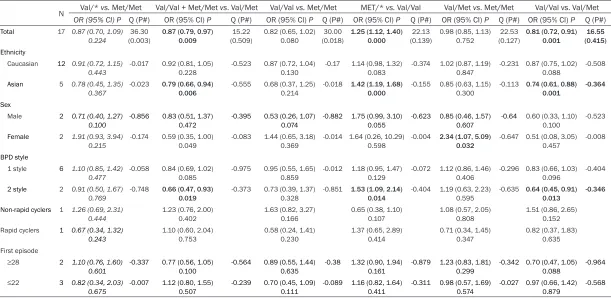
Meta-analysis results of the association be- tween COMT Val158Met polymorphism and MD are presented in Tables 3 and 4. A random-effects model was applied for analysis when heterogeneity between different studies was
significant (P-value of Q-test for heterogeneity,
P≤0.1); otherwise, a fixed-effects model was
used [32, 33].
Analysis of the association of COMT polymor-phism with bipolar disorder
Seventeen independent studies with 3,027 BPD patients and 3,108 healthy controls were included in this meta-analysis. The following genotypes of the COMT Val158Met gene re-
vealed an overall significant (P<0.05)
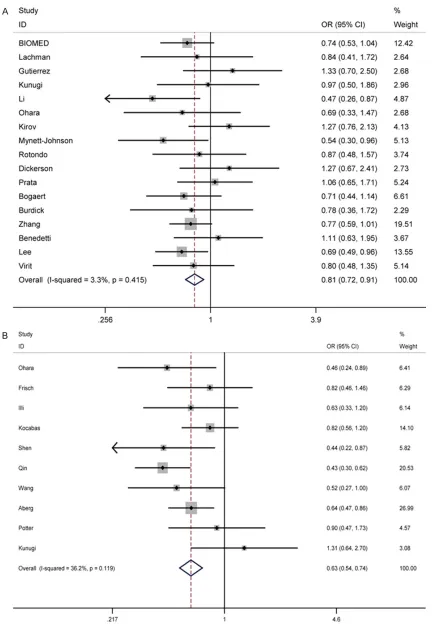
associa-tion with BPD: (a) Val/Val + Met/Met geno- type vs. Val/Met genotype, OR=0.87, 95% CI (0.79, 0.97) P=0.009, P#=0.509, Table 3; (b) MET allele carriers vs. Val/Val genotype, OR= 1.25, 95% CI (1.12, 1.40) P<0.001, P#= 0.139, Table 3; (c) Val/Val genotype vs. Val/ Met genotype, OR=0.81, 95% CI (0.72, 0.91) P=0.001, P#=0.415, Figure 2A and Table 3.
Similarly, stratified analysis based on ethnicity
(Table 3) also revealed that the same geno-types of the COMT Val158Met gene were
sig-nificantly associated with BPD risk in the Asian
population (Val/Val + Met/Met genotype vs. Val/Met genotype, OR=0.79, 95% CI [0.66, 0.94] P=0.006, P#=0.555; MET allele carriers vs. Val/Val genotype, OR=1.42, 95% CI [1.19, 1.68] P<0.001, P#=0.155; Val/Val genotype vs. Val/Met genotype, OR=0.74, 95% CI [0.61, 0.88], P=0.001, P#=0.364). However, the trend in the association of COMT Val158- Met polymorphism with BPD was not consis-tent in the Caucasian population. Moreover,
some stratified analyses of other subgroups have also revealed significant associations. For
example, female patients usually have a high- er proportion of association with Val/Met ge- notype vs. Met/Met genotype (OR=2.34, 95% CI [1.07, 5.09] P=0.032, P#=0.647), while patients with type 2 BPD have a higher pro-
portion of the Val/Met genotype compared with the Val/Val genotype (OR=0.64, 95% CI [0.45, 0.91] P=0.013, P#=0.346), as shown in Table 3. The following genotypes of the COMT
Val158Met gene revealed a significantly high
heterogeneity in the overall analysis: Val allele carrier vs. Met/Met genotype and Val/Val geno-type vs. Met/Met genotype.
Analysis of the association of COMT polymor-phism with major depressive disorder
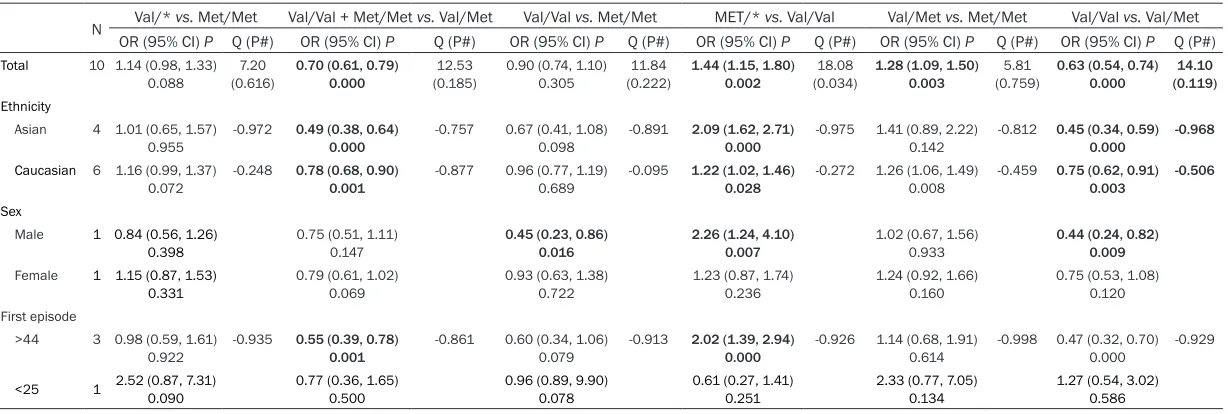
Ten independent studies representing 1,692 MDD patients and 3,853 healthy controls were part of this meta-analysis. MDD revealed a
sig-nificant (P<0.05) association (Table 4) with the
following genotypes of the COMT Val158Met gene: (a) Val/Val + Met/Met genotype vs. Val/ Met genotype, OR=0.70, 95% CI (0.61, 0.79) P<0.001, P#=0.185; (b) Met allele carrier vs. Val/Val genotype, OR=1.44, 95% CI (1.15, 1.80) P=0.002, P#=0.034; (c) Val/Met geno-type vs. Met/Met genotype, OR=1.28, 95% CI (1.09, 1.50) P=0.003, P#=0.759; (d) Val/Val genotype vs. Val/Met genotype, OR=0.63, 95% CI (0.54, 0.74) P<0.001, P#=0.119 (Figure 2B).
Similarly, stratified analysis based on ethnicity also revealed a significant association between
COMT Val158Met polymorphism and MDD risk in both Asian (Val/Val + Met/Met genotype vs. Val/Met genotype, OR=0.49, 95% CI (0.38, 0.64) P<0.001, P#=0.757; MET allele carrier vs. Val/Val genotype, OR=2.09, 95% CI (1.62, 2.71) P<0.001, P#=0.975; Val/Val genotype vs. Val/Met genotype, OR=0.45, 95% CI (0.34, 0.59) P<0.001, P#=0.968) and Caucasian (Val/Val + Met/Met genotype vs. Val/Met geno-type, OR=0.78, 95% CI (0.68, 0.90) P=0.001, P#=0.877; MET allele carrier vs. Val/Val geno-type, OR=1.22, 95% CI (1.02, 1.46) P=0.028, P#=0.272; Val/Met genotype vs. Met/Met genotype, OR=1.26, 95% CI (1.06, 1.49) P=0.008, P#=0.459; Val/Val genotype vs. Val/ Met genotype, OR=0.75, 95% CI (0.62, 0.91) P=0.003, P#=0.506) populations. In addition,
the stratified analysis of other subgroups also revealed a significant association between
geno-Table 3. Meta-analysis results of different Val158Met genotypes and BPD
N Val/* vs. Met/Met Val/Val + Met/Met vs. Val/Met Val/Val vs. Met/Met MET/* vs. Val/Val Val/Met vs. Met/Met Val/Val vs. Val/Met OR (95% CI) P Q (P#) OR (95% CI) P Q (P#) OR (95% CI) P Q (P#) OR (95% CI) P Q (P#) OR (95% CI) P Q (P#) OR (95% CI) P Q (P#)
Total 17 0.87 (0.70, 1.09)
0.224 (0.003)36.30 0.87 (0.79, 0.97) 0.009 (0.509)15.22 0.82 (0.65, 1.02) 0.080 (0.018)30.00 1.25 (1.12, 1.40) 0.000 (0.139)22.13 0.98 (0.85, 1.13) 0.752 (0.127)22.53 0.81 (0.72, 0.91) 0.001 (0.415)16.55
Ethnicity
Caucasian 12 0.91 (0.72, 1.15)
0.443 -0.017 0.92 (0.81, 1.05) 0.228 -0.523 0.87 (0.72, 1.04) 0.130 -0.17 1.14 (0.98, 1.32) 0.083 -0.374 1.02 (0.87, 1.19) 0.847 -0.231 0.87 (0.75, 1.02) 0.088 -0.508 Asian 5 0.78 (0.45, 1.35)
0.367 -0.023 0.79 (0.66, 0.94) 0.006 -0.555 0.68 (0.37, 1.25) 0.214 -0.018 1.42 (1.19, 1.68) 0.000 -0.155 0.85 (0.63, 1.15) 0.300 -0.113 0.74 (0.61, 0.88) 0.001 -0.364
Sex
Male 2 0.71 (0.40, 1.27)
0.100 -0.856 0.83 (0.51, 1.37) 0.472 -0.395 0.53 (0.26, 1.07) 0.074 -0.882 1.75 (0.99, 3.10) 0.055 -0.623 0.85 (0.46, 1.57) 0.607 -0.64 0.60 (0.33, 1.10) 0.100 -0.523 Female 2 1.91 (0.93, 3.94)
0.215
-0.174 0.59 (0.35, 1.00) 0.049
-0.083 1.44 (0.65, 3.18) 0.369
-0.014 1.64 (0.26, 10.29) 0.598
-0.004 2.34 (1.07, 5.09) 0.032
-0.647 0.51 (0.08, 3.05) 0.457
-0.008 BPD style
1 style 6 1.10 (0.85, 1.42) 0.477
-0.058 0.84 (0.69, 1.02) 0.085
-0.975 0.95 (0.55, 1.65) 0.859
-0.012 1.18 (0.95, 1.47) 0.129
-0.072 1.12 (0.86, 1.46) 0.406
-0.296 0.83 (0.66, 1.03) 0.096
-0.404 2 style 2 0.91 (0.50, 1.67)
0.769
-0.748 0.66 (0.47, 0.93) 0.019
-0.373 0.73 (0.39, 1.37) 0.328
-0.851 1.53 (1.09, 2.14) 0.014
-0.404 1.19 (0.63, 2.23) 0.595
-0.635 0.64 (0.45, 0.91) 0.013
-0.346
Non-rapid cyclers 1 1.26 (0.69, 2.31)
0.444 1.23 (0.76, 2.00) 0.402 1.63 (0.82, 3.27) 0.166 0.65 (0.38, 1.10) 0.107 1.08 (0.57, 2.05) 0.808 1.51 (0.86, 2.65) 0.152
Rapid cyclers 1 0.67 (0.34, 1.32)
0.243 1.10 (0.60, 2.04) 0.753 0.58 (0.24, 1.41) 0.230 1.37 (0.65, 2.89) 0.414 0.71 (0.34, 1.45) 0.347 0.82 (0.37, 1.83) 0.635 First episode
≥28 2 1.10 (0.76, 1.60)
0.601 -0.337 0.77 (0.56, 1.05) 0.100 -0.564 0.89 (0.55, 1.44) 0.635 -0.38 1.32 (0.90, 1.94) 0.161 -0.879 1.23 (0.83, 1.81) 0.299 -0.342 0.70 (0.47, 1.05) 0.088 -0.964
≤22 3 0.82 (0.34, 2.03)
0.675
-0.007 1.12 (0.80, 1.55) 0.507
-0.239 0.70 (0.45, 1.09) 0.111
-0.089 1.16 (0.82, 1.64) 0.411
-0.311 0.98 (0.57, 1.69) 0.574
-0.027 0.97 (0.66, 1.42) 0.879
-0.568
[image:6.792.91.702.84.382.2]Table 4. Meta-analysis results for different genotypes of Val158Met and MDD
N Val/* vs. Met/Met Val/Val + Met/Met vs. Val/Met Val/Val vs. Met/Met MET/* vs. Val/Val Val/Met vs. Met/Met Val/Val vs. Val/Met OR (95% CI) P Q (P#) OR (95% CI) P Q (P#) OR (95% CI) P Q (P#) OR (95% CI) P Q (P#) OR (95% CI) P Q (P#) OR (95% CI) P Q (P#)
Total 10 1.14 (0.98, 1.33)
0.088 (0.616)7.20 0.70 (0.61, 0.79) 0.000 (0.185)12.53 0.90 (0.74, 1.10) 0.305 (0.222)11.84 1.44 (1.15, 1.80) 0.002 (0.034)18.08 1.28 (1.09, 1.50) 0.003 (0.759)5.81 0.63 (0.54, 0.74) 0.000 (0.119)14.10
Ethnicity
Asian 4 1.01 (0.65, 1.57)
0.955 -0.972 0.49 (0.38, 0.64) 0.000 -0.757 0.67 (0.41, 1.08) 0.098 -0.891 2.09 (1.62, 2.71) 0.000 -0.975 1.41 (0.89, 2.22) 0.142 -0.812 0.45 (0.34, 0.59) 0.000 -0.968
Caucasian 6 1.16 (0.99, 1.37)
0.072 -0.248 0.78 (0.68, 0.90) 0.001 -0.877 0.96 (0.77, 1.19) 0.689 -0.095 1.22 (1.02, 1.46) 0.028 -0.272 1.26 (1.06, 1.49) 0.008 -0.459 0.75 (0.62, 0.91) 0.003 -0.506
Sex
Male 1 0.84 (0.56, 1.26)
0.398 0.75 (0.51, 1.11) 0.147 0.45 (0.23, 0.86) 0.016 2.26 (1.24, 4.10) 0.007 1.02 (0.67, 1.56) 0.933 0.44 (0.24, 0.82) 0.009
Female 1 1.15 (0.87, 1.53) 0.331
0.79 (0.61, 1.02) 0.069
0.93 (0.63, 1.38) 0.722
1.23 (0.87, 1.74) 0.236
1.24 (0.92, 1.66) 0.160
0.75 (0.53, 1.08) 0.120 First episode
>44 3 0.98 (0.59, 1.61) 0.922
-0.935 0.55 (0.39, 0.78) 0.001
-0.861 0.60 (0.34, 1.06) 0.079
-0.913 2.02 (1.39, 2.94) 0.000
-0.926 1.14 (0.68, 1.91) 0.614
-0.998 0.47 (0.32, 0.70) 0.000
-0.929
<25 1 2.52 (0.87, 7.31) 0.090 0.77 (0.36, 1.65) 0.500 0.96 (0.89, 9.90) 0.078 0.61 (0.27, 1.41) 0.251 2.33 (0.77, 7.05) 0.134 1.27 (0.54, 3.02) 0.586
type, OR=0.44, 95% CI (0.24 0.82) P=0.009.
Similarly, the first episode subgroup was asso
-ciated with both the “>44” age group (Val/Val genotype + Met/Met genotype vs. Val/Met gen-otype, OR=0.55, 95% CI [0.39, 0.78] P=0.001, P#=0.861; MET allele carrier vs. Val/Val geno-type, OR=2.02, 95% CI [1.39, 2.94] P<0.001, P#=0.926; Val/Val genotype vs. Val/Met geno-type, OR=0.47, 95% CI [0.32, 0.70], P#=0.929) and “<25” age group (Val/Val genotype vs. Met/Met genotype, OR=0.96, 95% CI [0.89, 9.90] P<0.001, P#=0.929). The overall analy-sis revealed high heterogeneity in the Val/Val
Q-test for heterogeneity: P#<0.1). All data pre-sented above are shown in Table 4.
Heterogeneity analysis
Significant heterogeneity was observed in the
overall pooled analysis; whereas, the degree of
heterogeneity in the stratified analysis was less
as shown in Tables 3 and 4.
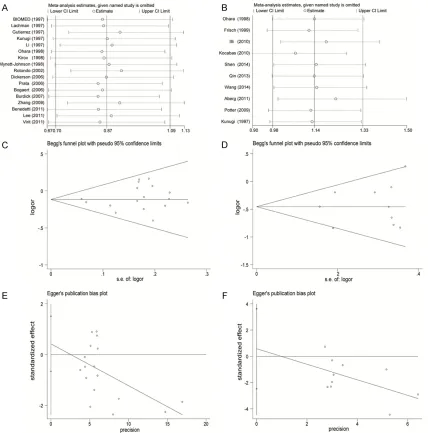
[image:9.612.95.523.73.506.2]recalculating the ORs and 95% CIs. Overall, pooled estimates were minimally altered each time a single study was removed, as shown in Figure 3A and 3B; suggesting the stability of the results in both the BPD and MDD groups. In order to assess publication bias in this analy-sis, Begg’s funnel plot and Egger’s test were performed. No evidence of publication bias was observed, as shown in Figure 3C-F. The values of each test were as follows: (1) BPD: Begg’s test P=0.650, Egger’s test P=0.323; (2) MDD: Begg’s test P=0.858, Egger’s test P=0.673. Discussion
COMT rs4680 polymorphism is due to the mutation of amino acid valine to methionine at codon 158 of the COMT gene, which causes a difference in the functional ability of this enzyme to catabolize dopamine. Some studies have shown that Met allele carriers increase the risk of MD [11]. In contrast, few studies did not show a positive association between COMT rs4680 polymorphism and MD.
Therefore, based on these case-control stud-ies, we made an effort to identify whether an association between the COMT gene and MD exists. This study was conducted with a ratio-nale that the presence of a single Met allele in the COMT Val158Met gene could elevate the risk of MD. These analyzed studies represented high heterogeneity, which could be attributed to study design, location, quality and psychiat-ric diagnostic criteria. Data were analyzed by random effects model due to high heterogene-ity in some genotypes among the included studies.
The meta-analysis results of BPD cases involv-ing 3,027 BPD patients and 3,108 healthy con-trols revealed that the proportion of rs4680 Met allele carriers are higher in BPD patients compared to healthy individuals. Furthermore, the Val/Met genotype had a more statistically
significant association with BPD in the total
population. These observations were
consis-tent with the findings of Zhang et al., [16], Lee
et al., [17] and Mynett-Johnson et al., [34]; in which, they all reported that Val158Met
poly-morphism of the COMT gene influences its sus
-ceptibility to BPD. However, it is worth mention-ing that different subgroups have shown differ-ent levels of association. In Caucasians, no
significant association was found between BPD
and Val158Met polymorphism of the COMT gene (P>0.05). However, Met allele carriers do appear to be closely associated with BPD in the Asian group; which means that a high propor-tion of these Asian patients are Met allele
carri-ers. Since this association is statistically signifi -cant in the overall population (P<0.05), this indicates that these overall results were mainly derived from the Asian population. The differ-ence of association based on ethnicity could be attributed to the following reasons: (1) diverse genetic composition between ethnic popula-tions; (2) different environmental factors and lifestyle backgrounds; and (3) although there was no evidence of publication bias in this study, we could not ignore the fact that studies with negative results are harder to be pub-lished. Furthermore, the assessment of the
association of rs4680 with BPD in stratified
subgroups involving gender and BPD revealed that female patients had a higher proportion of the Val/Met genotype compared to the Met/ Met genotype; and patients with type 2 BPD had a higher proportion of the Val/Met geno-type compared with the Val/Val genogeno-type. These results illustrate that the Val/Met geno-type is closely correlated with BPD in certain subgroups. However, this subgroup analysis has some limitations: (a) the number of articles in this study was not large enough, which may lead to unstable results; and (b) the different
subgroups could not be further classified based
on their ethnicity.
Interestingly, this is the first meta-analysis
study that assessed the association of COMT Val158Met polymorphism with MDD. This anal-ysis included 10 independent samples with
1,692 MDD patients, and we observed a signifi
-cant association between MDD and the Val158Met COMT gene with several different genotypes. Overall results suggest that Met allele carriers such as “MET/* vs. Val/Val”, “Val/Val vs. Val/Met” and “Val/Met vs. Met/ Met” increased the risk of MDD; but not Val/Val genotype vs. Met/Met genotype. A super domi-nance model (Val/Val genotype + Met/Met genotype vs. Val/Met genotype) analysis also revealed similar results. Furthermore, a sub-group analysis of both Asians and Caucasians also suggest a trend similar to the total popula-tion. Surprisingly, only male MDD patients had a higher proportion of Met allele carriers,
com-pared with the Val/Val genotype. In the first epi
proportion of Met allele carriers and the Val/ Met genotype in MDD patients over the Val/Val genotype. However, in the “<25” group, the pro-portion of Met/Met genotype was higher than the Val/Val genotype; but the Val/Met genotype did not show any association with MDD. Again, this subgroup analysis had a disadvantage of having a small sample size. Therefore, to effec-tively understand this association in different subgroups, a larger sample size would be required.
Based on these two different meta-analyses, we conclude that Met allele carriers obviously had a higher risk of BPD and MDD in some sub-groups due to the altered regulation of dopa-mine (DA) levels. Bousman et al., [35], suggest-ed that subjects homozygous for APS haplotype (which contains Met at rs4680) had the lowest COMT activity, while subjects with two copies of LPS or HPS (which contain Val at rs4680) had the highest activity. This suggests that Met allele carriers could increase the risk of MD [11].
Another probable explanation of the increased risk of MD with the Val/Met genotype could be anti-heterosis. Heterosis occurs when subjects heterozygous for an allele have a different phe-notype from homozygotes. This concept was originally applied to crop genetics in the context of hybrid vigor; however, at present, heterosis is increasingly being recognized in humans [36, 37]. There have been studies that linked heter-osis to COMT gene Val158Met polymorphism,
where heterozygous alleles have a significant
advantage against schizophrenia aggression. It is worth mentioning that the meta-analysis results of this study were different, since
het-erozygotes have a significant anti-heterosis
advantage in BPD and MDD.
In parallel, some potential limitations of the included data sets in this study should be con-sidered before making any concrete judgment on the overall relevance of the current study. First, gene-gene and gene-environment inter-action could not be analyzed due to the unavail-ability of relevant data. Second, populations included in this meta-analysis were primarily comprised of Asians and Caucasians. Lack of data from other ethnic groups may mislead the
overall findings. Third, the study scale in some
subgroups of the present meta-analysis was not large enough such as gender, different
dis-ease subtypes and age. Fourth, our study only included English and Chinese articles. Despite these limitations, all studies included in this meta-analysis clearly met our selection criteria. Genetic model comparisons were used to eval-uate MD risk with COMT rs4680 polymorphism. Furthermore, subgroups analysis based on eth-nicity, MD type and study scale provided better knowledge on COMT rs4680 polymorphism and MD risk.
In summary, our study confirms that COMT
rs4680Met allele carriers increase the risk of
MD, which is consistent with previous findings.
However, some subgroups did not show similar patterns; and this may be due to the small sam-ple size. Analyzing data from other ethnic groups with a larger sample size would be
nec-essary to establish a final concrete statement
on COMT rs4680 polymorphism and MD risk. Acknowledgements
This study was supported by the National Natural Science Foundation of China (8116- 0361, Junduan Wu).
Disclosure of conflict of interest None.
Address correspondence to: Li Yang, School of Pub- lic Health, Guangxi Medical University, 22 Shuang- yong Road, Nanning 530000, China. Tel: +86-13517811879; Fax: +86-021-64085875; E-mail: [email protected]
References
[1] Murray CJ and Lopez AD. Evidence-based health policy-lessons from the global burden of disease study. Science 1996; 274: 740-743. [2] Lee S, Jeong J, Kwak Y and Park SK.
Depres-sion research: where are we now? Mol Brain 2010; 3: 8.
[3] Murray CJ and Lopez AD. Alternative projec-tions of mortality and disability by cause 1990-2020: global burden of disease study. Lancet 1997; 349: 1498-1504.
chal-lenges in global mental health. Nature 2011; 475: 27-30.
[5] Lapidus KA, Soleimani L and Murrough JW. Novel glutamatergic drugs for the treatment of mood disorders. Neuropsychiatr Dis Treat 2013; 9: 1101-1112.
[6] Sullivan PF, Neale MC and Kendler KS. Genetic epidemiology of major depression: review and meta-analysis. Am J Psychiatry 2000; 157: 1552-1562.
[7] Kieseppa T, Partonen T, Haukka J, Kaprio J and Lonnqvist J. High concordance of bipolar I dis-order in a nationwide sample of twins. Am J Psychiatry 2004; 161: 1814-1821.
[8] Huang CC, Chang YH, Lee SY, Chen SL, Chen SH, Chu CH, Huang SY, Tzeng NS, Lee IH and Yeh TL. The interaction between BDNF and DRD2 in bipolar II disorder but not in bipolar I disorder. Am J Med Genet B Neuropsychiatr Genet 2012; 159: 501-507.
[9] Brahe C, Bannetta P, Meera Khan P, Arwert F and Serra A. Assignment of the catechol-O-methyltransferase gene to human chromo-some 22 in somatic cell hybrids. Hum Genet 1986; 74: 230-234.
[10] Grossman MH, Emanuel BS and Budarf ML. Chromosomal mapping of the human
cate-chol-O-methyltransferase gene to 22q11.1→
q11.2. Genomics 1992; 12: 822-825.
[11] Lachman HM, Papolos DF, Saito T, Yu YM, Szumlanski CL and Weinshilboum RM. Human catechol-O-methyltransferase pharmacogenet-ics: description of a functional polymorphism and its potential application to neuropsychiat-ric disorders. Pharmacogenetics 1996; 6: 243-250.
[12] Weinshilboum RM and Raymond FA. Inheri- tance of low erythrocyte catechol-o-methyl-transferase activity in man. Am J Hum Genet 1977; 29: 125-135.
[13] Hirata H, Hinoda Y, Okayama N, Suehiro Y, Kawamoto K, Kikuno N, Rabban JT, Chen LM and Dahiya R. COMT polymorphisms affecting protein expression are risk factors for endome-trial cancer. Mol Carcinog 2008; 47: 768-774. [14] Hong JP, Lee JS, Chung S, Jung J, Yoo HK,
Chang SM and Kim CY. New functional single nucleotide polymorphism (Ala72Ser) in the COMT gene is associated with aggressive be-havior in male schizophrenia. Am J Med Genet B Neuropsychiatr Genet 2008; 147B: 658-660.
[15] Shen X, Wu Y, Guan T, Wang X, Qian M, Lin M, Shen Z, Sun J, Zhong H, Yang J, Li L and Yuan Y. Association analysis of COMT/MTHFR poly-morphisms and major depressive disorder in Chinese Han population. J Affect Disord 2014; 161: 73-78.
[16] Zhang Z, Lindpaintner K, Che R, He Z, Wang P, Yang P, Feng G, He L and Shi Y. The Val/Met
functional polymorphism in COMT confers sus-ceptibility to bipolar disorder: evidence from an association study and a meta-analysis. J Neu-ral Transm 2009; 116: 1193-1200.
[17] Lee SY, Chen SL, Chen SH, Huang SY, Tzeng NS, Chang YH, Wang CL, Lee IH, Yeh TL, Yang YK and Lu RB. The COMT and DRD3 genes in-teracted in bipolar I but not bipolar II disorder. World J Biol Psychiatry 2011; 12: 385-391. [18] Benedetti F, Dallaspezia S, Locatelli C,
Radae-lli D, Poletti S, Lorenzi C, Pirovano A, Colombo C and Smeraldi E. Recurrence of bipolar mania is associated with catechol-O-methyltransfer-ase Val (108/158) Met polymorphism. J Affect Disord 2011; 132: 293-296.
[19] Åberg E, Fandiño-Losada A, Sjöholm LK, For-sell Y and Lavebratt C. The functional Val 158 Met polymorphism in catechol-O-methyltrans-ferase (COMT) is associated with depression and motivation in men from a Swedish popula-tion-based study. J Affect Disord 2011; 129: 158-166.
[20] Wang X, Wang Z, Wu Y, Yuan Y, Hou Z and Hou G. Association analysis of the catechol-O-meth-yltransferase /methylenetetrahydrofolate re-ductase genes and cognition in late-onset de-pression. Psychiatry Clin Neurosci 2014; 68: 344-352.
[21] Illi A, Setala-Soikkeli E, Kampman O, Viikki M, Nuolivirta T, Poutanen O, Huhtala H, Mononen N, Lehtimaki T and Leinonen E. Catechol-O-methyltransferase val108/158met genotype, major depressive disorder and response to se-lective serotonin reuptake inhibitors in major depressive disorder. Psychiatry Res 2010; 176: 85-87.
[22] Stang A. Critical evaluation of the Newcastle-Ottawa scale for the assessment of the quality of nonrandomized studies in meta-analyses. Eur J Epidemiol 2010; 25: 603-605.
[23] Massat I, Souery D, Del-Favero J, Nothen M, Blackwood D, Muir W, Kaneva R, Serretti A, Lo-renzi C, Rietschel M, Milanova V, Papadimitri-ou GN, Dikeos D, Van Broekhoven C and Men-dlewicz J. Association between COMT (Val158- Met) functional polymorphism and early onset in patients with major depressive disorder in a European multicenter genetic association study. Mol Psychiatry 2005; 10: 598-605. [24] Walshe M, Vassos E, Picchioni M, Shaikh M,
Toulopoulou T, Collier D, McDonald C, Murray R and Bramon E. The Association between COMT, BDNF, and NRG1 and premorbid social functioning in patients with psychosis, their
relatives, and controls. Scientifica (Cairo)
2012; 2012: 560514.
schizophre-nia and bipolar disorder versus controls. Schizophr Res 2010; 122: 31-37.
[26] Dutt A, McDonald C, Dempster E, Prata D, Shaikh M, Williams I, Schulze K, Marshall N, Walshe M, Allin M, Collier D, Murray R and Bra-mon E. The effect of COMT, BDNF, 5-HTT, NRG1 and DTNBP1 genes on hippocampal and later-al ventricular volume in psychosis. Psychol Med 2009; 39: 1783-1797.
[27] Abdolmaleky HM, Cheng KH, Faraone SV, Wil-cox M, Glatt SJ, Gao F, Smith CL, Shafa R, Aeali B and Carnevale J. Hypomethylation of MB-COMT promoter is a major risk factor for schizophrenia and bipolar disorder. Hum Mol Genet 2006; 15: 3132-3145.
[28] Serretti A, Cusin C, Cristina S, Lorenzi C, Lilli R, Lattuada E, Grieco G, Costa A, Santorelli F, Barale F, Smeraldi E and Nappi G. Multicentre Italian family-based association study on tyro-sine hydroxylase, catechol-O-methyl transfer-ase and Wolfram syndrome 1 polymorphisms in mood disorders. Psychiatr Genet 2003; 13: 121-126.
[29] Seok JH, Choi S, Lim HK, Lee SH, Kim I and Ham BJ. Effect of the COMT val158met poly-morphism on white matter connectivity in pa-tients with major depressive disorder. Neuro-sci Lett 2013; 545: 35-39.
[30] Papolos D, Veit S, Faedda G, Saito T and Lach-man H. Ultra-ultra rapid cycling bipolar disor-der is associated with the low activity catechol-amine-O-methyltransferase allele. Mol Psychi- atry 1998; 3: 346-349.
[31] Shifman S, Bronstein M, Sternfeld M, Pisante A, Weizman A, Reznik I, Spivak B, Grisaru N, Karp L, Schiffer R, Kotler M, Strous RD, Swartz-Vanetik M, Knobler HY, Shinar E, Yakir B, Zak NB and Darvasi A. COMT: a common suscepti-bility gene in bipolar disorder and schizophre-nia. Am J Med Genet B Neuropsychiatr Genet 2004; 128B: 61-64.
[32] Alvim-Soares A, Miranda D, Campos SB, Figueira P, Romano-Silva MA and Correa H. Postpartum depression symptoms associated with Val158Met COMT polymorphism. Arch Womens Ment Health 2013; 16: 339-340. [33] Comasco E, Sylven SM, Papadopoulos FC,
Sundstrom-Poromaa I, Oreland L and Skalki-dou A. Postpartum depression symptoms: a case-control study on monoaminergic func-tional polymorphisms and environmental stressors. Psychiatr Genet 2011; 21: 19-28. [34] Mynett-Johnson L, Murphy V, Claffey E, Shields
D and McKeon P. Preliminary evidence of an association between bipolar disorder in fe-males and the catechol-O-methyltransferase gene. Psychiatr Genet 1998; 8: 221-225. [35] Bousman CA, Katalinic N, Martin DM, Smith
DJ, Ingram A, Dowling N, Ng C and Loo CK.
Ef-fects of COMT, DRD2, BDNF, and APOE
geno-typic variation on treatment efficacy and cogni -tive side effects of electroconvulsive therapy. J ECT 2015; 31: 129-35.
[36] Jones G, Zammit S, Norton N, Hamshere M, Jones S, Milham C, Sanders R, McCarthy G, Jones L and Cardno A. Aggressive behaviour in patients with schizophrenia is associated with catechol-O-methyltransferase genotype. Br J Psychiatry 2001; 179: 351-355.
[37] Zubieta JK, Heitzeg MM, Smith YR, Bueller JA, Xu K, Xu Y, Koeppe RA, Stohler CS and Gold-man D. COMT val158met genotype affects mu-opioid neurotransmitter responses to a pain stressor. Science 2003; 299: 1240-1243. [38] BIOMED. No association between bipolar
dis-order and alleles at a functional polymorphism in the COMT gene. Br J Psychiatry 1997; 170: 526-528.
[39] Gutierrez B, Bertranpetit J, Guillamat R, Valles V, Arranz MJ, Kerwin R and Fananas L. Associa-tion analysis of the catechol O-methyltransfer-ase gene and bipolar affective disorder. Am J Psychiatry 1997; 154: 113-115.
[40] Kunugi H, Vallada HP, Hoda F, Kirov G, Gill M, Aitchison KJ, Ball D, Arranz MJ, Murray RM and Collier DA. No evidence for an association of affective disorders with high-or low-activity al-lele of catechol-o-methyltransferase gene. Biol Psychiatry 1997; 42: 282-285.
[41] Li T, Vallada H, Curtis D, Arranz M, Xu K, Cai G, Deng H, Liu J, Murray R, Liu X and Collier DA. Catechol-O-methyltransferase Val158Met poly-morphism: frequency analysis in Han Chinese subjects and allelic association of the low ac-tivity allele with bipolar affective disorder. Pharmacogenetics 1997; 7: 349-353.
[42] Ohara K, Nagai M and Suzuki Y. Low activity allele of catechol-o-methyltransferase gene and Japanese unipolar depression. Neuro- report 1998; 9: 1305-1308.
[43] Kirov G, Murphy K, Arranz M, Jones I,
McCan-dles F, Kunugi H, Murray R, McGuffin P, Collier
D and Owen M. Low activity allele of catechol-O-methyltransferase gene associated with rapid cycling bipolar disorder. Mol Psychiatry 1998; 3: 342-345.
[44] Rotondo A, Mazzanti C, Dell’Osso L, Rucci P, Sullivan P, Bouanani S, Gonnelli C, Goldman D and Cassano GB. Catechol o-methyltransfer-ase, serotonin transporter, and tryptophan hy-droxylase gene polymorphisms in bipolar disor-der patients with and without comorbid panic disorder. Am J Psychiatry 2002; 159: 23-29. [45] Dickerson FB, Boronow JJ, Stallings C, Origoni
gene-environmental effects in a complex human psychiatric disorder. Bipolar Disord 2006; 8: 124-132.
[46] Prata DP, Breen G, Munro J, Sinclair M, Os-borne S, Li T, Kerwin R, Clair DS and Collier DA. Bipolar 1 disorder is not associated with the RGS4, PRODH, COMT and GRK3 genes. Psy-chiatr Genet 2006; 16: 229-230.
[47] Van Den Bogaert A, Sleegers K, De Zutter S, Heyrman L, Norrback KF, Adolfsson R, Van Broeckhoven C and Del-Favero J. No allelic as-sociation or interaction of three known func-tional polymorphisms with bipolar disorder in a northern Swedish isolated population. Psy- chiatr Genet 2006; 16: 209-212.
[48] Burdick KE, Funke B, Goldberg JF, Bates JA, Jaeger J, Kucherlapati R and Malhotra AK. COMT genotype increases risk for bipolar I
dis-order and influences neurocognitive perfor -mance. Bipolar Disord 2007; 9: 370-376. [49] Virit O, Erdal ME, Savas HA, Barlas IO, Yumru
M, Gokdogan T, Ozen ME and Herken H. Cate-chol-O-methyltransferase gene Val108/158- Met polymorphism in bipolar disorder. Neurol Psychiat Br 2011; 17: 46-50.
[50] Frisch A, Postilnick D, Rockah R, Michaelovsky E, Postilnick S, Birman E, Laor N, Rauchverger B, Kreinin A, Poyurovsky M, Schneidman M, Modai I and Weizman R. Association of unipo-lar major depressive disorder with genes of the serotonergic and dopaminergic pathways. Mol Psychiatry 1999; 4: 389-392.
[51] Potter GG, Taylor WD, McQuoid DR, Steffens DC, Welsh-Bohmer KA and Krishnan KR. The COMT Val158Met polymorphism and cognition in depressed and nondepressed older adults. Int J Geriatr Psychiatry 2009; 24: 1127-1133. [52] Kocabas NA, Faghel C, Barreto M, Kasper S,
Linotte S, Mendlewicz J, Noro M, Oswald P, Souery D, Zohar J and Massat I. The impact of catechol-O-methyltransferase SNPs and haplo-types on treatment response phenohaplo-types in major depressive disorder: a case-control as-sociation study. Int Clin Psychopharmacol 2010; 25: 218-227.