Nine-channel wavelength tunable single mode
laser array based on slots
Wei-Hua Guo,1,* Qiaoyin Lu,2, Marta Nawrocka,2, Azat Abdullaev,2, James O’Callaghan,3, and John F. Donegan2
1Department of Electrical & Computer Engineering, University of California Santa Barbara, CA 93106, USA 2School of Physics, Trinity College Dublin, Dublin 2, Ireland
3Tyndall National Institute, University College Cork, Ireland
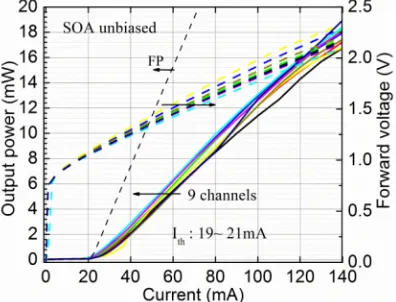
Abstract: A 9-channel wavelength tunable single-mode laser array based on slots is presented. The fabricated laser array demonstrated a threshold current in a range of 19~21 mA with the SOA unbiased at 20°C under continuous wave condition. Stable single mode performances have been observed with side-mode suppression-ratio (SMSR) > 50 dB. The output power higher than 37 mW was obtained at the SOA injected current of 70 mA for all the 9 channels within the laser array. A wavelength quasi-continuous tuning range of about 27 nm has been achieved for the laser array with the temperature variations from 10°C to 45°C. This array platform is of a single growth and monolithically integrable. It can be easily fabricated by standard photolithography. In addition, it potentially removes the yield problem due to the uncertainty of the facet cleaving.
©2013 Optical Society of America
OCIS codes: (250.0250) Optoelectronics; (250.5960) Semiconductor lasers; (140.3570) Lasers, single-mode; (250.5300) Photonic integrated circuits.
References and links
1. J. De Merlier, K. Mizutani, S. Sudo, K. Naniwae, Y. Furushima, S. Sato, K. Sato, and K. Kudo, “Full C-band external cavity wavelength tunable laser using a liquid-crystal-based tunable mirror,” IEEE Photon. Technol. Lett. 17(3), 681–683 (2005).
2. L. A. Coldren, G. A. Fish, Y. Akulova, J. S. Barton, L. Johansson, and C. W. Coldren, “Tunable semiconductor lasers: a tutorial,” J. Lightwave Technol. 22(1), 193–202 (2004).
3. Y. Tohmori, Y. Yoshikuni, H. Ishii, F. Kano, T. Tamamura, Y. Kondo, and M. Yamamoto, “Broad-range wavelength-tunable superstructure grating (SSG) DBR lasers,” IEEE J. Quantum Electron. 29(6), 1817–1823 (1993).
4. A. J. Ward, D. J. Robbins, G. Busico, E. Barton, L. Ponnampalam, J. P. Duck, N. D. Whitbread, P. J. Williams, D. C. J. Reid, A. C. Carter, and M. J. Wale, “Widely tunable DS-DBR laser with monolithically integrated SOA: Design and performance,” IEEE J. Sel. Top. Quantum Electron. 11(1), 149–156 (2005).
5. D. C. Byrne, J. P. Engelstaedter, W. H. Guo, Q. Y. Lu, B. Corbett, B. Roycroft, J. O’Callaghan, F. H. Peters, and J. F. Donegan, “Discretely tunable semiconductor lasers suitable for photonic integration,” IEEE J. Sel. Top. Quantum Electron. 15(3), 482–487 (2009).
6. T. Yu, L. Zou, L. Wang, and J.-J. He, “Single-mode and wavelength tunable lasers based on deep-submicron slots fabricated by standard UV-lithography,” Opt. Express 20(15), 16291–16299 (2012).
7. H. Ishii, K. Kasaya, and H. Oohashi, “Narrow spectral linewidth operation (<160kHz) in widely tunable distributed feedback laser array,” Electron. Lett. 46(10), 714–715 (2010).
8. B. Kelly, R. Phelan, D. Jones, C. Herbert, J. O’Carroll, M. Rensing, J. Wendelboe, C. B. Watts, A.
Kaszubowska-Anandarajah, P. Perry, C. Guignard, L. P. Barry, and J. O’Gorman, “Discrete mode laser diodes with very narrow linewidth emission,” Electron. Lett. 43(23), 1282–1283 (2007).
9. J. P. Engelstaedter, B. Roycroft, and B. Corbett, “Laser and detector using integrated reflector for photonic integration,” Electron. Lett. 44(17), 1017–1019 (2008).
10. S. O’Brien, F. Smyth, Kai Shi, J. O’Carroll, P. M. Anandarajah, D. Bitauld, S. Osborne, R. Phelan, B. Kelly, J. O’Gorman, F. H. Peters, B. Roycroft, B. Corbett, and L. P. Barry, “Design, characterization, and applications of index-patterned Fabry-Perot Lasers,” IEEE J. Sel. Top. Quantum Electron. 17(6), 1621–1631 (2011).
12. Y. Wang, Y. Yang, S. Zhang, L. Wang, and J.-J. Hou, “Narrow linewidth single-mode slotted Fabry-Perot laser using deep etched trenches,” IEEE Photon. Technol. Lett. 24(14), 1233–1235 (2012).
13. Q. Lu, W.-H. Guo, D. Byrne, and J. F. Donegan, “Design of slotted single mode lasers suitable for photonic integration,” IEEE Photon. Technol. Lett. 22(11), 787–789 (2010).
14. W.-H. Guo, Q. Lu, M. Nawrocka, A. Abdullaev, M. Lynch, V. Weldon, and J. F. Donegan, “Integrable slotted single mode lasers,” IEEE Photon. Technol. Lett. 24(8), 634–636 (2012).
15. Q. Lu, W.-H. Guo, M. Nawrocka, A. Abdullaev, C. Daunt, J. O’Callaghan, M. Lynch, V. Weldon, F. Peters, and J. F. Donegan, “Single mode lasers based on slots suitable for photonic integration,” Opt. Express 19(26), B140– B145 (2011).
16. Q. Lu, W.-H. Guo, A. Abdullaev, M. Nawrocka, M. Lynch, V. Weldon, and J. F. Donegan, “Two-section single mode lasers based on slots suitable for photonic integration,” Electron. Lett. 48(15), 945–946 (2012).
17. Q. Lu, A. Abdullaev, M. Nawrocka, W.-H. Guo, and J. F. Donegan, “Single mode lasers based on slots integrated with a semiconductor optical amplifier,” IEEE Photon. Technol. Lett. 25, 564–567 (2013).
18. W.-H. Guo, D. C. Byrne, Q. Lu, B. Corbett, and J. F. Donegan, “Fabry-Perot laser characterization based on the amplified spontaneous emission spectrum and the Fourier series expansion method,” IEEE J. Sel. Top. Quantum Electron. 17(5), 1356–1363 (2011).
1. Introduction
Wavelength-tunable semiconductor lasers are key components for the future dense-wavelength division-multiplexed (DWDM) optical communication system. So far, a number of wavelength-tunable lasers have been developed such as external cavity lasers [1], sampled-grating distributed Bragg reflector (SG-DBR) lasers [2], super-structure sampled-grating distributed Bragg reflector (SSG-DBR) lasers [3], digital supermode distributed.
Bragg reflector (DS-DBR) lasers [4]. Tunable lasers based on surface gratings have also been demonstrated, which has the cost advantages due to its simple process [5,6] compared with the conventional buried DBR based lasers.
Single mode laser arrays are another option to produce a tunable laser, where a set of individual single mode lasers are monolithically fabricated on one chip and each one can be tuned over a limited range (normally ~5 nm). Compared with other types of tunable lasers, these kinds of lasers have advantages of stable laser performance without mode-hops. Recently, such a laser array based on buried DFB gratings has been reported with a narrow linewidth of 160 kHz over 40 nm tuning range [7], which makes it much more suitable for coherent communications systems. However, fabricating such laser arrays requires both high resolution processing and complex re-growth steps.
Realizing lasers with very simple fabrications has attracted a lot of interests over the world [8–12]. Recently, by introducing a group of slots into the surface of the ridge on one side of the laser cavity, we have successfully designed and demonstrated single mode lasers with side mode suppression ratio (SMSR) more than 50 dB [13,14]. Such a laser has also been demonstrated to integrate with an EA modulator using identical active layer (IAL) [15]. This laser structure is monolithically integrable, regrowth free and can be fabricated using standard photolithography. Therefore such a laser platform has several advantages that firstly it has a significant cost reduction, secondly it enables the use of AlGaInAs material for un-cooled operation, and lastly it enables the integration with semiconductor optical amplifiers (SOA) to control the output power. To potentially solve the single mode yield problem due to the uncertainty of the cleaved facet position, we further presented the two-section slotted single mode laser structure [16]. By integrating a monolithic SOA, the laser has demonstrated an output power more than 45 mW [17].
In this work, we present a 9-channel single mode laser array based on such laser platform. Results show that the fabricated laser array spans a discrete wavelength range from 1540 to 1563 nm with the side-mode suppression-ratio more than 50 dB for all the 9 channels within the array.
2. Device structure
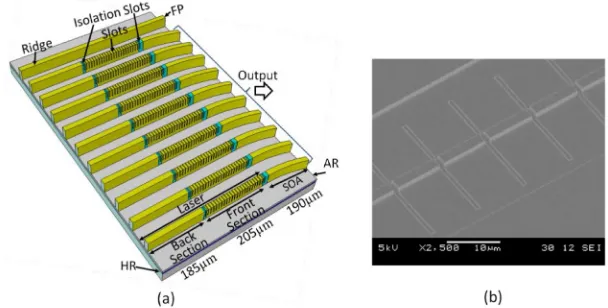
structure is based on a standard 1550 nm LD design. The active region consists of five AlGaInAs quantum wells. Above it are 1.6 μm-thick p-doped InP layer, 50 nm-thick p-doped InGaAsP layer, and 200 nm-thick InGaAs contact layer. One side of each laser has multiple uniformly distributed slots which act as an active DBR reflector of the laser and provide sufficient one side (front) feedback for lasing operation. The other (back) side reflection is provided by the facet. Because in this case we still need to cleave the back facet, there is a single mode issue caused by the uncertainty of this cleaving position. To remove this yield problem, each laser is divided into two sections electrically isolated by the last slot from the group of slots as seen from Fig. 1 (a): the front section includes a group of slots and the back section consists of straight waveguide section. By tuning the back section current of some lasers in the array, i.e., tuning the longitudinal mode position relative to the reflection peak, it is possible to make a laser array with good single mode performance for all the channels. Considering the loss caused by the etched slots, a SOA is naturally integrated with but electrically isolated from each laser to boost the output power. To reduce the reflection from the front facet, the SOA section is curved to generate a 7° angle from the normal of the facet. To further improve the laser performance in terms of increasing the output power and reducing the threshold current, the antireflection (AR) and high reflection (HR) coating films are applied to the front and the back facets of the laser array, respectively.
Fig. 1. (a) 3D schematic structure of tunable slotted single mode laser array. (b) SEM picture of etched slots.
[image:3.612.154.458.288.442.2]. 2
B p
eff
m d
n
λ
= (1)
where the dp is the slot period, λB is the Bragg wavelength, neff is the average effective refractive index in waveguide structure and m is grating order which is 37. For all of the 9-channel lasers in the array, lasing wavelengths are designed as 1542.2, 1545.4, 1548.6, 1551.8, 1555, 1558.2, 1561.4, 1564.6, and 1567.8 nm with a channel spacing of 3.2 nm. 3. Device fabrication and characteristics
[image:4.612.209.407.348.499.2]The designed laser array was fabricated using the similar process in [16]. Two steps of inductively coupled plasma (ICP) based dry etching with Cl2 /N2 gas combinations were used to form the ridge and the slots. The ridge was etched with a height of 1.8 μm which resulted in a slot depth of about 1.3 μm with 0.5 μm shallower than the ridge as was determined by this two-step dry etching process. The four corners of etched slots are quite sharp, as shown in Fig. 1(b) of the SEM pictures of the etched slots. But there are also issues with the fabrication as seen from the SEM picture: there are residual InP walls left beside the ridge at the slot positions which we think have increased the loss of slots. The total length of each laser in the fabricated array is around 400 μm integrated with the 190 μm long curved front SOA. The back section of the laser was about 185 μm long between the back facet and the first slot (from left). The front section was about 205 μm long slot section. After the ridge was passivated and metal contacted (the electrode metal covered the slots area except for the isolation slots), the laser array bars were coated with high reflection and antireflection films. Finally, the laser arrays were cleaved into individual bars mounted on AlN carriers.
Fig. 2. Measured light-current-voltage (L-I-V) curve for all the 9-channel laser array and the FP laser on same chip at 20°C under CW condition.
laser is reduced to around half of the FP laser due to the loss caused by the etched slots. By measuring the amplified spontaneous emission (ASE) spectra of FP lasers fabricated with the same process, we calculated the net modal gain spectrum using Fourier series expansion method [18]. For the current density of 2.3 kA/cm2 (threshold ~19 mA), the corresponding net mode gain estimated is around 35 cm−1. Thus the amplitude reflection |r| and transmission |t| from 24 slots are calculated as 0.54 and 0.62, respectively, using the scattering matrix method. This yields a loss (1-|r|2-|t|2) about 0.3. The imperfect slot fabrication and the unbiased SOA reduce the slope efficiency further. All of these factors together roughly explain the slope efficiency drop of the single mode laser compared with the FP laser on the same bar.
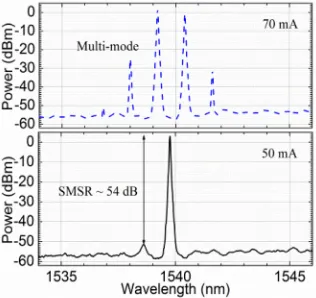
Fig. 3. Measured output spectrum vs. back section current for the channel 1 laser.
The output light from the laser array was collected by a lensed single mode fiber and analyzed by an Agilent 86140B optical spectrum analyzer (OSA). The resolution of the OSA was set to be 0.06 nm with sensitivity of −80 dBm. For the channel laser number 1, 7 and 8, because the longitudinal modes do not coincide well with the reflection peak due to the unsuitable back facet cleaving position, the front and back sections of these lasers were separately biased. To achieve a good single mode performance, the current of the back section was adjusted slightly (keeping the front section current constant) to tune the longitudinal mode position in order to align with the reflection peak. Figure 3 shows typically how such laser tuning behavior varied with different back section current for the channel 1 laser at 15°C. It was found that the SMSR reached 54 dB when the injected back current was 50 mA for this channel.
injection of 70 mA for the SOA section. The SOA was found to have a negligible influence on the laser performance.
[image:6.612.129.481.295.581.2]Fig. 4. Measured laser performance for the 9 channels with a total driving current of around 130 mA of each laser (a) output spectrum with SOA section unbiased; (b) output power vs. SOA current injection.
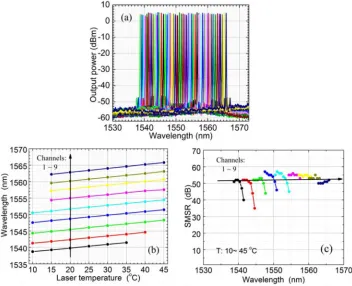
Fig. 5. Measured wavelength tuning behaviour of the fabricated laser array at the laser driving current of around 130 mA over the temperature range from 10˚C to 45˚C: (a) output spectrum; (b) Lasing wavelength vs. temperature; (c) SMSR vs. lasing wavelength.
measured output spectra over a temperature range from 10˚C to 45˚C with a temperature step of 5 degree. Figure 5(b) plots the measured lasing wavelength versus the chip temperature for all the 9 channels within the laser array. It can be seen that a wavelength quasi-continuous tuning range of about 27 nm was obtained over the 35 degree temperature range. The measured SMSR of the laser array is plotted in Fig. 5(c) as a function of lasing wavelength during the temperature tuning, which shows the SMSR was more than 35dB over the whole tuning range. The drop of the SMSR from over 50 dB to above 35 dB for the channels on the short wavelength side with increased temperature is not caused by competition from the modes adjacent to the lasing mode but from the mode which is one free spectral range (FSR) longer, where the FSR is determined by the slot period to be about 40 nm. In our future work non-periodically spaced slots will be used to suppress these reflection peaks which are one FSR away from the main peak. This can be done by simply using a three-period structure as demonstrated in our previous work [15].
In summary, we present 9-channel wavelength tunable single mode laser array based on slots. The fabricated laser array exhibits a threshold current range of 19~21mA. The stable single mode performance is obtained for all the 9 channel lasers with side-mode suppression-ratio >50 dB at 20°C. The output power of the laser array reaches 37 mW with the total driving current of 130 mA of the laser section when the SOA is biased at 70 mA. By tuning the chip temperature a quasi-continuous tuning range ~27 nm is achieved over a temperature range from 10°C to 45°C. The presented laser array structure just needs a single wafer growth and can be fabricated by standard photolithography. It is also monolithically integrable to other devices. In addition, it can potentially achieve a high single mode yield. Therefore such a laser array platform has strong application potentials in optical communication systems. Acknowledgment