Query and Output: Generating Words by Querying Distributed Word
Representations for Paraphrase Generation
Shuming Ma1, Xu Sun1,2, Wei Li1, Sujian Li1, Wenjie Li3, Xuancheng Ren1 1MOE Key Lab of Computational Linguistics, School of EECS, Peking University
2Deep Learning Lab, Beijing Institute of Big Data Research, Peking University 3Department of Computing, The Hong Kong Polytechnic University
{shumingma, xusun, liweitj47, lisujian, renxc}@pku.edu.cn [email protected]
Abstract
Most recent approaches use the sequence-to-sequence model for paraphrase genera-tion. The existing sequence-to-sequence model tends to memorize the words and the patterns in the training dataset instead of learn-ing the meanlearn-ing of the words. Therefore, the generated sentences are often grammati-cally correct but semantigrammati-cally improper. In this work, we introduce a novel model based on the encoder-decoder framework, called Word Embedding Attention Network (WEAN). Our proposed model generates the words by query-ing distributed word representations (i.e. neu-ral word embeddings), hoping to capturing the meaning of the according words. Following previous work, we evaluate our model on two paraphrase-oriented tasks, namely text sim-plification and short text abstractive summa-rization. Experimental results show that our model outperforms the sequence-to-sequence baseline by the BLEU score of 6.3 and 5.5 on two English text simplification datasets, and the ROUGE-2 F1 score of 5.7 on a Chi-nese summarization dataset. Moreover, our model achieves state-of-the-art performances on these three benchmark datasets.1
1 Introduction
Paraphrase is a restatement of the meaning of a text using other words. Many natural language generation tasks are paraphrase-orientated, such as text simplification and short text summariza-tion. Text simplification is to make the text easier to read and understand, especially for poor read-ers, while short text summarization is to generate a brief sentence to describe the short texts (e.g. posts on the social media). Most recent approaches use sequence-to-sequence model for paraphrase gen-eration (Prakash et al.,2016;Cao et al.,2017). It
1The code is available at https://github.com/
lancopku/WEAN
compresses the source text information into dense vectors with the neural encoder, and the neural decoder generates the target text using the com-pressed vectors.
Although neural network models achieve suc-cess in paraphrase generation, there are still two major problems. One of the problem is that the ex-isting sequence-to-sequence model tends to mem-orize the words and the patterns in the training dataset instead of the meaning of the words. The main reason is that the word generator (i.e. the output layer of the decoder) does not model the semantic information. The word generator, which consists of a linear transformation and a softmax operation, converts the Recurrent Neural Network (RNN) output from a small dimension (e.g. 500) to a much larger dimension (e.g. 50,000 words in the vocabulary), where each dimension repre-sents the score of each word. The latent assump-tion of the word generator is that each word is in-dependent and the score is irrelevant to each other. Therefore, the scores of a word and its synonyms may be of great difference, which means the word generator learns the word itself rather than the re-lationship between words.
The other problem is that the word generator has a huge number of parameters. Suppose we have a sequence-to-sequence model with a hid-den size of 500 and a vocabulary size of 50,000. The word generator has up to 25 million parame-ters, which is even larger than other parts of the encoder-decoder model in total. The huge size of parameters will result in slow convergence, be-cause there are a lot of parameters to be learned. Moreover, under the distributed framework, the more parameters a model has, the more bandwidth and memory it consumes.
To tackle both of the problems, we propose a novel model called Word Embedding Attention Network (WEAN). The word generator of WEAN
is attention based, instead of the simple linear soft-max operation. In our attention based word gen-erator, the RNN output is a query, the candidate words are the values, and the corresponding word representations are the keys. In order to predict the word, the attention mechanism is used to se-lect the value matching the query most, by means of querying the keys. In this way, our model gen-erates the words according to the distributed word representations (i.e. neural word embeddings) in a retrieval style rather than the traditional gener-ative style. Our model is able to capture the se-mantic meaning of a word by referring to its em-bedding. Besides, the attention mechanism has a much smaller number of parameters compared with the linear transformation directly from the RNN output space to the vocabulary space. The reduction of the parameters can increase the con-vergence rate and speed up the training process. Moreover, the word embedding is updated from three sources: the input of the encoder, the input of the decoder, and the query of the output layer.
Following previous work (Cao et al.,2017), we evaluate our model on two paraphrase-oriented tasks, namely text simplification and short text abstractive summarization. Experimental results show that our model outperforms the sequence-to-sequence baseline by the BLEU score of 6.3 and 5.5 on two English text simplification datasets, and the ROUGE-2 F1 score of 5.7 on a Chinese sum-marization dataset. Moreover, our model achieves state-of-the-art performances on all of the bench-mark datasets.
2 Proposed Model
We propose a novel model based on the encoder-decoder framework, which generates the words by querying distributed word representations with the attention mechanism. In this section, we first present the overview of the model architecture. Then, we explain the details of the word gener-ation, especially the way to query word embed-dings.
2.1 Overview
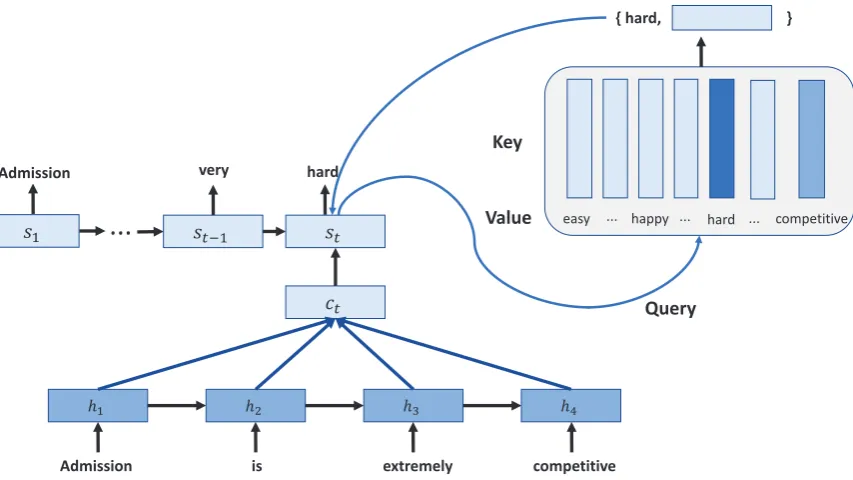
Word Embedding Attention Network is based on the encoder-decoder framework, which consists of two components: a source text encoder, and a tar-get text decoder. Figure1is an illustration of our model. Given the source texts, the encoder com-presses the source texts into dense representation
vectors, and the decoder generates the paraphrased texts. To predict a word, the decoder uses the hid-den output to query the word embeddings. The word embeddings assess all the candidate words, and return the word whose embedding matches the query most. The selected word is emitted as the predicted token, and its embedding is then used as the input of the LSTM at the next time step. After the back propagation, the word embedding is up-dated from three sources: the input of the encoder, the input of the decoder, and the query of the out-put layer. We show the details of our WEAN in the following subsection.
2.2 Encoder and Decoder
The goal of the source text encoder is to pro-vide a series of dense representation of complex source texts for the decoder. In our model, the source text encoder is a Long Short-term Memory Network (LSTM), which produces the dense rep-resentation {h1, h2, ..., hN} from the source text {x1, x2, ..., xN}:
The goal of the target text decoder is to generate a series of paraphrased words from the dense rep-resentation of source texts. Fisrt, the LSTM of the decoder compute the dense representation of gen-erated words st. Then, the dense representations
are fed into an attention layer (Bahdanau et al.,
2014) to generate the context vectorct, which
cap-tures context information of source texts. Atten-tion vectorctis calculated by the weighted sum of
encoder hidden states:
ct= N X
i=1
αtihi (1)
αti=
eg(st,hi)
PN
j=1eg(st,hj)
(2)
where g(st, hi) is an attentive score between the
decoder hidden state st and the encoder hidden
statehi.
In this way,ctandstrespectively represent the
context information of source texts and the target texts at thetthtime step.
2.3 Word Generation by Querying Word Embedding
For the current sequence-to-sequence model, the word generator computes the distribution of output wordsytin a generative style:
݄ଵ ݄ଶ ݄ଷ ݄ସ
ܿ௧
ݏ௧ିଵ ݏ௧
Admission is extremely competitive
easy ... happy ... hard ... competitive
{ hard,
Value Key
Query very
}
hard
...
ݏଵ
[image:3.595.87.514.62.302.2]Admission
Figure 1: An overview of Word Embedding Attention Network.
whereW ∈Rk×V is a trainable parameter matrix,
kis hidden size, andV is the number of words in
the vocabulary. When the vocabulary is large, the number of parameters will be huge.
Our model generates the words in a retrieval style rather than the traditional generative style, by querying the word embeddings. We denote the combination of the source context vector ct and
the target context vectorstas the queryqt:
qt= tanh(Wc[st;ct]) (4)
The candidate words wi and their corresponding
embeddings ei are paired as the key-value pairs {wi, ei}(i= 1,2, ..., n), wherenis the number of
candidate words. We give the details of how to de-termine the set of candidate words in Section2.4. Our model uses qt to query the key-value pairs {wi, ei}(i = 1,2, ..., n) by evaluating the
rele-vance between the query qt and each word
vec-tor ei with a score function f(qt, ei). The query
process can be regarded as the attentive selection of the word embeddings. We borrow the attention energy functions (Luong et al.,2015) as the rele-vance score functionf(qt, ei):
f(qt, ei) =
qTtei dot
qTtWaei general
vT tanh(W
qqt+Weei) concat
(5)
where Wq and We are two trainable parameter
matrices, and vT is a trainable parameter vector.
In implementation, we select the general attention function as the relevance score function, based on the performance on the validation sets. The key-value pair with the highest score {wt, et} is
se-lected. At the test stage, the decoder generates the key wt as the tth predicted word, and inputs the
valueetto the LSTM unit at thet+ 1thtime step.
At the training stage, the scores are normalized as the word probability distribution:
p(yt) =sof tmax(f(qt, ei)) (6)
2.4 Selection of Candidate Key-value Pairs
As described in Section2.3, the model generates the words in a retrieval style, which selects a word according to its embedding from a set of candidate key-value pairs. We now give the details of how to obtain the set of candidate key-value pairs. We extract the vocabulary from the source text in the training set, and select thenmost frequent words
as the candidate words. We reuse the embeddings of the decoder inputs as the values of the candi-date words, which means that the decoder input and the predicted output share the same vocabu-lary and word embeddings. Besides, we do not use any pretrained word embeddings in our model, so that all of the parameters are learned from scratch.
2.5 Training
cross entropy between the predicted word proba-bility distribution and the golden one-hot distribu-tion:
L=−X i
ˆ
yilogp(yi) (7)
We use Adam optimization method to train the model, with the default hyper-parameters: the learning rate α = 0.001, and β1 = 0.9, β2 = 0.999,= 1e−8.
3 Experiments
Following the previous work (Cao et al., 2017), we test our model on the following two paraphrase orientated tasks: text simplification and short text abstractive summarization.
3.1 Text Simplification 3.1.1 Datasets
The datasets are both from the alignments be-tween English Wikipedia website2and Simple En-glish Wikipedia website.3 The Simple English Wikipedia is built for “the children and adults who are learning the English language”, and the arti-cles are composed with “easy words and short sen-tences”. Therefore, Simple English Wikipedia is a natural public simplified text corpus.
• Parallel Wikipedia Simplification Corpus (PWKP). PWKP (Zhu et al., 2010) is a widely used benchmark for evaluating text simplification systems. It consists of aligned complex text from English WikiPedia (as of Aug. 22nd, 2009) and simple text from Sim-ple Wikipedia (as of Aug. 17th, 2009). The dataset contains 108,016 sentence pairs, with 25.01 words on average per complex sen-tence and 20.87 words per simple sensen-tence. Following the previous work (Zhang and La-pata, 2017), we remove the duplicate sen-tence pairs, and split the corpus with 89,042 pairs for training, 205 pairs for validation and 100 pairs for test.
• English Wikipedia and Simple English Wikipedia (EW-SEW).EW-SEW is a pub-licly available dataset provided by Hwang et al. (2015). To build the corpus, they first align the complex-simple sentence pairs, score the semantic similarity between the complex sen-tence and the simple sensen-tence, and classify
2http://en.wikipedia.org 3http://simple.wikipedia.org
each sentence pair as a good, good partial, partial, or bad match. Following the previous work (Nisioi et al.,2017), we discard the un-classified matches, and use the good matches and partial matches with a scaled threshold greater than 0.45. The corpus contains about 150K good matches and 130K good partial matches. We use this corpus as the train-ing set, and the dataset provided by Xu et al. (Xu et al.,2016) as the validation set and the test set. The validation set consists of 2,000 sentence pairs, and the test set contains 359 sentence pairs. Besides, each complex sentence is paired with 8 reference simplified sentences provided by Amazon Mechanical Turk workers.
3.1.2 Evaluation Metrics
Following the previous work (Nisioi et al.,2017;
Hu et al.,2015), we evaluate our model with dif-ferent metrics on two tasks.
• Automatic evaluation. We use the BLEU
score (Papineni et al.,2002) as the automatic evaluation metric. BLEU is a widely used metric for machine translation and text sim-plification, which measures the agreement between the model outputs and the gold ref-erences. The references can be either single or multiple. In our experiments, the refer-ences are single on PWKP, and multiple on EW-SEW.
• Human evaluation.Human evaluation is
es-sential to evaluate the quality of the model outputs. Following Nisioi et al. (2017) and Zhang et al. (2017), we ask the human raters to rate the simplified text in three dimensions: Fluency, Adequacy and Simplicity. Fluency assesses whether the outputs are grammati-cally right and well formed. Adequacy rep-resents the meaning preservation of the sim-plified text. Both the scores of fluency and adequacy range from 1 to 5 (1 is very bad and 5 is very good). Simplicity shows how simpler the model outputs are than the source text, which ranges from 1 to 5.
3.1.3 Settings
PWKP BLEU PBMT (Wubben et al.,2012) 46.31 Hybrid (Narayan and Gardent,2014) 53.94 EncDecA (Zhang and Lapata,2017) 47.93 DRESS (Zhang and Lapata,2017) 34.53 DRESS-LS (Zhang and Lapata,2017) 36.32 Seq2seq (our implementation) 48.26
[image:5.595.308.527.61.242.2]WEAN (our proposal) 54.54
Table 1: Automatic evaluation of our model and other related systems on PWKP datasets. The results are re-ported on the test sets.
EW-SEW BLEU
PBMT-R (Wubben et al.,2012) 67.79 Hybrid (Narayan and Gardent,2014) 48.97 SBMT-SARI (Xu et al.,2016) 73.62 NTS (Nisioi et al.,2017) 84.70 NTS-w2v (Nisioi et al.,2017) 87.50 EncDecA (Zhang and Lapata,2017) 88.85 DRESS (Zhang and Lapata,2017) 77.18 DRESS-LS (Zhang and Lapata,2017) 80.12 Seq2seq (our implementation) 88.97
[image:5.595.73.291.61.172.2]WEAN (our proposal) 94.45
Table 2: Automatic evaluation of our model and other related systems on EW-SEW datasets. The results are reported on the test sets.
tune our hyper-parameter on the development set. The model has two LSTM layers. The hidden size of LSTM is 256, and the embedding size is 256. We use Adam optimizer (Kingma and Ba,2014) to learn the parameters, and the batch size is set to be 64. We set the dropout rate (Srivastava et al.,
2014) to be 0.4. All of the gradients are clipped when the norm exceeds 5.
3.1.4 Baselines
We compare our model with several neural text simplification systems.
• Seq2seq is our implementation of the sequence-to-sequence model with attention mechanism, which is the most popular neu-ral model for text generation.
• NTSandNTS-w2v (Nisioi et al., 2017) are two sequence-to-sequence model with ex-tra mechanism like prediction ranking, and NTS-w2v uses a pretrain word2vec.
• DRESSandDRESS-LS(Zhang and Lapata,
2017) are two deep reinforcement learning
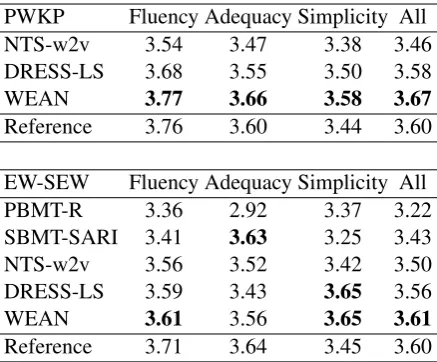
PWKP Fluency Adequacy Simplicity All NTS-w2v 3.54 3.47 3.38 3.46 DRESS-LS 3.68 3.55 3.50 3.58 WEAN 3.77 3.66 3.58 3.67
Reference 3.76 3.60 3.44 3.60
EW-SEW Fluency Adequacy Simplicity All PBMT-R 3.36 2.92 3.37 3.22 SBMT-SARI 3.41 3.63 3.25 3.43 NTS-w2v 3.56 3.52 3.42 3.50 DRESS-LS 3.59 3.43 3.65 3.56 WEAN 3.61 3.56 3.65 3.61
Reference 3.71 3.64 3.45 3.60
Table 3: Human evaluation of our model and other re-lated systems on PWKP and EW-SEW datasets. The results are reported on the test sets.
sentence simplification models.
• EncDecA is a model based on the
encoder-decoder with attention, implemented by
Zhang and Lapata(2017).
• PBMT-R(Wubben et al., 2012) is a phrase based machine translation model which reranks the outputs.
• Hybrid(Narayan and Gardent,2014) is a hy-brid approach which combines deep seman-tics and mono-lingual machine translation.
• SBMT-SARI (Xu et al., 2016) is a
syntax-based machine translation model which is trained on PPDB dataset (Ganitkevitch et al.,
2013) and tuned with SARI.
3.1.5 Results
We compare WEAN with state-of-the-art mod-els for text simplification. Table 1 and Table 2
LCSTS R-1 R-2 R-L
RNN-W(Hu et al.,2015) 17.7 8.5 15.8
RNN(Hu et al.,2015) 21.5 8.9 18.6
RNN-cont-W(Hu et al.,2015) 26.8 16.1 24.1 RNN-cont(Hu et al.,2015) 29.9 17.4 27.2
SRB(Ma et al.,2017) 33.3 20.0 30.1
CopyNet-W(Gu et al.,2016) 35.0 22.3 32.0 CopyNet(Gu et al.,2016) 34.4 21.6 31.3 RNN-dist(Chen et al.,2016) 35.2 22.6 32.5 DRGD(Li et al.,2017) 37.0 24.2 34.2 Seq2seq 32.1 19.9 29.2
[image:6.595.72.292.61.227.2]WEAN 37.8 25.6 35.2
Table 4: ROUGE F1 score on the LCSTS test set. R-1, R-2, and R-L denote ROUGE-R-1, ROUGE-2, and ROUGE-L, respectively. The models with a suffix of ‘W’ in the table are word-based, while the rest of mod-els are character-based.
It shows that the neural models have better per-formance in BLEU, and WEAN achieves the best BLEU score with 94.45.
We perform the human evaluation of WEAN and other related systems, and the results are shown in Table3. DRESS-LS is based on the rein-forcement learning, and it encourages the fluency, simplicity and relevance of the outputs. There-fore, it achieves a high score in our human eval-uation. WEAN gains a even better score than DRESS-LS. Besides, WEAN generates more ad-equate and simpler outputs than the reference on PWKP. The predictions of SBMT-SARI are the most adequate among the compared systems on EW-SEW. In general, WEAN outperforms all of the other systems, considering the balance of flu-ency, adequate and simplicity. We conduct sig-nificance tests based on t-test. The sigsig-nificance tests suggest that WEAN has a very significant improvement over baseline, withp ≤ 0.001over
DRESS-LS in all of the dimension on PWKP,
p≤0.05over DRESS-LS in the dimension of
flu-ency,p ≤ 0.005over NTS-w2v in the dimension
of simplicity and p ≤ 0.005over DRESS-LS in
the dimension of all.
3.2 Large Scale Text Summarization 3.2.1 Dataset
Large Scale Chinese Social Media Short Text Summarization Dataset (LCSTS): LCSTS is constructed byHu et al.(2015). The dataset con-sists of more than 2,400,000 text-summary pairs, constructed from a famous Chinese social media
website called Sina Weibo.4 It is split into three parts, with 2,400,591 pairs in PART I, 10,666 pairs in PART II and 1,106 pairs in PART III. All the text-summary pairs in PART II and PART III are manually annotated with relevant scores ranged from 1 to 5. We only reserve pairs with scores no less than 3, leaving 8,685 pairs in PART II and 725 pairs in PART III. Following the previous work (Hu et al.,2015), we use PART I as training set, PART II as validation set, and PART III as test set.
3.2.2 Evaluation Metrics
Our evaluation metric is ROUGE score (Lin and Hovy, 2003), which is popular for summariza-tion evaluasummariza-tion. The metrics compare an auto-matically produced summary against the refer-ence summaries, by computing overlapping lex-ical units, including unigram, bigram, trigram, and longest common subsequence (LCS). Follow-ing previous work (Rush et al., 2015; Hu et al.,
2015), we use ROUGE-1 (unigram), ROUGE-2 (bi-gram) and ROUGE-L (LCS) as the evaluation metrics in the reported experimental results.
3.2.3 Settings
The vocabularies are extracted from the training sets, and the source contents and the summaries share the same vocabularies. We tune the hyper-parameters based on the ROUGE scores on the validation sets. In order to alleviate the risk of word segmentation mistakes, we split the Chi-nese sentences into characters. We prune the vo-cabulary size to 4,000, which covers most of the common characters. We set the word embedding size and the hidden size to 512, the number of LSTM layers of the encoder is 2, and the num-ber of LSTM layers of the decoder is 1. The batch size is 64, and we do not use dropout (Srivastava et al.,2014) on this dataset. Following the previ-ous work (Li et al.,2017), we implement a beam search optimization, and set the beam size to 5.
3.2.4 Baselines
We compare our model with the state-of-the-art baselines.
• RNN and RNN-cont are two sequence-to-sequence baseline with GRU encoder and de-coder, provided byHu et al.(2015).
#Param PWKP EWSEW LCSTS
[image:7.595.318.512.63.227.2]Seq2seq 12.80M 12.80M 2.05M WEAN 0.13M 0.13M 0.52M
Table 5: The number of the parameters in the out-put layer. The numbers of rest parameters between Seq2seq and WEAN are the same.
• RNN-dist(Chen et al.,2016) is a distraction-based neural model, which the attention mechanism focuses on the different parts of the source content.
• CopyNet (Gu et al., 2016) incorporates a
copy mechanism to allow part of the gener-ated summary is copied from the source con-tent.
• SRB (Ma et al., 2017) is a sequence-to-sequence based neural model with improving the semantic relevance between the input text and the output summary.
• DRGD (Li et al., 2017) is a deep recurrent generative decoder model, combining the de-coder with a variational autoende-coder.
• Seq2seq is our implementation of the sequence-to-sequence model with the atten-tion mechanism.
3.2.5 Results
We report the ROUGE F1 score of our model and the baseline models on the test sets. Ta-ble 4 summarizes the comparison between our model and the baselines. Our model achieves the score of 37.8 ROUGE-1, 25.6 ROUGE-2, and 35.2 ROUGE-L, outperforming all of the previ-ous models. First, we compare our model with the sequence-to-sequence model. It shows that our model significant outperforms the sequence-to-sequence baseline with a large margin of 5.7 ROUGE-1, 5.7 ROUGE-2, and 6.0 ROUGE-L. Then, we compare our model with other related models. The state-of-the-art model is DRGD (Li et al., 2017), which obtains the score of 37.0 ROUGE-1, 24.2 ROUGE-2, and 34.2 ROUGE-L. Our model has a relative gain of 0.8 ROUGE-1, 1.4 ROUGE-2 and 1.0 ROUGE-L over the state-of-the-art models.
0 2 4 6 8 10 12 14 16
0 10 20 30 40 50
Epoch
BLEU
Training Curve
WEAN S2S
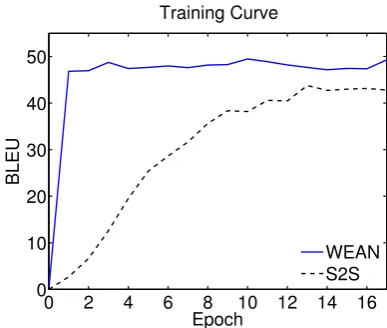
Figure 2: The training curve of WEAN and Seq2seq on the PWKP validation set.
4 Analysis and Discussion
4.1 Reducing Parameters
Our WEAN reduces a large number of the param-eters in the output layer. To analyze the parame-ter reduction, we compare our WEAN model with the sequence-to-sequence model. Table5lists the number of the parameters in the output layers of two models. Both PWKP and EWSEWhave the vocabulary size of 50000 words and the hidden size of 256, resulting50000×256 = 12,800,000
parameters. LCSTS has a vocabulary size of 4000 and the hidden size of 512, so the seq2seq has
4000×512 = 2,048,000parameters in the
out-put layers. WEAN only has two parameter ma-trices and one parameter vector at most in Equa-tion 5, without regard to the vocabulary size. It has256×256×2 + 256 = 131,328parameters on PWKP and EWSEW, and512×512×2+512 = 524,800parameters on LCSTS. Besides, WEAN
does not have any extra parameters in the other part of the model.
4.2 Speeding up Convergence
[image:7.595.81.280.64.106.2]Source Yoghurt or yogurt is a dairy product produced by bacterial fermentation of milk .
Reference Yoghurt or yogurt is a dairy productmadeby bacterial fermentation of milk .
NTS . or yoghurtis a dairy productproducedby bacterial fermentation of milk .
NTS-w2v It is madeby bacterial fermentation of milk .
PBMT-R Yoghurt or yogurt is a dairy productproducedby bacterial fermentationof .
SBMT-SARI Yogurt or yogurt is a dairy productdrawn upby bacterial fermentation of milk .
WEAN Yoghurt or yogurt is a dairy productmadeby bacterial fermentation of milk .
Source Depending on the context, another closely-related meaning of constituent is that of a citizen residing in the area governed, represented, or otherwise served by a politician; sometimes this is restricted to citizens who elected the politician.
Reference The word constituent can also be used to refer toa citizenwho livesin the area that is governed, represented, or otherwise served by a politician; sometimesthe wordis restricted to citizens who elected the politician.
NTS Depending on the context, another closely-related meaning of constituent is that of a citizenliving in the area governed, represented, or otherwise served by a politician; sometimes this is restricted to citizens who elected the politician.
NTS-w2v This is restricted to citizens who elected the politician.
PBMT-R Depending on the context and meaning of closely-relatedsiemens-martin -rrb- is a citizen living in the area, or otherwise,was governed by a 1924-1930 shurba; this is restricted to people who electedit.
SBMT-SARI In terms ofthe context, another closely-related sense of the componentis that of a citizenlivingin the areacovered, make up, or if not, served by a policy; sometimes this islimitedto the people who elected thepolicy.
[image:8.595.73.531.59.425.2]WEAN Depending on the context, another closely-related meaning of constituent is that of a citizenwho livesin the area governed, represented, or otherwise served by a politician; sometimesthe wordis restricted to citizens who elected the politician.
Table 6: Two examples of different text simplification system outputs in EW-SEW dataset. Differences from the source texts are shown in bold.
4.3 Case Study
Table6shows two examples of different text sim-plification system outputs on EW-SEW. For the first example, NTS, NTS-w2v and PBMT-R miss some essential constituents, so that the sentences are incomplete and not fluent. SBMT-SARI gen-erates a fluent sentence, but the output does not preserve the original meaning. The predicted sen-tence of WEAN is fluent, simple, and the same as the reference. For the second example, NTS-w2v omits so many words that it lacks a lot of information. PBMT-R generates some irrele-vant words, like ’siemens-martin’, rrb-’, and ’-shurba’, which hurts the fluency and adequacy of the generated sentence. SBMT-SARI is able to generate a fluent sentence, but the meaning is dif-ferent from the source text, and even more diffi-cult to understand. Compared with the statistic model, WEAN generates a more fluent sentence. Besides, WEAN can capture the semantic mean-ing of the word by querymean-ing the word embeddmean-ings, so the generated sentence is semantically correct,
and very close to the original meaning.
5 Related Work
Our work is related to the encoder-decoder framework (Cho et al., 2014) and the attention mechanism (Bahdanau et al., 2014). Encoder-decoder framework, like sequence-to-sequence model, has achieved success in machine transla-tion (Sutskever et al.,2014;Jean et al.,2015; Lu-ong et al., 2015; Lin et al., 2018), text summa-rization (Rush et al., 2015; Chopra et al., 2016;
Nallapati et al.,2016;Wang et al.,2017;Ma and Sun, 2017), and other natural language process-ing tasks (Liu et al.,2017). There are many other methods to improve neural attention model (Jean et al.,2015;Luong et al.,2015).
Zhu et al.(2010) constructs a wikipedia dataset, and proposes a tree-based simplification model.
presents a method for text simplification using phrase based machine translation with re-ranking the outputs. Kauchak(2013) proposes a text sim-plification corpus, and evaluates language model-ing for text simplification on the proposed corpus.
Narayan and Gardent(2014) propose a hybrid ap-proach to sentence simplification which combines deep semantics and monolingual machine trans-lation. Hwang et al. (2015) introduces a paral-lel simplification corpus by evaluating the simi-larity between the source text and the simplified text based on WordNet.Glavaˇs and ˇStajner(2015) propose an unsupervised approach to lexical sim-plification that makes use of word vectors and re-quire only regular corpora. Xu et al. (2016) de-sign automatic metrics for text simplification. Re-cently, most works focus on the neural sequence-to-sequence model. Nisioi et al. (2017) present a sequence-to-sequence model, and re-ranks the predictions with BLEU and SARI.Zhang and La-pata(2017) propose a deep reinforcement learning model to improve the simplicity, fluency and ade-quacy of the simplified texts. Cao et al. (2017) introduce a novel sequence-to-sequence model to join copying and restricted generation for text sim-plification.
Rush et al. (2015) first used an attention-based encoder to compress texts and a neural network language decoder to generate summaries. Follow-ing this work, recurrent encoder was introduced to text summarization, and gained better perfor-mance (Lopyrev,2015;Chopra et al.,2016). To-wards Chinese texts,Hu et al.(2015) built a large corpus of Chinese short text summarization. To deal with unknown word problem,Nallapati et al.
(2016) proposed a generator-pointer model so that the decoder is able to generate words in source texts. Gu et al. (2016) also solved this issue by incorporating copying mechanism.
6 Conclusion
We propose a novel model based on the encoder-decoder framework, which generates the words by querying distributed word representations. Exper-imental results show that our model outperforms the sequence-to-sequence baseline by the BLEU score of 6.3 and 5.5 on two English text simplifi-cation datasets, and the ROUGE-2 F1 score of 5.7 on a Chinese summarization dataset. Moreover, our model achieves state-of-the-art performances on these three benchmark datasets.
Acknowledgements
This work was supported in part by National Natu-ral Science Foundation of China (No. 61673028), National High Technology Research and Devel-opment Program of China (863 Program, No. 2015AA015404), and the National Thousand Young Talents Program. Xu Sun is the corre-sponding author of this paper.
References
Dzmitry Bahdanau, Kyunghyun Cho, and Yoshua Bengio. 2014. Neural machine translation by jointly learning to align and translate. CoRR abs/1409.0473.
Ziqiang Cao, Chuwei Luo, Wenjie Li, and Sujian Li. 2017. Joint copying and restricted generation for paraphrase. InProceedings of the Thirty-First AAAI Conference on Artificial Intelligence. pages 3152– 3158.
Qian Chen, Xiaodan Zhu, Zhenhua Ling, Si Wei, and Hui Jiang. 2016. Distraction-based neural networks for modeling documents. InProceedings of the 25th International Joint Conference on Artificial Intelli-gence (IJCAI 2015). AAAI, New York, NY. Jianpeng Cheng and Mirella Lapata. 2016. Neural
summarization by extracting sentences and words. InProceedings of the 54th Annual Meeting of the As-sociation for Computational Linguistics, ACL 2016, August 7-12, 2016, Berlin, Germany, Volume 1: Long Papers.
Kyunghyun Cho, Bart van Merrienboer, C¸aglar G¨ulc¸ehre, Dzmitry Bahdanau, Fethi Bougares, Hol-ger Schwenk, and Yoshua Bengio. 2014. Learning phrase representations using RNN encoder-decoder for statistical machine translation. In Proceedings of the 2014 Conference on Empirical Methods in Natural Language Processing, EMNLP 2014. pages 1724–1734.
Sumit Chopra, Michael Auli, and Alexander M. Rush. 2016. Abstractive sentence summarization with at-tentive recurrent neural networks. InNAACL HLT 2016, The 2016 Conference of the North American Chapter of the Association for Computational Lin-guistics: Human Language Technologies. pages 93– 98.
Juri Ganitkevitch, Benjamin Van Durme, and Chris Callison-Burch. 2013. PPDB: the paraphrase database. InHuman Language Technologies: Con-ference of the North American Chapter of the Asso-ciation of Computational Linguistics, Proceedings. pages 758–764.
the Association for Computational Linguistics, ACL. pages 63–68.
Jiatao Gu, Zhengdong Lu, Hang Li, and Victor O. K. Li. 2016. Incorporating copying mechanism in sequence-to-sequence learning. In Proceedings of the 54th Annual Meeting of the Association for Com-putational Linguistics, ACL 2016.
Baotian Hu, Qingcai Chen, and Fangze Zhu. 2015. LC-STS: A large scale chinese short text summarization dataset. InProceedings of the 2015 Conference on Empirical Methods in Natural Language Process-ing, EMNLP 2015, Lisbon, Portugal, September 17-21, 2015. pages 1967–1972.
William Hwang, Hannaneh Hajishirzi, Mari Ostendorf, and Wei Wu. 2015. Aligning sentences from stan-dard wikipedia to simple wikipedia. InNAACL HLT 2015. pages 211–217.
S´ebastien Jean, KyungHyun Cho, Roland Memisevic, and Yoshua Bengio. 2015. On using very large tar-get vocabulary for neural machine translation. In Proceedings of the 53rd Annual Meeting of the As-sociation for Computational Linguistics, ACL 2015. pages 1–10.
David Kauchak. 2013. Improving text simplification language modeling using unsimplified text data. In Proceedings of the 51st Annual Meeting of the Asso-ciation for Computational Linguistics, ACL. pages 1537–1546.
Diederik P. Kingma and Jimmy Ba. 2014. Adam: A method for stochastic optimization. CoRR abs/1412.6980.
Piji Li, Wai Lam, Lidong Bing, and Zihao Wang. 2017. Deep recurrent generative decoder for ab-stractive text summarization. InProceedings of the 2017 Conference on Empirical Methods in Natural Language Processing, EMNLP 2017, Copenhagen, Denmark, September 9-11, 2017. pages 2091–2100.
Chin-Yew Lin and Eduard H. Hovy. 2003. Auto-matic evaluation of summaries using n-gram co-occurrence statistics. InHuman Language Technol-ogy Conference of the North American Chapter of the Association for Computational Linguistics, HLT-NAACL 2003.
Junyang Lin, Shuming Ma, Qi Su, and Xu Sun. 2018. Decoding-history-based adaptive control of attention for neural machine translation. CoRR abs/1802.01812.
Tianyu Liu, Kexiang Wang, Lei Sha, Baobao Chang, and Zhifang Sui. 2017. Table-to-text genera-tion by structure-aware seq2seq learning. CoRR abs/1711.09724.
Konstantin Lopyrev. 2015. Generating news head-lines with recurrent neural networks. CoRR abs/1512.01712.
Thang Luong, Hieu Pham, and Christopher D. Man-ning. 2015. Effective approaches to attention-based neural machine translation. In Proceedings of the 2015 Conference on Empirical Methods in Natural Language Processing, EMNLP 2015. pages 1412– 1421.
Shuming Ma and Xu Sun. 2017. A semantic rele-vance based neural network for text summarization and text simplification. CoRRabs/1710.02318.
Shuming Ma, Xu Sun, Jingjing Xu, Houfeng Wang, Wenjie Li, and Qi Su. 2017. Improving semantic relevance for sequence-to-sequence learning of chi-nese social media text summarization. In Proceed-ings of the 55th Annual Meeting of the Association for Computational Linguistics, ACL 2017, Vancou-ver, Canada, July 30 - August 4, Volume 2: Short Papers. pages 635–640.
Ramesh Nallapati, Bowen Zhou, C´ıcero Nogueira dos Santos, C¸aglar G¨ulc¸ehre, and Bing Xiang. 2016. Abstractive text summarization using sequence-to-sequence rnns and beyond. In Proceedings of the 20th SIGNLL Conference on Computational Natural Language Learning, CoNLL 2016, Berlin, Germany, August 11-12, 2016. pages 280–290.
Shashi Narayan and Claire Gardent. 2014. Hybrid sim-plification using deep semantics and machine trans-lation. In Proceedings of the 52nd Annual Meet-ing of the Association for Computational LMeet-inguis- Linguis-tics, ACL. pages 435–445.
Sergiu Nisioi, Sanja Stajner, Simone Paolo Ponzetto, and Liviu P. Dinu. 2017. Exploring neural text sim-plification models. InProceedings of the 55th An-nual Meeting of the Association for Computational Linguistics, ACL. pages 85–91.
Kishore Papineni, Salim Roukos, Todd Ward, and Wei-Jing Zhu. 2002. Bleu: a method for automatic eval-uation of machine translation. InProceedings of the 40th Annual Meeting of the Association for Compu-tational Linguistics. pages 311–318.
Aaditya Prakash, Sadid A. Hasan, Kathy Lee, Vivek V. Datla, Ashequl Qadir, Joey Liu, and Oladimeji Farri. 2016. Neural paraphrase generation with stacked residual LSTM networks. In COLING 2016, 26th International Conference on Computational Lin-guistics, Proceedings of the Conference: Techni-cal Papers, December 11-16, 2016, Osaka, Japan. pages 2923–2934.
Alexander M. Rush, Sumit Chopra, and Jason Weston. 2015. A neural attention model for abstractive sen-tence summarization. In Proceedings of the 2015 Conference on Empirical Methods in Natural Lan-guage Processing, EMNLP 2015, Lisbon, Portugal, September 17-21, 2015. pages 379–389.
networks from overfitting. Journal of Machine Learning Research15(1):1929–1958.
Xu Sun, Xuancheng Ren, Shuming Ma, and Houfeng Wang. 2017a. meprop: Sparsified back propaga-tion for accelerated deep learning with reduced over-fitting. In Proceedings of the 34th International Conference on Machine Learning, ICML 2017, Syd-ney, NSW, Australia, 6-11 August 2017. pages 3299– 3308.
Xu Sun, Xuancheng Ren, Shuming Ma, Bingzhen Wei, Wei Li, and Houfeng Wang. 2017b. Training simpli-fication and model simplisimpli-fication for deep learning: A minimal effort back propagation method. CoRR abs/1711.06528.
Xu Sun, Bingzhen Wei, Xuancheng Ren, and Shuming Ma. 2017c. Label embedding network: Learning la-bel representation for soft training of deep networks. CoRRabs/1710.10393.
Ilya Sutskever, Oriol Vinyals, and Quoc V. Le. 2014. Sequence to sequence learning with neural net-works. InAdvances in Neural Information Process-ing Systems 27: Annual Conference on Neural Infor-mation Processing Systems 2014. pages 3104–3112.
Sho Takase, Jun Suzuki, Naoaki Okazaki, Tsutomu Hi-rao, and Masaaki Nagata. 2016. Neural headline generation on abstract meaning representation. In Proceedings of the 2016 Conference on Empirical Methods in Natural Language Processing, EMNLP 2016, Austin, Texas, USA, November 1-4, 2016. pages 1054–1059.
Kexiang Wang, Tianyu Liu, Zhifang Sui, and Baobao Chang. 2017. Affinity-preserving random walk for multi-document summarization. In Proceedings of the 2017 Conference on Empirical Methods in Nat-ural Language Processing, EMNLP 2017, Copen-hagen, Denmark, September 9-11, 2017. pages 210– 220.
Kristian Woodsend and Mirella Lapata. 2011. Learn-ing to simplify sentences with quasi-synchronous grammar and integer programming. InProceedings of the 2011 Conference on Empirical Methods in Natural Language Processing, EMNLP. pages 409– 420.
Sander Wubben, Antal van den Bosch, and Emiel Krahmer. 2012. Sentence simplification by mono-lingual machine translation. In The 50th An-nual Meeting of the Association for Computational Linguistics, Proceedings of the Conference. pages 1015–1024.
Jingjing Xu, Xu Sun, Xuancheng Ren, Junyang Lin, Binzhen Wei, and Wei Li. 2018. Dp-gan: Diversity-promoting generative adversarial network for gen-erating informative and diversified text. CoRR abs/1802.01345.
Wei Xu, Courtney Napoles, Ellie Pavlick, Quanze Chen, and Chris Callison-Burch. 2016. Optimizing statistical machine translation for text simplification. TACL4:401–415.
Xingxing Zhang and Mirella Lapata. 2017. Sen-tence simplification with deep reinforcement learn-ing. InProceedings of the 2017 Conference on Em-pirical Methods in Natural Language Processing, EMNLP 2017, Copenhagen, Denmark, September 9-11, 2017. pages 584–594.