Proceedings of NAACL-HLT 2018, pages 583–594
SRL4ORL: Improving Opinion Role Labeling Using
Multi-Task Learning With Semantic Role Labeling
Ana Marasovi´c and Anette Frank Research Training Group AIPHES Department of Computational Linguistics
Heidelberg University
{marasovic,frank}@cl.uni-heidelberg.de
Abstract
For over a decade, machine learning has been used to extract opinion-holder-target struc-turesfrom text to answer the questionWho ex-pressed what kind of sentiment towards what?. Recent neural approaches do not outperform the state-of-the-art feature-based models for Opinion Role Labeling (ORL). We suspect this is due to the scarcity of labeled train-ing data and address this issue ustrain-ing differ-ent multi-task learning (MTL) techniques with a related task which has substantially more data, i.e. Semantic Role Labeling (SRL). We show that two MTL models improve signif-icantly over the single-task model for label-ing of both holders and targets, on the devel-opment and the test sets. We found that the vanilla MTL model which makes predictions using only shared ORL and SRL features, per-forms the best. With deeper analysis we deter-mine what works and what might be done to make further improvements for ORL.
1 Introduction
Fine-Grained Opinion Analysis (FGOA) aims to: (i) detect opinion expressions (O) that convey at-titudes such as sentiments, agreements, beliefs or intentions (like feared in example (1)), (ii) mea-sure their intensity (e.g. strong), (iii) identify their holders (H), i.e. entities that express an attitude (e.g. it), (iv) identify their targets (T), i.e. enti-ties or propositions at which the attitude is di-rected (e.g.violence) and (v) classify their target-dependent attitude (e.g. negative sentiment)1.
(1) Australia said [it]H [feared]Oneg[violence]T
if voters thought the election had been stolen.
As the commonly accepted benchmark corpus MPQA (Wiebe et al., 2005) uses spbased an-notations to represent opinion entities(opinions,
1Examples are drawn from MPQA (Wiebe et al.,2005).
holders and targets), the task is usually approached with sequence labeling techniques and the BIO encoding scheme (Choi et al., 2006; Yang and Cardie,2013;Katiyar and Cardie,2016). Initially pipeline models were proposed which first pre-dict opinion expressions and then, given an opin-ion, label its opinion roles, i.e. holders and tar-gets (Kim and Hovy,2006;Johansson and Mos-chitti, 2013). Pipeline models have been sub-stituted with so-called joint models that simulta-neously identify all opinion entities, and predict which opinion role is related to which opinion (Choi et al.,2006;Yang and Cardie,2013;Katiyar and Cardie,2016). Recently an LSTM-based joint model was proposed (Katiyar and Cardie, 2016) that unlike the prior work (Choi et al.,2006;Yang and Cardie,2013) does not depend on external re-sources (such as syntactic parsers or named en-tity recognizers). The neural variant does not out-perform the feature-based CRF model (Yang and Cardie,2013) in Opinion Role Labeling (ORL).
Both the neural and the CRF joint models achieve about 55% F1 score for predicting which targets relate to which opinions in MPQA. Thus, these models are not yet ready to answer the ques-tion this line of research is usually motivated with:
Who expressed what kind of sentiment towards what?. Our goal is to investigate the limitations of neural models in solving different subtasks of FGOA on MPQA and to gain a better understand-ing of what is solved and what is next.
We suspect that one of the fundamental obsta-cles for neural models trained on MPQA is its small size. One way to address scarcity of labeled data is to use multi-task learning (MTL) with ap-propriate auxiliary tasks. A promising auxiliary task candidate for ORL is Semantic Role Labeling (SRL), the task of predicting predicate-argument structure of a sentence, which answers the ques-tion Who did what to whom, where and when?.
Australia said it feared violence if voters thought the election had been stolen .
say.01 A0 - A1 A1 A1 A1 A1 A1 A1 A1 A1 A1 A1
-fear.01 - - A0 - A1 AMADV AMADV AMADV AMADV AMADV AMADV AMADV AMADV
-think.01 - - - A0 - A1 A1 A1 A1 A1
-steal.01 - - - A1 A1 - - -
-Table 1: Output of the SRL demo.
Table1illustrates the output of the SRL demo2for
example (1), following the PropBank SRL scheme (Palmer et al.,2005)3.
SRL4ORL.The semantic roles of the predicate
fear (marked blue bold) correspond to the opin-ion roles H and T, according to MPQA. For this reason, the output of SRL systems has been com-monly used for feature-based FGOA models (Kim and Hovy,2006;Johansson and Moschitti,2013; Choi et al., 2006;Yang and Cardie, 2013). Ad-ditionally, a considerable amount of training data is available for training SRL models (Table 2 in Sec.3), which made neural SRL models success-ful (Zhou and Xu,2015;Yang and Mitchell,2017). Obstacles. Although SRL is similar in nature to ORL, it cannot solve ORL for all cases ( Rup-penhofer et al.,2008). In example (2) holder and target of the predicatepleasecorrespond to A1, A0 semantic roles respectively, wheres for the predi-catefearin (1) holder and target correspond to A0, A1 respectively. We took into account this ob-servation when deciding on an appropriate MTL model by splitting its parameters into shared and task-specific ones (i.e. hard-parameter sharing).
(2) [I]A1
H am very [pleased]Opos that [the
Coun-cil has now approved the Kyoto Protocol thus enabling the EU to proceed with its ratification]A0
T .
A further obstacle for properly exploiting SRL training data with MTL could be specificities, in-consistency and incompleteness of the MPQA an-notations. In example (3), Rice expressed his negative sentiment towardsthe three countries in questionbysetting the criteriawhich states some-thing negative about those countries: theyare re-pressive and grave human rights violators [...]. In this case, the model should not pick any local se-mantic role for the target.
(3) The criteria [set by]Oneg [Rice]H are the
fol-lowing: [the three countries in question]T are
2http://barbar.cs.lth.se:8081 3Henceforth we use the PropBank SRL framework.
repressive and grave human rights violators, and aggressively seeking weapons [...]. In examples (4–5), the same opinion expression
concernedrealizes different scopes for the target. A model which exploits SRL knowledge could be biased to always label targets as complete SRL role constituents, as in example (5).
(4) Rice told us [the administration]H was
[concerned]Oneg that [Iraq]T would take
ad-vantage of the 9/11 attacks.
(5) [The Chinese government]H is deeply
[concerned]Oneg about [the sudden
deterio-ration in the Middle East situation]T, Tang
said.
Regarding incompleteness, prior work ( Kati-yar and Cardie,2016) has shown that their model makes reasonable predictions in sentences which do not have annotations at all, e.g. [mothers]H
[care]O for [their young]T, in: From the fact that
mothers care for their young, we can not deduce that they ought to do so, Hume argued.
The examples above show that incorporating SRL knowledge via multi-task learning is a rea-sonable way to improve ORL, but at the same time they alert us that given the specificities of MPQA and ORL annotations in general, it is not obvious whether MTL can overcome divergences in the an-notation schemes of opinion and semantic role la-beling. We investigate this research question by adopting one of the recent successful architectures for SRL (Zhou and Xu,2015) and experiment with different multi-task learning frameworks.
[image:2.595.79.528.63.116.2]Figure 1: Fully-shared
(FS) MTL. Figure 2: Hierarchical-MTL (H-MTL).
2 Neural MTL for SRL and ORL
Neural multi-task learning (MTL) receives a lot of attention and new MTL architectures emerge reg-ularly. Yet there is no clear consensus which MTL architecture to use in which conditions. We exper-iment with well-received architectures that could adapt to different cases of ORL from Section1.
As a general neural architecture for single- and multi-task learning we use the recently proposed SRL model (Zhou and Xu, 2015) (Z&X-STL) which successfully labels semantic roles without any syntactic guidance. This model consists of a stack of bi-directional LSTMs and a CRF which makes the final prediction. The inputs to the first LSTM are not only token embeddings but three additional features: embedding of the predicate, embedding of the context of the predicate and an indicator feature (1 if the current token is in the predicate context, 0 otherwise). Thus, every sen-tence is processed as many times as there are pred-icates in it. Adapting this model for labeling of opinion roles is straightforward, the only differ-ence being that opinion expressions can be multi-words and only two opinion roles are assigned.
MTL techniques aim to learn several tasks jointly by leveraging knowledge from all tasks. In the context of neural networks, MTL is commonly used in such a way that it is predefined which layers have tied parameters and which are task-specific (i.e. hard-parameter sharing). There are various ways of defining which parameters should be shared and how to train them.
Fully-shared (FS) MTL model.A fully-shared model (Fig.1) shares all parameters of the general model except the output layer. Each task has a task-specific output layer which makes the predic-tion based on the representapredic-tion produced by the final LSTM. When training on a mini-batch of a certain task, parameters of the output layer of the
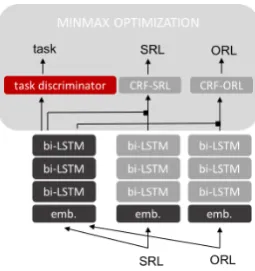
Figure 3: (Adversarial) state-private ((A)SP) MTL.
other tasks are not updated. This model should be effective for constructions with a clear mapping between opinion and semantic roles such as{H7→
A0, T7→A1}as in example (1) (Sec.1).
Hierarchical MTL (H-MTL) model.For NLP applications, often some given (high-level) task is supposed to benefit from another (low-level) task more than the other way around, e.g. parsing from POS tagging. This intuition lead to design-ing hierarchical MTL models (Søgaard and Gold-berg,2016;Hashimoto et al.,2017) in which pre-dictions for low-level tasks are not made on the basis of the representation produced at the final LSTM, but on the representation produced by a lower-layer LSTM (Fig. 2). Task-specific layers atop shared layers could potentially give the model more power to distinguish or ignore certain se-mantic roles. If so, this MTL model is more suit-able for examples like (2) and (3) (Sec.1).
Shared-private (SP) MTL model.In the state-private model, in addition to the stack of shared LSTMs, each task has a stack of task-specific LSTMs (Liu et al., 2017) (Fig. 3). Representa-tions at the outermost shared LSTM and the task-specific LSTM are concatenated and passed to the task-specific output layer. The ORL representa-tion produced independently from SRL gives the model the ability to utilize the shared and entirely task-specific information. For labeling of targets, it is expected that for examples (1) & (5) the model relies mostly on the shared representation, for ex-amples (2) & (4) on both shared and ORL-specific representations, and for example (3) solely on the ORL-specific representation.
[image:3.595.352.480.61.197.2] [image:3.595.75.289.65.223.2]task train size dev size test size |Y|
CoNLL’05 SRL 90750 3248 6071 106
MPQA (4-CV) ORL 3141.25 1055 1036.75 7
MPQA (10-CV) ORL 3516.3 1326 349.3 7
Table 2: Datasets w/ nb. of SRL predicates/ORL opin-ions in train, dev & test set, size of label inventory.
SP model with a task discriminator (Liu et al., 2017). The task discriminator (Fig.3, marked red) predicts to which task the current batch of data belongs, based on the representation produced by the shared LSTMs. If the shared LSTMs are task-invariant, the discriminator should perform badly. Thus, we update the shared parameters to maxi-mize the discriminator’s cross-entropy loss. At the same time we want the discriminator to challenge the shared LSTMs, so we update the discrimi-nator’s parameters to minimize its cross-entropy loss. This minmax optimization is known as ad-versarial training and recently it gained a lot of attention for NLP applications (Liu et al., 2017; Chen et al., 2017; Kim et al., 2017; Qin et al., 2017;Wu et al.,2017;Gui et al.,2017;Li et al., 2017;Zhang et al.,2017;Joty et al.,2017).
3 Experimental setup
3.1 Datasets
For SRL we use the newswire CoNLL-2005 shared task dataset (Carreras and M`arquez,2005), annotated with PropBank predicate-argument structures. Sections 2-21 of the WSJ corpus ( Char-niak et al.,2000) are used for training and section 24 as dev set. The test set consists of section 23 of WSJ and 3 sections of the Brown corpus.
For ORL we use the manually annotated MPQA 2.0. corpus (Wiebe et al.,2005;Wilson,2008). It mostly contains news documents, but also travel guides, transcripts of spoken conversations, e-mails, fundraising letters, textbook chapters and translations of Arabic source texts.
We report detailed pre-processing of MPQA4
and data statistics in the Supplementary Material.
3.2 Evaluation metrics
For both tasks we adopt evaluation metrics from prior work. For SRL, precision is defined as the proportion of semantic roles predicted by a system
4Examples how to use our scripts can be
found at https://github.com/amarasovic/ naacl-mpqa-srl4orl/blob/master/generate_ mpqa_jsons.py.
which are correct, recall is the proportion of gold roles which are predicted by a system, F1 score is the harmonic mean of precision and recall.
In case of ORL, we report 10-fold CV5and
re-peated 4-fold CV withbinary F1 scoreand propo-rtional F1 score, for holders and targets separately.
Binary precision is defined as the proportion of predicted holders (targets) that overlap with the gold holder (target),binary recallis the proportion of gold holders (targets) for which the model pre-dicts an overlapping holder (target). Proportional recallmeasures the proportion of the overlap be-tween a gold holder (target) and an overlapping predicted holder (target), proportional precision
measures the proportion of the overlap between a predicted holder (target) and an overlapping gold holder (target). F1 scores are the harmonic means of the corresponding precision and recall.
3.3 Training details
We evaluate our models using two evaluation set-tings. First, we followKatiyar and Cardie(2016) which set aside 132 documents for development
and used the remaining 350 documents for 10-fold CV. However, in the 10-fold CV setting, the size of the tests sets is 3 times smaller than the dev set size (Table2, row 3), and, consequently, results in high-variance estimates on the test sets. Therefore we additionally evaluate our models with 4-fold CV. We set aside 100 documents for development and use 25% of the remaining documents for test-ing. The resulting test sets are comparable in size to the dev set (Table2, row 2). We run 4-fold CV twice with two different random seeds. We do not tune hyperparameters (HPs), but follow suggesti-ons proposed in the thorough HP study for seque-nce labeling tasks (Reimers and Gurevych,2017). HPs can be found in the Supplementary Material.
4 Results
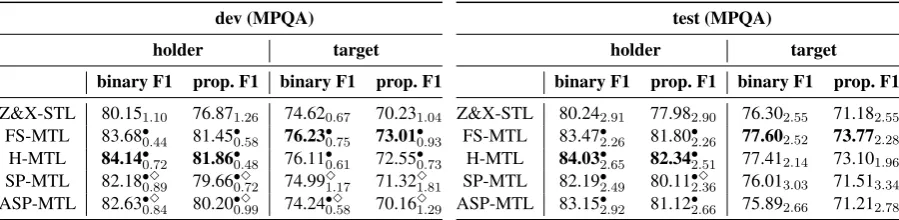
We evaluate all models after every batch sizetrain size it-eration on the ORL dev set and save them if they achieve a higher arithmetic mean of proportional F1 scores of holders and targets on the ORL dev set. The saved models are used for testing.
We report the mean of F1 scores over10 folds
and the standard deviation (appears as a subscript) of all models in Table3. We report the mean of F1 scores over4folds and2different seed (8
evalua-5We used the same splits as the prior work (Katiyar and
dev (MPQA)
holder target
binary F1 prop. F1 binary F1 prop. F1
Z&X-STL 80.151.10 76.871.26 74.620.67 70.231.04
FS-MTL 83.68•
0.44 81.45•0.58 76.23•0.75 73.01•0.93
H-MTL 84.14•
0.72 81.86•0.48 76.11•0.61 72.55•0.73
SP-MTL 82.18•3
0.89 79.66•03.72 74.9931.17 71.3231.81
ASP-MTL 82.63•3
0.84 80.20•03.99 74.240•3.58 70.1631.29
test (MPQA)
holder target
binary F1 prop. F1 binary F1 prop. F1
Z&X-STL 80.242.91 77.982.90 76.302.55 71.182.55
FS-MTL 83.47•
2.26 81.80•2.26 77.602.52 73.772.28
H-MTL 84.03•
2.65 82.34•2.51 77.412.14 73.101.96
SP-MTL 82.19•
2.49 80.11•23.36 76.013.03 71.513.34
ASP-MTL 83.15•
[image:5.595.75.525.62.172.2]2.92 81.12•2.66 75.892.66 71.212.78
Table 3: ORL 10-fold CV results.
dev (MPQA)
holder target
binary F1 prop. F1 binary F1 prop. F1
Z&X-STL 79.731.19 77.061.14 76.090.94 70.451.07
FS-MTL 83.58•
0.69 82.16•0.59 78.32•1.57 75.09•2.27
H-MTL 82.36•3
0.81 80.84•03.98 78.11•0.82 74.89•1.33
SP-MTL 82.21•3
0.79 80.23•03.88 76.1431.18 71.1430.97
ASP-MTL 81.413
1.27 79.39•13.45 76.491.39 72.13•1.87
test (MPQA)
holder target
binary F1 prop. F1 binary F1 prop. F1
Z&X-STL 80.421.92 77.482.06 73.841.17 67.032.13
FS-MTL 83.67•
1.52 81.59•1.50 77.04•1.45 73.01•2.53
H-MTL 82.80•
1.87 80.40•1.91 77.12•1.34 73.16•1.78
SP-MTL 82.51•
2.17 80.03•2.00 74.6131.32 68.7032.32
ASP-MTL 81.773
1.74 79.3231.62 74.920•3.84 69.89•1.80
Table 4: ORL repeated 4-fold CV results.
tions) and the standard deviation of all models in Table4. Evaluation metrics follow Section3.2.
We mark significant difference between MTL models and the single-task (Z&X-STL) model, observed using a Kolmogorov-Smirnov signifi-cance test (p <0.05) (Massey Jr,1951), with•in superscript and between the FS-MTL model and other MTL models with3.
STL vs. MTL. In the 10-fold CV evaluation setting (Table 3), the FS-MTL and the H-MTL models improve over the Z&X-STL model in all evaluation measures, for both holders and targets. When evaluated in the repeated 4-fold CV setting (Table4), all MTL models improve over the Z&X-STL model in all evaluation measures, for both holders and targets.
The FS-MTL and the H-MTL models improve
significantly in all evaluation measures, for both holders and targets, on both dev and test sets, when evaluated with repeated 4-fold CV. With 10-fold CV the improvements are also significant, except for targets on the test set. This is probably due to the small size of the test sets (Table2, row 3), which results in a high-variance estimate. Indeed, standard deviations on the 10-fold CV test sets are always much higher compared to the dev set or to the test sets of 4-fold CV.
It is not surprising that larger improvements are visible in the labeling of holders. They are usually short, less ambiguous and often presented with the
A0 semantic role, whereas annotating targets is a challenging task even for humans.6
Larger improvements are visible for propor-tional F1 score than for binary F1 score. That is, more data and SRL knowledge helps the model to better annotate the scope of opinion roles.
Comparing MTL models. In Section2we in-troduced MTL models with task-specific LSTM layers hypothesizing that these layers should give MTL models more power to adapt to a variety of potentially problematic cases that we illustrated in the Introduction. However, our results show that the FS-MTL model performs significantly better or comparable to MTL models that include task-specific layers. Reimers and Gurevych (2017) show that MTL is especially sensitive to the selec-tion of HPs. Thus, a firm and solid comparison of the different MTL models requires thorough HP optimization, to properly control the number of parameters and regularization of the models. We leave HP optimization for future work.
5 Analysis
Our aim in this section is to analyze what the pro-posed models are good at, in which ways MTL im-proves over the single-task ORL model and what could be done to achieve further progress.
We evaluate the FS-MTL and the Z&X-STL
6Wilson(2008) reports annotator agreement for target
1 MalingaF S,ZXsaidaccording to the guidelines in the booklet, the election had been legitimate .
2 movie um-hum that ’s interesting so that was a good movie too well do youF S,ZXthinkwe’ve covered baseball i think so okay well have a good night
3 The nationF S,ZXshould certainlybe concernedabout the plans to build a rocket launch pad , work on the infrastructure for which is due to start in 2002 , with launches beginning from 2004 .
4 Bam on Sunday said sheF S,ZXbelievedZimbabwe’s election was not free and fair , adding they were not in line with international standards as well as those of her organisation .
5 The majority report , endorsed only by the ANC , said the observer missionF S,ZX had notedthat over three million Zimbabweans had cast their votes and this substantially represented the will of the people .
Table 5: The dev examples for which both models (FS-MTL, Z&X-STL)correctlypredict theholderin 6/8 trials.
1 Indonesiahas come under pressurefrom several quarters to take tougher action against alleged terrorist leadersbut has played down the threatZX F S.
2 Mugabe even talked about hisdesireto keep safeguarding Zimbabwe ’s sovereignty and landZX in spiritF Swhen he dies , a dream which the veteran leader said forced him to sacrifice a bright teaching career in the 1950s to lead [...].
3 Under his blueprint , the governmenthopesto stabilize the economythrough curtailing state expenditure , reforming public enterprises and expanding agricultureF S,ZX.
4 He said those who thought the election process would be rigged were supporters of the MDC party , adding that they wereprejudging andwantedto direct the process F S,ZX.
5 People in the rural areas support the ruling party because our party has been genuine onits policyon land reformF S,ZX.
Table 6: The dev examples for which both models (FS-MTL, Z&X-STL)correctlypredict thetargetin 6/8 trials.
[image:6.595.73.291.494.571.2]easy hard % opinions that are predicates 91.32 93.33 % holders that are subjects 77.84 38.79 % holders that are A0 roles 74.10 33.33 avg. distance between holders & opinions 1.54 7.56
Table 7: Statistics ofholderprediction.
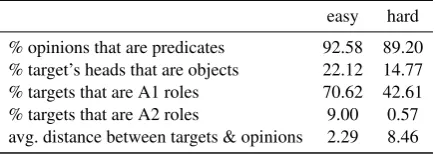
easy hard % opinions that are predicates 92.58 89.20 % target’s heads that are objects 22.12 14.77 % targets that are A1 roles 70.62 42.61 % targets that are A2 roles 9.00 0.57 avg. distance between targets & opinions 2.29 8.46
Table 8: Statistics oftargetprediction.
models on the ORL dev set using 4-fold CV re-peated twice with different seeds (8 evaluation tri-als). We say that a model predicts a role of a given opinion expression correctly if the model predicts a role that overlaps with the correct role in at least 6 out of 8 evaluation trials. If a model predicts a role that overlaps with the correct role in at most 2 out of 8 trials, we say that the model predicts the roleincorrectly. The requirement on 6-8 (in)correct predictions reduces the risk of an-alyzing inconsistent predictions and enables us to
draw firmer conclusions. We analyze the follow-ing scenarios:
(i) both the FS-MTL model and the Z&X-STL model make correct predictions (Tables5–6)
(ii) the FS-MTL model makes a correct predic-tion, while the Z&X-STL makes an incorrect prediction (Tables11–12)
(iii) both models make wrong predictions (Tables 9–10)
In the following, we categorize predictions in case (i) aseasy cases, and predictions in case (iii) ashard cases.
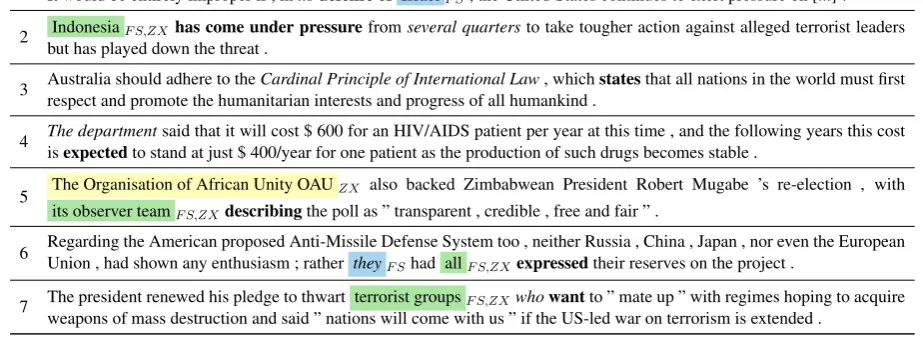
In Tables 5–6 and 9–12, the opinion expression is bolded, the correct role is italicized, predictions of the FS-MTL model are colored blue (subscript
FS), predictions of the Z&X-STL model are col-ored yellow (subscriptZX) and green marks pre-dictions where both models agree. For simplic-ity, we show only holders or targets, although the models predict both roles jointly.
What works well? There are 668/1055 in-stances in the dev set for which both models pre-dict holders correctly, and 663/1055 for targets.
1 It would be entirely improper if , initsdefense of IsraelF S, the United States continues to exert pressure on [...] . 2 IndonesiaF S,ZXhas come under pressurefromseveral quartersto take tougher action against alleged terrorist leaders
but has played down the threat .
3 Australia should adhere to therespect and promote the humanitarian interests and progress of all humankind .Cardinal Principle of International Law, whichstatesthat all nations in the world must first 4 The departmentisexpectedto stand at just $ 400/year for one patient as the production of such drugs becomes stable .said that it will cost $ 600 for an HIV/AIDS patient per year at this time , and the following years this cost
5 The Organisation of African Unity OAUZX also backed Zimbabwean President Robert Mugabe ’s re-election , with its observer teamF S,ZXdescribingthe poll as ” transparent , credible , free and fair ” .
6 Regarding the American proposed Anti-Missile Defense System too , neither Russia , China , Japan , nor even the EuropeanUnion , had shown any enthusiasm ; rather they F Shad allF S,ZXexpressedtheir reserves on the project .
[image:7.595.67.529.74.243.2]7 The president renewed his pledge to thwart terrorist groupsF S,ZXwhowantto ” mate up ” with regimes hoping to acquire weapons of mass destruction and said ” nations will come with us ” if the US-led war on terrorism is extended .
Table 9: The dev examples for which both models (FS-MTL, Z&X-STL)incorrectlypredict the holderin 6/8 trials.
1 State-sanctioned land invasionsZimbabwe ’s food production and famine is already looming in much of the country ., several timesdeclaredillegal by Zimbabwe ’s courts , as well as a drought have disrupted 2 But hetold the nationF S,ZXthat in spite ofstiff opposition to the agrarian reforms from powerful Western countries ,
especially the country ’s former colonial power of Britain, he would press ahead to seize farms from whites and [...] . 3 If the Europeans wish to influence Israel in the political arena – inheartedly– they will not be able to promote their positions in such a manner .a directionthat many in Israelwould support whole-4 TheyF S,ZXare fully aware that these are dangerousindividuals, hesaidduring a press conference [...] .
5 And her little girljust complained, ” I don’t want towash the dishes” .
6 DuringPresident Bush’s speech, Ithoughtof hecklingZX; ’ What are you going to do with the Kyoto Protocol ?F S’ 7 At first Ididn’t want to apply for itF S,ZX, but the principal called me during the summer months and said , ” Sandra the
time is running out , you need to apply ”.
Table 10: The dev examples for which both models (FS-MTL, Z&X-STL)incorrectlypredict thetarget in 6/8 trials.
cases) are subjects of their governing heads or A0 roles. The statistics in Table 7 (col. 1, rows 2– 3) supports this observation.7 In contrast, holders
that both models predict incorrectly (hard cases) are less frequently subjects or A0 roles (col. 2, rows 2–3). Also,easyholders are close to the cor-responding opinion expression: the average dis-tance is1.54 tokens (Table7, row 4), contrary to
thehardholders with the average distance of7.56.
Examples 1–5 in Table 6 suggest that targets that can be properly labeled by both models are objects of their governing heads or A1 roles. Ta-ble8, row 3, shows that the majority of theeasy
targets are indeed A1 roles, in contrast to thehard
targets. Similar to holders, theeasytargets are in average7tokens closer to the opinion expression.
What to do for further improvement? There are 165/1055 instances in the dev set for which
7The statistics is calculated using the output of mate-tools
(Bj¨orkelund et al.,2010).
both models predict holders incorrectly, and 176 for targets.
As we have seen so far, many holders that are subjects or A0 roles, and targets that are A1 roles, are properly labeled by both models. However, a considerable amount of such holders and targets are not correctly predicted (Table7–8, col. 2, rows 2–3). Thus our models do not work flawlessly for all such cases. A distinguishing property of the
hardcases is the distance of the role from the opin-ion. Thus, future work should advance the model’ s ability to capture long-range dependencies.
1 Yoshihisa Murasawa , a management consultant for Booz-Allen & Hamilton Japan Inc. , said his firmF S,ZXwill likely be recommending acquisitions of Japanese companies moreZXoften to foreign clients in the future .
2 The sourceF S, interviewed by Interfax in Grozny ,expressed confidencethat that the command of the Russian forces in Chechnya would soon “ be able to obtain documentary confirmation ” that Khattab was dead .
3 The Commonwealth team earlierthis weekF S saidthat ” the conditions in Zimbabwe did not adequately allow the free and fair expression of will by the electorate ”.
4 Publishing such biased reports will only createmistrustamong nationsF Sregarding the objectives and independence of the UN Commission on Human Rights .
5 The Inkatha Freedom Party , Democratic Alliance , New National Party , African Christian Democratic Party , the Pan Africanist Congress and the United Christian Democratic PartyZXhad disagreed with the ANCF Sconclusion.
6 The Nigerian leader , President Olusegun ObasanjoZX, had urged the ministerF S,ZXnot to attack Blair frontally over Britain ’s negative position regarding Zimbabwe , but to deal [...] .
7 US diplomatsZXsay BushF S,ZXwill seek to supportKim ’s Nobel Prize winning policy by offering new talks with the North , while remaining firm about North Korea ’s missile sales and its feared chemical and biological weapons programmes.
Table 11: The dev examples for which the FS-MTL modelcorrectlypredicts theholderin 6/8 trials, whereas the Z&X-STL model predictsincorrectlyin 6/8 trials.
1 In most cases hedescribed the legal punishmentsF Slike floggings and executions of murderers and major drug traffickers
that are applied based on the Shria , or Islamic law as human rights violations.
2 In anotherverbal attackKharazi accused the United StatesF Sof wanting to exercise ” world dictatorship ” since the ” horrible attacks ” of September 11 .
3 He said those who thought the election process would be rigged were supporters of the MDC party , adding that theyprejudgingand wanted to direct the process were ZX.
4 However , the fact that certain countries have a more balanced view of the conflictZXis not the only reason to doubt that
anti-Israeli decisionsF Swill , in fact ,be adopted.
5 But his tough stand on P’yongyangF Shas provoked concernin SeoulZX, where President Kim Tae-chung , who is in the last year of his five-year term , has been trying to prise the hermit state out of isolation .
Table 12: The dev examples for which the FS-MTL modelcorrectlypredicts thetargetin 6/8 trials, whereas the Z&X-STL model predictsincorrectlyin 6/8 trials.
a nominal predicate and the holder is its object. The sentence is in passive voice but the models probably interpret it in the active voice and thus make the wrong prediction. In the third exam-ple, the opinion expression is the head of the rel-ative clause that modifies the holder. These ex-amples raise the following questions: would im-proved consistency with syntax lead to improve-ments for ORL and could we train a dependency parsing model with SRL and ORL to help the models handle syntactically harder cases?
Example 4 shows that holders specific to the MPQA annotation schema are hard to label as they require inference skills: fromthe department said, we can defeasibly infer that it is the department
whoexpects [this cost] to stand at just$400/year [...]. To handle such cases, it would be worth try-ing traintry-ing our models jointly with models for recognizing textual entailment.
Examples 6–7 illustrate that some gap in
per-formance stems from difficulties in processing MPQA. Example 5 has no gold holder, but the models make plausible predictions. For example 6, FS-MTL predicts the discontinuous holderthey ... all, while MPQA allows only contiguous enti-ties. Therefor our evaluation scripts interpretthey
and all as two separate holders and deem all as incorrect, resulting with lower precision. Finally, for example 7 our models make plausible predic-tions. However, the gold holder is always the en-tity from the coreference cluster that is the closest to the opinion.8The evaluation scripts needs to be
extended such that predicting any entity from the coreference cluster is considered to be correct. To conclude, to better evaluate future developments, it would be worth curating MPQA instances with missing roles and extending evaluation to account for coreferent holders and discontinuous roles.
The examples in Table10demonstrate that
ficulties in labeling targets originate from simi-lar reasons as for holders. Examples 1–3 demon-strate complex syntactic constructions, examples 4–6 MPQA-specific annotations that require infer-ence and example 7 exemplifies a missing target.
How does MTL help? There are 18/1055 in-stances in the dev set for which the FS model pre-dicts the holder correctly and the Z&X-STL model does not, and 19/1055 for targets.
For holders, for 9 out 18 of such examples, the Z&X-STL model does not predict anything (as in examples 2–5 in Table 11). From examples 1– 5 we notice that SRL data helps to handle more complex syntactic constructions. From examples 5–7 we observed that using MTL with SRL helps to handle cases when more than one person or or-ganization is present in the close neighborhood of the opinion. For targets, for 11 out of 18 cases the Z&X-STL model does not predict anything as in examples 1–2 in Table 11. We conclude that the greatest improvements from the FS-MTL model comes from having far fewer missing roles.
6 Related work
FGOA.Closest to our work areYang and Cardie (2013) (Y&C) and Katiyar and Cardie (2016) (K&C). They as well label both holders and targets in MPQA. By contrast, our focus is on the task of ORL. We thus refrain from predicting opinion ex-pressions first, to ensure a reproducible evaluation setup on a fixed set of gold opinion expressions. The MTL models we develop in this work will, however, be the basis for the full task in a later stage. Because of these differences, direct com-parison to Y&C and K&C is not possible. How-ever, if we compare our results we notice a big gap that demonstrates that opinion expression extrac-tion is the import step in FGOA. Similar to K&C, Liu et al.(2015) jointly labels opinion expressions and their targets in reviews.
Some work focuses entirely on labeling of opin-ion expressopin-ions (Yang and Cardie, 2014; Irsoy and Cardie, 2014). Other work looks into spe-cific subcategories of ORL: opinion role induction for verbal predicates (Wiegand and Ruppenhofer, 2015), categorization of opinion words into actor and speaker view (Wiegand et al.,2016b), opinion roles extraction on opinion compounds (Wiegand et al.,2016a). Wiegand and Ruppenhofer(2015) report72.54binary F1 score for labeling of
hold-ers in MPQA (results for targets are not reported).
Neural SRL. New neural SRL models have emerged (He et al., 2017; Yang and Mitchell, 2017; Marcheggiani and Titov, 2017) since we started this work. In future work we can improve our models with such new proposals.
Auxiliary tasks for MTL. Other work inves-tigates under which conditions MTL is effective. Mart´ınez Alonso and Plank (2017) show that the best auxiliary tasks have low kurtosis of labels (usually a small label set) and high entropy (la-bels occur uniformly). We show that the best MTL model for ORL is the model which uses shared layers only. Thus it seems reasonable to consider only a small and uniform SRL label set{A0, A1}.
Bingel and Søgaard (2017) show that MTL works when the main task has a flattening learn-ing curve, but the auxiliary task curve is still steep. We notice such behavior in our learning curves.
7 Conclusions
We address the problem of scarcity of annotated training data for labeling of opinion holders and targets (ORL) using multi-task learning (MTL) with Semantic Role Labeling (SRL). We adapted a recently proposed neural SRL model for ORL and enhanced it with different MTL techniques. Two MTL models achieve significant improve-ments with all evaluation measures, for both hold-ers and targets, on both dev and test set, when eval-uated with repeated 4-fold CV. We recommend evaluation with comparable dev and test set sizes for future work, as this enables more reliable eval-uation.
With deeper analysis we show that future devel-opments should improve the ability of the models to capture long-range dependencies, investigate if consistency with syntax can improve ORL, and consider other auxiliary tasks such as dependency parsing or recognizing textual entailment. We em-phasize that future improvements can be measured more reliably if opinion expressions with missing roles are curated and if the evaluation considers all mentions in opinion role coreference chains as well as discontinuous roles.
Acknowledgments
References
Joachim Bingel and Anders Søgaard. 2017. Identify-ing beneficial task relations for multi-task learnIdentify-ing in deep neural networks. InProceedings of the 15th Conference of the European Chapter of the Associa-tion for ComputaAssocia-tional Linguistics: Volume 2, Short Papers. Association for Computational Linguistics, Valencia, Spain, pages 164–169. http://www.
aclweb.org/anthology/E17-2026.
Anders Bj¨orkelund, Bernd Bohnet, Love Hafdell, and Pierre Nugues. 2010. A high-performance syntac-tic and semansyntac-tic dependency parser. InProceedings of the 23rd International Conference on Computa-tional Linguistics: Demonstrations. Association for Computational Linguistics, pages 33–36.
Xavier Carreras and Llu´ıs M`arquez. 2005. Intro-duction to the CoNLL-2005 Shared Task: Se-mantic Role Labeling. In Proceedings of the Ninth Conference on Computational Natural Lan-guage Learning (CoNLL-2005). Association for Computational Linguistics, Ann Arbor, Michigan, pages 152–164. http://www.aclweb.org/
anthology/W/W05/W05-0620.
Eugene Charniak, Don Blaheta, Niyu Ge, Keith Hall, John Hale, and Mark Johnson. 2000. Bllip 1987-89 wsj corpus release 1. Linguistic Data Consortium, Philadelphia36.
Xinchi Chen, Zhan Shi, Xipeng Qiu, and Xuanjing Huang. 2017.Adversarial multi-criteria learning for chinese word segmentation. InProceedings of the 55th Annual Meeting of the Association for Compu-tational Linguistics (Volume 1: Long Papers). As-sociation for Computational Linguistics, Vancouver, Canada, pages 1193–1203. http://aclweb.
org/anthology/P17-1110.
Yejin Choi, Eric Breck, and Claire Cardie. 2006. Joint extraction of entities and relations for opin-ion recognitopin-ion. In Proceedings of the 2006 Conference on Empirical Methods in Natural Lan-guage Processing. Association for Computational Linguistics, Sydney, Australia, pages 431–439.
http://www.aclweb.org/anthology/W/
W06/W06-1651.
Tao Gui, Qi Zhang, Haoran Huang, Minlong Peng, and Xuanjing Huang. 2017. Part-of-speech tag-ging for twitter with adversarial neural networks. In Proceedings of the 2017 Conference on Em-pirical Methods in Natural Language Processing. Association for Computational Linguistics, Copen-hagen, Denmark, pages 2401–2410. https://
www.aclweb.org/anthology/D17-1255.
Kazuma Hashimoto, Caiming Xiong, Yoshimasa Tsu-ruoka, and Richard Socher. 2017. A joint many-task model: Growing a neural network for multiple nlp tasks. In Proceedings of the 2017 Conference on Empirical Methods in Nat-ural Language Processing. Association for Com-putational Linguistics, Copenhagen, Denmark,
pages 446–456. https://www.aclweb.org/
anthology/D17-1046.
Luheng He, Kenton Lee, Mike Lewis, and Luke Zettle-moyer. 2017. Deep semantic role labeling: What works and what’s next. InProceedings of the 55th Annual Meeting of the Association for Computa-tional Linguistics (Volume 1: Long Papers). As-sociation for Computational Linguistics, Vancou-ver, Canada, pages 473–483. http://aclweb.
org/anthology/P17-1044.
Ozan Irsoy and Claire Cardie. 2014. Opinion mining with deep recurrent neural networks. In Proceed-ings of the 2014 Conference on Empirical Methods in Natural Language Processing (EMNLP). Associ-ation for ComputAssoci-ational Linguistics, Doha, Qatar, pages 720–728. http://www.aclweb.org/
anthology/D14-1080.
Richard Johansson and Alessandro Moschitti. 2013. Relational Features in Fine-Grained Opinion Anal-ysis. Computational Linguistics39:473–509. Shafiq Joty, Preslav Nakov, Llu´ıs M`arquez, and
Is-raa Jaradat. 2017. Cross-language Learning with Adversarial Neural Networks. In Proceedings of the 21st Conference on Computational Natu-ral Language Learning (CoNLL 2017). Associ-ation for ComputAssoci-ational Linguistics, Vancouver, Canada, pages 226–237. http://aclweb.
org/anthology/K17-1024.
Arzoo Katiyar and Claire Cardie. 2016. Investigat-ing LSTMs for Joint Extraction of Opinion Enti-ties and Relations. InProceedings of the 54th An-nual Meeting of the Association for Computational Linguistics (Volume 1: Long Papers). Berlin, Ger-many, pages 919–929. http://www.aclweb.
org/anthology/P16-1087.
Soo-Min Kim and Eduard Hovy. 2006. Extract-ing Opinions, Opinion Holders, and Topics Ex-pressed in Online News Media Text. In Pro-ceedings of the Workshop on Sentiment and Sub-jectivity in Text. Sydney, Australia, pages 1–
8. http://www.aclweb.org/anthology/
W/W06/W06-0301.
Young-Bum Kim, Karl Stratos, and Dongchan Kim. 2017. Adversarial adaptation of synthetic or stale data. InProceedings of the 55th Annual Meeting of the Association for Computational Linguistics (Vol-ume 1: Long Papers). Association for Computa-tional Linguistics, Vancouver, Canada, pages 1297– 1307. http://aclweb.org/anthology/ P17-1119.
Jiwei Li, Will Monroe, Tianlin Shi, S´ebastien Jean, Alan Ritter, and Dan Jurafsky. 2017. Adversar-ial learning for neural dAdversar-ialogue generation. In
Proceedings of the 2017 Conference on Empirical Methods in Natural Language Processing. Associ-ation for ComputAssoci-ational Linguistics, Copenhagen, Denmark, pages 2147–2159. https://www.
Pengfei Liu, Shafiq Joty, and Helen Meng. 2015. Fine-grained opinion mining with recurrent neural net-works and word embeddings. In Proceedings of the 2015 Conference on Empirical Methods in Nat-ural Language Processing. Association for Compu-tational Linguistics, Lisbon, Portugal, pages 1433– 1443. http://aclweb.org/anthology/ D15-1168.
Pengfei Liu, Xipeng Qiu, and Xuanjing Huang. 2017. Adversarial multi-task learning for text classifica-tion. In Proceedings of the 55th Annual Meet-ing of the Association for Computational LMeet-inguis- Linguis-tics (Volume 1: Long Papers). Association for Com-putational Linguistics, Vancouver, Canada, pages 1–10. http://aclweb.org/anthology/ P17-1001.
Diego Marcheggiani and Ivan Titov. 2017. En-coding sentences with graph convolutional net-works for semantic role labeling. In Proceed-ings of the 2017 Conference on Empirical Methods in Natural Language Processing. Association for Computational Linguistics, Copenhagen, Denmark, pages 1506–1515. https://www.aclweb.
org/anthology/D17-1159.
H´ector Mart´ınez Alonso and Barbara Plank. 2017. When is multitask learning effective? semantic se-quence prediction under varying data conditions. In Proceedings of the 15th Conference of the Eu-ropean Chapter of the Association for Computa-tional Linguistics: Volume 1, Long Papers. As-sociation for Computational Linguistics, Valencia, Spain, pages 44–53. http://www.aclweb.
org/anthology/E17-1005.
Frank J. Massey Jr. 1951. The Kolmogorov-Smirnov test for goodness of fit. Journal of the American sta-tistical Association46(253):68–78.
Martha Palmer, Paul Kingsbury, and Daniel Gildea. 2005. The Proposition Bank: An Annotated Cor-pus of Semantic Roles. Computational Linguistics
31:71–106.
Lianhui Qin, Zhisong Zhang, Hai Zhao, Zhiting Hu, and Eric Xing. 2017. Adversarial connective-exploiting networks for implicit discourse rela-tion classificarela-tion. In Proceedings of the 55th Annual Meeting of the Association for Computa-tional Linguistics (Volume 1: Long Papers). Asso-ciation for Computational Linguistics, Vancouver, Canada, pages 1006–1017. http://aclweb.
org/anthology/P17-1093.
Nils Reimers and Iryna Gurevych. 2017. Optimal hy-perparameters for deep lstm-networks for sequence labeling tasks.arXiv preprint arXiv:1707.06799. Josef Ruppenhofer, Swapna Somasundaran, and Janyce
Wiebe. 2008. Finding the Sources and Targets of Subjective Expressions. In Proceedings of the Sixth International Conference on Language Re-sources and Evaluation (LREC). Marrakech, Mo-rocco, pages 2781–2788.
Anders Søgaard and Yoav Goldberg. 2016. Deep multi-task learning with low level tasks supervised at lower layers. In Proceedings of the 54th An-nual Meeting of the Association for Computational Linguistics (Volume 2: Short Papers). Associa-tion for ComputaAssocia-tional Linguistics, Berlin, Ger-many, pages 231–235. http://anthology.
aclweb.org/P16-2038.
Janyce Wiebe, Theresa Wilson, and Claire Cardie. 2005. Annotating Expressions of Opinions and Emotions in Language. Language Resources and Evaluation39:165–210.
Michael Wiegand, Christine Bocionek, and Josef Rup-penhofer. 2016a. Opinion holder and target extrac-tion on opinion compounds – a linguistic approach. InProceedings of the 2016 Conference of the North American Chapter of the Association for Compu-tational Linguistics: Human Language Technolo-gies. Association for Computational Linguistics, San Diego, California, pages 800–810. http://
www.aclweb.org/anthology/N16-1094.
Michael Wiegand and Josef Ruppenhofer. 2015. Opin-ion holder and target extractOpin-ion based on the induction of verbal categories. In Proceed-ings of the Nineteenth Conference on Compu-tational Natural Language Learning. Association for Computational Linguistics, Beijing, China, pages 215–225. http://www.aclweb.org/
anthology/K15-1022.
Michael Wiegand, Marc Schulder, and Josef Ruppen-hofer. 2016b. Separating actor-view from speaker-view opinion expressions using linguistic features. InProceedings of the 2016 Conference of the North American Chapter of the Association for Compu-tational Linguistics: Human Language Technolo-gies. Association for Computational Linguistics, San Diego, California, pages 778–788. http://
www.aclweb.org/anthology/N16-1092.
Theresa Ann Wilson. 2008. Fine-Grained Subjectivity And Sentiment Analysis: Recognizing The Intensity, Polarity, And Attitudes Of Private States. Ph.D. the-sis, University of Pittsburgh.
Yi Wu, David Bamman, and Stuart Russell. 2017. Adversarial training for relation extraction. In
Proceedings of the 2017 Conference on Empirical Methods in Natural Language Processing. Associ-ation for ComputAssoci-ational Linguistics, Copenhagen, Denmark, pages 1779–1784. https://www.
aclweb.org/anthology/D17-1187.
Bishan Yang and Claire Cardie. 2013. Joint Inference for Fine-grained Opinion Extraction. In Proceed-ings of the 51st Annual Meeting of the Association for Computational Linguistics (Volume 1: Long Pa-pers). Sofia, Bulgaria, pages 1640–1649. http://
www.aclweb.org/anthology/P13-1161.
clas-sification. Transactions of the Association for Com-putational Linguistics2:505–516.
Bishan Yang and Tom Mitchell. 2017. A joint sequen-tial and relational model for frame-semantic parsing. InProceedings of the 2017 Conference on Empirical Methods in Natural Language Processing. Copen-hagen, Denmark, pages 1258–1267. https://
www.aclweb.org/anthology/D17-1129.
Meng Zhang, Yang Liu, Huanbo Luan, and Maosong Sun. 2017. Adversarial training for unsupervised bilingual lexicon induction. In Proceedings of the 55th Annual Meeting of the Association for Compu-tational Linguistics (Volume 1: Long Papers). As-sociation for Computational Linguistics, Vancouver, Canada, pages 1959–1970. http://aclweb.
org/anthology/P17-1179.
Jie Zhou and Wei Xu. 2015. End-to-end learning of semantic role labeling using recurrent neural net-works. In Proceedings of the 53rd Annual Meet-ing of the Association for Computational LMeet-inguistics and the 7th International Joint Conference on Natu-ral Language Processing (Volume 1: Long Papers). Beijing, China, pages 1127–1137. http://www.