Proceedings of NAACL-HLT 2018, pages 386–392
A Dynamic Oracle for Linear-Time 2-Planar Dependency Parsing
Daniel Fern´andez-Gonz´alez and Carlos G´omez-Rodr´ıguez
Universidade da Coru˜na
FASTPARSE Lab, LyS Research Group, Departamento de Computaci´on Campus de Elvi˜na, s/n, 15071 A Coru˜na, Spain
[email protected],[email protected]
Abstract
We propose an efficient dynamic oracle for training the 2-Planar transition-based parser, a linear-time parser with over 99% cover-age on non-projective syntactic corpora. This novel approach outperforms the static train-ing strategy in the vast majority of languages tested and scored better on most datasets than the arc-hybrid parser enhanced with theSwap transition, which can handle unrestricted non-projectivity.
1 Introduction
Linear-time greedy transition-based parsers such asarc-eager,arc-standardandarc-hybrid(Nivre, 2003, 2004; Kuhlmann et al., 2011) are widely used for dependency parsing due to their efficiency and performance, but they cannot deal with non-projective syntax. To address this, various exten-sions have been proposed, involving new trans-itions (Attardi, 2006; Nivre, 2009; Fern´andez-Gonz´alez and G´omez-Rodr´ıguez, 2012), data structures (G´omez-Rodr´ıguez and Nivre, 2010; Pitler and McDonald, 2015) or pre and postpro-cessing (Nivre and Nilsson,2005). Among these extensions, the 2-Planar parser (G´omez-Rodr´ıguez and Nivre,2010) has attractive properties, as it (1) keeps the original worst-case linear time, (2) has close to full coverage of non-projective phenom-ena, and (3) needs no pre- or post-processing.
Dynamic oracles (Goldberg and Nivre, 2012) are known to improve the accuracy of greedy pars-ers by enabling more robust training, by explor-ing configurations beyond the gold path. While dynamic oracles have been defined for many transition-based algorithms (Goldberg and Nivre, 2013; Goldberg et al., 2014; G´omez-Rodr´ıguez et al., 2014; G´omez-Rodr´ıguez and Fern´andez-Gonz´alez, 2015; de Lhoneux et al., 2017), none is available so far for the 2-Planar system. The
lack of the arc-decomposability property, which can be used to derive dynamic oracles for parsers that have it, makes the obtention of one non-trivial. To fill this gap, we define an efficient dy-namic oracle for the 2-Planar transition-based parser, using similar loss calculation techniques as described in (G´omez-Rodr´ıguez and Fern´andez-Gonz´alez, 2015) for the non-arc-decomposable Covington parser (Covington,2001). Training the 2-Planar parser with this novel strategy achieves accuracy gains in the vast majority of datasets tested. In addition, we empirically compare our novel approach to the most similar existing altern-ative:1 the arc-hybrid parser with a swap trans-ition trained with a static-dynamic oracle, recently introduced by de Lhoneux et al. (2017); which can handle unrestricted non-projective dependen-cies inO(n2)worst-case time in theory, but
expec-ted linear time in practice (Nivre,2009). Our ap-proach outperforms this swap-based system on av-erage over a standard set of dependency treebanks.
2 The 2-Planar parser
We briefly sketch the 2-Planar transition sys-tem, which was defined by G´omez-Rodr´ıguez and Nivre(2010,2013) under the transition-based parsing framework (Nivre,2008) and is based on the arc-eager algorithm (Nivre, 2003), keeping its linear time complexity. It works by building, in a single pass, two non-crossing graphs (called planes) whose union provides a dependency parse in the set of 2-planar (or pagenumber-2) graphs, which is known to cover over 99% of parses in a large number of real treebanks (G´omez-Rodr´ıguez and Nivre,2010;G´omez-Rodr´ıguez,2016).
hΣ1,Σ2, B, Ai, where Σ1 and Σ2 are,
respect-ively, the active stack and inactive stack and are tied to each of the planes or pages of the output graph, B is a buffer of unread words, andA the set of dependency arcs built so far. For an in-put string w1· · ·wn, the parser starts at
config-uration cs(w1. . . wn) = h[ ],[ ],[w1. . . wn],∅i,
applying transitions until a terminal configuration
hΣ1,Σ2,[ ], Aiis reached, andAyields the output.
Figure 1 shows the parser’s transitions. The
Shift transition pops the first (leftmost) word in
the buffer, and pushes it to both stacks; theReduce
transition pops the top word from the active stack, implying that we have added all arcs to or from it on the plane tied to that stack; and theLeft-Arcand
Right-Arc transitions create a leftward or
right-ward dependency arc connecting the first word in the buffer to the top of the active stack. Finally, theSwitchtransition makes the active stack
inact-ive and vice versa, changing the plane the parser is working with. Transitions that violate the single-head or acyclicity constraints are disallowed, so that the output is a forest. Finally, to guarantee the termination of the parsing process, two consecut-iveSwitchtransitions are not allowed.
3 A dynamic oracle
We now define an efficient dynamic oracle to train the 2-Planar algorithm, which operates under the assumption of a fixed assignment of arcs to planes. Following Goldberg and Nivre (2013), if the Hamming loss (L) between trees t andtG is the
amount of words with a different head intandtG,
then implementing a dynamic oracle reduces to defining a loss function`(c)which, given a parser
configuration c and a gold treetG, computes the
minimum loss between tG and a tree reachable
fromc.2 We call this the minimum loss of config-urationc,`(c) = mint|c tL(t, tG). A correct
dy-namic oracle will return the set of transitionsτthat do not increase this loss (i.e.,`(τ(c))−`(c) = 0), thus leading to the best parse reachable fromc.
For parsers that are arc-decomposable3, `(c) can be obtained by counting gold arcs that arenot individually reachable fromc, which is trivial in most parsers. Unfortunately, the 2-Planar parser
2We say that an arc set X is reachable from config-uration c, and we write c X, if there is some (pos-sibly empty) path of transitions fromcto some configuration c0=hΣ1,Σ2, B, A0i, withX⊆A0.
3i.e., if every individual arc ofXis reachable from a given configurationc, the setXas a whole is reachable fromc.
is non-arc-decomposable. To show this, it suffices to consider any configuration where an incorrect arc created inAforms a cycle together with a set of otherwise reachable gold arcs, just as in the proof of non-arc-decomposability for Covington provided by G´omez-Rodr´ıguez and Fern´andez-Gonz´alez (2015). In fact, the same counter-example provided there also works for this parser. Note, however, that non-arc-decomposability in the 2-Planar parser not only comes from cycles (as in Covington) but also from situations where, due to a poor assignment of planes to already-built arcs, no possible plane assignment allows building a set of pending gold arcs. Thus, the loss calcula-tion technique of the Covington dynamic oracle is not directly applicable to the 2-Planar parser.
However, if we statically choose a canonical plane assignment and we calculate loss with re-spect to that assignment (i.e., creating a correct arc in the non-canonical plane incurs loss), then the Covington technique, based on counting individu-ally unreachable arcs and then correcting for the presence of cycles, works for the 2-Planar parser. This is the idea of our dynamic oracle, which therefore is a correct dynamic oracle only with re-spect to a preset criterion for plane assignment, and not for all the possible plane assignments that would produce the gold dependency structure.
In particular, given a 2-planar gold dependency tree whose set of arcs istG, we need to divide it
into two gold arc setst1
G andt2G, associated with
each plane.4In this paper, we take as canonical the division provided by the static oracle of G´omez-Rodr´ıguez and Nivre (2010), which prefers to build arcs in the active plane to minimize the num-ber ofSwitchtransitions needed.5
Once the plane assignment is set, we can associ-ate individually unreachable arcs to a plane. Then, we can calculate configuration loss as:
`(c) =|U1(c, tG1)∪ U2(c, t2G)|
+nc(A∪(I1(c, t1G)∪ I2(c, t2G)))
4In practice, for gold parses that are not 2-planar, some arcs will need to be discarded, so thatt1
G∪t2Gwill be a
2-planar subset oftG. Note that in this case, our oracle is
cor-rect with respect to this 2-planar subset, but it does not guar-antee minimum loss with respect to the original non-2-planar graph (in the same way as existing projective dynamic oracles do not guarantee it with respect to non-projective trees).
Shift: hΣ1,Σ2, wi|B, Ai ⇒ hΣ1|wi,Σ2|wi, B, Ai Reduce: hΣ1|wi,Σ2, B, Ai ⇒ hΣ1,Σ2, B, Ai
Left-Arc: hΣ1|wi,Σ2, wj|B, Ai ⇒ hΣ1|wi,Σ2, wj|B, A∪ {wj →wi}i
only if@wk|wk→wi∈A(single-head) andwi→∗wj6∈A(acyclicity). Right-Arc: hΣ1|wi,Σ2, wj|B, Ai ⇒ hΣ1|wi,Σ2, wj|B, A∪ {wi →wj}i
only if@wk|wk→wj∈A(single-head) andwj→∗wi6∈A(acyclicity). Switch: hΣ1,Σ2, B, Ai ⇒ hΣ2,Σ1, B, Ai
Figure 1: Transitions of the 2-Planar dependency parser. The notationwi →∗ wj ∈ A means that there is a
(possibly empty) directed path fromwitowjinA.
where fori ∈ {1,2}, each setIi(c, ti
G) = {x →
y ∈ tiG | c (x → y)} is the set of indi-vidually reachable arcs oftiG from configuration c;Ui(c, ti
G)is the set ofindividually unreachable
arcsoftiG from c, defined astiG \ Ii(c, tiG); and
nc(G)denotes the number of cycles in a graphG.
To compute the sets of individually unreach-able arcs Ui(c, tiG) from a configuration c = hΣ1,Σ2, B, Ai, we examine gold arcs. A gold arc
x → y ∈ tiG will be in Ui(c, tiG) if it is not in
A∩tiG(the set of already-built arcs from the plane of interest), and at least one of the following holds:
• min(x, y)6∈Σi∪B∨max(x, y)6∈B, (i.e.,
min(x, y)must be in planei’s stack or in the buffer, and max(x, y) must be in the buffer so that the arcx→ycan still be built),
• there is some z 6= 0, z 6= x such thatz → y∈A, (i.e., we cannot createx→ybecause it would violate the single-head constraint),
• x and y are on the same weakly connected component ofA(i.e., we cannot createx → ydue to the acyclicity constraint).
• x → y ∈A∩t3G−i (i.e., the arc was already erroneously created in the other plane and, therefore, is unreachable in planei).
Once we have Ui(c, tiG) for each of the two
planes,Ii(c, ti
G)can be obtained astiG\ Ui(c, tiG).
Finally, since the graphA∪ I1(c, t1G)∪ I2(c, t2G)
has in-degree 1, the algorithm by Tarjan (1972) can be used to implement the functionncto count
its cycles inO(n) time. For this reason, the full
loss calculation runs in linear time as well.6
6The check for acyclicity using weakly connected com-ponents has no impact on the complexity: when weakly con-nected components are represented using path compression
Given a plane assignment, `(c) is an exact
ex-pression of the loss of a configuration of the 2-Planar parser as expressed in Figure 1, without the control constraint that forbids two consecut-ive Switch transitions. This can be proven us-ing the same reasonus-ing as for the Covus-ington loss expression of (G´omez-Rodr´ıguez and Fern´andez-Gonz´alez, 2015). Thus, the computation of `(c)
provides a complete and correct dynamic oracle for this parser under a given plane assignment, by directly evaluating`(τ(c))−`(c)for each
trans-ition τ. However, to make the oracle correct for the practical version, where consecutive Switch
transitions are disallowed, we need to modify the cost calculation for theSwitchtransition.
In particular, applying aSwitchtransition does
not affect the loss, so `(Switch(c))−`(c) is al-ways 0. Indeed, if Switch transitions are always
allowed, their cost is zero because they can always be undone and thus never affect the reachability of any arcs. However, when consecutiveSwitch
transitions are banned to ensure parser termina-tion, choosing to Switch can have consequences
as, in the resulting configuration, the parser will be forced to take one of the other four transitions, which may lead to suboptimal outcomes compared to not having switched.
To address this, we compute the cost ofSwitch
transitions instead as min({`(τ(Switch(c))) −
`(c)|τ 6= Switch}), i.e., the minimum number of gold arcs missed after being forced to apply one of the other four transitions afterSwitch(if this cost
is0, then switching stacks is an optimal choice). Adding this modification makes the dynamic or-acle correct for the practical version of the parser
that disallows consecutiveSwitchtransitions.
Regularization While the above dynamic oracle is theoretically correct, we noticed experimentally that the Switch transition tends to switch stacks very frequently during training, due to explora-tion. This leads the parser to learn unnecessarily long and complex transition sequences that change planes more than needed, harming accuracy.
To avoid this, we add a regularization term to `(c) representing the transition sequence length
from c to its minimum-loss reachable tree(s), to discourage unnecessarily long sequences. This amounts to penalizing the Switch transition if
there is any zero-cost transition available in the active plane and changing planes will delay its application. Thus, arcs assigned to the currently active plane will be built before switching if pos-sible, enforcing a global arc creation order. This is similar to the prioritization of monotonic paths in (Honnibal et al., 2013, §6), as they also penalize
unneeded actions that will need to be undone later.
4 Experiments
4.1 Data and Evaluation
We conduct our experiments on the commonly-used non-projective benchmark compounded of nine datasets from the CoNLL-X shared task (Buchholz and Marsi, 2006) and all datasets from the CoNLL-XI shared task (Nivre et al., 2007).7 We also use the Stanford Dependencies (de Marneffe and Manning,2008) conversion (us-ing the Stanford parser v3.3.0)8of the WSJ Penn Treebank (PTB-SD) (Marcus et al., 1993) with standard splits. Labelled and Unlabelled Attach-ment Scores (LAS and UAS) are computed includ-ing punctuation for all datasets except for the PTB where, following common practice, the punctu-ation is excluded. We train our system for 15 it-erations and choose the best model according to development set accuracy. Statistical significance is calculated using a paired test with 10,000 boot-strap samples.
4.2 Model
We implement both the static oracle and the dy-namic oracle with aggressive exploration for the
7We use for evaluation the latest version for each lan-guage, i.e., if a language appeared in both CoNLL-X and CoNLL-XI, we use the CoNLL-XI dataset.
8https://nlp.stanford.edu/software/ lex-parser.shtml
2-Planar parser under the neural network archi-tecture proposed by Kiperwasser and Goldberg (2016). We also add the static-dynamic arc-hybrid parser with Swap transition (de Lhoneux et al., 2017), implemented under the same framework to perform a fair comparison.
The neural network architecture used in this paper is taken from Kiperwasser and Goldberg (2016). We use the same BiLSTM-based featur-ization method that concatenates the representa-tions of the top 3 words on the active stack and the leftmost word in the buffer for the arc-hybrid and 2-Planar algorithms, and we add the top 2 words on the inactive stack for the latter. Follow-ingKiperwasser and Goldberg(2016), we also in-clude the BiLSTM vectors of the rightmost and leftmost modifiers of words from the stacks, as well as the leftmost modifier of the first word in the buffer. We initialize word embeddings with 100-dimensional GloVe vectors (Pennington et al., 2014) for English and use 300-dimensional Face-book vectors (Bojanowski et al., 2016) for other languages. The other parameters of the neural net-work keep the same values as in (Kiperwasser and Goldberg,2016).
4.3 Results
Table1shows that the 2-Planar parser trained with a dynamic oracle outperforms the static training strategy in terms of UAS in 15 out of 20 languages, with 8 of these improvements statistically signific-ant (α =.05), and one statistically significant
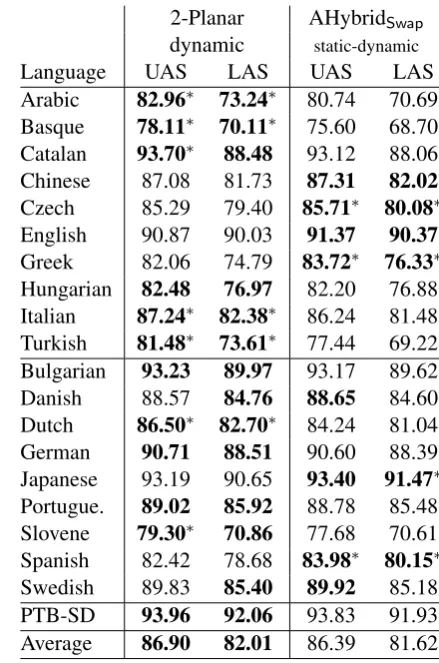
de-crease. When comparing with the enhanced arc-hybrid system in Table2, our approach provides a better UAS in 12 out of 20 datasets tested, achiev-ing statistically significant (α = .05) gains in
ac-curacy on 7 of them, and significant losses on 3 of them.
We could not find a clear pattern to explain why the 2-Planar algorithm outperforms arc-hybrid plusSwapin some languages and vice versa. The
arc-2-Planar 2-Planar static dynamic
Language UAS LAS UAS LAS
Arabic 83.20 73.48 82.96 73.24 Basque 77.61 69.94 78.11 70.11
Catalan 92.50 87.92 93.70∗ 88.48∗ Chinese 85.95 80.97 87.08∗ 81.73∗ Czech 84.67 78.56 85.29 79.40
English 89.57 88.69 90.87∗ 90.03∗ Greek 81.93 74.23 82.06 74.79
Hungarian 81.50 75.94 82.48∗ 76.97∗ Italian 86.85 82.36 87.24 82.38
Turkish 81.68 73.59 81.48 73.61
Bulgarian 93.14 89.74 93.23 89.97
Danish 88.31 84.23 88.57 84.76
Dutch 85.51 81.63 86.50∗ 82.70∗ German 90.80 88.71 90.71 88.51 Japanese 92.51 90.56 93.19∗ 90.65∗ Portugue. 88.68 85.12 89.02∗ 85.92∗ Slovene 78.67 70.49 79.30 70.86
[image:5.595.299.519.60.392.2]Spanish 83.63∗ 79.79∗ 82.42 78.68 Swedish 89.92 85.48 89.83 85.40 PTB-SD 93.59 91.60 93.96∗ 92.06∗ Average 86.51 81.65 86.90 82.01
Table 1: Parsing accuracy of the 2-Planar parser trained with static and dynamic oracles on CoNLL-XI (first block), CoNLL-X (second block) and PTB-SD (third block) datasets. Best results for each language are shown in boldface. Statistically significant improve-ments (α=.05) are marked with∗.
hybrid system that can handle unrestricted non-projectivity. The reasons, beyond the scope of this research, might be related to different dependency length distributions or non-projective topologies.
We noticed that, in general, the 2-Planar parser has higher precision on non-projective arcs and the enhanced arc-hybrid parser has a better recall.
5 Conclusion
We present an efficient dynamic oracle to train the 2-Planar transition-based parser, which is cor-rect with respect to a given plane assignment, and results in notable gains in accuracy. The parser trained with this dynamic oracle performs better on average than an expected linear-time parser supporting unrestricted non-projectivity.
2-Planar AHybridSwap
dynamic static-dynamic
Language UAS LAS UAS LAS
Arabic 82.96∗ 73.24∗ 80.74 70.69 Basque 78.11∗ 70.11∗ 75.60 68.70 Catalan 93.70∗ 88.48 93.12 88.06 Chinese 87.08 81.73 87.31 82.02
Czech 85.29 79.40 85.71∗ 80.08∗ English 90.87 90.03 91.37 90.37
Greek 82.06 74.79 83.72∗ 76.33∗ Hungarian 82.48 76.97 82.20 76.88 Italian 87.24∗ 82.38∗ 86.24 81.48 Turkish 81.48∗ 73.61∗ 77.44 69.22 Bulgarian 93.23 89.97 93.17 89.62 Danish 88.57 84.76 88.65 84.60 Dutch 86.50∗ 82.70∗ 84.24 81.04 German 90.71 88.51 90.60 88.39 Japanese 93.19 90.65 93.40 91.47∗ Portugue. 89.02 85.92 88.78 85.48 Slovene 79.30∗ 70.86 77.68 70.61 Spanish 82.42 78.68 83.98∗ 80.15∗ Swedish 89.83 85.40 89.92 85.18 PTB-SD 93.96 92.06 93.83 91.93 Average 86.90 82.01 86.39 81.62
Table 2: Parsing accuracy of the 2-Planar parser trained with the dynamic oracle and the arc-hybrid parser with theSwaptransition trained with a static-dynamic oracle on CoNLL-XI (first block), CoNLL-X (second block) and PTB-SD (third block) datasets. Best results for each language are in boldface. Statistically significant improvements (α=.05) are marked with∗.
Acknowledgments
This work has received funding from the European Research Council (ERC), under the European Union’s Horizon 2020 research and innova-tion programme (FASTPARSE, grant agreement No 714150), from the TELEPARES-UDC pro-ject (FFI2014-51978-C2-2-R) and the ANSWER-ASAP project (TIN2017-85160-C2-1-R) from MINECO, and from Xunta de Galicia (ED431B 2017/01).
References
[image:5.595.82.423.61.393.2]Piotr Bojanowski, Edouard Grave, Armand Joulin, and Tomas Mikolov. 2016. Enriching word vec-tors with subword information. arXiv preprint arXiv:1607.04606.
Sabine Buchholz and Erwin Marsi. 2006. CoNLL-X shared task on multilingual dependency parsing. In Proceedings of the 10th Conference on Computa-tional Natural Language Learning (CoNLL). pages 149–164. http://www.aclweb.org/anthology/W06-2920.
Michael A. Covington. 2001. A fundamental algorithm for dependency parsing. InProceedings of the 39th Annual ACM Southeast Conference. ACM, New York, NY, USA, pages 95–102.
Miryam de Lhoneux, Sara Stymne, and Joakim Nivre. 2017. Arc-hybrid non-projective dependency pars-ing with a static-dynamic oracle. InProceedings of the The 15th International Conference on Parsing Technologies (IWPT).. Pisa, Italy.
Marie-Catherine de Marneffe and Christopher D. Manning. 2008. The stanford typed depend-encies representation. In Coling 2008: Pro-ceedings of the Workshop on Cross-Framework and Cross-Domain Parser Evaluation. Associ-ation for ComputAssoci-ational Linguistics, Strouds-burg, PA, USA, CrossParser ’08, pages 1–8.
http://dl.acm.org/citation.cfm?id=1608858.1608859.
Daniel Fern´andez-Gonz´alez and Carlos G´omez-Rodr´ıguez. 2012. Improving transition-based dependency parsing with buffer transitions. In Pro-ceedings of the 2012 Joint Conference on Empirical Methods in Natural Language Processing and Com-putational Natural Language Learning. Association for Computational Linguistics, pages 308–319.
http://aclweb.org/anthology/D/D12/D12-1029.pdf.
Yoav Goldberg and Joakim Nivre. 2012. A dynamic oracle for arc-eager dependency parsing. In Pro-ceedings of COLING 2012. Association for Compu-tational Linguistics, Mumbai, India, pages 959–976.
http://www.aclweb.org/anthology/C12-1059.
Yoav Goldberg and Joakim Nivre. 2013. Training deterministic parsers with non-deterministic oracles. Transactions of the Association for Computational Linguistics 1:403–414.
http://anthology.aclweb.org/Q/Q13/Q13-1033.pdf.
Yoav Goldberg, Francesco Sartorio, and Giorgio Satta. 2014. A tabular method for dynamic oracles in transition-based parsing. Transactions of the Asso-ciation for Computational Linguistics2:119–130.
Carlos G´omez-Rodr´ıguez. 2016. Restricted non-projectivity: Coverage vs. efficiency. Comput. Linguist. 42(4):809–817. ht-tps://doi.org/10.1162/COLI a 00267.
Carlos G´omez-Rodr´ıguez and Daniel Fern´andez-Gonz´alez. 2015. An efficient dynamic oracle for
unrestricted non-projective parsing. In Proceed-ings of the 53rd Annual Meeting of the Association for Computational Linguistics and the 7th Interna-tional Joint Conference on Natural Language Pro-cessing of the Asian Federation of Natural Language Processing, ACL 2015, July 26-31, 2015, Beijing, China, Volume 2: Short Papers. pages 256–261.
http://aclweb.org/anthology/P/P15/P15-2042.pdf.
Carlos G´omez-Rodr´ıguez and Joakim Nivre. 2010.
A transition-based parser for 2-planar dependency structures. In Proceedings of the 48th Annual Meeting of the Association for Computational Lin-guistics. Association for Computational Linguistics, Stroudsburg, PA, USA, ACL ’10, pages 1492–1501.
http://dl.acm.org/citation.cfm?id=1858681.1858832.
Carlos G´omez-Rodr´ıguez and Joakim Nivre. 2013. Di-visible transition systems and multiplanar depend-ency parsing.Comput. Linguist.39(4):799–845. ht-tps://doi.org/10.1162/COLI a 00150.
Carlos G´omez-Rodr´ıguez, Francesco Sartorio, and Giorgio Satta. 2014. A polynomial-time dy-namic oracle for non-projective dependency parsing. In Proceedings of the 2014 Confer-ence on Empirical Methods in Natural Lan-guage Processing (EMNLP). Association for Computational Linguistics, pages 917–927.
http://aclweb.org/anthology/D14-1099.
Matthew Honnibal, Yoav Goldberg, and Mark John-son. 2013. A non-monotonic arc-eager trans-ition system for dependency parsing. In Proceed-ings of the Seventeenth Conference on Computa-tional Natural Language Learning, CoNLL 2013, Sofia, Bulgaria, August 8-9, 2013. pages 163– 172. http://aclweb.org/anthology/W/W13/W13-3518.pdf.
Eliyahu Kiperwasser and Yoav Goldberg. 2016. Simple and accurate dependency parsing using bidirectional LSTM feature representations. TACL 4:313–327. ht-tps://transacl.org/ojs/index.php/tacl/article/view/885.
Marco Kuhlmann, Carlos G´omez-Rodr´ıguez, and Giorgio Satta. 2011. Dynamic programming algorithms for transition-based dependency pars-ers. In Proceedings of the 49th Annual Meeting of the Association for Computational Linguist-ics: Human Language Technologies - Volume 1. Association for Computational Linguistics, Stroudsburg, PA, USA, HLT ’11, pages 673–682.
http://dl.acm.org/citation.cfm?id=2002472.2002558.
Mitchell P. Marcus, Beatrice Santorini, and Mary Ann Marcinkiewicz. 1993. Building a large annotated corpus of English: The Penn Treebank. Computa-tional Linguistics19:313–330.
Joakim Nivre. 2004. Incrementality in deterministic dependency parsing. In Proceedings of the Work-shop on Incremental Parsing: Bringing Engineering and Cognition Together (ACL). pages 50–57.
Joakim Nivre. 2008. Algorithms for Determ-inistic Incremental Dependency Parsing. Computational Linguistics 34(4):513–553.
https://doi.org/10.1162/coli.07-056-R1-07-027.
Joakim Nivre. 2009. Non-projective dependency pars-ing in expected linear time. In Proceedings of the Joint Conference of the 47th Annual Meeting of the ACL and the 4th International Joint Conference on Natural Language Processing of the AFNLP (ACL-IJCNLP). pages 351–359.
Joakim Nivre, Johan Hall, Sandra K¨ubler, Ryan McDonald, Jens Nilsson, Sebastian Riedel, and Deniz Yuret. 2007. The CoNLL 2007 shared task on dependency parsing. In Pro-ceedings of the CoNLL Shared Task Session of EMNLP-CoNLL 2007. pages 915–932.
http://www.aclweb.org/anthology/D/D07/D07-1096.pdf.
Joakim Nivre and Jens Nilsson. 2005. Pseudo-projective dependency parsing. In ACL ’05: Pro-ceedings of the 43rd Annual Meeting of the Associ-ation for ComputAssoci-ational Linguistics. AssociAssoci-ation for Computational Linguistics, Morristown, NJ, USA, pages 99–106.
Jeffrey Pennington, Richard Socher, and Chris-topher D. Manning. 2014.Glove: Global vectors for word representation. InEmpirical Methods in Nat-ural Language Processing (EMNLP). pages 1532– 1543.http://www.aclweb.org/anthology/D14-1162.
Emily Pitler and Ryan McDonald. 2015. A linear-time transition system for crossing inter-val trees. In Proceedings of the 2015 Confer-ence of the North American Chapter of the As-sociation for Computational Linguistics: Human Language Technologies. Association for Computa-tional Linguistics, Denver, Colorado, pages 662– 671. http://www.aclweb.org/anthology/N15-1068.