A Tensor-based Factorization Model of Semantic Compositionality
Tim Van de Cruys
IRIT – UMR 5505 CNRS Toulouse, France
Thierry Poibeau?
LaTTiCe – UMR 8094 CNRS & ENS
Paris, France
Anna Korhonen
Computer Laboratory & DTAL? University of Cambridge
United Kingdom
Abstract
In this paper, we present a novel method for the computation of compositionality within a distri-butional framework. The key idea is that com-positionality is modeled as a multi-way interac-tion between latent factors, which are automat-ically constructed from corpus data. We use our method to model the composition of sub-ject verb obsub-jecttriples. The method consists of two steps. First, we compute a latent factor model for nouns from standard co-occurrence data. Next, the latent factors are used to induce a latent model of three-waysubject verb object interactions. Our model has been evaluated on a similarity task for transitive phrases, in which it exceeds the state of the art.
1 Introduction
In the course of the last two decades, significant progress has been made with regard to the automatic extraction of lexical semantic knowledge from large-scale text corpora. Most work relies on the distribu-tional hypothesis of meaning (Harris, 1954), which states that words that appear within the same contexts tend to be semantically similar. A large number of researchers have taken this dictum to heart, giving rise to a plethora of algorithms that try to capture the semantics of words by looking at their distribu-tion in text. Up till now, however, most work on the automatic acquisition of semantics only deals with individual words. The modeling of meaning beyond the level of individual words – i.e. the combination of words into larger units – is to a large degree left unexplored.
The principle of compositionality, often attributed to Frege, is the principle that states that the meaning of a complex expression is a function of the meaning of its parts and the way those parts are (syntactically) combined (Frege, 1892). It is the fundamental prin-ciple that allows language users to understand the meaning of sentences they have never heard before, by constructing the meaning of the complex expres-sion from the meanings of the individual words. Re-cently, a number of researchers have tried to reconcile the framework of distributional semantics with the principle of compositionality (Mitchell and Lapata, 2008; Baroni and Zamparelli, 2010; Coecke et al., 2010; Socher et al., 2012). However, the absolute gains of the systems remain a bit unclear, and a sim-ple method of composition – vector multiplication – often seems to produce the best results (Blacoe and Lapata, 2012).
In this paper, we present a novel method for the joint composition of a verb with its subject and di-rect object. The key idea is that compositionality is modeled as a multi-way interaction between latent factors, which are automatically constructed from corpus data. In order to adequately model the multi-way interaction between a verb and its subject and objects, a significant part of our method relies on tensor algebra. Additionally, our method makes use of a factorization model appropriate for tensors.
The remainder of the paper is structured as follows. In section 2, we give an overview of previous work that is relevant to the task of computing composition-ality within a distributional framework. Section 3 presents a detailed description of our method, in-cluding an overview of the necessary mathematical
machinery. Section 4 illustrates our method with a number of detailed examples. Section 5 presents a quantitative evaluation, and compares our method to other models of distributional compositionality. Section 6, then, concludes and lays out a number of directions for future work.
2 Previous Work
In recent years, a number of methods have been de-veloped that try to capture compositional phenomena within a distributional framework. One of the first approaches to tackle compositional phenomena in a systematic way is Mitchell and Lapata’s (2008) ap-proach. They explore a number of different models for vector composition, of which vector addition (the sum of each feature) and vector multiplication (the elementwise multiplication of each feature) are the most important. They evaluate their models on a noun-verb phrase similarity task, and find that the multiplicative model yields the best results, along with a weighted combination of the additive and mul-tiplicative model.
Baroni and Zamparelli (2010) present a method for the composition of adjectives and nouns. In their model, an adjective is a linear function of one vector (the noun vector) to another vector (the vector for the adjective-noun pair). The linear transformation for a particular adjective is represented by a matrix, and is learned automatically from a corpus, using partial least-squares regression.
Coecke et al. (2010) present an abstract theoreti-cal framework in which a sentence vector is a func-tion of the Kronecker product of its word vectors, which allows for greater interaction between the dif-ferent word features. A number of instantiations of the framework are tested experimentally in Grefen-stette and Sadrzadeh (2011a) and GrefenGrefen-stette and Sadrzadeh (2011b). The key idea is that relational words (e.g. adjectives or verbs) have a rich (multi-dimensional) structure that acts as a filter on their arguments. Our model uses an intuition similar to theirs.
Socher et al. (2012) present a model for composi-tionality based on recursive neural networks. Each node in a parse tree is assigned both a vector and a matrix; the vector captures the actual meaning of the constituent, while the matrix models the way
it changes the meaning of neighbouring words and phrases.
Closely related to the work on compositionality is research on the computation of word meaning in context. Erk and Pad´o (2008, 2009) make use of selectional preferences to express the meaning of a word in context; the meaning of a word in the pres-ence of an argument is computed by multiplying the word’s vector with a vector that captures the inverse selectional preferences of the argument. Thater et al. (2009, 2010) extend the approach based on se-lectional preferences by incorporating second-order co-occurrences in their model. And Dinu and La-pata (2010) propose a probabilistic framework that models the meaning of words as a probability distri-bution over latent factors. This allows them to model contextualized meaning as a change in the original sense distribution. Dinu and Lapata use non-negative matrix factorization (NMF) to induce latent factors. Similar to their work, our model usesNMF– albeit in a slightly different configuration – as a first step towards our final factorization model.
In general, latent models have proven to be useful for the modeling of word meaning. One of the best known latent models of semantics is Latent Seman-tic Analysis (Landauer and Dumais, 1997), which uses singular value decomposition in order to auto-matically induce latent factors from term-document matrices. Another well known latent model of mean-ing, which takes a generative approach, is Latent Dirichlet Allocation (Blei et al., 2003).
The idea of modeling compositionality by means of tensor (Kronecker) product has been proposed in the literature before (Clark and Pulman, 2007; Coecke et al., 2010). However, the method presented here is the first that tries to capture compositional phenomena by exploiting the multi-way interactions between latent factors, induced by a suitable tensor factorization model.
3 Methodology
3.1 Mathematical preliminaries
The methodology presented in this paper requires a number of concepts and mathematical operations from tensor algebra, which are briefly reviewed in this section. The interested reader is referred to Kolda and Bader (2009) for a more thorough introduction to tensor algebra (including an overview of various factorization methods).
Atensoris a multidimensional array; it is the gen-eralization of a matrix to more than two dimensions, ormodes. Whereas matrices are only able to ture two-way co-occurrences, tensors are able to cap-turemulti-wayco-occurrences.1 Following prevail-ing convention, tensors are represented by boldface Euler script notation (X), matrices by boldface capi-tal letters (X), vectors by boldface lower case letters (x), and scalars by italic letters (x).
Then-mode productof a tensorX∈RI1×I2×...×IN
with a matrixU∈RJ×In is denoted byX×
nU, and is defined elementwise as
(X×nU)i1...in−1jin+1...iN =
In
∑
in=1
xi1i2...iNujin (1)
TheKronecker productof matricesA∈RI×Jand
B∈RK×Lis denoted byA⊗B. The result is a matrix of size(IK)×(JL), and is defined by
A⊗B=
a11B a12B · · · a1JB a21B a22B · · · a2JB
..
. ... . .. ... aI1B aI2B . . . aIJB
(2)
1In this research, we limit ourselves to three-way co-occurrences of verbs, subject, and objects, modelled using a three-mode tensor.
A special case of the Kronecker product is the outer productof two vectorsa∈RI andb∈
RJ, de-noteda◦b. The result is a matrixA∈RI×J obtained by multiplying each element ofawith each element ofb.
Finally, the Hadamard product, denoted A∗B, is the elementwise multiplication of two matrices
A∈RI×J andB∈RI×J, which produces a matrix that is equally of sizeI×J.
3.2 The construction of latent noun factors
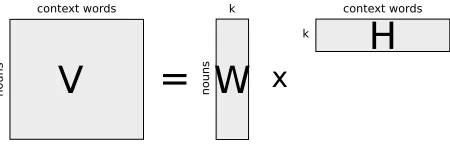
The first step of our method consists in the construc-tion of a latent factor model for nouns, based on their context words. For this purpose, we make use of non-negative matrix factorization (Lee and Seung, 2000). Non-negative matrix factorization (NMF) minimizes an objective function – in our case the Kullback-Leibler (KL) divergence – between an original matrix
VI×J andWI×KHK×J (the matrix multiplication of matricesWandH) subject to the constraint that all values in the three matrices be non-negative. Param-eterK is set I,J so that a reduction is obtained over the original data. The factorization model is represented graphically in figure 1.
=
x
V
W
H
k
k
n
o
u
n
s
context words
n
o
u
n
s
[image:3.612.315.540.397.470.2]context words
Figure 1: Graphical representation ofNMF
NMF can be computed fairly straightforwardly, alternating between the two iterative update rules represented in equations 3 and 4. The update rules are guaranteed to converge to a local minimum in the KLdivergence.
Haµ←Haµ
∑iWia(WH)Viµ
iµ
∑kWka
(3)
Wia←Wia
∑µHaµ Viµ (WH)iµ
∑vHav
(4)
3.3 Modeling multi-way interactions
on the latent factors induced in the first step. Our latent interaction model is inspired by a tensor factor-ization model called Tucker decomposition (Tucker, 1966), although our own model instantiation differs significantly. In order to explain our method, we first revisit Tucker decomposition, and subsequently explain how our model is constructed.
3.3.1 Tucker decomposition
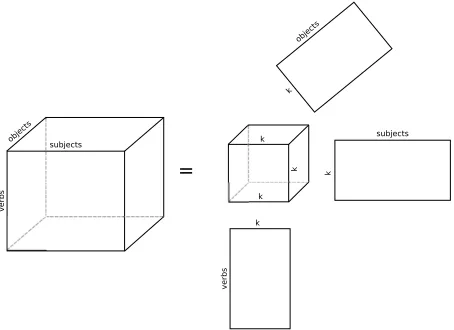
Tucker decomposition is a multilinear generaliza-tion of the well-known singular value decomposigeneraliza-tion, used in Latent Semantic Analysis. It is also known as higher order singular value decomposition (HOSVD, De Lathauwer et al. (2000)). In Tucker decomposi-tion, a tensor is decomposed into a core tensor, multi-plied by a matrix along each mode. For a three-mode tensorX∈RI×J×L, the model is defined as
X = G×1A×2B×3C (5)
= P
∑
p=1
Q
∑
q=1
R
∑
r=1
gpqrap◦bq◦cr (6)
Setting P,Q,RI,J,L, the core tensorG repre-sents a compressed, latent version of the original ten-sorX; matricesA∈RI×P,B∈
RJ×Q, andC∈RL×R represent the latent factors for each mode, while
G∈RP×Q×R indicates the level of interaction be-tween the different latent factors. Figure 2 shows a graphical representation of Tucker decomposition.2
subjects
verbs
objects
=
objects
k
k
k
verbs
subjects
k
k
[image:4.612.73.300.471.636.2]k
Figure 2: A graphical representation of Tucker decompo-sition
2whereP=Q=R=K, i.e. the same number of latent factors Kis used for each mode
3.3.2 Reconstructing a Tucker model from two-way factors
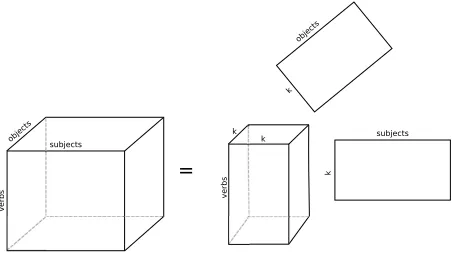
Computing the Tucker decomposition of a tensor is rather costly in terms of time and memory require-ments. Moreover, the decomposition is not unique: the core tensorGcan be modified without affecting the model’s fit by applying the inverse modification to the factor matrices. These two drawbacks led us to consider an alternative method for the construc-tion of the Tucker model. Specifically, we consider the factor matrices as given (as the output from our first step), and proceed to compute the core tensorG. Additionally, we do not use a latent representation for the first mode, which means that the first mode is represented by its original instances.
Our model can be straightforwardly applied to lan-guage data. The core tensor G models the latent interactions between verbs, subject, and objects. G is computed by applying the n-mode product to the appropriate mode of the original tensor (equation 7),
G=X×2WT×3WT (7)
whereXV×N×Nis our original data tensor, consisting of the weighted co-occurrence frequencies of svo triples (extracted from corpus data), and WN×K is our latent factor matrix for nouns. Note that we do not use a latent representation for the verb mode. To be able to efficiently compute the similarity of verbs (both within and outside of compositional phrases), only thesubjectandobjectmode are represented by latent factors, while the verbmode is represented by its original instances. This means that our core tensorG will be of sizeV×K×K.3 A graphical representation is given in figure 3.
Note that both tensorXand factor matricesWare non-negative, which means our core tensor Gwill also be non-negative.
3.4 The composition ofsvotriples
In order to compute the composition of a particular subject verb object triplehs,v,oi, we first extract the appropriate subject vectorwsand object vectorwo (both of length K) from our factor matrixW, and
subjects
verbs
objects
=
objects
k
k
verbs
subjects k
[image:5.612.73.300.60.187.2]k
Figure 3: A graphical representation of our model instan-tiation without the latent verb mode
compute the outer product of both vectors, resulting in a matrixYof sizeK×K.
Y=ws◦wo (8)
Our second and final step is then to weight the original verb matrix Gv of latent interactions (the appropriate verb slice of tensor G) with matrix Y, containing the latent interactions of the specific sub-ject and obsub-ject. This is carried out by taking the Hadamard product ofGvandY.
Z=Gv∗Y (9)
4 Example
In this section, we present a number of example com-putations that clarify how our model is able to capture compositionality. All examples come from actual cor-pus data, and are computed in a fully automatic and unsupervised way.
Consider the following two sentences:
(1) The athlete runs a race.
(2) The user runs a command.
Both sentences contain the verb run, but they rep-resent clearly different actions. When we compute the composition of both instances ofrunwith their respective subject and object, we want our model to show this difference.
To compute the compositional representation of sentences (1) and (2), we proceed as follows. First, we extract the latent vectors for subject and object (wathlete and wrace for the first sentence, wuser and
wcommand for the second sentence) from matrix W.
Next, we compute the outer product of subject and object –wathlete◦wraceandwuser◦wcommand– which yields matrices Yhathlete,raceiandYhuser,commandi. By virtue of the outer product, the matricesY– of size K×K– represent the level of interaction between the latent factors of the subject and the latent factors of the object. We can inspect these interactions by look-ing up the factor pairs (i.e. matrix cells) with the high-est values in the matricesY. Table 1 presents the fac-tor pairs with highest value for matrixYhathlete,racei; table 2 represents the factor pairs with highest value for matrixYhuser,commandi. In order to render the fac-tors interpretable, we include the three most salient words for the various factors (i.e. the words with the highest value for a particular factor).
The examples in tables 1 and 2 give an impression of the effect of the outer product: semantic features of the subject combine with semantic features of the object, indicating the extent to which these features interact within the expression. In table 1, we notice that animacy features (28, 195) and a sport feature (25) combine with a ‘sport event’ feature (119). In table 2, we see that similar animacy features (40, 195) and technological features (7, 45) combine with another technological feature (89).
Similarly, we can inspect the latent interactions of the verbrun, which are represented in the tensor slice
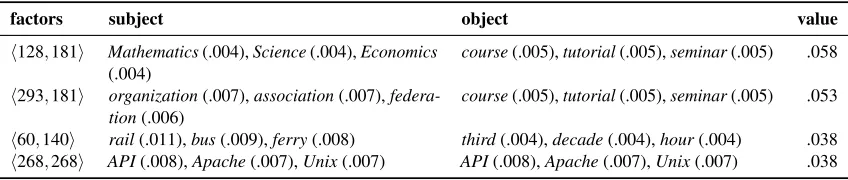
Grun. Note that this matrix contains the verb seman-tics computed over the complete corpus. The most salient factor interactions forGrunare represented in table 3.
Table 3 illustrates that different senses of the verb runare represented within the matrixGrun. The first two factor pairs hint at the ‘organize’ sense of the verb (run a seminar). The third factor pair repre-sents the ‘transport’ sense of the verb (the bus runs every hour).4 And the fourth factor pair represents the ‘execute’ or ‘deploy’ sense of run (run Linux, run a computer program). Note that we only show the factor pairs with the highest value; matrixG con-tains a value for each pairwise combination of the latent factors, effectively representing a rich latent semantics for the verb in question.
The last step is to take the Hadamard product of matricesYwith verb matrixG, which yields our final
factors subject object value
h195,119i people(.008),child(.008),adolescent(.007) cup(.007),championship(.006),final(.005) .007
h25,119i hockey(.007),poker(.007),tennis(.006) cup(.007),championship(.006),final(.005) .004
h90,119i professionalism(.007),teamwork(.007), confi-dence(.006)
cup(.007),championship(.006),final(.005) .003
[image:6.612.96.518.61.139.2]h28,119i they(.004),pupil(.003),participant(.003) cup(.007),championship(.006),final(.005) .003
Table 1: Factor pairs with highest value for matrixYhathlete,racei
factors subject object value
h7,89i password(.009),login(.007),username(.007) filename(.007),null(.006),integer(.006) .010
h40,89i anyone(.004),reader(.004),anybody(.003) filename(.007),null(.006),integer(.006) .007
h195,89i people(.008),child(.008),adolescent(.007) filename(.007),null(.006),integer(.006) .006
h45,89i website(.004),Click(.003),site(.003) filename(.007),null(.006),integer(.006) .006
Table 2: Factor pairs with highest value for matrixYhuser,commandi
matrices,Zrun,hathlete,raceiandZrun,huser,commandi. The Hadamard product will act as a bidirectional filter on the semantics of both the verb and its subject and object: interactions of semantic features that are present in both matrixYandGwill be highlighted, while the other interactions are played down. The result is a representation of the verb’s semantics tuned to its particular subject-object combination. Note that this final step can be viewed as an instance of function application (Baroni and Zamparelli, 2010). Also note the similarity to Grefenstette and Sadrzadeh’s (2011a,2011b) approach, who equally make use of the elementwise matrix product in order to weight the semantics of the verb.
We can now go back to our original tensorG, and compute the most similar verbs (i.e. the most similar tensor slices) for our newly computed matricesZ.5
If we do this for matrixZrun,hathlete,racei, our model comes up with verbsfinish(.29), attend(.27), and win(.25). If, instead, we compute the most similar verbs forZrun,huser,commandi, our model yieldsexecute (.42),modify(.40),invoke(.39).
Finally, note that the design of our model natu-rally takes into account word order. Consider the following two sentences:
(3) man damages car
(4) car damages man
5Similarity is calculated by measuring the cosine of the vec-torized and normalized representation of the verb matrices.
Both sentences contain the exact same words, but the process of damaging described in sentences (3) and (4) is of a rather different nature. Our model is able to take this difference into account: if we compute
Zdamage,hman,cari following sentence (3), our model yieldscrash(.43),drive(.35),ride(.35) as most sim-ilar verbs. If we do the same forZdamage,hcar,mani fol-lowing sentence (4), our model instead yieldsscare (.26),kill(.23),hurt(.23).
5 Evaluation
5.1 Methodology
In order to evaluate the performance of our tensor-based factorization model of compositionality, we make use of the sentence similarity task for transi-tive sentences, defined in Grefenstette and Sadrzadeh (2011a). This is an extension of the similarity task for compositional models developed by Mitchell and Lapata (2008), and constructed according to the same guidelines. The dataset contains 2500 similarity judgements, provided by 25 participants, and is pub-licly available.6
The data consists of transitive verbs, each paired with both a subject and an object noun – thus form-ing a small transitive sentence. Additionally, a ‘land-mark’ verb is provided. The idea is to compose both the target verb and the landmark verb with subject and noun, in order to form two small compositional
6http://www.cs.ox.ac.uk/activities/
[image:6.612.91.521.177.242.2]factors subject object value
h128,181i Mathematics(.004),Science(.004),Economics (.004)
course(.005),tutorial(.005),seminar(.005) .058
h293,181i organization(.007),association(.007), federa-tion(.006)
course(.005),tutorial(.005),seminar(.005) .053
h60,140i rail(.011),bus(.009),ferry(.008) third(.004),decade(.004),hour(.004) .038
[image:7.612.94.518.60.150.2]h268,268i API(.008),Apache(.007),Unix(.007) API(.008),Apache(.007),Unix(.007) .038
Table 3: Factor combinations forGrun
phrases. The system is then required to come up with a suitable similarity score for these phrases. The cor-relation of the model’s judgements with human judge-ments (scored 1–7) is then calculated using Spear-man’sρ. Two examples of the task are provided in
table 4.
p target subject object landmark sim
19 meet system criterion visit 1 21 write student name spell 6
Table 4: Two example judgements from the phrase simi-larity task defined by Grefenstette and Sadrzadeh (2011a)
Grefenstette and Sadrzadeh (2011a) seem to cal-culate the similarity score contextualizing both the target verb and the landmark verb. Another possibil-ity is to contextualize only the target verb, and com-pute the similarity score with the non-contextualized landmark verb. In our view, the latter option pro-vides a better assessment of the model’s similar-ity judgements, since contextualizing low-similarsimilar-ity landmarks often yields non-sensical phrases (e.g. sys-tem visits criterion). We provide scores for both contextualized and non-contextualized landmarks.
We compare our results to a number of different models. The first is Mitchell and Lapata’s (2008) model, which computes the elementwise vector mul-tiplication of verb, subject and object. The second is Grefenstette and Sadrzadeh’s (2011b) best scoring model instantiation of the categorical distributional compositional model (Coecke et al., 2010). This model computes the outer product of the subject and object vector, the outer product of the verb vector with itself, and finally the elementwise product of both results. It yields the best score on the transitive sentence similarity task reported to date.
As a baseline, we compute the non-contextualized
similarity score for target verb and landmark. The up-per bound is provided by Grefenstette and Sadrzadeh (2011a), based on interannotator agreement.
5.2 Implementational details
All models have been constructed using theUKWAC corpus (Baroni et al., 2009), a 2 billion word corpus automatically harvested from the web. From this data, we accumulate the input matrixVfor our firstNMF step. We use the 10K most frequent nouns, cross-classified by the 2Kmost frequent context words.7 MatrixVis weighted using pointwise mutual infor-mation (PMI, Church and Hanks (1990)).
A parsed version of the corpus is available, which has been parsed with MaltParser (Nivre et al., 2006). We use this version in order to extract oursvotriples. From these triples, we construct our tensorX, using 1Kverbs×10Ksubjects×10Kobjects. Note once again that the subject and object instances in the sec-ond step are exactly the same as the noun instances in the first step. TensorXhas been weighted using a three-way extension ofPMI, following equation 10 (Van de Cruys, 2011).
pmi3(x,y,z) =log p(x,y,z)
p(x)p(y)p(z) (10)
We setK=300 as our number of latent factors. The value was chosen as a trade-off between a model that is both rich enough, and does not require an excessive amount of memory (for the modeling of the core tensor). The algorithm runs fairly effi-ciently. EachNMFstep is computed in a matter of seconds, with convergence after 50–100 iterations. The construction of the core tensor is somewhat more
evolved, but does not exceed a wall time of 30 min-utes. Results have been computed on a machine with Intel Xeon 2.93Ghz CPU and 32GB of RAM.
5.3 Results
The results of the various models are presented in ta-ble 5;multiplicativerepresents Mitchell and Lapata’s (2008) multiplicative model,categoricalrepresents Grefenstette and Sadrzadeh’s (2011b) model, and latentrepresents the model presented in this paper.
model contextualized non-contextualized
baseline .23
multiplicative .32 .34
categorical .32 .35
latent .32 .37
upper bound .62
Table 5: Results of the different compositionality models on the phrase similarity task
In the contextualized version of the similarity task (in which the landmark is combined with subject and object), all three models obtain the same result (.32). However, in the non-contextualized version (in which only the target verb is combined with sub-ject and obsub-ject), the models differ in performance. These differences are statistically significant.8 As mentioned before, we believe the non-contextualized version of the task gives a better impression of the systems’ ability to capture compositionality. The contextualization of the landmark verb often yields non-sensical combinations, such assystem visits crite-rion. We therefore deem it preferable to compute the similarity of the target verb in composition (system meets criterion) to the non-contextualized semantics of the landmark verb (visit).
Note that the scores presented in this evalua-tion (including the baseline score) are significantly higher than the scores presented in Grefenstette and Sadrzadeh (2011b). This is not surprising, since the corpus we use – UKWAC – is an order of magni-tude larger than the corpus used in their research – the British National Corpus (BNC). Presumably, the scores are also favoured by our weighting measure.
8p<0.01; model differences have been tested using stratified shuffling (Yeh, 2000).
In our experience,PMIperforms better than weight-ing with conditional probabilities.9
6 Conclusion
In this paper, we presented a novel method for the computation of compositionality within a distribu-tional framework. The key idea is that composition-ality is modeled as a multi-way interaction between latent factors, which are automatically constructed from corpus data. We used our method to model the composition ofsubject verb objectcombinations. The method consists of two steps. First, we com-pute a latent factor model for nouns from standard co-occurrence data. Next, the latent factors are used to induce a latent model of three-waysubject verb objectinteractions, represented by a core tensor. Our model has been evaluated on a similarity task for tran-sitive phrases, in which it matches and even exceeds the state of the art.
We conclude with a number of future work issues. First of all, we would like to extend our framework in order to incorporate more compositional phenomena. Our current model is designed to deal with the latent modeling ofsubject verb objectcombinations. We would like to investigate how other compositional phenomena might fit within our latent interaction framework, and how our model is able to tackle the computation of compositionality across a differing number of modes.
Secondly, we would like to further explore the possibilities of our model in which all three modes are represented by latent factors. The instantiation of our model presented in this paper has two latent modes, using the original instances of the verb mode in order to efficiently compute verb similarity. We think a full-blown latent interaction model might prove to have interesting applications in a number of NLPtasks, such as the paraphrasing of compositional expressions.
Finally, we would like to test our method using a number of different evaluation frameworks. We think tasks of similarity judgement have their merits, but in a way are also somewhat limited. In our opinion, re-search on the modeling of compositional phenomena within a distributional framework would substantially
benefit from new evaluation frameworks. In particu-lar, we think of a lexical substitution or paraphrasing task along the lines of McCarthy and Navigli (2009), but specifically aimed at the assessment of composi-tional phenomena.
Acknowledgements
Tim Van de Cruys and Thierry Poibeau are supported by theCentre National de la Recherche Scientifique (CNRS, France), Anna Korhonen is supported by the Royal Society(UK).
References
Brett W. Bader, Tamara G. Kolda, et al. 2012. Matlab ten-sor toolbox version 2.5. http://www.sandia.gov/ ~tgkolda/TensorToolbox/.
Marco Baroni and Roberto Zamparelli. 2010. Nouns are vectors, adjectives are matrices: Representing adjective-noun constructions in semantic space. InProceedings of the 2010 Conference on Empirical Methods in Nat-ural Language Processing, pages 1183–1193, Cam-bridge, MA, October. Association for Computational Linguistics.
Marco Baroni, Silvia Bernardini, Adriano Ferraresi, and Eros Zanchetta. 2009. The wacky wide web: A collection of very large linguistically processed web-crawled corpora. Language Resources and Evaluation, 43(3):209–226.
William Blacoe and Mirella Lapata. 2012. A comparison of vector-based representations for semantic compo-sition. InProceedings of the 2012 Joint Conference on Empirical Methods in Natural Language Process-ing and Computational Natural Language LearnProcess-ing, pages 546–556, Jeju Island, Korea, July. Association for Computational Linguistics.
David M. Blei, Andrew Y. Ng, and Michael I. Jordan. 2003. Latent dirichlet allocation. The Journal of Ma-chine Learning Research, 3:993–1022.
Kenneth W. Church and Patrick Hanks. 1990. Word association norms, mutual information & lexicography. Computational Linguistics, 16(1):22–29.
Stephen Clark and Stephen Pulman. 2007. Combining symbolic and distributional models of meaning. In Pro-ceedings of the AAAI Spring Symposium on Quantum Interaction, pages 52–55.
Bob Coecke, Mehrnoosh Sadrzadeh, and Stephen Clark. 2010. Mathematical foundations for a compositional distributed model of meaning. Lambek Festschrift, Lin-guistic Analysis, vol. 36, 36.
Lieven De Lathauwer, Bart De Moor, and Joseph Vande-walle. 2000. A multilinear singular value decomposi-tion. SIAM Journal on Matrix Analysis and Applica-tions, 21(4):1253–1278.
Georgiana Dinu and Mirella Lapata. 2010. Measuring distributional similarity in context. InProceedings of the 2010 Conference on Empirical Methods in Natural Language Processing, pages 1162–1172, Cambridge, MA, October.
Katrin Erk and Sebastian Pad´o. 2008. A structured vector space model for word meaning in context. In Pro-ceedings of the Conference on Empirical Methods in Natural Language Processing, pages 897–906, Waikiki, Hawaii, USA.
Katrin Erk and Sebastian Pad´o. 2009. Paraphrase assess-ment in structured vector space: Exploring parameters and datasets. InProceedings of the Workshop on Geo-metrical Models of Natural Language Semantics, pages 57–65, Athens, Greece.
Gottlob Frege. 1892. Uber Sinn und Bedeutung.¨ Zeitschrift f¨ur Philosophie und philosophische Kritik, 100:25–50.
Eugenie Giesbrecht. 2010. Towards a matrix-based dis-tributional model of meaning. InProceedings of the NAACL HLT 2010 Student Research Workshop, pages 23–28. Association for Computational Linguistics. Edward Grefenstette and Mehrnoosh Sadrzadeh. 2011a.
Experimental support for a categorical compositional distributional model of meaning. InProceedings of the 2011 Conference on Empirical Methods in Natural Language Processing, pages 1394–1404, Edinburgh, Scotland, UK., July. Association for Computational Linguistics.
Edward Grefenstette and Mehrnoosh Sadrzadeh. 2011b. Experimenting with transitive verbs in a discocat. In Proceedings of the GEMS 2011 Workshop on GEomet-rical Models of Natural Language Semantics, pages 62–66, Edinburgh, UK, July. Association for Computa-tional Linguistics.
Zellig S. Harris. 1954. Distributional structure. Word, 10(23):146–162.
Richard A Harshman and Margaret E Lundy. 1994. Parafac: Parallel factor analysis.Computational Statis-tics & Data Analysis, 18(1):39–72.
Tamara G. Kolda and Brett W. Bader. 2009. Ten-sor decompositions and applications. SIAM Review, 51(3):455–500, September.
Tamara G. Kolda and Jimeng Sun. 2008. Scalable tensor decompositions for multi-aspect data mining. InICDM 2008: Proceedings of the 8th IEEE International Con-ference on Data Mining, pages 363–372, December. Thomas Landauer and Susan Dumais. 1997. A solution
the-ory of the acquisition, induction, and representation of knowledge. Psychology Review, 104:211–240. Daniel D. Lee and H. Sebastian Seung. 2000. Algorithms
for non-negative matrix factorization. InAdvances in Neural Information Processing Systems 13, pages 556– 562.
Diana McCarthy and Roberto Navigli. 2009. The En-glish lexical substitution task.Language resources and evaluation, 43(2):139–159.
Jeff Mitchell and Mirella Lapata. 2008. Vector-based models of semantic composition.proceedings of ACL-08: HLT, pages 236–244.
Joakim Nivre, Johan Hall, and Jens Nilsson. 2006. Malt-parser: A data-driven parser-generator for dependency parsing. InProceedings of LREC-2006, pages 2216– 2219.
Richard Socher, Brody Huval, Christopher D. Manning, and Andrew Y. Ng. 2012. Semantic compositionality through recursive matrix-vector spaces. InProceedings of the 2012 Joint Conference on Empirical Methods in Natural Language Processing and Computational Nat-ural Language Learning, pages 1201–1211, Jeju Island, Korea, July. Association for Computational Linguistics. Stefan Thater, Georgiana Dinu, and Manfred Pinkal. 2009. Ranking paraphrases in context. InProceedings of the 2009 Workshop on Applied Textual Inference, pages 44–47, Suntec, Singapore.
Stefan Thater, Hagen F¨urstenau, and Manfred Pinkal. 2010. Contextualizing semantic representations using syntactically enriched vector models. InProceedings of the 48th Annual Meeting of the Association for Compu-tational Linguistics, pages 948–957, Uppsala, Sweden. Ledyard R. Tucker. 1966. Some mathematical notes on
three-mode factor analysis. Psychometrika, 31(3):279– 311.
Tim Van de Cruys. 2010. A non-negative tensor fac-torization model for selectional preference induction. Natural Language Engineering, 16(4):417–437. Tim Van de Cruys. 2011. Two multivariate
generaliza-tions of pointwise mutual information. InProceedings of the Workshop on Distributional Semantics and Com-positionality, pages 16–20, Portland, Oregon, USA, June. Association for Computational Linguistics. Alexander Yeh. 2000. More accurate tests for the