Original Article
The ABCD patient classification tool for nurse-to-patient
assignment to improve nursing workload
balance: a multi-center study
Ziwen Wang1,2, Liming You1, Jing Zheng1, Xiangdong Guan3
1Sun Yat-sen University School of Nursing, Guangzhou, China; 2Department of Critical Care Medicine, Guangzhou Institute of Respiratory Disease, The First Affiliated Hospital of Guangzhou Medical University, Guangzhou, China; 3Department of Critical Care Medicine, The First Affiliated Hospital of Sun Yat-sen University, Guangzhou, China
Received March 13, 2017; Accepted April 17, 2017; Epub June 15, 2017; Published June 30, 2017
Abstract: Objective: The ABCD patient classification tool was established based on the patients’ disease status and nursing needs with the aim of better nursing resource allocation. The objective of this study was to determine the effectiveness of the ABCD classification tool in balancing workload of intensive care unit (ICU) nurses. Methods: A multi-center before-after study including adult and senile patients admitted to the general ICU was conducted. During the before phase between May 20th and June 24th 2012, the nurses for day shifts were allocated by nursing
managers according to the standard practice. Subsequently, the nursing managers and relevant nurses received education and training for the ABCD patient classification tool. The after phase included consecutive eligible pa -tients between August 1st and September 4th 2012 that was classified into four-grade groups (A, B, C, D) and the
patients in A group needed supreme care. Thereafter, the nurses were matched with patient classification and allocated through the enumeration method. The actual nursing workload for every day shift was evaluated using the mini-version of the Therapeutic Intervention Scoring System (TISS-28). The differences in inter-phase outcome measures including the coefficient of variation, the percent of nurses with normal workload (TISS-28 score, 40-50), and nurses’ satisfaction score were compared. A two-level fitting model was further utilized to estimate the influ -ence of ABCD classification tool on the probability of a normal workload. Results: After using the ABCD patient clas -sification tool, the coefficient of variation in nurses’ workload decreased from 32.40% to 28.50% and the percent of nurses with normal workload increased from 23.64% to 37.5%. The probability of a normal workload increased by 43% (β1=-0.358, P<0.01) when both day shift and nurse staffing based on the ABCD patient classification tool were fitted. No significant inter-phase difference in nurses’ satisfaction about workload was found (P=0.486). Conclusion: The ABCD patient classification tool is helpful in balancing nurses’ workload in the general ICU.
Keywords: Intensive care unit (ICU), ABCD patient classification tool, nurses’ workload, two-level model
Introduction
Nursing shortage is becoming a major health-care issue worldwide and will not change in the near future [1]. The insufficient nursing usually means increased workload to existing nurses, which might be a serious threat to nursing qual-ity and safety of patients in the intensive care unit (ICU) [2, 3]. Moreover, the increased labor demand is positively related with nurses’ job dissatisfaction, stress and burnout [4]. In these situations, a better nurse staffing method that optimizes match of nursing workload with patient needs as well as balance of workload among nurses is required [5].
[9-13]. However, these tools are flawed at com -plexity or invalidity which hinders the wide application of these tools in determining nurs-ing assignment [14].
Patient classification tools with the capacity of predicting patient needs for nursing and con-necting patient needs with nursing workload, have often been tried to guide patient-to-nurse assignment [15-17]. The four-grade ABCD clas-sification of ICU patients is a self-developed tool in China which helps classify nursing tasks into four grades of care reflecting patients’ actual nursing needs [18]. The purpose of this study is to evaluate the effectiveness of the ABCD patient classification tool for guiding patient-to-nurse assignment for ICU nurses and the effects on balancing nursing workload.
Methods
Study design and sample
An approval from the Ethics Committees of Sun Yat-sen University & the Sixth Affiliated Hospital of Sun Yat-sen University was got before the ini -tiation of this prospective before-after study, and the Ethics Research Grant Number was 2012016. Six general ICUs (Center 1 to 6) from five hospitals in Guangdong Province, China participated in this multi-center study which was conducted from May 20th to September 4th
2012. The first five-week (May 20th to June 24th)
study served as control (before phase) during which the nursing administrators allocated nurses at day shift to ICU patients based on tra -ditional standard practice. This was followed by five-week training of administrators and nurses about the ABCD patient classification tool to ensure full understanding and right application.
From August 1st and September 4th 2012, the
nursing administrators utilized the ABCD pa-tient classification tool to complete nursing staffing and the interphase differences in nurs -ing workload distribution and nurses’ satisfac -tion score about workload was compared.
Four-grade ABCD patient classification tool for nurse staffing
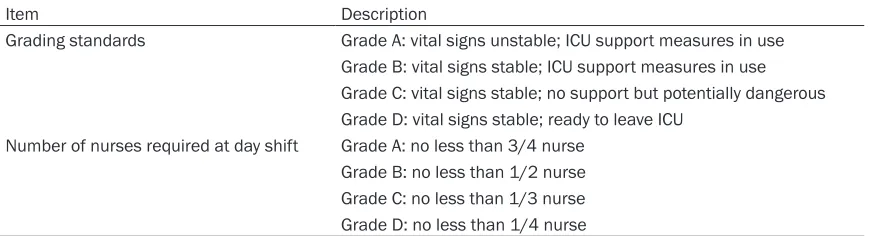
[image:2.612.90.525.85.203.2]The ABCD patient classification tool was designed to predict nurse workload and guide nurse staffing [18]. Specifically, the adult and senile patients admitted to general ICU were classified into four-grade A, B, C and D groups based on patients’ disease status and nursing needs. Patients who needed ICU support with unstable life signs were grouped into A grade in which at least 3/4 nurse per patient was need-ed. The severity of disease and the need for ICU support decreases from grade A to D corre-sponding to decreased need of nursing. The classification criteria and the corresponding nursing assignment proposal are shown in Table 1.
There were three steps when the ABCD patient classification tool was used for patient-to-nurse assignment. First, the patients were grouped according to disease status and nursing needs. Then, total nursing demand was calculated based on patients’ grading. Scores of TISS-28 were used to calculate the number of nurses needed. Based on results from Miranda, et al.
[19], a TISS-28 score of 1 corresponded to 10.6 min of nursing work time. Therefore, our study limited the TISS-28 scores between 40 and 50 points for each nurse at the day shift which was consistent with suggestions from British Association of Critical Care [14]. At last, the Table 1. The ABCD patient classification tool
Item Description
Grading standards Grade A: vital signs unstable; ICU support measures in use Grade B: vital signs stable; ICU support measures in use Grade C: vital signs stable; no support but potentially dangerous Grade D: vital signs stable; ready to leave ICU
Number of nurses required at day shift Grade A: no less than 3/4 nurse Grade B: no less than 1/2 nurse Grade C: no less than 1/3 nurse Grade D: no less than 1/4 nurse
Note: day shift refers to 08:00-16:00; ICU support measures including ventilation, the use of vasoactives and hepatic/renal
nurses were matched with and allocated to patients by managers using the enumeration method. Two factors were considered when nurses were matched with patients: 1) the beds of multiple patients served by the same nurse should be as close as possible to minimize trav -el distance; 2) patients with protective isolation or segregation should not be served by the same nurses to avoid cross-infection. Every match was checked to ensure it was rea-sonable.
Outcome measures
The changes of coefficients of variation in nurs -es’ workload evaluated using TISS-28 was cho -sen as the main outcome measure. TISS-28 scores were collected at the end of the day shift by trained student nurses recruited as assessment personnel. A smaller coefficient of variation in workload indicated a more bal -anced workload distribution.
Other outcome measures included the percent of nurses with normal workload (40-50 patient TISS-28 scores), the probability of a normal workload based on 2-level model and the inter -phase difference in nurses’ satisfaction score.
Nurses’ satisfaction score about nurse staffing was got using a six-item questionnaire which included satisfaction with their own workload, balance of workload, the fairness of task assignments, the efficiency of patient care, patient care needs, and the method of task assignment. Each item was scored between 1 and 10 with 10 as fully satisfied and 1 as the
least satisfied. The sum of scores from each item was used as the overall satisfaction score with a range from 6 to 60 theoretically.
Statistical analysis
Statistical analyses were performed using SPSS 19.0 (SPSS Inc., Chicago, IL, USA) or MLwiN Version 2.02 (Centre for Multilevel Modelling, University of Bristol, UK). Nurses’ satisfaction scores were expressed as mean ± standard deviation (SD) and other outcome measures were expressed as percent.
For the percent of nurses with normal work -load, a Chi-square (χ2) test was used to detect
the effects of intervention. For satisfaction score changes, one-way ANOVA was adopted to calculate the interphase difference. A P value of less than 0.05 was considered statistically significant.
For the prediction of probability of a normal workload, a two-level fitting model was used in which nurses’ workload was the dependent variable. The workload was defined as a binary variable with 0 representing high or low work -load and 1 representing normal work-load. The ABCD patient classification tool guided nurse-to-patient assignment was set as level 1 and day shift was set as level 2. Considering that the average sample size was 3-7 nurses per shift in level 1, level 2 was set as 420 day shifts to ensure that the total sample number of level 1 was approximately at least 1680 (4*420). Results
During the study periods, data from a total of 3800 patient/shift with 1981 nurse/shift were collected (802 patients in 6 centers). A total of 627 questionnaires were distributed and all were collected with valid scores. 99 question-naires were excluded because of shift turnover and was not on day shift 10 days before the survey. Among the rest 528 questionnaires, 258 were from the control period.
Coefficients of variation in nurses’ workload
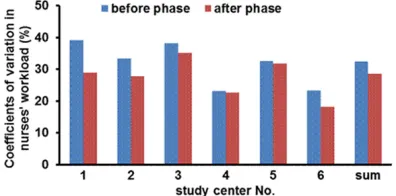
As shown in Figure 1, the coefficient of varia -tion of the workload decreased from 32.4% (before phase) to 28.5% (after phase) (3.9%). All the six centers saw a drop of coefficient of variation with Center 1 showing the greatest decrease.
[image:3.612.90.288.74.172.2]The percent of nurses with normal workload
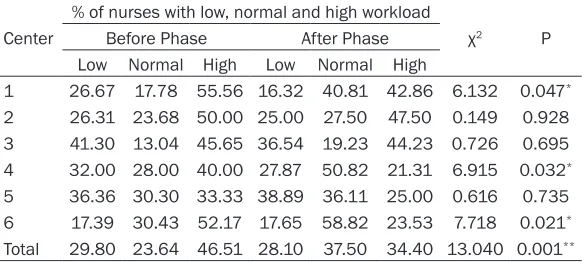
Table 2 describes the percent of nurses with normal workload in each study center. After application of the ABCD classification tool, the proportion of normal workload increased from 23.64% (before phase) to 37.50% (after phase). The high and low workload percentage dec-reased from 46.51% to 34.40% and from 29.80% to 28.10% respectively. Single-center analysis found that the percent of nurses with normal workload was significantly increased in center 1, 4, and 6 (all P<0.05).
Probability of normal workload
The null model for the probability of normal workload found that the fixed effect of the inter -cept (β0) was -0.725 (P<0.001) and the residu-al variation of level 2 was 0.236 (P=0.004), suggesting a significant inter-group variation in level 2 (day shift) and a need for a multi-level model. After adding the intervention (ABCD patient classification tool) variable, a significant main effect was found (P<0.001). The ABCD classification method could significantly incr-ease the proportion of normal work load com -pared with the traditional task assignment method (OR=1.43). The residual variation using 2-level model (P=0.012) suggested other fac -tors still involved (Table 3).
Nurses’ satisfaction score
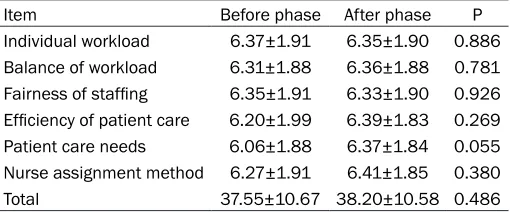
As shown in Table 4, after introducing the ABCD patient classification tool, the mean nurses’ satisfaction score did not change significantly (37.55 vs. 38.20; before vs. after; P=0.486).
load. Nurses’ satisfaction score did not change after application of the ABCD classification tool.
We found that by using the ABCD patient clas-sification method, the coefficient of variation of the workload decreased from 32.4% to 28.5% suggesting a more balanced nursing assign-ment. Mullinax et al. [20] used the range instead of the coefficient of variation as an indi -cator of workload distribution. One problem of using range to evaluate workload distribution was that it only accounts for the difference between the maximum and minimum values and did not contain information of other values. Thus, the conclusion from range might be influ -enced by extreme values. Compared with range, the coefficient of variation was calculat -ed using all the data and was more stable than range. Taken together, we thought the coeffi -cient of variation was superior to range in evalu-ating balance degree of workload.
We found that the percent of nurses with nor-mal load increased after using the ABCD patient classification tool. Dykstra et al. [21] used the self-designed Intensity Index to level nurses assignments in general wards and found the percent of shifts during which the nurses per-ceived their workload as within target was increased from 76% to 86%. The percent of nurses with normal workload in our study was much lower than reports from Dykstra et al.
Two reasons might help explain the difference. Firstly, the current study was conducted with nurses working in ICU which was typically linked with nursing shortage and over workload [22, 23]. Secondly, the definition of normal work -Table 2. The percent of nurses with normal workload in each study
center
Center
% of nurses with low, normal and high workload
χ2 P
Before Phase After Phase Low Normal High Low Normal High
1 26.67 17.78 55.56 16.32 40.81 42.86 6.132 0.047*
2 26.31 23.68 50.00 25.00 27.50 47.50 0.149 0.928 3 41.30 13.04 45.65 36.54 19.23 44.23 0.726 0.695 4 32.00 28.00 40.00 27.87 50.82 21.31 6.915 0.032*
5 36.36 30.30 33.33 38.89 36.11 25.00 0.616 0.735 6 17.39 30.43 52.17 17.65 58.82 23.53 7.718 0.021*
Total 29.80 23.64 46.51 28.10 37.50 34.40 13.040 0.001** Note: *P<0.05 and **P<0.001, before phase vs. after phase.
None of the six-item satis-faction score observed a sig-nificant change with the application ABCD classifica -tion tool.
Discussion
-load was different. In our study, the normal range of nurses’ workload was set as a TISS-28 score of between 40-50 which was based on data accumulated over 10 years development of TISS [24] and clinical trials in 22 Dutch ICUs [19]. In the study by Dykstra et al. [21], the range of a normal workload was defined based on data derived from a 26-bed and 20-day con-dition and set as one-third of the upper limit.
van Oostveen et al. [25] developed a computer-ized decision support system to guide nurse-to-patient assignment and used the nurse satis-faction score as an outcome measure. They found that although the more nurses’ workload dropped, the nurses’ satisfaction with the group of patients assigned to each nurse decreased. Similarly, the satisfaction score of nurses on the ABCD classification method was similar to that on the standard task assignment method (P=0.380). No difference in satisfac -tion score was found for individual workload, staffing fairness or workload balance in our study. These subjective results were also differ-ent from our results about workload distribu -tion evaluated using the TISS-28 score. One problem might be that the questionnaire for satisfaction evaluation might not be sensitive enough to detect a small difference. Another explanation might be the relatively small sam-ple size of current study and short duration of observation. More data from large-sized trials was needed to confirm our results. Last but not least, nurses’ job satisfaction might be influ
-sification tool. Further studies using ABCD patient classification to guide ICU nurse staff -ing for all shifts with longer intervention dura-tion were still needed.
In conclusion, nurse-to-patient assignment guided by the ABCD patient classification tool promotes more balanced workload among gen -eral ICU nurses. The nurses experience similar degree of acceptance to the new nurse staffing method as routine practice. More well-designed large-scaled studies are needed to further con-firm the usefulness of the ABCD patient classi -fication tool in ICU nurse staffing.
Acknowledgements
This paper is supported by the China Medical Board (Grant 08-889) and principal investiga-tor (PI) Liming You.
Disclosure of conflict of interest None.
Address correspondence to: Xiangdong Guan, De- partment of Critical Care Medicine, The First Affiliated Hospital of Sun Yat-sen University, No. 58 Zhongshan 2nd Road, Guangzhou 510080, China.
Tel: 87332200 Ext. 8456; Fax: +86-020-87331008; E-mail: [email protected]
References
[image:5.612.89.525.85.140.2][1] Hudspeth R. Staffing healthy workplaces: some global nursing shortage issues. Nurs Adm Q 2013; 37: 374-376.
Table 3. Stochastic intercept model of nurses’ workload distribution
Parameter Estimated Value Standard Error Test Value P
Intercept -0.900 0.077 137.759 <0.001**
Intervention (ABCD patient classification tool) 0.358 0.106 11.289 <0.001**
Residual 0.200 0.080 6.243 0.012*
Note: *P<0.05 and **P<0.001.
Table 4. Nurses’ satisfaction score during the before and after phase
Item Before phase After phase P
Individual workload 6.37±1.91 6.35±1.90 0.886
Balance of workload 6.31±1.88 6.36±1.88 0.781
Fairness of staffing 6.35±1.91 6.33±1.90 0.926
Efficiency of patient care 6.20±1.99 6.39±1.83 0.269
Patient care needs 6.06±1.88 6.37±1.84 0.055
Nurse assignment method 6.27±1.91 6.41±1.85 0.380
Total 37.55±10.67 38.20±10.58 0.486
enced by multiple factors including emotion, workload, salary and so on [26].
[image:5.612.91.346.197.303.2]-[2] McGahan M, Kucharski G, Coyer F; Winner ACCCN Best Nursing Review Paper 2011 spon-sored by Elsevier. Nurse staffing levels and the incidence of mortality and morbidity in the adult intensive care unit: a literature review. Aust Crit Care 2012; 25: 64-77.
[3] Ferrer J, Boelle PY, Salomon J, Miliani K, L’Heriteau F, Astagneau P and Temime L. Man -agement of nurse shortage and its impact on pathogen dissemination in the intensive care unit. Epidemics 2014; 9: 62-69.
[4] Toh SG, Ang E, Devi MK. Systematic review on the relationship between the nursing shortage and job satisfaction, stress and burnout levels among nurses in oncology/haematology set-tings. Int J Evid Based Healthc 2012; 10: 126-141.
[5] van den Oetelaar WF, van Stel HF, van Rhenen W, Stellato RK and Grolman W. Balancing nurs -es’ workload in hospital wards: study protocol of developing a method to manage workload. BMJ Open 2016; 6: e012148.
[6] Nogueira Lde S, Domingues Cde A, Poggetti RS and de Sousa RM. Nursing workload in inten -sive care unit trauma patients: analysis of as-sociated factors. PLoS One 2014; 9: e112125. [7] Bahadori M, Ravangard R, Raadabadi M, Mo-savi SM, Gholami Fesharaki M and Mehrabian F. Factors affecting intensive care units nurs-ing workload. Iranian Red Crescent Med J 2014; 16: e20072.
[8] Guo XX, Yang XM and Guo QF. The application of score-based nurse arrangement in nursing human resource management. Chinese Nurs-ing Management 2009; 9: 56-57.
[9] Carmona-Monge FJ, Rollan Rodriguez GM, Quiros Herranz C, Garcia Gomez S and Marin-Morales D. Evaluation of the nursing workload through the nine equivalents for nursing man-power use scale and the nursing activities score: a prospective correlation study. Inten-sive Crit Care Nurs 2013; 29: 228-233. [10] Debergh DP, Myny D, Van Herzeele I, Van
Maele G, Reis Miranda D and Colardyn F. Mea-suring the nursing workload per shift in the ICU. Intensive Care Med 2012; 38: 1438-1444.
[11] Pyykko AK, Laurila J, Ala-Kokko TI, Hentinen M and Janhonen SA. Intensive care nursing scor-ing system. Part 1: classification of nursscor-ing di -agnoses. Intensive Crit Care Nurs 2000; 16: 345-356.
[12] Pyykko AK, Laurila J, Ala-Kokko TI and Hentin -en M. Int-ensive care nursing scoring system Part 2: nursing interventions and nursing out-comes. Intensive Crit Care Nurs 2001; 17: 16-27.
[13] Le GJ, Lemeshow S and Saulnier F. A new Sim-plified Acute Physiology Score (SAPS II) based on a European/North American multicenter study. JAMA 1993; 270: 2957.
[14] Adomat R and Hewison A. Assessing patient category/dependence systems for determin-ing the nurse/patient ratio in ICU and HDU: a review of approaches. J Nurs Manag 2004; 12: 299-308.
[15] Miranda DR, Ryan DW, Schaufeli WB and Fidler V. EURICUS-I: introduction. Springer Berlin Hei -delberg; 1998.
[16] Yu D, Ma Y, Sun Q, Lu G and Xu P. A nursing care classification system for assessing work -load and determining optimal nurse staffing in a teaching hospital in China: a pre-post inter-vention study. Int J Nurs Pract 2015; 21: 339-349.
[17] Daraiseh NM, Vidonish WP, Kiessling P and Lin L. Developing a patient classification system for a neonatal ICU. J Nurs Adm 2016; 46: 636-641.
[18] Zhou XZ, Xiong XL, Dai QF and Huang YL. Study on the efficiency of ABCD nursing classification and human resources assignment in ICU. Jour -nal of Nurses Training 2013; 28: 1063-1065. [19] Miranda DR, de Rijk A and Schaufeli W. Simpli
-fied therapeutic intervention scoring system: the TISS-28 items--results from a multicenter study. Crit Care Med 1996; 24: 64-73. [20] Mullinax C and Lawley M. Assigning patients to
nurses in neonatal intensive care. Journal of the Operational Research Society 2002; 53: 25-35.
[21] Dykstra C and Bridges E. Intensity index: quan -tifying workloads and balancing assignments. Nurs Manage 2012; 43: 36-42.
[22] Chuang CH, Tseng PC, Lin CY, Lin KH and Chen YY. Burnout in the intensive care unit profes-sionals: a systematic review. Medicine (Balti-more) 2016; 95: e5629.
[23] Nelson J, Valentino L, Iacono L, Ropollo P, Cineas N and Stuart S. Measuring workload of nurses on a neurosurgical care unit. J Neurosci Nurs 2015; 47: E9-19.
[24] Keene AR and Cullen DJ. Therapeutic interven -tion scoring system: update 1983. Crit Care Med 1983; 11: 1-3.
[25] van Oostveen CJ, Braaksma A and Vermeulen H. Developing and testing a computerized de -cision support system for nurse-to-patient as-signment: a multimethod study. Comput In-form Nurs 2014; 32: 276-285.