FinDSE@FinTOC-2019 Shared Task
Carla Abreu1,2, Henrique Lopes Cardoso1,2, Eug´enio Oliveira1,2 Faculdade de Engenharia da Universidade do Porto1, LIACC2
Rua Dr. Roberto Frias, s/n, Porto, Portugal (ei08165, hlc, eco)@fe.up.pt
Abstract
We present the approach developed at the Fac-ulty of Engineering of the University of Porto to participate in FinTOC-2019 Financial Doc-ument Structure Extraction – Detection of ti-tles sub-task. Several financial documents are produced in machine-readable format. Due to the poor structure of these documents, it is an arduous task to retrieve the desired informa-tion from them. The aim of this sub-task is to detect titles in this kind of documents. We propose a supervised learning approach mak-ing use of lmak-inguistic, semantic and morpholog-ical features to classify a text block as title or non title. The proposed methodology got a F1 score of 97.01%.
1 Introduction
Several financial documents are produced, every day, for different financial applications. Some of these documents are mandatory by law, how-ever they are not created following the same stan-dard and sometimes have a poor structure, mak-ing it difficult to retrieve the desired informa-tion. These documents are usually published in machine-readable format (such as Portable Docu-ment Format (PDF) files) but unfortunately, they remain untagged – they have no tags for identi-fying layout items such as paragraphs, columns, or tables. Document structuring has clear bene-fits to users, enabling them to gain direct access to the relevant part of the document (which can be lengthy), improving also search performance.
Financial Prospectuses are financial documents where investment funds are described, and have a non-standard content format. These documents need to be consulted by distinct persons and fast retrievals of data are desired.
A lot of effort has already been put to label the structure of documents. Some known projects are the Million Book project (Linke, 2003), the
Open Content Alliance (OCA) (Suber, 2005), or the digitisation of Google (Coyle, 2006) (Doucet et al.,2011). Projects that have aim at automati-cally recognizing document structure take, as in-put, a document in PDF format, or its content ob-tained via Optical Character Recognition (OCR).
Document structure extraction is a well studied problem in document analysis, and has been ap-plied in distinct types of documents and in differ-ent domains. Works on this matter go from scien-tific articles (Klampfl et al.,2014) (Bast and Ko-rzen,2017) to books (Linke,2003).
Rangoni et al. (Rangoni et al., 2012) make use of three types of features: geometrical (width, height, X position, among others), morphological (the font and other characteristics, such as italics, bold, and so on) and semantic (language, is nu-meric, and so on). Bitew (Bitew, 2018) also in-cludes three distinct categories: textual features (similar to semantic), markup features (similar to morphological) and linguistic (related with Part of Speech). As described, some authors groups fea-tures in categories; however, some studies use only one category, including Kim et al. (Kim et al., 2017), who make use of morphological elements only for logical structured extraction.
The methodologies used to address this prob-lem include rule-based and machine learning ap-proaches (Klampfl and Kern,2013) (He,2017).
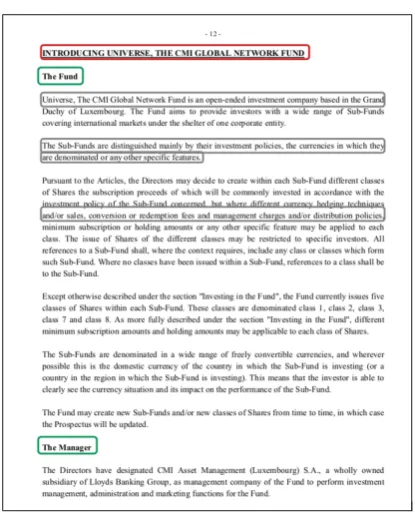
Figure 1: Financial Prospectuses document layout
2 Sub-Task Description
The task addressed in this work concerns the detection of titles in financial prospectuses (R´emi Juge,2019). Given a set of text blocks, the goal is to classify each given text block as a ‘title’ or ‘non-title’. As shown in Figure 11, titles can have different layouts (marked with red and green boxes), and they have to be distinguished from regular text (‘non-title’ marked with grey boxes).
The evaluation metric used in the task is the F1 metric.
3 Dataset
FinTOC organizers provide an excel file with text blocks information. Each line represents one text block and each column their characteristics:
• text blocks: text block textual content;
• begins with numbering: 1 if the text block begins with a numbering such as 1., A/, b), III., etc. . . .;0otherwise;
• is bold:1if the text block appears in bold in the PDF document;0otherwise;
• is italic: 1if the text block is in italic in the pdf document;0otherwise;
1FNP Workhop Series – Title detection subtask:
http://wp.lancs.ac.uk/cfie/shared-task/
Title Non Title
Excel - Number of Rows 2,420 13,092
Average of NC / TB 25.03 152.82
Standard Deviation of NC / TB 14.87 300.87
Variance of NC / TB 221 90,525.25
Min of NC / TB 2 1
[image:2.595.323.509.60.131.2]Max of NC / TB 143 7,715
Table 1: Training set statistics (TB = text block; NC = number of characters).
• is all caps:1if the text block is all composed of capital letters;0otherwise;
• begins with cap: 1 if the text block begins with a capital letter;0otherwise;
• xmlfile: the xmlfile from which the above fea-tures have been derived;
• page nb: the page number in the PDF where the text bock appears;
• label:1if text block is a title,0otherwise.
The test set has the same format as the training set, but without information in the last column of the CSV file. This column is meant to be filled in by systems participating in the task.
The training set contains 44 distinct documents, not standardized. The CSV file used as training set contains 75625 annotated rows. More details about the training set are included on Table1and Table2.
The test set is composed of 7 PDF files (whose length ranges from 35 to 134 pages, with an av-erage of 64 pages). The CSV file is composed of 14816 non-annotated rows.
4 Proposed approach
4.1 Features
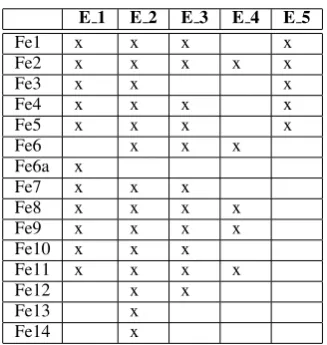
Text blocks are provided with some characteris-tics, such as: (Fe1) begins with numbering; (Fe2) is bold; (Fe3) is italic; (Fe4) is all caps; and (Fe5) begins with cap. These elements are described in Section3.
We have extracted additional features from the text block, as follows:
• (Fe6) Number of characters;
• (Fe6a) Number of characters distributed in categories (Table2) ;
IDCategory Range TST itle TSN onT itle
0 0 0 0
1 1 - 3 2 334
2 4 - 9 80 48
3 10 - 16 695 203 4 17 - 21 553 160 5 22 - 30 400 87 6 31 - 40 366 73 7 41 - 50 164 48 8 51 - 70 129 108 9 71 - 100 23 157 10 101 - 150 8 178 11 151 - 200 0 181 12 201 - 400 0 523 13 401 - 600 0 172 14 601 - 1000 0 114 15 1001 - 1500 0 30
[image:3.595.99.265.61.213.2]16 >1501 0 4
Table 2: Number of characters distributed in categories and in the training set (TS)
• (Fe8) Last block character type: alphabetic upper/lower, numeric, other (space or punc-tuation);
• (Fe9) Number of tokens;
• (Fe10) Number of sentences contained in the block text;
• (Fe11) Part Of Speech of the first token in the block text;
• (Fe12) Contains date;
• (Fe13) Title suggestion word - if the first token belongs to one of these words: ap-pendix’, ’annex’, and others;
• (Fe14) Tense block - check if the text block is written in the past, present or future.
The enunciated features belong to three differ-ent types: morphological (Fe2, Fe3, Fe4, Fe5, Fe6, Fe6a, Fe7, Fe8), semantic (Fe1, Fe12), and lin-guistic (Fe11, Fe13, Fe14). Tense, part of speech, title suggestion words and contains date are lan-guage dependent features applied only to English language.
4.2 Classification Algorithms
Supervised learning techniques create a model that predicts the value of a target variable based on a set of input variables. One challenge is to select the most appropriate algorithm for the task of clas-sifying as ‘title’ or ‘non-title’ a given text block. We have compared the following algorithms: De-cision Tree (DT), Extra-tree classifier (EXT), and Gradient Boosting (GBC).
As shown in Table 3, different configurations were attempted for each algorithm. Implemen-tations of these algorithms are provided by the
AlgID Algorithm Configuration
DT 1 DT random state=0
DTC 1 DT max depth=None
min samples split=2 random state=0
EXT 1 EXT n estimators=10
max depth=None min samples split=2 random state=0
GBC 1 GBC loss=’exponential’
GBC 2 GBC n estimators=2000
[image:3.595.334.504.62.192.2]learning rate=0.75 max depth=5
Table 3: List of algorithm configurations
E 1 E 2 E 3 E 4 E 5
Fe1 x x x x
Fe2 x x x x x
Fe3 x x x
Fe4 x x x x
Fe5 x x x x
Fe6 x x x
Fe6a x
Fe7 x x x
Fe8 x x x x
Fe9 x x x x
Fe10 x x x
Fe11 x x x x
Fe12 x x
Fe13 x
Fe14 x
Table 4: List of features used in each experimental setup.
Python library scikit-learn library2.
5 Experimental Setup
The set of features used in each experimental setup is shown in Table 4. Experiment 5 (E 5) is our baseline, as this setup includes all the features available in the dataset. We combine all the avail-able features with all extracted by us in Experi-ment 2 (E 2). We create a model based on E 2 and select all the features with an importance above 0.03 to compose Experiment 3 (E 3) and above 0.07 to include in Experiment 4 (E 4).
Experiment 1 (E 1) was based in our analysis regarding text blocks number of characters cate-gories distribution, such as presented in Table2.
6 Experimental Evaluation
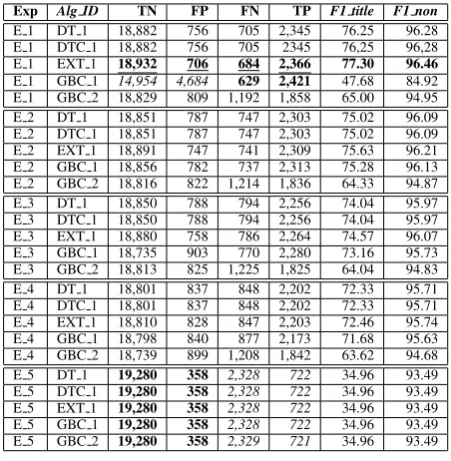
Several combinations of features (Table4) and al-gorithms (Table3) were applied to solve the title classification problem. The results obtained are shown in Table5.
[image:3.595.336.500.225.398.2]Exp Alg ID TN FP FN TP F1 title F1 non
E 1 DT 1 18,882 756 705 2,345 76.25 96.28 E 1 DTC 1 18,882 756 705 2345 76,25 96,28 E 1 EXT 1 18,932 706 684 2,366 77.30 96.46
E 1 GBC 1 14,954 4,684 629 2,421 47.68 84.92 E 1 GBC 2 18,829 809 1,192 1,858 65.00 94.95 E 2 DT 1 18,851 787 747 2,303 75.02 96.09 E 2 DTC 1 18,851 787 747 2,303 75.02 96.09 E 2 EXT 1 18,891 747 741 2,309 75.63 96.21 E 2 GBC 1 18,856 782 737 2,313 75.28 96.13 E 2 GBC 2 18,816 822 1,214 1,836 64.33 94.87 E 3 DT 1 18,850 788 794 2,256 74.04 95.97 E 3 DTC 1 18,850 788 794 2,256 74.04 95.97 E 3 EXT 1 18,880 758 786 2,264 74.57 96.07 E 3 GBC 1 18,735 903 770 2,280 73.16 95.73 E 3 GBC 2 18,813 825 1,225 1,825 64.04 94.83 E 4 DT 1 18,801 837 848 2,202 72.33 95.71 E 4 DTC 1 18,801 837 848 2,202 72.33 95.71 E 4 EXT 1 18,810 828 847 2,203 72.46 95.74 E 4 GBC 1 18,798 840 877 2,173 71.68 95.63 E 4 GBC 2 18,739 899 1,208 1,842 63.62 94.68
E 5 DT 1 19,280 358 2,328 722 34.96 93.49
[image:4.595.72.298.61.292.2]E 5 DTC 1 19,280 358 2,328 722 34.96 93.49 E 5 EXT 1 19,280 358 2,328 722 34.96 93.49 E 5 GBC 1 19,280 358 2,328 722 34.96 93.49 E 5 GBC 2 19,280 358 2,329 721 34.96 93.49
Table 5: Results
E 5 is the experiment that has as feature set all the features available upfront with the dataset. This experiment got similar results using distinct supervised learning algorithms. The results ob-tained indicate that this set of features are not enough to classify block text titles, showing a high number of false negatives and a low number of true positives.
The DT 1 and DTC 1 algorithms have distinct configurations, however they presented the same results when exposed to the same feature set. The GBC 1 algorithm configuration was more sensible when exposed to a specific feature set – in E 1, this algorithm has shown the higher number of false positives obtained in our experiments. GBC 2 was the worst configuration algorithm used in this clas-sification, having the lowest value of true posi-tives.
The feature set used in E 1 includes all features provided by the competition organizers. Other fea-tures were added, some of them related to how the text appears in the text block (such as number of characters or sentences), and also language depen-dent features (such as the case of F11). Except for GBC 1, all other algorithm configurations reached their best result. EXT 1 got the best performance in the task of title classification.
FinTOC-2019 received two submissions for each participant, on which we achieved F1 score of 97.01% on E 1 with EXT 1 reaching the fifth position and the sixth position with F1 score of 96.84% on E 1 with DT 1.
7 Conclusion
It is difficult to retrieve the desired information from lengthy documents when the Table Of Con-tent (TOC) is missing. TOC helps the reader to identify what is written in each section, enabling an oriented reading. The aim of this study is to classify each text block into title or non-title, a step towards identifying each section in a document.
In this work we propose a supervised learning strategy to classify text blocks. We also proposed an extension of the provided feature set based on recognizing new characteristics of text blocks (re-lated with the text block composition and the use of linguistic resources). The dataset available in this competition was composed by five features. We experimented the use of these features but the results obtained point out that these are not enough to the envisaged classification task.
We recognize more features in text blocks, some of them related with the text composition and oth-ers related with linguistic resources. Not all of these features have shown to be essential for title classification.
Title detection got an high performance us-ing Extra-Tree classifier with the followus-ing features: the five ones available on the dataset (begings with numbering, is bold, is italic,
is all caps, begin with cap) and six more (num-ber of characters, first sentence character, last sentence character, number of tokens, number of sentences, Part of speech of the first sentence element).
References
Hannah Bast and Claudius Korzen. 2017. A bench-mark and evaluation for text extraction from pdf. In Proceedings of the 17th ACM/IEEE Joint Con-ference on Digital Libraries, pages 99–108. IEEE Press.
Semere Kiros Bitew. 2018. Logical structure extrac-tion of electronic documents using contextual infor-mation. Master’s thesis, University of Twente.
Karen Coyle. 2006. Mass digitization of books. The Journal of Academic Librarianship, 32(6):641–645.
Yi He. 2017. Extracting document structure of a text with visual and textual cues. Master’s thesis, Uni-versity of Twente.
Tae-young Kim, Suntae Kim, Sangchul Choi, Jeong-Ah Kim, Jae-Young Choi, Jong-Won Ko, Jee-Huong Lee, and Youngwha Cho. 2017. A machine-learning based approach for extracting logical structure of a styled document. TIIS, 11(2):1043–1056.
Stefan Klampfl, Michael Granitzer, Kris Jack, and Ro-man Kern. 2014. Unsupervised document structure analysis of digital scientific articles. International journal on digital libraries, 14(3-4):83–99.
Stefan Klampfl and Roman Kern. 2013. An unsu-pervised machine learning approach to body text and table of contents extraction from digital scien-tific articles. InInternational Conference on Theory and Practice of Digital Libraries, pages 144–155. Springer.
Erika C Linke. 2003. Million book project. Encyclo-pedia of Library and Information Science: Lib-Pub, page 1889.
Yves Rangoni, Abdel Bela¨ıd, and Szil´ard Vajda. 2012. Labelling logical structures of document images us-ing a dynamic perceptive neural network. Interna-tional Journal on Document Analysis and Recogni-tion (IJDAR), 15(1):45–55.
Sira Ferradans R´emi Juge, Najah-Imane Bentabet. 2019. The fintoc-2019 shared task: Financial doc-ument structure extraction. In The Second Work-shop on Financial Narrative Processing of NoDal-ida 2019.