Domain Adaptation for MT:
A Study with Unknown and Out-of-Domain Tasks
Hoang Cuong Agolo, Inc.
Abstract
Translation quality could degrade non-gracefully outside the desired domain for MT. Meanwhile, translation requests are often unknown and potentially out-of-domain in practice. This paper shows that having an ecosystem with a range of pre-trained domain-specific MT systems can reduce the effect: a translation task can be out of scope of most pre-trained MT systems, but a few others can be capable of handling the task. But how to obtain the best translation from an ecosystem for such translation requests? We contribute two frameworks to address the problem. Experiments show that our frameworks give the performance in the middle be-tween top rank MT systems with reason-ably large-scale ecosystems.
1 Introduction
Translation models have been developed under the assumption that we know the domain at test time in advance, and the domain is strictly relevant to our training data. However, we inevitably will come across test data that is sampled from a different dis-tribution to our training data when using the mod-els in the wild. Another critical thing is that the domain of test data is often unknown in practice (e.g. Google Translate and Microsoft Translators receive translation requests from their users with-out knowing in advance their interests).
We have not had a solution for this well-known problem yet. Machine Translation (MT) has been
c
2019 The authors. This article is licensed under a Creative Commons 4.0 licence, no derivative works, attribution, CC-BY-ND.
advanced by new models, including using Neu-ral Machine Translation (NMT) instead of Sta-tistical Machine Translation (SMT). The hope is that a better translation model would improve the translation in all settings/situations. This, how-ever, is not true. Translation quality could degrade nongracefully outside the desired domain for both NMT and SMT. In fact, it has been known that NMT suffers even harder than SMT when the test data is out-of-domain (Koehn and Knowles, 2017; Chu and Wang, 2018). We also improve MT by using domain adaptation methods (i.e. improving translation system from having a small seed in-domain data such as system interpolation, instance weighting and data selection). In practice, this is not a thorough solution because we do not know the domain of user translation requests in advance. The contribution of this work is to pro-vide a simple, easy-and-fast-to-deploy, translation model-agnostic1solution to the challenging
prob-lem. Our approach is to construct an “ecosystem” with a range of pre-trained domain-specific MT systems, each specialized in a certain domain (e.g. Speech, Financial, Food, etc.). Our intuition is that having such an ecosystem could reduce the de-crease in translation quality for an outside domain. That is, an out-of-domain translation task can be out of scope of most pre-trained MT systems in the ecosystem. However, with the diversity of do-mains in a reasonably large ecosystem, we hope there is a chance to have certain pre-trained sys-tems in the ecosystem that can be capable of han-dling the task well. The larger our ecosystem is, the more likely we have more capable pre-trained MT systems to an out-of-domain task.
The next step is to work on an unsupervised 1We aim for a solution that works with both NMT, SMT or
method that automatically finds the best transla-tions from an ecosystem for every translation re-quest from an unknown and out-of-domain trans-lation task. This is surprisingly difficult. Creat-ing a domain classifier for translation requests pro-vides suboptimal performance, because the target domain is unknown and out-of-domain. System combination could degrade translation quality sub-stantially, as the majority of pre-trained MT sys-tems in the ecosystem are incapable of handling the task. We propose two frameworks to address the problem.
VOTING I involves two separate steps for
han-dling each translation request: First, the request is translated by allpre-trained MT systems. Sec-ond, the translation output that is most similar to others is returned to the user. An agreement mea-sure is proposed to calculate how similar transla-tion outputs are. The intuitransla-tion behind VOTING I
is that good translations may be similar to the oth-ers. That is, because they are good translations, they must be similar to translation references, and therefore it is likely that they are similar to the oth-ers as well.
VOTINGII selects only alimitednumber of MT
systems for decoding. Decoding cost is thus sub-stantially cheaper in VOTING II. The intuition
be-hind VOTING II is that MT systems that are good
in a domain tend to agree with each other. How-ever, the expertise parameters of MT systems re-garding to an unknown domain are hidden and we thus do not know which MT systems we should select. In VOTINGII expertise parameters are
ini-tialized randomly and our heuristic learning algo-rithm consequently updates the parameters during translation. We note that VOTING II works with
the assumption that the translation requests would be handled in sequential (not parallel). While this is not true for all cases, it is true when we trans-late request translations of large documents as one task.
We conduct extensive experiments with
Spanish-English, French-English and German-English to support our intuition. Experiments show that VOTING I gives the performance in
between the top two systems for medium-scale ecosystem, and in between the top three systems for a large-scale ecosystem. VOTING II performs
substantially better than VOTING I and
occasion-ally reaches close to the top Rank 1 MT system for medium-scale ecosystems. Our framework
is scalable and has promising applications to large-scale online translation services.2
2 Related Work
This paper discusses a complementary problem to domain adaptation: How to handle unknown and out-of-domain translation tasks. Domain adapta-tion has been an active topic of research for many years. A survey of domain adaptation for MT can be referred to (Chu and Wang, 2018; Cuong and Sima’an, 2017). Within MT, but the domain of the request is typically known in advance. do-main adaptation can be regarded as injecting prior knowledge about the target translation task into learning.
Combination of in-domain data with a general-domain system A common is approach is to combine a system trained on the in-domain data with a general-domain system (Koehn and Schroeder, 2007; Farajian et al., 2017; Kobus et al., 2017; Foster et al., 2010; Shah et al., 2010; Bisazza et al., 2011; Sennrich, 2012b; Razmara et al., 2012; Cuong and Sima’an, 2014a; Cuong and Sima’an, 2015; Sennrich et al., 2013; Haddow, 2013; Hildebrand and Vogel, 2008; Joty et al., 2015; Wang et al., 2018; Khayrallah et al., 2017; Chen et al., 2017; Tars and Fishel, 2018) or to com-bine the in-domain system with a system trained on a selected subset (Axelrod et al., 2011; Duh et al., 2013; Kirchhoff and Bilmes, 2014; Eetemadi et al., 2015; Chen and Huang, 2016; Wang et al., 2018; van der Wees et al., 2017; Cuong and Sima’an, 2014b).
Meta-information Prior knowledge may also lie in meta-information about training data. This could be document-annotated information (Eidel-man et al., 2012; Hu et al., 2014; Hasler et al., 2014; Zhang et al., 2014; Su et al., 2015), and domain-annotated sub-corpora (Chiang et al., 2011; Sennrich, 2012b; Chen et al., 2013; Kothur et al., 2018; Michel and Neubig, 2018; Bapna and Firat, 2019).
Other DA Topics Recent work also performs adaptation by exploiting separate in-domain devel-opment sets (Sennrich, 2012a; Carpuat et al., 2013; Mansour and Ney, 2014; Clark et al., 2012; Wang et al., 2012). Rewarding domain invariance is also
2The code can be downloaded at:
another approach to perform unsupervised adapta-tion (Cuong et al., 2016). Combining several dif-ferent Machine Translation outputs operating on the same input is also a promising DA approach (Jayaraman and Lavie, 2005; Hildebrand and Vo-gel, 2008).
Using online methods for adapting MT sys-tems in a scenario where human feedback (e.g. post-edited MT output) is constantly returned has been gaining interest recently (Ortiz-Mart´ınez et al., 2010; Koehn et al., 2014; Denkowski et al., 2014; Bertoldi et al., 2014; Blain et al., 2015; Ortiz-Mart´ınez, 2016; Wuebker et al., 2016; Ka-rimova et al., 2018). Using Bayesian models pro-vides promising results for adapting MT systems (e.g. see (Denkowski et al., 2014; Bertoldi et al., 2014; Blain et al., 2015; Peris and Casacuberta, 2018)). Recently, deploying bandit learning algo-rithms shows promising results for minimizing the cost of human feedback for improving system per-formance (e.g. see (Sokolov et al., 2015; Sokolov et al., 2016; Sokolov et al., 2017; Nguyen et al., 2017)).
3 Our Framework
Assume we are given a set of N pre-trained MT systems mN
1 = {m1, m2, . . . , mN}. At test time, our goal is to handle anunknownand out-of-domain translation task:f1K ={f1, f2, . . . , fK}.
Note that the requests may be submitted intermit-tently by the user, which is common in practice (e.g. as in web-based translation services).
3.1 Voting I
Our first proposed framework is VOTING I. It
in-volves two separate steps. First, each translation requestf is translated by allpre-trained MT sys-tems. Second, the translation output produced by an MT system that is most similar to others is re-turned to the user. Note that this approach is quite similar to (Macherey and Och, 2007), only that the approach here is made to be symmetrical.
Technically, the agreement between two trans-lation outputs em and em0 produced by two dif-ferent MT systems m and m0 is calculated as the arithmetic mean between BLEU+1(e, e0) and BLEU+1(e0,e):
a(em, em0) = BLEU+1(em, em
0) +BLEU+1(em0, em).
2
Here, BLEU+1 (Lin and Och, 2004) is a variant of BLEU for sentence-level assessment (Papineni
et al., 2002). Given that all N MT systems are used to decode each translation request, the aver-age agreement score between one translation out-putem produced by an MT systemm and all the others produced by other MT systems m0is calcu-lated as:
a(em) = X
m06=m
1
N −1a(em, em0). (1)
VOTING I simply uses the proposed
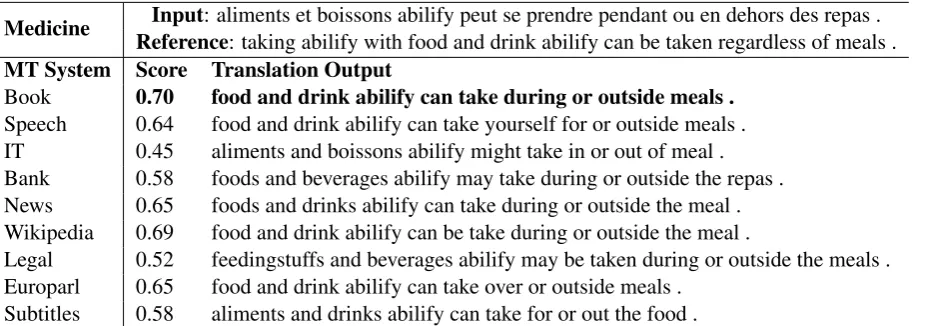
agree-ment measure to rank translation outputs. As dis-cussed, our assumption is that good translations (e.g. Book, Wikipedia) is likely to be similar to the others. See Table 1 for a positive example we obtain from our experiments with VOTINGI .
3.2 Voting II
MT systems can generate similar translations by chance. We show such an example we obtain from our experiments with VOTING I in Table 2 (on the
left). There are also cases of “black sheep”: a very good translation may be too different from the oth-ers. Table 2 (on the right) shows such an exam-ple. VOTING I is not able to handle these issues.
Applying VOTINGI is expensive regarding the
de-coding cost.
How to address these issues? In our refined framework – VOTING II, we introduce a set of expertise parameters of all MT systems: ΘN
1 =
{θm1, θm2, . . . , θmN}. Here, expertise parameter
θmrepresents how suitable a systemmto a certain domain. VOTINGII simply selects only the topM MT systems with the highest expertise parameters, instead of using allN MT systems for decoding each translation request. In our experiments, we setM = 3.
VOTINGII addresses the shortcomings of VOT -INGI as follows:
• (1) VOTING II explicitly filters bad MT
sys-tems for a certain domain;
• (2) VOTING II ranks translation outputs
ac-cording to a sum of a(em) + θm instead of onlya(em)as in VOTINGI;
• and (3) the decoding cost is substantially re-duced (with a ratio of(N −M)/N). As dis-cussed, VOTING II works with the
Medicine Reference: taking abilify with food and drink abilify can be taken regardless of meals .Input: aliments et boissons abilify peut se prendre pendant ou en dehors des repas . MT System Score Translation Output
Book 0.70 food and drink abilify can take during or outside meals . Speech 0.64 food and drink abilify can take yourself for or outside meals . IT 0.45 aliments and boissons abilify might take in or out of meal . Bank 0.58 foods and beverages abilify may take during or outside the repas . News 0.65 foods and drinks abilify can take during or outside the meal . Wikipedia 0.69 food and drink abilify can be take during or outside the meal .
Legal 0.52 feedingstuffs and beverages abilify may be taken during or outside the meals . Europarl 0.65 food and drink abilify can take over or outside meals .
[image:4.595.76.539.71.234.2]Subtitles 0.58 aliments and drinks abilify can take for or out the food .
Table 1:Positive example with VOTINGI: Good translations (e.g. Book, Wikipedia) tend to be similar to the others.
Medicine Input: resume des caracteristiques du produitReference: summary of product characteristics Input: ´etiquetage et noticeReference: labelling and package leaflet
MT System Score Translation Output Score Translation Output
Book 0.62 resume of product characteristics 0.30 labelling and package leaflet Speech 0.78 resume of caracteristiques of the product 0.53 ´etiquetage and warning IT 0.77 resume of caracteristiques the product 0.53 tag and notice
Bank 0.46 summary of characteristics of product 0.74 ´etiquetage and notice News 0.78 resume of caracteristiques of the product 0.74 ´etiquetage and notice Wikipedia 0.74 resume the caracteristiques of the product 0.74 ´etiquetage and notice Legal 0.69 resume of the characteristics of the product 0.36 labelling and document Europarl 0.70 resume the caracteristiques product 0.74 ´etiquetage and notice Subtitles 0.63 resume some caracteristiques the product 0.74 ´etiquetage and notice
Table 2:Two negative examples with VOTINGI. On the left: bad translations (e.g. IT, Wikipedia, Speech) are also similar to the others by chance. On the right: a case of “black sheep”: a very good translation (Book) is too different from the others.
Of course the expertise parameters of MT sys-tems are hidden. The question is how to learn them? The intuition behind VOTING II is that MT
systems that are good in a certain domain are likely to agree with each other.
Two models are proposed in this paper to im-plement the idea. They are in the same spirit: the expertise parameter of each systemm is sampled from a posterior distributionπm(θ):θm ∼πm(θ). Our heuristic learning algorithm starts in a naive state, and we do not have any a-priori preference for one system over another. The algorithm con-sequently updates the parameters of the posterior distributionπm(θ)based on agreement scores for translation outputs produced by system m. The proposed models use different posterior distribu-tionsπ(θ) for samplingθ. Our goal of proposing
different models is to investigate which one that addresses the problem best.
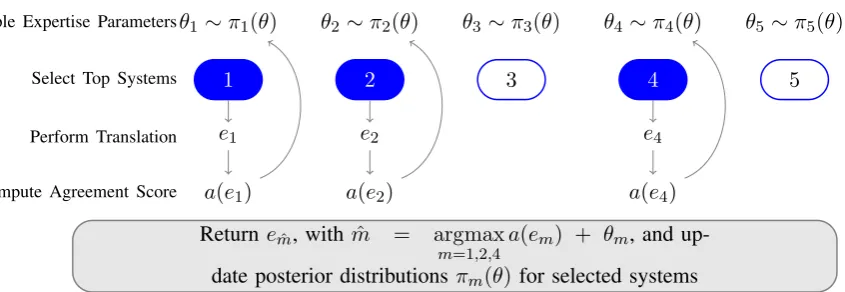
Figure 1 illustrates the framework.
3.2.1 Voting II Real
Our first model (VOTING II - REAL) uses
nor-mal distribution to sample expertise parameters. Let us assume a sample of agreement scores from all translation outputs produced by an MT system masAm = {a1, a2, . . . , a|Am|}.Here,|Am|
de-notes the sample size. Let us denote the sample
meanand samplevarianceasµ¯m andδ2m.
In VOTING II - REAL, we assume (by way of
the Central Limit Theorem) that the expertise pa-rameter of systemmis approximately normal with meanµ¯mand varianceδm2/|Am|:
θm∼ N(¯µm, δm2/|Am|). (2)
We propose a heuristic algorithm for learning expertise parameters in VOTINGII - REAL:
1 2 3 4 5
e1 e2 e4
θ1 ∼π1(θ) θ2 ∼π2(θ) θ3∼π3(θ) θ4 ∼π4(θ) θ5 ∼π5(θ)
a(e1) a(e2) a(e4)
Sample Expertise Parameters
Select Top Systems
Perform Translation
Compute Agreement Score
Returnemˆ, withmˆ = argmax
m=1,2,4
a(em) + θm, and
[image:5.595.100.523.89.235.2]up-date posterior distributionsπm(θ) for selected systems
Figure 1:The setup of VOTINGII forN = 5. Expertiseθis sampled from posterior distributionπ(θ)for each system, and three systems are selected. Here we assume the top3systems arem1,m2andm4. Then, agreement scores for their translations are calculated. The translation with the highest agreement is returned. Finally, the posterior distributions are updated for all three selected systems.
• Select top three MT systems m, m0 and m00 with the highest expertise parameters and de-code translation requestf. Let us assume trans-lation outputs are as em, em0 and em00 respec-tively.
• Computea(em),a(em0)anda(em00).
• Adda(em) to Am, a(em0) toAm0 and a(em00)
toAm00. Update sample meanµ¯m and sample varianceδ2
mforAm,Am0andAm00.
Analysis: MT systems are promoted/demoted ex-plicitly during learning. A high agreement score increases the sample mean for a promoted system, while a low agreement score decreases the sample mean for a demoted system. A promoted system becomes more likely to be selected in later rounds, but it is not the case for a demoted system.
The chance of being selected for MT systems also depends on variance for sampling expertise parameters. The variance effect decreases with sample size|A|. This reflects that the learning be-comes gradually more confident about its estimate of expertise parameters.
3.2.2 Voting II Binary
Our second model (VOTING II - BINARY) uses
Beta distribution to sample expertise parameters. The parameters of the posterior distribution is up-dated based on a simplified outcome of agreement scores, which has only two values: [0, 1] (i.e. SUCCESS/FAILURE). This is done by perform-ing a Bernoulli trial with success probability ex-actly as the agreement score.
Let us assume a sample of simplified agreement scores from all translation outputs produced by an
MT systemmasAm¯ = {¯a1,a¯2, . . . ,¯a|A¯m|}.For
this sample, we focus on the numbers of SUC-CESSes/FAILUREs instead of the sample mean
and sample variance. Let us denote the numbers asSmandFm.
In VOTING II - BINARY, we assume that for a
sample of simplified agreement scoresA¯, the
num-ber of SUCCESSes is the output of a Binomial probability distribution with |A|¯ Bernoulli trials with success probability exactly as expertise pa-rameterθ. We also use the Beta distribution with two hyper-parametersαandβfor priors for the ex-pertise parameterθin VOTINGII - BINARY,
main-taining uncertainty over their values.
This results in a Beta-Binomial model for VOT -ING II - BINARY: the expertise parameterθm of each MT systemmis sample from a Beta distribu-tion with hyper-parametersSm+αandFm+β:
θm∼Beta(Sm+α, Fm+β). (3)
In our experiments we setα = β = 1 for every MT system.
Our heuristic algorithm for learning expertise parameters in VOTINGII - BINARYis in the same
spirit as in VOTINGII - REAL. Given a translation
requestf, expertise parameters are drawn from the posterior distributions, and top three MT systems m,m0andm00with the highest expertise parame-ters are selected to decodef. This results in dif-ferent translation outputsem,em0andem00 respec-tively. The update is as follows:
• Computea(em),a(em0)anda(em00).
Bernoulli trials with success probability exactly asa(em),a(em0)anda(em00)respectively.
• Adda¯(em)toAm¯ ,a¯(em0)toA¯m0anda¯(em00)to
¯
Am00. Update forSm andFm forAm¯ ,Sm0 and Fm0 forA¯m0,Sm00andFm00forA¯m00.
Analysis: MT systems are promoted/demoted ex-plicitly during learning: the posterior Beta(S+ 1 +
α, F+β) has a higher mean than Beta(S+α, F+
β) and the posterior Beta(S+α, F + 1 +β) has a
lower mean than distribution Beta(S+α, F +β).
Both Beta(S + 1 +α, F +β) and Beta(S +
α, F + 1 +β) have a lower variance than
distri-bution Beta(S +α, F +β). The variance effect
thus also decreases with sample size|A|¯.
4 Experiment Design
We conduct experiments with three language pairs:
Spanish-English, French-English and German-English. We create different translation ecosys-tems with a large number (from6to10) of
domain-specific MT systems for experiments. Our experi-ments are extensive with23translation tasks in
to-tal, which are unknown and out-of-domain. Note that we use NMT for one language pair and SMT for the rest, and the motivation behind this deci-sion is simply that training SMT is somewhat eas-ier than NMT for us.
4.1 Domain-specific MT system
Spanish-English: Our MT system is an attention-based Neural MT system (Bahdanau et al., 2015) for English-Spanish. We use Nematus (Sen-nrich et al., 2016; Sen(Sen-nrich and Haddow, 2016) with 512-dimensional word embeddings and lay-ers. We use a vocab size of 50K for both the source and target languages. The vocabulary con-tains the top word types from all domains com-bined, and we train on sentences up to length 50. Pervasive dropout (Gal and Ghahramani, 2015) is applied to all vertical and recurrent connections, but not on word types. We optimize MT systems using Adam (Kingma and Ba, 2014) with a learn-ing rate of0.0001and use early-stopping to pre-vent over-fitting. Translations are obtained using beam search with a beam of size12.
We create a medium scale translation ecosys-tem with 6 different domain-specific Neural MT
systems for Spanish-English. Each MT system is trained on a domain-specific dataset consisting of
250Ksentence pairs, which is taken from OPUS.
The system is tuned on an in-domain devset with
3K sentence pairs. The domains are: Subtitles
(Domain 1),Wikipedia(Domain 2),Medicine (Do-main 3), Legal (Domain 4), News (Domain 5), andSpeech(Domain 6). Each domain has an in-domain test set with3K sentence pairs as transla-tion task.
French-English: The scale of our ecosystem is in-creased to 10 instead of 6 for experiments with
French-English, Our MT systems are with SMT instead of Neural MT systems. Each SMT sys-tem is a standard phrase-based approach (Koehn et al., 2003). The language model is a4-gram model
with Kneser-Ney smoothing, estimated by KenLM (Heafield et al., 2013) from in-domain monolin-gual corpus. We use the k-best batch MIRA to tune MT systems (Cherry and Foster, 2012). Fi-nally, the decoder is MOSES (Koehn et al., 2007). Each domain-specific SMT system is trained on a domain-specific dataset consisting of250K sen-tence pairs, and tuned on an in-domain devset with
3Ksentence pairs taken from OPUS. The domains are: Book (Domain 1), Speech (Domain 2), IT
(Domain 3),Bank(Domain 4),News(Domain 5),
Medicine(Domain 6),Wikipedia (Domain 7), Le-gal(Domain 8),European Parliament(Domain 9),
Subtitles(Domain 10). Similarly, each domain has an in-domain test set with 3K sentence pairs as translation task.
German-English: Domain-specific MT systems are constructed differently for German-English. We first train an SMT system on a dataset con-sisting of4.1M sentence pairs released for WMT 2015 Shared Task. We then optimize the system over7different domain-specific devsets with
dif-ferent domains taken from TAUS. The domains are: Consumer Electronics (Domain 1), Hardware (Domain 2), Industrial Electronics (Domain 3), Legal (Domain 4), Professional & Business (Do-main 5), Software (Do(Do-main 6), Retail Distribution (Domain 7).
The agreement degree between domain-specific MT systems for our German-English translation ecosystem for the pair is expected to be signifi-cantly higher than for the other cases.
4.2 Translation Task
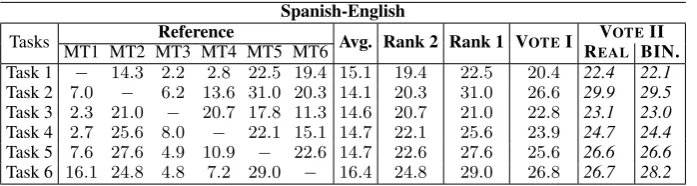
Spanish-English
Tasks MT1 MT2 MT3 MT4 MT5 MT6Reference Avg. Rank 2 Rank 1 VOTEI REALVOTEBIN.II
Task 1 − 14.3 2.2 2.8 22.5 19.4 15.1 19.4 22.5 20.4 22.4 22.1
Task 2 7.0 − 6.2 13.6 31.0 20.3 14.1 20.3 31.0 26.6 29.9 29.5
Task 3 2.3 21.0 − 20.7 17.8 11.3 14.6 20.7 21.0 22.8 23.1 23.0
Task 4 2.7 25.6 8.0 − 22.1 15.1 14.7 22.1 25.6 23.9 24.7 24.4
Task 5 7.6 27.6 4.9 10.9 − 22.6 14.7 22.6 27.6 25.6 26.6 26.6
[image:7.595.127.476.71.164.2]Task 6 16.1 24.8 4.8 7.2 29.0 − 16.4 24.8 29.0 26.8 26.7 28.2
Table 3: Results for Spanish-English experiments.
French-English
Tasks MT1 MT2 MT3 MT4 MT5 MT6 MT7 MT8 MT9 MT10Reference Avg. Rank 3 Rank 2 Rank 1 VOTEI REALVOTEBIN.II
Task 1 − 9.6 6.3 9.8 12.2 8.7 11.5 11.7 13.9 5.7 9.9 11.7 12.2 13.9 12.7 13.0 12.5
Task 2 18.3 − 14.8 13.3 27.3 11.4 21.4 10.7 22.3 20.2 17.7 21.4 22.3 27.3 22.5 23.1 23.0
Task 3 16.9 22.9 − 15.6 19.6 14.1 19.9 12.5 17.5 16.1 17.2 19.6 19.9 22.9 19.2 19.2 20.5
Task 4 33.9 21.9 21.5 − 29.0 22.9 26.2 35.0 34.2 11.3 26.2 33.9 34.2 35.0 30.2 29.0 30.3
Task 5 16.0 20.7 11.2 13.2 − 10.7 18.4 12.0 17.9 12.9 14.8 17.9 18.4 20.7 17.5 17.8 16.9
Task 6 26.7 22.5 21.6 24.7 26.9 − 25.0 21.8 22.3 16.8 23.1 25.0 26.7 26.9 25.9 26.2 25.9
Task 7 15.8 18.8 14.1 15.6 20.8 14.9 − 14.8 17.8 14.9 16.4 17.8 18.8 20.8 18.6 19.4 18.1
Task 8 31.4 15.8 11.0 27.3 22.3 15.2 23.6 − 29.4 18.8 20.8 27.3 29.4 31.4 26.6 24.9 27.9
Task 9 21.4 15.1 7.6 15.7 19.5 8.4 16.4 14.8 − 8.6 14.2 16.4 19.5 21.4 19.3 18.9 19.5
[image:7.595.68.549.195.327.2]Task 10 12.0 23.3 10.7 9.6 22.8 8.3 16.9 8.4 17.3 − 14.4 17.3 22.8 23.3 17.5 17.6 15.5
Table 4: Results for French-English experiments.
pre-trained domain-specific systems.
5 Results
5.1 Ecosystem Performance
We first investigate how well the ecosystems han-dle unknown and out-of-domain translation tasks. Tables 3, 4 and 5 present the results (in BLEU). Note that:
• AVG: average of BLEU score of MT systems
• Rank 3, Rank 2, Rank 1: top 3 MT systems
• Vote I: VOTINGI method
• Vote II Real: VOTINGII method with real
re-ward
• Vote II Bin: VOTING II method with binary
reward
As expected, translation quality degrades sub-stantially for most pre-trained MT systems given such a translation task. TheSubtitle-adapted MT system for Spanish-English (MT 1 - Tables 3) is a notable example to raise the issue: the translation accuracy substantially drops for the other out-of-domain translation tasks (i.e. Task 2 (Wikipedia):
7.0 BLEU score, Task 3 (Medicine): 2.3 BLEU
score, Task 4 (Legal): 2.7 BLEU score, Task 5
(News): 7.6 BLEU score, Task 6 (Speech): 16.1
BLEU score).
However, the degradation of each pre-trained MT system is different from the others. For exam-ple, the Speech-adapted MT system for Spanish-English (MT 6 - Tables 3) drops their perfor-mance significantly for only Task 3 (Medicine) (11.3BLEU score) and Task 4 (Legal) (15.1BLEU
score). The Speech-adapted MT system is capable of handling other out-of-domain translation tasks (i.e. Task 1 (Subtitles): 19.4 BLEU score, Task
2 (Wikipedia): 20.3BLEU score, Task 5 (News): 22.6BLEU score).
For 23 out-of-domain translation tasks in total, our results show that despite the translation quality substantially drops for most pre-trained MT sys-tems, a few pre-trained MT systems are still com-petitive to handle the tasks. In 21/23 cases, top
MT systems with respect to a certain translation task are still able to handle the task well.3
This supports our claim: Having a large-scale ecosystem of pre-trained MT systems is very use-ful for handling out-of-domain tasks in practice. But is it possible to gain competitive performance to top rank MT systems from ecosystem of pre-trained domain-specific systems for unknown and out-of-domain translation tasks? Our experiments show that it is possible with our proposed frame-works.
3For convenience, we set a BLEU threshold (20) to decide if
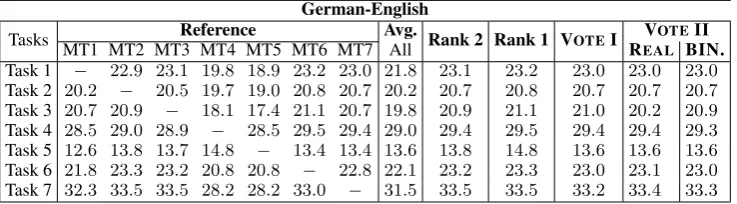
German-English
Tasks MT1 MT2 MT3 MT4 MT5 MT6 MT7 AllReference Avg. Rank 2 Rank 1 VOTEI REALVOTEBIN.II
Task 1 − 22.9 23.1 19.8 18.9 23.2 23.0 21.8 23.1 23.2 23.0 23.0 23.0
Task 2 20.2 − 20.5 19.7 19.0 20.8 20.7 20.2 20.7 20.8 20.7 20.7 20.7
Task 3 20.7 20.9 − 18.1 17.4 21.1 20.7 19.8 20.9 21.1 21.0 20.2 20.9
Task 4 28.5 29.0 28.9 − 28.5 29.5 29.4 29.0 29.4 29.5 29.4 29.4 29.3
Task 5 12.6 13.8 13.7 14.8 − 13.4 13.4 13.6 13.8 14.8 13.6 13.6 13.6
Task 6 21.8 23.3 23.2 20.8 20.8 − 22.8 22.1 23.2 23.3 23.0 23.1 23.0
[image:8.595.116.485.72.174.2]Task 7 32.3 33.5 33.5 28.2 28.2 33.0 − 31.5 33.5 33.5 33.2 33.4 33.3
Table 5: Results for German-English experiments.
Spanish-English
Tasks MIN SC Avg. DC Avg. VAll TRs OTEI REAL BIN.VOTEII
Task 1 2.2 10.9 15.1 18.6 21.0 20.4 22.4 22.1
Task 2 6.2 15.2 14.1 15.7 25.7 26.6 29.9 29.5
Task 3 2.3 18.4 14.6 15.2 20.9 22.8 23.1 23.0
Task 4 2.7 13.9 14.7 13.5 23.9 23.9 24.7 24.4
Task 5 4.9 14.0 14.7 17.3 25,1 25.6 26.6 26.6
[image:8.595.71.305.212.306.2]Task 6 4.8 17.0 16.4 18.2 26,9 26.8 26.7 28.2
Table 6: A detailed comparison for other baselines (SC: System Combination, DC: Domain Classification, Avg. TR: Average baseline between top rank MT systems (Rank 1 and Rank 2) for Spanish-English.
5.2 Our Framework Performance
Tables 3, 4 and 5 present the results. Note that our models are stochastic, and results for our ex-periments are averaged among20runs. The main
findings are:
VOTINGI substantially outperforms Rank 2 for
all cases for Spanish-English. It outperforms Rank 3 for6/10tasks for French-English. We would like to emphasize that: (1) this performance is obtained without any knowledge about translation task; and (2) the gap between the best and the worst MT systems for each task in ecosystems is huge (i.e. usually around+20BLEU score). This validates
the idea behind VOTING I: Good translations are
likely to be similar to the others.
We perform System Combination (SC) by en-sembling all NMT systems for the tasks. SC rather gives a poor performance in our setting (Table 6). We should emphasize that the result is rather ex-pected: SC degrades translation quality substan-tially because most pre-trained MT systems in the ecosystem are incapable of handling the task.4
We also create a simple domain classifier (DC) for translation requests: We train different in-domain language models from in-in-domain mono-4We should also note that interpolating all SMT systems gives
a rather poor performance as well. This is because of the same reason: most pre-trained MT systems in the ecosystem are incapable of handling the task. We did not report the results here due to space constraints.
lingual corpora, and perform a search to select an MT system from the ecosystem based on their language model probability of each translation re-quest:mˆ = argmax
m=1,...,N
Pm(f). DC also rather gives
a poor performance in our setting (Table 6). It out-performs the average baseline (Avg. All) in most cases, but its performance is far behind the middle of top rank MT systems (Avg. TRs). The result is unsurprising: it is hard to expect a domain classi-fier for translation requests provides robust perfor-mance for target domain that is not only unknown but also out-of-domain.
Interestingly, VOTING I gives the performance
at least in the middle between Rank 1 and Rank 2 in5/6tasks for Spanish-English, except only Task
1. Meanwhile, the performance is at least in the middle between Rank 1, Rank 2 and Rank 3 in
3/10tasks for French-English.
VOTINGII - REAL and VOTINGII - BINARY
perform better than VOTING I for 5/6 tasks for
Spanish-English. All these frameworks perform substantially better (at least +1.0 BLEU score)
than VOTINGI in4cases (Tasks 1, 2, 3 and 5). For
French-English, VOTINGII - REAL and VOTING
II - BINARY perform at least compatible to VOT -ING I for6/10 tasks. Each of these frameworks
performs better than VOTINGI for4/10tasks.
The results validate the idea behind VOTING II:
MT systems that are good in a domain tend to agree with each other.
VOTING II - REAL usually performs better
than VOTING II - BINARY. This is reasonable as
in VOTING II - BINARY, model parameters are
updated based on simplified outcome of the agree-ment scores instead of the agreeagree-ment scores.
Despite having a different set up for construct-ing domain-specific MT systems, all our observa-tions are also confirmed for German-English as in Table 5. VOTING I gives the performance in the
except only Task 5. VOTING II provides
compat-ible performance to VOTINGI. This is reasonable
as when MT systems are close to the others regard-ing their translation quality, the benefits of reduc-ing the decodreduc-ing cost is what VOTING II is
ex-pected to provide. It is worthy to emphasize that our VOTINGframeworks still outperform the
aver-age baseline significantly.
5.3 Disadvantage of our method
While the result from our method is impressive, we should be clear about its disadvantage. We found that:
• A generic system trained with all the training data of the different domains normally pro-duces significantly better performance than what our framework provides.
• An indomain MT system trained on in-domain training data normally produces sig-nificantly better performance than what our framework provides as well.
Improving our framework to make it work compat-ible to those stronger baselines is a goal of future research.
6 Conclusion
This work shows that having an ecosystem of pre-trained domain-specific MT systems is not only ef-ficient for in-domain translation tasks, but could be also very useful for out-of-domain translation tasks. More specifically, we show that an out-of-domain translation task can be out-of-scope of most pre-trained adapted MT systems in the ecosystem, but a few others can be still very ca-pable of handling the task. We conduct exten-sive experiments with different scale (from 6 to 10) ecosystems of pre-trained MT systems to
sup-port our claim. We also contribute two frame-works that gain competitive performance to top rank MT systems from ecosystem of pre-trained domain-specific systems for unknown and poten-tially out-of-domain translation tasks. We hope our study fills an important gap in the domain adapta-tion literature: making translaadapta-tion ecosystems with domain-adapted MT systems capable of handling unknown and out-of-domain tasks.
Acknowledgement
This work was conducted when the author was at University of Amsterdam, as well as when he was
in his visiting research to University of Sheffield. The author would like to thanks many people since then, including: Kashif Shah, Lucia Specia, Joost Bastings, Khalil Simaa’n, Ivan Titov. The author also thanks reviewers for their constructive com-ments.
References
[Axelrod et al.2011] Axelrod, Amittai, Xiaodong He, and Jianfeng Gao. 2011. Domain adaptation via pseudo in-domain data selection. InEMNLP. [Bahdanau et al.2015] Bahdanau, Dzmitry, Kyunghyun
Cho, and Yoshua Bengio. 2015. Neural Machine Translation by Jointly Learning to Align and Trans-late. InProceedings of the International Conference on Learning Representations (ICLR).
[Bapna and Firat2019] Bapna, Ankur and Orhan Firat. 2019. Non-parametric adaptation for neural machine translation.CoRR, abs/1903.00058.
[Bertoldi et al.2014] Bertoldi, Nicola, Patrick Simianer, Mauro Cettolo, Katharina W¨aschle, Marcello Fed-erico, and Stefan Riezler. 2014. Online adaptation to post-edits for phrase-based statistical machine trans-lation.Machine Translation.
[Bisazza et al.2011] Bisazza, Arianna, Nick Ruiz, and Marcello Federico. 2011. Fill-up versus interpo-lation methods for phrase-based smt adaptation. In IWSLT.
[Blain et al.2015] Blain, F., F. Bougares, A. Hazem, L. Barrault, and H. Schwenk. 2015. Continuous adaptation to user feedback for statistical machine translation. InNAACL-HLT (Short Papers).
[Carpuat et al.2013] Carpuat, Marine, Hal Daume III, Katharine Henry, Ann Irvine, Jagadeesh Jagarla-mudi, and Rachel Rudinger. 2013. Sensespotting: Never let your parallel data tie you to an old domain. InACL.
[Chen and Huang2016] Chen, Boxing and Fei Huang. 2016. Semi-supervised convolutional networks for translation adaptation with tiny amount of in-domain data. InConll.
[Chen et al.2013] Chen, Boxing, Roland Kuhn, and George Foster. 2013. Vector space model for adap-tation in statistical machine translation. InACL. [Chen et al.2017] Chen, Boxing, Colin Cherry, George
Foster, and Samuel Larkin. 2017. Cost weight-ing for neural machine translation domain adapta-tion. InProceedings of the First Workshop on Neu-ral Machine Translation, pages 40–46. Association for Computational Linguistics.
[Chiang et al.2011] Chiang, David, Steve DeNeefe, and Michael Pust. 2011. Two easy improvements to lex-ical weighting. InACL HLT (Short Papers).
[Chu and Wang2018] Chu, Chenhui and Rui Wang. 2018. A survey of domain adaptation for neural ma-chine translation. InProceedings of the 27th Inter-national Conference on Computational Linguistics, pages 1304–1319, Santa Fe, New Mexico, USA, Au-gust. Association for Computational Linguistics.
[Clark et al.2012] Clark, Jonathan H, Alon Lavie, and Chris Dyer. 2012. One system, many domains: Open-domain statistical machine translation via fea-ture augmentation. AMTA.
[Cuong and Sima’an2014a] Cuong, Hoang and Khalil Sima’an. 2014a. Latent domain phrase-based mod-els for adaptation. InProceedings of the 2014 Con-ference on Empirical Methods in Natural Language Processing. Association for Computational Linguis-tics.
[Cuong and Sima’an2014b] Cuong, Hoang and Khalil Sima’an. 2014b. Latent domain translation mod-els in mix-of-domains haystack. In Proceedings of COLING.
[Cuong and Sima’an2015] Cuong, Hoang and Khalil Sima’an. 2015. Latent domain word alignment for heterogeneous corpora. InNAACL-HLT.
[Cuong and Sima’an2017] Cuong, Hoang and Khalil Sima’an. 2017. A survey of domain adaptation for statistical machine translation. Machine Translation, 31(4):187–224, December.
[Cuong et al.2016] Cuong, Hoang, Khalil Sima’an, and Ivan Titov. 2016. Adapting to all domains at once: Rewarding domain invariance in smt. InTACL.
[Denkowski et al.2014] Denkowski, Michael, Chris Dyer, and Alon Lavie. 2014. Learning from post-editing: Online model adaptation for statistical machine translation. InEACL.
[Duh et al.2013] Duh, Kevin, Graham Neubig, Kat-suhito Sudoh, and Hajime Tsukada. 2013. Adap-tation data selection using neural language models: Experiments in machine translation. InACL (Short Papers).
[Eetemadi et al.2015] Eetemadi, Sauleh, William Lewis, Kristina Toutanova, and Hayder Radha. 2015. Survey of data-selection methods in statistical machine translation. Machine Translation.
[Eidelman et al.2012] Eidelman, Vladimir, Jordan Boyd-Graber, and Philip Resnik. 2012. Topic models for dynamic translation model adaptation. InACL (Short Papers).
[Farajian et al.2017] Farajian, M. Amin, Marco Turchi, Matteo Negri, and Marcello Federico. 2017. Multi-domain neural machine translation through unsu-pervised adaptation. InProceedings of the Second
Conference on Machine Translation, pages 127–137, Copenhagen, Denmark, September. Association for Computational Linguistics.
[Foster et al.2010] Foster, George, Cyril Goutte, and Roland Kuhn. 2010. Discriminative instance weighting for domain adaptation in statistical ma-chine translation. InEMNLP.
[Gal and Ghahramani2015] Gal, Y. and Z. Ghahramani. 2015. A Theoretically Grounded Application of Dropout in Recurrent Neural Networks. ArXiv e-prints, December.
[Haddow2013] Haddow, Barry. 2013. Applying pair-wise ranked optimisation to improve the interpola-tion of translainterpola-tion models. In NAACL HLT (Short Papers).
[Hasler et al.2014] Hasler, Eva, Phil Blunsom, Philipp Koehn, and Barry Haddow. 2014. Dynamic topic adaptation for phrase-based mt. InEACL.
[Heafield et al.2013] Heafield, Kenneth, Ivan Pouzyrevsky, Jonathan H. Clark, and Philipp Koehn. 2013. Scalable modified kneser-ney language model estimation. InACL (Short Papers). [Hildebrand and Vogel2008] Hildebrand, Almut Silja
and Stephan Vogel. 2008. Combination of Ma-chine Translation Systems via Hypothesis Selection from Combined N-Best Lists. InProceedings of the Eighth Conference of the Association for Machine Translation in the Americas, pages 254–261. [Hu et al.2014] Hu, Yuening, Ke Zhai, Vladimir
Eidel-man, and Jordan Boyd-Graber. 2014. Polylingual tree-based topic models for translation domain adap-tation. InACL.
[Jayaraman and Lavie2005] Jayaraman, Shyamsundar and Alon Lavie. 2005. Multi-engine machine trans-lation guided by explicit word matching. In Pro-ceedings of the ACL 2005 on Interactive Poster and Demonstration Sessions, ACLdemo ’05, pages 101– 104, Stroudsburg, PA, USA. Association for Compu-tational Linguistics.
[Joty et al.2015] Joty, Shafiq, Hassan Sajjad, Nadir Durrani, Kamla Al-Mannai, Ahmed Abdelali, and Stephan Vogel. 2015. How to avoid unwanted preg-nancies: Domain adaptation using neural network models. InEMNLP.
[Karimova et al.2018] Karimova, Sariya, Patrick Simi-aner, and Stefan Riezler. 2018. A user-study on online adaptation of neural machine translation to human post-edits. Machine Translation, 32(4):309– 324.
[Kingma and Ba2014] Kingma, Diederik and Jimmy Ba. 2014. Adam: A method for stochastic optimiza-tion. arXiv preprint arXiv:1412.6980.
[Kirchhoff and Bilmes2014] Kirchhoff, Katrin and Jeff Bilmes. 2014. Submodularity for data selection in machine translation. InEMNLP.
[Kobus et al.2017] Kobus, Catherine, Josep Crego, and Jean Senellart. 2017. Domain control for neu-ral machine translation. In Proceedings of the In-ternational Conference Recent Advances in Natural Language Processing, RANLP 2017, pages 372–378, Varna, Bulgaria, September. INCOMA Ltd.
[Koehn and Knowles2017] Koehn, Philipp and Rebecca Knowles. 2017. Six challenges for neural machine translation. InProceedings of the First Workshop on Neural Machine Translation, pages 28–39. Associa-tion for ComputaAssocia-tional Linguistics.
[Koehn and Schroeder2007] Koehn, Philipp and Josh Schroeder. 2007. Experiments in domain adaptation for statistical machine translation. InWMT.
[Koehn et al.2003] Koehn, Philipp, Franz Josef Och, and Daniel Marcu. 2003. Statistical phrase-based translation. InNAACL HLT.
[Koehn et al.2007] Koehn, Philipp, Hieu Hoang, Alexandra Birch, Chris Callison-Burch, Marcello Federico, Nicola Bertoldi, Brooke Cowan, Wade Shen, Christine Moran, Richard Zens, Chris Dyer, Ondˇrej Bojar, Alexandra Constantin, and Evan Herbst. 2007. Moses: Open source toolkit for statistical machine translation. InACL.
[Koehn et al.2014] Koehn, Philipp, Chara Tsoukala, and Herve Saint-Amand. 2014. Refinements to interactive translation prediction based on search graphs. InACL (Short Papers).
[Kothur et al.2018] Kothur, Sachith Sri Ram, Rebecca Knowles, and Philipp Koehn. 2018. Document-level adaptation for neural machine translation. In Proceedings of the 2nd Workshop on Neural Ma-chine Translation and Generation, pages 64–73, Melbourne, Australia, July. Association for Compu-tational Linguistics.
[Lin and Och2004] Lin, Chin-Yew and Franz Josef Och. 2004. Orange: A method for evaluating automatic evaluation metrics for machine translation. In COL-ING.
[Macherey and Och2007] Macherey, Wolfgang and Franz J. Och. 2007. An empirical study on comput-ing consensus translations from multiple machine translation systems. In Proceedings of the 2007 Joint Conference on Empirical Methods in Natural Language Processing and Computational Natural Language Learning (EMNLP-CoNLL), pages 986– 995, Prague, Czech Republic, June. Association for Computational Linguistics.
[Mansour and Ney2014] Mansour, Saab and Hermann Ney. 2014. Unsupervised adaptation for statistical machine translation. InWMT.
[Michel and Neubig2018] Michel, Paul and Graham Neubig. 2018. Extreme adaptation for personalized neural machine translation. In Proceedings of the 56th Annual Meeting of the Association for Compu-tational Linguistics (Volume 2: Short Papers), pages 312–318, Melbourne, Australia, July. Association for Computational Linguistics.
[Nguyen et al.2017] Nguyen, Khanh, Hal Daum´e III, and Jordan Boyd-Graber. 2017. Reinforcement learning for bandit neural machine translation with simulated human feedback. In Proceedings of the 2017 Conference on Empirical Methods in Natu-ral Language Processing, pages 1464–1474, Copen-hagen, Denmark, September. Association for Com-putational Linguistics.
[Ortiz-Mart´ınez et al.2010] Ortiz-Mart´ınez, Daniel, Is-mael Garc´ıa-Varea, and Francisco Casacuberta. 2010. Online learning for interactive statistical ma-chine translation. InNAACL-HLT.
[Ortiz-Mart´ınez2016] Ortiz-Mart´ınez. 2016. Online learning for statistical machine translation. Comput. Linguist.
[Papineni et al.2002] Papineni, Kishore, Salim Roukos, Todd Ward, and Wei-Jing Zhu. 2002. Bleu: A method for automatic evaluation of machine trans-lation. InACL.
[Peris and Casacuberta2018] Peris, ´Alvaro and Fran-cisco Casacuberta. 2018. Active learning for in-teractive neural machine translation of data streams. InProceedings of the 22nd Conference on Computa-tional Natural Language Learning, pages 151–160, Brussels, Belgium, October. Association for Compu-tational Linguistics.
[Razmara et al.2012] Razmara, Majid, George Foster, Baskaran Sankaran, and Anoop Sarkar. 2012. Mix-ing multiple translation models in statistical machine translation. InACL.
[Sennrich and Haddow2016] Sennrich, Rico and Barry Haddow. 2016. Linguistic input features improve neural machine translation. In Proceedings of the First Conference on Machine Translation, pages 83– 91, Berlin, Germany, August. Association for Com-putational Linguistics.
[Sennrich et al.2013] Sennrich, Rico, Holger Schwenk, and Walid Aransa. 2013. A multi-domain transla-tion model framework for statistical machine trans-lation. InACL.
[Sennrich2012a] Sennrich, Rico. 2012a. Mixture-modeling with unsupervised clusters for domain adaptation in statistical machine translation. In EAMT.
[Sennrich2012b] Sennrich, Rico. 2012b. Perplexity minimization for translation model domain adapta-tion in statistical machine translaadapta-tion. InEACL.
[Shah et al.2010] Shah, Kashif, Lo¨ıc Barrault, and Hol-ger Schwenk. 2010. Translation model adaptation by resampling. InWMT.
[Sokolov et al.2015] Sokolov, Artem, Stefan Riezler, and Tanguy Urvoy. 2015. Bandit structured predic-tion for learning from partial feedback in statistical machine translation. InMTSummit.
[Sokolov et al.2016] Sokolov, Artem, Julia Kreutzer, Christopher Lo, and Stefan Riezler. 2016. Learning structured predictors from bandit feedback for inter-active nlp. InACL.
[Sokolov et al.2017] Sokolov, Artem, Julia Kreutzer, Kellen Sunderland, Pavel Danchenko, Witold Szy-maniak, Hagen F¨urstenau, and Stefan Riezler. 2017. A shared task on bandit learning for machine trans-lation. In Proceedings of the Second Conference on Machine Translation, pages 514–524, Copen-hagen, Denmark, September. Association for Com-putational Linguistics.
[Su et al.2015] Su, Jinsong, Deyi Xiong, Yang Liu, Xi-anpei Han, Hongyu Lin, Junfeng Yao, and Min Zhang. 2015. A context-aware topic model for sta-tistical machine translation. InACL-IJCNLP.
[Tars and Fishel2018] Tars, Sander and Mark Fishel. 2018. Multi-domain neural machine translation. CoRR, abs/1805.02282.
[van der Wees et al.2017] van der Wees, Marlies, Ari-anna Bisazza, and Christof Monz. 2017. Dynamic data selection for neural machine translation. In Pro-ceedings of the 2017 Conference on Empirical Meth-ods in Natural Language Processing, pages 1400– 1410. Association for Computational Linguistics.
[Wang et al.2012] Wang, Wei, Klaus Macherey, Wolf-gang Macherey, Franz Och, and Peng Xu. 2012. Improved domain adaptation for statistical machine translation. InAMTA.
[Wang et al.2018] Wang, R., M. Utiyama, A. Finch, L. Liu, K. Chen, and E. Sumita. 2018. Sentence selection and weighting for neural machine transla-tion domain adaptatransla-tion. IEEE/ACM Transactions on Audio, Speech, and Language Processing, pages 1– 1.
[Wuebker et al.2016] Wuebker, Joern, Spence Green, John DeNero, Sasa Hasan, and Minh-Thang Luong. 2016. Models and inference for prefix-constrained machine translation. InACL.