UniParse: A universal graph-based parsing toolkit
Daniel Varab IT University Copenhagen, Denmark
Natalie Schluter IT University Copenhagen, Denmark [email protected]
Abstract
This paper describes the design and use of the graph-based parsing framework and toolkit UniParse, released as an open-source python software package devel-oped at the IT University, Copenhagen Denmark. UniParse as a framework novelly streamlines research prototyping, development and evaluation of graph-based dependency parsing architectures. The system does this by enabling highly efficient, sufficiently independent, read-able, and easily extensible implementa-tions for all dependency parser compo-nents. We distribute the toolkit with ready-made pre-configured re-implementations of recent state-of-the-art first-order graph-based parsers, including highly efficient Cython implementations of feature en-coders and decoding algorithms, as well as off-the-shelf functions for computing loss from graph scores.
1 Introduction
Motivation. While graph-based dependency parsers are theoretically simple models, extensi-ble and modular implementations for sustainaextensi-ble parser research and development have to date been severely lacking in the research community. Con-tributions to parsing research generally centres around particular components of parsers in isola-tion, such as novel decoding algorithms, novel arc encodings, or novel learning architectures. How-ever, due to perceived gains in performance or due to the lack of foresight in writing sustainable code, these components are rarely implemented modularly or with extensibility in mind. This applies to prior sparse-feature dependency parsers (McDonald and Pereira (2006)’s MST parser), as well as recent state-of-the-art neural parsers
(Kiperwasser and Goldberg, 2016; Dozat and Manning, 2017). Implementations of parser components are generally tightly coupled to one another which heavily hinders their usefulness in future research.
With UniParse, we provide a flexible, highly expressive, scientific framework for easy, low-barrier of entry, highly modular, efficient devel-opment and fair benchmarking of graph-based dependency parsing architectures. With the framework we distribute pre-configured state-of-the-art first-order sparse and neural graph-based parser implementations to provide strong base-lines for future research on graph based depen-dency parsers.
Novel contributions
• We align sparse feature and neural research in graph-based dependency parsing to a com-mon terminology. With this shared termi-nology we develop a unified framework for the UniParse toolkit to rapidly prototype new parsers and easily compare performance to previous work.
• Prototyping is now rapid due to modular-ity: parser components may now be devel-oped in isolation, with no resulting loss in efficiency. Measuring the empirical perfor-mance of a new decoder no longer require implementing an encoder, and investigating the synergy between a learning strategy and a decoder no longer requires more than a flag or calling a library function.
• Preprocessing is now made explicitwithin its own component and is thereby adequately isolated and portable.
literature and have implemented these in Uni-Parse in an explicit manner.
• To the best of our knowledge, UniParse is the first attempt at unifying existing de-pendency parsers to the same code base. Moreover, UniParse is to our knowledge the first attempt to enable first-order sparse-feature dependency parsing in a shared python codebase.
We make the parser freely available under a GNU General Public License1.
2 Terminology of a unified dependency parser
Traditionally, a graph-based dependency parser consists of three components. AnencoderΓ, a set ofparameters λ, and adecoder h. The possible dependency relations between all words of a sentence S are modeled as a complete directed graphGSwhere words are nodes and arcs are the relations. An arc inGSis called a factor whichΓ associates with ad-dimensional feature vector, its encoding. The set of parameters λare then used to produce scores from the constructed feature vectors according to some learning procedure. These parameters are optimized over treebanks. Lastly a decoder h is some maximum spanning tree algorithm with input GS and scores for factors ofGSgiven byλ; it outputs a well-formed dependency tree, which is the raw output of a dependency model.
Recent work on neural dependency parsers learns factor embeddings discriminatively along-side the parameters used for scoring. The result is thatΓandλof dependency parsers fuse together into a union of parameters. Thus, in this work we fold the notion of encoding into the parameter space. Now, for the neural models, all parameters are trainable, whereas for sparse-feature models, the encodings of sub-sets of arcs are non-trainable. So the unified terminology addresses only param-etersλand a decoderh.
3 API and the joint model architecture
We provide two levels of abstraction for imple-menting graph-based dependency parsers. First, our descriptive high-level approach focuses on ex-pressiveness, enabling models to be described in
1github.com/danielvarab/uniparse
just a few lines of code by providing an interface where the required code is minimal, only a means to configure design choices. Second, as an alter-native to the high-level abstraction we emphasise that parser definition is nothing more than a com-position of pre-configured low-level modular im-plementations. With this we invite cherry picking of the included implementations of optimised de-coders, data preprocessors, evaluation module and more. We now briefly overview the basic use of the joint API and list the central low-level mod-ule implementations included with the UniParse toolkit.
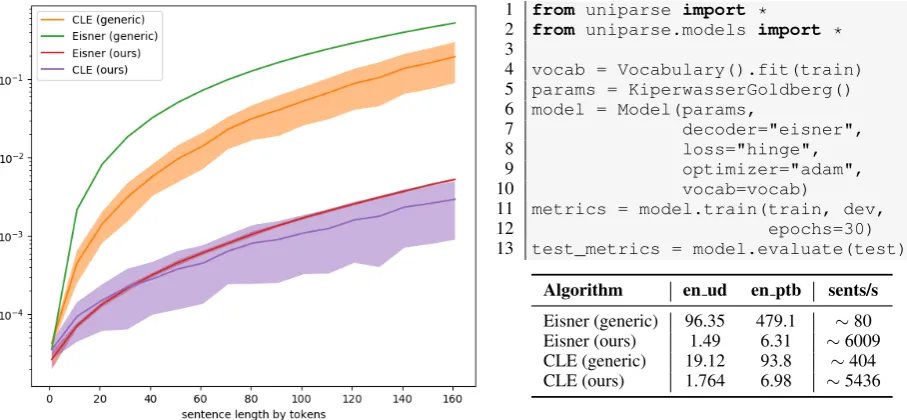
Elementary usage (high level). For ease of use we provide a high-level class to encapsulate neu-ral training. Its use results in a significant reduc-tion in the amount of code required to implement a parser and counters unwanted boilerplate code. It provides default configurations for all included components, while enabling custom implementa-tion whenever needed. Custom implementaimplementa-tions are only required to be callable and adheres to the framework’s function definition. The mini-mum requirement with the use of this interface is a parameter configuration, loss function, optimizer, and batch strategy. In Listing 1 we show an exam-ple imexam-plementation of Kiperwasser and Goldberg (2016)’s neural parser in only a few lines. The full list of possible arguments along with their inter-faces can be found in the toolkit documentation.
Vocabulary. This class facilitates preprocessing of CoNLL-U formatted files with support for out-of-vocabulary management and alignment with pre-trained word embeddings. Text preprocessing strategies have significant impact on NLP model performance. Despite this, little effort has put into describing such techniques in recent litera-ture. Without these details preprocessing becomes yet another hyper-parameter of a model, and ob-fuscates research contribution. In the UniParse toolkit, we include a simple implementation for recently employed techniques in parsing for token cleaning and mapping.
1 from uniparse import *
2 from uniparse.models import *
3
4 vocab = Vocabulary().fit(train)
5 params = KiperwasserGoldberg()
6 model = Model(params,
7 decoder="eisner",
8 loss="hinge",
9 optimizer="adam",
10 vocab=vocab)
11 metrics = model.train(train, dev,
12 epochs=30)
13 test_metrics = model.evaluate(test)
Algorithm en ud en ptb sents/s
Eisner (generic) 96.35 479.1 ∼80 Eisner (ours) 1.49 6.31 ∼6009 CLE (generic) 19.12 93.8 ∼404 CLE (ours) 1.764 6.98 ∼5436
Figure 1: (Right code snippet) Implementation of Kiperwasser and Goldberg (2016)’s neural parser in only a few lines using UniParse.
(Right table and left figure) Number of seconds a decoder takes to decode an entire dataset. Score matrices are generated uniformly in the range[0,1]. The random generated data has an impact on CLE due to its greedy nature; The figure demonstrates this by the increasingly broad standard deviation band. Experiments are run on an Ubuntu machine with an Intel Xeon E5-2660, 2.60GHz CPU.
in the codebase for Dozat and Manning (2017)2 (this is not described in the published work). With unobtrusive design in mind any alternative custom batching strategy may be employed directly, no in-teraction with the framework is needed.
Decoders We include optimised Cython imple-mentations of first-order decoder algorithms with the toolkit. This includes Eisner’s algorithm (Eis-ner, 1996) and Chu-Liu-Edmonds (Chu and Liu, 1965; Edmonds, 1967; Zwick, 2013). In Figure 1 we compare the performance of our decoder implementations against pure python implementa-tions3on randomised score input. Our implemen-tations outperform a pure python implemenimplemen-tations by a order of several magnitudes.
Evaluation. UAS and LAS are central depen-dency parser performance metrics, measuring un-labeled and un-labeled arc accuracy respectively with UAS = #correct arcs#arcs and LAS = #correctly labeled arcs#arcs . Unfortunately, there are also a number unreported
2https://github.com/tdozat/Parser-v1 3https://github.com/
LxMLS/lxmls-toolkit/blob/
1bdc382e509d24b24f581c1e1d78728c9e739169/ lxmls/parsing/dependency_decoder.py
preprocessing choices preceding the application of these metrics, which renders direct comparison of parser performance in the literature futile, re-gardless of how well-motivated these preprocess-ing choices are. These are generally discovered by manually screening the code implementations when these implementations are made available to the research community. Two important variations found in state-of-the-art parser evaluation are the following.
1. Punctuation removal.Arcs incoming to any punctuation are somtimes removed for eval-uation. Moreover, the definition of punctu-ation is not universally shared. We provide a clear python implementation for these met-rics with and without punctuation arc dele-tion before applicadele-tion, where the definidele-tion of punctuation is clear: punctuation refers to tokens that consist of characters complying to the Unicode punctuation standard.4 This is the strategy employed by the widely used Perl evaluation script, which to our knowl-edge, originates from the CoNLL 2006 and
4https://www.compart.com/en/unicode/
[image:3.595.72.526.90.300.2]Parser configurations Dataset UAS wo.p.. original
LAS wo.p. original
UAS wo.p.
LAS wo.p.
UAS w.p.
LAS w.p.
Kiperwasser and Goldberg en ud — — 87.71 84.83 86.80 85.12 (2016) en ptb 93.32 91.2 93.14 91.57 92.56 91.17 da — — 83.72 79.49 83.24 79.62 Dozat and Manning en ud — — 91.47 89.38 90.74 89.01 (2017) en ptb 95.74 95.74 95.43 94.06 94.91 93.70 da — — 87.84 84.99 87.42 84.98
[image:4.595.107.490.64.196.2]MSTparser en ud — — 75.55 66.25 73.47 65.20 (2006) + extensions en ptb — — 76.07 64.67 74.00 63.60 da — — 68.80 55.30 67.17 55.52
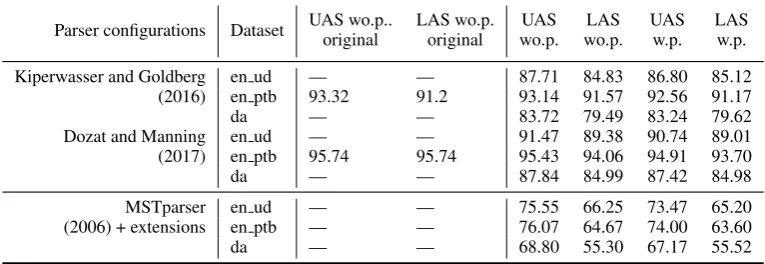
Table 1: UAS/LAS for included parser configurations. We provide results with (w.p.) and without (wo.p.) punctuation. For the English universal dependencies (UD) dataset we exclude the github repository suffix EWT. Regarding (Dozat and Manning, 2017), despite having access to the published TensorFlow code of we never observed scores exceed 95.58.
2007 shared tasks.5 We infer this from refer-ences in (Buchholz and Marsi, 2006). 2. Label prefixing. Some arc labels are
“com-posite”, their components separated by a colon. An example from the English Uni-versal Dependencies data set is the label obl:tmod. The official CoNLL 2017 shared-task evaluation script6 allows partial matching of labels based on prefix matches for components, for example matching to oblofobl:tmodgiving full points. We in-clude this variant in the distributed UniParse evaluation module.
Loss Functions. Common loss functions apply to scalar values, or predictions vectors represent-ing either real values or probabilities. However loss functions for dependency parsers are unortho-dox in that they operate on graphs, which has been dealt with in various creative ways over the years. We include a set of functions that apply to first-order parser graphs which are represented as square matrices. In the future we hope to expand this set for first-order, as well as explore higher-order structures.
Callbacks. While we have done our uttermost to design UniParse in a unobtrusive manner, few limitations may occur when developing, and es-pecially during exploration of model configura-tions when using the high-level model class. This could be the likes of manual updating of optimis-ers learning rates during training, or logging
gran-5
https://depparse.uvt.nl/SoftwarePage. html#eval07.pl
6https://universaldependencies.org/
conll17/baseline.html
ulated loss and accuracy. To accommodate this we include callback functionality which hooks into the training procedure enabling users to do the last few things perhaps inhibited by the framework. We include a number of useful pre-implemented callback utilities, such as a Tensorboard logger7, model saver, and a patience mechanism for early stopping.
Included parsers. We include three state-of-the-art first-order dependency parser implementa-tions as example configuraimplementa-tions of UniParse: Mc-Donald and Pereira (2006)’s MST sparse-feature parser 8, Kiperwasser and Goldberg (2016) and Dozat and Manning (2017)’s graph-based neu-ral parsers. Experiments are carried out on En-glish and Danish: the Penn Treebank (Marcus et al., 1994) (en ptb, training on sections 2-21, de-velopment on section 22 and testing on section 23), converted to dependency format following the default configuration of the Stanford Depen-dency Converter (version≥3.5.2), and the English (en ud), and Danish (da) datasets from Version 2.1 of the Universal Dependencies project (Nivre et al., 2017). Table 1 shows how our parser con-figurations perform compared with the originally reported parser performance.
7
github.com/tensorflow/tensorboard 8Note that this MST parser implementation consists of a
4 Concluding remarks
In this paper, we have described the design and usage of UniParse, a high-level un-opinionated framework and toolkit that supports both feature-based models with on-line learning techniques, as well as recent neural architectures trained through backpropagation. We have presented the framework as answer to a long-standing need for highly efficient, easily extensible, and, most of all, directly comparable graph-based dependency parsing research.
The goal of UniParse is to ease development and evaluation of graph-based syntatic parsers. Future work includes extending UniParse to a gen-eral parsing pipeline from raw text.
References
Sabine Buchholz and Erwin Marsi. 2006. Conll-x shared task on multilingual dependency parsing. In In Proceedings of CoNLL, pages 149–164. Associa-tion for ComputaAssocia-tional Linguistics.
Y.J. Chu and T.H. Liu. 1965. On the shortest arbores-cence of a directed graph. Sci. Sinica, 14:13961400.
Timothy Dozat and Christopher M. Manning. 2017. Deep biaffine attention for neural dependency pars-ing. InProceedings of ICLR.
J. Edmonds. 1967. Optimum branchings. J. Res. Nat. Bur. Standards, 71B:233240.
Jason M. Eisner. 1996.
https://doi.org/10.3115/992628.992688 Three new probabilistic models for dependency parsing: An exploration. In Proceedings of the 16th Con-ference on Computational Linguistics - Volume 1, COLING ’96, pages 340–345, Stroudsburg, PA, USA. Association for Computational Linguistics.
Eliyahu Kiperwasser and Yoav Goldberg. 2016. Sim-ple and accurate dependency parsing using bidirec-tional lstm feature representations. Transactions of the ACL, 4:313–327.
Mitchell Marcus, Grace Kim, Mary Ann Marcinkiewicz, Robert MacIntyre, Ann Bies, Mark Ferguson, Karen Katz, and Britta Schas-berger. 1994. The penn treebank: Annotating predicate argument structure. In Proceedings of the Workshop on Human Language Technology, HLT ’94, pages 114–119, Stroudsburg, PA, USA. Association for Computational Linguistics.
Ryan McDonald and Fernando Pereira. 2006. Online learning of approximate dependency parsing algo-rithms. In Proceedings of EACL. Association for Computational Linguistics.
Joakim Nivre et al. 2017.
http://hdl.handle.net/11234/1-2515 Universal dependencies 2.1. LINDAT/CLARIN digital library at the Institute of Formal and Applied Linguistics ( ´UFAL), Faculty of Mathematics and Physics, Charles University.