Linguistic Reflexes of Well-Being and Happiness in Echo
Jiaqi Wu, Marilyn Walker, Pranav Anand and Steve Whittaker
University of California Santa Cruz
{jwu64,mawalker,panand,swhittak}@ucsc.edu
Abstract
Different theories posit different sources for feelings of well-being and happiness. Appraisal theory grounds our emotional responses in our goals and desires and their fulfillment, or lack of fulfillment. Self-Determination theory posits that the basis for well-being rests on our assess-ments of our competence, autonomy and social connection. And surveys that mea-sure happiness empirically note that peo-ple require their basic needs to be met for food and shelter, but beyond that tend to be happiest when socializing, eating or hav-ing sex. We analyze a corpus of private micro-blogs from a well-being application calledECHO, where users label each
writ-ten post about daily events with a happi-ness score between 1 and 9. Our goal is to ground the linguistic descriptions of events that users experience in theories of well-being and happiness, and then exam-ine the extent to which different theoretical accounts can explain the variance in the happiness scores. We show that recurrent event types, such asOBLIGATIONandIN -COMPETENCE, which affect people’s
feel-ings of well-being are not captured in cur-rent lexical or semantic resources.
1 Introduction
There has recently been huge interest in well-being, with a recent review arguing that psycho-logical well-being plays a causal role in promot-ing job success, physical health, and long-term re-lationships (Lyubomirsky et al.,2005;Kahneman,
1999). In this paper we analyze a corpus of private micro-blogs from a well-being application called
ECHO, with the aim to detect, understand, and
fur-RECORDING(Negative): I have to clean the kitchen since it’s my chore this week, but I really don’t want to do it! REFLECTION(Positive): I’m glad I did it!! The kitchen was clean and I watched the kardashians while doing it! RECORDING(Positive): I am having a lovely lunch with my two friends. We are eating at Pacific Thai. Tom yu-umm!!
REFLECTION(Negative): I miss hanging out with friends, I’ve been so busy lately.
Figure 1:RECORDINGandREFLECTIONof Echo
ther advance systems that can improve both short and longer-term issues with well-being.
ECHO initiates user-written reactions to daily
events, calledRECORDINGS, as well as subsequent REFLECTIONSon those events at points in the
fu-ture (Isaacs et al.,2013).1Each reaction is labelled
at the time of recording or reflectionby the user, the first-person experiencer, with ahappiness rat-ing from 1 and 9. Note that all users’ posts and ratings are private, distinguishing this corpus from public sources like LiveJournal, where the content of posts might be influenced by considerations of self-presentation. Figure 1 shows a RECORDING
andREFLECTIONfrom two users, after binning the
happiness ratings into positive and negative. Our goal is to ground the linguistic descrip-tions of events that users experience, such as those in Figure 1, in theories of well-being and hap-piness. Without such a grounding, it is difficult for the ECHO system to make recommendations
to users to improve their well-being, or to explain the relationships between different event types and well-being, or to develop a policy that can do a good job of selecting events for targeted reflec-tion (Konrad et al.,2015;Isaacs et al.,2013). That is, forECHO’s purposes, we need techniques that
1The ECHO corpus is not publicly available because of
the ethical agreement with ECHO users. To protect users’ privacy, the uploaded images are not stored for analysis.
not only reliably categorize a user’s scalar happi-ness level, but are explanatory with respect to the sources of that happiness level.
There are two principal challenges to this goal. First, different theories posit different sources for feelings of well-being and happiness. Second, the relevant computational resources for senti-ment or mood are primarily lexically based, while many of the events can only be characterized well via their compositional semantics (Reschke and Anand,2011).
Other research also shares our motivation of un-derstanding the relationship between what peo-ple say and their levels of happiness and related moods. Mishne(2005) used a corpus of 340,000 posts from Livejournal that were self-annotated with the 40 most common moods. Lexical fea-tures alone improved classification accuracy by 6 to 15% over a balanced baseline. These results were then improved considerably (Keshtkar and Inkpen, 2009). Mihalcea and Liu (2006) exper-imented with the subset of happy/sad posts, and used conditional probability to explore the “hap-piness factor” of various terms, and the relation-ship of these terms to well-being categories such as human-centeredness and socialness. Schwartz et al.(2016) extract 5,100 public status updates on Facebook and have Turkers annotate them using Seligman’s dimensions for well-being: Positive Emotions, Engagement, Relationships, Meaning, and Accomplish (Seligman et al.,2006;Forgeard et al., 2011). They then predict each dimension with lexical and LDA topic features.
A related line of work builds lexico-semantic resources for sentiment analysis with a focus on how the participants of an event are affected by it.
Goyal and Riloff(2013) bootstrap a set of patient-polarity verbs from narratives andDing and Riloff
(2016) extract event-triples from blogs that reli-ably indicate positive or negative affect on one of the event participants. Reed et al. (2017) take a similar approach. Deng et al. (2013) annotate how participants of an event are affected, and Deng & Wiebe (2014) show that this assists inference about the author’s sentiment towards entities or events. Balahur et al. (2012) use the narratives produced by the ISEAR questionnaire (Scherer et al., 1986) for first-person examples of partic-ular emotions (“I felt angry when X and then Y happened”) and extract sequences of subject-verb-object triples, which they then annotate for seven
basic emotions. Choi & Wiebe (2014) use Word-Net to try to learn similar patterns, and Rupen-hofer & Brandes (2015) annotate synsets in Ger-maNet based on an event decomposition frame-work. Russo et al.(2015) proposed a shared task for recognition of a set of pleasant and unpleasant events from a clinical framework for well-being (MacPhillamy and Lewinsohn, 1982). Work on AFINN, SentiWordNet and the Connotation Lexi-con also aim to refine existing sentiment resources to capture more subtle notions of sentiment (Feng et al.,2013;Kang et al.,2014;Baccianella et al.,
2010;Nielsen,2011).
Here we report an exploratory study where we synthesize theoretical constructs associated with well-being and happiness from different sources. We then develop several methods for characteriz-ing events in terms of these theories. We examine the extent to which different theoretical accounts can explain the variance in the happiness scores in ECHO. We show that each theory explains a
part of the variance, but that our event character-izations need to be more fine-grained. We show that several recurrent event types which affect peo-ple’s feelings of well-being, such asOBLIGATION
andINCOMPETENCE, are not captured in current
lexical or semantic resources.
2 Background and Motivation
ECHO is designed to encourage users to react to
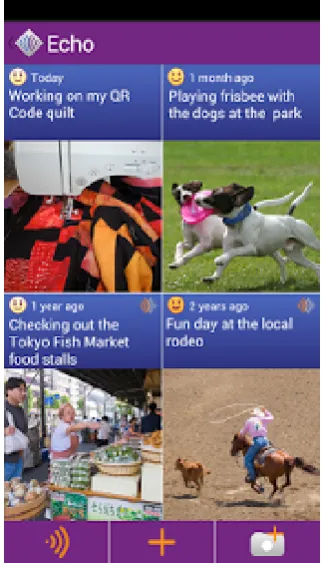
daily events as well as to periodically reflect on past events (Isaacs et al.,2013). Figure2depicts the user interface, showing aRECORDINGfrom
to-day, as well as prompts to reflect on events from the past.ECHOhas been deployed with 134 users,
in three different experiments on well-being ( Kon-rad et al., 2016b,a). The total corpus consists of 10354 posts, where 7573 are RECORDINGS and
2781 are REFLECTIONS. While the corpus could
be considered relatively small, these posts provide a window onto users’ private thoughts as opposed to what users are willing to make public on social media. In addtion, the annotations for happiness are provided by the user, the first-person experi-encer, and not by a third party.
Our aim is to explain users’ emotional reac-tions to different categories of events mentioned inECHO posts, linking the user reactions directly
Row # Source Subtype Affect Example
1 Goals Achieved POS I applied to an scholarship got a large chunk of my read-ing done and got started crammread-ing for next test . 2 Thwarted NEG Wasn’t able to get back in time for my class section . 3 Eudaimonics Autonomy POS Good day at work had the right support and students
were listening and behaving which was awesome. 4 Lack-Autonomy NEG Long list of things to do before going out tonight.
5 Competence POS After working hard and spending so many countless
hours, I finally finished my project for my psych class ! 6 Incompetence NEG My midterm was really long and I didn’t finish. 7 Connection POS Having a nice time with my parents watching the
Open-ing Winter Olympic Ceremony.
8 Lack or Neg-Connection NEG My friend needs a bone marrow biopsy and chemo. 9 Hedonics Savouring POS I love home cooking! Especially if it’s Italian.
[image:3.595.71.527.64.245.2]Savouring NEG The bus was rather packed and had a few people bump into me from where I was sitting.
Table 1: Examples of Theoretical Categories and Instantiations in ECHO
Figure 2: Screenshot of the Echo Interface
argue that success or failure in personal goals di-rectly mediates affect. Rows 1 and 2 in Table1. Such mediation arises because emotions have an important adaptive signaling function that serves to motivate future behaviors in relation to those goals. Row 1 provides a description from ECHO
of successfully achieving goals. Appraisal the-ory posits that goal achievement promotes posi-tive affect, which then serves to reinforce the rele-vant behavior. Row 2 provides an example of fail-ing to achieve an important personal goal, which
is posited to promote negative affect, motivating people to modify current behaviors to change that negative outcome.
[image:3.595.100.261.289.571.2]In addition, there is strong evidence from
SAVOURING theory (Jose et al., 2012; Bryant et al.,2011) arguing that people often experience highly positive or negative emotions arising from situations that aren’t directly goal-related, and that relate more directly to basic drives (Maslow,1943;
Elson, 2012). For example, experiences such as eating, experiencing nature, sex and physical exer-cise tend to engender positive emotions, whereas pain, discomfort and inactivity have the opposite effects, and these are documented in results from happiness surveys (Kahneman et al.,2004; Selig-man et al.,2006). Thus while experiences such as eating may serve the survival goal of preventing starvation, avoiding starvation is unlikely to be a direct personal goal every time we eat, suggest-ing that such experiences are not explained by Ap-praisal theory. Similar arguments have been made by Lewinsohn and colleagues who have shown that encouraging people to engage in certain sim-ple activities (shopping, mowing the lawn, driving, personal hygiene) have quite predictable effects on mood without engaging significant personal goals (MacPhillamy and Lewinsohn, 1982;Lewinsohn et al.,1985;Lewinsohn and Amenson,1978).
3 Empirical Approach
Dataset Pos Neg Total
Train 4743 3180 7923
Test 810 515 1325
Table 2: Number of Sentences for Train and Test
We start with the 10354 posts from the ECHO
corpus and map happiness scores between [1, 4] to negative, and scores between [6, 9] to positive. For posts labelled 5 by the experiencer, we categorize it as negative if itsREFLECTIONscore decreases to
lower than 5, and positive if itsREFLECTIONscore
increases. We label the rest of the 5s as neutral, and leave them aside. We then have 5997 posi-tive posts and 3573 negaposi-tive posts. We randomly sample 2868 posts as training data, and 478 as test data. We keep the rest of the 6224 posts untouched for future work. Then we split the posts into sen-tences. Table2shows the splits for each class.
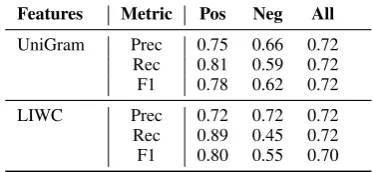
We first test the separability of the positive and negative sentences with an SVM classifier from Weka 3.8, using as baselines only unigrams and LIWC (Pennebaker et al., 2001) as features. Re-sults for these baseline classifiers are in Table 3,
Features Metric Pos Neg All
UniGram Prec 0.75 0.66 0.72 Rec 0.81 0.59 0.72 F1 0.78 0.62 0.72
LIWC Prec 0.72 0.72 0.72
[image:4.595.322.509.64.150.2]Rec 0.89 0.45 0.72 F1 0.80 0.55 0.70
Table 3: Weighted Metrics for SVM on Test
Unigram LIWC
fun affect,posemo,leisure good affect,posemo,drives,reward we we,social,drives,affiliation
lunch bio,ingest
glad affect,posemo
want cogproc,discrep
why interrog,cogproc,cause
need cogproc,discrep
no negate
[image:4.595.316.513.358.570.2]not negate,cogproc,differ
Table 4: The most informative UniGram features weighted by Information Gain
LIWC Words
negemo stress*, sad, sick, hate posemo fun, well, great, love negate dont, didnt, no, cant, havent anger hate, frustrat*, annoying
i i, my, me, im, myself
differ but, not, really, didnt leisure fun, game*, relax*, family discrep want, need, would, should sad sad, miss, hurt*, missed risk stop, problem*, avoid* anx stress*, nervous, worried ingest food*, dinner*, lunch* body sleep, slept, stomach* insight feel, know, think, found affiliat we, friends, friend, love reward good, got, get, great feel feel, feeling, felt, hard family family, mom, sister*, dad we we, our, us, weve, lets
Table 5: The most informative LIWC features ranked by Information Gain.
illustrating that the positive and negative classes can be separated with F1 above .70, and that both unigrams and LIWC perform worse on the nega-tive class.
Well-Being Frames Example Lexical Units
Goal Desiring, Intentionally Act, Purpose want, feel like, hope, wanted, wish, do, did, done, doing, does, plan, purpose, in order, intention, goals
Autonomy & Obliga-tion
Being obligated, Required event, Avoiding, Inhibit movement, Have as requirement, Complaining
complain, grumble, complaints, have to, had to, should, having to, need, get to, had to, have to, got to, should, avoid , ducking, take, need, needed, requires
Competence Activity done state, Attempt, Capabil-ity, Bungling, Difficulty, Practice, Ac-tivity finish, Accomplishment
finished, trying, try, tried, effort, attempt, efforts, can, could, exercise, practice, rehearsal, exercising, able, ability, unable, messed up; ruined; screwed up , ruin, hard, difficult, easy, tough, easier challenging, impossible, a breeze, hardest, finish, finishing, completed, accomplished, achieve
Connection & Lack-of Connection
Death, Forming relationships, So-cial event, Kinship, People, Peo-ple by residence, Telling, Communica-tion response
birthday, married, divorce, befriend, dinner, social, party, pic-nic, mom, family, parents, sister, cousin, told, tell, informed, people, girl, man, roommate, reply, answers, answer, reacted Savouring Emotions of mental activity,
Feel-ing, Annoyance, Desirability, Food, Chemical-sense description, Ambi-ent temperature, Emotions-by-stimulus, Stimulus focus, Intoxicants, Commu-nication noise, Experiencer Focus, Perception experience, Biological urge, Death
[image:5.595.75.524.68.365.2]enjoyed, like, hate, glad, annoyed, cry, yelled, whooped, honked, irritated, feel, feeling, yummy, alcohol, weed, drugs, dope, see, felt, seeing, hear, experience, senses, experiences, taste, feel, delicious, tasty, sweet, food, coffee, bread, cheese, good, bad, great, better, best, horrible, worst wonderful, weird, nice, relaxing, annoying, interesting, sad, weird enjoyable, comforting, entertaining, unpleasant, hilarious, rest, relaxation, exhilarating, tiring, nicer, disturbing, disappointing, embar-rassing, irritating, upsetting, heartbreaking, consoling, tedious, traumatic, chilling, calming, frightening touching, pleasure, sat-isfying, fascinating, tired, exhausted, sleepy, hungry, nauseated, horny
Table 6: Frame Categories and Associated Well-Being Classes.
and LIWC categories. We cannot recommend to anECHOuser that they should for example, try to
use the wordwhyless (Row 7) because it is corre-lated with negative feelings, or try to use less nega-tion (Rows 9 and 10). It is difficult to associate these features with well-being classes. Even in cases where the words seem to be strongly related to a well-being category, a single word typically fails to provide enough information, e.g., “it was funtalking to him” and “worked on afunproject” belong to different well-being classes. Moreover, the mapping of LIWC categories to words are many-to-many, e.g. the “discrep” category con-tains words related to both Goals and Autonomy. We posit that we need compositional semantic fea-tures to ground our a Well-Being classification of events.
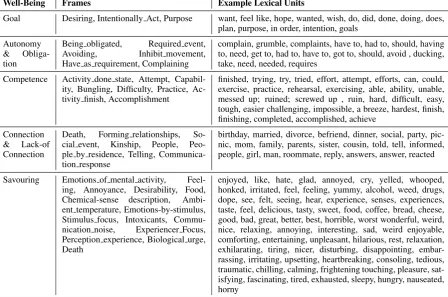
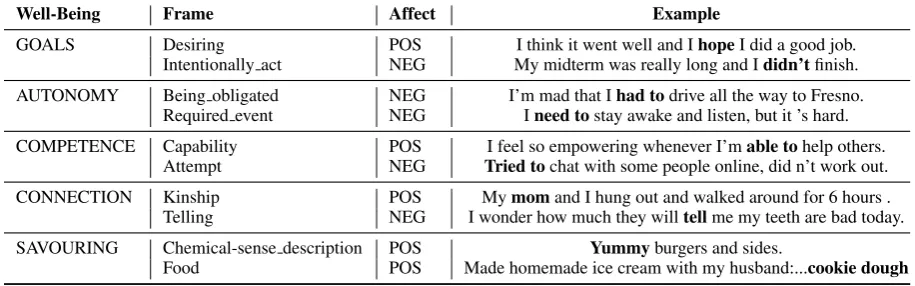
We thus explore two different methods for map-ping these well-being event categories into lexi-cal descriptions, one of which is top-down and the other which is bottom-up. Our top-down method is based on mapping general event types from FrameNet to the theoretical categories enumerated in Table 1. We take frame specific features for each theoretical category from the lexical units for each frame. For example, GOALS are often
dis-cussed in terms of specific frames from the Desir-ing and the Intentionally act classes, as shown in the first two rows of Table6.
We show that FrameNet features do pro-vide an interesting level of generalization but much of the compositional semantics of events is still missing from this characterization (Sec-tion 4). Thus, our bottom-up method applies the AutoSlog linguistic-pattern learner to induce lexically-grounded predicate patterns from the
ECHOdata (Section 5). We show how many light
verbs acquire a specific semantics with their ar-guments, and how common events like “Talking” are separated into positive and negative events de-pending on whether they are “Talking about” or “Talking with”.
4 Frames and Well-Being
Table6provides our posited mapping from frame categories to the appraisal category of GOALS as
well as to the eudaimonic categories of AUTON -OMY, COMPETENCE and CONNECTION, and to
the hedonic category ofSAVOURING. To develop
features related to these frame categories, we ap-ply SEMAFOR (Das et al., 2013) to label the
FrameNet 1.5 (Baker et al., 2015; Baker, 2014). We partition frame features into subsets corre-sponding to the different theoretical constructs as defined in Table6. We acknowledge that our map-ping may not be perfect, and that some frames could conceivably be categorized as both goal re-lated and eudaimonic.
Features Metric Pos Neg All
GOALS Prec 0.62 0.49 0.57
Rec 0.94 0.09 0.61 F1 0.75 0.15 0.51 EUDAIMONIC Prec 0.63 0.58 0.61 Rec 0.93 0.16 0.63 F1 0.75 0.25 0.56
SAVOURING Prec 0.61 0.44 0.55
Rec 0.97 0.04 0.61 F1 0.75 0.08 0.49 ALL FRAMES Prec 0.69 0.74 0.71 Rec 0.91 0.38 0.70 F1 0.78 0.50 0.67
Table 7: Coverage of Different Theoretical Cate-gories.
We train an SVM with each feature subset, and evaluate the models on our test set, with results in Table7. The general ALL FRAMEfeature is also
listed for comparison. The .67 F1 of FRAME is
slightly lower than LIWC in Table 3, but in our
view, more interpretable. In addition, the aver-age count ofFRAMEfeatures per sentence is an
or-der of magnitude less than LIWCfeatures (hence,
much less than unigram features), suggesting the targeted power of these features. See Table8. We posit that FRAMES are thus more discriminative
thanLIWCfor well-being classes, and thatFRAME
features are more naturally categorized into well-being categories at a semantic level.
Features Dataset Pos Neg Total
UniGram Train 8.5 9.9 9.1
Test 8.1 9.8 8.7
LIWC Train 25.4 31.4 27.8
Test 23.8 30.6 26.4
ALL FRAMES Train 2.7 5.2 3.7
Test 3.3 4.0 3.6
Table 8: Average Feature Counts for Sentence
The Goals section of Table 7 shows that Ap-praisal theory does well at predicting positive events, but performs poorly for negative events, primarily due to low recall. All features achieve
Features Metric Pos Neg All
AUTONOMY Prec 0.0 0.39 0.15
Rec 0.0 1.0 0..39
F1 0.0 .56 0.22
[image:6.595.312.519.63.185.2]COMPETENCE Prec 0.56 0.58 0.60 Rec 0.98 0.04 0.61 F1 0.76 0.07 0.49 CONNECTION Prec 0.62 0.58 0.60 Rec 0.97 0.06 0.62 F1 0.76 0.11 0.49
Table 9: Results for Individual Eudaimonic Cate-gories.
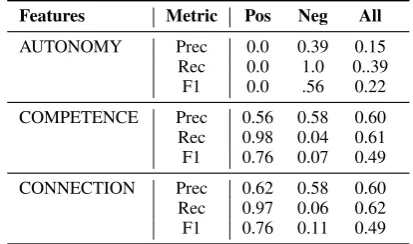
good F1 for the positive class, but not the negative class. This is consistent with the results in Table3. The EUDAIMONIC features include Autonomy
& Obligation, Competence and Connection. The SVM trained with just eudaimonic features pro-duces the highest F1 score for the negative class, highlighting the role of eudaimonic related events in negative well-being. See Table7. The results for an breaking eudaimonic into its constituent cat-egories is in Table9. The results show that most of our autonomy categories are related to nega-tive autonomy, to obligations that cause feelings of negative well-being. On the other hand, the re-sults indicate that competence and connection play a large role in positive well-being.
The top 25 most informative frame features are illustrated in Table 10 (out of 639 instanti-ated inECHO). These illustrate general events for
well-being, but compositional differences, such as “spending my nights by the side of my textbook” and “spending my nights with friends” are not cap-tured. The first “spend (time)” evokes the theo-retical construct of obligation, while “spend (time with)” is related to connection.
5 Linguistic Pattern Learning
We also apply Autoslog-TS, a weakly supervised linguistic-pattern learner as a way of learning some compositional patterns. Autoslog only re-quires training documents labeled broadly into our two classes of POSITIVE orNEGATIVE. The
learner uses a set of syntactic templates to define different types of linguistic expressions. In gen-eral, this method tends to produce high precision (and potentially low recall) markers of the partic-ular classes that can seed further hypothesizing.
Well-Being Frame Affect Example
GOALS Desiring POS I think it went well and IhopeI did a good job. Intentionally act NEG My midterm was really long and Ididn’tfinish. AUTONOMY Being obligated NEG I’m mad that Ihad todrive all the way to Fresno.
Required event NEG Ineed tostay awake and listen, but it ’s hard. COMPETENCE Capability POS I feel so empowering whenever I’mable tohelp others.
Attempt NEG Tried tochat with some people online, did n’t work out. CONNECTION Kinship POS Mymomand I hung out and walked around for 6 hours . Telling NEG I wonder how much they willtellme my teeth are bad today. SAVOURING Chemical-sense description POS Yummyburgers and sides.
[image:7.595.70.528.64.207.2]Food POS Made homemade ice cream with my husband:...cookie dough
Table 10: Top Frame Categories and Associated Well-Being Classes.
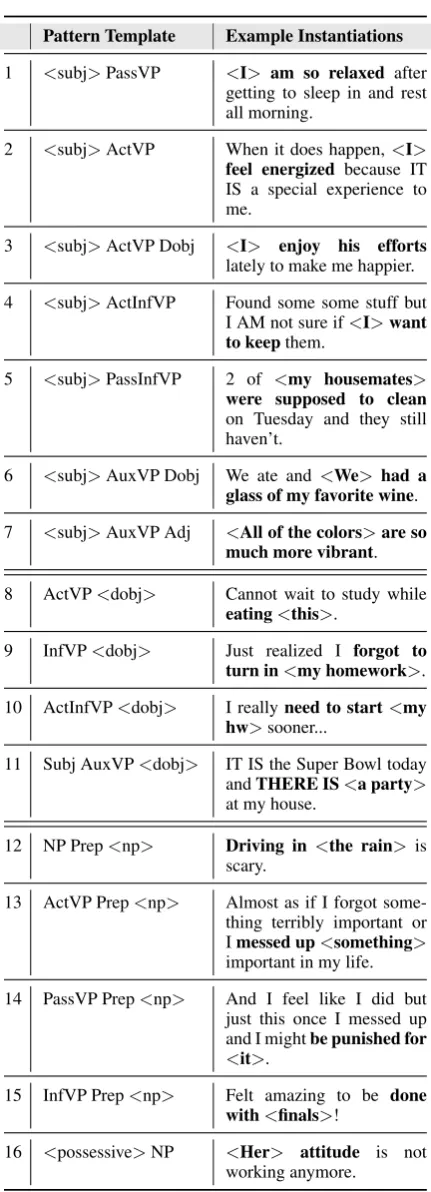
a specific lexico-syntactic pattern (in bold) that represents an instantiation of each general pattern template for learning well-being patterns in our data.2
In order to enable selection of particular pat-terns, AutoSlog-TS computes statistics on the strength of association of each pattern with each class, i.e. P(POSITIVE|p) and P(NEGATIVE |p),
along with the pattern’s overall frequency. We define two tuning parameters for each class: θf,
the frequency with which a pattern occurs,θp, the
probability with which a pattern is associated with the given class. AutoSlog lets us systematically explore tradeoffs with precision and recall. Here we selectθf andθp to optimize F1 on our test set.
For more detail, see (Riloff, 1996; Oraby et al.,
2015).
Our primary interest here is Autoslog’s ability to learn compositional patterns. Autoslog can, in principle, provide three kinds of information: i) it can provide supplement the lexical units for a given frame; ii) it can supplement the frames in a well-being category; and iii) it can reveal reliable markers of mood that well-being categories do not capture. Because our interest in frames is ulti-mately as a way of relating well-being categories with linguistic signals, we will not distinguish (i) and (ii) here.
Here we discuss all patterns with aθp > .7
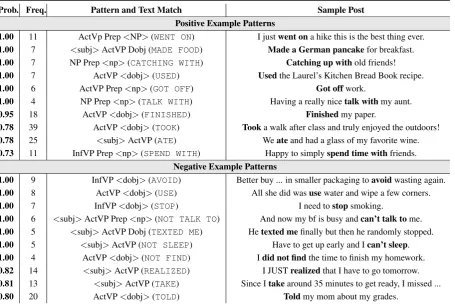
Sev-eral lexicosyntactic patterns fit within our well-being categories but are not captured by frames, while as expected there are overlaps between FrameNet and Autoslog as well. Examples are listed in Table 12. One large class includes straightforward lexical patterns: FINISHED, FIN
-2The examples are shown as general expressions for
read-ability, but the actual patterns must match the syntactic con-straints associated with the pattern template.
ISH, and FINALLY which we associate with
feel-ings of comptence. Verbal patterns with EAT
and ATE indicate savouring, with NOT EAT
reli-ably marking negative sentences. The frames also show many specific types of food (cake), and we use a comprehensive list from DBpedia (Lehmann et al., 2014) to collapse all these to the general type FOOD, allowing us to develop patterns such
asMADE FOOD.
Autoslog also discovers many patterns syntacti-cally linking content (nouns and verbs) and func-tion words (e.g., preposifunc-tions and light verbs). It thus furnishes a ready source for multi-word, par-tially compositional expressions of positivity or negativity. In what follows, we provide some ex-amples (note that in the patterns below, expres-sions in brackets are used to indicate expresexpres-sions not part of the pattern that correlate with it in the data).
There are 262 positive patterns of the form Verb/Noun + “with”, e.g. TALKED WITH, DINNER WITH, BREAKFAST WITH, STUDY -ING WITH, PLAYED WITH, TIME WITH, MET WITH, SHOPPING WITH, COFFEE WITH,
all of which describe activities that involve connection. There are also 100 negative patterns of this form, which are much more heteroge-nous, involving both negative social experiences (ARGUMENT WITH, DRAMA WITH, INFURI -ATED WITH, FIGHT WITH), but also various
problematic events (STRESSED WITH, DIF -FICULTIES WITH, DISSATISFIED WITH) and
instruments for negative events (STOP WITH, POISONING WITH). Moreover, while the positive
patterns cover 523 sentences in the data, the negative patterns cover only 133.
Pattern Template Example Instantiations
1 <subj>PassVP <I> am so relaxed after getting to sleep in and rest all morning.
2 <subj>ActVP When it does happen,<I> feel energized because IT IS a special experience to me.
3 <subj>ActVP Dobj <I> enjoy his efforts
lately to make me happier. 4 <subj>ActInfVP Found some some stuff but
I AM not sure if<I>want to keepthem.
5 <subj>PassInfVP 2 of <my housemates> were supposed to clean
on Tuesday and they still haven’t.
6 <subj>AuxVP Dobj We ate and<We>had a glass of my favorite wine. 7 <subj>AuxVP Adj <All of the colors>are so
much more vibrant. 8 ActVP<dobj> Cannot wait to study while
eating<this>.
9 InfVP<dobj> Just realized I forgot to turn in<my homework>. 10 ActInfVP<dobj> I reallyneed to start<my
hw>sooner...
11 Subj AuxVP<dobj> IT IS the Super Bowl today andTHERE IS<a party>
at my house.
12 NP Prep<np> Driving in <the rain> is scary.
13 ActVP Prep<np> Almost as if I forgot some-thing terribly important or Imessed up<something>
important in my life. 14 PassVP Prep<np> And I feel like I did but
just this once I messed up and I mightbe punished for <it>.
15 InfVP Prep<np> Felt amazing to be done with<finals>!
[image:8.595.70.286.55.652.2]16 <possessive>NP <Her> attitude is not working anymore.
Table 11: AutoSlog-TS Templates and Example Instantiations
“talk”, 32 positive (71 items) and 30 negative (66 items). The positive ones strongly indicate connection (e.g., TALK WITH, HAVE TALK, REMEMBER [TO] TALK, GOT [TO] TALK, TALK THROUGH). In contrast, the negative index
either the obligation to talk (e.g., TRYING TALK, NEED TALK, HAVE [TO] TALK) or a failure to
talk (e.g., NOT TALK TO, NOT WANT TALK, STOP TALKING).
There are 36 patterns with the string ‘go’, 12 positive (16 items) and 24 negative (40 items). There are 34 patterns involving the past tense form “went”, which reverses the polarity to 25 posi-tive patterns (273 items) and 9 negaposi-tive (9 items). Across the two versions of the lemma, the positive patterns provide several expressions for savour-ing (WENT/GO ON/FOR [a walk, a hike, a ride], WENT/GO SHOPPING/SWIMMING, WENT/GO TO
[the mall, a movie]). For the negative, the predom-inance of ‘go’ comes from the fact that they are largely negated (NOT GO TO [the movies]) or in
infinitive contexts that suggest obligation ([HAVE TO] GO TO[class], [HAVE TO] GO WORK).
Sim-ilarly, the positive class contains 9 patterns with ‘bought’ and 1 with ‘buy’ (ENTICED [TO] BUY)
and the negative class has 6 patterns with ‘bought’ and 16 with ‘buy’, all emphasiz-ing buyemphasiz-ing necessities (BUY GROCERIES/TICKET, NEED/WANT BUY, NOT BUY) Thus, even though
these expressions all involve the same verbs and prepositions, the surrounding environments, as re-flected in the form of the verb, split between posi-tive and negaposi-tive sentence classes.
There are 73 bigram patterns of the form
NEW X, 56 positive (83 items) and 17 negative (21
items). In general, the positive ones describe new objects –SHIRT,SHEETS,COMPUTER,CLOTHES, TEA– and acquaintances (NEW FRIEND), thus
en-compassing both Connection and possibly Savour-ing. In contrast, the negative patterns describe changes to routines – HABITS, school QUARTER, PROFESSOR, LIVING [conditions], or SCHEDULE
– which are likely to engender a sense of instabil-ity, and hence be Eudaimonically negative.
Thus, these patterns illustrate that Autoslog can serve as a high-precision method of building addi-tional patterns – especially composiaddi-tional ones – for a given well-being category.
6 Conclusions and Future Work
In this paper, we have advanced a synthetic cate-gorization of the sources for well-being and hap-piness. We have used a corpus of private micro-blogs from the ECHO application to explore how
Prob. Freq. Pattern and Text Match Sample Post Positive Example Patterns
1.00 11 ActVp Prep<NP>(WENT ON) I justwent ona hike this is the best thing ever.
1.00 7 <subj>ActVP Dobj (MADE FOOD) Made a German pancakefor breakfast.
1.00 7 NP Prep<np>(CATCHING WITH) Catching up withold friends!
1.00 7 ActVP<dobj>(USED) Usedthe Laurel’s Kitchen Bread Book recipe.
1.00 6 ActVP Prep<np>(GOT OFF) Got offwork.
1.00 4 NP Prep<np>(TALK WITH) Having a really nicetalk withmy aunt.
0.95 18 ActVP<dobj>(FINISHED) Finishedmy paper.
0.78 39 ActVP<dobj>(TOOK) Tooka walk after class and truly enjoyed the outdoors!
0.78 25 <subj>ActVP (ATE) Weateand had a glass of my favorite wine.
0.73 11 InfVP Prep<np>(SPEND WITH) Happy to simplyspend time withfriends.
Negative Example Patterns
1.00 9 InfVP<dobj>(AVOID) Better buy ... in smaller packaging toavoidwasting again.
1.00 8 ActVP<dobj>(USE) All she did wasusewater and wipe a few corners.
1.00 7 InfVP<dobj>(STOP) I need tostopsmoking.
1.00 6 <subj>ActVP Prep<np>(NOT TALK TO) And now my bf is busy andcan’t talk tome.
1.00 5 <subj>ActVP Dobj (TEXTED ME) Hetexted mefinally but then he randomly stopped.
1.00 5 <subj>ActVP (NOT SLEEP) Have to get up early and Ican’t sleep.
1.00 4 ActVP<dobj>(NOT FIND) Idid not findthe time to finish my homework.
0.82 14 <subj>ActVP (REALIZED) I JUSTrealizedthat I have to go tomorrow.
0.81 13 <subj>ActVP (TAKE) Since Itakearound 35 minutes to get ready, I missed ...
[image:9.595.74.530.63.367.2]0.80 20 ActVP<dobj>(TOLD) Toldmy mom about my grades.
Table 12: Examples of Characteristic ECHO Patterns using AutoSlog-TS Templates
FrameNet provides useful generalizations, while the linguistic pattern learner AutoSlog illustrates the details and challenges of the compositional na-ture of user’s descriptions of their daily experi-ences. Moreover, we have demonstrated that, in-dependently, each of these methods can produce performance similar to that of conventional lexical methods with a feature space that is smaller, and, in the case of FrameNet features, psychologically grounded. Our Autoslog exploration moreover re-veals a way of exploring the space of patterns that our FrameNet mapping has missed. In future work, we aim to automatically combine these two methods and bring the Autoslog patterns under the well-being categorization we have advocated here. We also plan to investigate new models with the untouched 6224 Echo posts, as well as larger pub-lic corpus like LiveJournal.
In addition, we plan to explore the source of the fact that there are more positive patterns (both as types and the tokens they capture) than the nega-tive ones, which directly relates to the lower Neg recall for all classifiers we tested. While we could not find any clear reason in our examination of the data, this asymmetry may indicate that markers of negativity are more syntactically distributed than
our current list of patterns looks for, or perhaps less linguistically reliable.
Acknowledgments
This research was partially supported by NSF Robust Intelligence #IIS-1302668-002 and NSF HCC #IIS-1321102.
References
Stefano Baccianella, Andrea Esuli, and Fabrizio Sebas-tiani. 2010. Sentiwordnet 3.0: An enhanced lexical resource for sentiment analysis and opinion mining. InLREC. volume 10, pages 2200–2204.
Colin Baker, Nathan Schneider, Miriam R L Petruck, and Michael Ellsworth. 2015. Getting the roles right: Using framenet in nlp. In Proceedings of the 2015 Conference of the North American Chap-ter of the Association for Computational Linguis-tics: Tutorial Abstracts. Association for Computa-tional Linguistics, Denver, Colorado, pages 10–12.
http://www.aclweb.org/anthology/N15-4006.
Collin Baker. 2014. Framenet: A knowledge
http://www.aclweb.org/anthology/W/W14/W14-3001.
Alexandra Balahur, Jesus M. Hermida, and Andres Montoyo. 2012. Building and exploiting emotinet, a knowledge base for emotion detection based on the appraisal theory model. IEEE Trans. Affect. Com-put.3(1):88–101.
A. Bandura. 1977. Self-efficacy: toward a unifying theory of behavioral change. Psychological review 84(2):191.
Fred B Bryant, Erica D Chadwick, and Katharina Kluwe. 2011. Understanding the processes that reg-ulate positive emotional experience: Unsolved prob-lems and future directions for theory and research on savoring.International Journal of Wellbeing1(1).
Yoonjung Choi and Janyce Wiebe. 2014.
+/-effectwordnet: Sense-level lexicon acquisition for opinion inference. InEMNLP. pages 1181–1191. Dipanjan Das, Desai Chen, Andr´e F. T. Martins,
Nathan Schneider, and Noah A. Smith. 2013. Frame-semantic parsing. Computational Linguistics XX(YY):WW–ZZ.
Edward L Deci and Richard M Ryan. 2010. Self-determination. Wiley Online Library.
Lingjia Deng, Yoonjung Choi, and Janyce Wiebe. 2013. Benefactive/malefactive event and writer at-titude annotation. InACL. pages 120–125.
Lingjia Deng and Janyce Wiebe. 2014. Sentiment propagation via implicature constraints. In EACL. pages 377–385.
Haibo Ding and Ellen Riloff. 2016. Acquiring knowl-edge of affective events from blogs using label prop-agation. InAAAI.
David K. Elson. 2012. Modeling Narrative Discourse. Ph.D. thesis, Columbia University, New York City. Song Feng, Jun Seok Kang, Polina Kuznetsova, and
Yejin Choi. 2013. Connotation lexicon: A dash of sentiment beneath the surface meaning. In Associa-tion for ComputaAssocia-tional Linguistics (ACL).
Marie JC Forgeard, Eranda Jayawickreme, Margaret L Kern, and Martin EP Seligman. 2011. Doing the right thing: Measuring wellbeing for public policy. International Journal of Wellbeing1(1).
Amit Goyal and Ellen Riloff. 2013. A computational model for plot units. Computational Intelligence 29(3):466–488.
Ellen Isaacs, Artie Konrad, Alan Walendowski, Thomas Lennig, Victoria Hollis, and Steve Whit-taker. 2013. Echoes from the past: how technol-ogy mediated reflection improves well-being. In Proceedings of the SIGCHI Conference on Human Factors in Computing Systems. ACM, pages 1071– 1080.
Paul E Jose, Bee T Lim, and Fred B Bryant. 2012. Does savoring increase happiness? a daily diary study. The Journal of Positive Psychology7(3):176– 187.
Daniel Kahneman. 1999. Objective happiness. Well-being: The foundations of hedonic psychology3:25. Daniel Kahneman, Alan B Krueger, David A Schkade, Norbert Schwarz, and Arthur A Stone. 2004. A survey method for characterizing daily life expe-rience: The day reconstruction method. Science 306(5702):1776–1780.
Jun Seok Kang, Song Feng, Leman Akoglu, and Yejin Choi. 2014. Connotationwordnet: Learning con-notation over the word+sense network. In Pro-ceedings of the 52nd Annual Meeting of the Asso-ciation for Computational Linguistics (Volume 1: Long Papers). Association for Computational Lin-guistics, Baltimore, Maryland, pages 1544–1554.
http://www.aclweb.org/anthology/P14-1145. Fazel Keshtkar and Diana Inkpen. 2009. Using
senti-ment orientation features for mood classification in blogs. InNatural Language Processing and Knowl-edge Engineering, 2009. NLP-KE 2009. Interna-tional Conference on. IEEE, pages 1–6.
Artie Konrad, Victoria Bellotti, Nicole Crenshaw, Si-mon Tucker, Les Nelson, Honglu Du, Peter Pirolli, and Steve Whittaker. 2015. Finding the adaptive sweet spot: Balancing compliance and achievement in automated stress reduction. InProceedings of the 33rd Annual ACM Conference on Human Factors in Computing Systems. ACM, pages 3829–3838. Artie Konrad, Ellen Isaacs, and Steve Whittaker.
2016a. Technology-mediated memory: Is technol-ogy altering our memories and interfering with well-being? ACM Transactions on Computer-Human In-teraction (TOCHI)23(4):23.
Artie Konrad, Simon Tucker, John Crane, and Steve Whittaker. 2016b. Technology and reflection: Mood and memory mechanisms for well-being. Psychol-ogy of well-being6(1):1–24.
Jens Lehmann, Robert Isele, Max Jakob, Anja Jentzsch, Dimitris Kontokostas, Pablo Mendes, Se-bastian Hellmann, Mohamed Morsey, Patrick van Kleef, S¨oren Auer, and Chris Bizer. 2014. DBpe-dia - a large-scale, multilingual knowledge base ex-tracted from wikipedia. Semantic Web Journal. Peter M Lewinsohn and Christopher S Amenson. 1978.
Some relations between pleasant and unpleasant mood-related events and depression. Journal of ab-normal psychology87(6):644.
Sonja Lyubomirsky, Laura King, and Ed Diener. 2005. The benefits of frequent positive affect: Does hap-piness lead to success? Psychological bulletin 131(6):803.
Douglas J MacPhillamy and Peter M Lewinsohn. 1982. The pleasant events schedule: Studies on reliability, validity, and scale intercorrelation. Journal of Con-sulting and Clinical Psychology50(3):363–380.
Abraham Harold Maslow. 1943. A theory of human motivation. Psychological review50(4):370.
Rada Mihalcea and Hugo Liu. 2006. A corpus-based approach to finding happiness. InAAAI Spring Sym-posium: Computational Approaches to Analyzing Weblogs. pages 139–144.
Gilad Mishne. 2005. Experiments with mood classifi-cation in blog posts. InProceedings of ACM SIGIR 2005 workshop on stylistic analysis of text for infor-mation access. volume 19, pages 321–327.
Finn ˚Arup Nielsen. 2011. A new anew: Evaluation of a word list for sentiment analysis in microblogs. arXiv preprint arXiv:1103.2903.
Shereen Oraby, Lena Reed, Ryan Compton, Ellen Riloff, Marilyn Walker, and Steve Whittaker. 2015. And thats a fact: Distinguishing factual and emo-tional argumentation in online dialogue. NAACL HLT 2015page 116.
Andrew Ortony, Gerald L Clore, and Allan Collins. 1990. The cognitive structure of emotions. Cam-bridge university press.
J. W. Pennebaker, M. E. Francis, and R. J. Booth. 2001. LIWC: Linguistic Inquiry and Word Count.
Lena Reed, Jiaqi Wu, Shereen Oraby, Pranav Anand, and Marilyn Walker. 2017. Learning lexico-functional patterns for first-person affect. In Pro-ceedings of the 55th Annual Meeting of the Associa-tion for ComputaAssocia-tional Linguistics.
Kevin Reschke and Pranav Anand. 2011. Extract-ing contextual evaluativity. In Proceedings of the Ninth International Conference on Computational Semantics. Association for Computational Linguis-tics, pages 370–374.
Ellen Riloff. 1996. Automatically generating extrac-tion patterns from untagged text. In Proceedings of the national conference on artificial intelligence. pages 1044–1049.
Josef Ruppenhofer and Jasper Brandes. 2015. Ex-tending effect annotation with lexical
decomposi-tion. In6TH WORKSHOP ON COMPUTATIONAL
APPROACHES TO SUBJECTIVITY, SENTIMENT AND SOCIAL MEDIA ANALYSIS WASSA 2015. page 67.
Irene Russo, Tommaso Caselli, and Carlo Strappa-rava. 2015. Semeval-2015 task 9: Clipeval im-plicit polarity of events. In Proceedings of the 9th International Workshop on Semantic Evalua-tion (SemEval 2015). AssociaEvalua-tion for Computa-tional Linguistics, Denver, Colorado, pages 443– 450. http://www.aclweb.org/anthology/S15-2077. R.M. Ryan and E.L. Deci. 2000. Self-determination
theory and the facilitation of intrinsic motivation, so-cial development, and well-being. American psy-chologist55(1):68.
Klaus R Scherer, Angela Schorr, and Tom Johnstone. 2001. Appraisal processes in emotion: Theory, methods, research. Oxford University Press. Klaus R Scherer, Harald G Wallbott, and Angela B
Summerfield. 1986.Experiencing emotion: A cross-cultural study. Cambridge University Press. H Andrew Schwartz, Maarten Sap, Margaret L Kern,
Johannes C Eichstaedt, Adam Kapelner, Megha Agrawal, Eduardo Blanco, Lukasz Dziurzynski, Gregory Park, David Stillwell, et al. 2016. Predict-ing individual well-bePredict-ing through the language of social media. InPac Symp Biocomput. volume 21, pages 516–527.