95
A Tree-to-Sequence Model for Neural NLG in Task-Oriented Dialog
Jinfeng Rao, Kartikeya Upasani, Anusha Balakrishnan, Michael White,Anuj Kumar,Rajen Subba
Facebook Assistant
{raojinfeng,kart,anushabala,,mwhite14850,anujk,rasubba}@fb.com
Abstract
Generating fluent natural language responses from structured semantic representations is a critical step in task-oriented conversational systems. Sequence-to-sequence models on flat meaning representations (MR) have been dominant in this task, for example in the E2E NLG Challenge. Previous work has shown that a tree-structured MR can improve the model for better discourse-level structuring and sentence-level planning. In this work, we propose a tree-to-sequence model that uses a tree-LSTM encoder to leverage the tree struc-tures in the input MR, and further enhance the decoding by a structure-enhanced attention mechanism. In addition, we explore combin-ing these enhancements with constrained de-coding to improve semantic correctness. Our method not only shows significant improve-ments over standard seq2seq baselines, but also is more data-efficient and generalizes bet-ter to hard scenarios.
1 Introduction
Generating fluent natural language responses from structured semantic representations is crucial to building engaging and effective task-oriented di-alog systems. Neural approaches for natural lan-guage generation (NNLG), particularly sequence-to-sequence approaches, have achieved promis-ing results and were dominant in the recent E2E Challenge. Most of these approaches are built on flat meaning representations (MR) that use key-value pairs to capture attributes to be conveyed in responses. However, coupled with such flat MRs, current NNLG methods still struggle with 1) reliably performing sentence-level planning and discourse-level structuring (Reed et al., 2018); 2) avoiding generating semantic errors like halluci-nated content (Duˇsek et al., 2018, 2019); and 3) generalizing to hard inputs (Wiseman et al.,2017).
To help overcome these drawbacks, Balakrish-nan et al. (2019) propose a novel tree-structured meaning representation to gain better control of the discourse structure and content in generated ut-terances. Their proposed tree-structured MRs con-sist of three sets of non-terminal tokens: argument, dialog act and discourse act. A dialog act is a min-imum atomic unit that contains a few arguments to be expressed in an utterance, while discourse acts define the relationship between dialog acts.
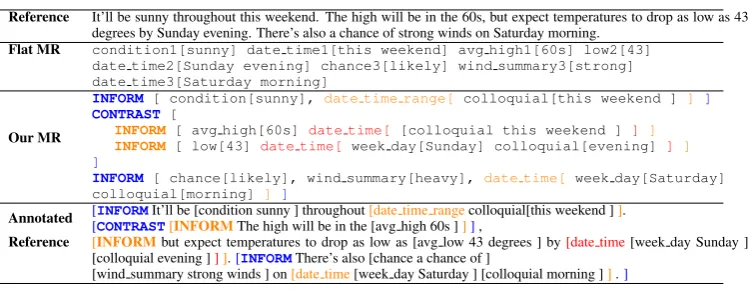
An example of their tree-structured MR for the weather domain is provided in Table1, along with a flat MR and human reference. We also add a reference annotated with the tree-structured MR in the last row. The tree-structured MR provides much better controllability to a live task-oriented dialog system, where developers can easily in-ject external knowledge into a rule-based response planner to specify the relationship between mul-tiple dialog acts (e.g., rainy is the opposite to sunny), and the grouping of arguments in a dia-log act is possible. These consideration have been shown to be critical to user perceptions of qual-ity and naturalness (Lemon et al., 2004;Carenini and Moore,2006;Walker et al.,2007;White et al.,
2010;Demberg et al.,2011).
In their Seq2Seq model, Balakrishnan et al.
(2019) treat the tree-structured MR as just a se-quence of tokens, ignoring the inherent tree struc-ture (though this strucstruc-ture is taken into account in constrained decoding). We aim to examine the hy-pothesis that a better representation of the input tree structures could lead to better generalizability of the model and enhance semantic correctness. Therefore, we propose a tree-to-sequence model that uses a tree-based encoder to better represent the tree-structured MRs, and a structure-enhanced decoder to further incorporate contextual informa-tion in decoding.
Reference It’ll be sunny throughout this weekend. The high will be in the 60s, but expect temperatures to drop as low as 43 degrees by Sunday evening. There’s also a chance of strong winds on Saturday morning.
Flat MR condition1[sunny] date time1[this weekend] avg high1[60s] low2[43] date time2[Sunday evening] chance3[likely] wind summary3[strong] date time3[Saturday morning]
Our MR
INFORM [ condition[sunny], date time range[ colloquial[this weekend ] ] ] CONTRAST [
INFORM [ avg high[60s] date time[ [colloquial this weekend ] ] ] INFORM [ low[43] date time[ week day[Sunday] colloquial[evening] ] ] ]
INFORM [ chance[likely], wind summary[heavy], date time[ week day[Saturday] colloquial[morning] ] ]
Annotated [INFORMIt’ll be [condition sunny ] throughout[date time rangecolloquial[this weekend ]].
[CONTRAST[INFORMThe high will be in the [avg high 60s ]]],
Reference [INFORMbut expect temperatures to drop as low as [avg low 43 degrees ] by[date time[week day Sunday ] [colloquial evening ]]].[INFORMThere’s also [chance a chance of ]
[image:2.595.118.493.58.203.2][wind summary strong winds ] on[date time[week day Saturday ] [colloquial morning ]].]
Table 1: Sample flat MR with reference compared against tree-structured MR. The last row shows an annotated reference with the tree-structured MR. Nodes in blue are all children of the root node of the tree.
• We propose a tree-to-sequence (tree2seq) model to better leverage the inherent struc-tures in the tree-based MRs. Coupled with the constrained decoding technique from (Balakrishnan et al.,2019), we explore whether combining better learning and de-coding methods yields the best performance.
• Extensive evaluations on conversational weather and E2E datasets (Duˇsek et al.,
2019) show that the tree2seq model can significantly improve semantic correctness. Analysis further shows that tree2seq is more data-efficient and generalizes better to hard scenarios.
2 Related Work
Several previous works have focused on adding planning steps to neural NLG architectures or em-ployed non-sequential encoders.Puduppully et al.
(2019) add a content planning step where a set of input database records are mapped to an or-dered list of selected records; however, their ap-proach does not employ hierarchical content plans as in our approach. Moryossef et al. (2019) add a symbolic text planning step where facts are grouped and ordered in the input; in contrast to our work though, their approach uses standard Seq2Seq models for realization and leaves no or-dering choices to the model. Previous work on AMR and WebNLG (Beck et al.,2018;Song et al.,
2018;Marcheggiani and Perez-Beltrachini,2018) has demonstrated improvements over Seq2Seq models by using graph-to-sequence models; while similar in principle, these works do not explore the use of hierarchical content plans as intermediate structures and do not experiment with constrained decoding.
Elder et al. (2019) propose using an interme-diate representation motivated by a universal de-pendency tree, and find that this greatly improves performance. However, their approach is still Seq2Seq-based and can’t explicitly model the tree structures. Similar to our approach,Eriguchi et al.
(2016) use a tree-to-sequence model for machine translation, but here we focus on NLG and use dif-ferent tree encoder and constrained decoding tech-niques.
3 Tree-to-Sequence Model
3.1 Tree-Based Encoder
The input to our model is a tree-structured MR, and the output is an annotated reference, e.g., the last row in Table 1. Having annotated non-terminal tokens in the output allows us to check whether all arguments are expressed in output fol-lowing the input tree structures.
We represent each token in the input MR as a tree node, using the tree structure to compute the hidden state of thek-th parent nodehpkas a func-tion of its child states{hc1k , ...,hcN
k }:
hpk=ftree({hc1k, ...,hckN})
where N is the number of children for k-th node andftreeis a non-linear function. We implemented
a variant of the N-ary TreeLSTM by (Tai et al.,
2015) as our tree encoder.
children nodes have been processed. As nodes can have different number of children nodes, we padded non-leaf nodes to have the same number of children nodes (i.e., N) for batch processing. Overall, the batch calculation ends up with 5-10X speedup compared to single-tree forward, allow-ing us to train on large datasets.1
3.2 Structure-Enhanced Decoder
The tree-based encoder returns a list of hidden states {h1, ...,hK}, where K is the length of
source sequence. We first initialize the initial de-coder states1as its root hidden state:
s1 =hroot
In a standard attentional seq2seq (Bahdanau et al.,2014),αj(k)denotes the attention score
be-tweenj-th target statesj andk-th source statehk.
Then a weighted sum over source hidden states are calculated asdj = Pkαj(k)hk, and is used for
updating the context state as follows:
ˆ
sj =tanh(Wd·[sj;dj] +bd) (1)
where [sj;dj] is a concatenation of hidden state
sj anddj. Nextsbj is used for predicting thej-th target token:
P(yj|y<j, x) =softmax(Ws·sbj +bs)
However, the above decoding procedure doesn’t take the tree structures into account. We adopted the input feeding approach (Eriguchi et al.,2016) by modifying equation (1) to feed the previous unit sj−1to update thej-th context state:
b
sj =tanh(Wd·[sj;dj; ˆsj−1] +bd)
The input feeding approach allows us to enrich the contextual information when predicting the cur-rent token, in particular because sjˆ−1 is often the parent state ofj-th node (given that the output tree structures are linearized to a sequence of words).
3.3 Constrained Decoding
Balakrishnan et al. (2019) propose a constrained decoding approach that derives constraints from the input tree structure to be enforced during de-coding. In the beam search process, if a predicted non-terminal token violates the input MR struc-ture, then the token is rejected. This allows beam
1On the E2E dataset, the batchized tree2seq model takes
20 and 2 minutes every epoch in training and testing.
search to explore more valid hypotheses with the same beam size. Their experiments show that con-strained decoding can significantly improve the semantic correctness of generated responses by avoiding missing/repeating arguments and reduc-ing hallucinated content while also enforcreduc-ing de-sired groupings. (See their paper for further details on how the constraints are enforced.)
Though constrained decoding yields promising results in Balakrishnan et al.’s experiments, it’s worth observing that constrained decoding does not affect the training process, which means that it doesn’t help with generalization and relies on a strong base model. Therefore, we experiment with combining our tree-to-sequence model with con-strained decoding, in order to determine whether the two methods work better in combination.
4 Experiments
4.1 Setup
Datasets: We conducted experiments on both the enriched E2E dataset and the weather dataset from (Balakrishnan et al.,2019).
Models We consider both Seq2Seq-based mod-els and our proposed Tree2Seq modmod-els in our ex-periments. All Seq2Seq models use an LSTM-based encoder and decoder, with attention, while the Tree2Seq models have the architecture de-scribed in Section3.
• S2S: Standard S2S-TREEmodel proposed in (Balakrishnan et al.,2019). This is a Seq2Seq model in which the input is a linearized text representation of the MR, while the output is an annotated response (example in Table1). • S2S-CONSTR: This is the S2S-CONSTR
model proposed in (Balakrishnan et al.,
2019). This is identical in architecture to the S2S model, and differs only in the decoding step, where constrained decoding is applied to ensure semantic correctness.
• T2S: Our proposed model, with tree-based encoding and structure-enhanced decoding. • T2S-CONSTR: Has the same architecture as
T2S, but with constrained decoding applied to the decoder to ensure semantic correctness.
Model E2E Weather
Metric BLEU TreeAcc Gram. Corr. BLEU TreeAcc Gram. Corr.
- NODISC DISC - - - NODISC DISC -
-S2S 74.58 99.68 95.28 93.59 83.85 76.75 96.62 83.30 94.17 87.40
S2S-CONSTR 74.69 99.89 97.78 94.33 85.89 77.45 98.52 91.61 94.20 90.40
Our Approaches
T2S 74.75 99.89 96.96 94.83 84.66 77.86 97.1 88.80 94.55 89.75
[image:4.595.81.519.62.147.2]T2S-CONSTR 74.63 99.84 98.60 94.68 85.68 77.82 99.11 94.13 94.14 91.84
Table 2: Results on E2E and Weather datasets. All metrics are percentages.
0.2 0.4 0.6 0.8 1
1 2 3 4 5 6 7 8+
TreeAcc
#DialogActs
Weather Tree Accuracy Distribution
S2S T2S S2S-Constr T2S-Constr
Figure 1: Tree Accuracy Distribution on Weather
1)BLEU-4(Papineni et al.,2002); 2)Tree accu-racy(Balakrishnan et al.,2019), which is a binary metric to indicate whether the tree structure in the prediction matches that of the input MR exactly.
For human evaluation, annotators rate model re-sponses in abinaryscale on two dimensions:
• Grammaticality (Gram): Our evaluation guidelines included considerations for proper subject-verb agreement, word order, gram-matical completeness, etc..
• Correctness (Corr): Measures semantic
correctnessof the responses. Our guidelines
considered sentence structure, contrast, hal-lucinations (incorrectly included attributes), and missing attributes. We asked annotators to evaluate model predictions against the ref-erence rather than the MR.
Our human evaluation was conducted in a double-blind setting, in which two annotators indepen-dently provide ratings for each response, and a third annotator resolves any disagreements be-tween the two. The disagreement rate is 20.7% for the weather dataset and 23.2% for the E2E dataset.
4.2 Main Results
Table 2 shows the main results. For the tree ac-curacy metric, we report the numbers on two dis-joint subsets: discourse subset (column DISC), which contains inputs with 1+ discourse acts, and
0.5 0.6 0.7 0.8 0.9 1
1000 2000 5000 10000 20000 25000
TreeAcc
# Training Samples Weather Data Efficiency Study
[image:4.595.326.506.182.311.2]S2S T2S
Figure 2: Data Efficiency Study on Weather
no-discourse subset (column NODISC), which in-cludes inputs without any discourse acts. The dis-course subset is expected to be more challenging as it contains longer and more complex inputs.
From the table, we can see that all approaches are roughly comparable on BLEU scores. With tree accuracy, T2S consistently outperforms S2S in on both the discourse and no-discourse subsets, with the exception of the NODISC subset of the E2E data, where all models are close to 100% ac-curacy. The margins of improvement from T2S are higher on the discourse subset, suggesting T2S is more effective on hard inputs. S2S-Constr consistently outperforms S2S and T2S, affirming the effectiveness of constrained decoding. Over-all, combining the enhanced encoding and decod-ing methods, T2S-Constr achieves the best perfor-mance on all subsets (again, except with NODISC tree accuracy for E2E, where ceiling performance is effectively reached).
[image:4.595.87.273.183.315.2]Column G/T/C Text
MR Input
- Join [
INFORM [ area[riverside] name[ name ] price range[high] eat type[restaurant] [near near ] ]
CONTRAST [
INFORM [ rating[1 out of 5] family friendly no[no] ]
INFORM [ food italian[ food italian ] ] ] ]
Annotated - [Join[INFORMThere is a [price range high ] price range [eat type restaurant ] [name name] in [area riverside ] near [ near ]]
Reference [CONTRAST[INFORMIt is [family friendly not kids friendly ] and [rating has low ] customer ratings]but[INFORMthey serve [food italian Italian food ] .]]]
S2S 1/0/0 [Join[INFORM[name name ] is a [price range high ] priced [eat type restaurant ] in the [area riverside ] area near [near near ] .] [CONTRAST[INFORMis [family friendly no not children friendly ] ,]but[INFORMit has a customer rating of [rating 1 out of 5] .]]] T2S 1/0/0 [Join[INFORM[name name ] is a [price range high ] priced [eat type restaurant ] in the
[area riverside ] area near [near near ] .] [CONTRAST[INFORMit has a customer rating of [rating 1 out of 5] , ] but[INFORMis [family friendly no not children friendly ] and serves [food italian Italian ] food.]]]
T2S-Constr 1/1/1 [Join[INFORM[name name ] is a [price range high ] priced [eat type restaurant ] in the [area riverside ] area near [near near ] .] [CONTRAST[INFORMit is [family friendly not children friendly ] and has a [rating 1 out of 5] rating ]
[image:5.595.111.494.60.264.2]but[INFORMit serves [food italian Italian ] food.]]]
Table 3: Sample model responses. Row ‘Annotated Reference’ is human-annotated reference. Column ‘G/T/C’ represents the value of grammaticality/tree accuracy/correctness of model predicted response.
where the tree accuracy doesn’t align with the cor-rectness numbers from human evaluation (the gap on weather is smaller). Our analysis show most correctness errors are mainly due to: 1) the com-positional MR inputs were missing information in the reference which was caused by the noisy dataset creation byBalakrishnan et al. (2019); 2) some attributes caused confusions to human an-notators, e.g., “20-30 pounds” can imply “a mid-priced restaurant”; 3) a legitimate amount of con-tent hallucinations, especially in hard inputs and unseen attributes.
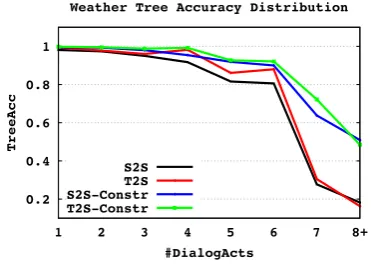
We also plot the tree accuracy distribution against the number of dialog acts in Figure1. (We skip this figure for E2E dataset for space reasons, as it shows similar pattern to weather dataset.) Clearly, for smaller numbers of dialog acts (#Di-alogActs<= 3), all models perform roughly the same and almost hit 100% accuracy. But the gains of T2S is much more clear when the number of di-alog acts is larger than 3. T2S-Constr is also gen-erally better than S2S-Constr in most cases, and both are more effective for complex MRs (7 or 8+ dialog acts), where there are very few MRs (less than 0.5%) in the training set.
Data Efficiency. We set up a data efficiency ex-periment, in which we trained each model on in-creasingly larger subsets of our training set (while keeping the test set constant). Figure 2 shows the results of this experiment. Overall T2S con-sistently outperforms S2S, and the difference is larger with fewer training samples. This suggests that structure awareness leads to better
representa-tions and improves data efficiency.
4.3 Sample Analysis
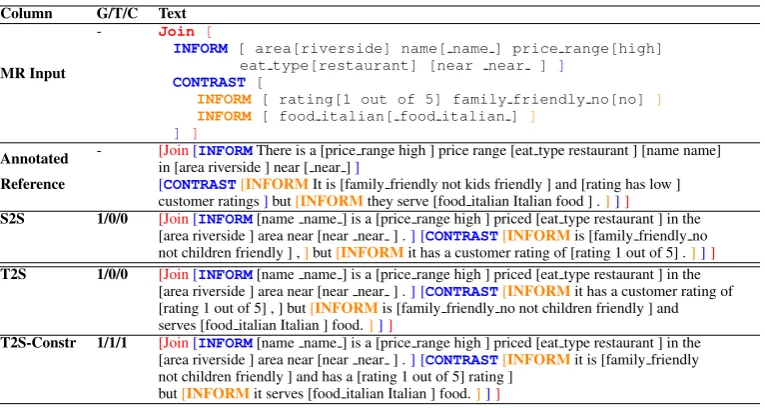
We also provide some sample responses on E2E in Table3. Column ‘G/T/C’ stands for the value of grammaticality, tree accuracy and correctness of model prediction. We obviate S2S-Constr re-sponse here as it is similar to T2S-Constr.
From the example, we can see that T2S mistak-enly contrasted the family friendly and customer rating attributes, largely due to the overwhelm-ing contrast patterns between family friendly and customer rating in training data. In addition to the contrast mistake, S2S completely ignores the attribute of serving Italian food, suggesting its poor generalization ability to rare argument (i.e.,
food italian). T2S-Constr shared the first
sentence with the T2S approach, but was able to correct the constrast mistake by adding structure constraints during beam search.
5 Conclusion
References
Dzmitry Bahdanau, Kyunghyun Cho, and Yoshua Ben-gio. 2014. Neural machine translation by jointly learning to align and translate. arXiv preprint arXiv:1409.0473.
Anusha Balakrishnan, Jinfeng Rao, Kartikeya Upasani, Michael White, and Rajen Subba. 2019. Con-strained decoding for neural NLG from composi-tional representations in task-oriented dialogue. In
Proceedings of the 57th Annual Meeting of the As-sociation for Computational Linguistics. To appear.
Daniel Beck, Gholamreza Haffari, and Trevor Cohn. 2018. Graph-to-sequence learning using gated graph neural networks. In Proceedings of the 56th Annual Meeting of the Association for Com-putational Linguistics (Volume 1: Long Papers), pages 273–283, Melbourne, Australia. Association for Computational Linguistics.
Giuseppe Carenini and Johanna D. Moore. 2006. Gen-erating and evaluating evaluative arguments. Artifi-cial Intelligence, 170:925–952.
Vera Demberg, Andi Winterboer, and Johanna D Moore. 2011. A strategy for information presenta-tion in spoken dialog systems. Computational Lin-guistics, 37(3):489–539.
Ondˇrej Duˇsek, Jekaterina Novikova, and Verena Rieser. 2018. Findings of the E2E NLG challenge. In Pro-ceedings of the 11th International Conference on Natural Language Generation, pages 322–328. As-sociation for Computational Linguistics.
Ondˇrej Duˇsek, Jekaterina Novikova, and Verena Rieser. 2019. Evaluating the state-of-the-art of end-to-end natural language generation: The E2E NLG Chal-lenge.arXiv preprint arXiv:1901.11528.
Henry Elder, Jennifer Foster, James Barry, and Alexan-der OConnor. 2019. Designing a symbolic interme-diate representation for neural surface realization. In
Proceedings of the Workshop on Methods for Op-timizing and Evaluating Neural Language Genera-tion, pages 65–73.
Akiko Eriguchi, Kazuma Hashimoto, and Yoshimasa Tsuruoka. 2016. Tree-to-sequence attentional neu-ral machine translation. the 54th Annual Meeting of the Association for Computational Linguistics.
Oliver Lemon, Johanna Moore, Mary Ellen Foster, and Michael White. 2004. Generating tailored, compar-ative descriptions in spoken dialogue. In Proc. of FLAIRS. AAAI.
Diego Marcheggiani and Laura Perez-Beltrachini. 2018. Deep graph convolutional encoders for struc-tured data to text generation. In Proceedings of the 11th International Conference on Natural Lan-guage Generation, pages 1–9, Tilburg University, The Netherlands. Association for Computational Linguistics.
Amit Moryossef, Yoav Goldberg, and Ido Dagan. 2019.
Step-by-step: Separating planning from realization in neural data-to-text generation. InProceedings of the 2019 Conference of the North American Chap-ter of the Association for Computational Linguistics: Human Language Technologies, Volume 1 (Long and Short Papers), pages 2267–2277, Minneapolis, Minnesota. Association for Computational Linguis-tics. ArXiv preprint arXiv:1904.03396.
Kishore Papineni, Salim Roukos, Todd Ward, and Wei-Jing Zhu. 2002. BLEU: a method for automatic evaluation of machine translation. InProc. ACL-02.
Ratish Puduppully, Li Dong, and Mirella Lapata. 2019. Data-to-text generation with content selection and planning. InProceedings of AAAI. ArXiv preprint arXiv:1809.00582.
Lena Reed, Shereen Oraby, and Marilyn Walker. 2018.
Can neural generators for dialogue learn sentence planning and discourse structuring? In Proceed-ings of the 11th International Conference on Natural Language Generation, pages 284–295. Association for Computational Linguistics.
Linfeng Song, Yue Zhang, Zhiguo Wang, and Daniel Gildea. 2018. A graph-to-sequence model for AMR-to-text generation. InProceedings of the 56th Annual Meeting of the Association for Computa-tional Linguistics (Volume 1: Long Papers), pages 1616–1626, Melbourne, Australia. Association for Computational Linguistics.
Kai Sheng Tai, Richard Socher, and Christopher D Manning. 2015. Improved semantic representations from tree-structured long short-term memory net-works. In Proceedings of the 53rd Annual Meet-ing of the Association for Computational LMeet-inguistics and the 7th International Joint Conference on Natu-ral Language Processing (Volume 1: Long Papers), pages 1556–1566.
Marilyn Walker, Amanda Stent, Francois Mairesse, and Rashmi Prasad. 2007. Individual and domain adap-tation in sentence planning for dialogue. Journal of Artificial Intelligence Research (JAIR), 30:413–456.
Michael White, Robert A. J. Clark, and Johanna D. Moore. 2010. Generating tailored, comparative de-scriptions with contextually appropriate intonation.
Computational Linguistics, 36(2):159–201.