SemEval-2013 Task 5: Evaluating Phrasal Semantics
Ioannis Korkontzelos National Centre for Text Mining
School of Computer Science University of Manchester, UK
Torsten Zesch UKP Lab, CompSci Dept. Technische Universit¨at Darmstadt
Germany
Fabio Massimo Zanzotto Department of Enterprise Engineering
University of Rome “Tor Vergata” Italy
Chris Biemann
FG Language Technology, CompSci Dept. Technische Universit¨at Darmstadt
Germany
Abstract
This paper describes the SemEval-2013 Task 5: “Evaluating Phrasal Semantics”. Its first subtask is about computing the semantic simi-larity of words and compositional phrases of minimal length. The second one addresses deciding the compositionality of phrases in a given context. The paper discusses the impor-tance and background of these subtasks and their structure. In succession, it introduces the systems that participated and discusses evalu-ation results.
1 Introduction
Numerous past tasks have focused on leveraging the meaning of word types or words in context. Exam-ples of the former are noun categorization and the TOEFL test, examples of the latter are word sense disambiguation, metonymy resolution, and lexical substitution. As these tasks have enjoyed a lot suc-cess, a natural progression is the pursuit of models that can perform similar tasks taking into account multiword expressions and complex compositional structure. In this paper, we present two subtasks de-signed to evaluate such phrasal models:
a. Semantic similarity of words and compositional phrases
b. Evaluating the compositionality of phrases in context
For example, the first subtask addresses computing how similar the word “valuation” is to the compo-sitional sequence “price assessment”, while the sec-ond subtask addresses deciding whether the phrase ”piece of cake” is used literally or figuratively in the sentence “Labour was a piece of cake!”.
The aim of these subtasks is two-fold. Firstly, considering that there is a spread interest lately in phrasal semantics in its various guises, they provide an opportunity to draw together approaches to nu-merous related problems under a common evalua-tion set. It is intended that after the competievalua-tion, the evaluation setting and the datasets will comprise an on-going benchmark for the evaluation of these phrasal models.
Secondly, the subtasks attempt to bridge the gap between established lexical semantics and full-blown linguistic inference. Thus, we anticipate that they will stimulate an increased interest around the general issue of phrasal semantics. We use the no-tion of phrasal semantics here as opposed to lexi-cal compounds or compositional semantics. Bridg-ing the gap between lexical semantics and lBridg-inguis- linguis-tic inference could provoke novel approaches to cer-tain established tasks, such as lexical entailment and paraphrase identification. In addition, it could
timately lead to improvements in a wide range of applications in natural language processing, such as document retrieval, clustering and classification, question answering, query expansion, synonym ex-traction, relation exex-traction, automatic translation, or textual advertisement matching in search engines, all of which depend on phrasal semantics.
The remainder of this paper is structured as fol-lows: Section 2 presents details about the data sources and the variety of sources applicable to the task. Section 3 discusses the first subtask, which is about semantic similarity of words and compo-sitional phrases. In subsection 3.1 the subtask is described in detail together with some information about its background. Subsection 3.2 discusses the data creation process and subsection 3.3 discusses the participating systems and their results. Section 4 introduces the second subtask, which is about eval-uating the compositionality of phrases in context. Subsection 4.1 explains the data creation process for this subtask. In subsection 4.2 the evaluation statis-tics of participating systems are presented. Section 5 is a discussion about the conclusions of the entire task. Finally, in section 6 we summarize this presen-tation and discuss briefly our vision about challenges in distributional semantics.
2 Data Sources & Methodology
Data instances of both subtasks are drawn from the large-scale, freely available WaCky corpora (Baroni et al., 2009). The resource contains corpora in 4 lan-guages: English, French, German and Italian. The English corpus,ukWaC, consists of 2 billion words and was constructed by crawling to the .uk domain of the web and using medium-frequency words from the BNC as seeds. The corpus is part-of-speech (PoS) tagged and lemmatized using the TreeTagger (Schmid, 1994). The French corpus, frWaC, con-tains 1.6 billion word corpus and was constructed by web-crawling the .fr domain and using medium-frequency words from theLe Monde Diplomatique corpus and basic French vocabulary lists as seeds. The corpus was PoS tagged and lemmatized with the TreeTagger. The French corpus, deWaC, con-sists of 1.7 billion word corpus and was constructed by crawling the .de domain and using medium-frequency words from theSudDeutsche Zeitung
cor-pusand basic German vocabulary lists as seeds. The corpus was PoS tagged and lemmatized with the TreeTagger. The Italian corpus,itWaC, is a 2 billion word corpus constructed from the .it domain of the web using medium-frequency words from the Re-pubblica corpusand basic Italian vocabulary lists as seeds. The corpus was PoS tagged with the Tree-Tagger, and lemmatized using theMorph-it!lexicon (Zanchetta and Baroni, 2005). Several versions of the WaCky corpora, with various extra annotations or modifications are also available1.
We ensured that data instances occur frequently enough in the WaCky corpora, so that participat-ing systems could gather statistics for buildparticipat-ing dis-tributional vectors or other uses. As the evalua-tion data only contains very small annotated sam-ples from freely available web documents, and the original source is provided, we could provide them without violating copyrights.
The size of the WaCky corpora is suitable for training reliable distributional models. Sentences are already lemmatized and part-of-speech tagged. Participating approaches making use of distribu-tional methods, part-of-speech tags or lemmas, were strongly encouraged to use these corpora and their shared preprocessing, to ensure the highest possi-ble comparability of results. Additionally, this had the potential to considerably reduce the workload of participants. For the first subtask, data were pro-vided in English, German and Italian and for the sec-ond subtask in English and German.
The range of methods applicable to both subtasks was deliberately not limited to any specific branch of methods, such as distributional or vector models of semantic compositionality. We believe that the sub-tasks can be tackled from different directions and we expect a great deal of the scientific benefit to lie in the comparison of very different approaches, as well as how these approaches can be combined. An ex-ception to this rule is the fact that participants in the first subtask were not allowed to use directly defini-tions extracted from dictionaries or lexicons. Since the subtask is considered fundamental and its data were created from online knowledge resources, sys-tems using the same tools to address it would be of limited use. However, participants were allowed to
use other information residing in dictionaries, such as Wordnet synsets or synset relations.
Participating systems were allowed to attempt one or both subtasks, in one or all of the languages sup-ported. However, it was expected that systems per-forming well at the first basic subtask would pro-vide a good starting point for dealing with the sec-ond subtask, which is considered harder. Moreover, language-independent models were of special inter-est.
3 Subtask 5a: Semantic Similarity of Words and Compositional Phrases
The aim of this subtask is to evaluate the compo-nent of a semantic model that computes the simi-larity between word sequences of different length. Participating systems are asked to estimate the se-mantic similarity of a word and a short sequence of two words. For example, they should be able to fig-ure out thatcontactandclose interactionare similar whereasmegalomaniaandgreat madnessare not.
This subtask addresses a core problem, since sat-isfactory performance in computing the similarity of full sentences depends on similarity computations on shorter sequences.
3.1 Background and Description
This subtask is based on the assumption that we first need a basic set of functions to compose the meaning of two words, in order to construct more complex models that compositionally determine the meaning of sentences, as a second step. For compo-sitional distributional semantics, the need for these basic functions is discussed in Mitchell and Lapata (2008). Since then, many models have been pro-posed for addressing the task (Mitchell and Lapata, 2010; Baroni and Zamparelli, 2010; Guevara, 2010), but still comparative analysis is in general based on comparing sequences that consist of two words.
As in Zanzotto et al. (2010), this subtask proposes to compare the similarity of a 2-word sequence and a single word. This is important as it is the basic step to analyse models that can compare any word sequences of different length.
The development and testing set for this subtask were built based on the idea described in Zanzotto et al. (2010). Dictionaries were used as sources of
contact/[kon-takt]
1. the act or state of touching; a touching or meeting, as of two things or people.
2. close interaction
3. an acquaintance, colleague, or relative through whom a person can gain access to information, favors, influ-ential people, and the like.
Figure 1: The definition ofcontactin a sample dictionary
positive training examples. Dictionaries are natural repositories of equivalences between words under definition and sequences of words used for defining them. Figure 1 presents the definition of the word contact, from which the pair(contact, close interac-tion)can be extracted. Such equivalences extracted from dictionaries can be seen as natural and unbi-ased data instances. This idea opens numerous op-portunities:
• Since definitions in dictionaries are syntacti-cally rich, we are able to create examples for different syntactic relations.
• We have the opportunity to extract positive ex-amples for languages for which dictionaries with sufficient entries are available.
Negative examples were generated by matching words under definition with randomly chosen defin-ing sequences. In the followdefin-ing subsection, we pro-vide details about the application of this idea to build the development and testing set for subtask 5a.
3.2 Data Creation
Language Train set Test set Total
English 5,861 3,907 9,768 German 1,516 1,010 2,526
Italian 1,275 850 2,125
German - no names 1,101 733 1,834
Table 1: Quantitative characteristics of the datasets
were kept, only. For the purpose of extracting word and sequence pairs for this subtask, we consider as noun phrases, sequences that consist of adjectives or noun and end with a noun. In cases where the extracted noun phrase was longer than two words, the right-most two sequences were kept, since in most cases noun phrases are governed by their right-most component. Subsequently, we discarded in-stances whose words occur too infrequently in the WaCky corpora (Baroni et al., 2009) of each lan-guage. WaCky corpora are available freely and are large enough for participating systems to extract dis-tributional statistics. Taking the numbers of ex-tracted instances into account, we set the frequency thresholds at 10 occurrences for English and 5 for German and Italian.
Data instances extracted following this process were then checked by a computational linguist. Can-didate pairs in which the definition sequence was not judged to be a precise and adequate definition of the word under definition were discarded. These cases were very limited and mostly account for shortcom-ings of the very simple pattern used for extraction. For example, the pair(standard, transmission vehi-cle)coming from the definition of “standard” as “A manual transmission vehicle” was discarded. Simi-larly in German, the pair (Fremde (Eng. stranger), weibliche Person (Eng. female person)) was dis-carded. “Fremde”, which is of female grammat-ical genre, was defined as “weibliche Person, die man nicht kennt(Eng. female person, one does not know)”. In Italian, the pair(paese (Eng. land, coun-try, region), grande estensione (Eng. large tract)) was discarded, since the original definition was “grande estensione di terreno abitato e generalmente coltivato(Eng. large tract of land inhabited and cul-tivated in general)”.
The final data sets were divided into training and
held-out testing sets, according to a 60% and 40% ratio, respectively. The first three rows of table 1 present the numbers of the train and test sets for the three languages chosen. It was identified that a fair percentage of the German instances (approximately 27%) refer to the definitions of first names or family names. This is probably a flaw of the German part of Wiktionary. In addition, the pattern used for extrac-tion happens to apply to the definiextrac-tions of names. Name instances were discarded from the German data set to produce the data set described in the last row of table 1.
The training set was released approximately 3 months earlier than the test data. Instances in both set ware annotated as positive or negative. Test set annotations were not released to the participants, but were used for evaluation, only.
3.3 Results
Participating systems were evaluated on their ability to predict correctly whether the components of each test instance, i.e. word-sequence pair, are semanti-cally similar or distinct. Participants were allowed to use or ignore the training data, i.e. the systems could be supervised or unsupervised. Unsupervised systems were allowed to use the training data for de-velopment and parameter tuning. Since this is a core task, participating systems were not be able to use dictionaries or other prefabricated lists. Instead, they were allowed to use distributional similarity models, selectional preferences, measures of semantic simi-larity etc.
Participating system responses were scored in terms of standard information retrieval measures: accuracy (A), precision (P), recall (R) and F1 score
(Radev et al., 2003). Systems were encouraged to submit at most 3 solutions for each language, but submissions for fewer languages were accepted.
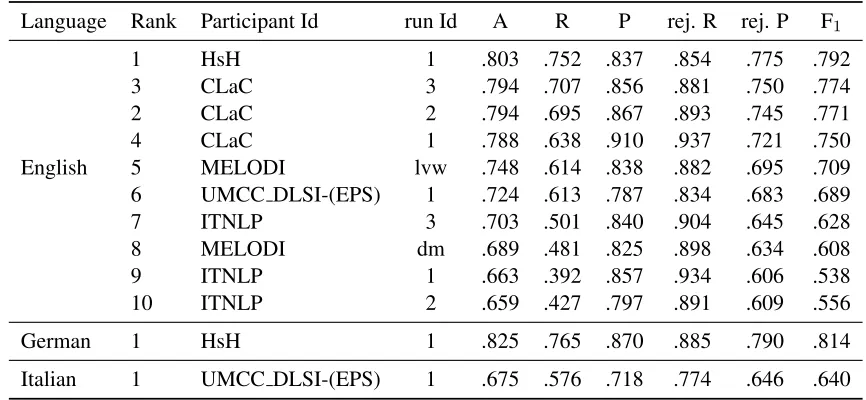
Language Rank Participant Id run Id A R P rej. R rej. P F1
1 HsH 1 .803 .752 .837 .854 .775 .792
3 CLaC 3 .794 .707 .856 .881 .750 .774
2 CLaC 2 .794 .695 .867 .893 .745 .771
4 CLaC 1 .788 .638 .910 .937 .721 .750
English 5 MELODI lvw .748 .614 .838 .882 .695 .709 6 UMCC DLSI-(EPS) 1 .724 .613 .787 .834 .683 .689 7 ITNLP 3 .703 .501 .840 .904 .645 .628 8 MELODI dm .689 .481 .825 .898 .634 .608 9 ITNLP 1 .663 .392 .857 .934 .606 .538 10 ITNLP 2 .659 .427 .797 .891 .609 .556
German 1 HsH 1 .825 .765 .870 .885 .790 .814
[image:5.612.88.521.55.255.2]Italian 1 UMCC DLSI-(EPS) 1 .675 .576 .718 .774 .646 .640
Table 2: Task 5a: Evaluation results. A, P, R, rej. and F1stand for accuracy, precision, recall, rejection and F1score, respectively.
these approaches performed better than some super-vised ones for this experiment. Below, we sum-marise the properties of participating systems.
(HsH)(Wartena, 2013) used distributed similarity and especially random indexing to compute similar-ities between words and possible definitions, under the hypothesis that a word and its definition are dis-tributionally more similar than a word and an arbi-trary definition. Considering all open-class words, context vectors over the entire WaCky corpus were computed for the word under definition, the defining sequence, its component words separately, the ad-dition and multiplication of the vectors of the com-ponent words and a general context vector. Then, various similarity measures were computed on the vectors, including an innovative length-normalised version of Jensen-Shannon divergence. The similar-ity values are used to train a Support Vector Machine (SVM) classifier (Cortes and Vapnik, 1995).
The first approach (run 1) of CLaC (Siblini and Kosseim, 2013) is based on a weighted semantic network to measure semantic relatedness between the word and the components of the phrase. A PART classifier is used to generate a partial decision trained on the semantic relatedness information of the labelled training set. The second approach uses a supervised distributional method based on words frequently occurring in the Web1TB corpus to cal-culate relatedness. A JRip classifier is used to
gen-erate rules trained on the semantic relatedness infor-mation of the training set. This approach was used in conjunction with the first one as a backup method (run 2). In addition, features generated by both ap-proaches were used to train the JRIP classifier col-lectively (run 3).
The first approach of MELODI (Van de Cruys et al., 2013), called lvw, uses a dependency-based vector space model computed over the ukWaC cor-pus, in combination with Latent Vector Weighting (Van de Cruys et al., 2011). The system computes the similarity between the first noun and the head noun of the second phrase, which was weighted ac-cording to the semantics of the modifier. The second approach, calleddm, used a dependency-based vec-tor space model, but, unlike the first approach, disre-garded the modifier in the defining sequence. Since both systems are unsupervised, the training data was used to train a similarity threshold parameter, only.
UMCC DLSI-(EPS) (D´avila et al., 2013) locates the synsets of words in data instances and computes the semantic distances between each synset of the word under definition and each synsets of the defin-ing sequence words. In succession, a classifier is trained using features based on distance and Word-Net relations.
the defining sequence in each instance. Their sec-ond attempt also uses an SVM, however trained on WordNet-based similarities. The third attempt of ITNLPis a combination of the previous two; it com-bines their features to train an SVM classifier.
4 Subtask 5b: Semantic Compositionality in Context
An interesting sub-problem of semantic composi-tionality is to decide whether a target phrase is used in its literal or figurative meaning in a given con-text. For example “big picture” might be used lit-erally as inClick here for a bigger pictureor figura-tively as inTo solve this problem, you have to look at the bigger picture. Another example is “old school” which can also be used literally or figuratively: He will go down in history as one of the old school, a true gentlemen.vs.During the 1970’s the hall of the old school was converted into the library.
Being able to detect whether a phrase is used lit-erally or figuratively is e.g. especially important for information retrieval, where figuratively used words should be treated separately to avoid false positives. For example, the example sentenceHe will go down in history as one of the old school, a true gentle-men.should probably not be retrieved for the query “school”. Rather, the insights generated from sub-task 5a could be utilized to retrieve sentences using a similar phrase such as “gentleman-like behavior”. The task may also be of interest to the related re-search fields of metaphor detection and idiom iden-tification.
There were no restrictions regarding the array of methods, and the kind of resources that could be employed for this task. In particular, participants were allowed to make use of pre-fabricated lists of phrases annotated with their probability of being used figuratively from publicly available sources, or to produce these lists from corpora. Assessing how well the phrase suits its context might be tackled using e.g. measures of semantic relatedness as well as distributional models learned from the underlying corpus.
Participants of this subtask were provided with real usage examples of target phrases. For each us-age example, the task is to make a binary decision whether the target phrase is used literally or
figu-ratively in this context. Systems were tested in two different disciplines: aknown phrasestask where all target phrases in the test set were contained in the training, and anunknown phrasessetting, where all target phrases in the test set were unseen.
4.1 Data Creation
The first step in creating the corpus was to compile a list of phrases that can be used either literally or metaphorically. Thus, we created an initial list of several thousand English idioms from Wiktionary by listing all entries under the category ENGLISH ID-IOMS using the JWKTL Wiktionary API (Zesch et al., 2008). We manually filtered the list removing most idioms that are very unlikely to be ever used literally (anymore), e.g.to knock on heaven’s door. For each of the resulting list of phrases, we extracted usage contexts from the ukWaC corpus (Baroni et al., 2009). Each usage context contains 5 sentences, where the sentence with the target phrase appears in a randomized position. Due to segmentation errors, some usage contexts actually might contain less than 5 sentences, but we manually filtered all usage con-texts where the remaining context was insufficient. This was done in the final cleaning step where we also manually removed (near) duplicates, obvious spam, encoding problems etc.
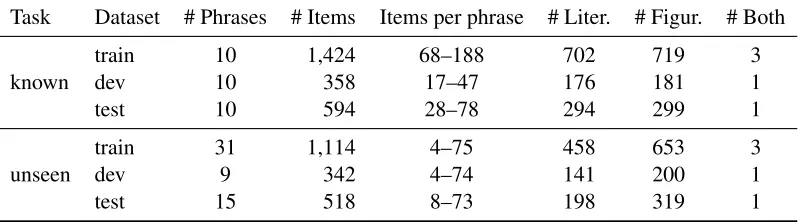
The target phrases in context were annotated for figurative, literal, both orimpossible to tell usage, using the CrowdFlower2 crowdsourcing annotation platform. We used about 8% of items as “gold” items for quality assurance, and had each example annotated by three crowdworkers. The task was comparably easy for crowdworkers, who reached 90%-94% pairwise agreement, and 95% success on the gold items. About 5% of items with low agree-ment and marked as impossible were removed. Ta-ble 3 summarizes the quantitative characteristics of all datasets resulting from this process. We took care in sampling the data as to keep similar distributions across the training, development and testing parts.
4.2 Results
Training and development datasets were made avail-able in advance, test data was provided during the evaluation period without labels. System
Task Dataset # Phrases # Items Items per phrase # Liter. # Figur. # Both
known
train 10 1,424 68–188 702 719 3
dev 10 358 17–47 176 181 1
test 10 594 28–78 294 299 1
unseen
train 31 1,114 4–75 458 653 3
dev 9 342 4–74 141 200 1
[image:7.612.107.506.57.168.2]test 15 518 8–73 198 319 1
Table 3: Quantitative characteristics of the datasets
Rank System Run Accuracy
1 IIRG 3 .779
2 UNAL 2 .754
3 UNAL 1 .722
5 IIRG 1 .530
4 Baseline MFC - .503
6 IIRG 2 .502
Table 4: Task 5b: Evaluation results for the known phrases setting
Rank System Run Accuracy
1 UNAL 1 .668
2 UNAL 2 .645
3 Baseline MFC - .616
[image:7.612.84.282.207.313.2]4 CLaC 1 .550
Table 5: Task 5b: Evaluation results for the unseen phrases setting
mance was measured in accuracy. Since all partic-ipants provided classifications for all test items, the accuracy score is equivalent to precision/recall/F1. Participants were allowed to enter up to three dif-ferent runs for evaluation. We also provide baseline accuracy scores, which are obtained by always as-signing the most frequent class (figurative).
Table 4 provides the evaluation results for the known phrases task, while Table 5 ranks participants for the unseen phrases task. As expected, the un-seen phrasessetting is much harder than theknown phrasessetting, as for unseen phrases it is not possi-ble to learn lexicalised contextual clues. In both set-tings, the winning entries were able to beat the MFC baseline. While performance in theknown phrases
setting is close to 80% and thus acceptable, the gen-eral task of recognizing the litgen-eral or figurative use of unseen phrases remains very challenging, with only a small improvement over the baseline. We refer to the system descriptions for more details on the tech-niques used for this subtask: UNAL(Jimenez et al., 2013),IIRG(Byrne et al., 2013) andCLaC(Siblini and Kosseim, 2013).
5 Task Conclusions
In this section, we further discuss the findings and conclusion of the evaluation challenge in the task of “Phrasal Semantics”.
Looking at the results of both subtasks, one ob-serves that the maximum performance achieved is higher for the first than the second subtask. For this comparison to be fair, trivial baselines should be taken into account. A system randomly assigning an output value would be on average 50% correct in the first subtask, since the numbers of positive and neg-ative instances in the testing set are equal. Similarly, a system assigning the most frequent class, i.e. the figurative use of any phrase, would be 50.3% and 61.6% accurate in the second subtask for seen and unseen test instances, respectively. It should also be noted that the testing instances in the first subtask are unseen in the respective training set. As a result, in terms of baselines, the second subtask on unseen data (Table 5) should be considered easier than the first subtask (Table 2). However, the best perform-ing systems achieved much higher accuracy in the first than in the second subtask. This contradiction confirms our conception that the first subtask is less complex than the second.
[image:7.612.87.284.365.444.2]Although the participating systems have employed a wide variety of approaches and tools, the difference between the best and worst accuracy achieved is relatively limited, in particular approximately 14%. Even more interestingly, unsupervised approaches performed better than some supervised ones. This observation suggests that no “golden recipe” has been identified so far for this task. Thus, probably different processing tools take advantage of different sources of information. It is a matter of future re-search to identify these sources and the correspond-ing tools, and then develop hybrid methods of im-proved performance.
In the second subtask, the results of evaluation on known phrases are much higher than on unseen phrases. This was expected, as for unseen phrases it is not possible to learn lexicalised contextual clues. Thus, the second subtask has succeeded in identify-ing the complexity threshold up to which the cur-rent state-of-the-art can address the computational problem. Further than this threshold, i.e. for unseen phrases, current systems have not yet succeeded in addressing it. In conclusion, the difficulty in eval-uating the compositionality of previously unseen phrases in context highlights the overall complexity of the second subtask.
6 Summary and Future Work
In this paper we have presented the 5th task of Se-mEval 2013, “Evaluating Phrasal Semantics”, which consists of two subtasks: (1) semantic similarity of words and compositional phrases, and (2) compo-sitionality of phrases in context. The former sub-task, which focussed on the first step of composing the meaning of phrases of any length, is less com-plex than the latter subtask, which considers the ef-fect of context to the semantics of a phrase. The paper presents details about the background and im-portance of these subtasks, the data creation process, the systems that took part in the evaluation and their results.
In the future, we expect evaluation challenges on phrasal semantics to progress towards two direc-tions: (a) the synthesis of semantics of sequences longer than two words, and (b) aiming to improve the performance of systems that determine the com-positionality of previously unseen phrases in
con-text. The evaluation results of the first task sug-gest that state-of-the-art systems can compose the semantics of two word sequences with a promising level of success. However, this task should be seen as the first step towards composing the semantics of sentence-long sequences. As far as subtask 5b is concerned, the accuracy achieved by the partici-pating systems on unseen testing data was low, only slightly better than the most frequent class baseline, which assigns the figurative use to all test phrases. Thus, the subtask cannot be considered well ad-dressed by the state-of-the-art and further progress should be sought.
Acknowledgements
The work relevant to subtask 5a described in this pa-per is funded by the European Community’s Seventh Framework Program (FP7/2007-2013) under grant agreement no. 318736 (OSSMETER).
References
Marco Baroni and Roberto Zamparelli. 2010. Nouns are vectors, adjectives are matrices: Representing adjective-noun constructions in semantic space. In
Proceedings of the 2010 Conference on Empiri-cal Methods in Natural Language Processing, pages 1183–1193, Cambridge, MA. Association for Compu-tational Linguistics.
Marco Baroni, Silvia Bernardini, Adriano Ferraresi, and Eros Zanchetta. 2009. The WaCky wide web: a collection of very large linguistically processed web-crawled corpora. Language Resources and Evalua-tion, 43(3):209–226.
Lorna Byrne, Caroline Fenlon, and John Dunnion. 2013. IIRG: A naive approach to evaluating phrasal seman-tics. In Proceedings of the 6th International Work-shop on Semantic Evaluation (SemEval 2012), At-lanta, Georgia, USA.
Corinna Cortes and Vladimir Vapnik. 1995. Support-vector networks. Machine Learning, 20(3):273–297. H´ector D´avila, Antonio Fern´andez Orqu´ın, Alexander
Ch´avez, Yoan Guti´errez, Armando Collazo, Jos´e I. Abreu, Andr´es Montoyo, and Rafael Mu˜noz. 2013. UMCC DLSI-(EPS): Paraphrases detection based on semantic distance. In Proceedings of the 6th Inter-national Workshop on Semantic Evaluation (SemEval 2012), Atlanta, Georgia, USA.
Emiliano Guevara. 2010. A regression model of adjective-noun compositionality in distributional se-mantics. In Proceedings of the 2010 Workshop on GEometrical Models of Natural Language Semantics, pages 33–37, Uppsala, Sweden. Association for Com-putational Linguistics.
Sergio Jimenez, Claudia Becerra, and Alexander Gel-bukh. 2013. UNAL: Discriminating between literal and figurative phrasal usage using distributional statis-tics and POS tags. In Proceedings of the 6th Inter-national Workshop on Semantic Evaluation (SemEval 2012), Atlanta, Georgia, USA.
Jeff Mitchell and Mirella Lapata. 2008. Vector-based models of semantic composition. In Proceedings of ACL-08: HLT, pages 236–244, Columbus, Ohio. As-sociation for Computational Linguistics.
Jeff Mitchell and Mirella Lapata. 2010. Composition in distributional models of semantics.Cognitive Science, 34(8):1388–1429.
Dragomir R. Radev, Simone Teufel, Horacio Saggion, Wai Lam, John Blitzer, Hong Qi, Arda C¸ elebi, Danyu Liu, and Elliott Drabek. 2003. Evaluation challenges in large-scale document summarization. In Proceed-ings of the 41st Annual Meeting on Association for Computational Linguistics - Volume 1, ACL ’03, pages
375–382, Morristown, NJ, USA. Association for Com-putational Linguistics.
Helmut Schmid. 1994. Probabilistic Part-of-Speech tag-ging using decision trees. InProceedings of the In-ternational Conference on New Methods in Language Processing, Manchester, UK.
Reda Siblini and Leila Kosseim. 2013. CLaC: Semantic relatedness of words and phrases. InProceedings of the 6th International Workshop on Semantic Evalua-tion (SemEval 2012), Atlanta, Georgia, USA.
Yoshimasa Tsuruoka, Yuka Tateishi, Jin-Dong Kim, Tomoko Ohta, John McNaught, Sophia Ananiadou, and Jun’ichi Tsujii. 2005. Developing a robust Part-of-Speech tagger for biomedical text. In Panayiotis Bozanis and Elias N. Houstis, editors,Advances in In-formatics, volume 3746, chapter 36, pages 382–392. Springer Berlin Heidelberg, Berlin, Heidelberg. Tim Van de Cruys, Thierry Poibeau, and Anna
Korho-nen. 2011. Latent vector weighting for word mean-ing in context. In Proceedings of the Conference on Empirical Methods in Natural Language Process-ing, EMNLP ’11, pages 1012–1022, Stroudsburg, PA, USA. Association for Computational Linguistics. Tim Van de Cruys, Stergos Afantenos, and Philippe
Muller. 2013. MELODI: Semantic similarity of words and compositional phrases using latent vector weight-ing. In Proceedings of the 6th International Work-shop on Semantic Evaluation (SemEval 2012), At-lanta, Georgia, USA.
Christian Wartena. 2013. HsH: Estimating semantic sim-ilarity of words and short phrases with frequency nor-malized distance measures. InProceedings of the 6th International Workshop on Semantic Evaluation (Se-mEval 2012), Atlanta, Georgia, USA.
Eros Zanchetta and Marco Baroni. 2005. Morph-it!: A free corpus-based morphological resource for the ital-ian language.Corpus Linguistics 2005, 1(1).
Fabio Massimo Zanzotto, Ioannis Korkontzelos, Francesca Fallucchi, and Suresh Manandhar. 2010. Estimating linear models for compositional dis-tributional semantics. In Proceedings of the 23rd International Conference on Computational Linguis-tics (COLING).