Unsupervised Induction of a Syntax-Semantics Lexicon
Using Iterative Refinement
Hagen F ¨urstenau CCLS
Columbia University New York, NY, USA [email protected]
Owen Rambow CCLS
Columbia University New York, NY, USA
Abstract
We present a method for learning syntax-semantics mappings for verbs from unanno-tated corpora. We learnlinkings, i.e., map-pings from the syntactic arguments and ad-juncts of a verb to its semantic roles. By learn-ing such linklearn-ings, we do not need to model in-dividual semantic roles independently of one another, and we can exploit the relation be-tween different mappings for the same verb, or between mappings for different verbs. We present an evaluation on a standard test set for semantic role labeling.
1 Introduction
A verb can have several ways of mapping its seman-tic arguments to syntax (“diathesis alternations”):
(1) a. We increased the response rate with SHK. b. SHK increased the response rate.
c. The response rate increased.
The subject ofincreasecan be the agent (1a), the in-strument (1b), or the theme (what is being increased) (1c). Other verbs that show this pattern include breakormelt.
Much theoretical and lexicographic (descriptive) work has been devoted to determining how verbs map their lexical predicate-argument structure to syntactic arguments (Burzio, 1986; Levin, 1993). The last decades have seen a surge in activity on the computational front, spurred in part by efforts to annotate large corpora for lexical semantics (Baker et al., 1998; Palmer et al., 2005). Initially, we have seen computational efforts devoted to finding classes of verbs that share similar syntax-semantics map-pings from annotated and unannotated corpora (La-pata and Brew, 1999; Merlo and Stevenson, 2001).
More recently, there has been an explosion of inter-est in semantic role labeling (with too many recent publications to cite).
In this paper, we explore learning syntax-semantics mappings for verbs from unannotated cor-pora. We are specifically interested in learning link-ings. A linking is a mapping for one verb from its syntactic arguments and adjuncts to all of its se-mantic roles, so that individual sese-mantic roles are not modeled independently of one another and so that we can exploit the relation between different mappings for the same verb (as in (1) above), or between mappings for different verbs. We there-fore follow Grenager and Manning (2006) in treat-ing linktreat-ings as first-class objects; however, we dif-fer from their work in two important respects. First, we use semantic clustering of head words of argu-ments in an approach that resembles topic modeling, rather than directly modeling the subcategorization of verbs with a distribution over words. Second and most importantly, we do not make any assumptions about the linkings, as do Grenager and Manning (2006). They list a small set of rules from which they derive all linkings possible in their model; in contrast, we are able to learn any linking observed in the data. Therefore, our approach is language-independent. Grenager and Manning (2006) claim that their rules represent “a weak form of Universal Grammar”, but their rules lack such common linking operations as the addition of an accusative reflex-ive for the unaccusatreflex-ive (Romance) or case mark-ing (many languages), and they include a specific (English) preposition. We have no objection to us-ing lus-inguistic knowledge, but we do not feel that we have the empirical basis as of now to provide a set of Universal Grammar rules relevant for our task.
A complete syntax-semantics lexicon describes how lexemes syntactically realize their semantic ar-guments, and provides selectional preferences on these dependents. Though rich lexical resources ex-ist (such as the PropBank rolesets, the FrameNet lex-icon, or VerbNet, which relates and extends these sources), none of them is complete, not even for En-glish, on which most of the efforts have focused. However, if a complete syntax-semantics lexicon did exist, it would be an extremely useful resource: the task of shallow semantic parsing (semantic ar-gument detection and semantic role labeling) could be reduced to determining the best analysis accord-ing to this lexicon. In fact, the learnaccord-ing model we present in this paper is itself a semantic role labeling model, since we can simply apply it to the data we want to label semantically.
This paper is a step towards the unsupervised in-duction of a complete syntax-semantics lexicon. We present a unified procedure for associating verbs with linkings and for associating the discovered se-mantic roles with selectional preferences. As input, we assume a syntactic representation scheme and a parser which can produce syntactic representations of unseen sentences in the chosen scheme reason-ably well, as well as unlabeled text. We do not as-sume a specific theory of lexical semantics, nor a specific set of semantic roles. We induce a set of linkings, which are mappings from semantic role symbols to syntactic functions. We also induce a lexicon, which associates a verb lemma with a dis-tribution over the linkings, and which associates the sematic role symbols with verb-specific selectional preferences (which are distributions over distribu-tions of words). We evaluate on the task of semantic role labeling using PropBank (Palmer et al., 2005) as a gold standard.
We focus on semantic arguments, as they are de-fined specifically for each verb and thus have verb-specific mappings to syntactic arguments, which may further be subject to diathesis alternations. In contrast, semantic adjuncts (modifiers) apply (in principle) to all verbs, and do not participate in diathesis alternations. For this reason, the Prop-Bank lexicon includes arguments but not adjuncts in its framesets. The method we present in this pa-per is designed to find verb-specific arguments, and we therefore take the results on semantic arguments
(Argn) as our primary result. On these, we achieve a 20% F-measure error reduction over a high syntac-tic baseline (which maps each syntacsyntac-tic relation to a single semantic argument).
2 Related Work
As mentioned above, our approach is most similar to that of Grenager and Manning (2006). However, since their model uses hand-crafted rules, they are able to predict and evaluate against actual PropBank role labels, whereas our approach has to be evaluated in terms of clustering quality.
The problem of unsupervised semantic role la-beling has recently attracted some attention (Lang and Lapata, 2011a; Lang and Lapata, 2011b; Titov and Klementiev, 2012). While the present paper shares the general aim of inducing semantic role clusters in an unsupervised way, it differs in treat-ing syntax-semantics linktreat-ings explicitly and model-ing predicate-specific distributions over them.
Abend et al. (2009) address the problem of un-supervised argument recognition, which we do not address in the present paper. For the purpose of building a complete unsupervised semantic parser, a method such as theirs would be complementary to our work.
3 Model
In this section, we decribe a model that generates arguments for a given predicate instance. Specifi-cally, this generative model describes the probability of a given set of argument head words and associated syntactic functions in terms of underlying semantic roles, which are modelled as latent variables. The semantic role labeling task is therefore framed as the induction of these latent variables from the observed data, which we assume to be preprocessed by a syn-tactic parser.
instances ofresponse ratein (1) should be assigned to the same cluster. We assume a fixed maximum number R of semantic roles per predicate and for-mulate argument classification as the task of assign-ing each argument in a predicate-argument struc-ture to one of the numbered roles 1, . . . , R. Such an assignment can therefore be represented by an
R-tuple, where each role position is either filled by one of the arguments or empty (denoted as ). We represent each argument by its head word and its syntactic function, i.e., the path of syntactic de-pendency relations leading to it from the predicate. In our example (1a), a possible assignment of ar-guments to semantic roles could therefore be rep-resented by a head word tuple (we,rate, ,SHK)
and a corresponding tuple of syntactic functions
(nsubj,dobj, ,prep with), where for the sake of the example we have chosen R = 4 and the third se-mantic role slot is empty. Note that this ordered
R-tuple thus represents a semantic labeling of the unordered set of arguments, which our model takes as input. While in the case of a single predicate-argument structure the assignment of predicate-arguments to arbitrary semantic role numbers does not provide additional information, its value lies in the con-sistent assignment of arguments to specific roles across instances of the same predicate. For exam-ple, to be consistent with the assignment above, (1b) would have to be represented by (,rate, ,SHK)
and(,dobj, ,nsubj).
To formulate a generative model of argument tu-ples, we separately consider the tuple of argument head words and the tuple of syntactic functions. The following two subsections will address each of these in turn.
3.1 Selectional Preferences
The probability of an argument in a certain semantic role depends strongly on theselectional preferences of the predicate with respect to this role. In the con-text of our model, we therefore need to describe the probabilityP(wr|p, r)of an argument head wordwr
depending on the predicatepand the roler. Instead of directly modeling predicate- and role-specific dis-tributions over head words, however, we model se-lectional preferences as distributionsχp,r(c)over
se-mantic word classesc = 1, . . . , C (withC being a fixed model parameter), each of which is in turn
as-sociated with a distributionψc(wr)over the
vocab-ulary. They are thus similar to topics in semantic topic models. An advantage of this approach is that semantic word classes can be shared among different predicates, which facilitates their inference. Techni-cally, the introduction of semantic word classes can be seen as a factorization of the probability of the argument headP(wr|p, r) =PCc=1χp,r(c)ψc(wr).
3.2 Linkings
Another important factor for the assignment of ar-guments to semantic roles are their syntactic func-tions. While in the preceding subsection we consid-ered selectional preferences for each semantic role separately (assuming their independence), the inter-dependence between syntactic functions is crucial and cannot be ignored: The assignment of an ar-gument does not depend solely on its own syntactic function, but on the wholesubcategorization frame of the predicate-argument structure. We therefore have to model the probability of the whole tuple
y= (y1, . . . , yR)of syntactic functions.
We assume that for each predicate there is a rela-tively small number of ways in which it realizes its arguments syntactically, i.e., in which semantic roles are linked to syntactic functions. These may corre-spond to alternations like those shown in (1). Instead of directly modeling the predicate-specific probabil-ityP(y|p), we consider predicate-specific distribu-tionsφp(l)over linkings l = (x1, . . . , xR). Such a
linking then gives rise to the tupley= (y1, . . . , yR)
by way of probability distributions P(yr|xr) =
ηxr(yr). This allows us to keep the number of
possi-ble linkingslper predicate relatively small (by set-tingφp(l) = 0for mostl), and generate a wide
vari-ety of syntactic function tuplesyfrom them.
3.3 Structure of the Model
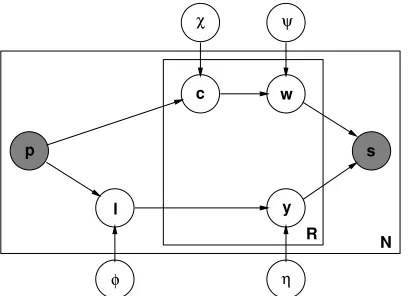
Figure 1 presents our linking model. For each predicate-argument structure in the corpus, it con-tains observable variables for the predicatepand the unordered setsof arguments, and further shows la-tent variables for the linkingland (for each role r) the semantic word classc, the head wordw, and the syntactic functiony.
The distributions χp,r(c) and ψc(w) are drawn
from Dirichlet priors with symmetric parametersα
dis-w
R N
p
l
c
y
s
φ η
χ ψ
Figure 1: Representation of our linking model as a Bayesian network. The nodespandsare observed for each of theN predicate-argument structures in the cor-pus. The latent variablesc,w,l, andyare inferred from the data along with their distributionsχ,ψ,φ, andη.
tributionφp(l), we are faced with an exponentially
large space of possible linkings (considering a set
Gof syntactic functions, there are(|G|+ 1)R pos-sible linkings). This is both computationally prob-lematic and counter-intuitive. We therefore maintain a global list L of permissible linkings and enforce
φp(l) = 0for alll /∈L. On the setLwe then draw
φp(l)from a Dirichlet prior with symmetric
param-eterγ. In Section 3.5, we will describe how the link-ing listLis iteratively induced from the data.
We introduced the distributionηxto allow for
in-cidental changes when generating the tuple of syn-tactic functions out of the linking. If this pro-cess were allowed to arbitrarily change any syntactic function in the linking, the linkings would be too un-constrained and not reflect the syntactic functions in the corpus. We therefore parameterize ηx in such
a way that the only allowed modifications are the addition or removal of syntactic functions from the linking, but no change from one syntactic function to another. We attain this by parameterizing ηx as
follows:
ηx(y) =
η ifx=y=
1−η
|G| ifx=andy∈G 1−ηx ifx∈Gandy = ηx ifx=y∈G
0 else
Here,Gagain denotes the set of all syntactic func-tions. The parameter η is drawn from a uniform
prior on the interval[0.0,1.0]and the |G| parame-tersηxforx ∈Ghave uniform priors on[0.5,1.0]. This has the effect that no syntactic function can change into another, that a syntactic function is never more probable to disappear than to stay, and that all syntactic functions are added with the same probability. This last property will be important for the iterative refinement process described in Sec-tion 3.5.
3.4 Training
In this subsection, we describe how we train the model described so far, assuming that we are given a fixed linking listL. The following subsection will address the problem of infering this list. In Sec-tion 3.6, we will then describe how we apply the trained model to infer semantic role assignments for given predicate-argument structures.
To train the linking model, we apply a Gibbs sam-pling procedure to the latent variables shown in Fig-ure 1. In each sampling iteration, we first sample the values of the latent variables of each predicate-argument structure based on the current distribu-tions, and then the latent distributions based on counts obtained over the corpus. For each predicate-argument structure, we begin with a blocked sam-pling step, simultaneously drawing values forwand
y, while summing outc. This gives us
P(w, y|p, l, s)∝
R
Y
r=1
ηxr(yr)
C
X
c=1
χp,r(c)ψc(wr)
where we have omitted the factorP(s|w, y), which is uniform as long as we assume thatw andy in-deed represent permutations of the argument sets. To sample efficiently from this distribution, we pre-compute the inner sum (as a tensor contraction or, equivalently, R matrix multiplications). We then enumerate all permutations of the argument set and compute their probabilities, defaulting to an approx-imative beam search procedure in cases where the space of permutations is too large.
Next, the linkinglis sampled according to
P(l|p, y)∝P(l|p)P(y|l) =φp(l) R
Y
r=1
ηxr(yr)
[image:4.612.85.289.54.202.2]not a problem.
After sampling the latent variablesw,y, andlfor each corpus instance, we go on to apply Gibbs sam-pling to the latent distributions. For example, forφp
we obtain
P(φp|p1, l1, . . . , pN, lN)∝P(φp) N
Y
i=1
P(li|pi)
∝Dir(γ)(φp)·
Y
l∈L
[φp(l)]np(l) = Dir(~np+γ)(φp)
Here np(l) is the number of corpus instances with
predicatepand latent linkingl, and~np is the vector
of these counts for a fixedp, indexed byl. Hence,
φp is drawn from the Dirichlet distribution
parame-terized by this vector, smoothed in each component byγ.
In the same way, the sampling distributions for
χp,r and ψc are determined as Dir(~np,r +α) and Dir(~nc+β), where each~np,ris a vector of counts1
indexed by word classes c and each~nc is a vector
of counts indexed by head words wr. Similarly,
we draw the parameter η in the parameterization of ηx from Beta n(, ) + 1,Px∈Gn(, x) + 1
and approximate ηx by drawing ηx from
Beta (n(x, x) + 1, n(x, ) + 1) and redrawing it uniformly from[0.5,1.0], if it is smaller than0.5. In this context,n(x, y)refers to the number of times the syntactic relation x is turned into y, counted over all corpus instances and semantic roles.
To test for convergence of the sampling process, we monitor the log-likelihood of the data. For each predicate-argument structure with predicate pi and argument setsi, we have
P(pi, si)∝X
l
P(l|pi)P(si|l)≈P(si|li)
=X
w,y
P(w, y, si|li) = X w,y⇒si
P(w, y|li) =:Li
The approximation is rather crude (replacing an ex-pected value by a single sample fromP(l|pi)), but
we expect the errors to mostly cancel out over the instances of the corpus. The last sum ranges over all pairs(w, y)that represent permutations of the argu-ment sets, and this can be computed as a by-product
1
Since we do not samplec, we use pseudo-counts based on
P(cr|p, r, wr)for each instance.
of the sampling process ofwandy. We then com-puteL := logQN
i=1Li = PN
i=1logLi, and termi-nate the sampling process ifLdoes not increase by more than0.1%over 5 iterations.
3.5 Iterative Refinement of Possible Linkings
In Section 3.3, we have addressed the problem of the exponentially large space of possible linkings by introducing a subsetL ⊂ GR from which linkings may be drawn. We now need to clarify how this sub-set is determined. In contrast to Grenager and Man-ning (2006), we do not want to use any linguistic intuitions or manual rules to specify this subset, but rather automatically infer it from the data, so that the model stays agnostic to the language and paradigm of semantic roles. We therefore adopt a strategy of iterative refinement.
We start with a very small set that only contains the trivial linking(, . . . , )and one linking for each of theRmost frequent syntactic functions, placing the most frequent one in the first slot, the second one in the second slot etc. We then run Gibbs sampling. When it has converged in terms of log-likelihood, we add some new linkings to L. These new link-ings are inferred by inspecting the action of the step fromltoyin the generative model. Here, a syntac-tic function may be added to or deleted from a link-ing. If a particular syntactic function is frequently added to some linking, then a corresponding linking, i.e., one featuring this syntactic function and thus not requiring such a modification, seems to be missing from the set L. We therefore count for each link-inglhow often it is either reduced by the deletion of any syntactic function or expanded by the addition of a syntactic function. We then rank these modifi-cations in descending order and for each of them de-termine the semantic role slot in which the modifica-tion (delemodifica-tion or addimodifica-tion) occured most frequently. By applying the modification to this slot, each of the linkings gives rise to a new one. We add the firstaof those, skipping new linkings if they are duplicates of those we already have in the linking set. We iterate this procedure, alternating between Gibbs sampling to convergence and the addition ofanew linkings.
3.6 Inference
space of permutations is too large for exhaustive enumeration, we apply a similar beam search pro-cedure as the one employed in training to approxi-mately maximizeP(w, y|p, s, l)for each value ofl. For efficiency, we do not marginalize over l. This has the potential of reducing prediction quality, as we do not predict the most likely role assignment, but rather the most likely combination of role assign-ment and latent linking.
In all experiments we averaged over 10 consec-utive samples of the latent distributions, at the end of the sampling process (i.e., when convergence has been reached).
4 Experimental Setup
We train and evaluate our linking model on the data set produced for the CoNLL-08 Shared Task on Joint Parsing of Syntactic and Semantic Dependen-cies (Surdeanu et al., 2008), which is based on the PropBank corpus (Palmer et al., 2005). This data set includes part-of-speech tags, lemmatized tokens, and syntactic dependencies, which have been con-verted from the manual syntactic annotation of the underlying Penn Treebank (Marcus et al., 1993).
4.1 Data Set
As input to our model, we decided not to use the syn-tactic representation in the CoNLL-08 data set, but instead to rely on Stanford Dependencies (de Marn-effe et al., 2006), which seem to facilitate seman-tic analysis. We thus used the Stanford Parser2 to convert the underlying phrase structure trees of the Penn Tree Bank into Stanford Dependencies. In the resulting dependency analyses, the syntactic head word of a semantic role may differ from the syntactic head according to the provided syntax. We therefore mapped the semantic role annotation onto the Stan-ford Dependency trees by identifying the tree node that covers the same set of tokens as the one marked in the CoNLL-08 data set.
The focus of the present work is on the linking behavior and classification of semantic arguments and not their identification. The latter is a substan-tially different task, and likely to be best addressed by other approaches, such as that of (Abend et al.,
2
version 1.6.8, available at http://nlp.stanford. edu/software/lex-parser.shtml
2009). We therefore use gold standard information of the CoNLL-08 data set for identifying argument sets as input to our model. The task of our model is then toclassifythese arguments into semantic roles. We train our model on a corpus consisting of the training and the test part of the CoNLL-08 data set, which is permissible since as a unsupervised system our model does not make any use of the annotated argument labels for training. We test the model per-formance against the gold argument classification on the test part. For development purposes (both signing the model and tuning the parameters as de-scribed in Section 4.4), we train on the training and development part and test on the development part.
4.2 Evaluation Measures
As explained above, our model does not predict spe-cific role labels, such as those annotated in Prop-Bank, but rather aims at clustering like argument instances together. Since the (numbered) labels of these clusters are arbitrary, we cannot evaluate the predictions of our model against the PropBank gold annotation directly. We follow Lang and Lapata (2011b) in measuring the quality of our clustering in terms of cluster purity and collocation instead.
Cluster purity is a measure of the degree to which the predicted clusters meet the goal of containing only instances with the same gold standard class la-bel. Given predicted clustersC1, . . . , CnC and gold
clusters G1, . . . , GnG over a set of n argument
in-stances, it is defined as
Pu= 1
n
nC
X
i=1
max j=1,...,nG
|Ci∩Gj|
Similarly, cluster collocation measures how well the clustering meets the goal of clustering all gold in-stances with the same label into a single predicted cluster, formally:
Co= 1
n
nG
X
j=1
max i=1,...,nC
|Ci∩Gj|
We determine purity and collocation separately for each predicate type and then compute their micro-average, i.e., weighting each score by the number of argument instances of this precidate. Just as preci-sion and recall, purity and collocation stand in trade-off. In the next section, we therefore report their
4.3 Syntactic Baseline
We compare the performance of our model with a simple syntactic baseline that assumes that semantic roles are identical with syntactic functions. We fol-low Lang and Lapata (2011b) in clustering argument instances of each predicate by their syntactic func-tions. We do not restrict the number of clusters per predicate. In contrast, Lang and Lapata (2011b) re-strict the number of clusters to 21, which is the num-ber of clusters their system generates. We found that this reduces the baseline by 0.1%F1-score (Argnon the development set, c.f. Table 1). If we reduce the number of clusters in the baseline to the number of clusters in our system (7), the baseline is reduced by another 0.8% F1-score. These lower baselines are due to lower purity values. In general, we find that a smaller number of clusters results in lowerF1 mea-sure for the baseline; the reported baseline therefore is the strictest possible.
4.4 Parameters and Tuning
For all experiments, we fixed the number of seman-tic roles atR = 7. This is the maximum size of the argument set over all instances of the data set and thus the lower limit forR. IfR was set to a higher value, the model would be able to account for the possibility of a larger number of roles, out of which never more than7are expressed simultaneously. We leave such investigation to future work. We set the symmetric parameters for the Dirichlet distributions toα= 1.0,β = 0.1, andγ = 1.0. This corresponds to uninformative uniform priors forχp,randφp, and
a prior encouraging a sparse lexical distributionψc,
similar as in topic models such as LDA (Blei et al., 2003).
The numberC of word classes, the number aof additional linkings in each refinement of the linking set L, and the number k of refinement steps were tuned on the development set. We first fixeda= 10
and trained models for C = 10,20, . . . ,100, per-forming 50 refinement steps. The bestF1score was obtained withC = 10afterk= 20refinements (i.e., with 200 linkings). Next, we fixed these two param-eters and trained models for a = 5,10,15,20,25. Here, we confirmed an optimal value ofa= 10.
5 Results
In this section, we give quantitative results, compar-ing our system to the syntactic baseline in terms of cluster purity and collocation, and a qualitative dis-cussion of some phenomena observed in the perfor-mance of the model.
5.1 Quantitative Results
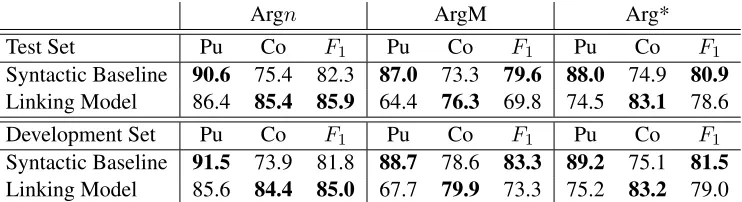
Table 1 shows the results of applying our models to the CoNLL-08 test with the parameter values tuned in Section 4.4. For comparison, we also show re-sults on the development set. The table is divided into three parts, one only considering semantic ar-guments (Argn), one considering adjuncts (ArgM), and one aggregating results over both kinds of Prop-Bank roles (Arg*). It can be seen that our model consistently outperforms the syntactic baseline in terms of collocation (by 10% on Argn, 3% on ArgM, and 8.2% overall). In terms of purity, however, it falls short of the baseline. As mentioned above, there is a trade-off between purity and collocation. Compared to our model, which we run with a total of7semantic role slots, the baseline predicts a large number of small argument clusters for each predi-cate, whereas our model tends to group arguments together based on selectional preferences.
In terms ofF1 score, our model outperforms the baseline by 3.6% on Argn, which translates into a relative error reduction by 20%. On adjuncts, on the other hand, our model falls short of the base-line by almost 10% F1 score. This indicates that our approach based on explicit representations of linkings is most suited to the classification of argu-ments rather than adjuncts, which do not participate in diathesis alternations and do therefore not profit as much from our explicit induction of linkings.
5.2 Qualitative Observations
Among the verbs with at least10test instances, in-clude shows the largest gain in F1 score over the baseline. In the test corpus, we find an interesting pair of sentences for this predicate:
Argn ArgM Arg*
Test Set Pu Co F1 Pu Co F1 Pu Co F1
Syntactic Baseline 90.6 75.4 82.3 87.0 73.3 79.6 88.0 74.9 80.9
Linking Model 86.4 85.4 85.9 64.4 76.3 69.8 74.5 83.1 78.6
Development Set Pu Co F1 Pu Co F1 Pu Co F1 Syntactic Baseline 91.5 73.9 81.8 88.7 78.6 83.3 89.2 75.1 81.5
[image:8.612.121.492.54.155.2]Linking Model 85.6 84.4 85.0 67.7 79.9 73.3 75.2 83.2 79.0
Table 1: Purity (Pu), collocation (Co), andF1scores of our model and the syntactic baseline in percent. Performance
on arguments (Argn), adjuncts (ArgM), and overall results (Arg*) are shown separately.
b. Not included in the bid are Bonwit Teller or B. Altman & Co. [...]
The first of these two sentences is generated from the linking (nsubj,dobj, , , , ,-rcmod), which does not need to be modified in any way to account for the subject that (coreferent with the head of the pred-icate in the modifying relative clause, binge) and the direct objectTeller (head of the phrase Bonwit Teller and B. Altman & Co.). These are assigned to the first and second role slots, respectively. The second sentence, on the other hand, is generated out of the linking(prep in,nsubjpass, , , , , ). Here, the passive subjectTelleris assigned to the second role slot (which we may interpret as theIncludee), while the first semantic role (theIncluder) is labeled on bid, which is realized in a prepositional phrase headed by the preposition in. Note that this alter-nation is not the general passive alteralter-nation though, which would have led toTeller is not includedbythe bid. Instead, the model learned a specific alternation pattern for the predicateinclude.
But even where a specific linking has not been learned, the model can often still infer a correct la-beling by virtue of its selectional preference com-ponent. In our corpus, the predicate give occurs mostly with a direct and an indirect object as in CNN recently gave most employees raises of as much as 15%. The model therefore learns a link-ing(nsubj,dobj, , , , ,iobj), but fails to learn that theBeneficient role can also be expressed with the prepositiontoas in
(3) [...] only 25% give$2,500 or more to charity each year.
However, when applying our model to this sentence, it nonetheless assignscharityto the last role slot (the
same one previously occupied by the indirect ob-ject). This is due to the fact thatcharity is a good fit for the selectional preference of this role slot of the predicategive.
6 Conclusions
We have presented a novel generative model of predicate-argument structures that incorporates se-lectional preferences of argument heads and explic-itly describes linkings between semantic roles and syntactic functions. The model iteratively induces a lexicon of possible linkings from unlabeled data. The trained model can be used to cluster given ar-gument instances according to their semantic roles, outperforming a competitive syntactic baseline.
The approach is independent of any particular lan-guage or paradigm of semantic roles. However, in its present form the model assumes that each predi-cate has its own set of semantic roles. In formalisms such as Frame Semantics (Baker et al., 1998), se-mantic roles generalize across sese-mantically similar predicates belonging to the same frame. A natural extension of our approach would therefore consist in modeling predicate groups that share semantic roles and selectional preferences.
References
Omri Abend, Roi Reichart, and Ari Rappoport. 2009. Unsupervised argument identification for semantic role labeling. InProceedings of the Joint Conference of the 47th Annual Meeting of the ACL and the 4th International Joint Conference on Natural Language Processing of the AFNLP, pages 28–36, Singapore. Collin F. Baker, J. Fillmore, and John B. Lowe. 1998.
The Berkeley FrameNet project. In 36th Meeting of the Association for Computational Linguistics and 17th International Conference on Computational Lin-guistics (COLING-ACL’98), pages 86–90, Montr´eal. David M. Blei, Andrew Y. Ng, and Michael I. Jordan.
2003. Latent dirichlet allocation. Journal of Machine Learning Research, 3:993–1022.
Luigi Burzio. 1986. Italian Syntax: A Government-Binding Approach. Reidel, Dordrecht.
Marie-Catherine de Marneffe, Bill MacCartney, and Christopher D. Manning. 2006. Generating typed de-pendency parses from phrase structure parses. In Pro-ceedings of LREC 2006.
Trond Grenager and Christopher D. Manning. 2006. Unsupervised discovery of a statistical verb lexicon. In Proceedings of the 2006 Conference on Empirical Methods in Natural Language Processing, pages 1–8, Sydney, Australia.
Joel Lang and Mirella Lapata. 2011a. Unsupervised se-mantic role induction via split-merge clustering. In
Proceedings of the 49th Annual Meeting of the Asso-ciation for Computational Linguistics: Human Lan-guage Technologies, pages 1117–1126, Portland, Ore-gon, USA.
Joel Lang and Mirella Lapata. 2011b. Unsupervised se-mantic role induction with graph partitioning. In Pro-ceedings of the 2011 Conference on Empirical Meth-ods in Natural Language Processing, pages 1320– 1331, Edinburgh, Scotland, UK.
Maria Lapata and Chris Brew. 1999. Using subcatego-rization to resolve verb class ambiguity. InIn Proceed-ings of Joint SIGDAT Conference on Empirical Meth-ods in Natural Language Processing and Very Large Corpora, pages 266—-274, College Park, MD. Beth Levin. 1993. English Verb Classes and
Alterna-tions: A Preliminary Investigation. The University of Chicago Press.
Mitchell M. Marcus, Beatrice Santorini, and Mary Ann Marcinkiewicz. 1993. Building a Large Annotated Corpus of English: The Penn Treebank. Computa-tional Linguistics, 19.2:313–330, June.
Paola Merlo and Suzanne Stevenson. 2001. Automatic verb classification based on statistical distributions of argument structure. Computational Linguistics, 27(3).
Martha Palmer, Daniel Gildea, and Paul Kingsbury. 2005. The Proposition Bank: An annotated corpus of semantic roles. Computational Linguistics, 31(1):71– 106.
Mihai Surdeanu, Richard Johansson, Adam Meyers, Llu´ıs M`arquez, and Joakim Nivre. 2008. The conll 2008 shared task on joint parsing of syntactic and se-mantic dependencies. InCoNLL 2008: Proceedings of the Twelfth Conference on Computational Natu-ral Language Learning, pages 159–177, Manchester, England.
Ivan Titov and Alexandre Klementiev. 2012. A bayesian approach to unsupervised semantic role induction. In