Proactive Learning for Named Entity Recognition
Maolin Li, Nhung T. H. Nguyen, Sophia Ananiadou National Centre for Text Mining
School of Computer Science, The University of Manchester, United Kingdom
{maolin.li, nhung.nguyen, sophia.ananiadou}@manchester.ac.uk
Abstract
The goal of active learning is to minimise the cost of producing an annotated dataset, in which annotators are assumed to be per-fect, i.e., they always choose the correct la-bels. However, in practice, annotators are not infallible, and they are likely to assign incorrect labels to some instances. Proac-tive learning is a generalisation of acProac-tive learning that can model different kinds of annotators. Although proactive learning has been applied to certain labelling tasks, such as text classification, there is little work on its application to named entity (NE) tagging. In this paper, we propose a proactive learning method for produc-ing NE annotated corpora, usproduc-ing two an-notators with different levels of expertise, and who charge different amounts based on their levels of experience. To opti-mise both cost and annotation quality, we also propose a mechanism to present mul-tiple sentences to annotators at each itera-tion. Experimental results for several cor-pora show that our method facilitates the construction of high-quality NE labelled datasets at minimal cost.
1 Introduction
Manually annotating a dataset with NEs is both time-consuming and costly. Active learning, a semi-supervised machine learning algorithm, aims to address such issues (Lewis, 1995; Settles,
2010). Instead of asking annotators to label the whole dataset, active learning methods present only representative and informative instances to annotators. Through iterative application of this process, a high-quality annotated corpus can be
produced in less time and at lower cost than tra-ditional annotation methods.
There are two strong assumptions in active learning: (1) instances are labelled by experts, who always produce correct annotations and are not affected by the tedious and repetitive nature of the task; (2) all annotators are paid equally, re-gardless of their annotation quality or level of ex-pertise. However, in practice, it is highly unlikely that all annotators will assign accurate labels all of the time. For example, especially for complex annotation tasks, some labels are likely to be as-signed incorrectly (Donmez and Carbonell,2008,
2010;Settles,2010). Furthermore, if annotation is carried out for long periods of time, tiredness and reduced concentration may ensue (Settles,2010), which can lead to annotation errors. An additional issue is that different annotators may have varying levels of expertise, which could make them reluc-tant to annotate certain cases, and they may assign incorrect labels in other cases. It is also possible that an inexperienced annotator may assign ran-dom labels.
To address the above-mentioned assumptions, proactive learning has been proposed to model dif-ferent types of experts (Donmez and Carbonell,
2008,2010). Proactive learning assumes that (1) not all annotators are perfect, but that there is at least one “perfect” expert and one less expe-rienced or “fallible” annotator; (2) as the perfect expert always provides correct answers, their time is more expensive than that of the fallible annota-tor. The annotation process in proactive learning is similar to traditional active learning. At each iteration, annotators will be asked to tag an unla-belled instance, the result of which will be added to the labelled dataset. However, the difference with proactive learning is that, in order to reduce annotation cost, an appropriate annotator is cho-sen to label each selected instance. For example, if
there is a high probability that the fallible annota-tor will provide the correct label for an unlabelled instance, then proactive learning will send this in-stance to be annotated by fallible annotator. This aims to ensure a simultaneous saving of costs and maintenance of the quality of the data.
Proactive learning has been used for several annotation tasks, such as binary and multi-class text classification, and parsing (Donmez and Car-bonell, 2008, 2010; Olsson, 2009). In contrast, this paper proposes a proactive learning method for NE tagging, i.e., a sequence labelling task.
Similarly to other efforts that have used proac-tive learning, our method models two annotators: a reliable one and a fallible one, who have differ-ent probabilities of providing correct labels. The reliable annotator is much more likely to produce correct annotations, but their time is expensive. In contrast, the fallible annotator is likely to as-sign incorrect annotations more often, but charges less for their services. It should be noted that the characteristics of our reliable expert are different from those proposed in previous work (Donmez and Carbonell, 2008, 2010). Specifically, in the conventional proactive learning, the reliable ex-pert is assumed to be perfect, i.e., he/she always provides correct annotations. However, in prac-tice, such an assumption is too strong, especially for NE annotation. Therefore, we assume that the reliable expert is not perfect, but that he/she has a higher expertise level in the target domain, and has a very low error rate. In order to determine an appropriate annotator for each sentence, we cal-culate the probability that an annotator will assign the correct sequence of labels in a selected unla-belled sentence. Furthermore, at each iteration, we use a batch sampling mechanism to select several sentences for annotators to label (instead of select-ing only a sselect-ingle sentence), which optimises both cost and performance.
For evaluation purposes, we simulate the two annotators by using two machine-learning based NER methods, namely LSTM-CRF (Lample et al.,
2016) as the reliable expert, and CRF (Lafferty et al., 2001) as the fallible expert. We then ap-ply our method to three corpora from different do-mains: ACE2005 (Walker et al.,2006) for general language entities, COPIOUS—an in-house corpus of biodiversity entities1, and GENIA (Kim et al.,
2003)—a corpus of biomedical entities. Our
ex-1The corpus is available upon request.
perimental results demonstrate that by using the proposed method, we can obtain a high-quality la-belled corpus at a lower cost than current baseline methods.
The contributions of our work are as follows. Firstly, we have modified the conventional proac-tive learning method to ensure its suitability for a sequence labelling task. Secondly, in con-trast to previous work, which selects a single in-stance for each annotator at each iteration ( Don-mez and Carbonell, 2008, 2010; Moon and Car-bonell, 2014), our method selects multiple sen-tences for presentation to annotators. Thirdly, by applying our method to a number of different cor-pora, we demonstrate that our method is general-isable to different domains.
2 Methodology
The proposed proactive learning for NE tagging is outlined in Algorithm 1. As an initial step, the performance of each expert is estimated based on a benchmark dataset (see Section 2.1). Sub-sequently, at each iteration, all sentences in the unlabelled dataset are sorted according to an ac-tive learning criterion. The top-N most informa-tive sentences are then used as input to the batch sampling step. In this step, a batch of sentences is divided into two sets to be distributed to the re-liable and fallible experts, respectively. Sentences distributed to the fallible experts are not only infor-mative, but there is also a high probability that the expert will provide correct labels for them. Mean-while, only those sentences that are estimated to be too difficult for the fallible expert to annotate will be sent to the reliable expert. By applying this process, annotation cost can be reduced. Fur-ther details about the batch sampling algorithm are presented in Section2.2.
In Algorithm 1, ULr is the set of selected un-labelled sentences assigned to the reliable expert andULf is the set assigned to the fallible expert.
Lr, Lf are the annotated results ofULr, ULf.
2.1 Expert performance estimation
Algorithm 1:Proactive Learning for NER
Input:a labelled datasetL, an unlabelled datasetUL, a test datasetT, a budgetB, a reliable experter
with costCrfor each sentence, a fallible expert
efwith costCf, the current costC Output:a labelled datasetL
1 Estimate the performance of each expert as described in Section2.1;
2 whileC < Bdo
3 Train a named entity recognition modelMonL; 4 Sort all sentences in the unlabelled dataset
according to an active learning criterion; 5 Select the topNsentences;
6 ULr, ULf =
BatchSampling(M, top Nsentences); 7 Lr, Lf ←erandef annotateULrandULf
respectively; 8 L=L∪Lr∪Lf;
9 UL=UL−ULr−ULf;
10 C=C+Cr∗ |Lr|+Cf∗ |Lf|;
11 end
charges less for their time. The likely anno-tation quality of each expert is estimated based on two different probabilities: the class probabil-ity, p(label|expert, c)and the sentence probabil-ityp(CorrectLabels|expert,x).
2.1.1 Class probability
The class probability, p(label|expert, c), is the probability that an expert provides a correct la-bel when annotating a named entity of class c. This probability is obtained by asking both the re-liable and fallible experts to annotate a benchmark dataset and calculatingF1scores for each of them
against the gold standard annotations.
2.1.2 Sentence probability
The sentence probability is the probability that an
expertprovides a sequence of correct labels for a sentencex.
We firstly compute the probability for each to-ken in the sentence by combining the class proba-bility and the likelihood that anexpertprovides a correct label for the token xi, as shown in Equa-tion1. The equation is inspired byMoon and Car-bonell(2014), who used it for a classification task.
p(CorrectLabel|expert,xi) =
|C|
X
c
p(c|xi)∗p(label|expert, c) (1)
C is the set of all entity labels and the label O.
p(c|xi) is the probability that a token xi is an entity of class c, which is predicted by an NER model.
Algorithm 2:Batch Sampling
Input:a named entity recognition modelM, top-N
sentences selected according to an active learning criterion
Output:ULr,ULf
1 ULr=∅;
2 ULf =∅;
3 whileBatch Sizedo // Stage 1
4 foreachsentencexdo
5 ifp(CorrectLabels|fallible,x)> αthen
6 ULf =ULf∪ {x};
7 BatchSize = BatchSize - 1
8 end
9 end
// Stage 2 10 ifBatch Size6=0then
11 Sort the remaining sentences according to a re-ranking criterion;
12 Calculate thresholdβ;
13 foreachsentencexdo
14 ifBatch Size6=0then
15 ifdiff(reliable, fallible,x)< β
then
16 ULf =ULf∪ {x};
17 else
18 ULr=ULr∪ {x};
19 end
20 BatchSize = BatchSize - 1;
21 end
22 end
23 end 24 end
Given the probabilities that an expert will pro-vide correct labels for each tokens in a sentence, the sentence probability is calculated by averag-ing all of these probabilities, as presented in Equa-tion2.
p(CorrectLabels|expert,x) =
P|x|
i p(CorrectLabel|expert,xi)
|x| (2)
|x|is the length of the sentencex.
2.2 Batch sampling
Instead of asking annotators to label only one sen-tence at each iteration, it is more efficient to ask them to annotate several sentences. To facilitate this, we propose a batch sampling algorithm that can select a set of sentences and assign them to appropriate annotators (see Algorithm2).
This batch sampling process is divided into two stages. In the first stage, unlabelled sentences for which the sentence probability for the fallible ex-pert is higher than a thresholdα, will be assigned to the fallible expert. Otherwise, the sentence will be passed to the second stage. In the second stage, we firstly reorder sentences according to a re-ranking criterion, as shown in Equation3. The intuition behind this re-ranking step is that in order to save on annotation costs, we set a high priority for sentences to be assigned to the fallible expert in certain cases. Specifically, for sentences that are informative and for which there is a small differ-ence between the sentdiffer-ence probabilities for the re-liable and fallible experts, we favour the selection of the fallible one.
ReRankingCriterion=
ActiveLearningCriterion(x) diff(reliable, fallible,x) (3)
For an unlabelled sentence x, the difference be-tween the sentence probabilities for the two ex-perts is calculated as shown in Equation4.
diff(reliable, fallible,x)
=|p(CorrectLabels|reliable,x) −p(CorrectLabels|fallible,x)| (4) If the above difference is not significant, i.e., it is less than a thresholdβ,xwill be distributed to the fallible expert. Otherwise, xwill be assigned to the reliable expert.
Equations (5) - (7) describe the estimation of the thresholdβ, in whichxi is theithsentence in the top-N sentences selected by an active learn-ing criterion. γ is a parameter that controls the value of the thresholdβ. γ ranges from 0 to 1. If
γ = 0, no sentences will be given to the fallible ex-pert to annotate. Ifγ = 1, the fallible expert will label all the BatchSize sentences. It should be noted thatβis a dynamic threshold, which is recal-culated based on the difference betweendiffmax anddiffminat each iteration.
diffmin =minNi (diff(reliable, fallible,xi)) (5)
diffmax =maxNi (diff(reliable, fallible,xi)) (6)
β =diffmin+γ(diffmax−diffmin) (7)
3 Experiments
3.1 Dataset
We have applied our method to three different cor-pora: (1) ACE2005 (Walker et al.,2006) which in-cludes named entities for the general domain, e.g., person, location, and organisation; (2) COPIOUS that includes five categories of biodiversity enti-ties, such as taxon, habitat, and geographical loca-tion; (3) GENIA (Kim et al.,2003), a biomedical named entity corpus.
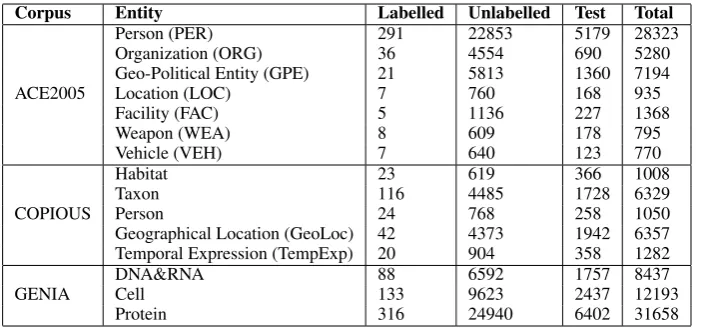
Table1shows the entity classes and the number of entities of each class that are annotated in the three corpora. As shown in the table, for the GE-NIA corpus, we combined the DNA and RNA en-tities into a single named entity class. Meanwhile, for ACE2005, although top-level entity classes are divided into a number of different subtypes, we only considered the top-level classes, as shown in the table.
For active and proactive learning experiments, 1% and 20% of sentences of each corpus were used as the initial labelled set and the test set, re-spectively. The remaining 79% of sentences were regarded as unlabelled data.
3.2 Expert simulation
We simulated the reliable and fallible experts by using two machine learning models: LSTM-CRF (Lample et al., 2016)—a neural network NER and CRF (Lafferty et al.,2001). To evaluate the performance of the two models, we conducted preliminary experiments, by firstly trained the two models on 80% of the labelled corpora and subse-quently testing them on the remaining 20% of the data.
Word embeddings As the three corpora belong to three different domains, we used three corre-sponding pre-trained word embeddings as input to the LSTM-CRF model.
• ACE2005: GoogleNews vectors2, which in-clude approximately 100 billion words.
Corpus Entity Labelled Unlabelled Test Total
ACE2005
Person (PER) 291 22853 5179 28323
Organization (ORG) 36 4554 690 5280
Geo-Political Entity (GPE) 21 5813 1360 7194
Location (LOC) 7 760 168 935
Facility (FAC) 5 1136 227 1368
Weapon (WEA) 8 609 178 795
Vehicle (VEH) 7 640 123 770
COPIOUS
Habitat 23 619 366 1008
Taxon 116 4485 1728 6329
Person 24 768 258 1050
Geographical Location (GeoLoc) 42 4373 1942 6357 Temporal Expression (TempExp) 20 904 358 1282
GENIA DNA&RNACell 88133 65929623 17572437 843712193
[image:5.595.124.477.61.226.2]Protein 316 24940 6402 31658
Table 1: Statistic information of the three corpora
• GENIA: word vectors trained on a combina-tion of PubMed, PMC and English Wikipedia texts (Pyysalo et al.,2013).
CRF features To train the CRF model, we used CRF++4 and employed following features: word base, lemma, part-of-speech tag and chunk tag of a token. We also used unigram and bigram features that combine the features of the previous, current and following token.
As illustrated in Table2, the LSTM-CRF model is mostly more precise and achieves wider cover-age than CRF. We therefore selected LSTM-CRF to simulate the reliable expert and CRF to simulate the fallible expert.
Corpus Pre. Re.CRF F1 Pre.LSTM-CRFRe. F1
ACE2005 73.89 65.07 69.20 75.69 74.11 74.89 COPIOUS 81.01 48.58 60.74 77.18 74.77 75.96 GENIA 73.90 64.52 68.89 75.41 73.91 74.66
Table 2: Performance of CRF and LSTM-CRF on the three corpora
The reliable expert (the LSTM-CRF model) was trained on 80% of the labelled data, while the falli-ble one (the CRF model) was trained on 60%. The
F1scores of the reliable and fallible experts when
applied to the test dataset are presented in Table3.
Corpus Fallible Reliable
[image:5.595.115.249.668.711.2]ACE2005 61.19 74.89 COPIOUS 50.92 75.96 GENIA 57.67 74.66
Table 3:F1scores of each expert on the three
cor-pora
4https://taku910.github.io/crfpp/
The class probability of each expert is pre-calculated based on the theF1score of each class
that an expert can achieve on the 1% initial la-belled set. Meanwhile, the sentence probability of each expert is estimated at each iteration.
3.3 Active learning criteria
Various active learning criteria were investigated using the three corpora. We firstly estimated the performance (F1 score) of a supervised NER
model by using CRF++ and the above-mentioned features. We then compared the performance of each active learning criterion with that of the su-pervised model. If the performance of one crite-rion approximates that of the supervised with the least number of iterations, we consider the crite-rion as the best one for proactive learning experi-ments.
We experimented with the following criteria: least confidence (Culotta and McCallum, 2005), normalized entropy (Kim et al., 2006), MMR (Maximal Marginal Relevance) (Kim et al.,2006), density (Settles and Craven,2008) when using fea-ture vectors and word embeddings, and the com-bination of least confidence and density criterion. Equation 8 describes the combination criterion used in our experiments. In this equation, ULis the current unlabelled dataset, xu is the uth un-labelled sentence in UL, the parameterλ = 0.8, and the similarity score (Settles and Craven,2008) were calculated by using feature vectors.
x∗= arg max
x (λ∗Least Confidence(x)
+ (1−λ)|UL|1 |XUL|
u=1
Corpus Entity Class Best Criterion
ACE2005
PER Density (w2v) ORG Density (f2v)
GPE Entropy
LOC Least Confidence
FAC Longest
WEA MMR
VEH Longest
(Overall) Entropy
COPIOUS
Habitat Density (f2v)
Taxon Entropy
Person Density (f2v)
GeoLoc Entropy
TempExp Least Confidence
(Overall) Entropy
GENIA
Protein Entropy Cell LC+Density (f2v) DNA&RNA Entropy
(Overall) Entropy
Table 4: The best active learning criteria on the three corpora
We also implemented two baseline criteria. The first one is random selection, in which a batch of sentences is selected randomly at each iteration. The second one, namelylongest, is a criterion that selects the longest sentences to be labelled.
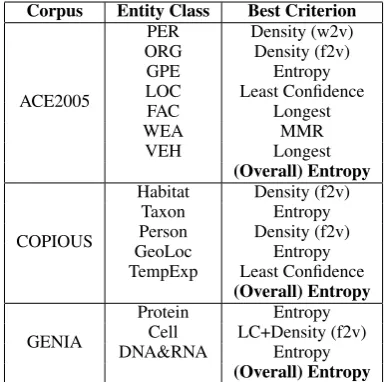
Among these criteria, we selected the best crite-rion for further experiments. The best critecrite-rion is the one that produced competitive or better perfor-mance (F-score) than that of a supervised learn-ing method with the least number of trainlearn-ing in-stances. We report these criteria for each entity class as well as for the overall corpus in Table4. In this table, Density (f2v) and Density (w2v) rep-resent the density criteria when using feature and word vectors, respectively. Entropy is the normal-ized entropy. LC+Density is the combined crite-rion, described in Equation 8. As shown in the table, the best criteria at the level of individual classes are diverse. However, overall, normalized entropy is the best criterion for all three corpora. We therefore selected this criterion in our proac-tive learning experiments.
3.4 Proactive learning results
Our method was evaluated on the test datasets of the three corpora mentioned in Section 3.1. For all experiments with proactive learning, we used the following settings: α = 0.975, γ = 0.05,
N = 200, and the annotation costs are 3 and 1 per sentence for the reliable and fallible experts, respectively.
3.4.1 BatchSize
We investigated different values of BatchSize
including 20, 10, 5, and 1. The results when
BatchSizeis 1 was not shown in Figure1as our method always selects the fallible expert at ev-ery iteration, which results in a performance that is inferior to the baselines. For the GENIA cor-pus, the F-scores are comparable, regardless of the
BatchSize used. Meanwhile, for the ACE2005 corpus, the F-scores are the highest when the batch size is 20. In contrast, for the COPIOUS corpus, the best scores are obtained with a batch size of 10.
3.4.2 Comparison with baselines
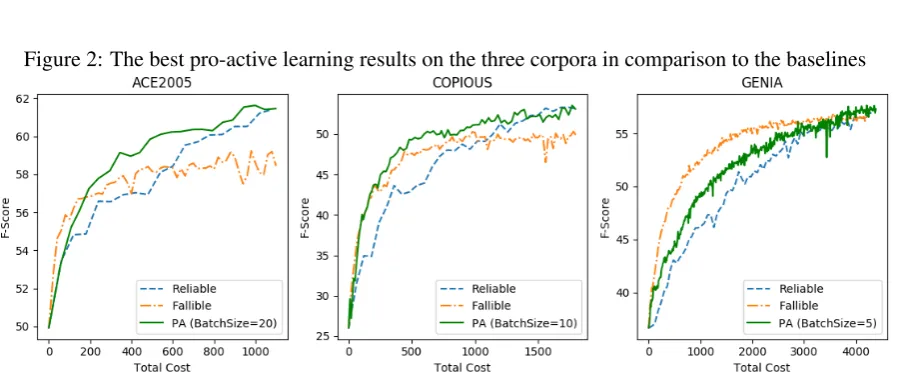
Figure2compares the experimental results of the two baseline methods (ReliableandF allible) and the best performance of the proposed proactive learning method (P A) with batch sizes of 20, 10, and 5, respectively, on the three corpora.Reliable
refers to a baseline in which we only select the re-liable expert at each iteration. Similarly, only the fallible expert was selected in theF allible exper-iments.
It can be seen that the performance of the three models is comparable between ACE2005 and the COPIOUS corpus. For these two corpora, P A
outperformed the two baselines. In most cases, by using P A, better F-scores are obtained at the same cost as the two baselines. Both P A and
Reliable performance is increased when the to-tal cost is increased. Meanwhile, for theF allible
model, the performance stabilises at a lower level than the other methods when cost rises above a certain level.
Regarding the GENIA corpus, P A acheived a higher performance than Reliable, but a lower performance than F allible in the range of costs from 0 to approximately 3,500. This can be partly explained by the fact that there are only three NE classes in this corpus. Hence, the annotation task is simpler than for the the other corpora, even for the fallible expert. However, when the cost is greater than 3,500, the performance of F allible
becomes stable, while the performance of P A
continues to increase.
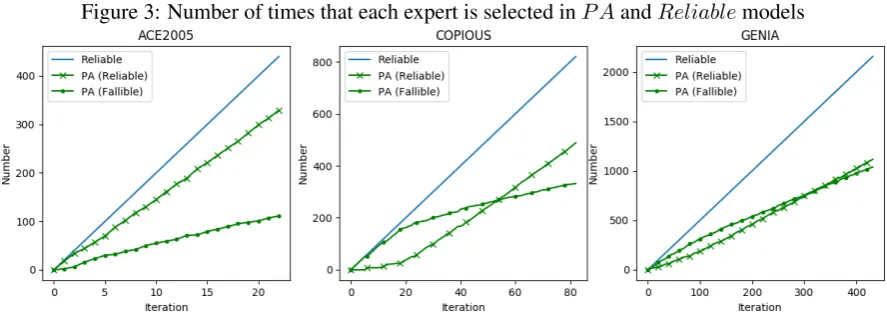
We also investigated the number of times that each expert was selected during the iterative pro-cess of P A. The results are shown in Figure 3.
[image:6.595.83.277.62.253.2]Figure 1: Pro-active learning results on the three corpora when using differentBatchSize
Figure 2: The best pro-active learning results on the three corpora in comparison to the baselines
Reliablecorresponds to the number of times that the reliable expert was selected inReliable base-line experiment. The figure illustrates that the number of times that the fallible expert is selected grows continually as the number of iterations in-creases. This shows that our method can effec-tively distribute appropriate unlabelled sentences to the fallible expert, in order to save on annota-tion costs.
4 Related work
4.1 Active learning for NER
Active learning aims to decrease annotation cost, whilst maintaining acceptable quality of annotated data. To achieve this, the method iteratively se-lects the most informative sentences to be anno-tated from an unlabelled data set.
One of the most common selection criteria used in applying active learning to the task of NE la-belling is the uncertainty-based criterion. This cri-terion assumes that the most uncertain sentence
is the most useful instance for learning an NER model. There are several ways to implement this, such as least confidence (Culotta and McCallum,
2005)–the lower the probability of a sequence of labels, the less confidence the model, and en-tropy (Kim et al.,2006) that can measure the un-certainty of a probability distribution. Some other criteria are a diversity measurement (Kim et al.,
2006) and a density criterion (Settles and Craven,
2008).
4.2 Cost-sensitive active learning
Cost-sensitive active learning is a type of active learning method that considers the annotation cost, e.g., budget, time or effort required to complete the annotation process (Olsson, 2009). Since proac-tive learning also models the reliability or exper-tise of each annotator in addition to the annotation cost, it can be considered as another case of cost-sensitive active learning.
[image:7.595.76.530.246.433.2]Figure 3: Number of times that each expert is selected inP AandReliablemodels
They predicted the probability that a reluctant or-acle refuses to annotate an instance and the prob-ability that a fallible oracle assigns a random la-bel to an instance. Each oracle charges a dif-ferent amount for their efforts. They also pro-posed a model that assigns different costs to unla-belled instances according to their annotation diffi-culty. For the multi-class classification task,Moon and Carbonell(2014) used the same approach but they had multiple experts, each of whom is spe-cialised for each class. Kapoor et al.(2007) pro-posed a decision-theoretic method for the task of voice mail classification. They defined a criterion named “expected value-of-information” that com-bines the misclassification risk with the labelling cost.
Cost-sensitive active learning was also applied to part-of-speech (POS) tagging (Haertel et al.,
2008). In this work, an hourly cost measurement was determined and a linear regression model was trained to predict the annotation cost. Hwa
(2000) aimed to reduce the manual effort for a parsing task by using tree entropy cost. Mean-while, Baldridge and Osborne (2004) measured the total annotation cost to create a treebank by using unit cost and discriminant cost.
5 Conclusion and future work
Our work constitutes the first attempt to use proac-tive learning method for named entity labelling. We simulated the behaviour of reliable and fal-lible experts having different levels of expertise and different costs. To save annotation costs and to ensure acceptable quality of the resulting an-notated data, the method favours the selection of the fallible expert. In order to increase efficiency, we also proposed a batch sampling algorithm to select more than one sentence in each iteration.
Experimental results for three corpora belonging to different domains demonstrate that the employ-ment of non-perfect experts can help to build gold standard dataset at reasonable cost. Moreover, our method performed well across the three different corpora, demonstrating the generality of our ap-proach.
A potential limitation of our approach is that the initial step is reliant on the availability of a gold standard corpus to estimate the experts’ per-formance. However, for some domains, it may be difficult to obtain such a dataset. Therefore, as future work, we will explore how we can assess experts’ performance without the need for gold-standard labelled data.
As a further extension to our work, we will explore the deployment of our method on crowd sourcing platforms, such as CrowdFlower5 and Amazon Mechanical Turk6. These platforms al-low annotations to be obtained from non-expert annotators in a rapid and cost-effective man-ner (Snow et al.,2008). These non-experts can be treated as non-perfect annotators in our proposed proactive learning method.
Acknowledgement
We would like to thank Paul Thompson for his valuable comments. This work is partially funded by the British Council (COPIOUS 172722806) and the Biotechnology and Biological Sciences Research Council, UK (EMPATHY, Grant No. BB/M006891/1).
References
Jason Baldridge and Miles Osborne. 2004. Active Learning and the Total Cost of Annotation. In
EMNLP. pages 9–16.
Aron Culotta and Andrew McCallum. 2005. Reduc-ing labelReduc-ing effort for structured prediction tasks. In
AAAI. volume 5, pages 746–51.
Pinar Donmez and Jaime G Carbonell. 2008. Proactive learning: cost-sensitive active learning with multiple imperfect oracles. InProceedings of the 17th ACM conference on Information and knowledge manage-ment. ACM, pages 619–628.
Pinar Donmez and Jaime G Carbonell. 2010. From ac-tive to proacac-tive learning methods. In Advances in Machine Learning I, Springer, pages 97–120. Robbie Haertel, Eric Ringger, Kevin Seppi, James
Car-roll, and Peter McClanahan. 2008. Assessing the costs of sampling methods in active learning for an-notation. InProceedings of the 46th Annual Meeting of the Association for Computational Linguistics on Human Language Technologies: Short Papers. As-sociation for Computational Linguistics, pages 65– 68.
Rebecca Hwa. 2000. Sample selection for statis-tical grammar induction. In Proceedings of the 2000 Joint SIGDAT conference on Empirical meth-ods in natural language processing and very large corpora: held in conjunction with the 38th An-nual Meeting of the Association for Computational Linguistics-Volume 13. Association for Computa-tional Linguistics, pages 45–52.
Ashish Kapoor, Eric Horvitz, and Sumit Basu. 2007. Selective Supervision: Guiding Supervised Learn-ing with Decision-Theoretic Active LearnLearn-ing. In IJ-CAI. volume 7, pages 877–882.
J-D Kim, Tomoko Ohta, Yuka Tateisi, and Junichi Tsu-jii. 2003. GENIA corpus–a semantically annotated corpus for bio-textmining. Bioinformatics19(suppl 1):i180–i182.
Seokhwan Kim, Yu Song, Kyungduk Kim, Jeong-Won Cha, and Gary Geunbae Lee. 2006. Mmr-based ac-tive machine learning for bio named entity recogni-tion. InProceedings of the Human Language Tech-nology Conference of the NAACL, Companion Vol-ume: Short Papers. Association for Computational Linguistics, pages 69–72.
John Lafferty, Andrew McCallum, Fernando Pereira, et al. 2001. Conditional random fields: Probabilis-tic models for segmenting and labeling sequence data. InProceedings of the eighteenth international conference on machine learning, ICML. volume 1, pages 282–289.
Guillaume Lample, Miguel Ballesteros, Sandeep Sub-ramanian, Kazuya Kawakami, and Chris Dyer. 2016. Neural Architectures for Named Entity Recognition.
In Kevin Knight, Ani Nenkova, and Owen Rambow, editors, HLT-NAACL. The Association for Compu-tational Linguistics, pages 260–270.
David D Lewis. 1995. Evaluating and optimizing au-tonomous text classification systems. In Proceed-ings of the 18th annual international ACM SIGIR conference on Research and development in infor-mation retrieval. ACM, pages 246–254.
Seungwhan Moon and Jaime G Carbonell. 2014. Proactive learning with multiple class-sensitive la-belers. In Data Science and Advanced Analytics (DSAA), 2014 International Conference on. IEEE, pages 32–38.
Fredrik Olsson. 2009. A literature survey of active ma-chine learning in the context of natural language pro-cessing. Swedish Institute of Computer Science. Sampo Pyysalo, Filip Ginter, Hans Moen, Tapio
Salakoski, and Sophia Ananiadou. 2013. Distribu-tional semantics resources for biomedical text pro-cessing. InProceedings of LBM 2013. LBM, pages 39–44.
Burr Settles. 2010. Active learning literature survey.
University of Wisconsin, Madison52(55-66):11. Burr Settles and Mark Craven. 2008. An analysis of
ac-tive learning strategies for sequence labeling tasks. InProceedings of the conference on empirical meth-ods in natural language processing. Association for Computational Linguistics, pages 1070–1079. Rion Snow, Brendan O’Connor, Daniel Jurafsky, and
Andrew Y Ng. 2008. Cheap and fast—but is it good?: evaluating non-expert annotations for natu-ral language tasks. In Proceedings of the confer-ence on empirical methods in natural language pro-cessing. Association for Computational Linguistics, pages 254–263.