Physiological and behavioural effects of changeover
from conventional to automatic milking in dairy cows
with and without previous experience
D. WEISS
1, E. MOESTL
2, R. M. BRUCKMAIER
11Physiology Weihenstephan, Technical University Munich, Freising, Germany 2Institute of Biochemistry, University of Veterinary Medicine, Vienna, Austria
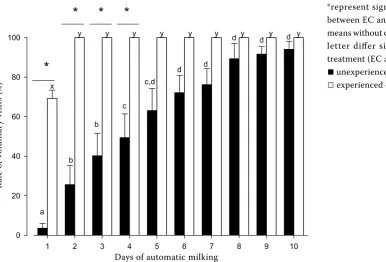
ABSTRACT: The effects of the changeover from conventional parlour to an automatic milking system (AMS) on behaviour and physiological parameters in dairy cows with and without previous experience in AMS milking were investigated. Heart rate increase was higher in unexperienced cows (UC) than in experienced cows (EC) during the first AMS visit (31 ± 2 and 12 ± 2 beats per min, respectively, P < 0.05). EC entered the automatic milking stall voluntarily without any intervention by the staff. In contrast, in UC the rate of voluntary visits was 4, 26, 40, 49, 63, 72, 76, 89, 91 and 94% during the first 10 d of AMS milking, respectively. Faecal cortisol metabolites were not affected by the changeover. In UC milk ejection was disturbed during the first visits, i. e. mean milk yield at the first milking in the AMS was significantly lower as compared to that in the parlour (67 ± 7%, P < 0.05), whereas milk ejection in EC was not disturbed. The total milk yield of the first 15 milkings differed significantly in UC (87.3 ± 2.4%) and EC (108.8 ± 3.3%) as compared to previous parlour yields (P < 0.05). In conclusion, cows with previous experience to AMS milking did not need a new adaptation period in the AMS after a transient period of parlour milking. In contrast, UC do need an intensive adaptation to the AMS in order to minimise production loss. Data clearly demonstrate that an adequate adaptation is crucial for successful milk production in AMS.
Keywords: automatic milking; behaviour; coping; cortisol; dairy cow; experience; heart rate
Cattle respond to a changed environment with physiological and behavioural adaptations. Milking in automatic milking systems (AMS) is associated with environmental changes as compared to con-ventional parlour milking (Hopster et al., 2002; Weiss et al., 2004). In conventional milking rou-tines the cows are driven to the milking parlour, whereas in AMS the cows enter the milking stall voluntarily.
However, a cow’s motivation to get milked seems to be weak and very variable (Prescott et al., 1998). Therefore several approaches to attract an AMS visit have been intensively studied (Winter and Hillerton, 1995; Ketelaar-de Lauwere et al., 1998; Hermans et al., 2003; Harms and Wendl, 2004).
Concentrate feeding in the AMS milking box positively reinforces AMS visits. Additionally, forced or selectively forced cow traffic systems with roughage only available after passing the AMS are
common (Harms and Wendl, 2004). In adapted cows these specific changes did not negatively ef-fect the physiological regulation during milking as compared to conventional systems (Hopster et al., 2002). However, the change from conventional to automatic milking is associated with elevated heart rates and adverse behaviour towards the AMS dur-ing the first visits. Furthermore, the milk yield can be reduced due to the changeover (Weiss et al., 2004). These reactions do not represent a long-term negative effect for cow’s welfare.
Dairy cows are able to cope successfully within days to AMS milking. Comparable effects have been demonstrated due to the change from tie stall milking towards parlour milking (Macha et al., 1981).
previ-ously known environment even after a longer pe-riod being handled elsewhere.
However, the effects of previous experience in being milked automatically on the change from conventional milking to AMS were to the best of our knowledge never intensively studied before. The aim of the present study was to quantify the reactions of dairy cows, with and without previous experience in AMS milking, towards the change from conventional to AMS milking. The hypothesis was tested that the cow-individual reaction differs according to their previous experience.
MATERIAL AND METHODS
Animals and husbandry. Nine cows with and 17 cows without experience to be milked in an AM system were used in the experiment. The experi-enced cows (EC) were previously milked during one whole lactation in the AMS. EC were dried off and housed during the dry period in a separate barn.
After parturition these cows were milked for 36 ±
5 d of their second to sixth lactation in the con-ventional milking parlour. The unexperienced cows (UC) were never before milked in an AMS. UC were in their first to their fifth lactation, lactational stages varied in UC between 24 and 316 in milk,
with an average of 176 ± 15 d. All cows belonged to
a herd of 100 Red-Holstein/Simmental crossbreed cows (about 70% of Red-Holstein).
The herd was housed in one single barn under identical feeding and management conditions (for details of the barn layout see Harms and Wendl, 2004). The diet consisted of maize and grass silage and concentrate according to the individual milk production. A maximum of 12 kg concentrate per day (approximately 50% of the total ratio) was of-fered in concentrate feeders and the AMS if daily milk yields exceeded 40 kg. Concentrate was omit-ted when daily milk yields declined below 14 kg. One half of the herd was milked in the AMS VMS (DeLaval, 14721 Tumba, Sweden), the other half in a conventional herringbone milking parlour (DeLaval). Routine milking times in the parlour started at 04.30 and at 15.30. In the AMS cows were milked during their voluntary visits. A selec-tively forced cow traffic (Harms and Wendl, 2004; Weiss et al., 2004) was applied. The feeding area was separated from the resting area by one-way gates, which allowed free access to the cubicles also without being milked. However, the cows were
obliged to pass the AMS before entering the feeding area. A bypass was available for those cows which had recently been milked. Cows had to pass the milking stall if milk yields of more than 7 kg were expected. Additionally concentrate feeding in the AMS milking stall positively reinforced AMS visits. When milking intervals exceeded 12 h the respec-tive cows were manually driven to the AMS.
UC were introduced in two groups in the AMS herd, balanced for age, lactational stage and milk yield, to prevent an overload of the AMS as previ-ously described (Weiss et al., 2004). The first group of 8 UC was analysed whereas another 30 cows were regularly milked in the AMS. The second group of 9 UC switched to AMS milking in a herd of 38 cows milked in the AMS. The 9 EC changed from par-lour to AMS milking whereas additionally 45 cows were milked in the AMS. UC experiments were performed in autumm 2001, whereas EC experi-ments were performed in winter 2002/2003.
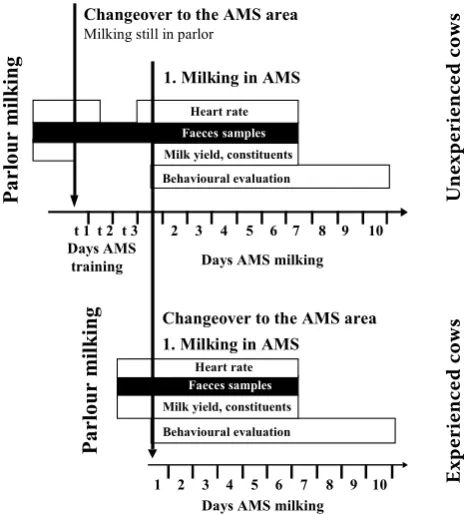
Experimental procedure. UC were trained to the AMS during 3 d, and the first milking was per-formed 4 d after the start of the training period (Figure 1). During the training period UC were kept during daytime in the AMS area and were twice daily manually driven into the AMS stall. They were milked in the parlour twice daily and remained in the parlour herd during the night. After the start of milking in the AMS UC were driven to the AMS af-ter milking inaf-tervals exceeded 12 h. EC were moved after the morning milking in the parlour to the AMS area. However, since all EC entered the AMS milk-ing stall voluntarily within 5 h after the changeover to the AMS herd, no training period was applied in EC. Starting at 13.00, EC were manually driven to the AMS milking stall on d 1 to determine teat coordinates in the AMS milking stall.
Except for a period of 24 h on d 3 of the training period in UC the heart rate was recorded continu-ously in UC and EC throughout the experiment un-til d 6 of automatic milking (Figure 1). Furthermore heart rate was recorded during two successive par-lour milkings in EC and UC before the changeo-ver. The heart rate was measured by means of a commercial system developed for horses using electrodes fixed to a special belt around the chest (Polar Horse Tester, Polar Electro GmbH, 64542 Büttelborn, Germany) (Hopster et al., 2002; Weiss et al., 2004). The heart rate signal was saved as 15-s averages for further analyses.
Days AMS milking t 1t 2 t 3 2 3 4 5 6 7 8 9 10
1. Milking in AMS Changeover to the AMS area Milking still in parlor
Heart rate Faeces samples Milk yield, constituents
Days AMS milking 1 2 3 4 5 6 7 8 9 10
Changeover to the AMS area
Heart rate Faeces samples Milk yield, constituents Behavioural evaluation Days AMS
training
1. Milking in AMS
Behavioural evaluation
U
ne
xp
er
ie
nc
ed
c
ow
s
Ex
pe
ri
en
ce
d
co
w
s
Pa
rl
ou
r
m
ilk
in
g
Pa
rl
ou
r
m
ilk
in
g
[image:3.595.64.297.91.349.2]1
Figure 1. Experimental protocol: In unexperienced cow (UC) a training period of 3 d was applied, whereas in experienced cows (EC) the training period was omit-ted. In UC the first arrow indicates the start of the training period. UC were driven twice daily to the auto-matic milking stall but were still milked twice daily in the parlour. The second arrow indicates the start of milking in the AMS, UC remained finally in the auto-matic milking area. EC were immediately milked in the automatic milking system. Milk recordings, heart rate measurement and faecal sampling were carried out as indicated by the bars
Ex
pe
ri
en
ce
d
co
w
s
U
ne
xp
er
ie
nc
ed
c
ow
s
twice daily at 07.00 and 18.00 from the rectum (about 10 g) and were immediately frozen at –20°C until further analyses. The DOA concentrations in the faeces was analysed as previously described by Moestl et al. (2002).
The milk yield and composition was recorded during parlour milking the last 10 d before the changeover to the AMS and during AMS milking until d 6. To determine milk yield and for milk sam-pling Lactocorders (Werkzeug- und Maschinenbau Balgach, 9436 Balgach, Switzerland) were used during parlour milkings. In the AMS the installed standard milk meter and sampling device were used (DeLaval MM15). Milk samples were anal-ysed for fat, protein, lactose and somatic cell count (Milko Scan 6000, Foss GmbH, 22769 Hamburg, Germany).
Data processing and statistical analyses. Data
are presented as means ± SEM. Statistical
signifi-cance was set at P < 0.05. Due to the variable
milk-ing intervals in AMS, milk yields were handled as production rate per hour. Production rate was cal-culated as the quotient of the actual milk yield and the corresponding interval from previous milking (Weiss et al., 2002, 2004). To demonstrate effects of the changeover, milk yields obtained in the AMS were expressed as relative values of mean parlour yields during 10 d prior to AMS training. Likewise the milk constituents during AMS milkings were calculated as relative values of parlour results.
The mean of the lower 30th percentile of the da-taset of each individual cow was defined as basal heart rate. The heart rates in the parlour and in the AMS were defined as average heart rate above basal level (HAB) as previously described (Weiss et al., 2004). Data during the first 2 min after entering the milking stall were analysed.
For statistical evaluation the MIXED procedure of the SAS 8.01 (SAS, 1999) program package was used. The model included the date, the time of the day and the lactation number as random variables. The number of visits, the number of milkings, the lactational stage and the treatment (UC and EC) entered the model as fixed variables. The cow was included into the model as repeated effect using the covariance structure compound symmetry.
Significant differences (P < 0.05) were localized
by using the least significant difference test.
RESULTS
Behavioural observations
*represent significant differences between EC and UC; a, b, c; x, y = means without common superscript letter differ significantly within
treatment (EC and UC) (P < 0.05)
■ unexperienced cows (UC)
[image:4.595.69.456.82.344.2]□ experienced cows (EC)
Figure 2. Rate of voluntary visit (mean ± SEM, n = 17 UC and 9 EC) in the AMS milking stall during the first 10 d of automatic milking
Days of automatic milking
1 2 3 4 5 6 7 8 9 10
R
at
e
of
v
ol
un
ta
ry
v
is
its
(
%
)
0 20 40 60 80 100
a b
b c
c,d
d d
d d d
x
y y y y y y y y y
*
*
* *
1 Days of automatic milking
Ra
te
o
f v
ol
un
ta
ry
v
is
its
(%
)
milking stall without physical forces after they were driven into the waiting area in front of the milking stall. All EC entered the AMS milking stall volun-tarily within 5 h when they were moved to the AMS herd after morning milking in the parlour. EC were once manually driven to the AMS stall starting at 13.00 to register the teat coordinates in the AMS stall. Thereafter, EC needed no more to be manually driven to the AMS during the experimental period. The rates of voluntary visits differing for UC and EC are shown in Figure 2. Except for the voluntary visit of one cow all UC needed to be driven to the AMS on d 1 of milking. Throughout the first 10 d of milking a steadily increasing rate of voluntary visits was observed in EC. The rate of 90% of vol-untary visits in UC was achieved not until d 9 of automatic milking.
Heart rate
The basal heart rate varied between 61 beats per min (bpm) and 85 bpm. HAB during the first 10 vis-its in the AMS milking stall are shown in Figure 3. HAB during parlour milking was similar in UC and EC. HAB was higher during the first visit of UC in the AMS milking stall than in the parlour and also higher than at the first AMS visit of EC. During the
2ndvisit HAB was still elevated in UC as compared
to EC, but did not significantly differ from that in the parlour. In UC HAB results of the 5th and 6th visit are missing because heart rate measurements were not performed on d 3 of the training period in UC (Figure 1). HAB in EC did not differ between parlour and AMS stall and did not significantly change with number of AMS visits.
HAB results during the first 10 AMS milkings are shown in Figure 4. Neither an effect of the num-ber of milkings nor an effect of previous experi-ence in AMS milking (UC vs. EC) was observed. Furthermore, HAB during parlour milking was similar to that obtained in the AMS.
11,17-Dioxoandrostane
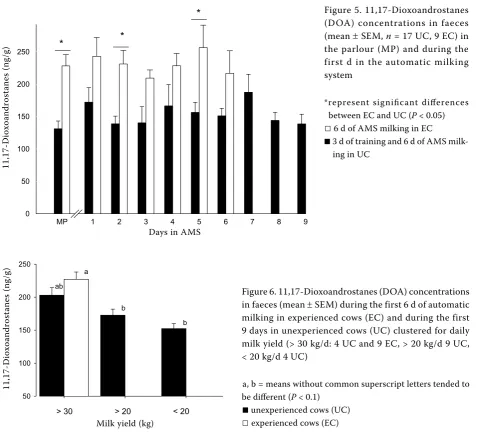
DOA concentrations during parlour milking and during the first days in AMS are shown in Figure 5. DOA concentrations did not differ between
morn-ing and evenmorn-ing samplmorn-ing (159 ± 8, 184 ± 8 ng/g in
UC and 228 ± 13, 222 ± 12 ng/g in EC for
Number AMS visits
MP 1 2 3 4 5 6 7 8 9 10
H
ea
rt
r
at
e
ab
ov
e
ba
sa
l l
ev
el
(
be
at
s
pe
r
m
in
)
0 10 20 30
b,c a
a,b
b
a,b a,b
b
b
c
*
*
[image:5.595.63.539.79.537.2]1
Figure 3. Heart rate above baseline (mean ± SEM, n = 17 UC, 9 EC) during milking in the parlour (MP) and during visits in the AMS stall
*represent significant differences between EC and UC; a, b c = means without common superscript letters
differ significantly (P < 0.05)
■ unexperienced cows (UC)
□ experienced cows (EC)
Number of AMS milkings
MP 1 2 3 4 5 6 7 8 9 10
H
ea
rt
r
at
e a
bo
ve
b
as
al
lev
el (beats per min)
0 5 10 15 20
1
Figure 4. Heart rate above baseline (mean ± SEM, n = 17 UC, 9 EC) during milking in the parlour (MP) and during visits were milking was performed in the automatic milking system. Neither an effect by the treatment (EC vs. EC) was observed nor effects due to the number of milkings
■ unexperienced cows (UC)
□ experienced cows (EC)
Number of AMS milkings
H
ea
rt
r
at
e
ab
ov
e
ba
sa
l l
ev
er
(b
ea
ts
p
er
m
in
)
Number of AMS visits
H
ea
rt
r
at
e
ab
ov
e
ba
sa
l l
ev
er
(b
ea
ts
p
er
m
in
)
had no effect on DOA concentrations, since neither in UC nor in EC the DOA results obtained in the parlor did not differ to any day after the changeover
to AMS milking (effect of the day: P = 0.48). Figure
6 presents mean DOA concentrations clustered for three levels of milk yield. DOA concentrations were high in high yielding cows irrespective of their previous experience to automatic milking. DOA
concentrations tended to be lower (P < 0.1) in low
yielding cows.
Milk yield and composition
The milk yield at the first milking in the AMS
was higher in EC (96 ± 2% of that obtained in the
parlour) than in UC (67 ± 7% of that obtained in
the parlour). Milk yields and composition of the first 15 AMS milkings are presented in Figure 7. Individual milk yields in UC during the first milk-ing varied between 8% and 96% of previous parlour yields. During 2nd, 3rd and 4th AMS milking milk yields in UC were similar to parlour yields whereas in further milkings milk yields were significantly reduced. Except for the second milking, relative milk yields were significantly higher in EC than in UC throughout the experimental period. Individual milk yields of the first AMS milking in EC varied between 85% and 106%. Milk yield in EC did not significantly differ from parlour yield. However, the milk yield during the first 15 AMS milkings
Days in AMS
MP 1 2 3 4 5 6 7 8 9
11
,1
7
D
io
xo
an
dr
os
ta
ne
s
(n
g/
g)
0 50 100 150 200
250 *
*
*
[image:6.595.62.540.80.519.2]1
Figure 5. 11,17-Dioxoandrostanes (DOA) concentrations in faeces (mean ± SEM, n = 17 UC, 9 EC) in the parlour (MP) and during the first d in the automatic milking system
*represent significant differences
between EC and UC (P < 0.05)
□ 6 d of AMS milking in EC
■ 3 d of training and 6 d of AMS
milk-ing in UC
Figure 6. 11,17-Dioxoandrostanes (DOA) concentrations in faeces (mean ± SEM) during the first 6 d of automatic milking in experienced cows (EC) and during the first 9 days in unexperienced cows (UC) clustered for daily milk yield (> 30 kg/d: 4 UC and 9 EC, > 20 kg/d 9 UC, < 20 kg/d 4 UC)
a, b = means without common superscript letters tended to
be different (P < 0.1)
■ unexperienced cows (UC)
□ experienced cows (EC)
Days in AMS
11
,1
7-D
io
xo
an
dr
os
ta
ne
s
(n
g/
g)
11
, 1
7
D
io
xo
an
dr
os
ta
ne
s
(n
g/
g)
50 100 150 200 250
> 30 > 20 < 20
Milk yield (kg)
ab a
b
b
1
11
,1
7-D
io
xo
an
dr
os
ta
ne
s
(n
g/
g)
Milk yield (kg)
parlour) than in UC (87 ± 1% of that obtained in
the parlour). Milk compostion was not significantly affected by the changeover.
Relative milk yields during the first 15 AMS milk-ings are shown in Figure 8. As indicated relative milk yield during the first 15 AMS milkings did not differ between lactational stages in UC. Relative milk yield was higher in EC than in UC irrespective of the stage of lactation.
However it has to be pointed out that no interac-tion between the stage of lactainterac-tion and the relative milk yield after the changeover was observed in UC. The milking interval for the first 15 AMS milkings
was shorter in EC (7.8 ± 0.2 h) than in UC (9.8 ±
0.2 h). The milking frequency was therefore 3.07 ±
0.01 milkings per day in EC and 2.45 ± 0.02
milk-ings per day in UC.
DISCUSSION
Figure 7. Milk yield (mean ± SEM, n = 17 UC, 9 EC) expressed as relative values of parlour results (100% = mean parlour results of 10 d prior to the changeover)
*represent significant differences between EC and UC; a, b, c = means without common superscript letters
differ significantly (P < 0.05)
•–• unexperienced cows (UC)
○–○ experienced cows (EC)
<100 <200 >200
Relative
milk
yield
(%)
50 60 70 80 90 100 110 120
Days in milk
b a
b
b
1
Figure 8. Milk yield (mean ± SEM) expressed as relative values of parlour results clustered for lactational stage (< 100 d in lactation: 6 unexperienced cows (UC) and 9 experienced cows (EC), < 200 d in lactation: 3 UC, > 200 d in lactation: 8 UC; 100% = mean parlour results of 10 d prior to the changeover)
a, b = means without common superscript letters differ
sig-nificantly (P < 0.05)
■ unexperienced cows (UC)
□ experienced cows (EC)
R
el
at
iv
e
fa
t c
on
te
nt
(
%
)
60 80 100 120
Number of AMS milkings
1 2 3 4 5 6 7 8 9 10 11 12 13 14 15
R
el
at
iv
e
pr
ot
ei
n
co
nt
en
t (
%
)
60 80 100 120
R
el
at
iv
e
m
ilk
y
ie
ld
(
%
)
60 70 80 90 100 110 120
a b
b,c b,c
c b,c c c c
c c
c c c
*
* * * * * * * * * * * *
c
1
Number of AMS milkings
Re
la
tiv
e
m
ilk
yi
el
d
(%
)
Re
la
tiv
e
fa
t
co
nt
en
t (
%
)
Re
la
tiv
e
pr
ot
ei
n
co
nt
en
t (
%
)
cow before the start of the first automatic milking. However, this visit, because of technical reasons, was the sole exception of manually moving EC to the AMS milking stall throughout the experimental period. The fact that EC did not use the AMS for about 80 d (dry period of six wk and 35 d parlour milking) and their immediate voluntary visit of the AMS, documents the considerable memory
capac-ity of the dairy cow. These findings correspond to results of Kovalcik and Kovalcik (1986).
UC never entered the AMS voluntarily within the training period. Although one cow entered the AMS voluntarily at the first day of milking, the rate of voluntary visits did not achieve levels of more than 90% until d 9 of AMS milking. The rate of vol-untary visits dafter successful adaptation to AMS
Days in milk
Re
la
tiv
e
m
ilk
y
ie
ld
(%
[image:7.595.63.297.578.752.2]milking corresponds to previous investigations in adapted cows (Winter and Hillerton, 1995; Ketelaar-de Lauwere et al., 1998; Hermans et al., 2003; Harms and Wendl, 2004). However, it has to be pointed out that this level was not approached until d 9 of AMS milking. Therefore, considering the training period of 3 d, a successful automatic milking, without an excessive use of labour to move the cows, did not take place until d 12 in the AMS.
Heart rate above basal level (HAB) in the indi-vidual cow was calculated. This was performed to prevent bias to the close correlation between base-line heart rate and daily milk yield as previously demonstrated (Weiss et al., 2004). During the first visit to the AMS the elevated HAB in UC indicat-ed a high sympathetic activation. The elevation of heart rate was comparable to results demonstrated by Hopster et al. (1995) after cow-calf separation in dairy cows. Rushen et al. (1999) demonstrated that fear of dairy cows of an aversive handler resulted in a less pronounced heart rate elevation compared to the remarkable effects observed during the first visit to the AMS. However, it has to be considered that already during the second and third visits the HAB was similar to those recorded in the parlour. In agreement to the previously discussed behavioural results, HAB was not elevated in EC during the first AMS visits. The present results are in contrast to observations of Hopster et al. (2002), where reduced heart rates during AMS milking as compared to par-lour milking were observed. This difference might be due to the fact that Hopster et al. (2002) calculated absolute heart rate values in contrast to the pres-ent investigation where heart rate was calculated on HAB basis. Furthermore in the present study HAB were calculated as means of the first two min after closing the gate in AMS or after entering the milking stall in the parlour whereas Hopster et al. (2002), demonstrated the progression during waiting before milking, until the end of milking.
DOA concentrations were not affected by the changeover, whereas Palme et al. (2000) reported a twice to trice fold increase in DOA concentrations as result of transportation in cattle. Obviously, the change to AMS milking did not cause a prolonged activation of the hypothalamic-pituitary-adrenal axis, neither in UC nor in EC. Although an eleva-tion in the sympathetic activaeleva-tion in UC was ob-served, the change to AMS milking seems to be a minor stressor.
However, the differences in DOA concentrations between UC and EC cannot be explained. The
man-agement, the housing, the barn staff and, except for the used charges of feed, the feeding was similar in UC and EC. Furthermore the time of the year was almost similar, since UC were tested in October and November and EC in January. DOA concentrations may be affected by the level of milk production. However, a direct effect of the milk yield on plas-ma cortisol concentration is unlikely (Schwalm and Tucker, 1978). With increasing milk yields the fraction of concentrate in the total ration is increased, this might change the formation of microorganisms in cows intestine. Possible this could have been affected faecal DOA concentrations (Moestl et al., 1999).
Milk constituents were not affected due to the changeover process. Therefore the observed ef-fect of a reduced milk yield in UC and enhanced milk yields in EC are probably due to a local effect in the mammary gland. As detailed discussed in a previous study (Weiss et al., 2004), the milk ejec-tion in UC was obviously reduced during the first AMS milkings due to a disturbance of milk ejec-tion (Bruckmaier et al., 1992, 1996; Rushen et al., 2001). This resulted in additional residual milk in the udder. Milk left in the bovine udder can reduce milk secretion and immediately enhances apoptosis of the mammary secretory tissue by local regula-tion (Peaker and Wilde, 1996; Stefanon et al., 2002). Contrary, in case of an increased milking frequency, these local regulations can enhance milk secretion and can enhance proliferation of secretory tissue. Probably the enhanced milk yields in EC were due to the same regulatory background as the reduced milk yields in UC.
CONCLUSION
In conclusion, the change from conventional to auto-matic milking was remarkably different between dairy cows with and without previous experience. Thispoints at the considerable memory potential of the dairy cow. Even after handling in another environment, experi-enced cows are immediately able to cope with AMS conditions. However, the change to automatic milk-ing is a challenge for unexperienced cows. Therefore great efforts must be undertaken to minimise negative effects during the first few milkings. Once cows are adapted successfully to automatic milking, the change to AMS seems to be unproblematic.
Corresponding Author
Rupert M. Bruckmaier, Physiology Weihenstephan, Technical University Munich, Weihenstephaner Berg 3, D-85350 Freising, Germany
Tel. +49 8161 714429, fax +49 8161 714204, e-mail: [email protected] REFERENCES
Bruckmaier R.M., Schams D., Blum J.W. (1992): Milk removal in familiar and unfamiliar surroundings – concentration of oxytocin, prolactin and beta-endor-phin. Journal of Dairy Research, 60, 449–456. Bruckmaier R.M., Pfeilsticker H.U., Blum J.W. (1996):
Milk yield, oxytocin and beta-endorphin gradually normalize during repeated milking in unfamiliar sur-roundings. Journal of Dairy Research, 63, 191–200. Harms J., Wendl G. (2004): Influence of cow traffic on
milking and animal behaviour in a robotic milking system. In: Meijering A., Hogeveen H., de Koning C.J.A.M. (eds.): Automatic Milking. Wageningen, The Netherlands. 487–493.
Hermans G.G., Ipema A.H., Stefanowska J., Metz J.H. (2003): The effect of two traffic situations on the be-havior and performance of cows in an automatic milk-ing system. Journal of Dairy Science, 86, 1997–2004. Hopster H., O’Connell J., Blokhuis H.J. (1995): Acute
effects of cow-calf seperation on heart rate, plasma cortisol and behaviour in multiparous dairy cows. Ap-plied Animal Behaviour Science, 44, 1–8.
Hopster H., Bruckmaier R.M., Van der Werf J.T., Korte S.M., Macuhova J., Korte-Bouws G., van Reenen C.G. (2002): Stress responses during milking; comparing conventional and automatic milking in primiparous dairy cows. Journal of Dairy Science, 85, 3206–3216. Ketelaar-de Lauwere C.C., Hendriks M.M.W.B., Metz
J.H.M., Schouten W.G.P. (1998): Behaviour of dairy cows under free or forced cow traffic in a simulated automatic milking system environment. Applied An-imal Behaviour Science, 56, 13–28.
Kovalcik K., Kovalcik M. (1986): Learning ability ad memory testing in cattle of different ages. Applied Animal Behaviour Science, 15, 27–29.
Macha J., Dvorak K., Masek N., Kimpl M. (1981): Adap-tion of cows to loose housing and to milking (in Czech). Zivocisna Vyroba,26, 507–514.
Moestl E., Messmann S., Bagu E., Robia C., Palme R. (1999): Measurement of glucocorticoid metabolite concentrations in faeces of domestic livestock. Journal of Veterinary Medicine A, 46, 621–631.
Moestl E., Maggs J.L., Schrotter G., Besenfelder U., Palme R. (2002): Measurement of cortisol metabolites in
fae-ces of ruminants. Veterinary Research Communica-tions, 26, 127–139.
Palme R., Robia C., Baumgartner W., Moestl E. (2000): Transport stress in cattle as reflected by an increase in faecal cortisol metabolite concentrations. Veteri-nary Record, 146, 108–109.
Peaker M., Wilde C.J. (1996): Feedback control of milk secretion from milk. Journal of Mammary Gland Biol-ogy and Neoplasia, 1, 307–315.
Prescott N.B., Mottram T.T., Webster A.J.F. (1998): Rel-ative motivations of dairy cows to be milked or fed in a Y-maze and an automatic milking system. Applied Animal Behaviour Science, 57, 23–33.
Rushen J., De Passille A.M., Munksgaard L. (1999): Fear of people by cows and effects on milk yield, behavior, and heart rate at milking. Journal of Dairy Science, 82, 720–727.
Rushen J., Munksgaard L., Marne P.G., DePassille A.M. (2001): Human contact and the effects of acute stress on cows at milking. Applied Animal Behaviour Sci-ence, 73, 1–14.
SAS Stat (1999): SAS Manual, release 8. Cary, NC, USA. Schwalm J.W., Tucker H.A. (1978): Glucocorticoids in
mammary secretions and blood serum during repro-duction and lactation and distributions of glucocorti-coids, progesterone, and estrogens in fractions of milk. Journal of Dairy Science, 61, 550–560.
Stefanon B., Colitti M., Gabai G., Knight C.H., Wilde C.J. (2002): Mammary apoptosis and lactation persist-ency in dairy animals. Journal of Dairy Research, 69, 37–52.
Weiss D., Hilger M., Meyer H.H.D., Bruckmaier, R.M. (2002): Variable milking intervals and milk composi-tion. Milchwissenschaft, 57, 246–249.
Weiss D., Helmreich S., Moestl E., Dzidic A., Bruck-maier R.M. (2004): Coping capacity of dairy cows dur-ing the change from conventional to automatic milking. Journal of Animal Science, 82, 563–570. Winter A., Hillerton J.E. (1995): Behaviour associated
with feeding and milking of early lactation cows housed in an experimental automatic milking system. Applied Animal Behaviour Science, 46, 1–15.