rsif.royalsocietypublishing.org
Research
Cite this article:
Christensen K, Papavassiliou
D, de Figueiredo A, Franks NR, Sendova-Franks
AB. 2015 Universality in ant behaviour.
J. R. Soc. Interface
12
: 20140985.
http://dx.doi.org/10.1098/rsif.2014.0985
Received: 2 September 2014
Accepted: 24 October 2014
Subject Areas:
mathematical physics, systems biology
Keywords:
social systems, behaviour, universality,
controlled experiment, ant
Author for correspondence:
Kim Christensen
e-mail: [email protected]
Electronic supplementary material is available
at http://dx.doi.org/10.1098/rsif.2014.0985 or
via http://rsif.royalsocietypublishing.org.
Universality in ant behaviour
Kim Christensen
1, Dario Papavassiliou
1,2, Alexandre de Figueiredo
1,3,
Nigel R. Franks
4and Ana B. Sendova-Franks
51Department of Physics, Imperial College London, Prince Consort Road, London SW7 2AZ, UK
2Centre for Complexity Science, University of Warwick, Coventry CV4 7AL, UK
3Department of Mathematics, Imperial College London, Queen’s Gate 180, London SW7 2AZ, UK
4School of Biological Sciences, University of Bristol, 24 Tyndall Avenue, Bristol BS8 1TQ, UK
5Department of Engineering Design and Mathematics, University of the West of England, Frenchay Campus,
Coldharbour Lane, Bristol BS16 1QY, UK
ABS-F, 0000-0001-9300-6986
Prediction for social systems is a major challenge. Universality at the social level has inspired a unified theory for urban living but individual variation makes predicting relationships within societies difficult. Here, we show that in ant societies individual average speed is higher when event duration is longer. Expressed as a single scaling function, this relationship is universal because for any event duration an ant, on average, moves at the corresponding average speed except for a short acceleration and deceleration at the beginning and end. This establishes cause and effect within a social system and may inform engineering and control of artificial ones.
1. Introduction
Social systems pose a major challenge in terms of planning and prediction [1,2]. Universality in relationships at the social level, such as between the size of cities and measures of income, innovation and even the pace of life [3,4] are stimulating the development of a unified theory of urban living [5]. It is not clear, however, whether universal relationships exist within societies because behaviour varies both among and within individuals [6] and involves scale invariant spontaneous activity [7–13]. Here, we show the existence of a universal relationship between the duration of an activity event and the average event speed for individuals within complete ant societies, which are model social systems [2,14]. Our results demonstrate that the average event speed profile within a society could be recov-ered for any event duration and corresponding environmental conditions, using a single scaling function and the value of the exponent characterizing the environ-mental size. This elucidates causal relationships in the workings of biological social systems and may inform the engineering and control of artificial ones.
Ant colonies are widely recognized as an experimental model for dynamical nonlinear systems [2,14], because they are self-organized adaptive societies whose macroscopic (colony-level) properties originate from interactions at the microscopic level among the individual ants themselves and between individ-uals and the environment. Furthermore, ants are, by any measure, extremely successful. For example, it is estimated that the biomass of ants equals the biomass of humans [15].
Why are ants so successful? Ants, like humans, are highly social. However, most human organizations have a top-down structure, that is, rules are passed down from above with the intention to control the dynamics at different levels and obtain specific outcomes. This often gives rise to rigid organizations that cannot easily adapt or self-regulate. A top-down structure might be successful in a static environment but it may be fatal in a dynamic environment. By con-trast, ant colonies have a bottom-up structure. That is, ants react to local information rather than having rules imposed from above [16]. This gives rise to highly adaptive societies that can easily self-regulate [16]. Indeed, one might hypothesize that the self-organizing bottom-up structure is the generator
&
2014 The Authors. Published by the Royal Society under the terms of the Creative Commons Attributionof the proven viability of ant colonies in ever-changing environments over 100 million years [15]. Hence learning how ant colonies work is imperative.
The first prerequisite is a well-defined characteristic to describe colony dynamics. The activity of individual ants is intermittent. They stop and go. Hence, their behaviour can be described in terms of bouts of activity juxtaposed with periods of inactivity. Here, we define an activity event as a consecutive sequence of movements with non-zero speeds bounded by zero speeds. We quantify such bouts of activity in terms of their duration and associated average speed. This approach of revealing the operational principles of dyna-mical systems based on defining an event and quantifying it, is analogous to that applied to the study of, for example, the atmosphere and the brain. In the former, an event, such as rainfall, is quantified by its duration and associated total precipitation [17,18]. In the latter, the event is a cluster of fMRI-measured brain activity in time and space, quantified by its total size [19].
Here, we measure the activity events generated by ran-domly sampled individual ants tracked over 100 min within their complete colonies housed in each of two nest sizes. We find that the duration of activity spans almost 3 orders of magnitude, from seconds to minutes.
Astonishingly, the average speed of an event increases with its duration. Mathematically, the average speed of an event is a sub-linear power law of its duration. The exponent of this relationship is greater when the colony resides in a larger nest. This means that for a particular speed, the corre-sponding event duration is longer in the smaller nests. It suggests that the event duration is the ‘cause’ and event speed the ‘effect’.
Intriguingly, despite the variability related to nest size, there is an overarching commonality among events of differ-ent duration across nest sizes and colonies. This commonality is revealed when speed and time within an event are expressed in appropriate unitless forms. When the speeds within an event are expressed in units of the average speed for this event and time as a proportion of the event duration, the relationship between such renormalized event speeds and renormalized time coalesces onto a universal function. According to this universal function, the renormalized speed is constant and at its highest in most of the range for renormalized time except for a small acceleration and decel-eration at the beginning and end. Thus, the universal function demonstrates that ants, on average, reach the characteristic average speed for an event duration almost immediately and maintain it throughout until a short deceleration at the end.
2. Methodology
We investigate the dynamics of the ant Temnothorax albipennis, which forms small colonies in rock crevices. Its natural homes are closely approximated in the laboratory by a 1 mm-high nest made of a rectangular chamber with a 2 mm-wide entrance cut out in cardboard and sandwiched between two microscope slides. The glass roof allows direct observation of the colony inside. The nest resides in a 100100 mm2Petri dish where food and water are
available at will. Each of three colonies, C1, C2and C3, was video recorded within two nest sizes: 3528 mm2and 5544 mm2in
a randomized order. All six experiments were carried out within 5 days (17–21 July 2006; table 1). The colonies were collected on 9 June 2006 from Dorset, UK, and workers were individually marked with unique combinations of colour paint dots.
The dynamics were recorded for 100 min by a digital video camera mounted above the nest. On the video recordings, ants were tracked manually with a cursor using ANTTRACKERv. 0.1
soft-ware [20]. This produced tracks (xi,yi;ti), wherexi,yiis the position
of the ant’s petiole (middle) as a percentage of the video screen at timetiwith time intervals ofDt(1)¼0.100+0.001 s.
We tracked the movement of individual ants within their complete, intact colony inside laboratory nests that closely approximate their nests in the field. None of the interactions that naturally occur in these colonies were filtered out or excluded in any way. Therefore, the recorded and analysed behaviour of individual ants is subject to interactions.
Individual ants were tracked one at a time by playing back the video recording in real time. Ants were selected for tracking at random from different regions of the nest at the beginning of the recorded period. Only a small proportion of the tracked ants (on average1/4) moved at the same time. Indeed, in general ants within their colony nest spend most of their time not moving. Ants that left the nest during the recorded period could not be identified reliably on their return. For this reason, the tracking of an ant was terminated on its leaving the nest.
3. Data processing
The data were processed to convert the percentage coordi-nates to spatial coordicoordi-nates in units of millimetres. Manual tracking with a cursor is not ideal and small deviations from the true path of an ant are inevitable, particularly when the ant is moving fast. Furthermore, tracking on what is a pixelated computer display introduces quantization
effects, where the very short time interval Dt(1)¼
[image:2.595.41.555.90.173.2]0.100 s between readings often means that only a small neighbour-hood around a given point is visited. Thus, changes in the spatial coordinates are integer multiples of some minimum length scale defined by the size of a pixel. Both of these errors in the data result in fluctuations on a small length
Table 1.
The number of worker ants, brood and randomly sampled worker ants in colonies C
1, C
2and C
3in the two nest sizes 35
28 mm
2and 55
44 mm
2; the * denotes the first nest-size treatment. All colonies had a single queen. Any decrease in brood no. within the 5 days of the study was due to
either the disappearance of eggs, which are eaten sometimes, or to pupae turning into young adults, which are immobile initially.
colony
C
13528C
55144C
23528C
25544C
33528C
35544total no. ants
121
92
67
nest size (mm
2)
35
28
55
44
35
28
55
44
35
28
55
44
total no. brood
59
77
44
40
42
28
tracked ants
28
13
22
17
9
12
rsif.r
oy
alsocietypublishing.org
J.
R.
Soc.
Interfa
ce
12
:
20140985
scale. To minimize their effect, we averaged out such small-scale fluctuations by applying the technique of coarse-graining
well known from statistical physics [21]. The original data (xi,yi;
ti) were coarse-grained by a factor n to produce new data
points. The first new data point is
x(1n)¼ 1
tnþ1t1 Xn
i¼1
xi(tiþ1ti), (3:1a)
y(1n)¼ 1
tnþ1t1 Xn
i¼1
yi(tiþ1ti) (3:1b)
and t(1n)¼1
n
Xn
i¼1
ti (3:1c)
and similar for thekth data point (x(kn),yk(n);t(kn)). The new time
interval between data points isDt(n)¼nDt(1).
We say that an ant is moving in the unit time interval
[t(kn);t(knþ)1[ when the associated speed
v(t(kn))¼
ffiffiffiffiffiffiffiffiffiffiffiffiffiffiffiffiffiffiffiffiffiffiffiffiffiffiffiffiffiffiffiffiffiffiffiffiffiffiffiffiffiffiffiffiffiffiffiffiffiffiffiffiffiffiffiffiffi
(x(knþ)1x
(n) k )
2
þ(y(knþ)1y (n) k )
2 q
t(knþ)1t (n) k
(3:2)
is non-zero, where t(knþ)1¼t
(n)
k þDt(n). Since a period of
acti-vity (movement) is followed by a period of inactiacti-vity (stoppage) and vice versa, we can define an activity event as a
sequence ofmconsecutive non-zero speeds. To be explicit, the
sequence. . ., 0, v(t0),. . .,v(t0þ(m21)Dt(n)),0,. . .with v(t0þ
jDt(n))=0 for j¼0,. . .,m21 constitutes an activity event
with durationT¼mDt(n)starting at timet0and ending at time
t0þT.
In the present analysis, we coarse-grained the data to a unit
time interval Dt(8)¼0.8 s. We chose 0.8 s as our time unit
because it gives a reasonable compromise between minimizing the quantization effects due to the pixel nature of the images and minimizing the loss of information. To investigate directly the effect of the level of coarse-graining, we applied the same analysis to the data after coarse-graining to a unit time interval
Dt(n)¼nDt(1)forn¼2, 4, 16 and 32, that is,Dt(n)¼0.2, 0.4, 1.6
and 3.2 s, respectively. We found that our results are robust to such a change in the time unit. See the end of §4 for details.
The bins associated with event durationsTwere determined
according to the following reasoning. Because the original
tracks had Dt(1)¼0.100+0.001 s and the data were
coarse-grained to a time unit of 0.8 s, the event durations were highly
concentrated around multiples ofDt(8)¼0.8 s. Hence, we
quan-tized the event durationTin units of 0.8 s. For example, events
with duration in the interval [9.2 s,10.0 s) were assignedT¼
9.6 s, while events with duration in the interval [10.0 s,10.8 s)
were assignedT¼10.4 s and so on. The same reasoning applies
for coarse-graining to 0.2, 0.4, 1.6 and 3.2 s with concentrations and quantization at the respective time interval.
4. Results: experiments
When an ant has a longer activity event, its speed is higher
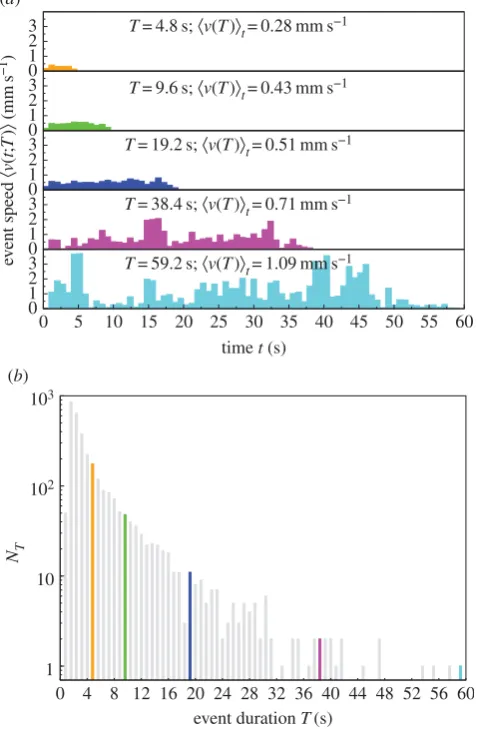
(figure 1). We consider allNTevents of durationTfor the sampled
ants within each colony and nest size. We evaluate the speed at
timetfor events with durationTby averaging over allNTevents:
kv(t;T)l¼ 1
NT XNT
i¼1
vi(t;T), (4:1)
wherevi(t;T) is the speed of eventiwith durationTat timet. We
denote the graph ofkv(t;T)lversus timetas the event speed
profile. The event speed at time t, kv(t;T)l, is non-zero for
t[[0,T]. Despite the fluctuations due to the relatively small
sample sizes, qualitatively, the event speed profiles show that
the longer the event, the higher the speedkv(t;T)l(figure 2).
To quantify how speed increases with event duration in a given colony and nest size, we consider the average speed for
events with durationTgiven by
kv(T)lt¼1
T
XT
t¼1
kv(t;T)l: (4:2)
The relationship between average speed and event duration is consistent with a power-law increase
kv(T)lt¼aTb, (4:3)
withb¼0.52 (figure 3). That 0,b,1 implies that the average
event speed increases sub-linearly with the duration of the event.
In all six experiments, the exponentbis greater than zero
(table 2, the 95% CIs do not overlap 0). Over all colonies, the expo-nent is statistically significantly higher for the larger nest size
(b¼0.60) than for the smaller nest size (b¼0.47, t¼3.911,
n¼340,p,0.001, general linear mixed model, electronic
sup-plementary material, tables S1 and S2, figures S1–S5) but there
is no significant difference in the constanta(0.12 and 0.13, for
the large and small nest size, respectively,t¼ 20.034,n¼340,
p.0.05, general linear mixed model, electronic supplementary
material, tables S1 and S2, figures S1–S5). This suggests that the environment feeds back into the relationship between average event speed and event duration.
Despite such environmentally related variability in the exponent that characterizes the relationship between the event duration and the average event speed, there is an under-lying universality in event speed profiles. We express the event
speed profiles of durationTin units of its associated average
speed kv(T)lt and time t in units of the duration such that
t=T[[0, 1] for all event speed profiles. Mathematically, this is
kv(t;T)l kv(T)lt ¼G
t
T : (4:4)
Whenkv(t;T)l=kv(T)ltis plotted againstt/T, the data coalesce
and trace out the graph of the scaling functionG. This function
initially increases and then, aroundt/T0.05, crosses over to
1125 1175 1200 1225 1275 1300
0 1 2 3 4 5 6
time t(s)
speed
v
(
t
) (mm
s
−1
)
T= 65 s
[image:3.595.321.545.42.202.2]1150 1250
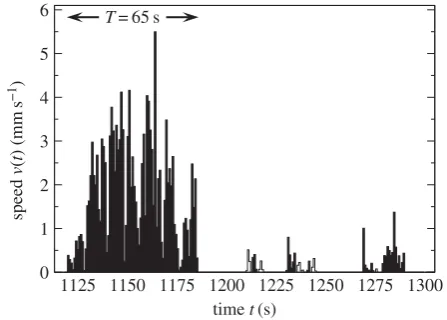
Figure 1.
An extract of 180 s of the time-series of the speed of a C
35544ant.
An event is a consecutive sequence of non-zero speeds. There are 11 events
and every other event has been coloured black. The longest event has
duration
T
¼
65 s. The longer the event, the higher the speed obtained.
rsif.r
oy
alsocietypublishing.org
J.
R.
Soc.
Interfa
ce
12
:
20140985
a constant 1 before decreasing at t/T0.90 towards zero (figure 4).
This function reveals the commonality between event speed profiles and contains the information necessary to
generate the event speed profile for any duration T using
equation (4.4) (figure 5). In figure 5a, there are three different
events of duration T¼15, 30, 60 s, respectively, where the
reached constant speed increases with the event duration
like aTb
with a¼0.13 and b¼0.52 (table 2). Figure 5b
shows that rescaling speed by dividing it bykv(T)ltaligns
ver-tically the three graphs. Figure 5cdemonstrates that rescaling
time by dividing it byTaligns the three graphs horizontally
and we obtain a data collapse onto the graph of the scaling
function G(t=T). The scaling function increases until at
t/T¼0.05 it reaches the constant value of 1 before starting
to decrease towards zero att/T¼0.90. Note that this process
can be reversed, that is, from the graph in figure 5c, we can
multiply the argument (t/T) of the scaling function G by
T¼15, 30, 60 s, respectively, to obtain figure 5b and then
multiply the function value kv(t;T)l=kv(T)lt by kv(T)lt to
recover figure 5a. Hence, the scaling function G compactly
contains all the information of the three different event
speed profiles displayed in figure 5a.
The above results obtained from data coarse-grained to a
time unit ofDt(8)¼0.8 s were replicated when the data were
coarse-grained to time units of 0.2, 0.4, 1.6 and 3.2 s (electronic supplementary material, tables S3 and S4). The power-law relationship between mean event speed and event duration as well as the significant difference between the exponents for large and small nest were robust to these changes (electronic supplementary material, tables S3 and S4).
5. Null model
As a complementary way of demonstrating that there is a non-trivial relationship between event duration and speed, we define a null model in which the observed speeds from
thePTNTevents are reallocated at random without
replace-ment to each event according to its duration (figure 6). Then we recalculate everything as with the real data.
6. Results: null model
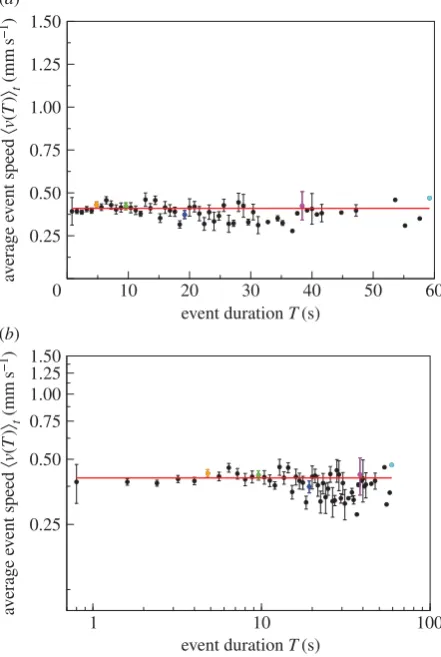
This procedure removes any correlations between the speeds and the events. Indeed, in the null model the average speed is constant and independent of the event duration (figures 7 and 8). 0
T= 4.8 s;·v(T)Òt= 0.28 mm s−1
T= 9.6 s;·v(T)Òt= 0.43 mm s−1
T= 19.2 s;·v(T)Òt= 0.51 mm s−1
T= 38.4 s;·v(T)Òt= 0.71 mm s−1
1 2 3
0 1 2 3
0 1 2 3
0 1 2 3
0 5
(a)
(b)
10 15 20 25 30 time t (s)
NT
event duration T(s)
ev
ent speed
·
v
(
t
;
T
)
Ò
(mm
s
−1
)
35 40 45 50 55 60 0
1 2 3
0 4 8 12 16 20 24 28 32 36 40 44 48 52 56 60 1
10 102
103
[image:4.595.322.543.46.375.2]T= 59.2 s;·v(T)Òt= 1.09 mm s−1
Figure 2.
(
a
) The event speed profile: speed
k
v
(
t
;
T
)
l
versus time
t
averaged
over events with duration
T
for sampled ants in C
13528, see equation (4.1). The
event speed profiles have durations
T
¼
4.8 s (orange), 9.6 s (green), 19.2 s
(blue), 38.4 s (magenta) and 59.2 s (cyan), and the number of events
N
Tis
176, 48, 11, 2, 1, respectively. The longer the event, the higher the average
event speed
k
v
(
T
)
l
t, see equation (4.2). (
b
) The number of events
N
Tversus
event duration
T
. The number of events decreases with event duration that
is quantized in units of 0.8 s. The highlighted events are those displayed in
(
a
). The total number of events
P
TN
T¼
3219 for C
13528.
0 10 20 30 40 50
(a)
(b)
60 0.25
0.50 0.75 1.00 1.25 1.50
1 10 100
0.25 0.50 0.75 1.00 1.25 1.50
event duration T(s)
event duration T(s)
av
erage e
v
ent speed
·
v
(
T
)
Òt
(mm
s
−1
)
av
erage e
v
ent speed
·
v
(
T
)
Òt
(mm
s
−1
)
Figure 3.
Average event speed
k
v
(
T
)
l
tversus event duration
T
on (
a
) linear–
linear scale and (
b
) log–log scale. Data for C
13528(solid circles). Error bars
indi-cate 1 s.e. of the mean. The longer the event duration, the bigger the error bars
owing to fewer events. Data points without an error bar consist of just one event.
The highlighted events are the same as in figure 2. The red curve displays a
power-law relationship
k
v
(
T
)
l
t¼
aT
b, with
b
¼
0.52 and
a
¼
0.13, that
is, the average event speed increases sub-linearly with the duration of the event.
rsif.r
oy
alsocietypublishing.org
J.
R.
Soc.
Interfa
ce
12
:
20140985
[image:4.595.46.285.48.413.2]Furthermore, the initial acceleration and the final
decel-eration disappear and the universal function is constant1
(figure 9).
7. Discussion and conclusion
What is the origin of the relationship between the average
event speedkv(T)lt and the event duration T? Possibly, the
more the free space in which an ant can move, the higher
the speed, on average, the ant can reach and this in turn
determines the duration T of the activity. Alternatively, an
ant may have a pre-determined durationT of a movement
[image:5.595.40.555.91.171.2]event and may adjust its speed as a consequence of event duration. This second alternative appears less probable because it would require ants to have an internal mechanism, which determines the duration of their movement events.
Table 2.
The estimate and 95% confidence intervals of the exponents
b
and coefficients
a
(in units of mm s
21) associated with the power-law relationship
k
v
(
T
)
l
t¼
aT
bfor the three investigated colonies in each of the two nest sizes. The values are based on simple linear regression fitted to the log – log
relationship between average event speed and event duration.
colony
C
13528C
15544C
23528C
25544C
33528C
35544exponent
b
0.52
0.61
0.40
0.53
0.48
0.68
95% CI for
b
+
0.06
+
0.09
+
0.07
+
0.06
+
0.12
+
0.11
coefficient
a
0.13
0.10
0.13
0.15
0.12
0.13
95% CI for
a
+
0.03
+
0.03
+
0.03
+
0.04
+
0.04
+
0.04
0 0.1 0.2 0.3 0.4 0.5 0.6 0.7 0.8 0.9 1.0
1 2 3 4 5 0
(a)
(b)
0.1 0.2 0.3 0.4 0.5
rescaled time t/T
rescaled time t/T
rescaled e
v
ent speed
·
v
(
t
;
T
)
Ò
·
v
(
T
)
Òt
0.6 0.7 0.8 0.9 1.0
1 2 3 4 5
rescaled e
v
ent speed
·
v
(
t
;
T
)
Ò
·
v
(
T
)
[image:5.595.320.544.177.675.2]Òt
Figure 4.
Rescaled event speed
k
v
(
t
;
T
)
l
=
k
v
(
T
)
l
tversus rescaled time
t
/
T
.
(
a
) Data for colony C
13528. Rescaling the speeds in an event of duration
T
with its average speed aligns the event speed profiles. Grey lines represent
the rescaled event speed profiles for the different durations. The
high-lighted events indicated with orange, green, blue, magenta and cyan
are the same as in figure 2. The average rescaled event speed profile
(black curve) traces out the scaling function
G
in equation (4.4). Error
bars indicate 1 s.e. of the mean. (
b
) The scaling functions
G
for
exper-iments
C
13528
(black),
C
55144(red),
C
35228(green),
C
55244(blue),
C
33528(cyan) and
C
35544
(magenta).
G
is universal because it is independent
of colony and nest size.
0.5 1.0 1.5 2.0
0 10 20 30 40 50 60
0
(a)
(b)
(c)
10 20 30 40 50 60
0.5 1.0 1.5 2.0
0 0.1 0.2 0.3 0.4 0.5 0.6 0.7 0.8 0.9 1.0
0.5 1.0 1.5 2.0
time t(s)
time t(s)
rescaled time t/T
ev
ent speed
v
(
t
;
T
) (mm
s
−1
)
rescaled e
v
ent speed
·
v
(
t
;
T
)
Ò
·
v
(
T
)
Òt
rescaled e
v
ent speed
·
v
(
t
;
T
)
Ò
·
v
(
T
)
Òt
Figure 5.
Sketch of the procedure for data collapse using a diagrammatic
representation of event speed profiles obtained for colony C
13528.
rsif.r
oy
alsocietypublishing.org
J.
R.
Soc.
Interfa
ce
12
:
20140985
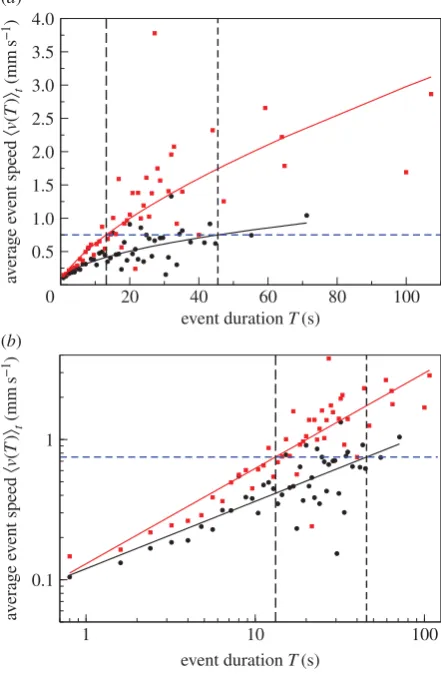
[image:5.595.51.275.201.527.2]However, the relationships in figures 1 and 2 provide evi-dence for the second alternative. The speed and the event speed profiles clearly demonstrate that ants occasionally reach very low speeds during a movement event. This suggests that an ant does not necessarily stop after it has reduced its speed. Indeed, the arrow of causation with speed as the determinant of event duration is eliminated by the relationship between event duration and average event speed for the two nest sizes. According to this relationship, the event duration for a given average event speed is longer in the smaller nest (figure 10). This contradicts the idea that when there is more free space, the speed an ant can reach leads to a longer event duration. Therefore, we favour the arrow of causation which points from duration to average speed in the processes underlying activity events in ants.
We found that the exponent of the power-law relationship between average event speed and event duration is larger in the larger nests. This means that for any event duration the average event speed of an ant, on average, is higher when its colony resides in the larger nest and that this difference increases disproportionately with increasing event duration. Such a nonlinear effect suggests interactions. Indeed,
everything else being equal, when a colony resides in the smaller nest, there is a higher probability of interactions with other colony members due to the higher density of workers and brood per unit area. This in turn is likely to reduce the average speed associated with the respective event duration. Hence our results also reveal that the univer-sal relationship between activity event duration and average speed is flexible to meet the requirements of a growing colony. The two nests we used were of a medium size, that
is on average 2000 mm2, with a range between 841 and
3025 mm2, the area preferred by both large and smallT.
albi-penniscolonies, which typically grow to a size of 400 workers [22]. Furthermore, none of the colonies in our study had their space restricted. Even workers in the largest colony (121 workers; table 1) in the smaller nest had more space than
the 5 mm2per adult worker provided byT. albipenniscolonies
when they build their own encircling nest wall out of sand grains [23].
We studied the bouts of activity of individual ants within their complete societies inside laboratory nests. Therefore, the relationship between activity event duration and average speed could be the result of individual behaviour, social interactions or a combination of the two. To establish the importance of social interactions for this relationship, we suggest that future studies use manipulative experiments or mutual information approaches to larger datasets [24,25].
1125 1150 1175 1200 1225 1250 1275 1300
0 1 2 3 4 5 6
T= 65 s
time t(s)
speed
v
(
t
) (mm
s
[image:6.595.57.275.42.201.2]−1)
Figure 6.
Data randomized according to the null model where all speeds are
pooled together and redistributed randomly among all events without
repla-cement. The relationship between speed and event duration is lost both
within and between events. Within events, there is no structure of speeds
such that they are low at the beginning and the end of the event. Between
events, there is no positive relationship between speed and event duration.
0 (a)
(b)
10 20 30 40 50 60
0.25 0.50 0.75 1.00 1.25 1.50
1 10 100
0.25 0.50 0.75 1.00 1.25 1.50
event duration T(s)
av
erage e
v
ent speed
·
v
(
T
)
Òt
(mm
s
−1
)
event duration T(s)
av
erage e
v
ent speed
·
v
(
T
)
Òt
(mm
s
−1
)
Figure 8.
Data for C
13528(solid circles) after random reallocation of speeds
among the events, see null model, on (
a
) linear – linear scale and (
b
) log –
log scale. Average event speed
k
v
(
T
)
l
tversus event duration
T
. Error bars
indi-cate 1 s.e. of the mean. The longer the event duration, the bigger the error bars
owing to fewer events. Data points without an error bar consist of just one
event. The average event speed is constant, independent of the event duration.
Fitting the randomized data yields
a
¼
0.41 mm s
21,
b
¼
0.
0 1 2 3
0 1 2 3
0 1 2 3
0 1 2 3
0 5 10 15 20 25 30 35 40 45 50 55 60
1 2 3
T= 4.8 s;·v(T)Òt= 0.41 mm s−1
T= 9.6 s;·v(T)Òt= 0.38 mm s−1
T= 19.2 s;·v(T)Òt= 0.44 mm s−1
T= 38.4 s;·v(T)Òt= 0.41 mm s−1
T= 59.2 s;·v(T)Òt= 0.39 mm s−1
time t (s)
ev
ent speed
·
v
(
t
;
T
)
Ò
(mm
s
−1
[image:6.595.323.544.48.377.2])
Figure 7.
Data randomized according to the null model. The event speed
profile, that is, speed
k
v
(
t
;
T
)
l
versus time
t
, has been averaged over all
events with a given duration
T
in colony C
13528. The positive relationship
between average speed and event duration is lost. The average speed is
constant at 0.41 mm s
21for all event durations (figure 8).
rsif.r
oy
alsocietypublishing.org
J.
R.
Soc.
Interfa
ce
12
:
20140985
[image:6.595.55.273.294.455.2]Our results are based on the activity of ants but we are convinced that our main conclusion that the duration of an activity event is determined before it commences is likely to be applicable as a general principle of animal behaviour across taxa, including humans. As our results also demon-strate, such a principle is not fixed and works in a feedback loop with the environment. Furthermore, the colonies in our experiment were in everyday, static conditions. If these conditions are perturbed and the system is under stress, things could change. Such hypotheses should be tested in future experiments using the generic framework applied here. This will elucidate further the underlying causal relationships in the way biological social systems work and inform the engineering and control of artificial social systems.
Data accessibility.Data are available at doi:10.5523/bris.cmcs6znssfim12 zo6zzmur1hq.
Acknowledgements. We are grateful to C. Y. Chng, D. Butcher, E. J. O’Reilly, Y. X. Chau, A. Worley, E. Hunt and the Ant Lab, Bristol.
Funding statement.K.C. and A.B.S.-F. acknowledge EPSRC grant nos. EP/E061761/1 and EP/E061796/1. A.B.S.-F. thanks a Leverhulme Trust Research Fellowship.
References
1. Liu YY, Slotine JJ, Baraba´si A. 2011 Controllability of complex networks.Nature473, 167 – 173. (doi:10. 1038/nature10011)
2. Ladyman J, Lambert J, Wiesner K. 2013 What is a complex system?Eur. J. Phil. Sci.3, 33 – 67. (doi:10. 1007/s13194-012-0056-8)
3. Bettencourt LMA, Lobo J, Helbing D, Ku¨hnert C, West GB. 2007 Growth, innovation, scaling, and the pace of life in cities.Proc. Natl Acad. Sci.
0 0.1
(a)
(b)
0.2 0.3 0.4 0.5 0.6 0.7 0.8 0.9 1.0
1 2 3 4 5 6 7 8 9
0 0.1 0.2 0.3 0.4 0.5 0.6 0.7 0.8 0.9 1.0
1 2 3 4 5
rescaled time t/T
rescaled e
v
ent speed
·
v
(
t
;
T
)
Ò
·
v
(
T
)
Òt
rescaled time t/T
rescaled e
v
ent speed
·
v
(
t
;
T
)
Ò
·
v
(
T
)
[image:7.595.52.275.47.376.2]Òt
Figure 9.
Data randomized according to the null model. (
a
) Data for colony
C
13528; black line shows the mean rescaled event speed profile over all event
durations; grey lines represent the rescaled event speed profiles for the different
event durations. Error bars indicate one standard error of the mean. (
b
) All
three colonies in each of the two nest sizes. The event speed has been rescaled
with
k
v
(
T
)
l
t¼
a
with
a
¼
0.4088, 0.4925, 0.3265, 0.6130, 0.3475,
0.6010 mm s
21for colonies and nest sizes C
13528, C
15544, C
23528, C
25544,
C
33528, C
35544, respectively, which represent the average speeds associated
with that colony and nest size. Note that the rescaling here is based on a constant,
k
v
(
T
)
l
t¼
a
, and is thus independent of event duration in contrast to the
orig-inal data, where
k
v
(
T
)
l
t¼
aT
b. Furthermore, the acceleration and deceleration
at the beginning and end, respectively, of an event are absent.
0 20
(a)
(b)
40 60 80 100
0.5 1.0 1.5 2.0 2.5 3.0 3.5 4.0
1 10 100
0.1 1
event duration T(s)
event duration T(s)
av
erage e
v
ent speed
·
v
(
T
)
Òt
(mm
s
−1
)
av
erage e
v
ent speed
·
v
(
T
)
Òt
(mm
s
−1
)
Figure 10.
Illustration of the argument that the arrow of causation points in the
direction from event duration to event speed. The data are for C
3on (
a
) linear –
linear scale and (
b
) log–log scale; black circles—small nest size: C
33528; red
squares—large nest size: C
35544; black and red lines represent the line of best
fit from the linear regression in the electronic supplementary material, figure S1
(the values of the parameters
a
and
b
are as in table 2, columns six and seven
for the small and large nest size, respectively). The value of average event speed
highlighted in blue is the mean of 0.75 mm s
21over all treatments and colonies.
When the colony is in the large nest, the average event speed of 0.75 mm s
21corresponds to event duration of 13.2 s. By contrast, the same average event
speed of 0.75 mm s
21corresponds to event duration of 45.5 s when the same
colony is in the small nest. In other words, the same average event speed is
associ-ated with a longer event duration in the smaller nest. This contradicts the idea that
speed determines event duration because ants moving at the same speed should
move for longer in the large nest where there is more space. Therefore, we favour
the alternative, namely that the event duration is already specified when the ant
begins to move and it reaches a higher speed in the larger nest because there is
more free space available.
rsif.r
oy
alsocietypublishing.org
J.
R.
Soc.
Interfa
ce
12
:
20140985
[image:7.595.323.544.50.388.2]USA104, 7301 – 7306. (doi:10.1073/pnas. 0610172104)
4. Batty M. 2008 The size, scale, and shape of cities.Science 319, 769–771. (doi:10.1126/science.1151419) 5. Bettencourt LMA, West GB. 2010 A unified theory of
urban living.Nature467, 912 – 913. (doi:10.1038/ 467912a)
6. Stamps JA, Briffa M, Biro PA. 2012 Unpredictable animals: individual differences in intraindividual variability (IIV).Anim. Behav.83, 1325 – 1334. (doi:10.1016/j.anbehav.2012.02.017)
7. Maye A, Hsieh CH, Sugihara G, Brembs B. 2007 Order in spontaneous behavior.PLoS ONE2, e443. (doi:10.1371/journal.pone.0000443)
8. Anteneodo C, Chialvo DR. 2009 Unraveling the fluctuations of animal motor activity.Chaos19, 033123. (doi:10.1063/1.3211189)
9. Brembs B. 2011 Towards a scientific concept of free will as a biological trait: spontaneous actions and decision-making in invertebrates.Proc. R. Soc. B 278, 930 – 939. (doi:10.1098/rspb.2010.2325) 10. Bazazi S, Bartumeus F, Hale JJ, Couzin ID. 2012
Intermittent motion in desert locusts: behavioural complexity in simple environments.PLoS Comput. Biol.8, e1002498. (doi:10.1371/journal.pcbi. 1002498)
11. Proekta A, Banavar JR, Maritan A, Pfaff DW. 2012 Scale invariance in the dynamics of spontaneous behavior. Proc. Natl Acad. Sci. USA109, 10 564–10 569. (doi:10.1073/pnas.1206894109)
12. Nepomnyashchikh VA. 2012 Variability in invertebrate behavior and the problem of free will.Biol. Bull. Rev.3, 406–411. (doi:10.1134/S2079086413050083) 13. Hsieh W-Het al. 2014 Simulated shift work in rats
perturbs multiscale regulation of locomotor activity. J. R. Soc. Interface11, 20140318. (doi:10.1098/rsif. 2014.0318)
14. Mitchell M. 2009Complexity: a guided tour. New York, NY: Oxford University Press.
15. Ho¨lldobler B, Wilson EO. 1994Journey to the ants: a story of scientific exploration. Cambridge, MA: The Belknap Press of Harvard University Press. 16. Camazine S, Deneubourg JL, Franks NR, Sneyd J,
Theraulaz G, Bonabeau E. 2001Self-organization in biological systems. Princeton, NJ: Princeton University Press.
17. Peters O, Hertlein C, Christensen K. 2002 A complexity view of rainfall.Phys. Rev. Lett.88, 018701. (doi:10.1103/PhysRevLett.88.018701) 18. Peters O, Neelin JD. 2006 Critical phenomena in
atmospheric precipitation.Nat. Phys.2, 393 – 396. (doi:10.1038/nphys314)
19. Tagliazucchi E, Balenzuela P, Fraiman D, Chialvo DR. 2012 Criticality in large-scale brain fMRI dynamics unveiled by a novel point process analysis. Front. Physiol.3, 15 : 1. (doi:10.3389/fphys.2012. 00015)
20. Lulham A. 2007 Bristol University. See http://www. cs.bris.ac.uk/~lulham/.
21. Flyvbjerg H, Petersen HG. 1989 Error estimates on averages of correlated data.J. Chem. Phys.91, 461 – 466. (doi:10.1063/1.457480)
22. Franks NR, Dornhaus A, Best CS, Jones EL. 2006 Decision making by small and large house-hunting ant colonies: one size fits all.Anim. Behav.72, 611 – 616. (doi:10.1016/j.anbehav.2005.11.019) 23. Franks NR, Wilby A, Silverman BW, Tofts C. 1992
Self-organizing nest construction in ants: sophisticated building by blind bulldozing.Anim. Behav.44, 357 – 375. (doi:10.1016/0003-3472(92)90041-7)
24. Shannon CE. 1948 A mathematical theory of communication.Bell Syst. Tech. J.27, 379 – 423. (doi:10.1002/j.1538-7305.1948.tb01338.x) 25. Baptista MS, Rubinger RM, Viana ER, Sartorelli JC,
Parlitz U, Grebogi C. 2012 Mutual information rate and bounds for it.PLoS ONE7, e46745. (doi:10. 1371/journal.pone.0046745)
rsif.r
oy
alsocietypublishing.org
J.
R.
Soc.
Interfa
ce
12
:
20140985