On Human–Machine Interaction During On-line Image Classifier Training
∗Edwin Lughofer
Department of Knowledge-based Mathematical Systems, Johannes Kepler University
A-4040 Linz, Austria, [email protected]
Jim Smith, Praminda Caleb-Solly and Muhammad Atif Tahir
Department of Computer Science
University of the West of England, Bristol, UK, [email protected]
Christian Eitzinger
Profactor GmbH
A-4407 Steyr-Gleink, Austria, [email protected]
Davy Sannen and Hendrik van Brussel
Department of Mechanical Engineering, Katholieke Universiteit Leuven
Celestijnenlaan 300B, B-3001 Leuven (Heverlee), Belgium, [email protected]
Abstract
This paper considers on a number of issues that arise when a trainable machine vision system learns directly from humans, rather than from a “cleaned” data set, i.e. data which is perfectly labelled with complete accuracy. This is done within the context of a generic system for the vi-sual surface inspection of manufactured parts, however, the issues treated are relevant not only to wider computer vi-sion applications, but also to classification more generally. Some of these issues arise from the nature of humans them-selves: they will be not only internally inconsistent, but will often not be completely confident about their decisions, es-pecially if they are making decisions rapidly. People will also often differ systematically from each other in the de-cisions they make. Other issues may arise from the na-ture of the process, which may require the machine learn-ing to have the capacity for real-time, online adaptation in response to users’ input. It may be that the users cannot always provide input to a consistent level of detail. We de-scribe how all of these issues may be tackled within a co-herent methodology. Using a range of classifiers trained on real data sets from a CD imprint production process, we will present results which show that most of these issues may ac-tually lead to improved performance.
∗This work was funded by the EC under grant no. 016429, project
DynaVis and the Upper Austrian Technology and Research Promotion. It reflects only the authors’ views.
1
Introduction
In many machine vision applications, such as inspection tasks for quality control, an automatic system tries to re-produce human cognitive abilities. The most efficient and flexible way to achieve this is to learn the task from a hu-man expert [5], either by supervised data or by knowledge acquisition from the human operators in form of rule bases. Typically, Machine Learning systems are trained in super-vised batch mode from a set of example data items each of which has a unique label. However, as Machine Learn-ing technology moves from research laboratories to practi-cal applications such as Machine Vision, a range of issues arise concerning how humans relate to, and interact with such systems [9] [6]. Not only does this question the feasi-bility, or even relevance of considering “cleaned” data sets, there is an increasing demand for systems to operate in sit-uations where off-line batch-mode processing is not appro-priate [7]. This can occur if data is hard, time-consuming or costly to obtain, or if the underlying processes change fairly rapidly, requiring re-configuration. Both of these cases lead to the need for an element of incremental on-line training [10], which prompts a renewed interest in the nature of the human interaction with adaptive ML systems [3] [1].
In this paper we focus on a number of issues relating to human-machine interaction in the context of a generic sys-tem for the visual surface inspection of manufactured parts. Section 2 describes the basic architecture of our generic sys-tem, the data sets used in this work and the experimental
framework. Section 3 deals with the issues arising when the nature of the application demands real-time on-line learning after an initial batch-mode phase. Section 4 deals with the fact that different users will often differ systematically from each other, and considers how best to incorporate this diver-sity of information. Other issues may arise from the fact that humans cannot always work as fast as the underlying appli-cations. For example, Section 5 considers how demand for rapid user responses may reduce the level of detail in the feedback they can produce, and suggests some alternative ways for dealing with this. In Section 6 we consider that for a number of reasons, the operator(s) may not be com-pletely confident in their decisions and show how a suitable change in the human-machine interface used for online la-belling can be exploited to capture this information and lead to performance improvements. We end by drawing some conclusions from this work, and highlighting areas that re-quire further research attention (Section 7).
2
Architecture and Data Sets
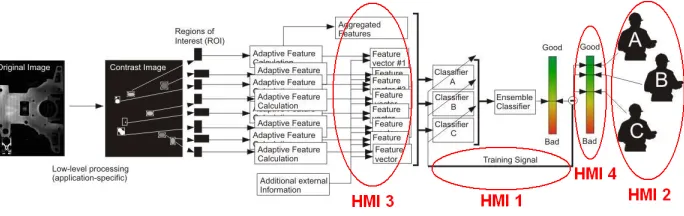
The whole framework is shown in Figure 1. Starting from the original image (left) a so-called “contrast image” is calculated, where the gray value of each pixel correlates to the degree of deviation from the normal appearance of the surface. This contrast image just serves as an inter-face to the subsequent processing steps in order to remove the application-dependent elements. From the contrast im-age regions of interest (ROI) are extracted, each of which contains a single object which may or may not be a fault. From the segmented ROIs a large number of object fea-tures are calculated such as area, brightness, homogeneity or roundness of objects characterizing their shape, size etc. These are complemented by aggregate features characteriz-ing images as a whole. The feature vectors are then pro-cessed by a trained classifier system that generates a final good/bad decision for the whole image. For off-line training the classifiers we exploited basically four different methods, namely: the decision tree-based classifiers CART[2], and
C4.5[14]; k-Nearest Neighbours (kNN) [8]; and two incre-mental learning algorithmseVQ-Class[12] and FLEXFIS-Class[13]. When applying these classification algorithms on the standard aggregated feature sets (containing 17 pre-defined features) to real-world data from an on-line CD im-print production process, we achieved accuracies between 87% and 93% as estimated by 10-fold cross-validation [16]. Even though the accuracies lie in a reasonable range, they fall short of the original goals for a very high-performance and robust system.
Hence, one goal of the enhanced human-machine inter-action issues discussed in this paper is to guide the classi-fiers towards 98% accuracy. Another goal is to widen the applicability and usability of the whole system. The
spe-cific issues for human-machine interaction are highlighted in Figure 1, where the labels HMI 1-4 refer to the issues dealt with in sections 3,4,5 and 6 respectively.
3
Incremental Classifiers based on
Opera-tors’ Feedback
On-line incremental training comes with adaptation of parameters and evolving structures (e.g. evolving neurons, rules etc.) and is required whenever the operator gives a feedback upon the classifier(s) decisions during on-line pro-duction mode. This is because a periodic rebuilding of the classifier using all the samples seen so far is impractical as it slows down the training process too much. On the other hand, if the classifier(s) would not be updated at all during the on-line production mode the classifier could not refine its parameters, react on changing operating conditions or system behaviors and hence end up in not satisfying per-formance. From a Human-Machine-Interface perspective, on-line learning highlights some interesting points. In a batch-mode model the user is asked to perform repeated interactions for image labelling without and feedback or reward. This can make the process seem time-consuming and possibly pointless. In contrast to this, on-line train-ing means that the user can “see” the system learntrain-ing from their input, building a progressively more accurate model, which can help to motivate them and increase their focus and attention. For dealing with the on-line learning prob-lem based on operator’s feedback we exploited an evolving clustering-based classifier (eVQ-Class[12]) and an evolv-ing fuzzy rule-based classifier (FLEXFIS-Class[13]). The first one is based on vector quantization and incorporates an on-line split-and-merge strategy for adapting the cluster partitions. The second one evolves multiple Takagi-Sugeno fuzzy (regression) models. Both take into account the class labels supplied during the incremental clustering process for forming the classifiers and are sufficiently flexible to in-tegrate new operating conditions (such as new image types) and newly arising fault classes into the structure of the clas-sifier.
up-Figure 1.Classification framework for classifying images into good and bad, the four major HMI issues marked with red ellip-soids.
Table 1.Performance of incremental on-line vs. static (an re-trained) batch classifiers Dataset Operator01 Operator02 Operator03 Operator04
CART static 70.94 78.82 80.00 76.08
CART re-trained 82.74 90.59 90.39 88.24 eVQ-Class static 68.82 76.67 76.27 74.71
eVQ-Class inc. 83.33 88.82 88.43 88.43
FLEXFIS-Class static 68.63 85.29 85.68 78.24 FLEXFIS-Class inc. 84.12 88.06 89.92 84.90
dated (kept static): it can be seen that by doing an adaptation during on-line mode the performance on new unseen sam-ples significantly increase by 10 to 15% over all operators. Furthermore, the third row shows us that, when re-training a batch classifier (the well known CART algorithm) on all training samples, the accuracy on the new unseen samples is not really better than for the incrementally trained ap-proaches.
4
Handling Input from Multiple Users
The idea ofclassifier ensemblesis to train a whole set (ensemble) of classifiers. Most research has considered the case where there is a single data set. Here these ensemble methods are used in a different context: the different opera-tors train their individual classifiers as they think would be best and the contradictions among these operators are then resolved using an ensemble method. There are generally two ways to combine the decisions of classifiers in ensem-bles: classifier selection and classifier fusion [17]. The as-sumption inclassifier selectionis that each classifier is “an expert” in some local area of the feature space. Classifier fusionassumes that all classifiers are trained over the whole feature space. For our application the latter is appropriate since the operators train the system with the data which is provided by the vision system. The fusion of the outputs of the different classifiers (trained by the different operators)
can be done using fixed or, if a “supervisor” has labelled the data, trainable classifier fusion methods. Note that this scenario is relevant in many companies: typically different operators work on the inspection systems in different shifts, while a supervisor, which is not working on the system, still somehow wants to be in control and have the opera-tors make decisions similar to what he would do. Classifier fusion methods (for a detailed survey see e.g. [11]) include 1.) Voting; 2.) Algebraic connectives such as maximum,
minimum,product,mean andmedian; 3.) Fuzzy Integral; 4.) Decision Templates; 5.)Dempster-Shafer combination; and 6.) Discounted Dempster-Shafer combination(an ex-tension of 5.) recently proposed in [15]). Also theOracle, a
hypotheticalensemble scheme that outputs the correct clas-sification if at least one of the classifiers in the ensemble outputs the correct classification, was considered. The ac-curacy of the Oracle can be seen as a “soft bound” on the accuracy which can be achieved by the classifiers and clas-sifier fusion methods.
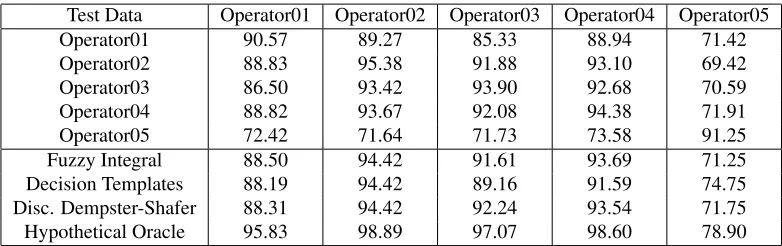
Table 2.Mean accuracy (in %) of classifiers when predicting labels provided by different users (columns). First five rows show single classifier trained by one operator. Last four rows show different methods for combining four classifiers trained by different operators to predict labels provided by fifth (column).
Test Data Operator01 Operator02 Operator03 Operator04 Operator05
Operator01 90.57 89.27 85.33 88.94 71.42
Operator02 88.83 95.38 91.88 93.10 69.42
Operator03 86.50 93.42 93.90 92.68 70.59
Operator04 88.82 93.67 92.08 94.38 71.91
Operator05 72.42 71.64 71.73 73.58 91.25
Fuzzy Integral 88.50 94.42 91.61 93.69 71.25 Decision Templates 88.19 94.42 89.16 91.59 74.75 Disc. Dempster-Shafer 88.31 94.42 92.24 93.54 71.75 Hypothetical Oracle 95.83 98.89 97.07 98.60 78.90
(column). We can see that three operators make very sim-ilar decisions (Operators 02, 03 and 04), one operator dif-fers slightly from these three operators (Operator01), and one operator makes decisions which are very different from all the other operators (Operator05). Note that the results of about 90% to 95% on the diagonal of this table denote the evaluation of the classifiers on the same data they were trained on. The last set of rows show the effect of train-ing classifier ustrain-ing four different operators, and then com-bining them to predict the labels provided by a fifth. For reasons of space, only the best performing methods are shown, which are the trainable methods Fuzzy Integral (FI), Decision Templates (DT)and Discounted Dempster-Shafer (DDS) together with hypothetical Oracle. From these re-sults we can see that the ensembles are able to represent the “supervisor” better than the individual classifiers in all cases, except when Operator01 is considered to be the su-pervisor. These improvements go up to close to 3% when Operator05 is considered as the supervisor. In general, FI and DDS are the best combination methods when several of the operators make decisions similar to the the supervisor; DT is the best combination method when none of the oper-ators agree well with the supervisor (this is the case when Operator05 is considered as the supervisor). In every case, except when Operator01 is the supervisor, the performance of the ensembles are also relatively close to the hypothet-ical Oracle. Note that if the operators do not agree very well with the supervisor a drop in the accuracy is recorded - e.g. approximately 20% of the decisions of Operator05 do not agree withanyof the other operators. In this case hypothetical Oracle bounds the achievable accuracy below 80%. From these results we can conclude that the ensemble methods can be effectively used to combine the decisions of different users to model the decisions of a supervisor, with improvements of up to 3%.
5
Handling Variable Levels of Detail in User
Inputs
A major problem of image classification problems is the fact that it is not known in advance how many regions of in-terests may be segmented from images occurring in the fu-ture, and yet most classification algorithms assume a fixed-size input data space. The most straightforward way to tackle this is to preprocess the object feature vectors through a learning system, and then present the outputs of that sys-tem as an additional image-level information. For exam-ple, if the data is labelled at the object-level, then super-vised object-level classifiers can be built [4] or alternatively if object labels are not available, unsupervised clustering methods can be used to reduce the dimensionality [3]. Su-pervised learning methods are highly useful if the training images contain labels for each object, but obtaining this in-formation requires significant operator input which may not be available off-line, or may simply be infeasible on-line due to the speed of production.
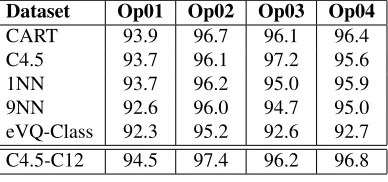
Table 3.Classification accuracy using two-level approach
Dataset Op01 Op02 Op03 Op04 CART 93.9 96.7 96.1 96.4 C4.5 93.7 96.1 97.2 95.6 1NN 93.7 96.2 95.0 95.9 9NN 92.6 96.0 94.7 95.0 eVQ-Class 92.3 95.2 92.6 92.7
C4.5-C12 94.5 97.4 96.2 96.8
defect classes for a better characterization of the whole im-ages. We also used an unsupervised approach, whereby we applied a clustering algorithm to findC clusters in our ob-ject training data, and then obob-jects in the test data were each assigned to the nearest cluster centroid - creating an image level data set with17 +C features from which supervised classifiers could be trained. This approach has a similar mo-tivation as the one before, but has the advantage that it can be also used when no labels on the single objects are pro-vided (which is often the case because of workload saving reasons). Table 3 shows the classification accuracy obtained for different operators. The first four rows show the results using the supervised approach with different types of clas-sifier. The final row shows the result of taking the unsuper-vised cluster based to create extra features to be used by a C4.5 classifier trained at the image level. Experimentation showed that a value ofC= 12gave the best results - which interestingly is almost the same as the number of classes defined by the users. Here, training an object classifier is a complex multi-classification approach, where just an accu-racy of about 80% can be achieved. However, the accuaccu-racy as well as the miss-detection rates on the whole images can be again improved when taking the outputs from the object classifiers as inputs to the aggregated features (leading to 30 features in sum). More importantly, the results demonstrate that the unsupervised approach actually does as well, if not better, than the supervised approaches.
6
Accomodating Partial Confidence of
Oper-ators
During the setup phase of an image classification frame-work, the labelling of several images can be a difficult task for the operators, especially in cases where real faults are hard to distinguish among themselves or between so-called pseudo-errors This problem can become even worse when the operators are not working in the relative calm of an off-line setting, but are providing real-time decisions at a speed driven by other factors. In this sense, it is
promis-ing, sometimes even necessary for the operator(s) to pro-vide information how confident they were when assigning the labels to certain images or objects. Here, only the con-fidences in the whole image labels are taken into account. The simplest way is to represent the users’s confidence as a value in range0.0(very unconfident) to1.0 (very confi-dent). This raises two issues: with what precision should the confidence be used, and how should this information be obtained from the users? Thankfully there is a body of work related to how opinions can best be gathered, which favors the so-called “Likert” scale used in questionnaires {strongly agree,. . .,strongly disagree} . Similarly here, rather than asking users to spend time thinking of an exact value to assign, we ask them for one of five distinct values, i.e. {20%,40%,80%,100%} confidence, partially driven by the needs of the GUI, resulting from an intensive round of discussion and design iteration with the industrial users. The next question is how to incorporate this extra informa-tion into the learning system. We evaluated two principle approaches. The first approach treats the task as a regression problem rather than a classification one. User’s decisions are transformed asscore= 0.5·(1.0 +/−conf idence), with +or −for ok and deceptive decisions respectively. However, results showed that this approach did not signif-icantly improve over the two-level approaches from earlier sections. One reason for this could be that regression mod-elling more or less just washes up the quite crisp decision boundaries achieved by classifiers on the good/bad labels, where in the end a threshold value of 0.5 again ends up in a crisp decision boundary, which does not generalize better as one which is directly learned on the class labels. It is also only applicable to two-class problems, and so is not suitable for more generic learning problems.
Table 4.Classification accuracy using two-level approach and duplicating feature vectors according to confidence levels of oper-ators. Results in bracket show improvement in percentage by each classifier over two-level approach.
Method CART C4.5 1NN 9NN eVQ-Class
Operator01 Acc. 94.4 (+0.5) 94.0 (+0.3) 93.7 (+0.0) 94.2 (+1.6) 93.4 (+1.2) Operator02 Acc. 97.7 (+1.0) 96.9 (+0.8) 96.2 (+0.0) 96.2 (+0.2) 96.7 (+1.5) Operator03 Acc. 98.0 (+1.1) 97.3 (+0.1) 95.0 (+0.0) 95.2 (+0.5) 96.5 (+3.9) Operator04 Acc. 97.0 (+0.6) 96.7 (+1.1) 95.9 (+0.0) 95.9 (+0.9) 95.6 (+2.9)
7
Conclusion and Outlook
As machine learning systems move out of the laboratory and into real-world applications such as vision and image processing, it is valuable to reconsider some of the assump-tions that have been made about how such systems can best learn from users. In this paper we have discussed some of the more important human-machine interaction problems, and suggested how they might be handled. Experiments conducted with ’real’ data within the context of a generic image processing system show that when properly handled, the human factors can represent an additional form of in-formation to these systems for improving performance and may widen the applicability and usability, rather than to be a disagreeable source of noise. Key issues of these factors include on-line guidance and feedback, a diversity of user skills, uncertainties as well as different levels of know-how and detail in users’ input. The improvements are made pos-sible by recent advances in the speed with which GUIs can operate. The next generation of user-interaction devices of-fers the potential to build on this research, creating much richer human-machine learning interaction.
References
[1] H. Bekel, I. Bax, G. Heidemann, and H. Ritter. Adap-tive computer vision: online learning for object recognition. InProceedings of the 26th DAGM Symposium on Pattern Recognition, pages 447–454. Springer-Verlag Berlin, 2004. [2] L. Breiman, J. Friedman, C. Stone, and R. Olshen.
Clas-sification and Regression Trees. Chapman and Hall, Boca Raton, 1993.
[3] P. Caleb-Solly and J. Smith. Adaptive surface inspection via interactive evolution. Image and Vision Computing, 25(7):1058–1072, 2007.
[4] P. Caleb-Solly and M. Steuer. Classification of surface de-fects on hot rolled steel using adaptive learning methods. InProc. of the IEEE Fourth International Conference on Knowledge-Based Intelligent Engineering Systems and Al-lied Technologies,vol. 1, pages 103–108.
[5] E. Castillo and E. Alvarez.Expert Systems: Uncertainty and Learning. Springer Verlag New York Inc., New York, USA, 2007.
[6] R. Cipolla and A. P. (editors).Computer Vision for Human-Machine Interaction. Cambridge University Press, Cam-bridge, UK, 1998.
[7] F. Gayubo, J. Gonzalez, E. D. L. Fuente, F. Miguel, and J. Peran. On-line machine vision system for detect split defects in sheet-metal forming processes. InProc. of the 18th International Conference on Pattern Recognition. IEEE Comput. Soc., Los Alamitos, CA, USA, 2006.
[8] T. Hastie, R. Tibshirani, and J. Friedman. The Elements of Statistical Learning: Data Mining, Inference and Predic-tion. Springer Verlag, New York, Berlin, Heidelberg, Ger-many, 2001.
[9] A. Jaimes and N. Sebe. Multimodal human computer inter-action: A survey. InProceedings of the International Work-shop on Human-Computer Interaction, HCI/ICCV 2005, pages 1–15. Springer Verlag, 2005.
[10] N. Kasabov.Evolving Connectionist Systems - Methods and Applications in Bioinformatics, Brain Study and Intelligent Machines. Springer Verlag, London, 2002.
[11] L. I. Kuncheva.Combining pattern classifiers: Methods and algorithms. Wiley, 2004.
[12] E. Lughofer. Extensions of vector quantization for incre-mental clustering. Pattern Recognition, 41(3):995–1011, 2008.
[13] E. Lughofer, P. Angelov, and X. Zhou. Evolving single-and multi-model fuzzy classifiers with FLEXFIS-Class. In
Proceedings of FUZZ-IEEE 2007, pages 363–368, London, UK, 2007.
[14] J. R. Quinlan.C4.5: Programs for Machine Learning. Mor-gan Kaufmann Publishers Inc, U.S.A., 1993.
[15] D. Sannen, H. V. Brussel, and M. Nuttin. Classifier fusion using discounted dempster-shafer combination. InProc. of International Conferernce on Machine Learning and Data Mining (MLDM 2007).
[16] D. Sannen, M. Nuttin, J. Smith, M. Tahir, E. Lughofer, and C. Eitzinger. An interactive self-adaptive on-line im-age classification framework. In A. Gasteratos, M. Vincze, and J. Tsotsos, editors,Proceedings of ICVS 2008, volume 5008 ofLNCS, pages 173–180. Springer, Santorini Island, Greece, 2008.