• No results found

acid,Methionine amino acids

N/A
N/A
Protected

Academic year: 2020

Share "acid,Methionine amino acids"

Copied!
12
0
0

Loading.... (view fulltext now)

Full text

(1)

Stability of binary and ternary complexes of Copper and Zinc transition metal ions with antitubercular drug and Serine, Valine, Glutamic

acid,Methionine amino acids

B K. Magare

a*

and M. B. Ubale

b

a

Shivaji Arts, Commerce and Science College Kannad, Dist. Aurangabad, (M.S.)India- 431103.

b
Vasantrao Naik Mahavidhyalaya Aurangabad, (M. S.)India-431003.

--- ABSTRACT: Stability constants of binary and ternary complexes of Cu(II) and Zn(II) transition metal ions withethambutol hydrochloride antitubercular drug (L) and serine(R

1

) valine(R

2

) methionine (R

3

)glutamic acid(R

4

)amino acids(R) have been determined pH metrically at 30

0

C temperature and 0.1 M ionic strength(NaClO

4

) in aqueous solution. The formation of various possible species has been evaluated by computer program and their stability were discussed in terms of ∆LogK, K

r

, K

L

and K

R

relative stability parameters.

KEYWORDS: binary and ternary, copper and zinc metals, antitubercular drug, amino acids.

INTRODUCTION

The role of coordination chemistry is very important to understand interaction of drug with trace

elements in the field of medicinal and biological sciences[1]. The stability constant of metal

complexes with drugs are useful to know the proper dose of drug and their effect with all other

components of blood stream as well as to measure the strength of metal ligand bonds[2].The

complexes of drugs are more potent than drug [3]. The studies of complex equilibria of metal

ions with drugs help to elucidate the mechanism of action of drugs [4]. The role of transition

metal ions and their complexes are involved in metabolism, transportation, detoxification,

(2)

diagnosis, treatment and catalytic processes in the systems [5]. Amino acids are the basic structural unit of proteins and played paramount role in the cell structure and various functions.

The ethambutol hydrochloride drug (L) [Chemical name of drug is 2,2’ethylenediamine-di- butanol hydrochloride] is an antitubercular drug that inhibits the transfer of mycolic acids into cell wall of tubercle bacillus[6] and is effectively used against actively growing micro organism of Genus mycobacteriumand structure is shown in Figure 1.

Figure 1: Structure of ethambutol hydrochloride drug (L).

C N

H OH

H N

OH CH

3

.HCl.

H

3

The literature survey reveals that there is huge scope to study the binary and ternary complexes of copper and zinc transition metal ions with antitubercular drugs and amino acids [7-14].Hence the present work deals with the systematic study of stability constants of binary and mixed ligand ternary complexes of Cu(II) and Zn(II) metal ions with ethambutol hydrochloride drug(L) and serine(R

1

)valine(R

2

)methionine(R

3

)glutamic acid(R

4

)amino acids (R)as secondary ligands.

EXPERIMENTAL Chemicals and solutions

All the chemical reagents used in the present investigation were Analar grade.The solutions of

drug and amino acids were prepared in carbonate free doubled distilled water having 6.80-6.90

pH. The NaOH solution was standardized with oxalic acid and kept in Pyrex vessel. The 1.0 M

sodium perchlorate (NaClO

4

) solutions were prepared to maintain the 0.1 M ionic strength of the

solutions by taking requisite amount of sodium per chlorate. The metal nitrates were used to

prepare the metal solutions andwere standardized by usual procedure [15].

(3)

Apparatus

The digital pH meter [Elico model LI 120; inbuilt temperature compensation and 1.0 -14 pH range with an accuracy of 0.01 pH Unit.] in conjunction with combined electrode were used for pH measurements. The glassware’s used in the present experiment were borosil glass quality and standardized as per standard procedure [16]. The experiments were carried out at 30

0

C(±1.0

0

C) temperature and 0.1M ionic strength (NaClO

4

) in aqueous solution. The pH meter was calibrated before every set of titrations by using 4.00 and 9.00 pH standard buffer solutions. All the necessary precautions were taken for smooth working of electrode [17].

Titration procedure

Thebinary and ternary stability constants of transition metal ions were determined by using Calvin Bjerrum pH titration techniques as modified by Irving and Rossotti[18]. The titration procedure involves following steps:

1) Free acid(HClO

4

) + NaClO

4

(A)

2) Free acid(HClO

4

) + NaClO

4

+ primary ligand (A+L) 3) Free acid(HClO

4

) + NaClO

4

+ primary ligand+ metal (A+L+M) 4) Free acid(HClO

4

) + NaClO

4

+ secondary ligand (A+R)

5) Free acid (HClO

4

)+ NaClO

4

+ secondary ligand+ metal (A+R+M)

6) Free acid(HClO

4

) + NaClO

4

+ primary ligand + secondary ligand+ metal (A+L+R+M)

(4)

The above thermostatic mixtures were titrated with a carbonate free standard NaOH solution.

The total volume of solution was kept constant at 50 ml by the adding distilled water.

Calculations

The proton ligand stability constants (pKa) and metal ligand stability constants (LogK) of binary complexes were determined by using MS office program.The equilibrium constants of ternary complexes,concentrations of metal ions, ligands, free metals, free ligands and various possible species that are formed during complexation were directly obtained as output ‘SCOGS’computer program [19] which employs nonlinear least square approach. The species distribution curves were obtained as computer output.

RESULTS AND DISCUSSION Binary complexes

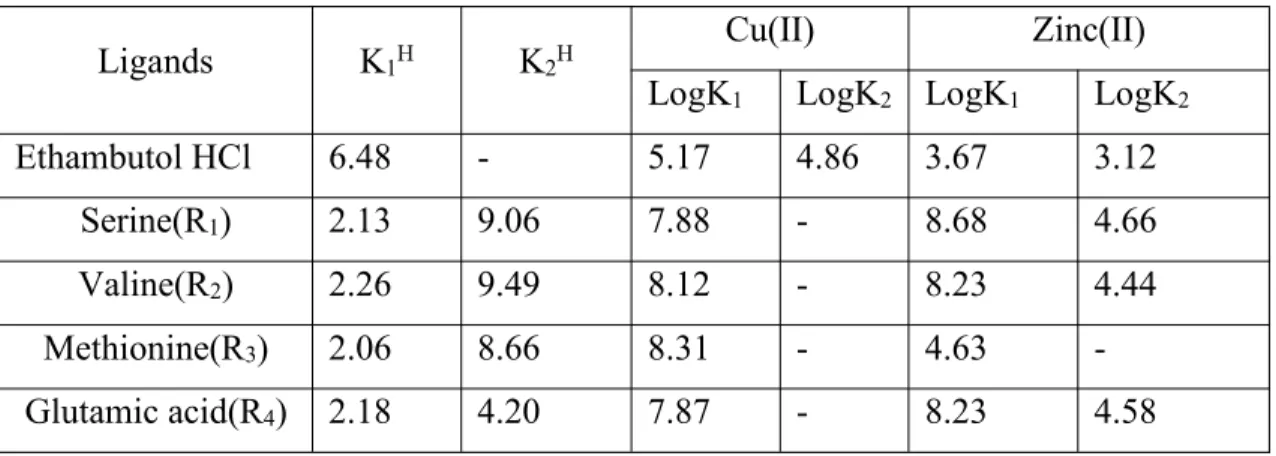
The proton ligand stability constants (pKa) and metal ligand stability constants (LogK) of binary complexes were determined by using Irving and Rossotti methods for the comparison with these of ternary systems. It is shown in Table 1.

Table 1: Stability constants of ethambutol HCl and amino acids metal complexes.

Ligands K

1H

K

2H

Cu(II) Zinc(II)

LogK

1

LogK

2

LogK

1

LogK

2

Ethambutol HCl 6.48 - 5.17 4.86 3.67 3.12

Serine(R

1

) 2.13 9.06 7.88 - 8.68 4.66

Valine(R

2

) 2.26 9.49 8.12 - 8.23 4.44

Methionine(R

3

) 2.06 8.66 8.31 - 4.63 -

Glutamic acid(R

4

) 2.18 4.20 7.87 - 8.23 4.58

(5)

The deviation of metal titration curves from ligand curve indicates the formation of binary complex. The highest values of n‾ (average number of ligands bound per metal atom) are around 2.0 indicates the formation of 1:1 and 1:2 binary complexes.

The order of stability of binary complexes of transition metal ions with drug(L) follows the natural order[Cu (II)>Zn (II)] of Irving and Williams series [20] which has been reported by several of researchers[21-22].In case of amino acids copper complexes shows low stability than zinc complexes. The low values of stability constants suggest the ionic interactions [20].

Mixed ligand complexes

The formation of 1:1:1 mixed ligand complexes (MLR) were identifiedqualitatively by the pH of precipitation of ML, MR, and MLR titration curves.It indicates the higher value of pH of precipitation of ternary system than corresponding binary systems [23].It has been also confirmed by drawing composite curve(C) as shown in Figure 2.

Stability of mixed ligand complexes

The Cu(II) LR

4

(glutamic acid) system shows high stability constants values among the present copper and zinc transition metal complexes with ethambutol HCl drug(L) and four amino acids whereas Zn(II)LR

3

(methionine) system shows low value which may be attributed to the bonding interaction of amino acids and metal ions. The stability constants and relative parameters of these mixed ligand complexes are enlisted in Table 2 and 3.

In Cu(II)LR system, the ternary complex with glutamic acid shows high value of stability

constant whereas serine ternary complex shows low value.The valine ternary complex of

Zn(II)LRsystem shows high value of stability and methionine system shows low value of

stability.

(6)

Figure2: Mixed ligand curve of Cu (II)LR

4

system

These variations may be attributed to steric, inductive effects and the increasing side chain of amino acids would results in more strain in bonding leads to the low values of stability as well as an aliphatic nature of amino acids.

The relative stabilities of mixed ligand complexes were quantitatively expressed in terms of

∆LogK, K

r

, K

L

and K

R

values which are defined by equations:

∆logK= logβ

111

-logK

10

-logK

01

K

r

= β

2111

/ β

20.

β

02

K

L

= β

111

/logK

10

(7)

K

R

= β

111

/logK

01

And shown in Table 2 and 3 along with stability constants of ternary systems of Cu(II) and Zn(II) transition metal ions respectively.

Table: 2

Stability constants of ternary complexes of Cu (II) with ethambutol-HCl (L) and amino acids and their relative parameters.

Amino Acids β

111

β

20

β

02

K

L

K

R

K

r

∆logK

Serine(R

1

) 11.18 10.03 7.88 6.01 3.30 1.25 -1.87 Valine(R

2

) 12.22 10.03 8.12 7.05 4.10 1.35 -1.07 Methionine(R

3

) 12.22 10.03 8.31 7.05 3.91 1.33 -1.26 Glutamic acid(R

4

) 12.85 10.03 7.87 7.68 4.98 1.44 -0.19

Table: 3

Stability constants of ternary complexes of Zn (II) with ethambutol-HCl (L) and amino acids and their relative parameters.

Amino Acids β

111

β

20

β

02

K

L

K

R

K

r

∆logK

Serine(R

1

) 10.33 6.79 13.34 6.66 1.65 1.03 -2.02 Valine(R

2

) 12.38 6.79 12.67 8.71 4.15 1.27 0.48 Methionine(R

3

) 8.29 6.79 4.63 4.62 3.66 1.45 -0.01 Glutamic acid(R

4

) 11.38 6.79 12.81 7.71 3.15 1.16 -0.52

The comparison of β

111

with β

20

and β

02

of these systems reveals the preferential formation of ternary complexes over the binarysystems [24]. The low values of K

L

and K

R

indicate the more stability of ternary complexes with respect to binary complexes of primary and secondary ligands. The positive values of Kr also support the extra stability of mixed ligand complexes which may be attributed to the interactions outside the coordinated sphere such as formation of hydrogen bonding between coordinated ligands, charge neutralization,chelate effect and electrostatic interactions between non coordinated charge group of ligands[25].The negative values of ∆LogK suggests the formation of ternary complexes but less stable having destabilized nature of complexes which has been reported in N and O donors [26]. The positive value of

∆logK in some cases is attributed to the extra stability of ternary complexes.

(8)

Species distribution curves

The concentration of various species formed in the complex formation process were directly obtained as a computer outputs and the species distribution curves of Cu(II)LR

4

systems were constructed by plotting percentage concentration of various possible species formed during complexation versus pH of solution as shown in Figure 3and 4 as representative graphs.

In Cu(II)LR

4

(glutamic acid) ternary system, primary ligand forms 1:1 and 1:2 binary complexes whereas secondary ligands forms only 1:1 binary complexes with copper. The species

distribution diagramof free metal (M), free ligands L and R indicates the slowly decrease in percentage concentration of free metal ions with increase in pH and percentage concentration of both ligands increases with increasein pH of solution. The percentage formation of FL is high (5.78%) than FR (0.334%) as shown in Figure 3

Figure: 3 Species distribution curve of Cu(II)LR

4

system

(pH versus % conc. of free metal and free ligands)

(9)

Figure: 4 Species distribution curve of Cu(II)LR

4

system (pH versus % conc. of various possible species )

The species distribution curve of various possible species of Cu(II)LR

4

system(Figure:4) clearly indicates the formation of ternary complexes(CuLR) which is about 91.46% at pH 6.4. It also shows that very less amount of formation of CuL binary species. The percentage concentration of CuR

2

(C

6

) decreases (96% to 8.14% from 2.30pH to 6.40pH) due to the formation of mixed ligand complexes as:

CuR

2

+CuL ↔ CuLR +CuR

The percentage concentration of HL (C

1

)species decreases (96% to 2.38% from 2.30pH to 6.40pH) as the pH increases indicates the deprotonation of primary ligand as shown in equilibria:

HL ↔L+H.

The possible equilibria in the formation of ternary complex are as follows:

Cu+L+R ↔CuLR.

CuR

2

+CuL ↔ CuLR +CuR

(10)

CuL

2

+CuR↔CuLR +CuL

CONCLUSION

(1)The stability constant of binary complexes with transition metal ions and primary ligand indicates the usual trend in order.(2) Mixed ligand stability constants of drug indicates high value of ternary complexes with aliphatic amino acids.(3) The negative values of ∆LogK suggests the formation of ternary complexes but less stable having destabilized nature of complexes and positive value of ∆logK in some cases is attributed to the extra stability of ternary complexes.(4) The positive values of Kr also supports the stability of mixed ligand complexes which may be attributed to the interactions outside the coordinated sphere such as formation of hydrogen bonding between coordinated ligands, charge neutralization,chelate effect and electrostatic interactions between non coordinated charge group of ligands.(5) The species distribution curve shows the formation of ternary complexes.

REFERENCES

[1]. Sigel, H. Mc Cormick, D.B. Chem. Rev.1970, 3,201.

[2]. Thomas G. Medicinal Chemistry, John Wiley and Son Co. Ltd. London.2002, P-1.

[3]. Magare B. K. and Ubale M. B., Asian Journal of Biochemical and Pharmaceutical Research, 2013,3,( 3), , 91-95.

[4]. Coryell, C.D.Special Problems in the Formation of Metal Complexes in Chemical Specificity in Biological Interaction,1954. Academic Press, New York, 90.

[5]. B K Magare, M B,Ubale Potentiometric and thermodynamic studies on transition metal

complexes of sulfamethoxazole drug and phenyl alanine in 40% alcohol water medium.,

International Journal of Universal Print,Vol 2018, 04,(05), , 279-282

(11)

[6]. Merck Index, Merck and Company INC, White house Station, 14

th

Ed.NJ, USA,2006,3720.

[7]. Agrawal, B. R., Magare, B.K.; Farooqui, M. N.;Janra, D. M.; Ubale, M.B.,Int. J. Chem.

Sci. 2009,7(3), 2169-2172.

[8]. Magare, B. K.;Farooqui, M. N.; Shelke, R.S.; Ubale, M. B. Orient. J. Chem., 2009.

25(2), 387- 390.

[9]. Gamal Abdelaziz Hussein Gouda, Gomaa Abdelgawad Mohammed Ali, Malaysian Journal of Analytical Sciences, 2017,Vol 21 No 6 1266 – 1275

[10]. Magare B K and Ubale M B, Acta Chim. Pharm. Indica,2013, 3(3), 227-230

[11].A. A. Al-Rashdi1, A. H. Naggar, O. A. Farghaly, H. A. Mauof, A. A. Ekshiba, American Journal of Analytical Chemistry, 2018, 9, 99-112.

[12]. Israel Leka Lere, Mamo Gebrezgiabher Beyene,Mulugeta Chekol And R.K. Upadhyay , Spectrophotometric Study Of Stability Constants Ofcr(III), Ni(II) And Cu(II) Complexes With Aschiff Base In Different SolventsOrient. J. Chem.,2013, Vol. 29(3), 1111-1114 2013 [13]. D. T. Sakhare, B.K. Magare, A. G. Shankarwar, Curr. Pharm. Res. 2019, 9(4), 3335-3344 [14]. Nandababu Singh Laishram, Journal of Chemical and Pharmaceutical Research,4(9), 2012,

4400-4405.

[15]. Schwarzenbach, G.Complexometric Titration, Menthuem and Co. Ltd. London,1957,69, 79, 82.

[16]. Vogel, A. L. A Text Book of Quantitative Inorganic Analysis, Pergamon Green and Co. Ltd.

London,1975. 539.

[17]. Bates, R. G.Determination of pH Theory and Practice, A Wiley Interscience Publication New York .1973.

[18]. Irving, H.M.; Rossotti, H. S.J. Chem. Soc.1953, 3397.

(12)

[19]. Sayce, I.G.Talanta,1988,15,1397.

[20]. Irving, H.;Williams, R. J. P.Nature,1946,162,746.

[21]. Karda, H. L.;Malik, J. S.;Gera,V.Ind. J. Chem.Soc.,1988,27A,456.

[22]. Mayadeo, M. S.;Nalgirkar,J. V.,Ind. J. Chem.Soc.,1993,70,68.

[23]. Rao, V. M.; Latha, M.P.; Rao, T. S.;Rao, G.N.J. Ind. Chem. Soc.,2006. 83, 925-927.

[24]. Rajbhoj, A.S.; Gaikwad, S.T.; Chondhekar, T. K.. J. Ind. Chem. Soc.,2007, 84,987-990.

[25]. Sakurai, T.; Yamauchi, O.; Nakahara, A.Bull. Chem. Soc. Japan,1977. 50,1776.

[26]. B. K. Magare and M. B. Ubale J. Chem. Bio. Phy . Sci. Sec. A, 2012,

Vol.2, No.1, 108- 113.

Figure

Table 1: Stability constants of ethambutol HCl and amino acids metal complexes.

References

Related documents