University of the West of England
BOUNDARY WORK IN THEORY AND PRACTICE:
PAST, PRESENT AND FUTURE
CHARLES EDWARD BOOTH
2 TABLE OF CONTENTS
Abstract ... 3
Acknowledgements ... 4
A Note on Referencing Conventions in the Thesis ... 5
Introduction to the Critical Commentary ... 6
Significance and Originality of the Work Presented ... 9
Themes, Commitments and Influences ... 9
The Context, Nature and Contribution of the Work ... 18
Impact and Influence of the Research ... 25
Methods and Methodology ... 28
Clarifying Issues of Contribution to the Selected Papers ... 31
Summary and Conclusion ... 33
Notes ... 37
References ... 39
Appendix A: Citations to Papers Selected for the Thesis ... 46
Appendix B: Citations to Papers Associated with Projects ... 47
Appendix C: Complete List of Publications (in chronological order) ... 48
3 Abstract
4 Acknowledgements
I thank my friends and colleagues at Bristol Business School and elsewhere. I particularly thank colleagues all over the world who have offered encouragement and criticism, and who have shared their ideas and their work with me. I thank Stuart Bowie, Judith Jordan and Julian Lowe for their encouragement and example. I particularly thank Ann Rippin for her comradeship.
I thank all my supervisors for their guidance and patience: Rebecca Boden, Peter Case, Svetlana Cicmil, Julian Lowe, and Mairi Mclean.
I thank my current and past co-authors on all our projects together for their comradeship and intellectual stimulation: the late Tony Beasley, Mick Beeby, Sara Bird, Stuart Bowie, Mike Broussine, Eugene Byrne, Rebecca Casbeard, Peter Clark, Agnés Delahaye, Kent Fedorowich, Robert French, Simon Gurr, Jane Harrington, Roy Stager Jacques, Judith Jordan, Giuliano Maielli, Steve Procter, Ann Rippin, Mick Rowlinson, Lindsay Udall, and Russ Vince.
I thank all those editors who have encouraged and solicited my work: Julian Baggini, Christian De Cock, Laura Costanzo, Damian O‟Doherty, Ted Fuller, Clive Gilson, Ruud van der Helm, Brad MacKay, Laurent Mermet, Alf Rehn, Harry Rothman, Mick Rowlinson, and Andreas Scherer.
I would particularly likely to thank, again, Mick Rowlinson for his friendship, generosity, forbearance and support.
I thank, and apologise to, anyone who has been overlooked in these acknowledgements and who should not have been.
Lastly, and most important, I would like to thank my family, Jill, Isobel and Harriet, for their infinite patience, tolerance and support of a partner and a father who has been too often absent or pre-occupied.
5 A Note on Referencing Conventions in the Thesis
This thesis follows the following referencing conventions: in-text and final references within the submitted papers are formatted according to the respective journal house style of each paper, while in-text references in the covering critical commentary are formatted according to the following conventions:
In-text references to one of the submitted papers are styled as in this example: *Booth (2003).
In-text references to one of my other publications are styled as in this example: Booth et al (2001).
In-text references to other authors‟ work are styled in the normal way: Clark (2000).
6 Introduction to the Critical Commentary
This thesis involves the submission of published academic work with a critical commentary, in accordance with the regulations of the University of the West of England on Supervised DPhil degrees. In this introduction to the thesis I discuss the selection of papers included in the thesis, begin to indicate their relevance and connection to the themes expressed in the title of the thesis, and provide an account of the structure of this critical commentary. I end by anticipating the conclusion of the critical commentary.
The works submitted are theoretical rather than empirical in nature (hence 'theory' in the thesis title) and are thematically connected either by a focus on practice (academic practice, or in and around work organizations more generally - hence 'practice'), or by a concern with connecting separate bodies of theory or disciplinary areas (hence 'boundary work'), or both. There are also common themes connecting the papers, in as much as organizational history - broadly conceived as the connection between the organizational past and present, and its interpretation, representation, and so on - and strategy (traditionally and historically concerned with organizational action which connects the present to the future) remain a major focus. The second clause of the thesis title is intended to reflect these concerns.
This commentary thus provides a critical assessment of the scholarly contribution of the papers selected for inclusion in the thesis, and discusses these contributions in the context of the broader corpus of my published work. As a number of the papers selected are co-authored, the commentary later explicitly discusses the nature and extent of my individual contribution. Although, as stated, the majority of the papers are theoretical, some papers in the broader corpus are grounded in empirical investigations, and the methodological issues and implications of this work are also discussed later in the commentary.
The papers selected for inclusion in the thesis are:
1. Booth, C. (1998a) Beyond Incommensurability in Strategic Management: A Commentary and an Application, Organization, 5, 257-265.
2. Booth, C. (2000a) The Problems and Possibilities of Reflexivity in Strategy, Electronic Journal of Radical Organization Theory, 4, 1. [ONLINE, 25 pp. ]
7 4. Booth, C. (2003) Does History Matter in Strategy? The Possibilities and Problems of
Counterfactual Analysis, Management Decision, 41, 96-104.
5. Clark, P., Booth, C., Rowlinson, M., Procter, C. & Delahaye, A. (2007) Project Hindsight: Exploring Necessity and Possibility in Cycles of Structuration and Co-Evolution, Technology Analysis & Strategic Management, 19, 83-97.
6. Booth, C., Clark, P., Delahaye, A., Procter, S. & Rowlinson, M. (2009a) Scenarios and Counterfactuals as Modal Narratives, Futures, 41, 87-95.
7. Booth, C., Clark, P., Delahaye, A., Procter, S. & Rowlinson, M. (2009b) Modal Narratives, Possible Worlds and Strategic Foresight, in Costanzo, L.A. & MacKay, R.B. (eds.) The Handbook of Research on Strategy and Foresight. Cheltenham: Edward Elgar, 113-127.
8. Casbeard, R. & Booth, C. (2012) Post-modernity and the Exceptionalism of the Present in Dark Tourism, Journal of Unconventional Parks, Tourism & Recreation Research, 4, 2-8.
9. Booth, C. (2013) Термен не мрет: A Fractional Biography of Failure, Management & Organizational History, 8, 1, 23-42.
8 2007) is an early output from a very successful externally funded research project that followed on from my work on counterfactuals, and is a paper that develops theory concerning what I had come to call „modal narratives‟ in organizational analysis (counterfactuals, scenarios and other similar thought experiments). Again, this theory development involves interdisciplinary activity („boundary work‟) and a preoccupation with temporal relations between past, present and future.
Papers 6 and 7 (*Booth et al, 2009a and 2009b) further develop conceptions associated with modal narratives, and with academic and professional practices. Despite nominally being co-authored, they were in fact conceived, developed and written wholly by me. Given the importance of demonstrating my own personal research achievements and contribution as part of this thesis, it was therefore essential that they were included. Paper 8 (*Casbeard & Booth, 2012) is among my more recent publications, written with one of my former doctoral students. Again, it exemplifies the theme of interdisciplinarity and the traffic of concepts, themes and accounts between intellectual domains. Finally, paper 9 (*Booth, 2013) represents an endeavour in organizational and technological history, being a somewhat unconventional „biography‟ of a technology and its inventor, informed both by certain developments in science studies and by critical historiography.
In summary then, the papers were chosen because I believe that they represent a particular achievement of note; they reflect major themes in the thesis and in my wider corpus of work; they are instances of important features of my research career; or because they display a combination of these attributes.
9 I then go on, in the next major section, to discuss methods and methodology in the work. I distinguish between the different types of theoretical work in the papers submitted, as well as discussing the empirical work represented in the broader body of my research. Because a number of the papers submitted are nominally or actually co-authored, it is important to clarify the nature and extent of my personal contribution to the work, and this is achieved in the next major section. The final section is a summary of and conclusion to the critical commentary, where I conclude that, despite weaknesses and conceptual flaws, the papers together represent an original contribution that has had a detectable, if modest, impact on scholarly knowledge.
Significance and Originality of the Work Presented
In this section I discuss the significance and originality (in short, the contribution) of the selected papers taken separately and together. I do this by first exploring certain themes, commitments and influences that have characterised and underpinned the work selected. I then discuss the papers in turn, putting them into the context in which they were written and published, describing the argument and/or findings, and assessing their contribution. I then turn, in a sub-section, to an assessment of the impact and influence of the selected papers. In the closing paragraphs I briefly set out what I feel to be their overall contribution. I conclude that the influence of my work is relatively modest, though it has informed certain debates in the literature.
Themes, Commitments and Influences
10
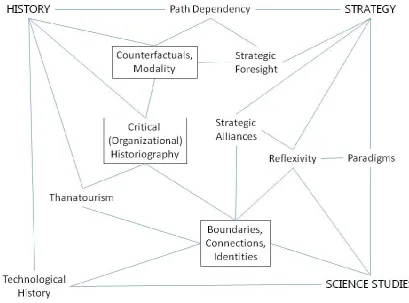
Figure 1: Themes and Connections
Figure 1, therefore, depicts some of the themes and connections instantiated by the selection of papers. The main themes act, effectively, as nodes, connecting many or most of the sub-themes. Paper 1 (*Booth, 1998a) is an exploration of paradigms and incommensurability in strategic management, thus connecting the strategy and science studies field, which are also connected in Paper 2 (*Booth, 2000a) in its extended discussion of reflexivity. Paper 3 (*Beeby & Booth, 2000) concerns learning in strategic alliances and other forms of inter-organizational relationships; as discussed below, it reflexively exemplifies its topic while simultaneously exploring it. The concern in science studies with reflexivity, though less explicit than in paper 2, is also present in this paper.
11 foresight, thus strengthening the connection between history and strategy. Although all three are theoretical papers, they are strongly concerned with issues of foresight and strategic practice. Paper 8 (*Casbeard & Booth, 2012) focuses on the historical theme of thanatourism, bringing historiographical insights and historical data to bear on the claims, assumptions and premises of the mainstream, somewhat presentist, dark tourism literature. Paper 9 (*Booth, 2013) presents a technological history informed both by science studies‟ concerns about multiplicity, fractionality and identity, and a critical historiography grounded in the work of Walter Benjamin.
I propose, then, to take these three nodes – history, modality and boundaries - as signifying common themes in the work, and deal with them in the following discussion. My treatment of each theme is somewhat different: as history in a sense underpins or supports the other themes, I use this discussion to trace some contributions to organizational history and draw on these to outline what I take to be a programmatic statement of a critical perspective on the field. In the discussion of modality, I trace the development of my arguments in this field; and in discussing boundaries and related issues, focus on the notion of a boundary object and how utilising this notion helps to illuminate two contrasting yet related treatments of boundaries, connections and identities in the selected papers.
History: In a passage in his autobiography, which possessed my imagination on first reading and has continued to do so ever since, R.G. Collingwood writes of the benefits of possessing a sense of history:
So long as the past and present are outside each other, knowledge of the past is not of much use in the problems of the present. But suppose the past lives on in the present; suppose, though incapsulated in it, and at first sight hidden between the present‟s contradictory and more prominent features, it is still alive and active; then the historian may very well be related to the non-historian as the trained woodsman is to the ignorant traveller. „Nothing here but trees and grass‟, thinks the traveller, and marches on. „Look,‟ says the woodsman, „there is a tiger in that grass‟. The historian‟s business is to reveal the less obvious features hidden from a careless eye in the present situation. (Collingwood, 1939; 100).
Collingwood then anticipates the „traveller‟s‟ reaction:
12 And provides his response:
There were two [possible] things, it seemed to me, which needed to be said in answer to that ... The first is this. You want a rifle? Then ... go to the gunsmith‟s. But do not expect the gunsmith to sell you a rifle which can see tigers as well as shoot them. For that, you must learn woodcraft ...
The second is this. If you are sure that the thing you are going to see in the grass is a tiger, and if your only idea about tigers is that they are things to shoot, take a rifle with you. But are you sure? What if it turns out to be your own child playing [Cowboys and] Indians? (Collingwood, 1939: 100-101).
The field of strategic management, along with mainstream approaches to organization studies, has long lacked a sense of history1. This generally ahistorical orientation in the
broader discipline has been discussed at length, often critically, by commentators (e.g. Zald, 1993: Kieser, 1994; Jacques, 1996, Burrell, 1997; Clark & Rowlinson, 2004); and in strategy itself by, for example, Teece, Pisano & Shuen (1997), *Booth (2003), Ericson (2006), Ericson & Melin (2010) and others. As Rowlinson, Stager Jacques & Booth (2009) point out, there is nothing inherently critical in adopting a historical orientation towards organizations and organizing. Indeed, they and others (for example, Taylor, Bell & Cooke, 2009) take pains to demonstrate that a critical orientation to organizational history is inimical to mainstream business history approaches. Nevertheless, a historically-informed approach has „been more integral to critical studies of organization than to the mainstream project‟ (Rowlinson, Stager Jacques & Booth, 2009: 286), and Booth & Rowlinson (2006) point to an alignment between critical management studies and calls for a historical reorientation in organization studies.
13 As well as shaping the nature of the engagement between history and organization studies, Rowlinson, Stager Jacques & Booth (2009) argue that a critical management and organizational history possesses at least two further features: a critical engagement with mainstream business history (see above), and a critical assessment of the treatment of history in critical management studies. For example, Jacques (1996: 14-15) argues that critical histories are „no less linear, progressive, teleological and truth-centered‟ than mainstream management textbooks. Rowlinson & Carter (2002) criticise an over-reliance on Foucault in critical management scholarship, echoing concerns of many historians that Foucault‟s work is anti-historical. The same authors take issue with Burrell‟s (1997) conception of the holocaust as a bureaucratic solution, inextricably connected with modernist management rationality. As Rowlinson, Stager Jacques & Booth (2009: 297-8) put it: „Burrell privileges aesthetic over factual criteria in his writing ... In no sense could it be said that Burrell is subservient to historical “facts”‟.
To summarise, then, a critical organizational history may be argued to be based on an analytical and narrative critique of mainstream approaches to organization studies and to business history, and of historical approaches in critical management studies. It is characterised by a fundamental philosophical engagement with historiographical issues of understanding, interpretation, and representation, as well as with traditional, more political, critical management studies concerns with emancipation, equality, and transformation.
In summary, as far as influences are concerned, the work of Collingwood (especially but not exclusively Collingwood, 1939) and that of Dening (especially Dening, 1996, but also his 1993) has been central in influencing what might be called my general attitude towards historical enquiry, whereas the work of Rowlinson and various colleagues has exemplified a more specific approach influencing my concerns with critical organizational history.
14 history and the social sciences) raised in me an exhilaration as to the possibility of crafting radically different historical narratives concerning organizations and organizing. Somehow, these narratives have yet to be written. But as my engagement with what I came to call „modal narratives‟ deepened and broadened, I came to realise that these narratives could be theoretically explicated and justified in a way that would strengthen the theory- and methods-base of critical organizational history.
As my reading in this area developed, I came to appreciate that the literature on counterfactual analysis and narrative was broad, fragmented and eclectic. In *Clark et al (2007: 84), we cite sources in disciplines as diverse as quantum mechanics, philosophy and semantics, as well as social psychology, political science, organization studies, futurology, history and literary studies. In my first published paper on the topic (*Booth, 2003), however, I drew mainly on a small number of historiographical sources on counterfactuals. I also, though, cited the sociologist of science Steve Fuller‟s review of Gross & Levitt‟s (1994) contribution to the so-called „Science Wars‟, in which Fuller (1995: 121) argued:
Events happen in bundles, and only after some time has passed are they unraveled and labeled. This is the stuff of which historical narratives are made. And only through such retellings of the past do we come to have any strong sense of what the world obliges, forbids, or merely permits.
15
System Operators
Alethic System Possible Impossible Necessary
Deontic System Permitted Prohibited Obliged
Axiological System Indifference Wrong Right
Epistemic System Uncertainty Ignorance Knowledge
(Source: *Booth et al, 2009b: 115; adapted from Ryan, 1991: 111)
FIGURE 2: Systems of Modalities
The second move in establishing our arguments for the importance of modal narratives was to specify their conditions for use, or usefulness. In seeking to characterise different styles of counterfactual argumentation, Tetlock & Belkin (1996: 7-16) list the following:
a. Idiographic
b. Nomothetic Theory-testing c. Idiographic-Nomothetic Synthesis
d. Pure Thought Experiments: Logical Proofs and Computer Simulations e. Mental Simulations of Counterfactual Worlds
i. Counterfactual morality tales ii. Counterfactual consistency probes
iii. Counterfactual exercises as de-biasing tools and means of stimulating the imagination.
16 necessary and sufficient conditions are the presence and interaction of estrangement and cognition, and whose main formal device is an imaginative framework alternative to the ... empirical environment‟. Thus, the modal narrative functions, in this context, as a „surprise machine‟.
This specification of the use of modal narratives thus allows and supports the claim that they are a fruitful tool for a critical management scholarship and practice more fully engaged with historical/historiographical perspectives. Hellekson (2001: 4-5), for example, argues that alternate histories (and by extension other speculative modal narratives):
[Q]uestion the nature of history and causality; they question accepted notions of time and space; they rupture linear movement; and they make readers rethink their world and how it has become what it is. They are a critique of the metaphors we use to discuss history. And they foreground the „constructedness‟ of history and the role narrative plays in this construction.
Similarly, Shippey (2003: 193) suggests that the purpose of modal narratives is „not to create belief in the unreal, but to subvert belief in the real, or what is accepted as real‟. Suvin (1979), too, is concerned that in imagining other worlds we come to see our own conditions of life in a new and critical light: cognitive estrangement through modal analysis, in this sense, thus represents a source for a political – emancipatory, transformational, critical, argumentative - as well as an intellectual or creative journey (*Booth et al, 2009a: 93. See also Rhodes and Westwood, 2008: 82-84).
17 Boundaries: In *Booth (2000a) I cite Peter Galison‟s influential work (1997) on trading zones, creoles and pidgins, as a means of exchange and interaction between social groups (such as scientific disciplines) with potentially incommensurable cultures and languages. Trading zones typically coalesce around a boundary object or system (Collins, Evans & Gorman, 2007), defined by Star & Griesemer (1989: 393) as follows:
Boundary objects are objects which are both plastic enough to adapt to local needs and the constraints of the several parties employing them, yet robust enough to maintain a common identity across sites. They are weakly structured in common use, and become strongly structured in individual use. These objects may be abstract or concrete. They have different meaning in different social worlds but their structure is common enough to more than one world to make them recognizable, a means of translation. The creation and management of boundary objects is a key process in developing and maintaining coherence across intersecting social worlds.
It seems to me that this conception provides significant richness for understanding some of the material presented in this thesis, most notably my theorising of counterfactuals and other modal narratives (papers 4-7) and of fractional identities (paper 9), although it also has application to other papers selected.
18 other words, attempting to stabilise, temporarily, some aspects of the interpretive flexibility of the concept.
In *Booth (2013), however, the analytical and narrative procedure reverses. Taking an ostensibly unitary object (or rather two objects; the inventor and the technology) I endeavour to argue that what appears to cohere can productively be understood as fractional. That is, I focused on the multiple yet related meanings, uses and developments of the technology, and of the practices associated with it; and on the multiple, fractional, yet connected identities of its inventor (*Booth, 2013: 23-4):
In the paper I draw attention to the multiple yet singular nature both of artefacts (such as the Theremin) and of agents (such as Termen). Such objects and subjects are singular (they cohere) yet fractional – they have no single centre, essence or meaning (Law 2002, 2 – 3). They are not just single or completely multiple; they are „de-centred‟.
Thus, the modal narratives project and the Termen paper can be said to stand in ironic, symmetrical relation to each other. In their opposing ways they draw attention to the constructedness and interpretive flexibility of concepts, objects and subjects, and of their representation. If all the selected papers by implication draw attention to issues of conceptual and disciplinary boundaries in a non-trivial but rather straightforward way - through their particular sources and inspirations, for example - these two specific projects have been chosen to exemplify a more subtle relation around deeper issues of boundaries, connections and identity.
The Context, Nature and Contribution of the Work
19 1996. Scherer invited me to be the discussant for the symposium, and subsequently a commentator on the other papers in the special issue. I originally wrote a full length article/commentary (published as a working paper: Booth, 1998b) but this had to be cut to its present form for space reasons. The excised material was an extended discussion concerning the strategic management field as a scholarly domain, and some of this material found its way into *Booth (2000a). *Booth (1998a) is structured in two parts; in the first I discuss certain characteristics of the strategic management field, and apply a paradigm framework based on the knowledge interests of Habermas (1972). In the second, I critically review the papers in the special issue, and end with a plea for conversation, tolerance and learning as part of a reflexive apprehension of the mutual constitution of interests, practices and accounts.
The paper presents a somewhat novel treatment of paradigms in strategic management (it was written before an extended application of Habermas‟s [1972] knowledge interests framework by Willmott [1997] appeared in print), and is original in that it provides a unique commentary on the other papers. A final point of note is that it is possible to determine here the beginnings of the application of ideas from the sociology of scientific knowledge in my work (for example, the references in the paper to the work of Harry Collins, Steve Yearley and Andrew Pickering. These influences also clearly shaped the conclusion to the paper, which reads as if it belongs more in paper 2 than in this one).
Paper 2 (*Booth, 2000a) appeared in a special issue on “Critical Approaches to Strategy” of the Electronic Journal of Radical Organization Theory. It was written especially for the special issue, though it contained material earlier written for Booth (1996) and Booth (1998b). The paper is structured in three main sections; an account of the historical development and current situation of the strategic management field, a review of some ideas about reflexivity, drawn from the broader sociology of scientific knowledge literature, and a programmatic statement of the need for a critical, reflexive „turn‟ in strategy.
20 title and an important theme in the selected papers). I also consider it a powerful and original essay which displays wit, style and verve, though it is arguably somewhat derivative of the ideas upon which it draws. I consider the paper to be both significant and highly original in the strategic management field, although its low citation count – see Appendix A - would seem to indicate that this judgement has not hitherto been shared in the mainstream strategic management literature.
Paper 3 (*Beeby & Booth, 2000) is my most highly cited paper (see Appendix A, below), probably because of fortunate timing, in that the late 1990s and early 2000s saw an increasing scholarly interest in organizational learning through strategic collaboration. The paper explores some theoretical issues concerning knowledge and learning in strategic alliances and other forms of inter-organizational relationship. It attempts a rapprochement, of sorts, between strategic management approaches to the topic (exemplified by my contribution) and approaches grounded in the organizational behaviour field (exemplified by that of my co-author). It therefore represents an account situated both in the topic and on it, rather as does paper 2, albeit in a different way3. In other words, the paper is an example of
dialogic inter-organizational learning (taking the authors as proxies for their sub-disciplines) as well as being about dialogic inter-organizational learning. The structure of the paper is as follows: a brief review of the literature on knowledge in networks and alliances is followed by a brief review of key concepts concerning learning organizations and the learning organization. We then present a conceptual framework based on dialogic approaches to learning at different organizational and inter-organizational levels, before concluding with a discussion of similarities and differences between the two academic fields in their approaches to the overall topic. In two sardonically written footnotes (themselves arguably displaying the reflexive approach called for in paper 2) we take pains to draw readers‟ attention to the „in and on topic‟ point made above.
Paper 4 (*Booth, 2003) is the first of a number of papers in which I explore the possible potential offered by the counterfactual analysis of organization history. It was published in the journal Management Decision which for a period subsumed another Emerald journal, the Journal of Management History4. It had been intended for a special issue of the Journal of
21 The paper purports to correct a perceived ahistorical tendency in strategic management by focusing on the strategic concept of path dependency, in which organizational history is demonstrably central. The paper then offers counterfactual analysis as a possible tool in understanding path dependency and organizational history, arguing that it represents a possible corrective to ahistorical thinking in the strategy domain. The paper is organised in four main sections: a discussion of two possible positions regarding history and organizational analysis, an account of the major principles and examples of path dependency; an exploration of the principles of counterfactual analysis, and a discussion of objections to counterfactual thinking, primarily - though not exclusively - those posed by idealist historiographers such as Michael Oakeshott and R.G. Collingwood.
The paper is very heavily influenced by my reading of Collingwood‟s work, with which I was somewhat intoxicated at the time. I also refer fairly extensively to material in the sociology of technology literature, with which I had begun to engage following my interest in SSK. I consider the paper to be a moderately successful application of some historiographical concepts to a problem (path dependency) in strategy, an approach that was to become somewhat more sophisticated in later papers. The main problem I have with the paper now is with its lack of clarity in the final section before the conclusion, where I could have demonstrated more conclusively that Collingwood‟s central doctrine of re-enactment, of „returning to the past those qualities of the present it once possessed‟ (Dening 1996: xv), was a means of effecting a rapprochement between his historiographical idealism and the use of counterfactual analysis. This is mentioned in passing earlier in the paper, but, in hindsight, could have been more fully developed.
22 dependence, and on that of organizational counterfactuals, where most of the papers citing it5 have been located.
Paper 5 (*Clark et al, 2007) was one of the first outputs generated by a research team (Rowlinson as principal investigator, Delahaye as research associate) that had been successful in winning funding from the Economic and Social Research Council (ESRC) under the „Evolution of Business Knowledge‟ (EBK) programme. The research project was split into a number of different streams, one of which (on counterfactual history in management and organizations) I was most heavily involved with. This paper built on previous empirical work by Clark (see p. 96, n. 26) to build what we called a „superfactual‟ (this terminology is discussed extensively in the paper, and in a little more detail in the „Impact and Influence‟ sub-section below). Briefly stated, a superfactual as we conceived it is an analytically structured narrative that, unlike counterfactuals which tend to emphasise agentic action, focuses on the constraints on action arising from structures and processes in a pre-existing stratified reality. Like a counterfactual, it is what we called (for the first time, in this paper) a „modal narrative‟; that is, a narrative whose main concern is with modality (necessity, possibility, contingency, and impossibility). Our (intentionally) wildly improbable account of Project Hindsight in the paper was intended to demonstrate that the decline of the English Knitwear industry (1960-2000) was inevitable, and outside the scope of agentic action to influence, alter or reverse: in other words, „our account of the Project is a retrospective narrative of what could not have happened [even] given contemporary hindsight‟ (p. 87). Needless to say, the originality and significance of the paper lies in it beginning to work out a programmatic agenda for modal narrative research, rather than in necessarily contributing to our knowledge of the Knitwear industry, the case merely providing a vehicle for the superfactual. From this paper, I went on to further develop the notion of modal narratives, most notably in *Booth et al (2009a and 2009b), while Clark and some of his colleagues, developed an independent programme of research about superfactuals (see „Impact and Influence‟ sub-section). At least one of these papers (Maielli, 2007) formed part of the symposium commented on in Maielli & Booth (2008).
23 Management in St Andrews in 2004 (Booth et al, 2004) and invited me to work it up for the special issue. The paper was essentially completed and accepted by 2007, but due to a bottleneck in the publication queue (probably relating to RAE2008 pressures) was not published until two years later. It therefore effectively pre-dates Maielli & Booth (2008). The paper presents a theoretical account of modal narratives, focusing on counterfactuals, scenarios, and alternate histories, mentioning superfactuals only in passing6. More than in
the earlier papers (*Booth, 2003; *Clark et al, 2007), in writing the paper I was concerned with explicating the theoretical underpinnings of modal narratives, and with how they „work‟; that is, with how they accomplish their effects. To a certain extent this first emphasis was necessitated by the subject of the special issue, but it also seemed to me to be an area the other papers had not fully addressed. It also enabled me to properly explore the doxastic/axiological use of modal narratives, which remains (in my view) where the real value of such endeavours might be realised.
The paper first presents in more detail than previously the main features of modality and modal narratives, before exploring two alternative paradigms (described in the paper as „fundamental schemata‟, p. 88) that underpin modal analysis: the temporal branching paradigm and the possible worlds paradigm. Counterfactuals, scenarios and alternate histories (and briefly, superfactuals) are discussed as varieties of modal narrative. Finally, I explore the notion of cognitive estrangement as the mechanism through which modal narratives accomplish their effects. By the end of the paper, it is clear that the function of modal narratives as I saw it is to subvert what I term the „fallacy of mimesis‟ (p. 93); that is, the (in my mind) improbable assumption that historians can wholly recover the past, or that futurologists can accurately predict the future.
24 and highly original, and it is probably, with *Booth et al (2009b), the paper I feel proudest of having written.
Paper 7 (*Booth et al, 2009b) reprises and extends material from *Booth (2003) *Clark et al (2007) and from *Booth et al (2009a). It was published as a chapter in a volume edited by Laura Costanzo and Brad MacKay, the second of whom invited the contribution. MacKay had earlier contributed to the Symposium on counterfactuals discussed above (MacKay, 2007) and as far as I am aware was the only other scholar researching counterfactuals in the management field (as opposed to economic history) prior to 2004 or so (see, e.g. MacKay & McKiernan, 2004). The extent to which paper 7 is developed from papers 4, 5 and 6, rather than merely reprising that material, is discussed in the „Contribution‟ section below. One obvious difference is that I draw more heavily on treatments of modality in literary theory than previously, particularly in the discussion of modal operators, proximity/accessibility relations, „small world‟ heuristics, modal heterogeneity, and the like, all of which adds focus and nuance to the analysis.
Paper 8 (*Casbeard & Booth, 2012) is a departure from previous papers, in that (a) it is overtly polemical, and (b) it engages with a topic new to my corpus of work, that of dark tourism or thanatourism. This is an area of the tourism literature receiving increasing attention, and involves travel for thanatological purposes, that is, to sites associated with death, atrocity, horror and disaster. With some exceptions, the dark tourism literature seems to assume, or worse, promote the view that dark tourism is exclusively a phenomenon of late modernity or post-modernity. This view seemed to my co-author and myself to be philosophically and historically indefensible, and this short paper was the result. It was published in 2012 as the lead paper in a special issue, on dark tourism, of a relatively new tourism and recreation studies journal. We first outline the position at which our polemic is directed, arguing that this demonstrates what we call „the exceptionalism of the present‟ (p.2), which we characterise as promoting the position „that contemporary society is somehow bracketed off from the past, and that contemporary social and cultural conditions can or should therefore be accorded exceptional status‟ (p. 2); or in other words, accorded ontological priority. We then deploy two historical case studies that show that thanatological travel of a demonstrably „post-modern‟ kind was occurring in the early/mid 19th century, and
25 attempt to historicise the dark tourism field (itself ineluctably connected with „heritage‟ if not „history‟), but adds to calls to do so. I also believe some of the concepts addressed in the paper, such as „the historical other‟ (p. 2) and the exceptionalism of the present, already referred to, are conceptually insightful and deserve a wider airing than they are likely to get in this literature. As stated in the introduction, the paper also demonstrates an interdisciplinary engagement which addresses the boundary theme in this thesis.
The final paper selected (*Booth, 2013) is an unconventional „fractional biography‟ of an early electronic musical instrument, the theremin, and of its inventor, Lev Termen. I had earlier used the history of the MOOG™ synthesiser as a case study to demonstrate some arguments regarding modal narratives in technological history (e.g. Booth, 2005) and had developed an interest in the history of electronic music technology in so doing. The fractional approach adopted was influenced at an early stage in the paper‟s development by some aspects of the science and technology studies literature (e.g. Law, 2002; Law & Mol, 2002; Mol, 2002; Law, 2004) and towards the end of its development by the critical historiography of Walter Benjamin. In this sense the paper fuses some theoretical concerns in technology studies with certain somewhat neglected (in the history of technology) historiographical insights in its contribution to critical management and organizational history. It also exhibits a fundamental concern with issues of reflexive representation, in that the very complex narrative with its deliberately heavy use of footnotes, consciously seeks to present a fractional and fragmented account in embodying and reflecting the theme of the paper.
Impact and Influence of the Research
In this sub-section I discuss the influence and impact of the selected papers and of my publications generally. I have chosen to do this in two ways: firstly, by presenting a very brief discussion of the citation counts of the papers, and, secondly, by a short narrative account of the influence of certain selected papers.
As of 28 August 2014, my publications as a whole had received 654 citations, according to Google Scholar™. My H-Index at that time was 11.7 The most citations my work received in a
26 groups of publications associated with particular projects, including papers not selected for the thesis.
Briefly, the overall citation picture is as follows: paper 1 (*Booth, 1998a) has received little attention in the scholarly literature, attracting five citations „in passing‟ (as it were) from organization studies texts written from a critical perspective. Paper 2 (*Booth, 2000a) received little more attention, appealing much to the same audience, although it seems to have been extensively cited and discussed in a multidisciplinary doctoral thesis on the underground music scene in Belgrade (Todorović, 2003). Paper 3 (*Beeby & Booth, 2000) has been relatively highly cited, again mostly „in passing‟. It received somewhat more extended attention in a doctoral thesis (Toiviainen, 2003), and in some of the citing articles (e.g. Fenwick & McMillan, 2005). Paper 4 (*Booth, 2003) has been reasonably widely cited, especially within the somewhat sparse literature on counterfactual analysis in organizational history.
Paper 5 (*Clark et al, 2007) has received few citations outside this literature, as has paper 7 (*Booth et al, 2009b). Of the group of papers submitted on modal narratives, paper 6 (*Booth et al, 2009a) has received the most attention outside this group, mainly from other contributions in the futures studies field (in areas as divergent as farming, transport and youth studies) which have found the modal narrative concept a useful approach. Finally, paper 8 (*Casbeard & Booth, 2012) and paper 9 (*Booth, 2013) have only recently been published: the former having received two citations, the latter none. Most of the texts citing the selected papers are journal articles written in English, but the work has also been cited in books, PhD theses, and conference papers, and in texts written in Chinese, Finnish, French, German, Italian, Korean, Japanese, Portuguese, Spanish and Swedish, amongst others.
27 journal, the editorial of which was Booth & Rowlinson (2006), and the inauguration and convening of a new historical stream at the biennial Critical Management Studies conference (which led more or less directly to the publication of Rowlinson, Stager Jacques & Booth, 2009). The indirect impact of *Booth (2003) has therefore been through a number of other papers, but also in helping to provide opportunities for other scholars to present and publish critically-oriented work in management and organizational history.
The work on modal narratives carried out as part of the EBK project (*Booth et al, 2009a and 2009b, *Clark et al, 2007) was thus heavily influenced by *Booth, 2003. Another important influence was Clark (2000). While *Booth‟s (2003) treatment of what we came to call modal narratives arguably tends to overplay the possibilities presented by agency in organizational action, Clark (2000 and passim.) emphasises the constraints posed by structure. The tension between these two emphases is particularly visible in *Clark et al (2007). It therefore became necessary to distinguish between two types of modal narrative which exemplified these „what if‟ and „even if‟ approaches. This distinction is already clear in the philosophical literature on conditionals (see McCloy & Byrne, 2002), where counterfactuals („what ifs‟) are distinguished from semi-factuals („even ifs‟). In a meeting immediately8 prior to the presentation of the first
version (Booth et al, 2003) of *Clark et al (2007) we agreed, on my suggestion, to coin the term „superfactual‟ to describe the sort of „super semi-factual‟ that was the subject of the paper9. Clark subsequently went on to further develop an independent research programme
around superfactuals alongside the EBK modal narratives papers, to which contributions were also made by his colleagues and former doctoral students (see Clark, 2006, 2009; Clark & Blundel, 2007; Maielli, 2006, 2007). Ironically, some of these papers preceded publication of *Clark et al (2007), though the priority of earlier „samizdat‟ versions of the latter is acknowledged.
28 hope and imagine, for any treatment of counterfactuals in strategy or management studies not to cite *Booth (2003) for example.
Methods and Methodology
In this section, I briefly discuss the methods and methodology of the selected papers, and of my work as a whole. The selected papers are theoretical rather than empirical in nature. They provide a theoretical contribution to the fields of strategy and organizational history and in some respects to practices within these fields. As the theoretical contributions are in most cases informed by an interdisciplinary endeavour, it may be said that they instantiate and reflect the focus implied by the title of the thesis. In the broader corpus, some theoretical papers are underpinned by empirical work which is not explicitly discussed, or discussed in passing only. Only a small minority of publications are straightforwardly empirical. After a discussion of the theoretical work selected for the thesis, I thereafter discuss briefly the empirical work reported in the broader corpus. In some cases, this empirical work was carried out by other members of the respective project teams (see Contribution section for an overview) and I clarify the extent of my engagement with the empirical work here.
29 through the illustrative cases of the Willey House and the Battle of Waterloo, derived from historical sources and presented in the paper).
More specifically conceptual papers are also often or generally concerned with bringing together concepts, issues and ideas from hitherto separate domains. In the case of *Booth (2000a) this involves applying certain concepts from the sociology of scientific knowledge to the field of strategy, in the process developing an organizing framework (figure 2, p. 7) to conceptualise potential approaches towards critical strategy research. In *Beeby & Booth (2000) we bring together approaches grounded in strategy and organizational behaviour, towards learning and knowledge in inter-organizational collaboration. An existing framework developed elsewhere (figure 2, p. 83) is adapted, and a new framework (figure 3, p. 85) developed to illustrate the arguments in the paper.
*Booth (2003) presents no specific framework as such, but is concerned with the fruitful combination of ideas from the philosophy of history (such as counterfactual analysis and historical constructionism) with ideas from contemporary strategy research (such as path dependency). *Clark et al (2007) and *Booth et al (2009a, 2009b), the three selected papers that focus on developing the concept of modal narratives, also concern the synthesis of ideas: from historiography, social psychology and philosophy, and their application to strategy and futures studies. In both *Clark et al (2007) and *Booth et al (2009b) conceptual frameworks are developed or adapted to illustrate the argument (figure 1, p. 93 and figure 6.1, p. 115, respectively).
As far as the broader EBK project is concerned, the empirical work (which involved content analysis - enabled by the use of NVivo™ software - of a large sample of business histories, company reports and accounts, websites, and other corporate texts, from which a number of case studies were developed) involved different members of the project team (and not myself) and did not inform the papers from the project selected for this thesis. An example of one of the project papers based on the empirical work is Delahaye et al (2009).
30 Appendix B) were very similar and are best described by a direct quote from the ECCH project report (Booth, Rippin et al, 2001: 122):
[T]he methodology adopted for this project was that of an exploratory study, with qualitative data gathered from a relatively small number of research sites being analysed to generate grounded theory. However ... there exists a large, if rather diffuse, literature [in two areas relevant to the research] ... We decided therefore that our approach should not be a purely inductive study, but rather one where insights were generated in parallel by the empirical data and the themes emerging from the two bodies of literature. As our empirical data, and our understanding of these literatures, developed over time, we cycled iteratively between data and literatures in order to build and refine our conceptual frameworks and in so doing to structure our data. Both the different literatures, and the data, were independently studied and analysed in depth by different members of the team so as to enhance the validity and reliability of the theory generation process.
As far as detailed research design, sampling and methods were concerned, there were more substantive differences between the two projects. The ECCH project first involved, as an orienting device, a period of non-participative observation by Rippin on the use of case teaching techniques in live classroom contexts. Following this, focus group interviews were carried out with students selected from a convenience sample of three higher education institutions, and semi-structured interviews with staff from a similar sample of eight institutions. With a small number of exceptions, where detailed interview notes were taken, interviews and focus group sessions were taped and transcribed before individual and collective analysis by all members of the team. Data collection was carried out by Rippin, usually with one or other members of the team (including sometimes myself) involved in the interviews. In addition, quantitative secondary data was collected and analysed (by Jordan) using descriptive statistics.
31 by these institutions and one further institution where interviews could not be arranged within the project timescale. The interviews were recorded and transcribed, and the data analysed independently and collectively by Harrington and myself.
Two other papers involved empirical research. Beasley & Booth (1995) involved the factor analysis, using SPSS™ software, of key institutional variables to underpin a strategic group analysis of higher education institutions. The research was jointly designed and written, but Beasley did the data analysis. Booth (2000c) reports the results of a qualitative content analysis, for which I was responsible, of a number of professional organizations‟ written codes of ethics, and the development of an original conceptual framework to assist in the analysis and categorisation of such codes.
In summary, then, theoretical rather than empirical work informs the majority of my papers, both more broadly and in terms of the papers selected for this thesis. In all but one case (Beasley & Booth, 1995: a paper not selected) the empirical data analysis is exploratory and involves qualitative data generated through interviews and/or documentary content analysis. Even in the papers and projects that were underpinned by empirical data collection, this was often carried out by my co-authors rather than by me, though I sometimes assisted in this. I have often been more involved in data analysis rather than data collection. However, I played a full part in the development of project research design in each case. The theoretical papers selected for the thesis differ from each other in important respects, and have been classified as commentary papers, polemical papers and conceptual papers. Most or all exhibit a concern for the application of insights, data or ideas from one domain or field to the concepts, issues and problems of another. A number of these papers develop or adapt original conceptual frameworks to exemplify or illustrate their arguments, and in some cases these frameworks provide the main original contribution of the paper and thus – indirectly and collectively – of the thesis.
Clarifying Issues of Contribution to the Selected Papers
As a number of the papers selected for this thesis are jointly authored, in this section I clarify the nature and extent of my contribution to the papers.
32 Sole-authored paper.
2. Booth, C. (2000a) The Problems and Possibilities of Reflexivity in Strategy, Electronic Journal of Radical Organization Theory, 4, No.1. [ONLINE, 25 pp. ]
Sole-authored paper.
3. Beeby, M. & Booth, C. (2000) Networks and Inter-Organizational Learning: A Critical Review, The Learning Organization: An International Journal, 7, 2, 75-88.
This paper arose from a one-off collaborative project initiated by Beeby. I wrote the introduction, conclusion, and footnotes, and the section on „Networks and knowledge in strategy‟ (pp. 76-79). The model original to the paper (Figure 3, p. 85) was jointly developed. Beeby acted as corresponding author.
4. Booth, C. (2003) Does History Matter in Strategy? The Possibilities and Problems of Counterfactual Analysis, Management Decision, 41, 96-104.
Sole-authored paper.
5. Clark, P., Booth, C., Rowlinson, M., Procter, C. & Delahaye, A. (2007) Project Hindsight: Exploring Necessity and Possibility in Cycles of Structuration and Co-Evolution, Technology Analysis & Strategic Management, 19, 83-97.
As has been stated, this paper arose from a research project funded by the ESRC Evolution of Business Knowledge (EBK) programme (Rowlinson as Principal Investigator). Although this was published as a multi-authored paper, in common with the other EBK project papers, the contributing authors were Clark and myself. Clark wrote the case study (pp. 87-92) and the discussion section (pp. 92-95.) I wrote the abstract and introduction (pp. 83-84), the theoretical section on modal narratives (pp. 84-87) and the notes and references (pp. 95-97). I also acted as corresponding author.
6. Booth, C., Clark, P., Delahaye, A., Procter, S. & Rowlinson, M. (2009) Scenarios and Counterfactuals as Modal Narratives, Futures, 41, 87-95.
33 7. Booth, C., Clark, P., Delahaye, A., Procter, S. & Rowlinson, M. (2009) Modal Narratives, Possible Worlds and Strategic Foresight, in Costanzo, L.A. & MacKay, R.B. (eds.) The Handbook of Research on Strategy and Foresight. Cheltenham: Edward Elgar, 113-127.
This chapter reprised, recast and developed material from the sections I wrote in *Clark et al (2007) and from *Booth (2003) and *Booth et al (2009a). Therefore, only some of the material was entirely original to this paper. The original material included the introduction (pp. 113-114), and about 2/3rds of each of the remaining sections of the paper. Although this, in common with the other EBK project papers, was published as a multi-authored paper, I was the only contributor, and also served as corresponding author.
8. Casbeard, R., and Booth, C. (2012) Post-modernity and the Exceptionalism of the Present in Dark Tourism, Journal of Unconventional Parks, Tourism & Recreation Research, 4, 2-8.
Both authors contributed, Casbeard writing the literature review section on Dark Tourism (p. 3). I wrote the rest, developed the conceptual model, and acted as corresponding author. I ceded lead authorship to Casbeard as a gesture of professional courtesy from supervisor to student.
9. Booth, C. (2013) „Термен не мрет: A Fractional Biography of Failure‟, Management & Organizational History, 8, 1, 23-42.
Sole-authored paper.
Summary and Conclusion
In *Booth (2003: 97) I quote R.G. Collingwood (1939:68):
34 incapsulated ... the silk of their period is in reality always a shot silk, combining in itself contradictory colours.
Put another way: „In the theatre of history there is never really an ending. There is only an exit-line that begins another conversation. The past ends in a sliding present.‟ (Dening, 2004: 345). In my current writing, which involves more traditional historical work (that is, primary research with original documents in archives), I have come to persuade myself that historical agents are somehow beside - rather than behind - me, walking through a foggy landscape in which they can sometimes be partially glimpsed, are sometimes entirely lost to sight, and are rarely to be seen in (almost) plain view. The twists and turns of intellectual labour in this twilight territory, this journey without maps, sometimes take me nearer to them, while at other times they remain obscured. This is history as spectral geography, the researcher striving but inevitably falling short in mapping this landscape of ghosts.
In concluding this commentary, I think I would want to extend this spectral geography metaphor to interdisciplinary work more generally. Dening argues that in interdisciplinary research, even interdisciplinary history, „inquiry is inevitably a lateral pursuit‟ (Dening, 2004: 46). Here the ghosts are not necessarily agents in time, but theories, discourses, epistemes, languages we struggle to comprehend and hope to master. Moreover, while the ontological landscape blends different temporal and disciplinary spaces, the lateral epistemological journey is intrinsically modal in nature. Some routes towards knowledge are possible, some impossible; some are necessary, some contingent or dependent on some other move. What if, as if, what now, even if, if only: all guide, shape, block, enable our endeavours of inquiry within this spectral landscape.
35 any endeavours become merely gestural. I am therefore deeply grateful to all my disciplinary colleagues for the opportunities that have fallen to me.
This critical commentary is intended to serve as an introduction to the papers selected for the thesis. According to the regulations of the University, such a commentary should:
[set] out the applicant‟s view of the nature and significance of the work submitted, the claim to originality, reference to research methodologies employed and the applicant‟s assessment of the contribution of the published work to existing knowledge in the relevant subject area.
In the introduction to the commentary I briefly commented on the title of the thesis and its relation to the selected papers, listed the papers selected for the thesis, and outlined the structure of the commentary. I then discussed in the second major section of the commentary, the background to the studies, their themes, and their originality and significance. In a sub-section, I briefly discussed their influence and impact, referring amongst other things to the citation data presented in Appendices A and B. I then provided a methodologically informed account of the papers, describing and assessing the extent of research competence displayed, as well as discussing the approach to theory and theorising in different types of the theoretical papers presented. Finally, I clarified, on a paper by paper basis, my personal research contribution to each of the studies. I therefore consider that the commentary successfully addresses the requirements of the regulations.
37 Notes
1. Ironically, in the case of Strategy, as the main pedagogical tool within the field is the so-called Harvard Case Study, a genre of textual artefacts describing historical organizational situations (Booth, Rippin, Bowie & Jordan, 2001).
2. Rowlinson, Stager Jacques & Booth (2009) argue that a historic turn (and by extension, a critical organizational history) would transform organization studies (OS) in three ways: a turn against the position that OS is or should be constituted as a social science; a turn towards history but not towards mainstream business history (deemed „strongly integrationist‟, p. 289); and a turn towards critical debates regarding historiography, and particularly towards an engagement with issues of historical representation.
3. I mean that paper 2 is a critical, reflexive strategy paper about the need for critically reflexive research in strategy.
4. The Journal of Management History was later revived as a separate entity, and acts as a publishing outlet for members of the Academy of Management Management History Division and others. It tends to focus, with some exceptions, on mainstream management history, whereas the journal (see „Influence and Impact‟ sub-section) established by myself and Rowlinson (Management & Organizational History) tends to publish more critical material.
5. It has also been cited, approvingly, in a paper in the Strategic Management Journal, the bastion of mainstream strategy research.
6. In this respect it functions almost as a reply to *Clark et al (2007) which so heavily emphasised the superfactual case of Project Hindsight.
7. According to Google Scholar™, the H-Index is „the largest number h such that h publications have at least h citations‟.
8. The written version of the paper presented, prepared before the meeting, makes no reference to superfactuals, only to semi-factuals.
39 References
Beasley, T. & Booth, C. (1995) Strategic Groups in the Higher Education Sector in England - An Exploratory Analysis. Research Paper 75/6, Strategy Development Group, Bristol Business School.
Beeby, M. & Booth, C. (2000) „Networks and Inter-Organizational Learning: A Critical Review‟, The Learning Organization: An International Journal, 7, 2, 75-88.
Booth, C. (1996) „Incommensurability and Multi-Paradigm Approaches in Strategy Research‟. Paper to the British Academy of Management Conference, Birmingham, September.
Booth, C. (1998a) „Beyond Incommensurability in Strategic Management: A Commentary and an Application‟, Organization, 5, 257-265.
Booth, C. (1998b) Beyond Incommensurability in Strategic Management: A Commentary and an Application, Research Paper 78/6, Strategy Development Group, Bristol Business School.
Booth, C. (2000a) „The Problems and Possibilities of Reflexive Approaches to Strategy‟, Electronic Journal of Radical Organization Theory, 4, 1. [ONLINE]
Booth, C. (2000b) „Does History Matter in Strategy? Historiographical Possibilities and Path Dependence‟, Paper for Management History Division, Academy of Management, Toronto, August.
Booth, C. (2000c) „Public Professionals or Public Servants? Making Sense of UK Local Government Professional Bodies' Codes of Ethics‟, in I.A. Glover & M.D. Hughes (eds.) Professions at Bay: Control and Encouragement of Ingenuity in British Management, Aldershot: Avebury, 107-126.
Booth, C. (2001) „Does History Matter in Organizations? The Possibilities and Problems of Counterfactual Analysis‟, Paper to Open University Workshop on Management History (1st
Management History Research Group Conference), Milton Keynes, March.
40 Booth, C. (2005) „Multiple Ontologies and Counterfactual Histories: The Cases of the Moog Synthesizer‟. Paper to the Workshop on Counterfactual History in Management and Organizations, University of Warwick, December.
Booth, C. (2013) „Термен не мрет: A Fractional Biography of Failure‟, Management & Organizational History, 8, 23-42.
Booth, C., Clark, P., Delahaye, A., Rowlinson, M. & Procter, S (2004) „Counterfactuals, Scenarios and Possible Worlds: Structure, Plausibility and Contingency in Narratives of Cognitive Estrangement‟. Paper to the British Academy of Management conference, St Andrews, 30 August-1 September.
Booth, C., Clark, P., Delahaye, A., Procter, S. & Rowlinson, M. (2009a) „Scenarios and Counterfactuals as Modal Narratives‟, Futures, 41, 2, 87-95.
Booth, C., Clark, P., Delahaye, A., Procter, S. & Rowlinson, M. (2009b) „Modal Narratives, Possible Worlds and Strategic Foresight‟, in Costanzo, L.A. & MacKay, R.B. (eds.) The Handbook of Research on Strategy and Foresight. Cheltenham: Edward Elgar, 113-127.
Booth, C. & Harrington, J. (2003) „Research Methods Modules and Undergraduate Business Research: An Investigation‟, The International Journal of Management Education, 3, 3, 19-31.
Booth, C., Procter, S., Rowlinson, M. & Clark, P. (2003) „What If – Business History Took Counterfactual Narratives Seriously?‟ Paper presented to the Association of Business Historians conference, Churchill College, Cambridge, May 2003.
Booth, C., Rippin, A., Bowie, S. & Jordan, J. (2001) The Use of the Case Method in Large and Diverse Undergraduate Business Programmes: Problems and Issues. Report to the European Case Clearing House and the Foundation for Management Education, March.
Booth, C. & Rowlinson, M. (2006) „Management and Organizational History: Prospects‟, Management & Organizational History, 1, 5-30.
Bouchikhi, H. (1998) „Living with and Building on Complexity: A Constructivist Perspective on Organizations‟, Organization, 5, 217-232.
41 Casbeard, R. & Booth, C. (2012) „Postmodernity and the Exceptionalism of the Present in Dark Tourism‟, Journal of Unconventional Parks, Tourism & Recreation Research, 4, 1, 2-8.
Clark, P. (2000) Organisations in Action: Competition Between Contexts. London: Routledge.
Clark, P. (2006) „Superfactuals, Structural Repertoires and Productive Units: Explaining the Evolution of the British Auto Industry‟, Competition & Change, 10, 393-410.
Clark, P. (2009) „Schama on Obama and American Renewal: Futuring Pre-existing Problem Sets‟, Prometheus, 27, 281-296.
Clark, P. & Blundel, R. (2007) „Penrose, Critical Realism and the Evolution of Business Knowledge: A Methodological Reappraisal‟, Management & Organizational History, 2, 45-62.
Clark, P., Booth, C., Rowlinson, M., Procter, C. & Delahaye, A. (2007) „Project Hindsight: Exploring Necessity and Possibility in Cycles of Structuration and Co-Evolution‟, Technology Analysis & Strategic Management, 19, 83-97.
Clark, P. & Rowlinson, M. (2004) „The Treatment of History in Organisation Studies: Towards an “Historic Turn”?‟ Business History, 46, 331-352.
Collingwood, R.G. (1939) An Autobiography, Oxford: Oxford University Press.
Collins, H., Evans, R., & Gorman, M. (2007) „Trading Zones and Interactional Expertise‟, Studies
in History and Philosophy of Science Part A, 38, 657-666.
Czarniawska, B. (1998) „Who is Afraid of Incommensurability?‟ Organization, 5, 273-275.
Czarniawska, B. (2003) „This Way to Paradise: On Creole Researchers, Hybrid Disciplines, and Pidgin Writing‟, Organization, 10, 430-434.
Delahaye, A., Booth, C., Clark, P., Procter, S. & Rowlinson, M. (2009) „The Genre of Corporate History‟, Journal of Organizational Change Management, 22, 27-48.
Dening, G. (1993) „The Theatricality of History Making and the Paradoxes of Acting‟, Cultural
Anthropology, 8, 73-95.
42 Dening, G (2004) Beach Crossings: Voyaging across Times, Cultures and Self, Carlton, VIC: The Miegunyah Press.
Divers, J. (2002) Possible Worlds. London: Routledge.
Doležel, L. (1976). „Narrative Modalities‟, Journal of Literary Semantics, 5, 5-14.
Donaldson, L. (1998) „The Myth of Paradigm Incommensurability in Management Studies: Comments by an Integrationist‟, Organization, 5, 267-272.
Ericson, M. (2006) „Exploring the Future, Exploiting the Past‟, Journal of Management History, 12, 121-136.
Ericson, M., & Melin, L. (2010). „Strategizing and History‟, in Golsorkhi, D., Rouleau, L., Seidl, D., & Vaara, E. (eds) Cambridge Handbook of Strategy as Practice. Cambridge: Cambridge University Press, 326-342.
Fenwick, J. & McMillan, J. (2005) „Organisational Learning and Public Sector Management: An Alternative View‟, Public Policy and Administration, 20, 42-55.
Ferguson, N., ed. (1997) Virtual History: Alternatives and Counterfactuals. London: Macmillan.
Fuller, S. (1995) „A Tale of Two Cultures and Other Higher Superstitions‟, History of the
Human Sciences, 8, 115-125.
Gallison, P. (1997) Image and Logic: A Material Culture of Microphysics. London: University of Chicago Press.
Habermas, J. (1972) Knowledge and Human Interests. London: Heinemann.
Hawthorn, G. (1993). Plausible Worlds: Possibility and Understanding in History and the Social
Sciences. Cambridge: Cambridge University Press.
Hellekson, K. (2001). The Alternate History: Refiguring Historical Time. Kent, OH: Kent State University Press.
Jacques, R. (1996). Manufacturing the Employee: Management Knowledge from the 19th to