1,1,3-Trimethyl-3-phenylindane
Jian Men, Mei-Jia Yang, Yan Jiang, Hua Chen and Guo-Wei Gao*
College of Chemistry, Sichuan University, Chengdu 610064, People’s Republic of China
Correspondence e-mail: [email protected]
Received 17 March 2008; accepted 8 April 2008
Key indicators: single-crystal X-ray study;T= 291 K; mean(C–C) = 0.002 A˚;
Rfactor = 0.041;wRfactor = 0.117; data-to-parameter ratio = 15.2.
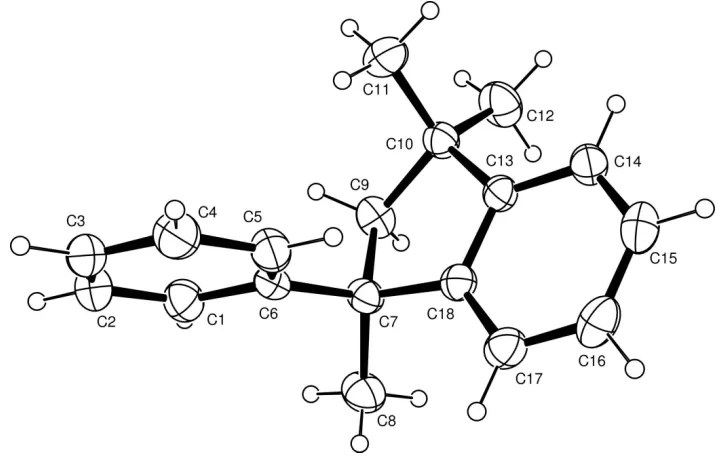
In the title compound, C18H20, the five-membered ring of the indane fragment adopts an envelope conformation, with the flap atom deviating by 0.399 (3) A˚ from the plane of the remaining four atoms. The dihedral angle between the phenyl ring and the indane benzene ring is 79.58 (7).
Related literature
For related literature, see: Bateman & Gordon (1974, 1976); Ghosh & Mittal (1996); Fegeret al.(1989).
Experimental
Crystal data
C18H20
Mr= 236.34
Triclinic,P1
a= 8.192 (2) A˚
b= 8.426 (3) A˚
c= 11.113 (4) A˚ = 69.30 (3) = 79.44 (5)
= 80.37 (2)
V= 701.0 (7) A˚3
Z= 2
MoKradiation = 0.06 mm 1
T= 291 (2) K 0.460.440.42 mm
Data collection
Enraf–Nonius CAD-4 diffractometer
Absorption correction: none 3682 measured reflections 2582 independent reflections
1770 reflections withI> 2(I)
Rint= 0.007
3 standard reflections every 200 reflections intensity decay: 0.7%
Refinement
R[F2> 2(F2)] = 0.040
wR(F2) = 0.117
S= 1.06 2582 reflections
170 parameters
H-atom parameters constrained
max= 0.17 e A˚ 3
min= 0.14 e A˚ 3
Data collection:DIFRAC(Gabe & White, 1993); cell refinement:
DIFRAC; data reduction:NRCVAX(Gabeet al., 1989); program(s) used to solve structure: SHELXS97(Sheldrick, 2008); program(s) used to refine structure: SHELXL97 (Sheldrick, 2008); molecular graphics:ORTEP-3 for Windows(Farrugia, 1997); software used to prepare material for publication:SHELXL97.
The authors are grateful to the National Undergraduates’ Innovative Experiment Project of China for financial support, and thank Mr Zhi-Hua Mao of Sichuan University for the X-ray data collection.
Supplementary data and figures for this paper are available from the IUCr electronic archives (Reference: GK2139).
References
Bateman, J. & Gordon, D. A. (1974). US Patent 3856752. Bateman, J. & Gordon, D. A. (1976). US Patent 3983092. Farrugia, L. J. (1997).J. Appl. Cryst.30, 565.
Feger, C., Khohasteh, M. M. & McGrath, J. E. (1989). Editors.Polyimides: Chemistry, Materials and Characterization. Amsterdam: Elsevier. Gabe, E. J., Le Page, Y., Charland, J.-P., Lee, F. L. & White, P. S. (1989).J. Appl.
Cryst.22, 384–387.
Gabe, E. J. & White, P. S. (1993).Am. Crystallogr. Assoc. Pittsburgh Meet.
Abstract PA104.
Ghosh, M. K. & Mittal, K. L. (1996). Polyimides: Fundamentals and Applications. New York: Dekker.
Sheldrick, G. M. (2008).Acta Cryst.A64, 112–122.
Acta Crystallographica Section E
Structure Reports
Online
supporting information
Acta Cryst. (2008). E64, o847 [doi:10.1107/S1600536808009690]
1,1,3-Trimethyl-3-phenylindane
Jian Men, Mei-Jia Yang, Yan Jiang, Hua Chen and Guo-Wei Gao
S1. Comment
Polyimides are well known for possessing excellent thermal and oxidative stability, as well as excellent mechanical
properties (Ghosh & Mittal, 1996; Feger et al., 1989). Furthermore, polyimides with phenylindane diamines and/or
dianhydrides incorporated into the polyimide backbone have been found to be soluble in high concentration in polar
organic solvents (Bateman & Gordon, 1974). Phenylindane diamines are prepared by a process comprising acid-catalyzed
dimerization of α-methylstyrene and subsequent nitration and reduction of the 1,1,3-trimethyl-3-phenyl-2,3-dihydro-1H
-indene (Bateman & Gordon, 1976).
The molecule of the title compound is shown in Fig. 1. Rings A (C1–C6) and B (C13–C18) are planar and form dihedral
angle of 79.58 (7)°. The B ring forms dihedral angle of 25.38 (14)° with the plane defined by the indane Csp3 atoms C7,
C9 and C10.
S2. Experimental
α-Methylstyrene (32.0 g, 0.30 mol) was added to a 500 ml flask equipped with a condenser and a mechanical stirrer, followed by slow addition of a previously prepared mixture of H2SO4 (68 ml) and H2O (130 ml). The reaction mixture
was refluxed for 20 h. After it was cooled to room temperature, the lower acid phase was drawn off and discarded. The
organic phase containing the phenylindane was washed with water several times. The product was recrystallized from
methanol that afforded white crystals (24 g, yield 68%, m.p. 323–324 K).
S3. Refinement
H atoms were positioned geometrically (C—H = 0.93–0.97 Å) and refined using a riding model, with Uiso(H) = 1.2Ueq
Figure 1
The molecular structure of the title compound with displacement ellipsoids drawn at the 30% probability level.
1,1,3-Trimethyl-3-phenylindane
Crystal data
C18H20
Mr = 236.34 Triclinic, P1 Hall symbol: -P 1
a = 8.192 (2) Å
b = 8.426 (3) Å
c = 11.113 (4) Å
α = 69.30 (3)°
β = 79.44 (5)°
γ = 80.37 (2)°
V = 701.0 (7) Å3
Z = 2
F(000) = 256
Dx = 1.120 Mg m−3
Mo Kα radiation, λ = 0.71073 Å Cell parameters from 28 reflections
θ = 4.4–7.7°
µ = 0.06 mm−1
T = 291 K Block, colourless 0.46 × 0.44 × 0.42 mm
Data collection
Enraf–Nonius CAD-4 diffractometer
Radiation source: fine-focus sealed tube Graphite monochromator
ω/2τ scans
3682 measured reflections 2582 independent reflections 1770 reflections with I > 2σ(I)
Rint = 0.007
θmax = 25.5°, θmin = 2.6°
h = −9→9
k = −3→10
l = −12→13
3 standard reflections every 200 reflections intensity decay: 0.7%
Refinement
Refinement on F2 Least-squares matrix: full
R[F2 > 2σ(F2)] = 0.040
wR(F2) = 0.117
S = 1.06
2582 reflections 170 parameters 0 restraints
Secondary atom site location: difference Fourier map
Hydrogen site location: inferred from neighbouring sites
H-atom parameters constrained
w = 1/[σ2(F
o2) + (0.0549P)2 + 0.0915P] where P = (Fo2 + 2Fc2)/3
(Δ/σ)max < 0.001 Δρmax = 0.17 e Å−3 Δρmin = −0.14 e Å−3
Extinction correction: SHELXL97 (Sheldrick, 2008), Fc*=kFc[1+0.001xFc2λ3/sin(2θ)]-1/4 Extinction coefficient: 0.154 (10)
Special details
Experimental. 1H NMR (400 MHz, CDCl
3): δ = 1.03, 1.35, 1.69 (s, 3H, –CH3), 2.21 and 2.40 (d, 2H, –CH2–), 7.11–7.29 (m, 9H, Ar—H).
Geometry. All e.s.d.'s (except the e.s.d. in the dihedral angle between two l.s. planes) are estimated using the full covariance matrix. The cell e.s.d.'s are taken into account individually in the estimation of e.s.d.'s in distances, angles and torsion angles; correlations between e.s.d.'s in cell parameters are only used when they are defined by crystal symmetry. An approximate (isotropic) treatment of cell e.s.d.'s is used for estimating e.s.d.'s involving l.s. planes.
Refinement. Refinement of F2 against ALL reflections. The weighted R-factor wR and goodness of fit S are based on F2, conventional R-factors R are based on F, with F set to zero for negative F2. The threshold expression of F2 > 2σ(F2) is used only for calculating R-factors(gt) etc. and is not relevant to the choice of reflections for refinement. R-factors based on F2 are statistically about twice as large as those based on F, and R-factors based on ALL data will be even larger.
Fractional atomic coordinates and isotropic or equivalent isotropic displacement parameters (Å2)
x y z Uiso*/Ueq
C18 0.39195 (18) 0.00422 (18) 0.21135 (14) 0.0428 (4)
C6 0.20481 (17) 0.27044 (18) 0.22736 (14) 0.0436 (4)
C14 0.6116 (2) −0.1842 (2) 0.32179 (15) 0.0527 (4)
H14 0.7136 −0.2011 0.3526 0.063*
C13 0.54458 (18) −0.02135 (18) 0.25548 (14) 0.0421 (4)
C7 0.34020 (18) 0.19224 (19) 0.14280 (14) 0.0453 (4)
C17 0.3069 (2) −0.1345 (2) 0.23220 (17) 0.0567 (4)
H17 0.2043 −0.1181 0.2025 0.068*
C10 0.61857 (19) 0.14541 (19) 0.22095 (15) 0.0478 (4)
C1 0.1330 (2) 0.4375 (2) 0.17672 (18) 0.0595 (5)
H1 0.1670 0.5006 0.0908 0.071*
C5 0.1502 (2) 0.1821 (2) 0.35573 (16) 0.0542 (4)
H5 0.1951 0.0697 0.3928 0.065*
C3 −0.0391 (2) 0.4221 (3) 0.3779 (2) 0.0665 (5)
H3 −0.1201 0.4724 0.4279 0.080*
C15 0.5266 (2) −0.3214 (2) 0.34208 (17) 0.0606 (5)
H15 0.5716 −0.4313 0.3863 0.073*
C2 0.0126 (2) 0.5121 (2) 0.2504 (2) 0.0696 (5)
H2 −0.0339 0.6240 0.2137 0.083*
C4 0.0303 (2) 0.2575 (3) 0.43009 (18) 0.0653 (5)
H4 −0.0034 0.1957 0.5164 0.078*
C9 0.5091 (2) 0.2673 (2) 0.11982 (16) 0.0543 (4)
H9A 0.5650 0.2782 0.0329 0.065*
H9B 0.4892 0.3795 0.1289 0.065*
C16 0.3754 (2) −0.2966 (2) 0.29712 (18) 0.0640 (5)
H16 0.3192 −0.3899 0.3107 0.077*
H8A 0.3617 0.1654 −0.0374 0.100*
H8B 0.2635 0.3405 −0.0340 0.100*
H8C 0.1759 0.1728 0.0293 0.100*
C11 0.5994 (3) 0.1997 (2) 0.34135 (19) 0.0690 (5)
H11A 0.4832 0.2128 0.3749 0.104*
H11B 0.6446 0.3062 0.3180 0.104*
H11C 0.6585 0.1139 0.4065 0.104*
C12 0.8028 (2) 0.1333 (3) 0.1630 (2) 0.0723 (6)
H12A 0.8426 0.2429 0.1377 0.109*
H12B 0.8146 0.0980 0.0883 0.109*
H12C 0.8669 0.0513 0.2266 0.109*
Atomic displacement parameters (Å2)
U11 U22 U33 U12 U13 U23
C18 0.0409 (8) 0.0477 (9) 0.0410 (8) −0.0052 (7) −0.0006 (6) −0.0185 (7)
C6 0.0386 (8) 0.0477 (9) 0.0461 (9) −0.0021 (7) −0.0125 (7) −0.0155 (7)
C14 0.0555 (10) 0.0501 (10) 0.0506 (9) 0.0029 (8) −0.0100 (8) −0.0171 (8)
C13 0.0434 (8) 0.0441 (8) 0.0388 (8) −0.0017 (6) −0.0031 (6) −0.0162 (7)
C7 0.0423 (8) 0.0506 (9) 0.0411 (8) −0.0023 (7) −0.0078 (6) −0.0131 (7)
C17 0.0481 (9) 0.0637 (11) 0.0656 (11) −0.0115 (8) −0.0018 (8) −0.0309 (9)
C10 0.0422 (8) 0.0472 (9) 0.0537 (9) −0.0060 (7) −0.0078 (7) −0.0155 (7)
C1 0.0623 (11) 0.0537 (10) 0.0595 (11) −0.0005 (8) −0.0128 (9) −0.0157 (8)
C5 0.0530 (10) 0.0568 (10) 0.0482 (9) 0.0022 (8) −0.0064 (8) −0.0158 (8)
C3 0.0483 (10) 0.0852 (14) 0.0811 (14) 0.0089 (9) −0.0138 (9) −0.0509 (12)
C15 0.0738 (12) 0.0422 (9) 0.0581 (10) −0.0012 (8) −0.0002 (9) −0.0138 (8)
C2 0.0668 (12) 0.0601 (11) 0.0882 (15) 0.0127 (9) −0.0238 (11) −0.0348 (11)
C4 0.0590 (11) 0.0837 (14) 0.0536 (10) −0.0014 (10) −0.0020 (9) −0.0289 (10)
C9 0.0491 (9) 0.0510 (9) 0.0525 (10) −0.0069 (7) −0.0026 (7) −0.0063 (8)
C16 0.0715 (12) 0.0493 (10) 0.0735 (12) −0.0191 (9) 0.0083 (10) −0.0267 (9)
C8 0.0659 (12) 0.0851 (13) 0.0473 (10) 0.0056 (10) −0.0148 (9) −0.0236 (9)
C11 0.0802 (13) 0.0639 (11) 0.0758 (13) −0.0119 (9) −0.0212 (10) −0.0317 (10)
C12 0.0464 (10) 0.0720 (12) 0.0943 (15) −0.0103 (9) −0.0070 (10) −0.0219 (11)
Geometric parameters (Å, º)
C18—C13 1.382 (2) C5—H5 0.9300
C18—C17 1.388 (2) C3—C4 1.368 (3)
C18—C7 1.520 (2) C3—C2 1.375 (3)
C6—C5 1.384 (3) C3—H3 0.9300
C6—C1 1.388 (2) C15—C16 1.376 (3)
C6—C7 1.536 (2) C15—H15 0.9300
C14—C15 1.379 (2) C2—H2 0.9300
C14—C13 1.382 (2) C4—H4 0.9300
C14—H14 0.9300 C9—H9A 0.9700
C13—C10 1.519 (2) C9—H9B 0.9700
C7—C8 1.538 (2) C16—H16 0.9300
C17—C16 1.377 (3) C8—H8B 0.9600
C17—H17 0.9300 C8—H8C 0.9600
C10—C12 1.530 (2) C11—H11A 0.9600
C10—C11 1.535 (3) C11—H11B 0.9600
C10—C9 1.539 (2) C11—H11C 0.9600
C1—C2 1.378 (3) C12—H12A 0.9600
C1—H1 0.9300 C12—H12B 0.9600
C5—C4 1.385 (2) C12—H12C 0.9600
C13—C18—C17 119.85 (15) C16—C15—C14 120.29 (16)
C13—C18—C7 111.75 (13) C16—C15—H15 119.9
C17—C18—C7 128.40 (14) C14—C15—H15 119.9
C5—C6—C1 116.91 (16) C3—C2—C1 120.35 (18)
C5—C6—C7 122.83 (14) C3—C2—H2 119.8
C1—C6—C7 120.26 (15) C1—C2—H2 119.8
C15—C14—C13 119.63 (16) C3—C4—C5 120.67 (18)
C15—C14—H14 120.2 C3—C4—H4 119.7
C13—C14—H14 120.2 C5—C4—H4 119.7
C14—C13—C18 120.23 (15) C10—C9—C7 108.20 (13)
C14—C13—C10 128.01 (14) C10—C9—H9A 110.1
C18—C13—C10 111.76 (14) C7—C9—H9A 110.1
C18—C7—C6 112.36 (13) C10—C9—H9B 110.1
C18—C7—C8 111.23 (14) C7—C9—H9B 110.1
C6—C7—C8 109.72 (13) H9A—C9—H9B 108.4
C18—C7—C9 100.82 (13) C15—C16—C17 120.42 (16)
C6—C7—C9 111.63 (13) C15—C16—H16 119.8
C8—C7—C9 110.83 (14) C17—C16—H16 119.8
C16—C17—C18 119.56 (16) C7—C8—H8A 109.5
C16—C17—H17 120.2 C7—C8—H8B 109.5
C18—C17—H17 120.2 H8A—C8—H8B 109.5
C13—C10—C12 112.22 (14) C7—C8—H8C 109.5
C13—C10—C11 110.21 (14) H8A—C8—H8C 109.5
C12—C10—C11 109.67 (15) H8B—C8—H8C 109.5
C13—C10—C9 101.46 (13) C10—C11—H11A 109.5
C12—C10—C9 111.39 (15) C10—C11—H11B 109.5
C11—C10—C9 111.70 (15) H11A—C11—H11B 109.5
C2—C1—C6 121.72 (18) C10—C11—H11C 109.5
C2—C1—H1 119.1 H11A—C11—H11C 109.5
C6—C1—H1 119.1 H11B—C11—H11C 109.5
C6—C5—C4 121.37 (17) C10—C12—H12A 109.5
C6—C5—H5 119.3 C10—C12—H12B 109.5
C4—C5—H5 119.3 H12A—C12—H12B 109.5
C4—C3—C2 118.96 (18) C10—C12—H12C 109.5
C4—C3—H3 120.5 H12A—C12—H12C 109.5