ToLeRating UR-STD
Jan Feyereisl and Uwe Aickelin
School of Computer Science
The University of Nottingham
Nottingham, UK
[email protected], [email protected]
Abstract
A new emerging paradigm of Uncertain Risk of Suspi-cion, Threat and Danger, observed across the field of in-formation security, is described. Based on this paradigm a novel approach to anomaly detection is presented. Our approach is based on a simple yet powerful analogy from the innate part of the human immune system, the Toll-Like Receptors. We argue that such receptors incorporated as part of an anomaly detector enhance the detector’s ability to distinguish normal and anomalous behaviour. In addi-tion we propose that Toll-Like Receptors enable the classi-fication of detected anomalies based on the types of attacks that perpetrate the anomalous behaviour. Classification of such type is either missing in existing literature or is not fit for the purpose of reducing the burden of an administrator of an intrusion detection system. For our model to work, we propose the creation of a taxonomy of the digital Acytota, based on which our receptors are created.
1
The State of Affairs
Signature and anomaly based intrusion detection sys-tems (IDS) have been around for many years, yet repeat-edly have encountered the same pitfalls over and over again. This issue has been raised in the past, notably by Gates and Taylor [4] who challenged the idea of network based ano-maly detection systems. Gates’ and Taylor’s account of the problem focuses mainly on anomaly detection in the net-work environment, however the area of host based intru-sion detection, be it signature or anomaly based, exhibit analogous issues. Systems which combine these two ap-proaches are sparse, let alone successful at attracting the security community to pursue the mixed approach further. We argue that such approach has so far been unsuccessful due to the way the fusion of the approaches was tackled.
One of the most counter-productive failings of existing IDS systems is the enduring presence of false positive alerts.
This problem is aggravated even more with the sheer vol-ume of such alerts. In anomaly based detection systems this is often due to the lack of re-training and re-calibration of detectors especially in unstable environments. These high volumes result in the difficulty of analysing logs produced by intrusion detection systems. Various forms of visuali-sation exist that attempt to solve this issue, however with little success [11]. Gates and Taylor [4] propose a classifi-cation of detected anomalies based on the type of attack that caused them in order for an IDS administrator to be able to prioritise and deal with most serious threats first. We pro-pose that the incorporation of our immunological analogy enables anomaly classification at a level suitable for such prioritisation.
A seemingly simple part of the innate immune system that only recently began its research journey by immunol-ogists has been our vital inspiration. This is the area of Pathogen Associated Molecular Patterns (PAMP) and Toll Like Receptors (TLR) in particular [3]. After some study of the security field, the authors realised that numerous re-searchers have presented ideas that support our proposed model, or that add functionality to form a more coherent whole outlining a paradigm worth investigating. We call this paradigm UR-STD.
2
The Uncertain Risk of STD
In 1994 Polly Matzinger shook the world of immunology with her controversial model of how the immune system op-erates [7]. Her view divided the immunological community which until this day segregates itself into classical immunol-ogy, theDangermodel and immunologists who don’t clas-sify themselves into any of the aforementioned camps. In Matzinger’s model, danger is defined as follows [7]:
The authors cannot determine if the shift in immunology from a concrete deterministic concept of self/non-self to a less concrete danger model had an effect on the thinking within the field of computer science, however a brief scan through research into new paradigms reveals a number of related approaches to computer security. Hollebeek’s paper [5] on the role of suspicion in model based IDS gives a fas-cinating account of two new concepts ofsuspicionand un-certainty. These are introduced as part of a forensic anal-ysis model that employs such new ways of thinking about what could constitute malicious behaviour in post-analysis. His definitions are as follows [5]:
• Suspicion-likelihood that a given event or pattern of events is evidence of malicious behaviour
• Uncertainty- likelihood that deductions are correct and the likelihood the observed behaviour is normal
under the assumption that no malicious behaviour is present
A number of points from Hollebeek’s work are comple-menting the thesis of this paper. Firstly the fact that in foren-sic analysis an analyst only needs a few clues in order to recognise an intrusion. This approach works well from a forensics point of view rather than anomaly detection, how-ever as will be shown in Section 6.2, this does not have to be the case. Secondly a concept which is paramount to the Danger model by Matzinger, the notion of context, as be-ing a vital part of an IDS. Hollebeek does not associate his views with immunology or the Danger model. The assump-tion therefore might be that an investigaassump-tion of Matzinger’s model might provide some additional inspiration, which can teach us something applicable to IDS.
Besides the already mentioned new metrics, Saydjari proposed a new measure for system security,Risk[13]. An-other term, originally classified more as a subjective mea-sure, nevertheless presented by Saydjari with all the quali-ties of a good metric. His definition is as follows [13]:
• Risk-risk of an event happening is the probability of that event happening multiplied by the consequences (damage or loss) from that event
• Overall Risk - the sum of the risk of all the bad events(failures) that can be induced by a malicious at-tacker on an information system
Last but not least the termthreat, which has been used in information security for decades, only now beginning to stand as a valid measure in its own right. Sahinoglu for example defines threat in his model in the following way [12]:
• Threat - the probability of the exploitation of some vulnerability or weakness within a specific time frame.
We propose that a new paradigm is emerging in exist-ing literature. This paradigm moves away from traditional forms of measures from quantifiably objective to seemingly more subjective ones. We call this theUncertain Risk of
Suspicion,Threat andDanger paradigm.
In the remainder of our paper we will present a new ap-proach to intrusion detection closely tied to the newly de-fined UR-STD paradigm, particularly to the notion of dan-ger, based on Matzinger’s model, suspicionby Hollebeek and a more general notion ofthreat.
3
PAMPing up Anomaly Detection
As proposed by Matzinger’s model and many subsequent research works undertaken by immunologists, pathogen as-sociated molecular patterns and their detectors play a vital role in detecting danger in the human body. One such type of PAMP detectors are Toll-Like Receptors which are de-scribed in more detail in Section 4. This paper proposes that PAMP receptors are a necessary extension to current anomaly detection techniques in order to obtain results from our systems that go beyond what has been achieved in both anomaly and signature based detection fields. Hollebeek [5] confirms this view, arguing that in forensics, an analyst does not analyse data in a naive way. In other words he can-not analyse data without knowing about what he is looking for. We suggest that receptors, such as TLRs are missing. As John McHugh stated in his work on locality, the under-standing of our systems with which we work is necessary to the degree, which will allow us to identify necessary parts of malicious activities [9]. Surprisingly McHugh’s intentions portray the functionality of TLRs in the human immune sys-tem very well.
3.1
Signatures and Anomalies
especially true when diversity is a factor in terms of ob-served attributes of a system. Such unique features are the extra knowledge that we need in order to distinguish be-tween anomalous and malicious behaviour. TLRs are the proposed way of storing and sensing such features when they occur. In order to obtain the necessary information about such features we propose the creation of a taxonomy of the digital Acytota as described in Section 5.
4
Toll-Like Receptors
Paramount to our model is the notion of lower level, low volume receptors, which detect by-products of malicious activity. Such receptors exist in the human body in the form of Toll-Like Receptors. In the following section we will in-troduce these structures and draw an analogy to computer security.
4.1
Function
Toll-like receptors are a set of receptors on the surface of immune cells, which act as sensors to foreign microbial products, more broadly described as PAMPs. Up to this date around twelve TLRs have been discovered in the hu-man body, each of them sensing a specific protein or a set of proteins discharged by viruses and bacteria. These mi-crobial products are of essential nature to the existence and function of the foreign entities, thus making it impossible for the bacteria and viruses to adapt and evade these recep-tors. A simple definition of TLRs is that they are the initial line of defence against pathogens attacking a system. They sound an alarm when they encounter certain virus or bac-teria specific chemicals, which trigger a cascade of events potentially resulting in an immune response. One can think of these receptors as piano keys. A different sound is played when a different key or combination of keys is pressed at once. TLRs can be categorised based on their specializa-tion. TLRs 1,2,4,5 and 6 mainly specialise in bacterial prod-ucts, whereas TLRs 3,7,8 and 9 specialise in the detection of virus specific by-products and nucleic acids. This func-tionality of TLRs is a feature which is in many ways anal-ogous to some problems computer security. The fact that different combinations of activated TLRs perform different actions make it possible for the idea to be used in a multi-dimensional environment such as intrusion detection.
4.2
Analogy
From the description of the functionality of TLRs, one can see that such receptors lend themselves to the missing component of anomaly detection. This is due to their sim-plicity yet powerful functionality. One can argue that in the human body TLRs detect ligands which are produced by
parts of malignant entities which are not subject to muta-tion. This is very different from the nature of digital mali-cious entities which can mutate or morph between versions or even on their own (e.g. polymorphic virus). However we argue that due to the deterministic nature of machines the creation of a taxonomy of the digital Acytota should be possible, which at some level is representative of the mali-cious entities digital systems encounter. Such a taxonomy will have to evolve over time at some level, however this will be incomparable in terms of frequency and volume to the level at which current signature based systems are up-dated.
To enforce our argument for TLRs as the correct candi-date for our analogy, we look back at Hollebeek’s work. In his paper, an overall suspicion in his model is described as
‘a function of the degree to which each resource, event, or inference is suspicious and the number of independent rea-sons we have for being suspicious of it’ [5]. Here we can see a clear parallel with the functionality of TLRs. Given that each resource, event and possibly an inference holds a set of TLRs, we can obtain a measure of suspicion, which together with existing anomaly based systems can give us a more decisive view of what is happening.
5
Towards a Taxonomy of the Digital Acytota
In order to be able to employ the functionality of TLRs in intrusion detection systems, we need to develop a taxon-omy of the digital malicious world. This is a pre-requisite, without which the proposed model becomes less effective. Such a taxonomy would not only allow us to implement the notion of TLRs fully, but would also allow us to classify detected malicious activities based on their type. One exist-ing analysis of system calls in terms of their threat level and class of possible malicious activity has been proposed by Bernaschi in [1]. He classified system calls into four differ-ent threat levels, based on what kind of attack they are most likely to be used for, and nine groups of system function-ality. For example Bernaschi classified system callsopen,
mountandlink, among others, as belonging to threat level group 1, which represents system calls generally used for attacks that allow for the full control of a system.
a Code Red or SQL/Slammer as an example, which corre-sponds to our desired, seemingly unique features. Another candidate is the set of system call arguments. These exhibit numerous features which can be considered unique to at-tacks. We can also clearly define what types of system call arguments can present a higher risk to a system. For exam-ple an argument which contains the reference to thepasswd
file under the Unix OS can be potentially much more haz-ardous than a reference to a word processing document in a user’s home directory. The inclusion of system call argu-ments in our TLR model should also ensure the detection of mimicry attacks.
6
Proof of Concept
In order to evaluate our model, we have developed a sys-tem which incorporates the afore-described model. This system was constructed by observing the human immune system and while maintaining some aspects of the biologi-cal functionality, the immune system was largely an inspira-tion rather than a guide. For the anomaly detector which in-corporates TLRs, Kohonen’s Self-Organising Maps (SOM) [6] have been used, due to their similarity to the role of tis-sue in the human body. Further justifications for the use of SOMs are described in the following section.
6.1
SOMs as a Somatic model
The idea of self-organising networks comes as an ideal analogy to an environment within which TLRs exist in the human body, tissue. This is based on their similar behaviour and functionality. Both self-organising networks and tissue have nodes/cells, which dynamically change based on the situation they are in. SOM networks adapt to data which is passed through them and in human tissue, cells die and new ones are created as the body needs them.
One such type of self-organising networks are the afore-mentioned Kohonen’s self-organising maps (SOM) [6]. Ko-honen’s SOM is an algorithm which allows the input of highly multi-dimensional data which is reduced to a pre-defined smaller dimensionality in order to represent such complex data in a more understandable manner for both human and machine. It organises the input data within a low-dimensional map, based on the similarity between the incoming data items and items already present in the map. In this way, the algorithm automatically organises and puts similar data items in topologically close proximity of each other within the generated map.
[image:4.612.318.536.69.146.2]This self-organisation presents a number of parallels be-tween the digital and a biological system. Such as the fa-cilitation of a possible localisation function based on the topological proximity of neighbouring nodes within a SOM [10], possibly of interest to the research on locality [9].
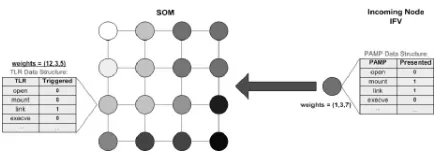
Figure 1. TLR implementation within a SOM
The ability of self-organising network algorithms such as Kohonen’s SOM allow us to experiment and take into account the issues of diversity [8] with little difficulty. As will be shown in Section 6.3, the ability to monitor a large variety as well as only few aspects of the monitored system, provide an ideal environment for TLR implementation.
6.2
Implementation of TLRs
In our system, the implementation of TLRs is achieved by the creation of a table structure for every node within a SOM. We have taken Bernaschi’s [1] system call threat level categorisation and experimented with threat level 1 group. This means system calls used in attacks which allow for the full control of a system. These 23 system calls are used in our model as one TLR, which each SOM node exhibits. Figure 1 shows the TLR model within the SOM context.
Kohonen’s SOM algorithm, just like any other unsuper-vised learning algorithm, comprises of two steps. Training and detection. The role of TLRs in training is different from detection. The SOM, besides being trained on various sys-tem signals described below, learns the PAMPs encountered during training. In our implementations PAMPs are simply system calls which have been called during a time frame that is represented by an incoming node (data vector). The algorithm initially starts with random values assigned to the maps node’s weight values, as proposed by Kohonen. The TLR data structure, as seen in Figure 1, is initialised for each node within the SOM map with a value for the Trig-gered field as0, meaning false. During training the map learns according to the standard SOM algorithm, with the additional functionality of activation of TLRs when relevant PAMPs are encountered. This activation occurs when in-coming nodes on which the SOM is trained present PAMPs which the SOM node’s TLRs bind to.
al-gorithm determines the winning node for the currently ob-served IFV, we simply trigger its TLRs depending on the presented PAMPs. This way we train our SOM not only on the IFV data but also on the specific features that are observable during normal operation of the monitored sys-tem/resource (i.e. a monitored process in our case). Once our SOM is trained, this represents a reduced representation of normal behaviour of the monitored system/resource.
In the detection stage, rather than adjusting the SOM map further, we simply find the Best Matching Unit (BMU) for the currently presented IFV and calculate their simi-larity. At the same time our system monitors if the cur-rently observed IFV presents a PAMP. If it does, then the algorithm checks which TLRs of the BMU have been trig-gered during training. If the IFV presents PAMPs which were present during training, than we assume that their pres-ence is justified, thus nothing additional happens. We might however retain the information holding the total number of triggered TLRs which were encountered during training for purposes yet to be investigated (e.g. SOM evolution). On the other hand if PAMPs are encountered which have not been detected during training, then our TLR activation level increases. This activation level is a measure of suspicious activity on its own, however we can use it to amend the result of the overall BMU distance measure, which is a rep-resentation of how anomalous a monitored IFV is. Thus making an IFV which presents a large number of PAMPs, not encountered during training, more anomalous and suspi-cious than an IFV which does not present any PAMPs. The effect of this action is to be further investigated and tested to fully appreciate its possibilities and correctness.
Using this model we argue that we are able to achieve what Hollebeek [5] proposed in his paper for forensics anal-ysis. Yet we are looking to achieve this for real-time IDS. His point of view that an analyst only needs a few clues to recognise an intrusion becomes viable with the use of TLR’s. Incompleteness as a necessary characteristic of the model is also pertinent in our case.
We further argue that the diversity of IFV’s with the ad-dition of TLR’s offers a view of a context within which ma-licious activities are detected, which inevitably is a vital part of an IDS [5]. This leads onto another vital capability of our system, which has not been implemented as of yet, however it is expected to be realised in the foreseeable future. This is the ability toclassifydetected anomalies based on the type of attack that most likely caused them. In our model this is to be implemented by assigning individual TLRs to a set of features which, as defined in our taxonomy of Acytota, represent a certain class of attacks. For example a recep-tor called TLR1 will detect any PAMPs that are associated with denial of service attacks. For such attacks we already have a set of commonly used system calls as suggested by Bernaschi [1]. Other unique features that could belong to
this receptor are for example specific types of IRC com-munication sequences exhibited by bots. Once our model contains a set of TLRs, each representing a class of attacks, we can incorporate various metrics from our UR-STD pa-radigm. For example we can define a measure of uncer-tainty, which depends on the proportion of activated TLRs and the total TLR activation level per SOM node. This will then provide us with a level of confidence showing to what degree a detected anomaly belongs to the chosen class of attacks. The choice of what class an anomaly belongs to is determined based on which TLR had the highest activa-tion level. Addiactiva-tionally the calculaactiva-tion of risk of a particu-lar type of anomaly, based on its classification is a possible candidate for further investigation.
The role of suspicion in our model is another metrics that can be used to make assumptions about the overall be-haviour of the monitored system. For example we use it to denote the total number of IFVs which present at least one PAMP to the SOM which has not been encountered during training. Thus we can obtain a measure of how suspicious a session or a window of events is. This measure is described in Section 6.3.3.
6.3
Experimental Design
As mentioned previously, our experimental setup is mainly for illustrative purposes. It is yet to be statisti-cally validated and further explored, however it provides a demonstration of our proposed TLR model with some ini-tial results.
6.3.1 Data
We have tested our model on a set of real data, based on the work of Twycross [14]. The data comprises of 55 sessions of normal behaviour and 5 attack sessions (4 sessions of a
wuftpdvulnerability exploit and 1nmapscan session). The session logs were generated using a process monitor, which samples various process specific information at a regular in-terval and system call information generated by the standard Unix tool calledstrace. A total number of 14 features have been observed using process monitor at any point in time, giving us a diverse coverage of the monitored system. For more information regarding the dataset please refer to [14].
6.3.2 SOM parameters
Table 1. SOM parameters
Parameter Value
SOM Size 15
Iterations 4
Initial Learning Rate 0.9
Neighbourhood Function squared
Neighbourhood Size 15/2
One parameter which is used in our system that does not conform to the basic SOM algorithm is the use of a distance metrics other than Euclidean. A normalisation percentage metrics is used due to the fact that the data used in our ex-periments is not normalised at the pre-processing stage. The formula used for calculating this BMU % distance measure is shown below:
P
Min(BMU,IF V)/(Max(BMU,IF V)/100)
N o.of Dimensions
This measure gives us a clearer indication of the similar-ity between the tested IFVs and the trained SOM.
The system calls used as TLRs in our model are as fol-lows: open, link, unlink, chmod, lchown, rename, fchown, chown, mknod, mount, symlink, fchmod, execve, setgid, treuid, setregid, setgroups, setfsuid, setfsgid, setresuid, se-tresgid, setuid, init module. As stated earlier they are threat level 1 group from Bernaschi’s work [1].
The SOM was trained on 7 normal sessions, chosen at random from the existing 55 sessions. The sessions used for training are as follows:2, 10, 14, 24, 35, 41, 57. Following the training session, the SOM was tested against a subset of the normal sessions not used during training and against all attack sessions.
6.3.3 Results
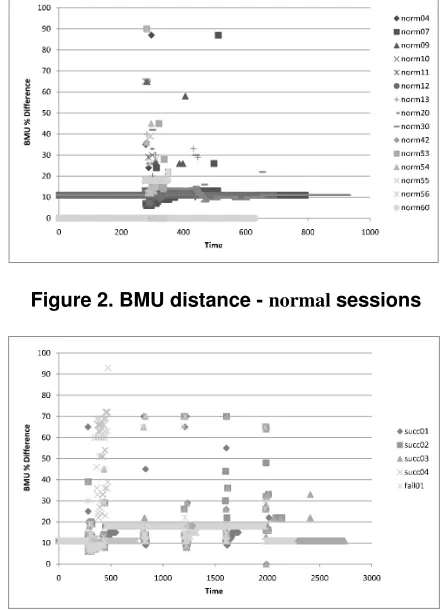
Our initial experiments have produced the following promising results. In Figure 2 we can see the result of the BMU % distance measure for a subset of our tested nor-mal sessions. From the graph we can see that the major-ity of IFVs belonging to the tested normal sessions have a percentage difference from the BMU in the range between 0 and 20%. Some false negatives in terms of BMU dis-tance measure would be generated, depending on the cho-sen threshold for what percentage difference is classified as anomalous IFVs. Nevertheless if the threshold is set to 50%, then only a handful of IFVs are above such threshold and they belong to a small subset of tested sessions. It is cor-rect to assume that by tweaking the SOM parameters and using a more precise BMU distance measure, these anoma-lous IFVs could be reduced even further.
[image:6.612.315.536.70.225.2]Comparing Figure 2 to Figure 3, we can clearly see that the BMU % distance measure for the majority of tested
[image:6.612.314.535.77.382.2]Figure 2. BMU distance -normalsessions
Figure 3. BMU distance -attacksessions
IFVs has on average increased. Also the number and spread of anomalous IFVs has increased and is present in all attack sessions. The session which produced the largest amounts of anomalous IFVs with a BMU distance of 50% and above is session 4 which is thenmapscan. This is possibly due to the fact that thenmapis a separate application from the one which is exploited by the wuftpd exploit. Thus session 4 produces more system calls and, as will be seen in Figure 4, a higher TLR activation level.
[image:6.612.89.247.82.167.2]ma-Figure 4. TLR activation level
licious entities, and with a corresponding dataset the TLR activation level results will be of more representative na-ture.
One could argue that the difference between the BMU % distance of the normal and the attack sessions is not sig-nificant enough on its own, however when we look at the TLR activation levels as shown in Figure 4, we can see that there is a clear distinction between normal and attack ses-sions. We argue that further investigation of the SOM pa-rameters will produce better results, at a level comparable or possibly higher than existing implementations of SOM based IDS systems. Once we correlate the results of BMU % distance with the TLR activation level we have a clear distinction between normal sessions and sessions that ex-hibit malicious behaviour.
7
Conclusion
The proposed Uncertain Risk of Suspicion, Threat and Danger paradigm points out to the information secu-rity field’s tendency to increasingly incorporate, originally rather subjective, measures as part of security solutions. We suggest that the use of such measures can have a positive impact on the manageability of the outcome of intrusion detection systems, especially from an administrator’s point of view. The incorporation of some of the proposed mea-sures in the form of biologically inspired receptors as part of an existing anomaly detection technique shows promis-ing results and points to the direction that such receptors might possibly be one of the missing links for successful anomaly detection in intrusion detection systems. Our view is that TLR’s inclusion not only enhances the detection ca-pability of anomaly detectors but also provides additional functionality by means of vital anomaly classification. The diverse nature of monitored features with the incorporated TLR functionality should also allow for the detection of, traditionally difficult to detect, attacks, such as race con-ditions and mimicry attacks. Further exploration of TLRs, their levels and their role as a classification mechanism is to be conducted in future research. The incorporation of
fur-ther parts of the UR-STD paradigm are also to be investi-gated in order to exploit all the possibilities of the proposed paradigm.
References
[1] M. Bernaschi, E. Gabrielli, and L. V. Mancini. REMUS: A security-enhanced operating system. ACM Transactions on Information and System Security, 5(1):36–61, Feb. 2002. [2] D. Denning. An intrusion-detection model. IEEE
Transac-tions on Software Engineering, 13(2):222–232, 1987. [3] A. Dunne and L. A. J. O’Neill. The interleukin-1
receptor/toll-like receptor superfamily: signal transduction during inflammation and host defense. Science’s STKE 2003, 2003:re3, 2003.
[4] C. Gates and C. Taylor. Challenging the Anomaly Detection Paradigm A provocative discussion. InNSPW ’06: Proceed-ings of the 2006 workshop on New security paradigms, New York, NY, USA, 2006. ACM Press.
[5] T. Hollebeek and R. Waltzman. The role of suspicion in model-based intrusion detection. InNSPW ’04: Proceedings of the 2004 workshop on New security paradigms, pages 87– 94, New York, NY, USA, 2004. ACM Press.
[6] T. Kohonen.Self-Organizing Maps. Springer-Verlag, Berlin, 1996.
[7] P. Matzinger. Tolerance, danger, and the extended family. Annual review of immunology, 12(0732-0582):991–1045, 1994.
[8] R. A. Maxion. Use of diversity as a defense mechanism. In NSPW ’05: Proceedings of the 2005 workshop on New se-curity paradigms, pages 21–22, New York, NY, USA, 2005. ACM Press.
[9] J. McHugh and C. Gates. Locality: a new paradigm for thinking about normal behavior and outsider threat. In NSPW ’03: Proceedings of the 2003 workshop on New se-curity paradigms, pages 3–10, New York, NY, USA, 2003. ACM Press.
[10] M. Neal, J. Feyereisl, R. Rascuna, and X. Wang. Don’t Touch Me, I’m Fine: Robot Autonomy Using an Artificial Innate Immune System. InProceedings of the 5th Inter-national Conference on Artificial Immune Systems (ICARIS 2006), number 4163 in Lecture Notes in Computer Science, pages 349–361, Oeiras, Portugal, 2006. Springer-Verlag. [11] K. Nyarko, T. Capers, C. Scott, and K. Ladeji-Osias.
Net-work intrusion visualization with NIVA, an intrusion detec-tion visual analyzer with haptic integradetec-tion. InHaptic In-terfaces for Virtual Environment and Teleoperator Systems, HAPTICS 2002, pages 277–284, 2002.
[12] M. Sahinoglu. Security meter: a practical decision-tree model to quantify risk.Security & Privacy Magazine, IEEE, 3:18–24, May-June 2005.
[13] O. S. Saydjari. Risk: A good system security measure. In COMPSAC ’06: Proceedings of the 30th Annual In-ternational Computer Software and Applications Confer-ence (COMPSAC’06), pages 37–38, Washington, DC, USA, 2006. IEEE Computer Society.
[image:7.612.58.277.68.186.2]