INTEGRATING REPLICATION PROCESSES WITH
MECHANICALLY INTERLOCKED MOLECULES
Annick Vidonne
A Thesis Submitted for the Degree of PhD
at the
University of St Andrews
2009
Full metadata for this item is available in
St Andrews Research Repository
at:
http://research-repository.st-andrews.ac.uk/
Please use this identifier to cite or link to this item:
http://hdl.handle.net/10023/913
This item is protected by original copyright
Integrating Replication Processes
with Mechanically Interlocked Molecules
by
Annick Vidonne
A thesis submitted to the School of Chemistry, University of St Andrews,
for the degree of Doctor of Philosophy,
I
Declarations
I, Annick Vidonne, hereby certify that this thesis, which is approximately 66,000 words in length, has been written by me, that it is the record of work carried out by me and that it has not been submitted in any previous application for a higher degree.
I was admitted as a research student in January 2005 and as a candidate for the degree of Doctor of Philosophy in January 2005; the higher study for which this is a record was carried out in the University of St Andrews between 2005 and 2009.
date ……… signature of candidate ………
I hereby certify that the candidate has fulfilled the conditions of the Resolution and Regulations appropriate for the degree of Doctor of Philosophy in the University of St Andrews and that the candidate is qualified to submit this thesis in application for that degree.
date ……… signature of supervisor ………
In submitting this thesis to the University of St Andrews we understand that we are giving permission for it to be made available for use in accordance with the regulations of the University Library for the time being in force, subject to any copyright vested in the work not being affected thereby. We also understand that the title and the abstract will be published, and that a copy of the work may be made and supplied to any bona fide library or research worker, that my thesis will be electronically accessible for personal or research use unless exempt by award of an embargo as requested below, and that the library has the right to migrate my thesis into new electronic forms as required to ensure continued access to the thesis. We have obtained any third-party copyright permissions that may be required in order to allow such access and migration, or have requested the appropriate embargo below.
The following is an agreed request by candidate and supervisor regarding the electronic publication of this thesis:
Access to all of printed copy but embargo of all of electronic publication of thesis for a period of two years on the following ground:
publication would preclude future publication
II
Contents
Declarations ...I Contents... II Acknowledgements ...IV Abstract... V Abbreviations ...VI
1 Introduction...1
1.1 Preamble...1
1.2 The chemistry of artificial replicators ...2
1.2.1 Replication models...2
1.2.2 Analysis of replicating systems ...5
1.2.3 Minimal replicating systems ...11
1.2.4 Reciprocal replicating systems ...24
1.2.5 Perspective ...26
1.3 Interlocked molecules ...27
1.3.1 Chemical topology ...27
1.3.2 Methods of rotaxane formation...28
1.3.3 Templated syntheses of [2]rotaxanes ...30
1.3.4 Thermodynamic approaches to the synthesis of rotaxanes ...38
1.3.5 Applications...40
1.4 Aims ...43
2 Strategy and design principles...44
2.1 Method of rotaxane synthesis...44
2.2 Replication models...45
2.3 Expanded replication scheme...46
2.4 Requirements ...49
2.4.1 Reactive sites ...49
2.4.2 Recognition sites ...50
2.4.3 Binding motif...51
2.5 Strategy...52
3 Design, synthesis and binding properties of macrocycles ...53
3.1 Design ...53
3.2 First generation of macrocycles...56
3.2.1 Urea macrocycle...56
3.2.2 Ethyleneurea macrocycle—ortho spacer ...57
3.2.3 Ethyleneurea macrocycle—meta spacer...61
3.2.4 Ethyleneurea macrocycle—para spacer...63
3.2.5 Symmetrical macrocycle ...64
3.3 Second generation of macrocycles...66
3.3.1 Ethyleneurea macrocycle—reverse spacers...66
3.3.2 Pyridine macrocycle...69
3.3.3 Diethylene glycol macrocycle ...73
3.4 Conclusions ...78
4 Integrating self-replication with the formation of rotaxanes ...80
4.1 Component L incorporating a 4-pyridone binding site...80
4.1.1 Design of a potential self-replicating rotaxane ...80
4.1.2 Synthesis of the nitrone ...81
4.1.3 Synthesis of the maleimide...82
4.2 Component L incorporating an amide binding site—alkyne spacers ...83
4.2.1 Design of a potential self-replicating rotaxane ...83
4.2.2 Binding study ...84
4.2.3 Synthesis of a simple rotaxane...85
4.3 Component L incorporating an amide binding site—phenyl spacers...88
4.3.1 Design of a potential self-replicating rotaxane ...88
III
4.3.3 Improving the design of the simple rotaxane ...96
4.3.4 Synthesis of a potential self-replicating rotaxane...102
4.4 Component L incorporating an amide binding site—reverse recognition site ...105
4.4.1 Design of a potential self-replicating rotaxane ...105
4.4.2 Synthesis of the maleimide...107
4.4.3 Binding study of the [LM] complex ...109
4.4.4 Synthesis of the nitrone ...114
4.4.5 Kinetic study of the thread ...115
4.4.6 Kinetic study of the rotaxane ...118
4.4.7 Additional binding study ...121
4.4.8 Computational study...125
4.5 Conclusions ...127
5 Self-replicating rotaxanes ...129
5.1 Model rotaxanes ...129
5.1.1 Synthesis of the maleimides...130
5.1.2 Binding study with the maleimides ...133
5.1.3 Additional binding study ...134
5.1.4 Synthesis of the nitrone ...138
5.1.5 Synthesis of the model rotaxanes...138
5.2 Self-replicating rotaxane with the diethylene glycol macrocycle ...141
5.2.1 Design ...141
5.2.2 Synthesis of the maleimide...142
5.2.3 Binding study of the [LM] complex ...143
5.2.4 Kinetic study of the thread ...144
5.2.5 Computational study of the thread ...148
5.2.6 Kinetic study of the rotaxane ...149
5.3 Self-replicating rotaxane with the pyridine macrocycle...152
5.3.1 Design ...152
5.3.2 Computational study of the rotaxane ...153
5.3.3 Binding study ...154
5.3.4 Synthesis of the rotaxane ...156
5.3.5 Kinetic study of the rotaxane ...159
5.4 Conclusions ...168
6 Conclusions and perspectives ...169
7 Experimental ...172
7.1 General procedures...172
7.2 NMR spectroscopy...173
7.3 Determination of binding constants...173
7.4 Kinetic measurements...174
7.5 Computational methods...174
7.6 Synthetic procedures ...175
8 Appendices ...242
8.1 Summary of binding experiments...242
8.2 X-ray crystallography determination data ...246
8.2.1 Macrocycle 94 ...246
8.2.2 Macrocycle 96 ...247
IV
Acknowledgements
I immensely enjoyed the four years I have spent in St Andrews for my PhD studies, for a number of reasons. Firstly, I was fortunate to work on an exciting and challenging research project. I am very grateful to my supervisor, Prof Douglas Philp, for giving me this opportunity. I also would like to thank him for leaving the door of his office always open, and for his contagious enthusiasm.
This work would have not been possible without the expertise of the technical staff. I wish here to express them my sincere gratitude. In particular, Melanja Smith and Dr Tomas Lebl assisted me with NMR spectroscopy, Caroline Horsburgh performed all the mass spectrometry analyses, and Prof Alexandra Slawin provided me the single-crystal X-ray diffraction data.
My experience in St Andrews has also been so unique thanks the fantastic people I was surrounded with. Special thanks go to the past and present members of the Philp research group: Dr Simon Turega, Dr Evan Wood, Dr Jan Sadownik, Peter Donnelly, Jose Cabrera, Craig Robertson, Jürgen Huck, Dr Vicente del Amo, Izzaty Hassan and all the project students. I also especially would like to thank the friends I have made on the fourth floor and in the rest of the Department, together with each of my flatmates.
V
Abstract
In the last twenty years, chemists have devised numerous synthetic chemical systems in which self-replication operates, demonstrating that molecules can replicate themselves without the aid of enzymes and that self-replication is not a prerogative of nucleic acids only. However, the coupling of replication to other recognition-mediated events and its exploitation in the amplification of large supramolecular assemblies, such as mechanically interlocked molecules, have remained unexplored areas. Among mechanically interlocked molecules, rotaxanes represent particularly attractive targets because of their application as molecular switches. This thesis describes how the recognition-mediated synthesis of a rotaxane can be combined to the amplification of its structure by replication.
VI
Abbreviations
Ac acetyl
AM1 Austin model 1
B3LYP Becke, 3-parameter, Lee, Yang and Parr
Boc tert-butoxycarbonyl
Bs benzenesulfonate
Bu butyl
calc. calculated mass
CI chemical ionisation
decomp. decomposed
DFT density functional theory
DMF dimethylformamide
DMSO dimethyl sulfoxide
DNA deoxyribonucleic acid
EDC 1-(3-dimethylaminopropyl)-3-ethylcarbodiimide hydrochloride
ES electrospray
Et ethyl
HMTA hexamethylenetetramine
HOBt 1-hydroxybenzotriazole
HRMS high resolution mass spectrometry
lit. literature
m.p. melting point
MALDI matrix-assisted laser desorption/ionization
Me methyl
MMFF Merck molecular force field
MS mass spectrometry
NBS N-bromosuccinimide
NMR nuclear magnetic resonance
Ph phenyl
PM3 parameterized model 3
Rf retention factor
RM1 Recife model 1
ROESY rotating frame nuclear Overhauser effect spectroscopy
sat. saturated
TBA tetrabutylammonium
TFA trifluoroacetic acid
THF tetrahydrofuran
TMEDA tetramethylethylenediamine
TS transition state
UV ultraviolet
1
1
Introduction
1.1 Preamble
1. Introduction
2
Biological systems demonstrate that chemical replication is possible and reveal that template effects are key to its success. However, a number of fundamental questions remain. Can molecules replicate themselves efficiently without the aid of enzymes or external cofactors? Are nucleic acids unique in their ability to store and transmit information at a molecular level? During the last twenty years, chemists have devised4 numerous non-enzymatic synthetic self-replicating systems in an attempt to answer these questions. These chemical model systems have also been designed in order to elucidate the essential principles of molecular self-replication, to identify the minimal requirements, to better understand the scope and the limitations, and to translate the principles into synthetic systems. For the synthetic chemist, these systems represent the ultimate synthetic machine, capable of templating the production of a large number of perfect copies of themselves from a single original molecule. For the biologist, they represent a link with the origin of life5—their study can perhaps shed light on prebiotic chemical evolution.
1.2 The chemistry of artificial replicators
1.2.1 Replication models
1. Introduction
3
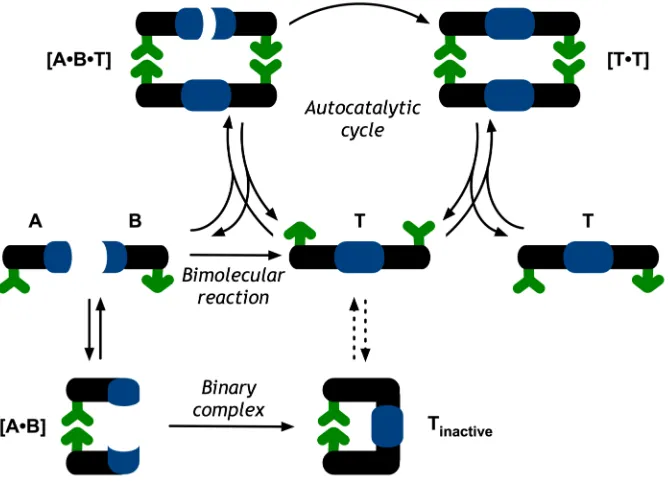
Figure 1.1 The minimal model of self-replication. Reagents A and B can react through three pathways—an uncatalysed bimolecular reaction, a recognition-mediated autocatalytic cycle recognition-mediated by a ternary complex [ABT] and a recognition-mediated pathway mediated by a binary complex [AB]. The blue cartoons represent the reactive sites and the green cartoons represent the recognition sites.
1. Introduction
4
the start of the autocatalytic cycle. Thus, assuming the open template T presents its recognition sites in the correct orientation, it can act as a template for its own formation, transmitting molecular information through the formation of identical copies of itself.
Self-replication is therefore a subset of autocatalytic reactions. In an autocatalytic reaction, the product formed in the reaction mixture is a catalyst for the same reaction. A system in which self-replication is operating can be defined as an autocatalytic reaction capable of transmitting structural information. This information can be stored as constitution, configuration, or long-living conformation. Key design elements in this model of replication are minimization of (a) reaction flux through the binary complex reaction channel and (b) inefficient autocatalysis as a result of product inhibition arising from an excessively stable product duplex [TT].
The model of self-replication discussed thus far involves self-complementary structures. However, template effects in a replication cycle can also operate in a reciprocal sense. The paradigm is DNA replication—the two strands of the double helix are not identical; one strand acts as a template for the formation of its complementary partner. The difference in template complementarity between minimal and reciprocal self-replication is a key distinction between these two types of system. In a minimal system, the template is self-complementary, whereas in a reciprocal system a pair of templates are complementary to each other. Therefore, reciprocal replicating systems rely on two interlinked crosscatalytic cycles in which the two templates catalyse the formation of each other. The processes involved in reciprocal replication are encapsulated schematically in Figure 1.2.
1. Introduction
5
and D and the reaction between E and F are orthogonal, only one reciprocal replication cycle is present in the system. However, if C can react with E and D with F, four replication cycles are possible: two minimal replication cycles—TCE and TDF may self-replicate—and the original reciprocal replication cycle TCD TEF and TEF TCD. Additionally, the minimal replicators TCE and TDF may crosscatalyse the formation of each other.
Figure 1.2 The reciprocal model of self-replication. Compounds C and D can react to form the template TCD, and, similarly, compounds E and F can react to form template TEF. TCD and TEF are mutually complementary. TCD is capable of assembling E and F into the ternary complex [EFTCD] which catalyses the formation of TEF. Similarly, TEF is capable of assembling C and D into the ternary complex [CDTEF] catalysing the formation of TCD. These two interlinked crosscatalytic cycles represent a formal reciprocal replication cycle. The blue cartoons represent the reactive sites and the green cartoons represent the recognition sites.
1.2.2 Analysis of replicating systems
Kinetic study
1. Introduction
6
a plateau when all reactants are consumed. Thus, the concentration–time profile of a replicating system should, in principle, be a sigmoidal, or "S"-shaped, curve. Therefore, a thorough analysis of the kinetic behaviour of the system is essential to analyze a replicator fully.
Control experiments
In order to demonstrate that the formation of a particular product is, indeed, the result of self-replicating behaviour, it is necessary to perform several control experiments. Firstly, it is necessary to identify a control compound which possesses the same chemical functionality as the building blocks of the replicator, but which is incapable of participating in any recognition-mediated processes. In practice, this control compound has usually its recognition site obstructed or removed. Measurement of kinetic data using this control compound provides a comparative baseline for all of the other studies.
Secondly, since the efficient operation of a self-replicating system hinges on the reversible binding events that occur during the autocatalytic cycle, it is important to demonstrate the reliance of the reaction on molecular recognition. Hence, the addition of a competitive inhibitor, which is unreactive but is capable of binding to the recognition sites present in A, B and T, to the reaction mixture will interfere with these crucial recognition processes. This interference will, in turn, disrupt the autocatalytic cycle resulting in a decrease in the rate of the reaction and/or its selectivity, often accompanied by disappearance of the sigmoidal curve.
The final, critical experiment that provides evidence that self-replication is operating within a system can be obtained by doping the reaction with the product T itself. The presence of pre-synthesized template T at the beginning of the reaction should result in a loss of the initial lag period in the rate profile for the reaction, providing evidence that the reaction is template-directed. However, it is important to point out that if the association constant of the product duplex is extremely high, adding template may not, in fact, add significant amounts of catalytically active free template to solution.
Optimization
1. Introduction
7
catalysis because the closed template Tinactive does not play any further role in the reaction process. By contrast, a self-replicating system is an attractive target as it offers its non-linear kinetic behaviour as a means of amplifying, in an exponential manner, a particular structure over others in the system.6 Therefore, the suppression, or ideally the eradication, of the binary complex route is an important parameter within the minimal model of self-replication that must be optimized to ensure an efficient system.
The second parameter that must be optimized is the catalytic efficiency within the ternary complex [ABT]. The template molecule T must accelerate the rate of reaction between the substrates A and B substantially compared with their rate of reaction in the absence of T.
The final requirement for efficient replication is the effective dissociation of the product duplex [TT]. Ideally, the duplex must be intrinsically less stable than the ternary complex [ABT]. This goal may be accomplished if a slight mismatch of the alignment of the recognition sites arises upon the formation of the new covalent bond(s). If the product duplex is extremely stable, it cannot dissociate and product inhibition arises. Hence, no new template is returned to the reaction and the autocatalytic cycle stalls. This situation raises the possibility of a self-replicating molecule that cannot complete the autocatalytic cycle. Such a system may be termed self-replicating because it constructs one copy of itself, but not autocatalytic, as it does not return significant amounts of free template to the reaction mixture. Thus, a self-replicating process is efficient when the binary complex channel is eradicated, and when a balance is found between effective binding of the substrates to the template and product release.
1. Introduction
8
constant of the product duplex resulting in increased product inhibition. Therefore, concentration and temperature must be adjusted with caution.
Kinetic simulation
1. Introduction
9
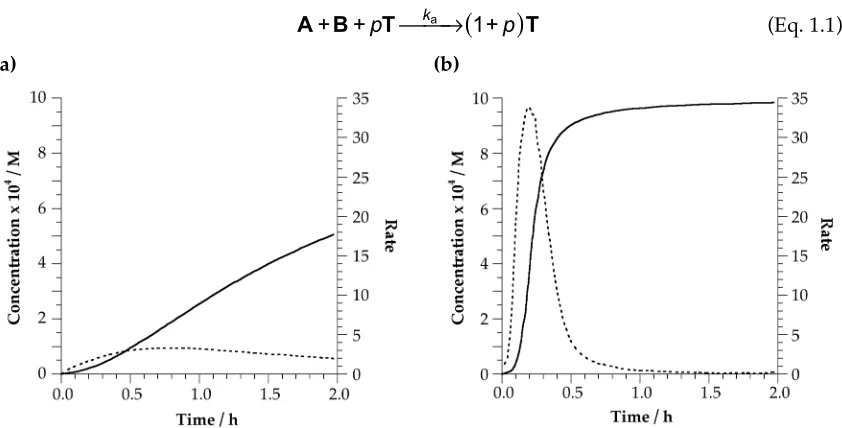
A+B+pT! "k!a
(
1+p)
T (Eq. 1.1) [image:17.595.103.524.83.297.2](a) (b)
Figure 1.3 Concentration vs. time (left y axis, solid curve) and rate vs. time (right y axis, dashed curve) profiles for (a) a reaction with an autocatalytic reaction order of 0.5 (p = 0.5) and (b) a reaction with an autocatalytic reaction order of 1 (p = 1). Data taken from reference 7.
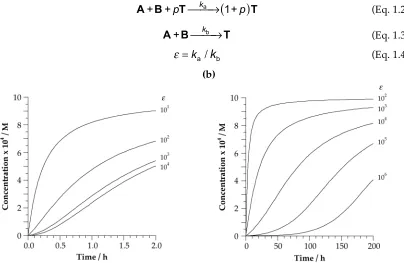
The curves of the concentration–time profiles shown in Figure 1.3 illustrate purely autocatalytic systems, which are rarely representative of real experimental systems. Figure 1.4 shows the corresponding growth curves when formation of template molecules through the bimolecular channel is taken into account. The autocatalytic efficiency ε, which is the ratio of the template-catalysed rate constant, ka, over the template-independent rate constant, kb, measures the relative contribution of the pathway involving T to the observed rate of reaction. A sigmoidal shape only becomes apparent in the concentration–time profile above a critical value of ε. Indeed, some experimental systems do not display sigmoidal production of the template even though an autocatalytic pathway is present within the system.
1. Introduction
10
A+B+pT! "k!a
(
1+p)
T (Eq. 1.2)A+B
! "
k!
b T (Eq. 1.3)! =ka
/
k
b (Eq. 1.4) [image:18.595.115.519.86.349.2](a) (b)
Figure 1.4 Concentration vs. time profiles for reactions with a contribution to their rates from an autocatalytic pathway (ka) and a bimolecular pathway (kb). The parameter ε (ka/kb) measures the relative importance of the two channels to the observed rate. For a reaction (a) with an autocatalytic reaction order of 0.5 (p = 0.5), increasing ε reveals a sigmoidal concentration vs. time profile with the point of inflection (maximal rate) convergent in time. For a reaction (b) with an autocatalytic reaction order of 1 (p = 1), increasing ε reveals a sigmoidal concentration vs. time profile with the point of inflection (maximal rate) which does not converge in time.
Often, the course of a reaction is followed by NMR spectroscopy, and so kinetic data for the system is usually based on the monitoring of NMR integrals. However, the changes in the observed chemical shifts for the various species present in solution during the course of the reaction are not taken into account. By contrast, thermodynamic parameters for the supramolecular complexes involved are usually derived from independent NMR titration experiments. Von Kiedrowski introduced8 a kinetic method ("kinetic NMR titration"), which combines analysis of integral and chemical shift changes, to harvest kinetic and thermodynamic information from the same experiment.
1. Introduction
11
1.2.3 Minimal replicating systems
The concept of non-enzymatic artificial self-replicating systems was established by von Kiedrowski in 1986 when he demonstrated that a palindromic hexadeoxynucleotide can catalyse10 its own formation from the self-complementary trinucleotide precursors 1 and 2 (Scheme 1.1). The 3'-phosphate group of trimer 1 is activated in situ by EDC, and trimer 2 bears a nucleophilic group at its 5'-terminus. Initial experiments did not reveal a sigmoidal curve for the production of hexadeoxynucleotide 3 (p = 0.48). Nevertheless, the observation of an increase in the rate of product synthesis when template is added initially, confirmed the autocatalytic contribution to the formation of template molecule.
NH N N N O NH2 O O P O O O O O O P O O O NH N N N O NH2 P N O O P O O O O O P O O O NH N N N O NH2 N O NH2 N O O P O O O O MeO N N O NH2 N NH2 O O O O C C G G G NH N N N O NH2 O O P O O O O O O P O O O NH N N N O NH2 P N O HO P O O O O O P O O O NH N N N O NH2 N O NH2 N O O P O O O O MeO N N O NH2 N NH2 O O O O C G C G G OH Cl Cl 1 2 3 C C
1. Introduction
12
Since this first demonstration, a considerable body of work has emerged on non-enzymatic synthetic replicating systems, based either on nucleic acids,11 peptides12 or small organic molecules. This chapter will mainly focus on the latter class of molecules, in light of the research carried out in this thesis. All replicating systems based on small organic molecules reported in the literature so far exploit one of these three types of covalent bond forming reactions: amide bond formation, imine production, and cycloaddition reactions.
Amide bond formation
Self-replication in small organic molecules was first described13 by Rebek and co-workers in 1990. The Rebek laboratory developed14 systems based upon amide bond formation as the chemical ligation step. The recognition between the components of the system is driven by the hydrogen-bonding between an adenine derivative and a Kemp's triacid imide. The design of these complementary recognition sites is reminiscent of biological systems—the imide presents a hydrogen-bond pattern similar to that of thymine. The first system constructed by Rebek in which self-replication operates is shown in Scheme 1.2.
NH O O O O + 4 5 6 O
OC6F5
O O O N N N N NH2 NH O O O O O HN O O O N N N N NH2 O O N O O H NH2 O O O N N N N N H H
OC6F5 O O O N O O H O O O N N N N N H H 6' O NH [4•5]
H2N
1. Introduction
13
Rebek demonstrated the importance of the size of the spacer within the ester building block; an early attempt15 incorporating a phenyl spacer, instead of a naphthyl spacer, failed, as a consequence of the resulting product remaining folded shut. In contrast, reaction between the activated pentafluorophenolate ester 4 and the amine 5 exhibits autocatalysis; seeding the reaction with prefabricated product 6 accelerates its initial rate, although no sigmoidal curve is observed. The reaction proceeds significantly slower when the imide nitrogen is methylated, and when one equivalent of 2,6-bis(acylamino)pyridine is added to the reaction mixture as competitive inhibitor. This observation is evidence that the rate enhancement is the result of molecular recognition. Rebek concluded that template 6 can catalyse its own formation, but that the observation of a sigmoidal growth curve is hampered by the dominant presence of the [AB] complex pathway.16 An unfavourable cis amide 6' is formed with the [45] complex; the subsequent isomerisation to the more favourable trans linkage prevents the product retaining intramolecular hydrogen bonding and returns free template to the mixture.
Rebek restructured17 this system to render the [AB] pathway less important by replacing the naphthyl spacer with a longer biphenyl group in template 8 (Scheme 1.3). This modification enforces the separation of ester 7 and bound amine 5 in the binary complex and this system does indeed exhibit a reaction profile with clear sigmoidal character. O HN O N H N O O Pr Pr Pr O O O H N N N N H N H O NH C6F5O
NH2 N O O Pr Pr Pr O O O H N N N N N H H O 5 7 8
Scheme 1.3 The longer biphenyl spacer present in activated ester 7, when compared to the naphthyl spacer present in 4 (Scheme 1.3), ensures that template 8 is formed principally by the reaction through the ternary complex [578] shown.
1. Introduction
14
that replicators with the adenine exocyclic amine monosubstituted are less efficient because they are limited to exploiting the Hoogsteen mode, and hence to a less favourable conformation. In order to eliminate the conformational complications from the binding of adenine in these two modes, Rebek and co-workers developed19 a second generation of replicators that incorporate a receptor able to chelate the purine through simultaneous Watson–Crick and Hoogsteen binding modes (Scheme 1.4). Rebek demonstrated that the reaction between activated ester 9 and amine 5 is self-replicating. The reaction through an [AB] complex is ruled out by the biphenyl substituent on the carbazole 9, but the efficiency of this system is impaired by strong product inhibition.
N HN
O
R2 N
N N
N N
H H
N O
O H
NH O N O
O H Pr
Pr
Pr Pr
Pr Pr
Watson-Crick Hoogsteen
O
OC6F5 9 R2 =
O
O O
NH2
R1
5 R1 =
Scheme 1.4 A combination of Watson–Crick and Hoogsteen hydrogen bonding patterns permit the recognition of 5 by 9.
Rebek also developed another class of template-directed system utilizing20 a thymine/diaminotriazine recognition motif, based around a xanthene scaffold. Recombination21 between this system and replicator 8 produced hybrid templates.
Imine bond formation
1. Introduction
15
the rate of the reaction depends linearly on the concentration of template 15. This first-order relationship indicates that product inhibition is not operative here. This result, although it originates from a crosscatalytic rather than an autocatalytic effect, suggests that self-replication with exponential autocatalysis is feasible in systems where the template forms a less stable complex with itself than with its precursors.
NO2
O O
O O
H H
N N
H H
N O
O O
H H
N N
H H
H2N R1
H2N NH2
N O
O O
R3 11
H2N NH2
NH2 R1
+ O
O O O
NO2 11 10 R1 = tBu
13 R1 = Me
R2 10 R1 = tBu 13 R1 = Me
12 R2 = NO 2 15 R2 = H
12 R3 = tBu 14 R3 = Me
NO2
Scheme 1.5 A series of auto- and crosscatalytic templates can be formed by combinations of amines 10 and 13 with aldehyde 11 in d6-DMSO.
The condensation between an amine and an aldehyde is a reversible process. This fact has been exploited23 by Giuseppone in an attempt to couple dynamic covalent chemistry24 and replication, by exploiting a replicator based on the original Rebek design 6, but replacing the activated ester in 4 with an aldehyde. In this situation, the system forms a template duplex reversibly and they created a system capable of a process they term duplication.
1. Introduction
16
Cycloaddition reactions
1. Introduction
17
16 17 18 N N N O N O O N O N C5H11O H H H H H N N N O H N O O N
O N C5H11 O
H H
Scheme 1.6 Diels–Alder cycloadduct 18 can assemble the chiral diene 16 and maleimide 17 in a catalytically-active ternary complex in CD2Cl2.
In 2005, von Kiedrowski re-evaluated28 the Sutherland system with respect to its stereochemical features, by synthesizing variants of the Sutherland replicator (Scheme 1.7). The recognition elements were replaced by an amidopyridine and a carboxylic acid in order to increase the solubility of the system. The monitoring of the reactions indicated no evidence for the formation of exo cycloadducts. Kinetic analysis of these systems leads to p values of 0.89 for the reaction between rac-19 and 20, and 0.9 for the reaction between rac-19 and 21. These data demonstrate that the von Kiedrowski variants are nearly exponential replicators and suggest that they are reasonable approximations of the Sutherland system. Studying the individual reactions between dienes (R)-19 and (S)-19 with maleimide 20 in the presence of 10% of template (R)-22 is instructive. Analysis of the concentration-time profiles demonstrates that 22 can catalyse its own formation. Additionally, (R)-22 can also catalyse the formation of (S)-(R)-22. The effect of the template is similar in both cases, indicating the presence of homochiral autocatalytic and heterochiral crosscatalytic channels. Kinetic modelling and fitting of reaction between diene 19 and maleimide 20 suggests that homochiral and heterochiral duplexes are nearly equally populated. N O O N N H O
CO2H
O N O O H H rac-19 R R
20 R = H 21 R = CH3 +
CO2H R
R N
H N
rac-22 R = H rac-23 R = CH3
1. Introduction
18
1. Introduction
19
O OH N O O N H O N N N H O m N CO2H OO
O
n N N
H O
m N
H
H CO2H
O O
O n
m = 1 n = 1
n = 2
endo: SR exo: SR
m = 2 m = 1
n = 1
n = 2
[image:27.595.165.462.81.309.2]m = 2 endo: AB exo: NR endo: AB exo: — endo: AB exo: AB endo: — exo: AB endo: NR exo: AB — endo: SRexo: AB O N H O N O m m n VIII VII VI V II I IV III H H
Figure 1.5 The combination of furan derivatives bearing an amidopyridine recognition site with maleimides bearing a carboxylic acid recognition site affords eight sets of potential replicators (systems I through VIII). The Diels–Alder reaction between the furan and maleimide give rise to two diastereoisomeric templates (endo and exo) in each system. The recognition-mediated reactivity in CDCl3 at 35 °C for each system is noted as follows: SR = self-replicating; AB = reaction through binary complex ([AB]) channel; NR = no recognition-mediated reactivity observed; – = no significant conversion under the reaction conditions employed.
1. Introduction
20
are rather efficient replicators, system XIV shows no recognition-mediated reactivity at all. This observation serves to emphasize the point that the structural window in which replication can be observed is rather narrow.
HO O m n N O O N H O N N N H O N O O H H
CO2H O
m
n N NH
O N O O H H O m
n CO2H
O
HO O
m O
m = 1 n = 1
n = 2 NR
m = 2 m = 1
n = 1
n = 2
m = 2 endo: SR
exo: SR endo: SR
exo: SR
endo: SR
exo: SR NR
endo: NR exo: AB NR endo: NRexo: AB
[image:28.595.167.463.158.372.2]XVI XV XIV XIII X IX XII XI
Figure 1.6 The combination of maleimides bearing an amidopyridine recognition site with furan derivatives bearing a carboxylic acid recognition site affords eight sets of potential replicators (systems IX through XVI). The Diels–Alder reaction between the furan and maleimide give rise to two diastereoisomeric templates (endo and exo) in each system. The recognition-mediated reactivity in CDCl3 at 35 °C for each system is noted as follows: SR = self-replicating; AB = reaction through binary complex ([AB]) channel; NR = no recognition-mediated reactivity observed; – = no significant conversion under the reaction conditions employed.
1. Introduction
21
Kinetic simulation affords values of p and ε of 0.40 and 20, respectively. These data suggests that dissociation of the [2525] duplex is limiting in this system. Evidence for the stability of the [2525] duplex comes from its behaviour in the solid state, because it crystallizes as a homodimer. A series of control experiments and kinetic modelling demonstrate that this system is relatively inefficient and has a weak replicating behaviour. Thus, the reaction between azide 24 and maleimide 20 is self-replicating—the template 25 is capable of assembling 20 and 24 and accelerating the reaction between them—but not autocatalytic, as the stability of the duplex prevents turnover.
N N O N N N O N N N N O O H H O O H H H N O O O O H N N 24 20 25 N N O N N N N O O H H O O H H 25 N N O N N N N O O H H O O H H 25
Scheme 1.8 Template 25 can assemble maleimide 20 and azide 24 in CDCl3 at 30 °C and accelerate the reaction between them.
1. Introduction
22
selectivity (trans/cis ratio = 6:1) of the reaction are increased. The formation of the major isoxazolidine trans-27 displays a sigmoidal rate profile, indicative of a self-replicating system. The addition of presynthesised template trans-27 at the beginning of the reaction enhances the formation of trans-27, and not cis-27, with concomitant disappearance of the initial lag period, resulting in an improved trans/cis ratio of 9:1. By contrast, the addition of pre-synthesized template cis-27 at the beginning of the reaction has no effect on the rate of production of either trans-27 or cis-27. The properties of this system demonstrate that only one of the two diastereoisomeric products of the cycloaddition reaction is capable of self-replication, acting as an efficient template for its own formation. Isoxazolidine trans-27 transmits its stereochemical information effectively to the forming template copy within the [2026trans-27] ternary complex. This diastereoisomer is acting as a selfish autocatalyst, enhancing the rate of formation of itself, but not its corresponding diastereoisomer. Isoxazolidine cis-27 is inactive in both an autocatalytic and in a crosscatalytic sense. Fitting of experimental data affords values of p and ε of 0.9 and 5000, respectively. These results indicate that dissociation of the product duplex is not limiting and therefore the turnover in the autocatalytic cycle is relatively efficient.
1. Introduction
23
of cis-30 to the reaction mixture has no effect on the rate profile. These observations show that the template trans-30 is amplified selectively through an autocatalytic self-replicating cycle. The contribution of cis-30 can even be removed by reducing the concentration of the reagents at the start of the reaction. Initial concentrations of 15 mM result in a trans/cis ratio of 135:1, and of 5 mM in a 250:1 ratio. Electronic structure calculations suggest (Scheme 1.10) that the two cycloadducts have very different geometries. Isoxazolidine trans-30 has an open structure in which the two recognition sites are freely available to interact with other complementary species in solution. By contrast, the structure of cis-30 is folded such that the recognition sites are placed in proximity to each other, thus rendering this product inert in a catalytic sense. It is clear that the major pathway for the formation of cis-30 is simply the bimolecular reaction between 28 and 29.
N O N O N H N O O H H OH O N O N O N N O O H H O O H H N O N O N N O O H H O O H H N O N O N N O O H H H N N O N O H N O O O O O O H H cis-27 N N H O N O N O O + 26 OH O 20 26 20 trans-27 trans-27 trans-27 trans-27 trans-27 N O N O N H N O O H H OH O
1. Introduction
24
cis-30 28
N
H N
O
N O
+ N O
O
CO2H
N O N
O
O H
H
CO2H NH
O
N 29
trans-30 trans-30
trans-30
trans-30
trans-30
cis-30 28
29
N O N
O
O H
H
CO2H NH
O
N
Scheme 1.10 Reaction of nitrone 29 with maleimide 28 in CDCl3 at –10 °C can potentially give rise to two diastereoisomeric cycloadducts—cis-30 and trans-30. However, the efficient operation of the autocatalytic cycle mediated by the ternary complex [2829trans-30] in this system ensures that trans-30 is formed almost exclusively. Ball-and-stick structures represent electronic structures calculations.
1.2.4 Reciprocal replicating systems
1. Introduction
25
28 31 33 29 34 32 N H N O N O N O O HO2CN O N NH O N O O
CO2H H
H
CO2H O N N H O N O O N O N O O H H O N N N O N H H N O O H H O O O H
O OH
30 35
N
O O
H H
O
CO2H HN O N Crosscatalytic Autocatalytic Autocatalytic
Scheme 1.11 Template trans-32 can assemble maleimide 28 and furan 31 into a crosscatalytic ternary complex [2831trans-32] in which the Diels–Alder reaction between 28 and 31, forming template 33, is accelerated. The trans diastereoisomer of template 32 accelerates the formation of the exo diastereoisomer of template 33 selectively. Similarly, template exo-33 can assemble nitrone 29 and maleimide 34 into a crosscatalytic ternary complex [2934trans-33] in which the 1,3-dipolar cycloaddition reaction between 29 and 34, forming template 32 is accelerated. The exo diastereoisomer of template 33 accelerates the formation of the trans diastereoisomer of template 33 selectively, completing a formal reciprocal replicating cycle. Combination of 29 with 28 and 31 with 34 gives rise to two minimal replicating templates 30 and 35. In experiments where 28, 29, 31 and 34 are mixed in CDCl3 at 25 °C, template trans-30 is the dominant product.
1. Introduction
26
formation of endo-33 of 1.5-fold. The exo/endo ratio rises from 1.3:1 for the uncatalysed reaction to 2:1 for the templated one. The addition of the diastereoisomeric template cis-32 accelerates only slightly the formation of both exo-33 and endo-33. Similarly, the addition of exo-33 to the 1,3-dipolar cycloaddition between nitrone 29 and maleimide 34 results in an increase in the rate of formation of trans-32 of 3.6-fold and a two-fold reduction in the rate of formation of cis-32. These changes generate a enhancement of the trans/cis ratio for the production of template 32 from 3:1 to 14:1. However, template endo-33 accelerates neither the formation of trans-32 nor cis-32. These results clearly show that reciprocal template effects operate between trans-32 and exo-33. Alternative combinations of the building blocks give rise to the minimal replicators 30 (Scheme 1.10) and 35 (system XI, Figure 1.6). Mixing all of the four building blocks 28, 29, 31 and 34 in a single reaction affords a product mixture in which trans-30 is the dominant species.
1.2.5 Perspective
Chemists have devised a wide range of synthetic chemical systems in which self-replication operates, demonstrating that molecules can replicate themselves without the aid of enzymes and that self-replication is not a prerogative of nucleic acids only. Self-replication is no longer an enigmatic process considered as exclusive to living matter. The development of models for studying self-replication has also demonstrated the principles by which chemical information can be transmitted and amplified.
1. Introduction
27
1.3 Interlocked molecules
1.3.1 Chemical topology
Among the rich and diverse library of supramolecular architectures that have been made possible by the exploitation of self-assembly techniques are mechanically interlocked molecules.37 A fascinating aspect of their architectures is their structure that marries38 topology with chemistry. Interlocked molecules consist of two or more components that are held together as a consequence of mechanical linking rather than by covalent bonds. The species they are composed of are connected to each other, not via chemical bonds but rather they are threaded through or around one another to form a single entity. The assemblies are often, but not always, supported by supramolecular interactions between the individual, covalent components. Strictly speaking, these structures are, however, true molecules and not supramolecular species, as these entities can only be separated by breaking a covalent bond.
1. Introduction
28
Figure 1.7 Schematic representation of the synthesis of a [2]rotaxane and of a [2]catenane.
The nomenclature39 employed with interlocked molecules involves placing in square brackets the total number of mechanically interlocked components before the name of the compounds.
Rotaxane and catenanes represent the forerunners of an ever-expanding family of more intricate assemblies. Among them are the trefoil knots40 (single thread interlocked with itself), the Solomon knots41 (doubly interlocked catenanes), the pretzelanes42 (bridged catenanes) and the borromean rings43 (three noncatenated yet mutually interlocked rings). For the remainder of this introduction, focus will be put on [2]rotaxanes because they embody the interlocked molecular architectures chosen to integrate replication processes.
1.3.2 Methods of rotaxane formation
1. Introduction
29
[image:37.595.153.470.186.416.2]stopper to the thread. The "slippage" strategy (Figure 1.8.c) exploits the size-complementarity between the macrocycle and the stoppers. The preformed dumbbell and macrocycle are heated together in order to slip the macrocycle past the bulky stoppers to produce the thermodynamically favoured rotaxane.
Figure 1.8 Kinetic approaches to the formation of [2]rotaxane: (a) clipping, (b) threading-and-stoppering and (c) slippage.
The first synthesis of a [2]rotaxane was reported44 by Harrison and Harrison in 1967. The early syntheses45 of rotaxanes were based mainly on statistical methods or on directed methodologies. The drawbacks of these approaches are the reliance on the chance interlocking of components for the former and the necessity of complex multi-step syntheses for the latter. As a consequence these methods are low yielding.
1. Introduction
30
1.3.3 Templated syntheses of [2]rotaxanes
Template-directed synthesis employs non-covalent intermolecular interactions between precursors to hold them in a favourable orientation for the final formation of covalent bonds. A variety of non-covalent interactions can be employed to template the formation of rotaxanes,49 such as metal-ligand interactions, π-π stacking, hydrogen bonding and hydrophobic interactions.
Transition metal
1. Introduction
31
to form rotaxanes based on copper-catalysed azide–alkyne 1,3-cycloaddition56 and palladium-catalysed C–C coupling reactions.57
N N
O O
N N
N N
O O
O O
O O
O O
O O
O O
N N
OH HO
N N
HO OH
I
+ (a)
(b)
36 37
38
39
40
N N
O O
O O
O O
Cu
Scheme 1.12 Synthesis of a rotaxane by the threading-and-stoppering methodology employing copper(I) to template its formation. Reagents and yields: (a) Cu(MeCN)4+BF4–; (b) 1. K2CO3, 2. Amberlite-CN, 42%.
π Donor-acceptor
1. Introduction
32
method. The preparation of this rotaxane takes advantage of the strong binding affinity between the charged π-electron-deficient bipyridinium-based tetracationic cyclophane and the π-electron-rich hydroquinone moiety incorporated into the thread. This complexation is driven by π-π stacking and charge-transfer interactions, as well as by C–HO hydrogen bonding. Other π-donors, that have been utilized in the construction of rotaxanes, able to recognize bipyridinium units include 1,5-dioxynaphthalene 46 and tetrathiafulvalene 47 derivatives (Figure 1.9). The rotaxanes can incorporate either the electron-rich or the electron-deficient aromatic units into the dumbbell component, with the complementary aromatic units located in the macrocycle.
O O O O
Si O O O O Si
O O O O
Si O O O O Si
N
N N
N
Br Br
+ +
2PF6–
4PF6–
(a) 41
42 43
44 N
N N
N
Scheme 1.13 Synthesis of a rotaxane by the clipping methodology employing charged π -donor/π-acceptor interaction to template its formation. Reagents and yield: (a) AgPF6, MeCN, 14%.
In addition to charged π-stacking systems, Sanders has reported61 that neutral
π-stacking motifs can be utilized for the construction of rotaxanes. The neutral
1. Introduction
33
46 derivative) self-assemble to give charge-transfer complexes. Severin discovered
another neutral π-stacking moiety, the 1,2-di(4-pyridyl)ethylene motif rendered electron deficient due to coordination to Lewis acidic boronic esters, that can be exploited to form62 rotaxanes.
O O
45 Donors
O
O
S
S S
S
N N N N
O O
O O
N O O
N O
O Acceptors
46 47
48 49 50
Figure 1.9 Some examples of π-electron acceptors and π-electron donors.
Hydrogen bonding
The elaboration of rotaxanes can also be mediated by another type of non-covalent interaction, namely hydrogen bonding.63 Three major classes of templates involving hydrogen bonds can be distinguished: (1) cationic templates,64 (2) neutral templates65 and (3) anionic templates.66
1. Introduction
34
51 O O O O O O O O N H2PF6–
+ 52 O O O O O O O O N H2
PF6–
N3 N3
N3 N3
O O O O O O O O N H2 54 PF6–
N N N N O O O O N N O O O O O O O O 53 (b) [51.52] (a)
Scheme 1.14 Synthesis of a rotaxane by the threading-and-stoppering methodology employing an ammonium ion to template its formation. Reagents and yield: (a) CH2Cl2, then (b), 31%.
Loeb found70 another cationic motif, the 1,2-bis(pyridinium)ethane dication, capable of self-assembling with macrocycle 52 to form [2]pseudorotaxane. The complex is held together by two modes of attractive interactions, N+CH2O hydrogen bonding and N+O ion-dipole interactions. This finding has been utilized to prepare71 rotaxanes.
1. Introduction
35
[55.56] NH
O
HN O
NH HN
O O
O Cl O
Cl
N O
N O
NH HN O O
O Cl O
Cl
NH2 H H
+
(b)
55 56
58
57 O
N H O
N H
NH O
HN O
NH HN O O
(a)
Scheme 1.15 Synthesis of a rotaxane by the threading-and-stoppering methodology exploiting the recognition between amides through hydrogen bonds to template its formation. Reagents and yield: (a) CH2Cl2, then (b) Et3N, CH2Cl2, 11%.
1. Introduction
36
rotaxane 62 is produced in 97% yield, which is remarkably high for a five-component reaction.
59
60 61
62 N
H O
O H N
Cl O
Cl O
H2N H2N
N H
O N O
N O
H H
N
O N
O H H
O H N (a)
Scheme 1.16 Synthesis of a rotaxane by the clipping methodology exploiting the recognition between amides through hydrogen bonds to template its formation. Reagents and yield: (a) Et3N, CHCl3, 97%.
1. Introduction
37
bonding to anions by the clipping methodology. More precisely the macroycle assembles around a squaraine thread, which acts as a template by virtue of its negatively charged oxygen atoms.
In the above examples, negatively charged groups are covalently attached parts of the assembling structures. Beer introduced82 the use of discrete anions as interpenetrating templates to direct the synthesis of rotaxanes (Scheme 1.17), in analogy with what has been achieved with metal templates by Sauvage. Pyridinium chloride thread 64, already equipped with large stoppers, associates with macrocycle precursor 63 by virtue of the chloride anion template. The chloride ion is tetrahedrally surrounded by amide NH groups and the perpendicular geometry is locked in by additional C–HO hydrogen bonds. Olefin metathesis is used to close the bislactam/crown ether hybrid macrocycle, affording rotaxane 66 after subsequent anion exchange.
63 O
NH
O HN
O O
O O
O O
N O
NH
O HN
O N O
N O
N
O N
O O
O O
O O
N
H
H H
H H
H H Cl
O N O
NH O
NH
O HN
O O
O O
O O
HN +
(a)
(b) 64
65 66
PF6– Cl–
1. Introduction
38
Hydrophobic
Hydrophobic binding is an alternative way of directing the formation of rotaxanes, in the case of systems sufficiently soluble in water. Promoting threading by the hydrophobic effect does not require a specific binding site to be built into the thread; it suffices the thread to be hydrophobic. The macrocycle needs a hydrophobic interior to accommodate the guest, and a hydrophilic exterior to render it water-soluble. The main type of amphiphilic macrocycles used in rotaxanes whose formation has been promoted by the hydrophobic effect are cyclodextrins.83 Ogino reported84 in 1981 a seminal work on rotaxanes incorporating a cyclodextrin as ring component. Anderson employed85 another type of water-soluble macrocycles with hydrophobic cavities to direct rotaxane formation, namely cyclophanes.
1.3.4 Thermodynamic approaches to the synthesis of rotaxanes
The final bond-forming reaction employed in most of the rotaxane syntheses discussed above was performed under kinetic control. Such protocol can result in the irreversible formation of undesired non-interlocked side-products (free macrocycle and free thread components), reducing the yield of the mechanically interlocked compounds. By contrast, reversible thermodynamically controlled approaches benefit from all the advantages of self-assembly, in particular from error checking and error correction steps. The thermodynamic regime allows the undesired or competitive by-products to be recycled to afford the most energetically favoured mechanically interlocked compound.
Slippage
In the slippage86 methodology, the macrocycle and the thread, which are synthesized independently prior to self-assembly, are heated together until the macrocycle slips over the thread’s stopper by overcoming the associated free energy of activation. The resulting pseudorotaxane is stabilized by non-covalent interactions. The rotaxane comes into being when the solution is cooled down to ambient temperature, at which point the free energy barrier to its dissociation back into its components becomes insurmountable.
1. Introduction
39
have also been synthesised by slippage using other binding motifs, such as the interaction of ammonium ions with crown ethers88 and the recognition between amides.89
2PF6–
(a) 68
O O O
N
N O O O
O O
O
O
O O O
O
O O
O O O
N
N
O O O
O
O O
O O O O
O O
O
2PF6– +
67
69
Scheme 1.18 Synthesis of a rotaxane by the slippage methodology. Reagents, conditions and yield: (a) MeCN, 60 °C, 52%.
The drawback of the slippage approach is that it leads to rotaxanes that are only stable under certain conditions. In fact an increase in temperature, solvent polarity or acidity can drastically affect the stability of rotaxanes obtained by slippage.
Reversible reactions
1. Introduction
40
Since the building blocks are labile, subsequent covalent modification or locking90 is required to create kinetically robust architectures.
Several types of reversible reactions have been used for rotaxane synthesis under thermodynamic control. The reversible nature of disulfide linkages has been employed91 by Takata to construct rotaxanes under thermodynamic control. Imine exchange, together with post-assembly covalent modification, was employed by Stoddart to synthesise rotaxanes, in two different ways. Either stoppers with amino groups were attached to aldehyde-terminated axle centre pieces92 (dynamic stoppering), or the macrocycle was modified so that an amino-terminated open-chain precursor was reacted with a dialdehyde93 (dynamic clipping). In both cases, reduction of the C=N double bonds provides stable rotaxanes. Olefin metathesis is another alternative to synthesise rotaxanes under thermodynamic control. This transformation is advantageous because removal of the catalyst is all that is required to lock the product distribution. An example of the use of this approach was shown in Scheme 1.17. Grubbs94 also employed this reaction for dynamic clipping and Leigh95 for dynamic stoppering. The kinetic lability of metal-ligand coordination bonds has also been employed96 to shift equilibria between interlocked and non-interlocked products.
1.3.5 Applications
1. Introduction
41
Instead of fighting against it, Brownian motion is utilized to power molecular machines.
Rotaxanes can exhibit a number of dynamic features such as pirouetting (the wheel component rotating around the axis component) and shuttling (the wheel component shuttling along the axis component). If two different recognition sites are incorporated within the dumbbell component, the macrocyclic component can dock at either at the two stations and can shuttle back and forth between them along the linear portion of the dumbbell. This process can be controlled by external stimulus that can be addressed through chemical,98 electrochemical99 or photochemical100 means.
1. Introduction
42
O O O S S S S O O O O O O O O O CH2 O O OMe CH2 O O OMe CH2 O O OMe N N N N4PF6–
O O O O O O S S S S O O O O O O O O O CH2 O O OMe CH2 O O OMe CH2 O O OMe N N N N
4PF6–
O
O O
–2e–
70 702+
+2e–
1. Introduction
43
Figure 1.10 Schematic representation of the operating cycle for a reversible molecular valve based on a derivative of redox switchable bistable rotaxane 70. The macrocycle is represented in dark blue, the tetrathiafulvalene unit in green, the dihydroxynaphthalene unit in red and the guest molecules in light blue. Taken from reference 102.
1.4 Aims
44
2
Strategy and design principles
Conceptually, the integration of the synthesis of a [2]rotaxane within a self-replicating system requires a number of design choices to be made.
2.1 Method of rotaxane synthesis
2. Strategy and design principles
45
2.2 Replication models
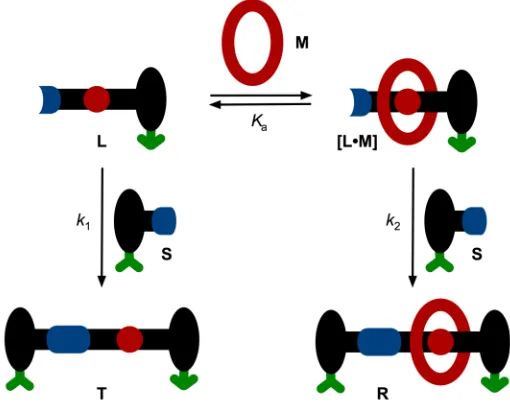
Recognition of these requirements allows the construction of the replication scheme depicted in Figure 2.1. The template (which forms the thread-like component of the rotaxane) has been extended compared to the template T shown in Figure 1.1, and now incorporates an additional binding site (red filled circle in Figure 2.1). The complementary recognition sites are located on the stoppers. Reaction between pseudorotaxane [LM] (formed through the association of macrocycle M with the linear component L) and stoppering reagent S affords the rotaxane R. Stoppering reagent S and linear component L bear complementary recognition sites on their stopper, hence S and [LM] can bind reversibly to the rotaxane R to form a catalytic quaternary complex [SLMR]. Bond formation occurs between S and [LM] to give the product duplex [RR], which then dissociates to return two molecules of R to the start of the autocatalytic cycle.
Figure 2.1 Minimal model for a replicating rotaxane based on the placement of one recognition site (green cartoons) on each of the stoppers. The blue cartoons represent the reactive sites, and the red cartoons the binding motif.
2. Strategy and design principles
46
recognition sites are located now on the same stopper of the rotaxane. As in the previous model, reaction between pseudorotaxane [LM] and stoppering reagent S affords the rotaxane R. Stoppering reagent S and pseudorotaxane [LM] can bind reversibly to the rotaxane R to form a catalytic quaternary complex [SLMR]. Bond formation occurs between S and [LM] to give the product duplex [RR], which then dissociates to return two molecules of R to the start of the autocatalytic cycle.
Figure 2.2 Minimal model for a replicating rotaxane based on the placement of the two recognition sites (green cartoons) on the same stopper. The blue cartoons represent the reactive sites, and the red cartoons the binding motif.
Both models can potentially be used in order to devise a self-replicating rotaxane. Since it seemed easier to design molecules based on the framework shown in Figure 2.1, the first model was chosen.
2.3 Expanded replication scheme
2. Strategy and design principles
47
macrocycle M with the linear component L. Above the dotted horizontal line, the [LM] complex can react with the stoppering reagent S to form rotaxane R (this process is analogous to the bimolecular channel in Figure 1.1). Rotaxane R can then enter an autocatalytic cycle (top right, Figure 2.3)—collecting the [LM] complex and stoppering reagent S and catalysing the formation of a second molecule of rotaxane R. Alternatively, rotaxane R can enter a crosscatalytic cycle (lower left, Figure 2.3)—collecting the unbound linear component L and stoppering reagent S and catalysing the formation of a molecule of thread T. Conversely, below the dotted horizontal line, unbound linear component L can react with the stoppering reagent S to form thread T (once again, this process is analogous to the bimolecular channel in Figure 1.1). Thread T can then enter an autocatalytic cycle (lower right, Figure 2.3)—collecting the unbound linear component L and stoppering reagent S and catalysing the formation of a second molecule of thread T. Alternatively, thread T can enter a crosscatalytic cycle (top left, Figure 2.3)—collecting the [LM] complex and stoppering reagent S and catalysing the formation of a molecule of rotaxane R.
2. Strategy and design principles
48
2. Strategy and design principles
49
2.4 Requirements
Three essential structural features are thus required by a self-replicating rotaxane system: a reactive site, a recognition site and a binding motif.
The spacer units also play an important role. They not only connect the different sites, but also balance the system’s rigidity/flexibility. Suitable shape and length must be chosen to hold the reactive sites at the correct distance, to eliminate product inhibition as a result of an excessively stable product duplex [RR] and to avoid side reaction (binary complex pathway).
2.4.1 Reactive sites
The first requirement of the design of a self-replicating rotaxane is the reactive sites, which connect the two parts of the thread. The stoppering reaction must be efficient and irreversible. The 1,3-dipolar cycloaddition between a nitrone and a maleimide was chosen as covalent bond forming reaction between the L and S components. The choice was guided by the previous success in exploiting this reaction in the implementation of minimal33,34 and reciprocal36 self-replicating systems.
2. Strategy and design principles
50
a symmetrical dipolarophile avoids further complication with regioselectivity issues. This cycloaddition reaction is fairly unselective,105 usually giving rise to a trans/cis ratio ranging between 1.4:1 and 3.9:1 depending on the substituents R1, R2 and R3.
R1 N O N O O R3 N O N O O R3 H H N O N O O R3 H H R1 N O N O O R1 N O N O O + R2 R2 R2 R2 R2 71 72 71 71 72 72 (±)-trans-73 endo-TS exo-TS (±)-cis-73 H R1 H R1 R3 R3
Scheme 2.1 Reaction between Z-nitrone 71 and maleimide 72, giving rise to two pairs of racemic diastereoisomeric cycloadducts—trans isoxazolidine 73, formed through an endo transition state, and cis isoxazolidine 73, formed through an exo transition state.


![Figure 1.8 Kinetic approaches to the formation of [2]rotaxane: (a) clipping, (b)](https://thumb-us.123doks.com/thumbv2/123dok_us/8688917.379500/37.595.153.470.186.416/figure-kinetic-approaches-formation-rotaxane-clipping-b.webp)