?JDSOQJB .BUJR
, =IFRJR <TCMJSSFE GOQ SIF .FHQFF OG 69IJL BS SIF
>NJUFQRJSX OG <S ,NEQFVR
&$%&
0TLL MFSBEBSB GOQ SIJR JSFM JR BUBJLBCLF JN ;FRFBQDI+<S,NEQFVR*0TLL=FWS
BS*
ISSP*##QFRFBQDI!QFPORJSOQX"RS!BNEQFVR"BD"TK#
9LFBRF TRF SIJR JEFNSJGJFQ SO DJSF OQ LJNK SO SIJR JSFM* ISSP*##IEL"IBNELF"NFS#%$$&'#&())
READING ANONYMITY:
NARRATIVE DIFFERENCE AND FRAMEWORK SELECTION IN THE CLAIMING OF TERRORIST VIOLENCE
by
VICTORIA DAVIS
A THESIS SUBMITTED IN PARTIAL FULFILLMENT OF THE REQUIREMENTS FOR THE DEGREE OF M.PHIL IN INTERNATIONAL RELATIONS AT THE UNIVERSITY OF ST ANDREWS
TABLE OF CONTENTS
Abstract 4
I. Introduction 5
A. History of Anonymity in Terrorism 5
B. Statement of Purpose 6
C. Value of Research 7
II. Review of Scholarship 9
A. Communicative Nature of Terrorism 9
B. Contextualizing the Terrorist Message 10
C. Current Explanations for Unclaimed Attacks 12
D. Another Look at Credit Claiming 23
III. Research Query and Methods 25
A. Query 25
B. Case Study Design and Selection 26
C. Methodology: Justification of the Discourse Analytic Approach 31
D. Methodology: Method of Discourse Analysis 35
E. Data Sources 37
IV. Constructivism as a Theoretical Approach 42
V. Case Study Narratives 46
A. A Brief Introduction to Anonymity 46
B. Introduction to Case Studies 47
C. Case Study: 1998 US Embassy Bombings 50
D. Case Study: 2008 Danish Embassy Bombing 64
E. Case Study: 2000 USS Cole Bombing 70
F. Case Study: 2000 Aqaba Rocket Bombings 80
G. Case Study: 2004 Madrid Train Bombings 85
H. Case Study: 2005 London Train Bombings 95
VI. Summary of Narrative Trends Across Case Studies 107
A. Civilization vs. Barbarism 107
C. Attacked vs. Attacker: The State and State Foil 118 D. Inability to Demarcate Relevant Information 124 E. Possibility of future attack as legitimizing state action 128
VII. Analysis 134
A. Risk and the Notion of Risk Society 134
B. Why Risk is Not an Appropriate Framework for the Terrorist Attack 135 C. The Distinction between Uncertainty and Ambiguity 136 D. Claimed/Unclaimed Terrorist Attacks as Framed under
Uncertainty, Ambiguity 138
E. Ambiguity as Applied to Claim Scholarship 143
VIII. Importance of Findings and Suggestions for Future Research 148
References 149
News Reference Key 162
ABSTRACT
While a significant proportion of terrorist attacks have always gone unclaimed scholarship has noted an increasing number of such acts over the past half-century, which appears to indicate that the claiming of violence may no longer constitute an essential terrorist strategy. The increasing gap between claimed and unclaimed attacks (where “unclaimed” is understood as a terrorist attack for which no credible assertion is issued by the perpetrating individual or group) cannot be explained by existing assumptions, which posit that terrorist groups will seek to advertise their success. This thesis attempts to develop a more complete understanding of this phenomenon by examining al Qaeda’s claim variation within a series of paired case studies to explore the presumption of narrative difference between the two types of attacks. Findings indicate that claimed acts of terrorism tend to be presented via a framework of uncertainty whereas unclaimed acts are presented within a framework of ambiguity. The distinction of ambiguous frameworks is that they allow the terrorist to operate in a newly created narrative space to perpetuate and expand the fear-provoking effects of violence by destabilizing mutually exclusive identities of blame and rendering attacker and victim indistinct, while at the same time confirming the imminent possibility of lethal harm. The variation between models has significant implications for policymakers given that the choice of framework limits or guides one towards particularized courses of action. Given the creative authority of the targeted society as definer of this
CHAPTER 1: INTRODUCTION
A. History of Anonymity in Terrorism
While a significant proportion of terrorist attacks have always gone unclaimed (see Cordes et al. 1985; Pluchinsky 1997), scholarship has noted an increasing number of unclaimed acts of terrorism over the past half-century (Gearson 2002; B. Hoffman 1996, 1997, 1999, 2006; Rorie 2008) that appears to indicate that the claiming of violence may no longer be an essential terrorist strategy. An average of 60% of terrorist attacks from 1970 to 1979 were claimed; this proportion dropped to 39% between 1980 and 1982 (Cordes et al., 1985, p.23), and has further declined in subsequent decades. LaFree and Dugan (2008) note the percentage of claimed attacks between the late 1990s and 2004 fell to 14.5% (p.28-9). In a study of terrorist claim staking between 1970 and 1997, Rorie (2008) finds evidence of a definitive shift towards anonymity over time with 1982 as the median of claimed attacks and 1993 as the median of unclaimed attacks (p.38). Contrary to conventional wisdom regarding the presumed publicity ambitions of terrorist organizations, there has been a similar drop in the claiming of the “terrorist spectacular” (B. Hoffman 1997). This is particularly unusual given that previous examinations of unclaimed attacks have found the majority of such incidents to be low-level actions that are not intended to cause casualties (Cordes et al., 1985, p.15).
2004; Nacos 2002; Picard 1993; Staun 2009; Waugh Jr. 1983). Explanations involving the advent of new technologies—such as remote time bombs that eliminated the “personal heroism” required by the anarchist bomb thrower of the 19th century and allowed for a less discriminating and more anonymous attack (Wardlaw, 1989, p.31)—also cannot explain the variation in claiming behavior between the late 1970s, 1980s and subsequent decades, given that such
technologies existed throughout the aforementioned period. The decline in claiming tendency has persisted despite the fact that, due to the supposedly poor communicative properties of violence (Cordes et al. 1985; Johnston 1995; Sper 1995), anonymity and lack of context have been found to generate confusion with regard to actor, motive, and message content that undermines the terrorist’s ability to gain support/understanding and elicit policy concessions from governments (A.M. Hoffman 2010). Furthermore, this tendency towards anonymity has increased in spite of the knowledge that the absence of media coverage (and the publicity it brings) is repeatedly cited as a factor in the decline of terrorist groups (Cordes et al. 1985; DeGhetto 1994; Horowitz 1983; Lockett 1995) and that the media is more likely to report on attacks in which responsibility has been established (Bockstette, 2008, p.19; Weimann & Winn 1993). This behavior is particularly puzzling in the case of large-scale or high-profile attacks, as current logic dictates that such an event requires a higher level of planning, expertise, and execution from which a successful terrorist group would benefit in terms of audience outreach through greater media coverage.
B. Statement of Purpose
fluctuating relationship between terrorists’ conflicting desire for publicity and anonymity. Specifically, discourse analysis situated within a constructivist framework will be used to explore paired claimed/unclaimed1 acts of terrorism to investigate the presumed difference in terrorist identity narratives attached to both types of attacks and determine whether claim status is correlated with certain actor characterizations that may attest to the increase in unclaimed attacks.
It should be noted that the use of a case study approach in the instance of a singular organization, though providing valuable insight from the perspective of “building-block” theory development, does caution against the overgeneralization of findings to all unclaimed terrorist acts.
Furthermore, the study does not profess to evaluate the effect of claim status on actors outside of the perpetrating terrorist organization and the target audience/government, such as sympathetic constituencies or rival terrorist groups. It is hoped that the foundational research conducted by this study will assist with the future development of a broader theoretical model for unclaimed terrorist attacks, particularly those that are religiously motivated.
C. Value of Research
Claims of responsibility provide a more complete understanding of the terrorists’ decision-making and planning strategy, as well as insight into variations between terrorist groups
(Rapoport 1997). According to A.M. Hoffman (2010), credit taking has the potential to reveal a great deal about the nature of the threat groups pose, their ultimate aims, the incentives affecting
their behavior, and the adequacy of government and audience response to their attacks. For instance, Enders and Sandler (2006) suggest that anonymous attacks presume groups are
disinterested in establishing grassroots support and do not place value in the possibility of future compromise, whereas claimed attacks are viewed as signaling a lack of fear of government counter-terrorism efforts (as cited in B. Hoffman 1997). According to Clarke and Newman (2006), choice-structuring properties not only provide information regarding the incident but also testify to the criminal offender (e.g. his/her needs, preferences, personal characteristics, and perceptions); understanding how acts of violence are driven and exploited by terrorist
motivations will enable law enforcement to manipulate situations to increase risk and difficulty of execution while minimizing rewards (as cited in Rorie 2008). The proposed comparative format allows for the empirical identification and investigation of circumstances under which a group will seek to formally claim their attacks as well as variation in the reception and
CHAPTER 2: REVIEW OF SCHOLARSHIP
A. The Communicative Nature of Terrorism
There is a dispute in both the academic and political world over who or what qualifies as worthy of the label “terrorism”; however, one of the most common elements of these varied depictions is the phenomenon’s communicative nature. Terrorism is conceptualized most broadly as a public act intended to coerce an audience (A.M. Hoffman 2010; Horgan, 2004, p.31; Weinberg et al. 2004). Scholarship has documented various aspects of this communicative function, including its manipulative power over audience perception (Schmid & Jongman, 1988, p.28), dependence upon context reading (Crelinsten 1989a), and its claim for attention and legitimacy (Crelinsten 1989b). According to Louise Richardson, “the point of terrorism is to communicate a message. It is not violence for the sake of it, or even violence in the expectation of defeating the enemy; rather it is violence to convey a political message” (2006, p.21). It is in fact this characteristic, the tendency to seek maximum attention and exposure as well as the necessity of justifying the violence in terms of social values, political or religious meaning, that distinguishes terrorism in the amorphous world of violent crime (Crenshaw, 1995, p.15; LaFree & Dugan, 2004, p.59; Staun, 2009, p.11).
1997, p.2,5; Cordes, 1987, p.2; Rapoport, 2004, p.1502). The absence of media coverage has been cited as a factor in the downfall of terrorism (see Cordes et al., 1985, p.17; DeGhetto, 1994, p.17); as Lockett (1995) notes, “[a]n ignored terrorist group does not influence” (p.20). Failure to attract media attention may stem from the group’s failure to provide the extraordinary (Horowitz 1983; Knutson, 1980, p.206) or from credit claiming; Weimann and Winn (1993) find that the media is more likely to report on attacks in which responsibility has been established (see
Bockstette, 2008, p.19; Rorie, 2008, p.8). However, the consequences of a poorly communicated message may outweigh even a lost media opportunity. Instances in which the audience fails to interpret or attributes an incorrect interpretation to an act of violence may result in the loss of popular sympathy as well as group legitimacy, decreasing the pool of potential recruits and available resources and posing a threat to organizational sustainability. This is especially true when the public perceives the victims of terrorist attacks to be entirely random (Ross & Gurr, 1989; USIP, 1999, p.4).
B. Contextualizing the Terrorist Message
In order to engender psychological effects that will translate into political gains for the terrorist
group, the audience who receives the terrorist message must “know or have a good idea who is responsible for the act, and (…) must understand the message, that is, why the terrorists attacked that target” (Cordes et al., 1985, p.15). Yet on their own, acts of violence appear to be a poor means of expression that often require clarification through other means. Decker and Rainey (1980) argue that terrorism has become a “carefully designed and rhetorically sophisticated attempt at communication” (p.3). However Cordes (1987) appears less optimistic at the
sending only as complicated a message as “be afraid.” Sper (1995) concurs that “one cannot
assume a terrorist group’s intent by its actions alone” (p.17). Without a clarifying discursive element, the terrorist act is left to speak for itself—a feat which it appears ill-equipped to accomplish.
According to Cordes et al. (1985), the principal method by which terrorists attempt to influence the behavior of their target audience is via the claiming of an act of terrorism (p.15). Claims add additional information to attacks (Wright, 2009, p.6) and are helpful in providing insights into the mindset of those who view violence as an effective and justified instrument in pursuing their aims (Kellen, 1982, p.2). Claims of responsibility reflect the plans upon which terrorist groups rely in ways that warnings cannot, given the control the terrorist exercises over their timing and content; claims are not filtered through governing authorities who possess editing potential (A.M. Hoffman, 2010, p.6).
designed bombs—require highly trained operatives that are both difficult to recruit and exceedingly hard to retain and or replace (A.M. Hoffman, 2010, p.6).
C. Current Explanations for Unclaimed Attacks
Given the perceived benefits—even necessity—of claiming an attack, what circumstances would deter a terrorist group from making such a claim? The following paragraphs review the limited yet contested scholarship addressing explanations of such groups’ propensity to anonymously commit acts of violence.
The New Religious Character of Terrorism
In comparison to previous secular ethno-separatist or left-wing terrorist groups, the religious character of the “new terrorism” does not necessitate the justification of violence to an earthly audience. With regard to political ideology, Rapoport (1997) argues that groups driven by ideologies championing material goals and the notion of mass support (e.g. Marxism or nationalism) are more likely to take credit, as it serves to generate popular support for the movement. In turn, Crenshaw’s (1996) research on terrorist renunciation of violence counters that ideologies stressing mass involvement (e.g. communism or socialism) may reject terrorism on principle due to its “elite” character (p.252).
Likewise, terrorists adhering to religious and millenarian beliefs are less likely to claim credit as they lack a real-world constituency to whom they can be held accountable (Enders & Sandler,
constrained by their audience on earth” (p.240); rather, they place service to God over political ambitions (Ranstorp 1996) and thus have no need of justifying the commitment of violence in service of an approving omniscient deity (Post, 2005, p.452; Rapoport 1984; Wright, 2009, p.18).
However, this sharp dichotomy between “religious” and “political” terrorism—and indeed between all general categories of non-state terrorist groups—as discrete and mutually exclusive is untenable. Neumann (2009) asserts that “if the objective is to change or transform societies by introducing aspects of religious law, creating a theocracy or even a caliphate (…) the political nature of the terrorist campaign can no longer be in doubt” (p.95). As with other politically motivated terrorist organizations, regardless of the grounds for their impetus, “[terrorists’] political programmes are violent expressions of ideological currents which are located on the radical fringes of mainstream society. In other words, they reflect broader political and/or social trends” (Neumann, 2009, p.95). This notion was confirmed by B. Hoffman (2006) in his
observation of the preeminence of the ethno-nationalist and/or irredentist aims over religious motives in groups such as the PLO, the IRA, and the FLN (p.82)
based upon the principle of defensive jihad (Blanchard, 2005, p.6). This may necessitate joining al Qaeda and likeminded organizations in opposing those attempting to construct secular
democratic governments or seeking to prop up existing regimes deemed non-Islamic (Blanchard, 2005, p.8)—a task that requires recruiting from sympathetic populations in much the same manner as any politically-oriented group. One may well argue that this goal (though perhaps grounded on religious principles) is clearly political in its objective, the pursuit of which requires public support in the same manner as a secular campaign.
Media Coverage and the Establishment of Legitimacy
Media attention does not automatically confer legitimacy, and the risk of inaccurately
communicating the terrorist message may provide an advantage to policymakers and depress the terrorists’ desire to claim responsibility. Risk of erroneous communications or interpretations by the media may lead to a loss of support for the terrorist group (Abrahms 2006). Due to the event-oriented and for-profit nature of the media (Rorie, 2008, p.10), publicity of a terrorist act may cover tactics used and their fallout but is unlikely to review the conditions that precipitated the attack (Altheide 1987). As Rapoport (1997) notes, “legitimizing terror is a difficult, usually impossible, always problematic task (…) to those who think justification is possible, very special circumstances are required: no alternatives, a desperate and/or exceedingly propitious situation, monstrous enemies unwilling to recognize limits who by their actions have made the terrorist in fact the true victim” (p.12). Unlike legislators—who possess large media relations
underlying issues and focus on punishing the perpetrators (Chermak & Gruenewald 2006; Picard 1993).
However, this argument does not take into account that terrorists are capable of, and often engage in, clarifying interpretations of violent acts; in fact both small and large organizations conduct a wide variety of formal press relations activities (Picard 1989). Note the videotapes publicized by Osama bin Laden, a more recent example of which attempted to direct audiences to the proper sources of interpretation and “clarify the ‘message’” of the September 11th terrorist attack (VOA 2009). Furthermore, terrorist organizations often have significant media resources at their disposal, possibly through a political arm2 that has full access to legitimate media sources and is capable of marshaling its own resources. Indeed, the asymmetry of media coverage in the terrorists’ favor (Bockstette 2008) has led policymakers to express concern at such groups’ ability to manipulate the media in the way they desire (see Isbell et al. 2006). The use of the Internet as a means of communication is also considered central to terrorist communications (Talbot 2005, p.48), and offers a broad publicity tool that is free of the media’s interpretive constraints. There have furthermore been instances in which terrorists were granted media opportunities to freely air their grievances; recall, for instance, the 1-hour uninterrupted
interview of Osama bin Laden by CNN’s Peter Arnett in 1997, wherein the Saudi exile was free to expound on these underlying “causalities.”
The Interpretive Power of Audience
One argument against the utility of claiming is that it is unnecessary; the message will reach the intended audience in any case (e.g. B. Hoffman, 1997, p.4). As Gearson (2002) suggests, “[t]he need to claim ‘credit' for an attack is not as important if, in the minds of the terrorists, the act speaks for itself” (p.11). Following the September 11th attacks, for instance, even Osama bin Laden trumpeted “[t]hose young men [inaudible] said in deeds, in New York and Washington, speeches that overshadowed all other speeches made everywhere else in the world. The speeches are understood by both Arabs and non-Arabs—even by Chinese” (USDOD 2001). Yet a quick survey of notable terrorist incidents contests this assumption. In the case of Pan Am Flight 103— unaccounted for until Libya’s 2003 admission of responsibility—investigators in the immediate wake of the attack were unable to pinpoint either perpetrator or grievance (USCIA 1988), leaving press and public alike speculating as to message and motive. As previously noted, this also occurred in the case of the 1995 Oklahoma City bombings, which provided no contextual clues pointing to Timothy McVeigh’s anger at the federal government and the handling of the 1993 Waco Siege and the Ruby Red incident. This confusion was further compounded by various expert misattributions that the bombing was the product of Islamist militarism. Furthermore, as described in the previous literature on credit claiming (e.g. Wright 2009), common attack techniques (e.g. bombings) are not easily distinguished from one another, requiring groups to differentiate themselves via credit claiming or expensive signature attacks. As the organizations with the resources to continuously fund such signature attacks are arguably outweighed by those who must rely upon more resource-conserving methods, no such
The Embarrassment of Failure
An argument put forth by Pluchinsky (1997) in the case of the failed terrorist attempt is that organizations may be too embarrassed to claim credit; terrorism is not for amateurs, and the benefits of being viewed as such by potential supporting communities and sponsors may be detrimental to the terrorist’s resource pool. Yet events over the past decade have demonstrated otherwise—such organizations appear to find utility in associating themselves even with failed plots, which calls into question whether it is the quantity or quality of media coverage that is most important. Al Qaeda in the Arabian Peninsula claimed responsibility for a failed mail bomb plot on American cargo planes in November 2010 as well as failed attempts to shoot down the Saudi royal family’s plane in October 2010 and assassinate the nation’s Anti-Terrorism Campaign head in August of the previous year. The Pakistani Taliban claimed ownership of a failed September 2008 bombing of Barcelona trains and more recently the attempted May 2010 attempted car bomb in New York City’s Times Square. Even al Qaeda and Osama Bin Laden claimed the failed 2009 Christmas Day Flight 253 bombing plot. Nor is this phenomenon limited to Islamist terrorist organizations; Continuity IRA claimed multiple failed attacks on police bases in April 2000 and June 2009, while the Real IRA accepted responsibility for a 2002 attempted police car bombing and 2004 bomb attempt in Derry. Thus, groups appear to derive some benefit from associating their names even with failed acts of violence; rather than hiding their
involvement, many go out of their way to advertise it.
Fear of Retaliation by Authorities
otherwise unavailable materials for destroying terrorists. According to Rapoport (1996),
publicity “helps an outraged public to mobilize its vast resources and produces information that the public needs to pierce the veil of secrecy all terrorist groups require” (p.viii).
However, scholarship has noted that high-profile methods such as hijackings, kidnappings, barricade-and-hostage events, and suicide attacks are claimed nearly all of the time—whether due to the possible link between, for instance, suicide and cultures of martyrdom (Hafez 2006, cited in A.M. Hoffman 2010) or due to the fact that high-profile methods often require the perpetrator to identify him/herself (Cordes et al., 1985, p.25)—whereas low-profile methods such as hit-and-run attacks are the least likely to be claimed. Assumption of responsibility for terrorist acts and exposure to government recrimination neither necessarily signals the end of an organization nor poses a significant hindrance to the ability to launch attacks. For instance, groups such as ETA, the IRA, and FARC were targets of government counter-terrorism efforts for significant lengths of time yet continued to conduct operations that impacted the target audience. Furthermore, heightened environmental pressure or governmental retaliatory measures often serve as predictors of increased internal cohesion (Bjorgo, 2009, p.34) by suppressing internal group conflict (Crenshaw 1992) while justifying and reaffirming the terrorist
threatens those goals it can be reduced or abandoned, as the state does not require violence to justify its existence (p.488).
Scholars have noted that attacks on the public at large may pressure governments to increase counter-terrorism measures, which may diminish the utility of claiming authorship of an attack (Gearson 2002; B. Hoffman 1996, 1997; Rapoport 1997). Yet conflicting literature cites that the general populace is less likely to be seen as a “legitimate” target and thus such an attack will result in greater backlash and compel the perpetrating group to publicly justify their target selection (B. Hoffman 1999; Picard 1993; Ross & Gurr 1989), which inevitably requires
assumption of responsibility. Rorie’s (2008) study on terrorist target selection finds that an attack on a specific target, as opposed to the general public, does not decrease the likelihood that it will be claimed.
responses allow terrorists to claim credit with little fear of retaliation, whereas frequent counterstrikes allow groups to capitalize on public outrage.
Even given the premise that claim making provides otherwise unknown information to
authorities, one must consider that terrorist groups may be functioning on organizational rather than individual rationality; acts of violence, though possibly unrelated to the group’s professed agenda, are therefore critical to its identity and legitimacy and may cause the group to continue such activities despite additional risks (Crenshaw 2001; DeGhetto 1994; Post 1987; Sper 1995; Waugh Jr. 1983). In such instances, the compulsion of organizational maintenance may diminish the cost of harsher counter-terrorism penalties given the comparative need to provide a source of validation and purpose for group members.
Public Relations Maintenance
Additionally, empirical studies indicate that the idea terrorists will damage their image by killing is not supported by hard evidence. In a study of public attitudes towards terrorism in Uruguay, Spain, Italy, Germany, and Northern Ireland, Hewitt (1990) observes that it is rather those groups that kill the most (e.g. ETA and the IRA) that have the most positive ratings, while groups who have killed far fewer (e.g. the Baader-Meinhof gang and the Red Brigades) have the most unfavorable image. (p.142-3). The study finds that attitudes towards political violence depend primarily upon structural-historical elements, and are therefore “little affected by either terrorist actions or by government policies”; moreover, “those (…) who assume that terrorist
sympathizers will be alienated by atrocities are equally deluded” (p.155).
Greater Fear-Inciting Potential
This strand of scholarship cites that terrorists maximize the element of surprise which— combined with the random targeting of victims—evokes higher levels of public anxiety (Garrison 2003; Gearson 2002; B. Hoffman 1997, 2006; Perl 1997; Wardlaw 1989) and presumably makes a greater contribution towards the furthering of the terrorist agenda. As an aside to her investigation of domestic terrorist targets, Rorie (2008) notes that in a comparison of claimed/unclaimed violence in newspaper reports, the media focused on the pervasiveness of public fear in the instance of anonymous terrorist acts. In the case of the former, the public was not as generally apprehensive but instead channeled their fear towards specific locations while expressing contempt for those responsible (p.52-3). According to Wardlaw (1989), if a victim of terrorism cannot understand the source of danger it is likely s/he will turn to a leader who
may be heightened (p.34-5). Cordes et al. (1985) observes that in the context of major terrorist unclaimed events the offender’s anonymity “enhances the confusion and tension surrounding the attack. Speculation abounds and theories of attribution are batted back and forth” (p.15), as was borne out in the previously mentioned 1995 Oklahoma City bombing and Pan Am Flight 103.
Yet there are problematic elements within this theory as well. According to Cordes et al. (1985), a number of unclaimed attacks achieve greater publicity than they would have had they been claimed due to public fear of a repeat performance by a mysterious and seemingly more effective unidentified perpetrator (p.15). Yet this finding conflicts with that of Weimann and Winn (1993), who note that the main benefit—increased publicity—of formally claiming responsibility for a terrorist attack derives from the fact that the media is more likely to report on attacks in which responsibility is known. Even if one assumes that anonymous terrorist acts are more adept at inciting fear, if the phenomenon’s primary purpose is to communicate or further a particular agenda (rather than mindless fear mongering), given the assumed limited communicative nature of violence it would appear that not claiming an attack may be counterproductive to the terrorist agenda.
Impact of Environmental Characteristics
whereas in areas of high competition it will choose to advertise its accomplishments to supporters and potential recruits. A.M. Hoffman’s study, however, limits itself to a single country (Israel); Wright’s (2009) multi-country analysis finds little support for this conclusion.
Wright instead explains claim variation based upon cultural discrepancy in the utility of claiming as a signaling mechanism. Yet Cordes et al. (1985) find no correlation between the geographic theater of the attack and its claim status; neither is any explanatory power inherent to the nationality of the target itself (p.25). Furthermore, in cases where those responsible are
eventually discovered, unclaimed attacks have not demonstrated a statistical proclivity to be the product of any particular ethnic or religious group.
D. Another Look at Credit Claiming
Scholarship generally refers to formal claims of responsibility only in passing, focusing instead on the propensity of terrorist groups to issue warnings prior to or manifestoes following an act of violence; indeed, compilations of these communiqués are not uncommon3. Instances where publicity is not sought by an organization are generally not discussed in relation to the terrorist decision-making strategy4, and where present are couched within a review of other
circumstantial factors (e.g. Pape 2003 and suicide terrorism)5. Within this literature, failure to take credit for a violent act tends to be based upon theoretical supposition6. Those few studies that do empirically analyze claim making are furthermore often applicable only as it relates to a particularized case or country of study (e.g. A.M. Hoffman 2010, Rorie 2008), and there appears yet to have been an examination of a single terrorist organization’s claiming patterns, which might provide insight into the circumstantial factors that influence claim making. A satisfactory explanation of unclaimed attacks, their communicative potential, and their place as a strategic tool for terrorist organizations to connect with their audience has yet to be offered.
3 See Alexander & Pluchinsky 1992; Baader-Meinhof/Red Army Faction 1977; Smith & Moncourt 2009.
4 Exceptions include B. Hoffman 1997, Pluchinsky 1997 5 As noted by Rorie, 2008, p.17
CHAPTER 3: RESEARCH QUERY AND METHODS
A. Query
Identity, as it is socially constructed by humans, is relational (in that the understanding of oneself is predicated on the creation of another grouping of characteristics of which one is not a part and the inclusiveness of each group is affected by social interaction) and cognitively processed based upon habit or prior experience (e.g. humans categorize experiences under a limited number of models that can be readily applied to new situations in order to organize and understand stimuli). It stands to reason that a society’s relationship with terrorism and its proponents consists of a cyclical application and re-definition/application of such frames based upon an amalgam of past and present experience. Consequently, the nature of terrorist actors should function as a research question rather than an assumption; not all terrorists may be “created equal” in the mind of the public (Klotz & Lynch 2007). The British public’s post-ceasefire understanding of and
relationship with the IRA, for instance, may differ widely from their understanding of the same group during The Troubles or their comparative conceptualization of al Qaeda following the 2005 London bombings.
This research seeks to explore the presumed difference in meaning attached to
The thesis addresses the following questions:
• Do claimed/unclaimed acts of terrorism differ in their depictions of the terrorist actor with regard to intrinsic characteristics, ascribed motivation, attack brutality, or the breadth of power attributed to the perpetrators? How is this understanding conveyed to the audience?
• Who is the “we” functioning as the counter to the terrorist “other,” and how are certain understandings of both actors encouraged or limited by the discourse? How does the emphasis or omission of certain aspects regarding the terrorist group affect the resulting identities?
• How does the resulting discourse affect the meaning attached to the event and the resulting significance of the perpetrators as defined by the target audience?
• How does the understanding of al Qaeda’s identity as well as that of the “other” fluctuate over time given continued attacks? How does this speak to the evolving relationship between a terrorist group and society?
B. Case Study Design and Selection
The use of the comparative case study format is appropriate for multiple reasons; first, the theoretical understanding of identity used here is predicated on the intersubjective, structural, social identity proposed by Hopf (2009). This necessitates the assumption that identities operate independently of whomever occupies the position of head of state—continuity in identity
one leader or administration (Hopf, 2009, p.286).7 The comparative structure permits examination of the phenomenon of interest within its original context, yet the inclusion of several case studies as part of a single investigation provides a body of alternative explanations, preventing the frequent interpretivist trap of defining terms in such a specific manner that parallels to other situations are unfeasible (Lin 1998).
It is understood among social scientists that the ideal conditions for paired comparisons rarely exist, and that the distinction between cases and non-cases may not be well defined (Klotz & Prakash, 2009, p.46). Certainly, in the case of “claimed” and “unclaimed” attacks, the dividing line is not always clear; claim issuance may be delayed, which renders problematic the case’s categorization under one mutually-exclusive label. For instance, in the case of the September 11th, 2001 attacks, al Qaeda leader Osama bin Laden denied responsibility for the bombings until a sudden video broadcast established his authorship in October 2004; should the attacks then be labeled as claimed, or divided into separate segments with October 29th, 2004 as the dividing point? What of those attacks claimed under a pseudonym, or attempts by non-credible or false actors to assume responsibility? Or, if the attack is committed anonymously, what of authorities’ identification of the perpetrator immediately or shortly after the attacks; does true anonymity matter, or is it simply public attribution of ownership that tips the balance between claimed and unclaimed acts of violence?
Given this constraint, Goertz (2006) proposes a case selection based upon a synthesis of the typology and “fuzzy set” approaches as it concerns “defining ideal types in terms of the most
exclusive features (‘and’) while recognizing that cases will evince a subset (‘or’) of those characteristics” (p.84, cited in Klotz & Prakash, 2009, p.57). The demarcation of “claimed” and “unclaimed” attacks is similarly “fuzzy” and necessitates definition as it is applied to the
research presented here. Yet as Klotz and Prakash (2009) recognize, “the tendency to
contextualize concepts need not be an insurmountable problem for comparing across cases (…) even an elusive concept like ‘regime’ has fuelled reams of insightful research on international cooperation and global governance, despite abiding definitional disputes” (p.45). Thus, even within the contested area of terrorism studies, scholarly and policy-related gains may be made despite the absence of absolute consensus as to definitional particulars, both as it concerns claim status as well as the subject of terrorism itself.
This study posits an understanding of a “claimed” terrorist attack as follows: any attack committed by a terrorist actor8 for which a credible and authentic claim of responsibility9 was issued by the perpetrator. An “unclaimed” attack is understood as follows: any attack by the aforementioned range of actors for which no credible or verified claim was issued, including those claims made via a pseudonym, false claiming by a group not responsible for the attack, or those groups to whom an attack is attributed solely on the basis of material evidence, political speculation, or historic behavioral patterns rather than formal claim making. An attempt was made to minimize the time lapse between attack execution and any issued claim of responsibility in order to preserve the integrity of distinct categories.
8 As defined by the 2010 United States list of Foreign Terrorist Organizations and the University of Maryland START database, or those homegrown groups inspired/trained by an actor
contained therein.
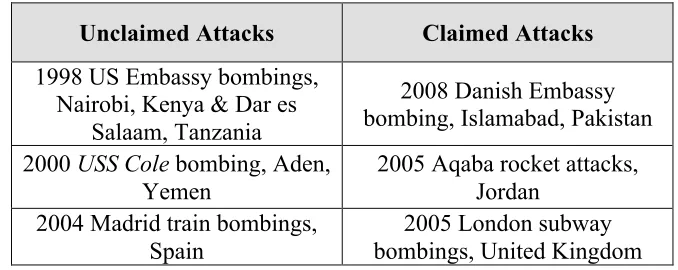
With regard to the dimensions along which the cases were paired, care was taken to match the attacks according to Mill’s Method of Difference by selecting from the gambit of al Qaeda attacks (or those of homegrown cells whit it trained or inspired) those cases sharing similar circumstantial factors aside from claim status. In particular, the researcher attempted to account for those characteristics identified by previous scholarship as having an effect on claim making behavior, such as group ideology, attack method, target type, degree of state sponsorship, nature of the proffered grievance, and cultural roots of both attacker and attacked. With the exception of the 2004 Madrid bombings, each unclaimed case is furthermore one for which al Qaeda founder Osama bin Laden explicitly denied involvement. The particulars of each pairing are related below.
Table 1: Selected Pairs of Unclaimed/Claimed Case Studies
Unclaimed Attacks Claimed Attacks 1998 US Embassy bombings,
Nairobi, Kenya & Dar es Salaam, Tanzania
2008 Danish Embassy bombing, Islamabad, Pakistan 2000 USS Cole bombing, Aden,
Yemen
2005 Aqaba rocket attacks, Jordan
2004 Madrid train bombings, Spain
2005 London subway bombings, United Kingdom
1998 US Embassy Bombings vs. 2008 Danish Embassy Bombing
were conducted in response to a perceived slight against the Muslim nation and galvanized by the “plight” of the terrorists’ “Muslim brothers and sisters.” In turn, the attacked states ascribe to similar Western-democratic values or, in the case of the host nations, share a contested space as both a product and current ally of former Western colonizing powers. Furthermore, though the attacks were targeted primarily towards American and Danish nationals, in both instances the causalities consisted mainly of local civilian staff. The selected targets represent outposts of the attacked countries’ prestige and influence in addition to constituting their primary channel of communication with the host society.
2000 USS Cole Bombing vs. 2005 Aqaba Rocket Attacks
Perpetrated against physical projections of American military might, the attacks targeted US naval ships deployed in the Middle East that were not engaged in combat activities at the time of attack. Both operations were attributed to one of the primary al Qaeda factions (e.g. the Afghani and Iraqi branches), though to differing outcomes; the attack on the USS Cole resulted
successfully in structural damage and the deaths of American sailors, whereas the Aqaba rockets missed their intended target and produced only collateral damage. Executed without state
support, both cases are viewed by the United States Armed Forces as of key significance within the context of attacks against their naval forces.
2004 Madrid Train Bombings vs. 2005 London Subway Bombings
time, each operation was considered the worst bombing in Europe since the Second World War as well as the worst terrorist atrocity within each country. Both bombings were shortly followed by another failed attempt (a bomb planted under the rail in Spain and a second attempt to bomb the London Underground), with the justification for the initial attacks centering on the country’s support for the US-led War on Terror. At the time of the bombings both the United Kingdom and Spain were considered leading allies of the United States (particularly in counter-terrorism matters), though both have long been considered havens or transit points for Islamic radicals despite decades-long traditions of handling domestic nationalist terrorism. It should be noted that in both instances the grassroots nature of the perpetrating cell resulted in substantial
bewilderment as to the exact nature of the relationship between the bombers and al Qaeda
Central. In the case of the London bombings, the confusion accompanying al-Zawahiri’s delayed claim (roughly two months after the fact) appears to have been an organizational strategy rather than an inability to communicate, given that the group has a documented history of following up ambiguous claims with more substantive and credible messages when it so desires (see the 2008 Danish Embassy bombing or the 2002 Mombasa attacks).
C. Methodology: Justification of the Discourse Analytic Approach
investigation would be advantageous to the application of process-tracing in identifying media content and its use of problem-framing as a causal mechanism in influencing public sentiment and the formulation of government policy.
Like process-tracing, discourse analysis and the accompanying constructivist framework
demonstrate a proclivity towards the examination of process and change (Fierke 2003); indeed, it has been suggested that an interpretivist research agenda can serve both as a precursor of and compliment to a process-tracing research design. Why, in the context of terrorism, is it then essential to examine terrorist operations as processes delineated both temporally and discursively rather than treating them as separate incidents? As Davis (2005) observes, “[t]hough it may make sense for some purposes to conceive of cases as discrete empirical entities, sometimes it makes more sense to think of them as complex phenomena, each of which comes with a history” (p.175). Simply put, a population’s experience with terrorism cannot be summarized as a list of distinct events but more accurately resembles a complex web of sustained relationships, wherein the response to every new attack is built upon understandings of and reactions to previous incidents and their perpetrators. Within this conceptualization, the use of discourse analysis may partially compensate for the loss of certain essential information and the oversimplification that Alexander George admits could undermine the validity and usefulness of a more positivist process-oriented approach (1979, p.47).
foundation for anticipated future research. As Lin (1998) has convincingly advised, should researchers have the opportunity to combine positivistic and interpretivist research they should begin with an “exploratory interpretivist study” in order to suggest hypotheses and mechanisms that may serve as the basis for positivist research. The reverse forces researchers to “impose a ‘plausible’ theoretical structure on the data before they examine it, which could easily leave out an important variable or include a nonessential one.” Because a positivist study will by definition exclude contextual information that may be relevant to an interpretivist study, the initial use of an interpretivist approach will, at the least, allow positivist studies to justify the omitted information as nonessential to the relationships under study based upon previous findings (Lin 1998). Hopf (2009) confirms this assessment: “noninterpretivist methods are most appropriate to the analysis of evidence that already has been collected through interpretivist, hermeneutic, ethnographic, or discourse analytic means” (p.293). Before examining a link between terrorist identity and public opinion in constraining policy formulation, it is necessary to first establish the nature of that identity, the alternative discourses available, and how the dominant narrative interacts and delineates the corresponding understanding of both terrorist and target.
The research proposed here is intended to answer the “what” of terrorist identity in media content and thereby shed light on how such depictions contribute to the cultivation of a certain public perspective. Yet as Wendt (1999) has argued, such constitutive questions are in fact explanatory and not merely descriptive: “[t]here are always ‘two stories to tell,’10 but they are not causal versus descriptive (…) Arguments from disparate sources [e.g. Charles Cross on the double-helix model or William Dray on the appropriate role of historians] suggest that theories
which answer ‘what’ or ‘how possible’ do ‘explain’ the world” (p.86). What follows, then, is a discussion of current interpretivist standards of scholarship as they relate to positivist criteria.
One must first recognize the divergence and consequential incomparability of interpretivist and positivist criteria of acceptable scholarship. For those in the positivist camp, the standard to which one’s results must be compared is the “averaging” effect—the “effect that one might imagine a variable having if the world allowed for a series of replication under the same conditions”—so as to be representative in the sense of the “typical.” Comparatively,
interpretivists seek a standard based upon accuracy of detail so as to produce a complete and specific representation, representative in the sense of the “faithful” (Lin 1998). There is further divergence in the handling of uncertainty within both types of research designs. Positivist approaches reduce uncertainty through the comparison of as many observations as possible on particular dimensions (those deemed important by the hypothesis), whereas interpretivists rely on exacting reportage of the circumstances under study and the thickness of the description to produce accurate research (Lin 1998). As such, the primarily constitutive questions investigated by interpretivists, critical theorists, and so forth elicit misunderstanding when judged by the standards of positivists’ primarily causal investigations (Wendt, 1999, p.85), despite the fact that both aspire to and generally succeed in “explaining” the world.
groups are legitimate standards by which to evaluate the validity and truth of a body of research, and their incommensurability makes one neither better nor worse but simply employed for different reasons. Within the context of this research, the interpretivist approach is preferred given the need for particularized detail; in seeking to establish the nature of terrorist identity as an affecting factor, the study relies on an exhaustive and nuanced recounting of such narratives to produce a complete and accurate representation. Every detail is important in its ability to potentially affect audience interpretation. Positivist approaches, which pass over such fine distinction in favor of comprehensive averages, would be unable to provide the necessary depth of description. Despite the incomparability of positivist and interpretivist research aims, answers to “why” questions necessitate answers to “how” and “what” questions (Lin 1998; Lupovici 2007; Wendt 1999) so that even positivist researchers must engage in at least implicit
constitutive analyses. Given that some of the most important natural science theories are of this type (e.g. the double-helix model of DNA or the kinetic theory of heat) (Wendt 1999, p.85), the value of meticulous interpretivist research has proven essential to expanding the field of
knowledge.
D. Methodology: Method of Discourse Analysis
The method of discourse analysis employed in this investigation is taken from Hopf’s procedure for investigating Soviet identity using mass texts (2009). Consisting of four distinct steps, the design proceeds as follows:
2. Contextualizing identities: the process of discerning what an identity means within the particular context of the original text. At the end stages of this process, the identities that predominate in the literature are quantitatively identified.
3. Intertextualizing identities: the process of identifying whether an identity holds the same meaning across sources. If so, this step renders a powerful case for intertextual consensus on a particular identity: “the deepest stability a social structure can attain is when no questions of disruption arise, not when ideas of disrupting it are periodically entertained, but then rejected after calculating relative costs and benefits, or after deciding one had better not” (Hopf 2009, p.284). If not, the revealing of alternate understandings across sources given a nominally same identity is equally noteworthy.
4. Intertextualization to discourses of identity: the process of conveying how the
intertextualized identities relate to one another in constructing a coherent account of the identity in question to form a discourse. A “discourse of identity” is the collection of intertextualized identities that appear repeatedly when a certain identity is constructed. A discourse predominates to the extent that it is numerically superior to alternate
E. Data Sources
The Use of Large-Sized Newspapers
Newspapers have often served as a critical medium for social science investigations; prior scholarship has faithfully documented their utility as a source, including more detailed content (Nacos 2003; Paletz et al. 1982, cited in Altheide 1987), ease of access, and archival
completeness (Padilla 2007). Though these advantages are important to the investigation at hand, newspapers have been selected as the primary medium for another important reason—the
communicative impetus of their journalists. As David Skok, Senior Producer of Online Content for Global News notes, the “ultimate purpose of journalism is to communicate with, and on behalf of, the audience” (Hogg 2010). The Pew Research Center’s Project for Excellence in Journalism elaborates on this assessment, endowing journalism with the central aim of providing audiences with “accurate and reliable information” that “creates a map for citizens to navigate society” for the purpose of functioning in society (2011). The mainstream conceptualization of journalism and its practitioners consequently assumes that individuals are able to understand and make use of what they read and implies that one of the duties of the journalist is to communicate said information in the most readily understandable fashion that both accounts for and is
journalists also “deliberately select words the average reader will immediately recognize as communicating enough information about the character. Because of their desire to be
understood,” such authors act as “unintentional ethnographers for the societies about which they write” (Hopf, 2009, p.288). Consequently, the use of newspaper articles provides the researcher with an articulate, detailed record of the identities and related assumptions under investigation written in a manner accessible to and shaped by elite and popular culture. This prevents an investigation restricted to a select few and provides a more accurate and relevant base for future research on media content and public opinion.
The case that must be made here is, therefore, justification for the use of large-circulation
American forces or interests—newspapers with a rapport for covering national and international events are essential.
Yet in order to compensate for accusations of elitism that have been occasionally levied against major newspapers, this study also includes data from the wire services of The Associated Press and Reuters. These services supplement national and international coverage not only for large papers but also for those with smaller circulations that rely on such sources to complement their limited news gathering resources (PEJ 2004). Consequently, the sources that have been identified in this study are ones made available to and consumed by all segments of the literate population, which strengthens the likelihood that their content would reflect the dominant cultural discourses on terrorism.
Justification of Country-Specific Sources
British coverage of the terrorist acts will be collected from Reuters, The Guardian, The Daily Telegraph and The Times. Reuters, headquartered in London, is the world’s largest international news agency and has a stated policy of “neutral language” when covering terrorist events (Thomson Reuters 2011). Also based in London, the left-leaning Guardian is one of the top-selling broadsheets and the largest English-language newspaper presence on the Internet behind The New York Times—in the case of the United Kingdom, it is also the highest-trafficked virtual news presence (Reid & Teizeira 2010). To balance the political leanings of The Guardian, content from the center-right The Daily Telegraph and The Times will be used in combination, given the difference in article output between these sources and their more liberal competitor. Both broadsheets are amongst the top three most-circulated of their kind in Britain.
When identifying sources from a non-English speaking nation in which an attack occurred, English translations of articles from the primary newspapers in each respective nation were gathered via the World News Connection (WNC) service. Prior scholarship has established that high-quality English translations of original sources (such as those offered by the WNC) yield approximately the same scores under the rigor of content analysis as the originals and thus the use of such translations will not distort conclusions drawn from translated documents (Hermann 1980; Winter 1973).
The Selection of Articles
reasonably permitted an analysis of all relevant articles, the analysis included the entire body of stories pertaining to the attack in question. For events where the quantity of articles generated surpassed the temporal resources of the investigator and given that selecting a random sample of articles would potentially eliminate key stories and bias the resulting analysis, the following methods were followed: (1) duplicate articles (the same story released for subsequent editions on the same day) were eliminated; (2) articles grounded in subjective opinion (those from the “commentary,” “opinion,” or “editorial” sections) were eliminated11; (3) those articles meeting the 600-word threshold of the “average article in a medium-sized paper” (according to the PEJ 2004) were retained, as it was assumed they were among the main features of the paper and were of sufficient length to provide data for the qualitative methodology employed.
CHAPTER 4: CONSTRUCTIVISM AS A THEORETICAL APPROACH
The adoption of a constructivist theoretical framework is predicated upon both the investigative limitations established by strictly positivist assumptions as well as the suitability of
constructivism as an approach to the phenomenon of terrorism. It is noteworthy that a significant proportion of relevant scholarship assumes a positivist interpretation of the world, and in so doing inherently perpetuates certain contradictions within the theory’s application to claim making. First, the limited body of empirically tested claim-related literature relies
overwhelmingly on the use of quantitative data, which narrows the understanding of terrorist events by quantifying only a portion of the elements inherent to an attack (those able to be translated into numerical form, such as casualty figures, location, group or single actor, etc.). Such datasets tend to be inadequate in their ability to perform a detailed examination of relevant factors—for instance, the nature and intensity of public response.
Perhaps due in part to the privileging of quantitative techniques, positivist theory limits valid data to that associated with observable phenomenon. This has contributed to the
conceptualization of violence as a “poor communicator,” in that it discounts the idea that who commits a terrorist act is equally significant to the understanding and interpretation of the act itself. An IRA bombing in Belfast, for instance, may not inspire the same level of shock and awe as the unpredicted detonation of a bomb in sleepy Oklahoma by persons unknown or an airborne assault on New York City’s iconic symbol of American economic power. Yet the same
scholarship simultaneously assumes the existence of a qualitative difference between
positivist framework, given that the primary factor of variance between the two types is, in fact, actor identity. Positivism fails to explain the divergence of response to attacks that are similar in all considerations except claim status. Where terrorists are concerned, all may not be created equal in the minds of the public; the nature of terrorist actors in particular should function as a research question rather than an assumption (Klotz & Lynch, 2007, p.94).
In ignoring the non-material, positivism additionally excludes elements such as cultural difference that previous literature (e.g. Wright 2009) has indicated may affect the utility of claiming terrorist attacks. Given the constraints on a terror cell’s material resources and its ability to physically inflict harm (Mulaj, 2010, p.20), one of the greatest power reserves such actors possess is their potential for coercive persuasion so as to convince others of the threat’s reality (Fierke, 2003, p.67), which may or may not involve a physical demonstration.
Furthermore, positivist theory does not account for change across time and space and thus does not explain the fluctuation in public perception a terrorist actor over time (e.g. the perceived threat from a relatively unknown al Qaeda in 1998 as compared to that conceptualized by a desensitized population following a decade of extensive public dissection of the group and its agenda).
In comparison, constructivist theory accounts for both the material and non-material elements of terrorist incidents, including the changing awareness of a particular actor in the minds of the government and public. It examines an act of terrorism within a framework of
historical context and processes of knowledge production may help to explain the variation in reaction to atrocities that positivist theory is unable to address. The compatibility of the
constructivist framework with qualitative methods yielding richly detailed data allows for greater insight into this phenomenon. Moreover, given that power can be exercised through both
physical capabilities as well as relationships (Klotz & Lynch, 2007, p.11), constructivism’s challenge to the positivist conceptualization of power as material resources is particularly relevant.
Constructivism provides a means to explore the fluctuating relationship between particular terrorist identities and audience response that has been ignored in traditional terrorism research, a factor made even more relevant given that the meaning of a terrorist event is collectively
generated by the interaction between terrorist and audience (Hulsse & Spencer, 2008, p.576; Zulaika & Douglass, 2008, p.29). This is even more pertinent in the instance of the unclaimed attack, in which the identity of the perpetrator is unknown. When paired with the method of discourse analysis, constructivism allows the researcher to inductively develop a pattern of meaning from these interactions that accounts for the fact that the complex picture of reality is superior to predictive positivist mechanisms.
necessitates constructivism’s ability to account for the influences of language, culture, and historical context, as well as its deviation from the over-determination of “structure” in neorealist and neoliberal theory (Fierke, 2010, p.180). Constructivist theory incorporates a social
CHAPTER 5: CASE STUDY NARRATIVES
A. A Brief Introduction to Anonymity
What constitutes uncertainty depends on “what we want to be able to predict, what we can predict, and what we might be able to do about it” (Marris, 1996, p.16). Arguably, uncertainty is at its most prevalent when there is urgent need for definitive identification despite the lack of evidence and there is little that can be done to alter these odds. Anonymity comprises a particular type of uncertainty that is linked with the inability to detect the identity of another individual or group—the inability to place an entity within the known pantheon to allow for prediction of behavior and appropriate response.
According to Williams (1988), anonymity is a “condition that frees individuals from social evaluation or scrutiny” (p.765); having a name for something makes it “knowable” to the
audience. There “may be individuals with whom we have spoken on the phone, whose names we know and on whose behalf we might have had to advocate in some way. In this regard, the anonymity of individuals is overcome for us primarily because we know them by name” (p.763). Yet thus stated, it may be argued that it is impossible for any entity to achieve true anonymity. Human nature dictates the delegation of a name and estimated attributes to unspecified
phenomenon so as to render them able to be processed and categorized; our knowledge is relative, depending upon comparisons with other “knowns” for understanding. In the case of an anonymous terrorist bombing, for instance, before the perpetrator’s identity is revealed by
Dorothy is guilty of a recent string of jewelry robberies, but we do know that the robber snatches only diamonds (and nothing else) from establishments accused of selling blood diamonds, which allows us to ascribe certain motivations or principles to the thief. In essence, anonymity is a war of labels between the sender and recipient underlined by the assumption that the sender derives some benefit, whether material or psychological, from the identity that is attributed to him (otherwise s/he would find an alternate means of expression). Anonymity is the set of characteristics, motivations, and persona that is attributed to a specific actor or actors in the absence of his/her given identity; it is the degree to which a message recipient perceives the source as unknown and unspecified (Anonymous, 1998, p.387) but it is also the content with which the recipient fills said gap and the resulting relationship between sender and recipient via a new mediator.
B. Introduction to Case Studies
Within the context of the following case studies, this research has identified a list of primary actors: (1) perpetrators; (2) suspects; (3) general terrorists; (4) al Qaeda; (5) Osama bin Laden; (6) the attacked state (the United States, Denmark, Spain, the United Kingdom); (7) the state foil (Kenya/Tanzania, Pakistan, Yemen, Jordan, the United States). Perpetrators encompasses those individuals responsible for the bombings before they are identified as particularized suspects. Alternately, suspects describes flesh-and-blood persons possessing unique histories and names once they have been detained by authorities. Note that perpetrators and suspects act as
and Osama bin Laden form the named counterparts to general terrorism12. The aforementioned pairs (perpetrators-suspects, general terrorism-al Qaeda/Osama bin Laden), as they relate to the present case studies, describe the same actors with varying degrees of specificity; suspects and al Qaeda/Osama bin Laden are “known” to the broader audience and therefore the subjects of memory recall, while the creation and development of perpetrators and general terrorism must be formulated by the receivers at the same time the message is being processed.
Anonymity is, ironically, a fundamentally social phenomenon, requiring an audience of at least one person—one cannot be anonymous if no one is aware of his or her existence (Marx, 1999, p.100). Rather, it is the recognition that there is “something to predict” and the realization that we have limited means by which to do so that creates the condition of flux within which anonymity functions. Thus, the analysis also encompasses the attacked state (the primary state target of the attack) as well as the state foil (either the nation in which the attack occurred, if not the attacked state, or that most frequently mentioned in comparison) as they respond to the multi-faceted identity of the bombers.
Analyses examine the case study data by dividing the investigative period into four stages, as determined by the shifting terrorist identity:
• No Claims of Responsibility: no groups or individuals have accepted responsibility for the bombing. There is scant evidence illuminating the criminals’ identities and attempts at further definition are captured by attributions to the perpetrator.
• Unverifiable Claims of Responsibility: several groups have unreliably claimed credit for the attack but a perceived lack of authenticity invalidates the assertions, resulting in continued use of perpetrator as bomber.
• Tentative Arrest of Suspects: authorities detain the first group of individuals whose extent of involvement is yet undetermined, establishing a parallel between perpetrators and suspects.
• Formal Arrest/Indictment of Suspects: convinced of the suspects’ involvement and guilt, authorities announce certainty of guilt for those detained, theoretically accompanied by shifting blame from perpetrators to suspects.
C. Case Study: 1998 US Embassy Bombings
What follows is a summary of the narrative discourse surrounding the primary actors in the 1998 US Embassy bombings, divided by investigative phase to highlight shifting understandings in media characterizations. The principally descriptive format presents the reader with a detailed accounting of evolving identity roles linked to each actor, the significance of which will be evaluated following the presentation of all case studies.
No Claims of Responsibility
The immediate media reaction to the bombing reads nothing extraordinary into the attack, committed by skilled but normal criminal actors against a world superpower well accustomed to such antagonistic actions. The unknown perpetrators are seen as untouchable by state
authorities. Their inability to be apprehended is not so much a product of American investigative failure as simply a result of the group’s operative sophistication. The difficulty in identifying the bombers can be attributed to four factors: (1) the skill of the terrorist group – careful,