An investigation into the micro-dynamics of routine
flexibility
A thesis by
ANDI ROSSI A. RAZAK
This thesis is submitted in partial fulfilment of the requirements for the degree of DOCTOR OF PHILOSOPHY (MANAGEMENT)
Lancaster University Management School, UK
II
Organisations are expected to possess the ability to adapt in order to sustain themselves in the ever-changing markets. Routines, which have traditionally been viewed as a source of stability, have recently been conceptualised as a source for organisational flexibility, having the capability to significantly determine whether an organisation can survive. This study contributes to this discussion by showing that the internal dynamics of routines, which comprise of ostensive and performative aspects, play a significant role in the emergence of endogenous routine flexibility. Insights into the ostensive-to-performative relationship have been gathered by studying a temporary project team over 18 months. Specifically, there are three insights: (1) routine actors’ pursuit to embrace the tacitness of routines promotes the emergence of ostensive routine change that is temporarily disengaged from the performative aspect, (2) the emergence of options at the ostensive level, act as a mechanism to legitimise the performative aspect, and (3) decoupling forms a mechanism for performative flexibility to accommodate the changing ostensives in the form of targeted outcomes. These insights lead to further understanding of the different types of relationships that exist within the internal dynamics of a routine i.e. disengaged, legitimation, and accommodating relationship. These ostensive-to-performative relationships exist due to the collective effort of the temporary team.
III
ABSTRACT ... II
LIST OF FIGURES, TABLES AND ABBREVIATIONS ... VIII
ACKNOWLEDGEMENTS ... XI
CHAPTER 1 : INTRODUCTION ... 1
CHAPTER 2 : FLEXIBILITY IN ORGANISATIONAL ROUTINES ... 6
2.1 Classical view of organisational routines ... 6
2.2 The evolution of the organisational routines literature ... 8
2.2.1 Behavioural theory perspective ... 10
2.2.1.1 Conceptualisation of organisational routines ... 10
2.2.1.2 Understanding of routine flexibility ... 12
2.2.2 Evolutionary economics perspective ... 13
2.2.2.1 Conceptualisation of organisational routines ... 13
2.2.2.2 Understanding of routine flexibility ... 15
2.2.3 Practice perspective... 16
2.2.3.1 Introduction to practice theory ... 17
2.2.3.2 Conceptualisation of organisational routines ... 20
2.2.3.3 Understanding of routine flexibility ... 23
2.2.4 Comparisons of theoretical perspectives... 24
2.3 Routine dynamics ... 26
2.3.1 History ... 26
2.3.2 Ostensive aspect ... 27
2.3.3 Performative aspect ... 30
2.3.4 Routine dynamics and artefacts ... 31
2.3.5 Ostensive-performative relationship ... 34
2.4 Routine flexibility: Sources and their impact on the internal dynamics of routines ... 35
2.4.1 Exogenous-ostensive flexibility ... 38
2.4.2 Exogenous-performative flexibility ... 39
IV
CHAPTER 3 : METHODOLOGY... 47
3.1 Research philosophy ... 47
3.1.1 Ontological assumptions ... 48
3.1.2 Epistemological assumptions ... 50
3.2 General research settings ... 51
3.3 Case construction ... 55
3.3.1 Sub-case 1: Emergent routine change ... 56
3.3.2 Sub-case 2: Options emerging during routine enactment ... 59
3.3.3 Sub-case 3: Novel actions in routine performance ... 62
3.4 Data collection ... 63
3.4.1 Observation ... 66
3.4.2 Interviews ... 72
3.4.3 Artefacts ... 74
3.4.4 Summary of data collection ... 77
3.5 Data analysis ... 77
3.5.1 The fundamentals of my analysis... 77
3.5.2 Sub-case 1: Emergent routine change ... 83
3.5.3 Sub-case 2: Routine flexibility through options ... 87
3.5.4 Sub-case 3: Novel actions in routine performance ... 92
3.6 Summary ... 95
CHAPTER 4 : OSTENSIVE FLEXIBILITY THAT IS DISENGAGED FROM THE PERFORMATIVE ... 96
4.1 Introduction and overview ... 96
4.2 Ambiguities and uncertainties ... 97
4.2.1 Resolving perceived uncertainties ... 98
4.2.2 Resolving boundary ambiguities ... 102
V
4.3.2 Routine scoping ... 108
4.3.3 Routine enactment ... 110
4.3.4 Summary of the emergence of ostensive routine change ... 111
4.4 Enforcement of the new routine ... 112
4.4.1 Legitimising the routine ... 114
4.4.2 Projecting information ... 116
4.4.3 Summary of enforcement of the new routine ... 117
4.5 Conceptual interpretation ... 118
CHAPTER 5 : OSTENSIVE AND PERFORMATIVE FLEXIBILITY VIA LEGITIMATION ... 125
5.1 Introduction and overview ... 125
5.2 Sourcing of print specialists ... 127
5.2.1 Overview of the case ... 127
5.2.2 How the options emerged ... 128
5.2.3 The outcome ... 132
5.3 Sourcing of print software ... 134
5.3.1 Overview of the case ... 134
5.3.2 How the options emerged ... 135
5.3.3 The outcome ... 140
5.4 Sourcing of print hardware ... 143
5.4.1 Overview of the case ... 143
5.4.2 How the options emerged ... 144
5.4.3 The outcome ... 150
5.5 Conceptual interpretation ... 153
CHAPTER 6 : PERFORMATIVE FLEXIBILITY TO ACCOMMODATE THE OSTENSIVE ... 160
VI
6.2.2 Sources of decoupling ... 162
6.2.3 Decoupling activities... 166
6.2.4 Summary ... 174
6.3 Decoupling in the hardware sourcing routine performance ... 175
6.3.1 Overview ... 175
6.3.2 Sources of decoupling ... 176
6.3.3 Decoupling activities... 177
6.3.4 Summary ... 185
6.4 Conceptual interpretation ... 186
CHAPTER 7 : DISCUSSION ... 193
7.1 Emergent routine change: The role of routine actors in ostensive flexibility ... 195
7.1.1 Actors as the source of ostensive exploration ... 195
7.1.2 Ostensive change decoupled from the performative ... 202
7.1.3 Summary ... 204
7.2 Legitimising routine performances: The emergence of options as a mechanism ... 205
7.2.1 The emergence of options ... 205
7.2.2 Legitimising actions ... 208
7.2.3 Summary ... 211
7.3 Novel actions for a targeted outcome: Decoupling as a mechanism ... 211
7.3.1 The emergence of targeted outcomes ... 212
7.3.2 Decoupling as a mechanism for performative flexibility ... 214
7.3.3 Summary ... 216
7.4 Routine flexibility: The role of the ostensive-to-performative relationship ... 217
7.4.1 Disengaged relationship ... 217
7.4.2 Legitimation relationship ... 218
7.4.3 Accommodating relationship ... 219
VII
8.1 Limitations ... 224
8.1.1 Observation of organisational routines ... 224
8.1.2 Limitations regarding data analysis ... 226
8.2. Future research ... 228
8.2.1 Enacting routines in a temporary setting... 229
8.2.2 Performative-to-ostensive relationship ... 230
REFERENCES ... 231
APPENDICES ... 242
Appendices for chapter 4 ... 242
VIII
LIST OF TABLES
Table 2.1 – Summary of the three perspectives in relation to routine flexibility ... 25
Table 2.2 – Summary of ostensive and performative flexibilities based on the source of flexibility ... 37
Table 3.1 – Summary of the key participants of this study ... 53
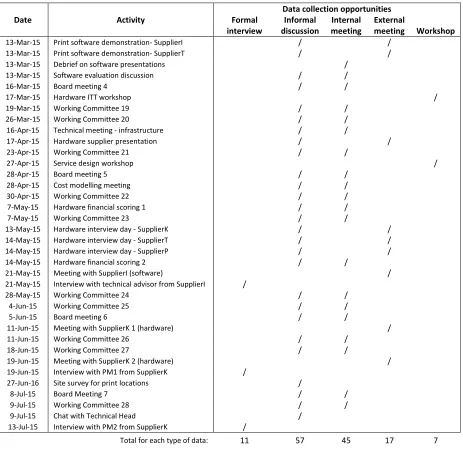
Table 3.2 – List of activities and the corresponding opportunities for data collection ... 65
Table 3.3 – Examples of the first round of coding for emergent routine change ... 84
Table 3.4 – Examples of the second round of coding for emergent routine change ... 85
Table 3.5 – Summary of differences in routine enactment ... 89
Table 3.6 – Examples of the first round of coding for the emergence of options ... 90
Table 3.7 – Examples of the second round of coding for the emergence of options ... 90
Table 3.8 – Examples of the first round of coding for novel actions in routine performance ... 93
Table 3.9 – Examples of the second round of coding for novel actions in routine performance . 93 Table 4.1 – Summary of the sources for routine change ... 105
Table 4.2 – Summary of how the ostensive change emerged ... 112
Table 4.3 – Summary of how the new routine was embedded ... 118
Table 4.4 – Evidence of the theoretical constructs for the emergence of ostensive change ... 120
Table 5.1 – Summary of the emerged options in the print specialists’ sourcing exercise ... 134
Table 5.2 – Summary of the emerged options in the print software sourcing exercise ... 142
Table 5.3 – Summary of the options that emerged in the print hardware sourcing exercise ... 152
Table 5.4 – Evidence of the theoretical constructs for the emergence of options as a legitimation mechanism ... 156
Table 6.1 – Summary of the various suppliers and their products... 160
Table 6.2 – Summary of decoupling sources and activities to accomplish the targeted software supplier ... 174
Table 6.3 – Summary of decoupling sources and activities to accomplish the targeted hardware supplier ... 185
Table 6.4 – Evidence of theoretical constructs for novel actions in accomplishing targeted outcomes ... 188
IX
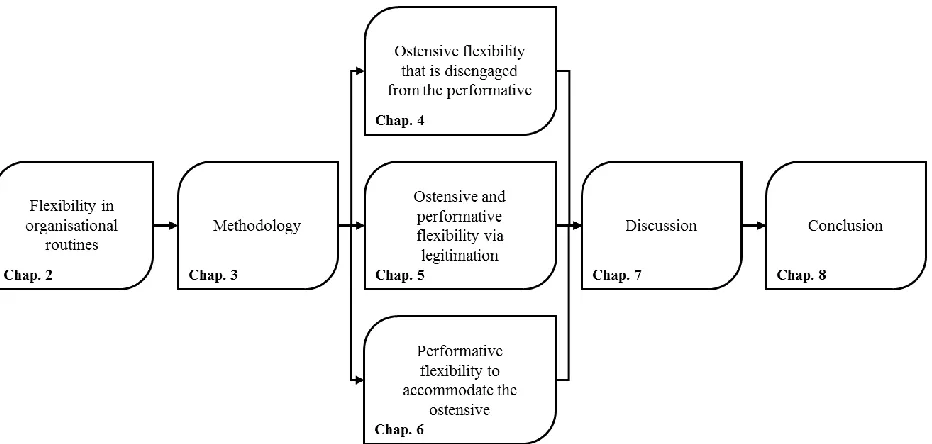
Figure 1.1 - A roadmap of the chapters in this thesis ... 5
Figure 2.1 – Organisational routines as generative systems (Pentland and Feldman 2005)... 34
Figure 3.1 – The existing request routine ... 57
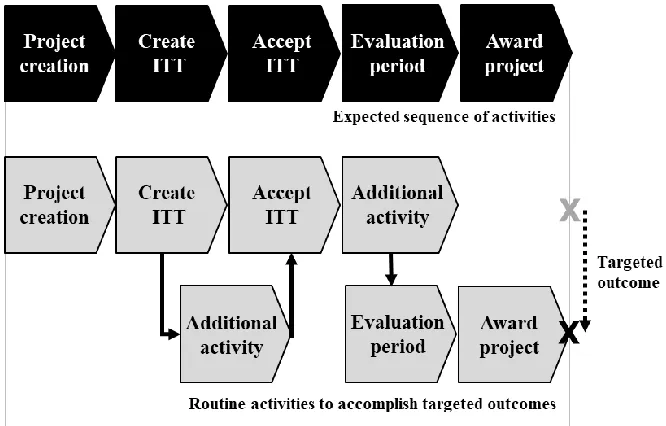
Figure 3.2 – Sourcing routine activities as listed in the Procurement portal ... 60
Figure 3.3 – The observed performative of the sourcing routine ... 60
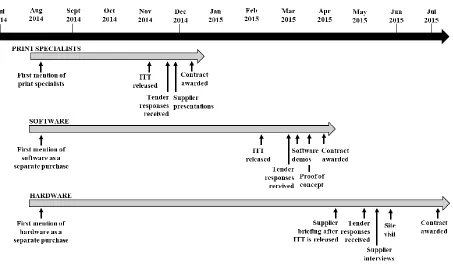
Figure 3.4 – The beginning and end of the three separate sourcing routines ... 62
Figure 3.5 – Observation of the routine enactment that formed sub-case 3 ... 63
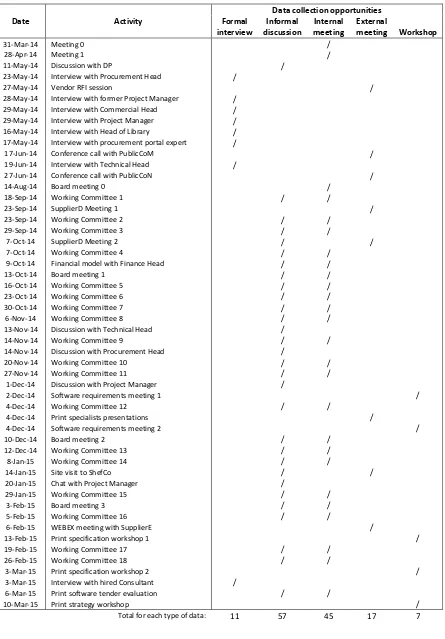
Figure 3.6 – Timeline of data collection activities ... 64
Figure 3.7 – User request made through the service desk ... 75
Figure 3.8 – Final response from an IT service desk personnel ... 75
Figure 3.9 – Interim arrangement policy announcement on PublicCo’s internal webpage ... 76
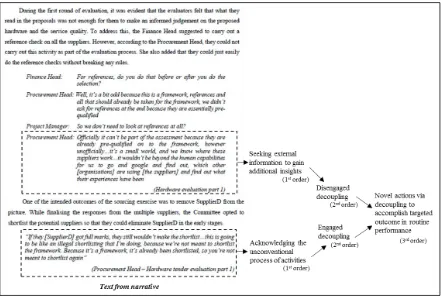
Figure 3.10 – Example 1 of linking the first-order narratives to the second- and third-order codes ... 79
Figure 3.11 – Example 2 of linking the first-order narratives to the second- and third-order codes ... 80
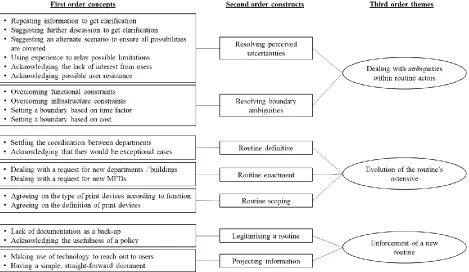
Figure 3.12 – Example of the second-order construct lifting the first-order concepts to a conceptual level for emergent routine change... 86
Figure 3.13 – Theoretical constructs derived from sub-case 1 ... 87
Figure 3.14 – Timeline showing the three sourcing routines from start to finish ... 88
Figure 3.15 – Example of the second-order constructs lifting the first-order concepts to a conceptual level for the emergence of options ... 91
Figure 3.16 – The theoretical constructs derived from sub-case 2 ... 92
Figure 3.17 – Example of the second-order construct lifting the first-order concepts to a conceptual level for novel actions in routine performance ... 94
Figure 3.18 – The theoretical constructs derived from sub-case 3 ... 94
Figure 4.1 – Existing request routine ... 97
Figure 4.2 – Revised request routine ... 113
Figure 4.3 – Interim arrangement policy announcement on PublicCo’s internal webpage ... 115
Figure 4.4 – Theoretical constructs for the emergence of ostensive change ... 120
X
Figure 5.4 – Options that emerged during the print hardware sourcing routine ... 151 Figure 5.5 – Theoretical constructs for the emergence of options as a legitimation mechanism 154 Figure 6.1 – Theoretical constructs for novel actions in accomplishing targeted outcomes ... 187
LIST OF ABBREVIATIONS
DPC Delta Purchasing Consortium
e.g. for example, for instance (Latin: exempli gratia)
et al. and others (Latin: et alii/alia)
EU European Union
i.e. that is to say; in other words (Latin: id est)
IT Information technology
ITT Invitation to tender
LPP London procurement partnership
MFD Multi-functional devices
NPA National Procurement Agreement
POC Proof of concept
PP Public procurement
PQQ Pre-qualification questionnaire R&D Research and development
Rep Representative
RFP Request for proposal
XI
Life is not all about you. It is about what you can share with others.
After a long, 10-year journey in industry, I came to realise that I needed to start giving back, using what I already have. I needed to be involved in something that could be shared and provide benefit to mankind. I then came across others who supported the notion of sharing knowledge. Specifically, two very special people; my in-laws, who gave me the confidence and encouragement to explore knowledge at the highest level, which led me to this PhD. And for that, I owe my deepest gratitude to them.
Also to my dearest wife, Hamadah, her uncountable sacrifices will always be the fortress behind my success, for always being there when I needed support the most, and taking good care of our precious Sophia. To my beloved parents and my close family members, I appreciate your constant prayers as part of my spiritual strength. Without them, I would not have survived the past three years.
I would also like to extend my gratitude to my former Master’s Degree supervisors and mentors in Sydney. Without their references and support, I may not have been able to be here in Lancaster and meeting many wonderful people in this special School.
Last but not least, to my PhD supervisors; Professor Martin Spring, and Dr Martin Friesl, I am grateful to have had both of you to guide me throughout this PhD journey. Indeed this PhD is not only about this thesis, but the journey itself. Both of you have helped to shape me into a better person intellectually and let me see knowledge in a new light. I hope I can continue to share this new knowledge with others in the future.
Thank you. Danke.
1
CHAPTER 1: INTRODUCTION
What makes routines flexible? Routine flexibility refers to the ability of a routine to adapt according to changing contexts. Organisational life consists of pressures, which force organisations1 to change and evolve rapidly to maintain a competitive advantage that yields superior economic performance. Without the ability to adapt, organisations will fall behind their competitors, unable to sustain themselves. Feldman and Pentland (2003) were among the first researchers to explicitly conceptualise routines as a source for organisational flexibility and change. Routines have the capability to provide significant impact on whether an organisation can sustain itself in the ever-changing markets. This is because routines themselves are, flexible. Feldman et al. (2016) point out that routines are dynamic because they are repeated patterns of actions, and thus are bound to change from one performance to another through the ongoing effort of actors. The overall aim of this study is to provide further insight into the occurrence of routine flexibility.
The classical view on organisational routines recognises them as a ‘black box’ (e.g. Cyert and March 1963; Nelson and Winter 1982) to understand the purpose of or motivations for routines, and how they affect organisations (Pentland and Feldman 2005; Parmigiani and Howard-Grenville 2011). For instance, routines are seen as a source of regularity or stability (Stinchcombe 1959; Crozier 1964), inflexibility (Weiss and llgen 1985; Gersick and Hackman 1990), and optimising cognitive effort due to their mindless characteristic (Cyert and March 1963). In these earlier studies, because routines were often examined as a whole unit (Parmigiani and Howard-Grenville 2011), they were used in a “highly flexible way” (Nelson and Winter 1982, p.97). This meant that a routine could refer to an organisational operation, or an individual skill. Although there are many benefits of this approach to viewing routines, such as being able to examine their inputs and outputs without having to map out their internal structure, it can also result in a narrow understanding of them (Pentland and Feldman 2005). To compensate for this limitation and to move away from the conceptual view of “routines as things” (Feldman et al. 2016, p.505), a new theoretical model was introduced by Feldman and Pentland (2003) based on structuration theory (Giddens 1984). The model suggests routines can be broken down into their internal dynamics,
1 Organisations here refer to commercial organisations only i.e. organisations with resources and priorities that aim
2
known as ostensive and performative aspects, which are interrelated with one another as a generative cycle (Pentland and Feldman 2005). The ostensive aspect represents actors’ abstract understanding of the routine, while the performative aspect represents the actual routine performance. By breaking down a routine into its internal dynamics, researchers are able to understand further how a routine is enacted in different contexts. This leads to recent studies that view routines as flexible, as opposed to being static and unable to change.
As past studies have shown, routine flexibility can be apparent in either the ostensive or the performative aspect. In the former, it can be intentional (Short and Toffel 2010) or unintentional (Reynaud 2005), driven through trial and error (Rerup and Feldman 2011) or having spontaneous variations (Bucher and Langley 2016) from the actors’ own initiatives (Burgelman 1994). Flexibility in the routine performance either occurs over a certain period of time (Beckman and Haunschild 2002), or in real time (Turner and Fern 2012), which can be accomplished through exerting power (Howard-Grenville 2005), setting priorities (Bruns 2009), and the use of experience (Feldman 2000; Dittrich et al. 2016). Although these past studies have focused on individual aspects of a routine, it is also important to acknowledge both in understanding routine flexibility. As pointed out by Feldman and Pentland (2003), the ostensive-performative relationship itself provides a continuous opportunity to produce different routine outcomes. Thus this study argues that both the ostensive and performative aspects are necessary for routine flexibility to occur. However, there has been little research that examines how the relationship between these two aspects plays a role in routine flexibility. Some of the studies that have tried to address this gap include Bucher and Langley (2016) on interacting spaces for reflection (ostensive) and experimentation (performative), and LeBaron et al. (2016) on how the ostensive is created, maintained, and repaired through performative flexibility. Whereas the focus of the first study was on spaces, the second focused on coordination, leaving many areas unexplored on the ostensive-performative relationship. This study aims to close this gap by primarily focusing on the relationship between the ostensive and performative aspects in routine flexibility.
3
mechanism for routine flexibility has always been linked to dependence on specific influences (e.g. past performance, predetermined options). This study disagrees with this notion by providing insight into routine flexibility that is not dependent on past performance and the use of artefacts, but is emergent and occurs through the routine actors’ own pursuit to gain better understanding of the routine. The performative aspect, for example, has been discussed as theoretically having the ability to be flexible based on how the ostensive provides guidance, accountability, and reference (Feldman and Pentland 2003). However, a routine’s performance will always have some form of novelty compared to the intended routine design i.e. the ostensive (Pentland and Feldman 2005). So, even though it is understood that the ostensive does not necessarily determine the routine’s performance, less is understood about whether ostensive flexibility results in performative flexibility. This provides a gap in the literature in terms of understanding the ostensive-to-performative relationship in routine flexibility.
Additionally, understanding the sources for routine flexibility can give insight into the characteristics and mechanisms of the occurrence. Sources that are external to the routine (i.e. exogenous) are likely to trigger controlled flexibility through use of structure (e.g. Reynaud 2005), or due to routine changes in response to the sources (e.g. Turner and Rindova 2012). On the other hand, sources that come from within the routine (i.e. endogenous) are likely to trigger changes that are either emergent (e.g. Whitford and Zirpoli 2014), or impromptu (e.g. Bruns 2009), which are dependent on the situation. This is particularly evident if the routine is part of an organisation’s norm (e.g. Howard-Grenville 2005) as it relies on tacit knowledge and thus is not bound to any explicit rules. This means that the characteristics and mechanisms for routine flexibility triggered by endogenous sources are endless, as no exact situation is likely to repeat itself. Thus this study intends to provide insight into the largely unexplored subject of endogenous routine flexibility. To address these gaps in the literature, this study aims to provide answers to the over-arching research question: How does the ostensive-to-performative relationship affect the emergence of endogenous routine flexibility?
4
gathering, to identify three significant sub-cases that were prominent. Each sub-case provides insight into different aspects of routine flexibility that address the gaps described earlier. Grounded analysis was conducted to establish theoretical constructs that led to four contributions to the organisational routines research.
Firstly, my analysis points out the important role of actors in routine flexibility. Their pursuit of trying to understand the tacit component of the routinegive rise to change in the ostensive aspect of the routine, i.e. there is a change in the actors’ abstract understanding of the routine, while the performative aspect, the routine performance, remains constant during this phase. Secondly, the emergence of options, ostensively during routine enactment, provides a mechanism to legitimise the routine performances via referring, guiding, and accounting actions. Thirdly, decoupling forms a mechanism for novel actions to accomplish a targeted outcome in the routine performance. Lastly, different relationships between the ostensive and performative aspects (i.e. disconnected, legitimation, accommodating) play a significant role in enabling emergent routine flexibility.
5
6
CHAPTER 2: FLEXIBILITY IN ORGANISATIONAL ROUTINES
2.1 Classical view of organisational routines
The concept of organisational routines was first introduced by Stene (1940) in his study about the science of administration, in which organisational routines are defined as part of an organisational activity which has become a habit of the organisation due to regular repetition without much consciousness. Any process or norm within an organisation that is carried out mindlessly is considered a routine, e.g. morning exercises as often seen in Japanese companies, or the daily five-minute meeting on the production floor in an automotive company. In subsequent work, organisational routines have been seen as a vital aspect of how organisations operate (March and Simon 1958; Cyert and March 1963), and play an important role in innovation through planned and unplanned changes. Overall, there are three consistent characteristics that were discussed in early studies of routines: (1) mindlessness, (2) regularity, and (3) inflexibility.
Mindlessness. The first characteristic refers to routines as mindless accomplishments, which
7
However, when routines are comfortably accepted as mindless accomplishments, this can also be a drawback in terms of performance if subtle (but important) changes are passed off as normal (Weiss and llgen 1985; Gersick and Hackman 1990). A good example, as presented by Gersick and Hackman (1990), is the Air Florida crash where the pilots overlooked the need to switch on the anti-ice system (because in normal circumstances the system is always off as ice build-up is unusual) while going through the take-off checklists. This resulted in not enough power during take-off because of the ice build-up. Thus, there appear to be some discrepancies with viewing routines as mindless actions. For instance, while the mindlessness of routines can be an advantage in terms of reserving cognitive effort for other organisational activities, it can also be a disadvantage in unique, or abnormal situations.
Regularity. Another characteristic of routines in classic literature is their regularity. When a
routine is created, it goes through an adaptation (Cyert and March 1963) or an evolution process (Nelson and Winter 1982) until it reaches a point where it is considered stabilised. From this point on, it is expected to be enacted without any change and thus becomes a regular process. This stability of workflow, or regularity of routines, is a key feature in bureaucratic administrations (Stinchcombe 1959; Crozier 1964). According to Crozier (1964), bureaucracies are built to avoid situations that would involve personal relationships which could form the basis of resistance to the organisation’s agenda. By having rules and routines that indirectly support the bureaucratic style of an organisation, members of the organisation willingly accept situations without much interference. Thus routines are seen as supporting bureaucratic administrations because of their regularity and stability.
Inflexibility. Inflexibility is the third characteristic of routines often discussed in classical
8
other words, routines are expected to be enacted with little change, and thus maintain their inflexibility.
2.2 The evolution of the organisational routines literature
In contrast to mindlessness, regularity and inflexibility as presented in early research on routines, organisational routines can also be flexible (Giddens 1984; Pentland and Rueter 1994; Feldman 2000; Orlikowski 2000; 2002). Although early researchers have acknowledged this characteristic in the form of adaptation (Cyert and March 1963), and evolution (Nelson and Winter 1982), the focus on the ability of routines to change is more apparent in recent studies. Classical studies have focused on understanding how organisations accomplish much of what they do through organisational routines (Feldman and Pentland 2003). For instance, Cyert and March (1963) aimed at understanding economic decision-making through examining the internal operations of an organisation. They developed a model that represented the choice process (in decision-making) based on standard operating procedures (SOPs) and rules of thumb. Thus their interest was in how the process was carried out from a macro point of view, or as a single phenomenon. Similarly, the work by Nelson and Winter (1982) aimed at understanding economic changes by examining capabilities and decision rules in an organisation. Those that are regular and predictable are referred to as ‘routines’ and carry the same characteristics as genes in biological evolutionary theory, such as the ability to be inherited (Nelson and Winter 1982).
9
Although routines remain within the control of their initiators, for example, policy makers, SOPs authors, and organisation vision and mission creators (i.e. higher management), they are naturally flexible in the sense that they evolve as the business of an organisation grows and changes (Perren and Grant 2000). Additionally, how a routine is enacted depends on the specific person and the timing (i.e. context) of its enactment, which means that the performance of a specific routine may be different every time. Routine actors have the ability to determine how a routine is enacted, according to different contexts. For instance, in the study by Orlikowski (2000), even though the routine was embedded in an online form, users drew on their own personal experience and understanding of their tax rights to complete the routine, thus leading to varying outcomes. When routines are seen as a source of flexibility and change, it indicates that they are not mindless, but effortful accomplishments (Pentland and Rueter 1994; Becker 2004). One of the first researchers to identify routines as effortful is Giddens (1984), who states that the concept of routine is “grounded in practical consciousness2” (p.60), which consists of everything actors know about
dealing with different social contexts, but not including “direct discursive expression” (p.xxiii). Thus it would be a huge mistake to assume routines are repetitive patterns that are carried out mindlessly. Furthermore, routines are said to grow along with the organisation’s growth and therefore are subjected to many challenges (Perren and Grant 2000), which undoubtedly require a good deal of effort to overcome. Similarly, in an organisation that carries out product development work, routines are explained as the boundaries that shape the work and which are constantly subjected to various challenges that can only be overcome by knowing how to navigate and negotiate through them (Orlikowski 2002).
In summary, although routines were initially viewed as sources of stability, inertia and inflexibility, they are now more commonly viewed as flexible and continuously changing. Besides the evolution of views on routines in general, the extension of research based on Cyert and March (1963) and Nelson and Winter’s (1982) fundamental views on routines has also evolved. Because of this, I find it necessary to examine in detail these various perspectives and how they theorise routine flexibility. The following sections provide a review of the literature on routines by focusing on three different perspectives: (1) behavioural theory, (2) evolutionary economics, and (3)
2 Practical consciousness is the fundamental concept of Giddens’ (1984) structuration theory in routinisation.
10
practice. The three perspectives are differentiated in terms of how they define routines, and specifically, how they view routine flexibility. Each view or idea is supported by various examples from both theoretical and empirical research.
2.2.1 Behavioural theory perspective
2.2.1.1 Conceptualisation of organisational routines
The behavioural theory perspective originates from the study of rules relating to economic decision-making as one of the internal operations of an organisation (Cyert and March 1963). Routines are defined as norms and expectations that “regulate the behaviour of individuals and interactions among them” (March et al. 2000, p.5). Cyert and March (1963) observed that general procedures (i.e. routines) can be summarised in terms of three rudimentary principles: (1) organisations look for procedures that minimise the need for predicting uncertain future events, (2) once a routine is set, changing or abandoning it will only happen under pressure, and (3) only simple rules are used as organisations rely on individual ‘judgement’ to provide flexibility.
Non-effortful. From the definition and the three principles described above, there are three
11
Stability. Secondly, because minimal cognitive effort is involved, routines provide stability
to an organisation by operating through control, i.e. managing the actions of its staff. Thus bureaucracy is highly associated with routines especially in ensuring that they thrive within the organisation (March et al. 2000). The view that routines are enacted without much consciousness denotes that they are used as a source of stability and become a prototypical mechanism of managing organisations (March et al. 2000). However, routines must go through a journey of adaptation before they finally reach a state of stability and settle down. The existence of routines themselves is the result of organisations having to solve ad-hoc problems and learn as they gain new knowledge. Once a routine is set, it is expected to persist without much opposition or pressure to change because it has already been designed to minimise any uncertainties. Therefore routines become the ideal tool for controlling how an organisation operates through bureaucracy (March and Simon 1958; Cyert and March 1963; March et al. 2000).
Procedural memory. Lastly, routines are embodied and carried out based on procedural
memory from learnt behaviour (Cohen and Bacdayan 1994). According to Knudsen (2008), ready-made resolutions to issues that frequently arise while enacting a routine are stored in an actor’s memory, similar to a script. In this case, routine behaviour is a form of scripted action. In Cohen and Bacdayan’s (1994) study, they observe how a routine is adapted over time based on learning from past performances, making the latest enactment more efficient than the previous. This continues until the routine reaches its maximum efficiency, i.e. least effort. Their study also observed that a time lapse between routine enactments does not alter their performance, which means that knowing how to perform a routine is stored as procedural memory and thus requires minimal cognitive effort. Based on the study by Bresman (2013), learning a routine may also depend on the experience of others. For instance, actors observe lessons learnt from other actors in their routine enactment, in order to incorporate them into their own routines. This vicarious learning3 (see Levitt and March 1988) can be adopted across different contexts and requires the commitment to learn from both the experienced actors and the actors learning the routine (Bresman 2013). This means that a particular routine can be adapted from another routine from a different context as long as it is learnt from the experience of the other routine actors.
3 A vicarious learning process is when a group of routine actors changes a routine, drawing on the experience of others
12
The behavioural theory perspective is derived from Cyert and March’s (1963) study on the behavioural theory of the firm and previously has not played a major role in influencing the direction of routine studies compared to the work by Nelson and Winter (1982) and Feldman and Pentland (Feldman 2000; Feldman and Pentland 2003; Pentland and Feldman 2005). Cyert and March’s (1963) views on routines tend to resonate with earlier research relating to routines, such as bureaucracy (Weber 1947; Crozier 1964) and mindless rules (Stene 1940) rather than more recent themes such as effortful accomplishments and flexibility (Becker 2004). Nonetheless, there has been an increase in studies that view routines from a behavioural perspective. Although the discussions in these studies may not be exactly the same as the original views set by Cyert and March (1963), the fundamentals, such as learning, cognitive effort, and routine adaptation have evolved in recent studies.
2.2.1.2 Understanding of routine flexibility
13 2.2.2 Evolutionary economics perspective
2.2.2.1 Conceptualisation of organisational routines
This second perspective of routines is derived from the work by Nelson and Winter (1982): An evolutionary theory of economic change. This book has been acknowledged by many as a pioneering piece of academic writing on the concept of routines for researchers (Becker 2004). The term ‘evolutionary’ originates from the ideas of biology, which feature the “ability to survive and grow” (Nelson and Winter 1982, p.9). Their attention on routines is focused on characteristics, or influences that enable routines to persist, as well as evolve. Understanding of routines based on these characteristics is achieved by treating routines as a ‘black box’ to understand why they exist (Pentland and Feldman 2005; Parmigiani and Howard-Grenville 2011). Evolutionary economists study routines to understand the input and output channels of the black box, i.e. what affects, and is affected by, routines. For instance, in the study by Miner et al. (2008), they examine sources (input channels) that affect the variation, selection and retention (output channels) of routines. Nelson and Winter (1982) state that their interest lies in the analysis of the “larger systems”, i.e. the functional role of organisations, rather than on individuals (actors) (p.51), which is the reason why this perspective only views routines as black boxes without going into their micro dynamics. Because of this, the word routine is used in a “highly flexible way” covering all organisational activities that have repetitive patterns to individual skill, or merely as an adjective for some uneventful effective performance both at an organisational as well as individual level (Nelson and Winter 1982, p.97). There are three concepts related to the evolutionary economics perspective on routines: (1) organisational memory, (2) truce, and (3) inertia.
Organisational memory. Nelson and Winter (1982) claim that organisations “remember by
14
(Knudsen 2008). Knudsen (2008) states that there are two main factors involved in transferring this experience or memory to others. First is knowledge of the habit (routine) itself, and second is the capacity to develop the habit. According to Winter (2003), a routine can be persistently maintained if the knowledge and capability related to it are continuously exercised. Thus the survival of routines is dependent on their continuous enactment.
Truce. Nelson and Winter (1982) characterise a routine as a truce, which implies it is a
“resolution to conflict” (Zbaracki and Bergen 2010, p.955). While it is recognised that there are differences in interests among routine actors, truce allows a routine to still function without it being obvious that many actors are involved (Nelson and Winter 1982). Nelson and Winter (1982) view truce as an important characteristic of routines because it signifies the control of organisation members through routines. Truce enforces actors to reject actions that could be interpreted as provocative, and also to be prepared to give an abrupt rejection to actions by others that threaten their rights under the truce. According to Becker (2004), truce applies to the relationship between actor and principal (e.g. workers and managers, managers and shareholders) as well as between peers (e.g. among workers, among managers). In the study by Zbaracki and Bergen (2010) on price adjustment routines, it was observed that small price adjustments have little impact on the truce between routine actors, whereas the opposite was observed when a large price adjustment is involved. This example shows that routines can only be characterised as a truce in certain contexts, i.e. where no big issues involving the routine are expected. This could also be the reason why the replication of routines in different contexts would yield a negative outcome (Gupta et al. 2015). According to Gupta et al. (2015), redesigning a routine in a new context requires investing in communication and incentives. What they are implying is that when the context of a routine changes significantly, effort is required to maintain the truce because it will not just automatically be renewed.
Inertia. Routines are also seen as a source of inertia (Yi et al. 2016). Nelson and Winter
15
bureaucracies. However, inertia can also cause routines to persist even if the feedback from the routine performance is negative, when it is ignored (Becker 2004). This is because the inertia of routines allows them to be controlled even if they are threatened by disruptions (Nelson and Winter 1982). According to Nelson and Winter (1982), organisations are expected to conform to routines even if they encounter difficulties with enacting them, and inertia ensures that this is achievable. Recent studies have also provided insight into how inertia can affect organisations in other ways. For instance, in the study by Yi et al. (2016), they found that the inertia of routines may give rise to variations that could potentially be valuable for organisational adaptation. If the implementation of a planned routine change is delayed, this may result in unintended variation in terms of the routine’s sequence and pace. For example, an organisation may be forced to relocate its resources according to exploitation and exploration activities to achieve both efficiency and flexibility (Yi
et al. 2016). In other words, if a certain routine cannot be changed, then the organisation needs to adapt their resources to fit the changing environments.
2.2.2.2 Understanding of routine flexibility
Routine studies from the evolutionary economics perspective do not explicitly reference the flexibility of routines. Some indirect acknowledgment of routine flexibility comes in the form of: (1) evolving through learning, and (2) acceptance of slippage in routine enactment (i.e. truce).
16
may occur in a single organisation, this flexibility is not shared inter-organisationally because what works well in one context cannot be enacted successfully in another (Gupta et al. 2015).
From Nelson and Winter’s (1982) study, the concept of truce in routines is an acceptance that not all actors would perform the routine according to the nominal standards of the organisation. They acknowledge that some slippage in routine performance is acceptable as long as it does not violate the expectations of the routine’s outcome. For example, if a procurement routine that normally takes 12 weeks to complete is completed in 13 weeks, it can still be acceptable depending on the organisation’s range of nominal standards. Thus routines are allowed some flexibility in the sense that actors are rarely surprised by these small slippages (Nelson and Winter 1982).
Much like the behavioural theory perspective, research based on the evolutionary economics perspective sees organisational routines as ‘black boxes’ to understand their roles in organisations (Pentland and Feldman 2005). Although there are many benefits of this, Pentland and Feldman (2005) point out that this view of routines is not accurate and “could lead to a narrow understanding of organisational routines” (p.801). What is limited by the research from these first two perspectives is addressed by the next perspective, the practice perspective.
2.2.3 Practice perspective
17
2.2.3.1 Introduction to practice theory
Practice theory was first used as an approach to studying organisational routines by Feldman (2000). Practice-based research is strongly associated with the French sociologist Pierre Bourdieu who called for research that highlights the importance of the relationship between actors and the field4 (Martin 2003; Gomez 2010). According to Bourdieu (1990), practice is the ‘doing’ by social
agents which gives meaning to a particular context or happening. His work on practice has contributed towards many strategy as practice studies such as Jarzabkowski (2003) and Whittington (2006). Other notable practice theorists besides Bourdieu include Michel de Certeau, Michel Foucault and Anthony Giddens who all share the ambition to overcome social theory’s ancient dualism between individualism and societism (Schatzki 2005; Whittington 2006). This study correlates with this ambition because it aims to investigate the duality of the two aspects of routines to gain an understanding of the relationship between the ostensive and the performative. In his book, Giddens (1984) states that practices are “considered to be at the root of the constitution of both subject and social object” (p.xxii). Many research disciplines have emerged in the practice literature including philosophy, sociology and culture, as well as science and technology (Schatzki 2001). By studying all these disciplines from a practice perspective, important insights into present-day understandings are gained, which also oppose the traditional ways of thinking. Practice-based research shifts the focus from theory to an in-depth analysis of what is actually happening in practice, thus encouraging direct engagement with practitioners (Golsorkhi et al.
2010). This allows theoretical understanding that has more practical relevance for managers. Furthermore, practice theory, which is focused on dynamics, relations, and enactment, offers a powerful tool to analyse organisations that are understood to be complex, dynamic, and unprecedented (Feldman and Orlikowski 2011).
There is no single, universal approach to practice research, yet there is common agreement about what phenomena involve practices, including knowledge, human activity, science, power, social institutions, and historical transformation (Schatzki 2001). Within the practice perspective, there exist various terms that have different implications for how studies are understood and
4 ‘Field’ refer to a number of different theories that have evolved and developed over time. Field theory provides
18
undertaken, thus providing different contributions to knowledge (Orlikowski 2010). As Orlikowski (2010) explains, there are three modes of engaging practice in research: (1) practice as a phenomenon, (2) practice as a perspective, and (3) practice as a philosophy.
Practice as a phenomenon. The first mode focuses on understanding what happens in
practice as opposed to what researchers claim in their theories, frameworks, or models. Researchers in this group recognise that there is a big gap between scientific knowledge and actual reality. Reasons why this gap exists are due to knowledge transfer difficulties, treating theory and practice as distinct kinds of research, and knowledge production problems (Van De Ven and Johnson 2006). Thus Van de Ven and Johnson (2006) suggest ‘engaged scholarship’, a collaborative form of inquiry between researchers and practitioners where both sides have leverage on their different perspectives to co-produce knowledge about a certain phenomenon. Action research is one example of engaged scholarship that uses intervention in a social situation as a way to develop new knowledge (Iversen et al. 2004). In their study on software process improvement (SPI), Iversen et al. (2004) involved 10 researchers and 30 SPI practitioners in four software organisations. The researchers’ role was to facilitate the adoption of risk management by the SPI practitioners where the outcome of this research was a risk management framework. So by engaging in action research, practical knowledge on the routine of SPI was created.
Practice as a perspective. The second mode of research focuses on articulating the value of
practice theories by giving attention to everyday activities as objects of analysis. This type of research is theoretically grounded in understanding the relationship between people, actions, artefacts, and contexts. Its main contribution to research is showing that practices shape organisational reality(Orlikowski 2010). Therefore, it treats practices as the focal lens for gaining insight into social reality. For example, knowledge on the dynamics and changing characteristics of routines was obtained through an empirical study of observing the housing routines involved in a student accommodation (Feldman 2000). Her study brought insight into how routines can be a source of change in organisations, thus demonstrating how the practice of routines can help shape how organisations operate.
19
by exercising power (p.14), depend on one another in a continuous social action. Structuration theory aims to end traditional social science perspectives on the concepts of action, meaning and subjectivity. It suggests that it is neither the experience of actors nor the existence of societal structure but social practices over time and space that are central to perspectives in social science. Giddens (1984) proposes that the concept of routinisation itself is “vital to the theory of structuration” because of its significant use of practical consciousness (p.60). Routines go through social change which transcends time and space, and therefore plays a key role in clarifying how the theory of structuration comes about as routines are integral to both the agent’s personality and the institutions of society (Giddens 1984). Pentland and Rueter (1994) supports this in saying that routines present a crucial connection between the “organisation as an object” (structure) and “organising as a process” (action) (p.484). What this means is that structures allow agents to use appropriate resources and act according to a situation in order to produce the anticipated array of action or in other words, routine (Pentland and Rueter 1994; Orlikowski 2000). More recently, Feldman and her colleagues (Feldman 2000; Feldman and Pentland 2003; Pentland and Feldman 2005) have adapted structuration theory using the terms ‘ostensive’ and ‘performative’ in relation to routines.
Practice as a philosophy. The third mode of research (practice as a philosophy) understands
that social reality is established through practices, and therefore studies under this mode must be ontologically, theoretically, and empirically grounded in lived practice (Orlikowski 2010). Furthermore, according to Orlikowski (2010), practice as a philosophy claims that all social life, and not just specific phenomena, is founded in ongoing practices. In her study, Schatzki (2005) demonstrates how alternative ontologies divide social theory into two contrasting principles, individualism and societism.5 Individualists maintain that social phenomena are constructed of individual people and their relations. On the other hand, societists deny this view of social phenomena, but claim that they are beyond individuals and inherently tied to the context from which they transpire (Schatzki 2005). Schatzki (2001) argues that both these ontologies are problematic and thus proposes an alternative approach that “steers a path between individualism and societism” (Orlikowski 2010, p.27).
5 Societism holds that there are social phenomena. Thus analyzing and explaining social affairs relates to phenomena,
20
Whereas the first and second mode state that practices matter and shape reality, the third claims that practices constitute social reality. The mode of research that is adopted for this thesis is practice as a perspective, which is used as the lens to study organisational routines.
2.2.3.2 Conceptualisation of organisational routines
Pentland and Rueter (1994) were the first to demonstrate that routines were not mindless, but were effortful accomplishments where change was possible by choosing from a repertoire of responses. Their study found that individuals are involved in mindful acts of choosing from a range of possible actions to achieve their desired performances. The support staff went through significant efforts to resolve their customers’ software issues while keeping to the structural pattern of the routine involving opening a case, followed by searching for a solution, and ending with closing the case officially. Thus the enactment of the support routine is far from being mindless. However, Feldman (2000) pointed out that the repertoires themselves, and the rules that enable the choosing to take place, can also change. The outcome of the chosen action could then be undesirable and subsequently lead to a different action being chosen. So different outcomes can generate multiple new ideas which lead to the understanding of the organisation as an ongoing accomplishment (Feldman 2000).
21
choose their actions are more of a process, rather than static, as they can also change (Feldman 2000). Structure is made up of inconsistent patterns (Manning 1982), i.e. varying rules to allow different practices to exist across varying spans of time and space (Giddens 1984). So human agency and changeable structures enable routine enactment to be a continuous ongoing accomplishment.
Thus routines from the practice perspective are based on three fundamentals: (1) routines are ongoing accomplishments, (2) agency is a vital aspect, and (3) structure is seen as a process rather than an entity.
Ongoing accomplishments. Ongoing accomplishments mean that “there can be no single,
invariant, or final” way of enacting a routine, “just multiple, recurrent, and situated enactments” (Orlikowski 2000, p.412). One of the first empirical studies that highlighted routines as ongoing accomplishments was Feldman (2000) who proposed routines were a source for continuous organisational change. Feldman (2000) describes routines as a flow6 involving a wide range of thoughts, feelings and actions, which opposes the earlier perspectives which state that the enactment of routines does not require much thinking. In addition, Orlikowski (2002) states that routines are ongoing flows of activities that are full of purpose, and are knowledgeable acts. When knowledge is involved, the enactment of routines is not passive but rather a continuous social achievement (Orlikowski 2002). The term ‘continuous’ refers to knowledge that is still evolving rather than static (e.g. how to drive a car), which is why the knowledge involved in routines is considered an ongoing accomplishment.
Agency. Emirbayer and Mische (1998) conceptualise agency as:
A temporally embedded process of social engagement, informed by the past (in its habitual aspect), but also oriented toward the future (as a capacity to imagine alternative possibilities) and toward the present (as a capacity to contextualize past habits and future projects within the contingencies of the moment) (p.963).
Thus, the temporal nature of human experience enables the variable orientations of agency (p.1012). Agency is the capability to carry out actions and make a difference (Giddens 1984) which is influenced by actors’ experiences. The emphasis on the importance of agency in routines is most
6 Feldman (2000) referred to unpublished work by Pentland et al. (1994) and (1996) regarding routines as a flow. In
a later published work (Malone et al 1999), they describe flow dependencies that occurs when “one activity produces
22
evident in the routine dynamics theoretical framework proposed by Feldman and Pentland (2003). This framework is built on Giddens’ (1984) structuration theory and Latour’s (1986) analysis of power, but has been adapted specifically for routines. According to Feldman and Pentland (2003), routines are more than just structure. They emphasise the role of agency in routines and hence relate routines to subjectivity and power. For instance, a set of rules or procedures on a piece of paper alone does not guarantee that a routine exists. Those rules could have been written down by an administrator to fulfil a request by their superior, based on their understanding of a certain activity. Actors need to enact what they understand about the rules to make up a routine. For instance, the road-mapping routine (Howard-Grenville 2005), a decision-making practice, is fully dependent on human actors. Although the routine itself is not codified anywhere, it still persists as it is embedded in the employees. What the employee understands, intends, and is interested in, is what makes up the performance of the routine.
Structure. A structure is a patterned arrangement that is recurrent with the purpose of
influencing or restricting the available choices and opportunities (Barker 2000). Structure can refer to a variety of facets: organisational, social, physical, and cognitive (Sewell 1992; Pentland and Rueter 1994). Structure is most commonly understood as ‘structuring’ some aspect of social life (Sewell 1992), or principles for generating practices which can be objectively regulated (Bourdieu 1977). For example, class structures politics, and gender structures job opportunities. However, the most fundamental problem as pointed out by Sewell (1992) is that structure has been assumed to be rigid and immutable. Rather, structures are “multiple, contingent, and fractured” and can enable changes to occur (p. 16). For example, in Feldman’s (2000) study, an equilibrium was not observed even though the intended outcomes of the routines were accomplished. This was because a manager’s interpretations of how effective an action is to an outcome could be different from a subordinate’s interpretation. Thus their schemata7 that form the basis of the routine enactment (i.e.
the routine’s structure) are constantly changing. This is in line with the first fundamental for routines, that organising is an ongoing accomplishment. Structure is also an ongoing accomplishment that changes with time and thus structure is a process, rather than a monolithic entity (Feldman 2000). According to Pentland and Rueter (1994), there are two elements that constitute the structure that enables and constrains actions in a routine: rules about how to put parts
7 Organisational schemata are “a set of shared assumptions, values, and frames of reference that give meaning to
23
of a repertoire of actions together, and the repertoire itself. So the rules and the collection of rules are ever-changing with varying contexts (Becker 2004) leading to multiple ways of enacting a routine.
Overall, the three fundamentals – ongoing accomplishments, agency, and structure –are key to the theoretical model proposed by Feldman and Pentland (2003) which is central to the practice perspective of routines. The model is made up of the ostensive aspect and the performative aspect. The ostensive aspect is the abstract understanding of the routine and “shapes our perception” of it (Feldman and Pentland 2003, p.101). It may exist explicitly in the form of regulations that are encoded in artefacts (e.g. Turner and Rindova 2012), or implicitly as the tacit knowledge of an organisation (e.g. Howard-Grenville 2005). The performative aspects are “specific actions taken by specific people at specific times” (Feldman and Pentland 2003, p.101). This study will have a specific focus on these aspects individually as well as their relationship with one another. Thus more in-depth discussion of the ostensive and performative aspects is covered in Section 2.3.
2.2.3.3 Understanding of routine flexibility
24
Besides being flexible ostensively, routines may also be flexible in the performative aspect because they are inherently improvisational (Feldman and Pentland 2003). The performances of routines are somewhat novel because they involve actors engaging in reflexive self-monitoring (Giddens 1984) to make sense of what they are doing and their choice of actions in specific contexts (Feldman and Pentland 2003; Becker 2004). In Bruns’ (2009) study, even though significant training was provided on how to enact the routine, on several occasions the routine actors were more prone to enacting the routine according to how they thought it should be enacted as opposed to what they had been taught during the training sessions. This illustrated a deviation from the expected routine performance set by the organisation, caused by the different intentions of the organisation (routine owners) and the routine actors. Another example of performative flexibility could be seen in the towel-changing routine in the study by Bapuji et al. (2012). Although the intention of the hotel was put in writing for all the hotel guests to see, the outcome was always different with each guest, i.e. some would put their towel in a place other than what was stated in the instructions, which made it difficult for the housekeepers to determine whether the guests wanted their towel changed or not. This issue was later rectified by the use of specific objects (i.e. hook on door, and a basket) to ensure the intentions of the hotel were clearly passed on to the hotel guests. In both these examples, the actors themselves improvised on the routine performance according to how they perceived the current context and interpreted what actions should be taken.
2.2.4 Comparisons of theoretical perspectives
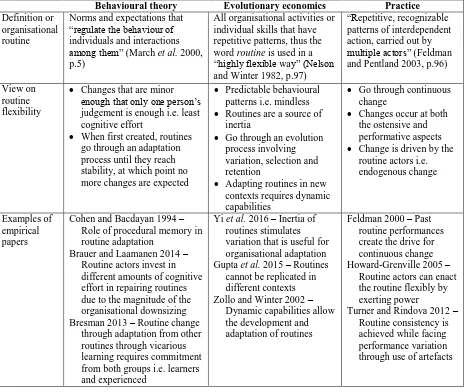
Table 2.1 is a summary of the three perspectives and their view of routine flexibility. It was observed that whereas the behavioural theory and evolutionary economics perspectives have quite similar views, the practice perspective provides an alternative view.
25
performed in the same way each time, thus it is expected to have no flexibility. However, this perspective does acknowledge that for a routine to be established, it must go through an evolutionary process in which it changes until it stabilises (Nelson and Winter 1982; Zollo and Winter 2002; Miner et al. 2008). The limitation from these first two perspectives due to their black box approach (Pentland and Feldman 2005) is addressed by the practice perspective, which focuses on the internal dynamics of organisational routines. Feldman and Pentland’s (2003) framework allows researchers to investigate how routines change according to their ostensive and performative aspects.
Behavioural theory Evolutionary economics Practice
Definition or organisational routine
Norms and expectations that “regulate the behaviour of individuals and interactions
among them” (March et al. 2000,
p.5)
All organisational activities or individual skills that have repetitive patterns, thus the
word routine is used in a
“highly flexible way” (Nelson and Winter 1982, p.97)
“Repetitive, recognizable patterns of interdependent action, carried out by multiple actors” (Feldman and Pentland 2003, p.96)
View on routine flexibility
Changes that are minor
enough that only one person’s judgement is enough i.e. least cognitive effort
When first created, routines
go through an adaptation process until they reach stability, at which point no more changes are expected
Predictable behavioural
patterns i.e. mindless
Routines are a source of
inertia
Go through an evolution
process involving variation, selection and retention
Adapting routines in new
contexts requires dynamic capabilities
Go through continuous
change
Changes occur at both
the ostensive and performative aspects
Change is driven by the
routine actors i.e. endogenous change
Examples of empirical papers
Cohen and Bacdayan 1994 – Role of procedural memory in routine adaptation
Brauer and Laamanen 2014 – Routine actors invest in different amounts of cognitive effort in repairing routines due to the magnitude of the organisational downsizing Bresman 2013 – Routine change
through adaptation from other routines through vicarious learning requires commitment from both groups i.e. learners and experienced
Yi et al. 2016 – Inertia of routines stimulates variation that is useful for organisational adaptation
Gupta et al. 2015 – Routines
cannot be replicated in different contexts Zollo and Winter 2002 –
Dynamic capabilities allow the development and adaptation of routines
Feldman 2000 – Past routine performances create the drive for continuous change Howard-Grenville 2005 –
Routine actors can enact the routine flexibly by exerting power
[image:36.612.76.542.246.638.2]Turner and Rindova 2012 – Routine consistency is achieved while facing performance variation through use of artefacts
Table 2.1 – Summary of the three perspectives in relation to routine flexibility
26
prescribed set of actions (Howard-Grenville 2005), and are generative systems (Pentland and Feldman 2005; 2008a). Their ability to be adapted between different situations allows organisations to respond to competing objectives (Aroles and McLean 2016), generate learning (Miner et al. 2008), and produce innovative outcomes (Sele and Grand 2016). The very repetition of routines requires them to have a certain degree of adaptation as well as the ability to be innovated via novel actions within different settings (Aroles and McLean 2016, p.12). Conversely, the flexibility of routine itself allows it to persist over time (Howard-Grenville 2005). Yet there are still many unanswered questions about how routines are changed, or even resist change (Cohen 2007). This study examines routine flexibility from the practice perspective to fill a gap in the literature on how the ostensive-to-performative relationship affects routine flexibility. Routine flexibility in this study is used to refer to routine enactment that differs from the conventional way, or the expectation of how it should be enacted. This includes any changes and deviations that can be either explicit, or implicit. Before going further, I think it is necessary to discuss routine flexibility by breaking it down into smaller categories. Specifically, the following section discusses the sources of routine flexibility and how they affect the different aspects of routines.
2.3 Routine dynamics
This section provides detailed explanations of the two aspects of the routine’s internal dynamics based on the aforementioned ostensive and performative framework by Feldman and Pentland (2003), which has become the main reference point for studies on routines from the practice perspective.
2.3.1 History
27
using an appropriate methodology to piece together the whole picture of the properties of society. On the other hand, performative was used to describe power in practice. According to Latour (1986), actors define what society is and it does not matter whether one knows more or less than another. The whole picture is established by finding the different practical ways actors define society. Although he noted that power can exist both in principle and practice, based on their definition, both these ideas (ostensive and performative) only exist as a duality; i.e. they cannot be blended together (Latour 1986; Simpson and Lorino 2016).
Feldman and Pentland (2003) adopted the ostensive and performative concepts from Latour (1986); ostensive refers to the principle of a phenomenon, and performative refers to the practical aspect of a phenomenon. However, they did not adopt the understanding of the concepts’ dualism. Rather, the routine dynamics model favours the notion of duality as presented by Giddens (1984). His work on structuration theory transcends the dualism of structure and agency as they constitute one another and are not independent phenomena. So, like mind and body which cannot be separated, the ostensive and performative aspects cannot exist without the other (Feldman and Orlikowski 2011). The ostensive aspect is the abstract idea of the routine, and the performative aspect is the acting out of the routine. For a routine to exist, there needs to be both the ostensive and performative aspects as “both aspects are necessary to constitute what we understand to be the routine” (Feldman and Pentland 2003, p. 102). Furthermore, these aspects are always relating to one another. Feldman and Pentland (2003) state that the ostensive aspect is used to guide, account for, and refer to a set of performances, whereas the performative aspect is essential for the creation, maintenance and modification of the ostensive aspect. The characteristics of both aspects are described further in the following sections.
2.3.2 Ostensive aspect