© 2019, IRJET | Impact Factor value: 7.211 | ISO 9001:2008 Certified Journal
| Page 6077
EI-Expression Illustrator
Rekha
1, Shivam Garg
2, Shivam Varshney
3, Yamini Joshi
4, Dr. Alka Singhal
1,2,3,4
Student, CSE Dept., IPEC Ghaziabad, India
5
Assistant Professor, CSE Dept., IPEC Ghaziabad, India
---***---
Abstract: As we are stepping forward from one generation to another, innumerous technologies are abiding us according to our necessities. Thus, we are thoroughly depending on these technologies as a part of human-computer interaction. And one of them is facial expression recognition. Human Face expression recognition is one of the most challenging tasks in social communication. Generally, face expressions are natural and direct means for human beings to communicate their emotions and intentions. Facial expressions are the key characteristics of non-verbal communication. Facial Extraction is one important step in expression analysis which contributes toward fast and accurate expression recognition. Happy sad, anger and fear etc. are facial expressions for facial recognition. There are different emotions that are categorized into following types: positive emotion and negative emotion. There are four types of generally using models: Face detection, extraction, Classification and recognition. This paper includes the introduction of facial expression recognition for extracting the effective and efficient method for facial expression recognition.
Keywords: Face detection, Facial expression
extraction, Expression recognition, Human-computer interaction.
1.
INTRODUCTION
The problem of automatic recognition of facial expressions is still an ongoing research, and it relies on advancements in Image Processing and Computer visualization techniques. Such systems have a variety of interesting applications, from human-machine interaction, to robotics and animations. Their aim is to provide robustness and high accuracy, but also to cope with variability in the environment and adapt to real time scenarios.
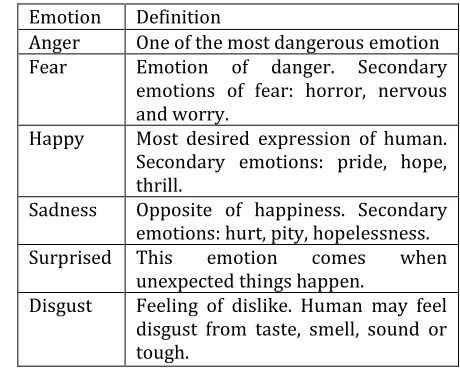
[image:1.612.331.561.206.390.2]This paper proposes an automatic facial expression recognition system, capable of distinguishing the four universal emotions: disgust, anger, fear, happiness, sadness.
Table 1: Universal Emotion Identification
Emotion Definition
Anger One of the most dangerous emotion
Fear Emotion of danger. Secondary
emotions of fear: horror, nervous and worry.
Happy Most desired expression of human.
Secondary emotions: pride, hope, thrill.
Sadness Opposite of happiness. Secondary
emotions: hurt, pity, hopelessness.
Surprised This emotion comes when
unexpected things happen.
Disgust Feeling of dislike. Human may feel
disgust from taste, smell, sound or tough.
2.
LITRATURE SURVEY
© 2019, IRJET | Impact Factor value: 7.211 | ISO 9001:2008 Certified Journal
| Page 6078
Setoff and Magee (1992), was vital in the findingthat the recognition of a facial expression is likely done by discrete categorization (e.g. a face is either happy or not). This suggests that the perception of facial expressions works in much the similar way that our recognition of shades of colors works – with identifiable boundaries prompting a set categorization. This is important as the definition of facial expression could either exist as an impression with a continuum, or as discrete variables. If perception is more keen to make concrete categorizations, it means that uncertainty with facial expressions isn’t beneficial when it comes to understanding the emotions of other people.
Carroll, J.M.; J.A. Russell (1996). "Do facial expressions signal definite emotions? Judging emotions from the face in context". Journal of Personality and Social Psychology. Certain facial expressions have been theorized to be easily recognizable signals of some specific emotions. If so, these
expressions should override situationally based
expectations used by a person in attributing one emotion to another. An alternative account is offered in which the face provides information admissible to emotion but does not signal a specific emotion. Therefore, in specified circumstances, situational rather than facial information was predicted to determine the judged emotion. This prediction was supported in 3 studies—indeed, in each of the 22 cases examined (e.g., a person in a frightening situation but displaying a reported "facial expression of anger or disgust" was judged as afraid). Situational information was especially noteworthy when it suggested a non-basic emotion.
THORAT Bali A Vision & Intelligent System Lab,
YANNAWAR Pravin LVision & Intelligent System Lab, MANZA Ganesh R Planning and Statistics Dept. of CS and IT, Dr. B.A.M.U. Aurangabad (MS) India,
They describe the medication of cascade object detector mechanism of ‘Viola-Jones’ for detection of essential facial components that contribute in formation of facial expression. The result obtained clearly provides confirmation about possibility of using thresholds for detection of expressions form video streams. The prototyped mechanism will be further tested with variety of expressions such as ‘sad’, ‘disgust’, ‘anger’ and ‘fear’.
3.
APPLICATIONS
Automated and real time facial expressions would play
vital role in human and computing machine interaction. Facial expression recognition would be useful from human
facilities to clinic practices. Analysis of facial expression plays fundamental roles for applications which are based on emotion recognition like Human Computer Interaction
(HCI), Social Robot, Animation, Alert System & Pain monitoring for patients.
This project “EXPRESSION ILLUSTRATOR” is developed using machine learning, anaconda, bootstrap, flask, html, CSS, java script and D-jango, YouTube API’s. The database of this project consist of 5000+ images of each emotion and quotes and videos using YouTube API’s. Expression Illustrator is a real time based project. The general procedure of Expression Illustrator follows several steps. The first step concerns face registration where there is a human-machine interaction will happen, for which the phase is known as face detection. It uses some a prior analysis of the face (e.g., eyes, mouth, eyebrows and nose) (fig. 1) and involved supervised learning where the task of inferring a function from labelled training data is done. The second concerns the image coding and classification (facial expressions recognition). Solutions for the recognition of facial expressions usually use these algorithms to frame the image around the face before performing the expression recognition. After recognizing the emotion (Happy, Sad, Anger, Neutral) the system will recommend the quotes and videos according respected to the emotion fetched by the system (fig. 2). For example, if the user in front of the system is sad, the system will detect the emotion of the user and fetch the emotion respective results and recommends some motivational or funny or inspirational things to the user to boost up his/her morale. Similarly, if the expression detected by the system is happy for a user, it will reflect the inspiring things which can be helpful in enhancement of spirit of doing work and spend the entire day with lot of joy and happiness.
Hence, our system is able to predict the following four emotions: 1. Happy, 2. Sad, 3. Anger, 4. Neutral and provide videos according to the emotion.
Fig.-1 Human Expressions
© 2019, IRJET | Impact Factor value: 7.211 | ISO 9001:2008 Certified Journal
| Page 6079
Robotics
Interactions are a complex issue that challenges both engineering and cognitive sciences. The recognition of human emotional states can provide important information either as a direct stimulus (stop or continue a mentioned behavior) or as a way to bias human- machine interactions. The general process of facial expression recognition follows several steps. The first step concerns face registration, we developed models for face detection. They use some a priori analysis of the face (e.g., eyes, mouth, and nose) and involved supervised learning. The second concerns the image coding and classification (facial expressions recognition). Solutions for the recognition of facial expressions usually use these algorithms to frame the image around the face before performing the expression recognition. This system will help the robot to communicate or interact with human in more precise manner. The System will help the robot by recommending users mood based videos.
Fig.-2 Flowchart of Expression Illustrator
Healthcare
Facial biometrics within healthcare is to secure patient data by using a unique patient photo instead of passwords and usernames.
With the increase in medical science and technology, biometrics is an industry worth watching. It’s clear that facial biometrics are a helpful tool for detecting user or patient facial expression. for example, a patient suffering from autism struggles to interpret expression, this system will help the patient in expressing and understanding the patient needs in future and may develop game or tools to help the patient.
E-Learning
E-learning means online/electronic learning. It is hard to detect the expression of learner. This system will check whether the leaner is enjoying the learning procedure or not for which we can use this concept and adjust the presentation style of an online tutor by making it more interactive and effective.
4.
RESULT AND CONCLUSION
There is increasing integration of computers and computer interfaces in our livelihood, due to the arise in the need of computers in order to be able to recognize and respond to human interaction and behavioral cues of mental and emotional states. The automated analysis of expressions is a challenging venture because of the uncertainty inherent in the inference of hidden mental states from behavioral cues. As the facial expression recognition systems are becoming more robust and effective in communications, many other innovative applications and uses are yet to be seen. The objective of this research paper is to give brief overview towards the procedure, various techniques, and application of Expression Illustrator system (Fig. 3).
© 2019, IRJET | Impact Factor value: 7.211 | ISO 9001:2008 Certified Journal
| Page 6080
Following are the samples of the expression Illustrator:Fig.-4 Beginning of the Expression Illustrator
Fig.-5 Expression Illustrator detects the user’s expression and tell the current emotion.
5.
FUTURE SCOPE
Face expression recognition systems have improved a lot over the past last decade. The focus has definitely shifted from posed expression recognition to a spontaneous expression recognition. Promising results can be obtained under face registration errors, fast processing time, and high correct recognition rate (CRR) and significant performance improvements can be obtained in our system. System is fully automatic and has the capability to work with images feed. It is able to recognize spontaneous expressions. Our system can be used in Digital Cameras wherein the image can be captured only when the person smiles. In security systems which can identify a person, in any form of expression he presents himself. Rooms in homes can set the lights, television to a person’s taste when they enter the room. Doctors can use these systems to understand the intensity of pain or illness of a deaf patient. Our system can be used to detect and track a user’s state of mind, and in mini-marts, shopping center to view the feedback of the customers to enhance the business etc.
6.
REFERENCES
1. Calder, A. J., & Young, A. W. (2005). Understanding the recognition of facial identity and facial expression. Nature Reviews Neuroscience, 6(8), 641.
2. Zhang, Z., Lyons, M., Schuster, M., & Akamatsu, S. (1998, April). Comparison between geometry-based and gabor-wavelets-based facial expression recognition using multi-layer perceptron. In Proceedings Third IEEE International Conference on Automatic face and gesture recognition (pp. 454-459). IEEE.
3. Bartlett, M. S., Littlewort, G., Fasel, I., & Movellan, J. R. (2003, June). Real Time Face Detection and Facial Expression Recognition: Development and Applications to Human Computer Interaction. In 2003 Conference on computer vision and pattern recognition workshop (Vol. 5, pp. 53-53). IEEE.
4. Calder, A. J., Keane, J., Manly, T., Sprengelmeyer, R., Scott, S., Nimmo-Smith, I., & Young, A. W. (2003). Facial expression recognition across the adult life span. Neuropsychologia, 41(2), 195-202.
5. Kim, K. I., Jung, K., & Kim, H. J. (2002). Face recognition using kernel principal component analysis. IEEE signal processing letters, 9(2), 40-42.8. Szwoch Wioleta; “Using Physiological Signals for Emotion Recognition”, 2013 IEEE.
6. Lien, J. J., Kanade, T., Cohn, J. F., & Li, C. C. (1998, April). Automated facial expression recognition based on FACS action units. In Proceedings Third IEEE International Conference on Automatic Face and Gesture Recognition (pp. 390-395). IEEE.
7.https://en.wikipedia.org/wiki/Facial_recognition_syste m
8. Parkins, R. (2012). Gender and emotional expressiveness: An analysis of prosodic features in emotional expression. Griffith University.
9. Castrillón, M., Déniz, O., Hernández, D., & Lorenzo, J. (2011). A comparison of face and facial feature detectors based on the Viola–Jones general object detection framework. Machine Vision and Applications, 22(3), 481-494.
© 2019, IRJET | Impact Factor value: 7.211 | ISO 9001:2008 Certified Journal
| Page 6081
11. Ekman, P. (1994), Strong Evidence for Universalsin Facial Expressions: A Reply to Russell’s Mistaken Critique, Psychological Bulletin, 115(2): 268-287
12. Sebe, N., Cohen, I., Gevers, T., and Huang, T.S. (2005), Multimodal Approaches for Emotion Recognition: A Survey, In Proc. Of SPIE-IS&T Electronic Imaging, SPIE Vol 5670: 56-67
13. Sebe, N., Lew, M.S., Cohen, I., Sun, Y., Gevers, T., and Huang, T.S.(2004), Authentic Facial Expression Analysis, Int. Conf. on Automatic Face and Gesture Recognition