warwick.ac.uk/lib-publications
Original citation:
Buisserety, Peter and Bernhardt, Dan. (2017) Dynamics of policymaking : stepping back to leap forward, stepping forward to keep back. American Journal of Political Science.
Permanent WRAP URL:
http://wrap.warwick.ac.uk/85888
Copyright and reuse:
The Warwick Research Archive Portal (WRAP) makes this work by researchers of the University of Warwick available open access under the following conditions. Copyright © and all moral rights to the version of the paper presented here belong to the individual author(s) and/or other copyright owners. To the extent reasonable and practicable the material made available in WRAP has been checked for eligibility before being made available.
Copies of full items can be used for personal research or study, educational, or not-for profit purposes without prior permission or charge. Provided that the authors, title and full bibliographic details are credited, a hyperlink and/or URL is given for the original metadata page and the content is not changed in any way.
Publisher’s statement:
"This is the peer reviewed version of the following article Buisserety, Peter and Bernhardt, Dan. (2017) Dynamics of policymaking : stepping back to leap forward, stepping forward to keep back. American Journal of Political Science which has been published in final form at http://dx.doi.org/10.1111/ajps.12301 This article may be used for non-commercial purposes in accordance with Wiley Terms and Conditions for Self-Archiving."
A note on versions:
The version presented here may differ from the published version or, version of record, if you wish to cite this item you are advised to consult the publisher’s version. Please see the ‘permanent WRAP URL’ above for details on accessing the published version and note that access may require a subscription.
Dynamics of Policymaking: Stepping Back to Leap
Forward, Stepping Forward to Keep Back
∗
Peter Buisseret† Dan Bernhardt‡
Short Title: Dynamics of Policymaking
∗We thank the Editor, three anonymous referees, Vincent Anesi, Scott Ashworth, Odilon Camara, Wiola
Dziuda, B˚ard Harstad, Niall Hughes, Gilat Levy, Karin Lundvall, Debraj Ray, Francesco Squintani, Vera Troeger, Stephane Wolton, and seminar audiences at Bristol, the LSE, Chicago, Queen Mary, Notting-ham, Stanford, NYU, Berkeley, the 2015 Priorat Workshop in Theoretical Political Science and the 2015 CRENoS Workshop on Institutions, Individual Behavior and Economic Outcomes for helpful comments and suggestions.
†Harris Public Policy, University of Chicago, 1155 E 60th Street, Chicago IL, 60637, USA. Email:
‡Departments of Economics and Finance, University of Illinois, Champaign, IL, 61801, USA, and
Abstract
We study dynamic policy-making when: today’s policy agreement becomes tomorrow’s status
quo; agents account for the consequences of today’s policies for future policy outcomes; and
there is uncertainty about who will hold future political power to propose and veto future
policy changes. Today’s agenda-setter holds back from fully exploiting present opportunities
to move policy toward her ideal point whenever future proposer and veto players are likely
to be alignedeitherin favor of reform, or against it. Otherwise, agenda-setters advance their short-run interests. Optimal proposals can vary discontinuously and non-monotonically with
political fundamentals.
Keywords: reform, agenda-setting, status quo, veto player.
1. Introduction
Policies implemented today partly determine the policies implemented in the future. This dynamic linkage in policy-making may arise through information (Callander and Hummel,
2014), preferences (Glaeser and Shleifer, 2005), or institutions (Bowen et al., 2014). We
study the consequences of a dynamic linkage that arises in contexts where existing policy
agreements prevail until they are superseded by a new agreement. This may be a consequence
of formal institutional rules, such as mandatory spending programs in the United States
(Bowen et al., 2014). It may also arise de facto: for example, the Barnett formula, used
in the United Kingdom to adjust public expenditure across Northern Ireland, Scotland and
Wales; introduced in 1978 as a temporary expedient, has been in continuous use, ever since.
A crucial feature of these environments is that the immediate payoff from today’s policy becomes the opportunity cost of changing future policy. In this paper, we ask: how does
this affect the short-term reform strategy of an agent whose long-term preference is to move
policy away from an unpalatable status quo? How does this strategy vary with the form and
degree of uncertainty over who will hold power in the future? And, how do answers to these
questions depend on agents’ ideological preferences in favor of, or against, policy reform?
We explore these questions in a political economy setting with far-sighted agents, building
on the seminal framework of Romer and Rosenthal (1979b). The novel ingredient that we
introduce is that agents face uncertainty about who will hold power in the future both to
propose and to accept policies vis-`a-vis the endogenous status quo.
Our model features a proposer and a veto player. The proposer may be an executive,
such as a president or prime minister, or a senior legislative office-holder such as the majority
leader in a legislative chamber. The veto player may be the median legislator in the same
or another legislative chamber, or a super-majority when such a rule applies.
We consider three types of veto player: a progressive, a centrist and aconservative. The
centrist and progressive both want to move policy in the same direction away from the extant
status quo, but a progressive wants to move policy further than a centrist. The conservative
also wants to shift policy, but in the opposite direction from the progressive and centrist. To
ease presentation, we assume that the initial veto player is a centrist.
Likewise, the proposer may either be a radical or a reactionary. A radical wants to
move policy away from the status quo in the same direction as progressive and centrist veto
players, but to a greater extent than both. Similarly, a reactionary wants to shift policy in
[FIGURE 1 ABOUT HERE]
Thus, the proposer and veto player are at best imperfectly aligned. Even when their
interests are nominally aligned, e.g., when they belong to the same political party, the
‘effective’ decisive agent need not precisely share a proposer’s preferences. This may be due
to explicit supermajority requirements or to the ability of a determined minority—on the
chamber floor, in a legislative committee, or a faction within the majority party—to impede
a bill’s progress.
The timing unfolds as follows. At date one, the proposer offers the veto player a choice between the status quo, and an alternative policy. If the veto player adopts the proposer’s
alternative, it becomes the new status quo. Otherwise, the initial status quo remains in
place. Between periods, the identities of both the legislative proposer and veto player may
change, for example, due to an election. Thus, a reactionary proposer may remain in power
or be replaced by a radical proposer, or vice versa. Similarly, the centrist veto player may
retain veto power, or be replaced by a progressive or conservative. Once again, the proposer
designs a policy. If approved by the veto player, it is implemented; otherwise the status quo
prevails.
Our paper derives how proposals are affected by uncertainty about who will hold future proposal and veto power, agents’ policy preferences, and their relative concern for future
policy outcomes. If agents care only about the present, the optimal proposal takes a simple
form: move policy as far as possible in the proposer’s favored direction, subject to the
constraint that the veto player prefers the policy to the status quo (Romer and Rosenthal
(1979b)).
When agents care about the future, though, optimal proposals may take a strikingly
different form. We show thatalignment of future proposer and veto player interests is a force
for today’s proposer to refrain moving policy in her preferred direction, whilemis-alignment
of their interests is a force for a radical to shift reform forward, and for a reactionary to maintain the status quo.
Alignment: A proposer and veto player are aligned if and only if there exist policies that both agents prefer to the status quo. In Figure 1, for example, a radical proposer is aligned
with both the progressive and centrist veto players, while a reactionary proposer is aligned
with the conservative veto player. A radical date-one proposer could exploit the centrist veto
player by moving policy toward her ideal policy. This, however, reduces her opportunity to
discontent with the new status quo. If a date-one radical is sufficiently confident of a future
friendly alignment between herself and a progressive veto player, she may prefer to hold
back, initially, in order to maximize her ability to exploit a progressive in the future.
A date-one radical may also prefer to hold back reform if she suspects that she will be
replaced by a future reactionary proposer who will face a conservative veto player. More
policy movement toward the radical’s ideal policy, today, exacerbates the conservative’s
dis-content with tomorrow’s status quo. This disdis-content can then be exploited by a reactionary proposer to achieve powerful counter-reform. If a radical fears a future hostile alignment
between a reactionary and a conservative veto player, she may prefer to hold back, initially.
A date-1 reactionary proposer faces a similar calculation, with the crucial difference
being that her notions of a friendly and hostile alignment are the opposite of the radical’s.
Thus, the possibilities of future alignment—both friendly and hostile—are forces for today’s
proposer to hold back from moving the initial status quo in her preferred direction.
Mis-alignment: A proposer and veto player aremis-aligned when there exists no alternative that both agents prefer to the status quo. In Figure 1, for example, a radical proposer is
mis-aligned with a conservative veto player, while a reactionary proposer is mis-aligned with
both the progressive and centrist veto players. If the future proposer and veto player are
mis-aligned, the proposer cannot move policy in her preferred direction—gridlock means that
the status quo that is inherited from the previous date will prevail. If a date-one proposer
anticipates a future mis-alignment, she prefers to accelerate her agenda rather than hold
back.
A proposer’s dynamic incentives turn on the prospects of future friendly alignment, hostile
alignment, and mis-alignment. A proposer can determine both (i) which potential veto
players will be partially aligned with each possible future proposer and (ii) how much each
veto player can be exploited. Moreover, a risk-averse proposer is most sensitive to the consequences of a hostile alignment that takes the policy outcome very far away from her
ideal. So, a radical or a reactionary’s proposal may reflect very different aspects of the
uncertainty that all agents face about who will hold future political power.
We provide conditions under which a reactionary proposes more initial reform than a
radical. This arises when, in the future, a radical proposer and progressive veto player are
likely to hold proposal and veto power. In this case, a radical ‘steps back in order to leap
forward’, fostering the opportunity to make dramatic future reform by showing restraint
ground today to prevent more drastic reform in the future.
A proposer’s dynamic incentives to hold back or accelerate her agenda arenot driven by
a calculation that more moderate policies are inherently more robust to changes in political
power. Rather, the durability of policy agreements turns on the extent to which they align
or mis-align the interests of possible future veto players and proposers. To illustrate with
reference to Figure 1, notice that by moving the date-1 policy away from the status quo and
toward the centrist’s ideal policy, an initial proposer induces less extreme date-two outcomes when the date-two proposer is a radical who faces a progressive veto player. By contrast, the
same date-1 policy moderation raises the prospect of a relatively extreme date-two policy
shift when the subsequent proposer is, instead, a reactionary who faces a conservative veto
player. The reason is that this policy change increases a reactionary’s ability to exploit the
conservative’s heightened discontent with the new status quo.
The standard explanation for why policymakers hold back from fully exploiting political
power is that they fear losing power in the future. This feature is also present in our setting,
and is especially relevant in non-democratic contexts. For example, an autocratic elite may
concede limited redistribution to stave off a threat of revolution (Acemoglu and Robinson (2000)). When one agent initially holds all political power, any change in the distribution
of power is necessarilyunfavorable to the incumbent.
In democratic contexts, however, future political power may evolve favorably or
unfa-vorably from an incumbent’s perspective. In a presidential system, a party may initially
control the legislature but then win the presidency, advancing from divided to unified
con-trol of government. Similar phenomena arise in parliamentary systems: in 2015, the British
Conservative Party won a majority, allowing them to dispense with their former coalition
partners, the Liberal Democrats. Such settings feature a second reason to hold back: partial
reform today engenders an opportunity cost of implementing more powerful reform in the future.
Our model can make sense of situations in which policy advocacy and opposition cannot
be explained by the respective groups’ and individuals’ contemporaneous policy interests. A
powerful illustration of ‘stepping forward to keep back’ can be found in the Second Reform
Act of 1867. That a British Conservative Government would implement legislation extending
voting rights to the British working class was long seen as paradoxical. However, Gallagher
(1980) argues that “[t]he Act was certainly conservative in that it was an early concession to
postponed further reform for nearly 20 years.
Another example from British political history illustrates the phenomenon of ‘stepping
back to leap forward’. In 1969, the British Labour government attempted to reform the
House of Lords by restricting the voting rights of hereditary peers and weakening their
capacity to delay legislation approved in the House of Commons. It was defeated, in part,
by a coalition of left-wing abolitionists within the Labour party, led by Michael Foot, who
“was anxious that any reform (rather than outright abolition) would merely serve to imbue the House of Lords with greater legitimacy and longevity...” (Shell, 2006, 191).
Do politically-minded agents possess the foresight to make such calculations? A
contem-porary example from American politics illustrates this foresight, where the opportunity cost
of short-run reform played a prominent role. The 2009American Clean Energy and Security
Act was designed to “curb the heat-trapping gases scientists have linked to climate change”4
by creating a cap and trade system. TheClean.org, “a grassroots coalition... devoted to
moving the U.S... to an economy based on renewable energy,” opposed this legislation,
arguing:
Since President Obama is likely to sign the bill with great fanfare, what will the public take away from this? Will they see it as a “win”—that the problem is
solved? If so, what will that mean for pushing for the needed steps later? How
will the public be mobilized to push their Representatives when the official and
media message is that this is “landmark” legislation?
‘Why We Cannot Support This Bill’ (http://goo.gl/zZ3U3r)
Our benchmark analysis presumes that the proposer is dynamically sophisticated, but
that the veto player evaluates alternatives to the status quo based on her current payoff. We conclude by showing how an initial centrist veto player who is dynamically sophisticated
may (a) accept policies that she would reject were she myopic, and (b) reject policies that
she would accept were she myopic.
The paper’s outline is as follows. After reviewing the literature, we present our base
model. We first analyze scenarios in which proposers never hold back, always exploiting a
centrist veto player to some extent. We then analyze the full model in which the identities of
4Broder, John (2009-06-26). “House Passes Bill to Address Threat of Climate Change”. New York
the proposer and veto player may change over time. Finally, we explore how primitives of the
political environment affect proposals, and analyze settings with a dynamically-sophisticated
veto player. A conclusion follows. Proofs and additional results are in an appendix.
Related Literature. Our work builds on the pioneering agenda-setting model of Romer and Rosenthal (1979b), in which a proposer with fixed identity makes a proposal that is pitted
against a default alternative in an up-or-down vote. In our setting, however, decision-making
does not end when a proposal is approved: a policy persists only until it is replaced with a new policy. Baron (1996) introduces an endogenous status quo to a spatial legislative bargaining
setting with a fixed distribution of agent preferences. He recovers a ‘dynamic median voter
theorem’: policies may move to the left or right in any period, but they gradually converge
to the median voter’s ideal policy. In our model, by contrast, the preferences of both the
proposer and veto player may evolve over time in ways that cannot be perfectly anticipated.
We show that convergence to either the present or to the anticipated future veto player’s
ideal policy need not occur.5 Chen and Eraslan (2015) allow an initial proposer to choose
from one of several issues, but once an issue is addressed it cannot be revisited.
In Penn (2009) a proposal is randomly (non-strategically) drawn at each date and pitted against the status quo. Voters are ‘farsighted’, taking into account both the immediate and
long-term consequences of the immediate policy outcome. Penn highlights how static and
dynamic voting considerations may diverge. We extend her work by modeling a strategic
agenda-setter, capturing the fact that in many real-world settings, agendas are chosen by
strategic agents who trade off current and future policy outcomes.
Dynamic linkages may arise through other channels. Callander and Hummel (2014)
explore an information channel: an incumbent’s policy choice reveals information to her
successor, changing her preferences over policies.6 Callander and Raiha (2014) explore a
technological channel: they assume that policy investments (infrastructure) persist across periods. Agenda manipulation arises because a successor’s preference over subsequent
in-vestments depends on past inin-vestments.
Our work also relates to a literature on the political economy of the timing and scope of
5Epple and Riordan (1987) were the first to consider an endogenous status quo in a ‘divide the dollar’
setting; subsequent work includes Kalandrakis (2004), Duggan and Kalandrakis (2012), and Baron and Bowen (2013). Some authors study policy environments that admit either spatial or distributive interpretations (Bernheim et al. (2006), Diermeier and Fong (2011)) and others include both dimensions, such as Bowen et al. (2014).
reform. A long-standing puzzle is why parties with an avowed opposition to reforms such
as market liberalization are more likely to implement these policies (Alesina et al. (2006),
Roland (2008)). Cukierman and Tommasi (1998) claim that these parties’ relative hostility
to such policies ensures that only they can credibly claim that they are necessary. Our
explanation is instead based on a fear that a failure to implement reform now will make the
inevitable actions of a successor even more drastic.
2. Model
We consider a two-date economy, with dates 1 and 2. The policy space is R. There
are two agents: a decisive veto player (“the veto player”), and a legislative proposer (“the
proposer”), whose date-t ideal policies are rt and pt, respectively. The legislative proposer may be interpreted as the executive or a senior legislative office-holder. The veto player could
be the median legislator or the ‘effective’ pivotal legislator in cases where a super-majority
requirement applies. In other settings, the veto player could be the median legislator in a
governing party or coalition.
The date-t payoff of an agent with ideal policy i from a date-t policy yt ∈R is ui(yt) = −(yt−i)2. There is an initial status quos1 >0, inherited from a previous legislative cycle.
The proposer is either a reactionary, or a radical, with ideal policies e and −e, respectively,
where e > s1. Initially, the veto player is a centrist, with an ideal policy that we normalize
to zero. Symmetry of agents’ ideal policies eases analysis, but is not needed for our results. The timing is as follows. At date 1, the proposer first chooses a policy y1 ∈ R that the
veto player may accept or reject. If accepted, the proposal is implemented; otherwise the
status quo s1 prevails. The policy implemented at date 1 serves as the status quos2 at date
2.
Between dates 1 and 2, an election occurs that may change the identities of the proposer,
veto player, or both. For example, in a parliamentary system, both agents may change
in the same election; in a presidential system in which election timing is staggered, one
agent may remain in office for sure, whilst the other faces potential replacement. In settings
where proposals originate in the legislature, a change in veto player could reflect a change
in president.
At date 2, the veto player may remain a centrist or be replaced by a conservative veto
player with ideal policym ≥s1, or by aprogressive veto player with ideal policy−m. Pr(r2)
remain a reactionary (radical) or be replaced by a radical (reactionary). We let α denote
the probability of a radical date-2 proposer, and let β = 1−α denote the probability of a
reactionary proposer. For simplicity, we assume that the probability distributions over these
transitions are independent.
At date 2, the proposer chooses a policy y2 ∈ R, which the veto player may accept
or reject. If accepted, the proposal is implemented; otherwise the date-2 status quo s2 is
implemented. The game then ends.
In real-world settings, proposer and veto players are often imperfectly aligned (i.e.,
e 6= m). In the United States, it is rare for a single party to control the House, Senate
and presidency; and even when the same party controls each branch, a supermajority may
be required in the Senate. Moreover, preferences may vary across the three branches, for
example, if agents face different electoral constituencies. In parliamentary systems where a
single party is likely to hold both a legislative majority and the executive, a party leader who
acts as a proposer must still win the support of a majority within the governing party. This
problem can be especially severe when parties must work together in a coalition government.
Institutional rules may also render the ‘effective’ veto player different from the median of the legislative chamber in which the party holds a majority. This would be the case if proposals
initiate in a lower chamber, but are subject to veto by an upper chamber.
We do not initially order the ideologies of the proposers and the relatively polarized veto
players, e and m. However, dynamic trade-offs arise almost exclusively in settings where at
least one proposer is more ideologically extreme than the corresponding veto player. Thus,
most of our analysis focuses on settings in which the proposer is relatively more ‘extreme’
than her most closely aligned veto player, i.e., when e > m.7
The payoff of an agent with ideal policy iis (1−δ)ui(y1) +δui(y2). The weightδ∈(0,1)
captures the degree to which agents value policy made in the next term relative to the current term. A policymaker may place less emphasis on the current term (δ close to one)
if an election will soon take place, since there will be an imminent opportunity to revise
policy after the election. The most natural interpretation of our two-date model is that the
policy in place at the end of the second term is subsequently locked in over a sufficiently long
horizon that future opportunities to change it are largely discounted by relatively impatient
politicians. In practice, it is often politically and practically infeasible for lawmakers to
7In Appendix A, we allow for arbitrary numbers of veto player and proposer types, and a general
implement frequent major innovations to a policy area (e.g., health insurance).
Throughout, we assume that the proposer is ‘dynamically sophisticated’: she recognizes
that political competition is not a one-shot game and fully accounts for the future
conse-quences of her proposal. To simplify exposition, our benchmark setting assumes that the veto
player evaluates policy solely according to her status quo payoff. This lets us focus on the
dynamic concerns of the proposer. Later, we consider a veto player who is also dynamically
sophisticated.
We assume that the distributions over the future holders of proposal and veto power are
independent and exogenous. Positive correlation strengthens incentives for an agent to hold
back from initially moving policy toward her ideal policy; while negative correlation weakens
those incentives. Positive correlation is likely in a parliamentary system, where the forces
that make a reactionary proposer more likely, also make a conservative veto player from
the same party more likely. In contrast, negative correlation may be likely in an American
context where the president faces a mid-term election in which her party typically performs
badly. In that case, the veto player’s ideology is likely to move away from the proposer’s.
We also assume the exogeneity of the distributions over future proposal and veto power. Policy reforms have indirect effects on preferences—given agents’ tastes, they affect their
induced preference trade-offs over future reforms vis-`a-vis the induced status quo. Our
analysis focuses on this effect. Policy reforms may also change agents’ underlying primitive
preferences. For example, allowing occupants of state-housing to purchase their homes may
alter their preferences over redistributive policies.8 Translated into our framework, there are
settings in which the distribution over proposal and veto power varies with today’s policy
choices. We make two observations. First, our framework lets us avoid conflating the two
channels whilst uncovering a bevy of subtle trade-offs. Second, the underlying demographics
of a society typically change slowly, taking several legislative cycles to evolve.9
8An example is Margaret Thatcher’s controversial ‘right-to-buy’ policy, in the 1980s.
9For example, Glaeser and Shleifer (2005) document the process by which James Curley, an Irish
3. When Won’t Politicians Hold Back?
We first identify settings in which politicians always want to move policy toward their ideal policies, past the policy preferred by a centrist veto player. These include (1) a static
setting where there are no future opportunities to revise policies; (2) the veto player is always
a centrist; or (3) veto players have more extreme ideologies than proposers, i.e.,m > e.
Static setting. A static setting is strategically equivalent to date 2 of a dynamic environ-ment, so we drop time subscripts, and refer to the status quo as s, and the ideal points of
the proposer and veto player as p and r. When future opportunities to change policy are
absent or fully discounted, a proposer wants to move policy as close as possible to her ideal
point, subject to receiving approval from the veto player (Romer and Rosenthal (1979b)).
[FIGURE 2 ABOUT HERE]
The veto player will accept any policy that is closer to her ideal policy r than the status
quo s. Suppose that a radical with ideal policy−e holds proposal power.
(1) If a veto player has ideal policy r ≥ s, she will veto any proposal that moves policy
toward the radical’s ideal policy. Thus, the radical can do no better than propose the status
quo.
(2) If a veto player has ideal policy r < s, and her loss is symmetric around her ideal point,
she will accept any proposal lying closer to her ideal point thans. Thus, the most reform she
is prepared to accept is the policy y < r satisfying s−r=r−y, i.e., the policyy = 2r−s. If a radical proposer’s ideal policy is sufficiently palatable to the veto player relative to
the status quo, i.e., if 2r−s≤ −e, then the radical proposes her own ideal policy. Otherwise,
she can do no better thany = 2r−s. Therefore, the radical’s static optimal proposal is:
y∗(−e, r, s) =
s if s≤r
s−2(s−r) if r < s < e+ 2r
−e if s≥e+ 2r.
(1)
A proposer’s ability to move policy rises with the distance between the status quo s and
the veto player’s ideal policy r. This is particularly relevant when a radical proposer and
veto player are partially aligned relative to the status quo, so that s > r, but not so much
case, the radical fully exploits the veto player’s desire for reform, jumping policy past r by
s−r.
Similarly, the optimal proposal of a reactionary with ideology e > m is:
y∗(e, r, s) =
s if s ≥r
s+ 2(r−s) if 2r−e < s < r
e if s ≤2r−e
(2)
Thus, if the proposer cares only about the immediate consequences of her proposal, she
moves the policy outcome as close as possible to her ideal policy.
This solution has implications for the dynamic setting. When a proposer and veto player
are only partially aligned relative to the status quo, a proposer’s ability to move policy rises
with the distance |r−s| between the status quo and the veto player’s ideal policy. When
the status quo arises from a previous proposal, this feature provides a proposer incentives to
refrain from maximizing her static payoff in order to increase her future advantage.
Centrist Veto Player Always Holds Power. Suppose now that today’s proposer is uncertain about the identity of tomorrow’s proposer, but the veto player is sure to remain
a centrist. This could reflect a setting in which a legislative chamber is the proposer, the
president is the veto player, and only the legislative chamber faces an imminent midterm
election.
At date 1, a centrist veto player accepts any proposal that is closer to her ideal policy
than the status quo. This is not a consequence of our assumption that a veto player evaluates
proposals according to her immediate payoff. In fact, if a veto player is certain to retain
veto power, her acceptance strategy is the same when she is dynamically sophisticated, and therefore internalizes the long-run consequences of her acceptance decisions.
Result 1. Suppose that a centrist is certain to hold veto power at both dates. Then at date one a radical proposes y1(−e)≤0, while a reactionary proposes y1(e)≥0.
Result 1 follows directly from the observation that for any date-2 status quo s2 =y1 ∈
[0, s1] or s2 =−y1, a radical will implement−y1 and a reactionary will implementy1.
This result does not mean that a proposer moves policy as close as possible to her ideal
point. In fact, her proposal trades off between static and dynamic incentives. Catering to
is because she can do no better than lock in her gains at date 2 by maintaining the induced
status quo, s2(= y1). However, as she moves policy closer to her ideal, the penalty from
losing proposal power grows increasingly severe. Thus:
Proposition 1. If a centrist veto player always holds veto power at both dates, then an interior solution for a proposer with ideal policy i∈ {−e, e} satisfies:
y1(i) =i−δi2 Pr(i loses proposal power). (3)
A radical’s proposaly1(−e)≤0 induces future mis-alignment between herself and a centrist,
and it raises the threat of a hostile alignment between a reactionary proposer and a centrist.
When a hostile alignment is more likely, a radical proposes less reform to avoid antagonizing
a centrist, who will be easier for a future reactionary to exploit. A reactionary proposer who
proposes y1(e)≥0 faces similar considerations.
When the veto player is always a centrist, each proposer’s concern for the long-run
always induces policy moderation. Nonetheless, dynamic incentives need not induce policy
moderation when the identity of the veto player can also change between dates.
Veto players are more extreme than proposers. Result 1 extends when (1) the veto player’s identity may change between periods, but (2) m > e, so that the ideologies of
non-centrist veto players are more extreme than those of proposers. Whenm > e, a radical who
faces a progressive at date 2 can achieve her ideal outcome −e regardless of the location of
the status quo s1 ≥ −e. The same holds for a reactionary-conservative pairing at date 2
when s1 ≤e. Since the precise location of the date-1 policy only affects the date-2 outcome
if the veto player is a centrist, Result 1 extends: a radical at date 1 selectsy1(−e)≤0, while
a reactionary proposer prefers y1(e)≥0.
Thus, the strategically-interesting setting is where proposers are more extreme than veto
players, i.e., where e > m (see Figure 1). In what follows, to ease presentation, we assume an even greater degree of imperfect alignment between proposers and veto players:
A1. e−m > m+s1.
A1 ensures that for any date-2 status quo resulting from date-1 interactions, each pro-poser wants to move policy closer to her ideal point than any veto player would accept.10
10When 0< e−m < m+s
1: ify1∈ [−s1,2m−e], a date-2 reactionary who faces a conservative veto
4. Identities of Proposers and Veto Players May Change Over Time
We now study optimal proposals at date 1 when the identities of the proposer and veto player may change over time, and proposers are more extreme than veto players.
When the veto player is always a centrist, the optimal date-1 proposal renders the centrist
veto player exploitable only by the opposing proposer, at date 2. When the veto player can
change over time, by contrast, each proposer faces a non-trivial decision about which types
of veto players she wants to be partially aligned with at date 2. When the veto player is not
dynamically sophisticated, she weakly prefers any policy y1 ∈ [−s1, s1] to s1. This means
that a proposer faces an initial decision about which side of a centrist’s ideal policy to place
her date-1 proposal.
A proposer’s continuation payoff from a policy y1 that becomes the date-2 status quo s2
is:
Vi(y1) = α
X
r2<y1
Pr(r2)ui(y1−2(y1−r2)) + X
r2≥y1
Pr(r2)ui(y1)
+ β
X
r2>y1
Pr(r2)ui(y1+ 2(r2−y1)) + X
r2≤y1
Pr(r2)ui(y1)
. (4)
The date-2 proposer will be a radical with probability α. If the radical holds proposal
power and r2 < y1, then the radical will exploit her friendly alignment to shift policy to
y1 −2(y1 −r2). If, instead, r2 ≥ y1, the radical and veto player are mis-aligned, so she
can do no better than maintain the status quo. With probability β, the proposer will be a
reactionary. If r2 > y1, then a reactionary will exploit her own friendly alignment with a
veto player to move policy toy1+ 2(r2−y1). If, instead, r2 ≤y1 then she and the veto player
will be mis-aligned, and maintain the status quo. Notice that friendly alignment from one
proposer’s perspective represents hostile alignment from the other’s.
Substituting these possible date-2 policy outcomes intoVi(yi) and recalling the quadratic
structure of preferences yields
Vi(y1) = −α
X
r2<y1
Pr(r2)(2r2 −i−y1)2+ X
r2≥y1
Pr(r2)(i−y1)2
−β
X
r2>y1
Pr(r2)(2r2−i−y1)2+ X
r2≤y1
Pr(r2)(i−y1)2
. (5)
Here, 2r2−iis the date-2 status quo policys2 =y1 that would let a proposer with ideology
i move policy all the way to i if she faced an aligned veto player with ideal policy r2. From
Assumption A1,e >2m+s1, so a proposer will never move date-1 policy this far.
The optimal policy of an agent with ideology isolves:
max y1∈[−s1,s1]
(1−δ)ui(y1) +δVi(y1). (6)
Solving yields:
Lemma 1. If the optimal policy of a proposer with ideal point iis interior, then it satisfies:
y1(i) = (1−δ)i+δ
α X
r2>y1(i)
Pr(r2)i+β X
r2<y1(i)
Pr(r2)i
+ δα X
r2<y1(i)
Pr(r2)(i+ 2(r2−i)) +β X
r2>y1(i)
Pr(r2)(i+ 2(r2−i))
, (7)
where y1(i)∈[−s1,0), or y1(i)∈(0, s1].
There are at most two solutions satisfying (7)—one on each side of the centrist veto player’s
ideal policy—reflecting that whether the centrist veto player is aligned with one proposer
or the other changes as y1 switches from one side of a centrist’s ideal point to the other.
Dynamic incentives are determined by two competing channels, an alignment channel,
α X
r2<y1(i)
Pr(r2)(i+ 2(r2−i)) +β X
r2>y1(i)
Pr(r2)(i+ 2(r2−i)), (8)
and a mis-alignment channel,
α X
r2>y1(i)
Pr(r2)i+β X
r2<y1(i)
Alignment Channel: In equilibrium, the initial proposal y1(i) becomes the date-2 status quo.
With probabilityα, the date-2 proposer is a radical. Ifr2 < y1(i), the radical is aligned with a
veto player. With complementary probabilityβ= 1−α, the date-2 proposer is a reactionary.
If r2 > y1(i), the reactionary is aligned with the veto player. The absolute magnitude of
2r2−i captures ideological conflicts of interest between a proposer and a partially-aligned
veto player.
For a radical, the first term in (8) reflects future friendly alignment, and the second term reflects hostile alignment. For a reactionary, the terms are reversed. Both friendly
and hostile alignment encourage a proposer to refrain from moving date-1 policy toward her
ideal. However, a risk-averse proposer weighs hostile alignment more heavily than friendly
alignment. So, unless she is likely to retain proposal power, a proposer holds back largely to
prevent future policy moves away from her ideal.
Mis-alignment Channel: At date 2, the ideologies of the proposer and veto player may admit
no mutually acceptable alternative to the induced status quo. This occurs if a proposer holds
power but faces a veto player whose ideal point lies on the opposite side of the status quo
from her own ideal point. When this happens, y1(i) will once again be implemented.
As the prospect of this policy inertia rises, a date-1 proposer prefers either to front-load
reform (if she is a radical) or to hold the line against reform (if she is a reactionary). Future
gridlock limits both the value of holding subsequent proposal power and the cost of losing
it. Mis-alignment thus constitutes a form of insurance for a proposer against the adverse
consequences of initially accelerating her own agenda.
5. Forces Shaping Incentives to Step Back or Leap Forward
A proposer’s immediate interest is to move date-1 policy toward her ideal policy. However,
the future consequences of a proposal present conflicting imperatives. We first focus on ‘local’ comparative statics that change the location of an interior solutiony1(i)∈(−s1,0) or
y1(i) ∈ (0, s1) within each interval. We then identify forces that lead to ‘jumps’ in y1 from
one side of the centrist veto player’s ideal point to the other.
Changes in Concerns for Current and Future Payoffs. A date-1 proposer has a short-run incentive to exploit a centrist as much as possible. However, any prospect of a
date-2 proposer-veto player alignment—be it friendly or hostile—consitutes a dynamic force
Proposition 2. If a proposer becomes more concerned about future payoffs (i.e., ifδ rises), then she always holds back more from moving her initial proposal toward her ideal point.
Short-run incentives yield no trade-offs for a proposer. By contrast, a future prospect of
either a friendly or hostile alignment gives a date-1 proposer a dynamic incentive to refrain
from unfettered exploitation of the centrist. And since dynamic incentives always urge more
restraint than static incentives, raising a proposer’s concern for future outcomes gives her a stronger incentive to hold back at date 1.
Proposition 2 implies that proposers will allocate major policy initiatives that depart most
significantly from the status quo to the start of a legislative cycle. For example, George
W. Bush proposed No Child Left Behind within three days of taking office, and his first
major tax reform was passed within five months of the start of his presidency. Likewise, the
Conservative-led UK Coalition government introduced one of its most controversial reforms—
the Academies Act 2010—within fourteen days of its commencement. By contrast, critics
contended that its final year was stymied by a lack of policy initiatives, serving merely as a
“long anteroom” to the next election.11 Our explanation for front-loading major initiatives is
distinct from ‘honeymoon’ arguments that emphasize a legislature’s deference to an executive just after his or her election (McCarty (1997)). Instead, we emphasize the relative imminence
of subsequent opportunities to change policy in the future.12
Changes in Uncertainty about Future Power. We next characterize the possibly paradoxical effects of a probabilistic shift toward a more reform-minded veto player: under plausible circumstances, both a radical and a reactionary proposer respond by accelerating
reform.
Proposition 3. Consider a shift in the distribution over date-2 veto players that redis-tributes probability mass from a conservative to a progressive. Regardless of whether a proposer is a radical or a reactionary, she responds by offering less reform if and only if the
probability she holds future proposal power exceeds 12 + m2e.
11See “ ‘Zombie coalition has run out of things to say’ say critics”, The Independent, 25 January 2014,
http://goo.gl/9RgRfd.
12Alternatively, Proposition 2 predicts that legislative activity, as measured by the submission of bills,
To illustrate, suppose the date-1 proposer is a radical. When a probability mass of >0
is taken from the future prospect of a conservative and redistributed to a progressive, the
local change in a date-1 radical’s proposal is:
δ(−e(β−α) +α(e−2m)−β(e+ 2m)). (10)
The probability of a mis-aligned future proposer-veto player pairing rises by (β−α). This
difference is positive when a reactionary proposer is more likely than a radical to hold future
proposal power, since a progressive is mis-aligned with a reactionary. A higher likelihood of
mis-alignment encourages a proposer to move her proposal toward her ideal policy.
The other two terms in (10) come from the alignment channel. A radical’s prospect of
a future friendly alignment with a progressive rises by α, and the prospect of a hostile
alignment between a reactionary proposer and a conservative falls by β. Expression (10)
reflects that these two terms are not weighted equally: a risk-averse proposer cares more about policies that result from hostile alignment.
If the probability of mis-alignment rises, i.e., if β > α, then a radical always accelerates
reform. What if, instead, a radical is more likely to hold proposal power in the future?
Holding back more allows a radical to better exploit a future friendly alignment. However,
unless she is very likely to retain proposal power, the first-order effect of a more
‘reform-friendly’ distribution of veto power is to lower her risk-adjusted alignment consideration
via the reduced risk of a future hostile alignment. This leads her to bring reform forward.
The impact of risk aversion is clearest when the distribution over future proposal power is
balanced, i.e., α = β = 12: the radical moves policy closer to her ideal point by a distance 2δm. Combining the mis-alignment and alignment channels, a radical holds back more if
and only if:
α > 1 2+
m
2e. (11)
The requisite threshold on a radical’s prospect of holding power also rises as her primitive
alignment with a progressive and a reactionary’s primitive alignment with a conservative—
both captured by me—rise. This reflects that, due to risk aversion, more aligned hostile
pairings make bad policy outcomes even worse; while more aligned friendly pairings make good policy outcomes even better. This raises the wedge between the risk-averse radical’s
evaluation of these two considerations.
likely to hold proposal power, i.e.,
α < 1 2 −
m
2e, (12)
as only then will mis-alignment dominate the change in her risk-adjusted alignment.
To place the proposition in context, consider a president facing a midterm election who
is sure to remain in office, but is uncertain about the election’s consequences for the ideology of the pivotal legislator in the lower chamber. The proposition implies that if a president
anticipates a favorable shift in the preferences of the pivotal legislator, it is better to hold
off on executing her agenda. If instead, the president anticipates an unfavorable shift, then
the next legislative session yields less scope for reversing initial concessions, so she prefers
to accelerate her agenda prior to the midterm election. Finally, if the president also faces
election and there is sufficient uncertainty about whether she will retain office, the proposition
reveals that regardless of her ideological preferences, she moves the initial policy toward the
anticipated location of the new pivotal legislator’s ideal policy.
Changes in Ideology. Changes in the ideological conflict between proposers and veto players affect the date-1 trade-offs a proposer faces to: (1) increase friendly alignment with
future veto players, (2) lower hostile alignment of an opposing proposer with veto players,
and (3) accelerate her agenda in anticipation of future mis-alignment.
The effect of greater polarization of veto players on date-1 proposals hinges solely on the
probability of a future alignment.
Proposition 4. Regardless of whether the date-1 proposer is a radical or a reactionary, more polarized veto players (increased m) induce the proposer to offer more reform if and
only if:
βPr(r2 =m)< αPr(r2 =−m). (13)
When a friendly alignment is more likely than a hostile alignment, raising m reduces the
imperative to raise the value of future friendly alignment by holding back, since a proposer can achieve more with the now more-aligned veto player for any date-2 status quo. The
proposer responds by moving policy in the direction of her ideal point. In contrast, when a
hostile alignment is more likely, if a hostile veto player moves closer to a hostile proposer, it
raises the imperative to mitigate futurehostile alignment.
To place Proposition 4 in context, suppose there is a right-wing status quo, and an
immi-nent election is expected to bring both the presidency and legislature under the control of the
with the winning presidential candidate benefit from their candidate’s popular support
(Fer-ejohn and Calvert (1984)), and which Halberstam and Montagnes (2015) show leads to the
election of more ideologically-extreme senators who support the president. When the
legis-lature is expected to become more ideologically polarized, the initial incumbent proposer—
regardless of her ideology—offers more reform. A reactionary makes concessions to avert
more drastic future policy shifts. By contrast, a radical initiates more reform today since
she can already achieve more in the future with a more ideologically polarized aligned veto player regardless of her initial proposal.
Greater polarization of proposers affects both static and dynamic trade-offs. It raises a
proposer’s immediate incentive to move policy toward her ideal, since more extreme
ideo-logical preferences raise the direct cost of holding back. Greater polarization of proposers
also affects both the alignment and mis-alignment channels, by raising a proposer’s conflict
of interest with both aligned and mis-aligned veto players.
Proposition 5. Suppose the polarizationeof proposers rises. Then if mis-aligned proposer-veto player pairings are more likely than aligned pairings, each proposer moves her date-1
proposal closer to her ideal policy. If, instead, aligned pairings are more likely, then there exists a ¯δ <1 such that if and only ifδ ≥δ, each proposer moves her date-1 proposal¯ further
from her ideal policy.
A more extreme proposer suffers a higher date-1 cost from failing to move policy toward
her ideal. She also suffers a higher cost of date-2 mis-alignment, since the status quo will be
implemented. If the net likelihood of future mis-alignment exceeds that of alignment, static
and dynamic considerations both lead a more extreme proposer to accelerate her agenda.
However, a more extreme proposer also has greater intrinsic conflicts of interest with all
veto players. This raises her incentive to hold back to raise future friendly alignment and reduce hostile alignment. By holding back, she lowers her conflict with aligned friendly veto
players; and she reduces an opposing proposer’s ability to exploit aligned hostile veto players.
If aligned proposer-veto player pairings are more likely than mis-aligned pairings, static
and dynamic incentives oppose each other. Then, if and only if a date-1 proposer cares
enough about future outcomes—for example, due to an imminent election—will she respond
by holding back. As the prospects of aligned pairings rise, the requisite size of δ falls since
the initial proposer is more certain about the need to hold back from exploiting the centrist
To place Proposition 5 in context, suppose that the next election may change the identity
of both the president and legislative majority. If control of the two branches is likely to fall to
different political parties, a more ideological president will accelerate her agenda before the
election. If, instead, the same party is likely to control both branches, the impact of more
extreme proposer preferences depends on the imminence δ of the election. If an election
is imminent and there will be an opportunity to revisit the issue in the next legislative
session, the president holds off working on the issue. This may be due to (1) a fear of losing power to an opposing aligned proposer-veto player pairing, or (2) an attempt to create even
more favorable conditions for aggressive reform. Otherwise, despite the likely prospect of
either favorable or unfavorable unified government, a more extreme proposer accelerates her
agenda.
Discrete Changes in Proposals. Changes in tastes, uncertainty and concern for the future affect local comparative statics through the alignment and mis-alignment channels. They
also affect the discrete trade-offs associated with whether a proposer wishes to (partially)
align herself with a centrist veto player, whenever there is uncertainty about whether the
centrist will hold future veto power. If the centrist will never hold future veto power, the
alignment of future veto players and proposers is unaffected by initial policy outcomes, and
the local solutions characterized in Lemma 1 coincide. If the centrist always holds veto power,
Result 1 implies that each proposer always prefers a date-1 outcome that lies between her
own ideal point and the centrist’s.
Suppose, therefore, that the probability tomorrow’s proposer faces a centrist veto player is strictly positive, but less than one. Jumps in optimal policies require that there exist
multiple interior solutions y1−(i) ∈ [−s1,0) and y+1(i) ∈ (0, s1]. In turn, multiple interior
solutions require that the date-1 proposer be more likely than not to retain proposal power.
To see why, recognize that Lemma 1 implies that for a date-1 proposer,
y1+(i)−y−1(i) =−2iδ(α−β) Pr(centrist), (14)
which, for example, can only result in y1+(−e)>0> y−1(−e) if α > β.
We explore how changes in the uncertainty associated with future proposal power affect
an initial radical proposer’s preference for aligning herself with a future centrist veto player.
Suppose, then, that α > β. When is it worthwhile for the radical to refrain from exploiting
veto player, and (2) inoculating herself against a future reactionary-conservative pairing?
Lety1∗(−e) denote a radical’s globally optimal interior solution. We have:
Proposition 6. Suppose a radical is more likely to hold future proposal power, i.e., α > β.
1. If Pr(conservative veto player)Pr(progressive veto player) ≤ 1− 2m
e then there exists α
∗(δ) (decreasing in δ) such that
y1∗(−e)>0 ifα > α∗(δ) and y1∗(−e)<0 otherwise.
2. If 1− 2m e <
Pr(conservative veto player)
Pr(progressive veto player) ≤1, theny
∗
1(−e)<0 for all δ.
3. If a conservative veto player is more likely than progressive veto player, then there
exists α∗∗(δ) (increasing in δ) such that y1∗(−e) < 0 if α > α∗∗(δ) and y∗1(−e) > 0
otherwise.
(1) When Pr(conservative veto player)Pr(progressive veto player) ≤1−2m
e a conservative veto player is much less likely than a progressive. Then, when proposal power is fairly balanced—i.e., when α > β, but the
difference is small—a date-1 radical proposer is largely concerned about the risk of a future
mis-alignment between a reactionary and a progressive. This implies that future policy is
likely to remain ‘stuck’ at the new status quo, so an initial radical proposer prefers to exploit
the centrist veto player immediately.
As the radical’s prospects α for retaining proposal power rise, so does the relative value
to her of holding back, since she is more likely to benefit from a friendly alignment with a progressive. There exists a threshold α∗(δ) at which the radical switches from exploiting
the centrist to holding back in the hope of extracting more from a future progressive veto
player. This is the point at which it is better to ‘step back in order to leap forward more
vigorously’. The threshold α∗(δ) declines in δ since a greater concern for the future raises
a radical’s willingness to hold back with even less favorable prospects of holding proposal
power.
(2) When 1− 2m e <
Pr(conservative veto player)
Pr(progressive veto player) ≤ 1, a progressive veto player is still more likely
than a conservative, but their likelihoods are closer. When the initial distribution of proposal
power is evenly balanced, today’s radical proposer again favors accelerating early reform.
However, as her prospect α of retaining proposal power rises, the greater prospect of a
forward, because the possibility of drawing an aligned progressive is not high enough to
sacrifice her ability to better exploit a centrist in one ‘jump’ rather than two.
(3) When Pr(conservative veto player)Pr(progressive veto player) > 1, a conservative veto player is more likely than a
pro-gressive. Then, if proposal power is initially fairly balanced, a radical is primarily
con-cerned about a future hostile alignment between a reactionary proposer and conservative
veto player. The radical initially prefers to neutralize the reactionary’s ability to implement
a counter-reform in the future by opting for a policy that aligns the centrist with the radical.
Relatively low prospects of holding future proposal power now lead the radical to favor less initial reform.
As the prospect that a radical retains proposal power rises, the value of forestalling a
reactionary falls. There exists anα∗∗(δ) at which a radical switches to accelerating reform, in
anticipation of future gridlock. Atα∗∗(δ), the need to hold back from exploiting the centrist
for fear of a future reactionary-conservative pairing is trumped by a desire to accelerate
reform in anticipation of future gridlock. The threshold α∗∗(δ) rises in δ since a more
patient proposer is more willing to hold back from exploiting the centrist to inoculate herself
against a future reactionary-conservative pairing.
The asymmetry in the thresholds for Pr(conservative veto player)Pr(progressive veto player) reflects risk aversion, since
a radical proposer’s date-2 payoff is most strongly affected by hostile alignment or mis-alignment. The ratio 2em reflects the intrinsic alignment between the progressive and radical.
As m rises, the urgency of holding back at date 1 to raise her future alignment with a
progressive falls. This raises the bar for a radical to forego early exploitation of the centrist.
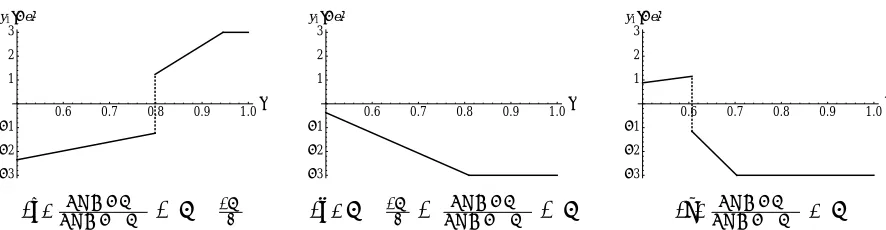
[FIGURE 3 ABOUT HERE]
Figure 3 illustrates a radical’s globally optimal proposal. In the Appendix, we extend
the example to compare with a reactionary’s proposal. Note the non-monotonicity in the
third panel: here, the date-2 veto player is most likely to be a centrist, but a conservative veto player is far more likely than a progressive. When an initial radical proposer is unlikely
to retain proposal power (α ≤α∗∗), she foregoes her ability to exploit the centrist in order
to reduce the damage from a future hostile alignment between a reactionary proposer and
conservative veto player. As a result, a radical proposer will be aligned with a centrist at
date 2. As her prospectαof retaining proposal power rises, a radical initially holds backeven
more, but not out of fear of a conservative veto player. Instead, she holds back to raise her
open the possibility of exploiting her in the future, and a centrist veto player is relatively
likely to arise at that date.
At α∗∗, the fear of a hostile aligned reactionary-conservative pairing is trumped by the
prospect of a mis-aligned radical-conservative pairing. If the radical holds future proposal
power, she is most likely either to face a centrist with whom she can achieve no more than
she could today, or a conservative with whom she can achieve no reform, at all. So, further
increases in proposal power lead the radical to accelerate reform as much as possible, as if she had based her initial proposal solely on static considerations.
Reversals. We highlight conditions under which a paradoxical ‘reversal’ occurs: a reac-tionary proposer moves policy further from her ideal and closer to the radical’s ideal than
would the radical, herself.
Proposition 7. If, at date two, the radical proposer is likely to hold power (α > β) and the veto player is likely to be a progressive (Pr(r2 = −m) > 12) then there exists a δ∗ < 1
such that if δ≥δ∗, a reactionary proposer proposes more reform at date one than a radical.
If agents who favor reform are likely to enjoy future proposal and veto power, a radical
proposer ‘steps back’ in order to ‘leap forward more vigorously’ in the future. For the same
reason, a reactionary offers incremental reform to forestall a wave of even more potent future reform. Risk aversion plays no role in this result. Rather, the key force is a net present value
calculation, which trades off a date-1 proposer’s prospective future policy gains from holding
back, relative to the immediate policy loss from failing to exploit the centrist.
This result can illuminate historical examples in which politicians advocate or oppose
policies that do not cater to their contemporaneous interests. We earlier highlighted an
attempt in 1969 to reform the House of Lords by the British Labour government that was
vanquished, in part, by opposition from within the Labour party. Strikingly, an earlier
Conservative government implemented the Life Peerages Act of 1958. This Act allowed
individuals who did not hold hereditary peerages to be appointed to the House of Lords,13 and it allowed female peers to sit in the House of Lords. It was bitterly opposed by the
Labour party, embodied in Hugh Gaitskell’s accusation during the bill’s debate:
“[t]he Bill is not really a reform Bill.... It leaves the present powers of the House
of Lords unchanged and it gives, conveniently, an apparently slightly more
spectable appearance to the House of Lords. We are opposed to a cloak of
respectability put upon a person when the reality is quite unchanged.”14
Subsequent retrospection by Conservatives supports Gaitskell’s concerns. In a 1998 policy
briefing, Conservative Member of Parliament Andrew Tyrie argued: “It was Conservative
reforms of the late 1950s and early 1960s which... modernised the Lords enough to protect
it from those who wanted it abolished”(Tyrie, 1998, ii). In this policy context, the forces identified in Proposition 7 appear to be relevant.
6. Dynamically-Sophisticated Veto Player
We have focused on the strategic considerations of a proposer given a veto player who
evaluates proposals solely according to her period payoffs. However, a veto player who is a pivotal legislator may have the same dynamic sophistication as the proposer, i.e., she
evaluates date-1 proposals based on current and future payoffs.
In general, there may be policies that a date-1 dynamically-sophisticated veto player
rejects that a myopic veto player would accept; or policies that a date-1
dynamically-sophisticated centrist veto player accepts, but a myopic veto player would not. For example,
if a future reactionary-conservative pairing is likely, a dynamically-sophisticated centrist veto
player may accept proposals that move date-1 policy past the status quo toward the
reac-tionary’s ideal point, since they forestall more extreme future outcomes. A date-1 radical
proposer likewise may exploit this opportunity to propose a policy that she likes even less than the status quo, but which nonetheless reduces the risk of an even more reactionary
pol-icy in the future.15 This is consistent with the well-documented phenomenon that left-wing
governments are as likely as right-wing governments to privatize state-owned industries, or to
engage in deficit-cutting and other pro-market reforms (Alesina et al. (2006), Roland (2008)).
Our explanation is closest to Schroeder’s defense of ‘Agenda 2010’: “Either we modernize
ourselves, and by that I mean as a social market economy, or others will modernize us, and
by that I mean unchecked market forces which will simply brush aside the social element”.16
14HC Deb 12 February 1958 vol 582, c 423
15Appendix B considers a setting with a dynamically-sophisticated veto player, illustrating these
possi-bilities, and establishing other results—including the robustness of Proposition 7.
16Gerhard Schroeder, ‘Agenda 2010—The Key to Germany’s Economic Success’,Social Europe, 23 April
Indeed, a proposer may be able to exploit a date-1 dynamically-sophisticated veto player
to achieve more extreme date-1 policy outcomes than would be feasible with a myopic
veto player. If, for example, a future radical-progressive pairing is likely, a
dynamically-sophisticated centrist veto player may accept proposals that move date-1 policy toward the
radical’s ideal point,past theprogressiveveto player’s ideal, thereby precluding a future
rad-ical’s ability to effect further policy change. A date-1 radical may exploit the centrist veto
player’s fear of a future radical-progressive pairing to obtain relatively extreme date-1 policy outcomes. A centrist veto player may be worse off for her dynamic sophistication: in contrast
with the myopic setting, she cannot commit to rejecting relatively extreme proposals.
7. Conclusion
Knowing when to ‘step back’ —whether primarily to leap forward or instead to keep
back—is a strategic imperative for political agents seeking not only to make short-run gains,
but also to achieve long-term policy goals. We show that the prospect of losing or retaining
political power yield two distinct rationales for agents to refrain from moving policy fully
toward their ideal points. We characterize when radical reform advocates prefer less
short-run reform, and illuminate our results with examples in which politicians advocate or oppose
policies that do not cater to their contemporaneous interests.
The dynamic trade-offs that we uncover have more general significance. Gupta (2009)
argues that incremental victories can have unintended consequences for social movements’ ability to mobilize resources in the future. She finds “movements seek to make incremental
gains in advancing their larger policy agenda; [but] this success... [can] enervate
program-matic activity as continued gains potentially diminish the urgency of the issue or the
demon-strable need for greater activism” (Gupta (2009), 406). Thus: “[s]uccess can be a bit of a
poisoned chalice to groups if their demonstrated ability to achieve good outcomes leads to
subsequent attrition in support levels” (Gupta (2009), 408).
Similar issues arise in legal contexts. Bell (1976) assesses the trade-offs faced by the
NAACP in pursuing legal attacks on racial segregation in U.S. schools. AfterBrown v. Board
of Education of Topeka (1954), civil rights lawyers who prosecuted local cases faced a tension
between “serving two masters”: their local clients, and the NAACP, which sought “to develop a broad scale attack on Jim Crow institutions” (Schraub (2013), 1288). In particular, “civil
rights lawyers would not settle for anything less than a desegregated system”, even when local
a counsel to the NAACP in Mississippi, Bell advised a community whose segregated school
had been closed by local authorities. He warned that they would not receive support if they
just attempted to re-open the school, but that they would receive support if they pursued a
full-scale desegregation suit, inducing them to file one of the first desegregation suits in the
state (Bell (1976), 476-477).
References
D Acemoglu and JA Robinson. Why did the west extend the franchise? democracy,
in-equality, and growth in historical perspective. Quarterly Journal of Economics, 115(4):
1167–1199, 2000.
Alberto Alesina, Silvia Ardagna, and Francesco Trebbi. Who adjusts and when? the political economy of reforms. IMF Staff Papers, 53:1–29, 2006.
David Baron. A dynamic theory of collective goods programs. American Political Science
Review, 90(2):316–330, June 1996.
David P Baron and T Renee Bowen. Dynamic coalitions. Working paper,
https://goo.gl/vqp06k, 2013.
Derrick A Bell. Serving two masters: Integration ideals and client interests in school
deseg-regation litigation. Yale Law Journal, pages 470–516, 1976.
B Douglas Bernheim, Antonio Rangel, and Luis Rayo. The power of the last word in
legislative policy making. Econometrica, 74(5):1161–1190, 2006.
T Renee Bowen, Ying Chen, and H¨ulya Eraslan. Mandatory versus discretionary spending:
the status quo effect. American Economic Review, 104(10):2941–2974, 2014.
Steven Callander and Patrick Hummel. Preemptive policy experimentation. Econometrica,
82(4):1509–1528, 2014.
Steven Callander and Davin Raiha. Durable policy, political accountability, and active waste. Working paper,https://goo.gl/bCI9fu, 2014.
Ying Chen and Hulya Eraslan. Dynamic agenda setting. Working paper,
George Douglas Howard Cole.British working class politics, 1832-1914. Labour book service,
1950.
Alex Cukierman and Mariano Tommasi. When does it take a nixon to go to china. American
Economic Review, 88(1):180–197, 88 1998.
Daniel Diermeier and Pohan Fong. Legislative bargaining with reconsideration. The
Quar-terly Journal of Economics, 126(2):947–985, 2011.
John Duggan and Tasos Kalandrakis. Dynamic legislative policy making. Journal of
Eco-nomic Theory, 147(5):1653–1688, 2012.
Wioletta Dziuda and Antoine Loeper. Dynamic collective choice with endogenous status
quo. Journal of Political Economy, 124(4):1148–1186, August 2016.
Dennis Epple and Michael H Riordan. Cooperation and punishment under repeated majority
voting. Public Choice, 55(1-2):41–73, 1987.
John A Ferejohn and Randall L Calvert. Presidential coattails in historical perspective. American Journal of Political Science, pages 127–146, 1984.
Thomas F Gallagher. The second reform movement, 1848-1867.Albion: A Quarterly Journal
Concerned with British Studies, 12(2):147–163, 1980.
Edward L Glaeser and Andrei Shleifer. The curley effect: The economics of shaping the
electorate. Journal of Law, Economics, and Organization, 21(1):1–19, 2005.
Devashree Gupta. The power of incremental outcomes: How small victories and defeats
affect social movement organizations. Mobilization: An International Quarterly, 14(4):
417–432, 2009.
Yosh Halberstam and B Pablo Montagnes. Presidential coattails versus the median voter:
Senator selection in us elections. Journal of Public Economics, 121:40–51, 2015.
Anastassios Kalandrakis. A three-player dynamic majoritarian bargaining game. Journal of
Economic Theory, 116(2):294–322, 2004.
Nolan M McCarty. Presidential reputation and the veto. Economics & Politics, 9(1):1–26,