warwick.ac.uk/lib-publications
Manuscript version: Author’s Accepted Manuscript
The version presented in WRAP is the author’s accepted manuscript and may differ from the
published version or Version of Record.
Persistent WRAP URL:
http://wrap.warwick.ac.uk/126047
How to cite:
Please refer to published version for the most recent bibliographic citation information.
If a published version is known of, the repository item page linked to above, will contain
details on accessing it.
Copyright and reuse:
The Warwick Research Archive Portal (WRAP) makes this work by researchers of the
University of Warwick available open access under the following conditions.
Copyright © and all moral rights to the version of the paper presented here belong to the
individual author(s) and/or other copyright owners. To the extent reasonable and
practicable the material made available in WRAP has been checked for eligibility before
being made available.
Copies of full items can be used for personal research or study, educational, or not-for-profit
purposes without prior permission or charge. Provided that the authors, title and full
bibliographic details are credited, a hyperlink and/or URL is given for the original metadata
page and the content is not changed in any way.
Publisher’s statement:
Please refer to the repository item page, publisher’s statement section, for further
information.
Authentic-Caller: Self-enforcing Authentication in a
Next Generation Network
Muhammad Ajmal Azad, Samiran Bag, Charith Perera, Mahmoud Barhamgi, Feng Hao
Abstract—The Internet of Things (IoT) or the Cyber-Physical System (CPS) is the network of connected devices, things and people which collect and exchange information using the emerging telecommunication networks (4G, 5G IP-based LTE). These emerging telecommunication networks can also be used to transfer critical information between the source and destination, informing the control system about the outage in the electrical grid, or providing information about the emergency at the national express highway. This sensitive information requires au-thorization and authentication of source and destination involved in the communication. To protect the network from unauthorized access and to provide authentication, the telecommunication operators have to adopt the mechanism for seamless verification and authorization of parties involved in the communication. Currently, the next-generation telecommunication networks use a digest-based authentication mechanism, where the call-processing engine of the telecommunication operator initiates the challenge to the request-initiating client or caller, which is being solved by the client to prove his credentials. However, the digest-based authentication mechanisms are vulnerable to many forms of known attacks e.g., the Man-In-The-Middle (MITM) attack and the password guessing attack. Furthermore, the digest-based sys-tems require extensive processing overheads. Several Public-Key Infrastructure (PKI) based and identity-based schemes have been proposed for the authentication and key agreements. However, these schemes generally require smart-card to hold long-term private keys and authentication credentials. In this paper, we propose a novel self-enforcing authentication protocol for the SIP-based next-generation network SIP-based on a low-entropy shared password without relying on any PKI or trusted third party system. The proposed system shows effective resistance against various attacks e.g., MITM, replay attack, password guessing attack, etc. We analyze the security properties of the proposed scheme in comparison to the state of the art.
Index Terms—SIP authentication, Identity Spoofing, Self-enforcing Authentication, Authorization, Password-based Au-thentication
I. INTRODUCTION
Over the last few decades, advances in networking tech-nologies, communication systems, improved processing power and availability of new tools, applications and software have changed the way Internet-connected devices, people, smart systems communicate and exchange information with minimal
Muhammad Ajmal Azad is with Department of Computer Science, The University of Derby, United Kingdom. Samiran Bag and Feng Hao are with with Department of Computer Science, The University of Warwick, United Kingdom. Charith Perera is with School of Computer Science and Informatics, Cardiff University, United Kingdom. Mahmoud Barhamgi is with Claude Bernard Lyon 1 University, France
E-mail: [email protected], [email protected], [email protected], [email protected], [email protected]
Manuscript received ..
human involvement [1]. The Internet of Things (IoT) and Cyber-Physical system (CPS) are the major driving forces in the smart interconnected environment. Though the smart connected environment has brought a lot of benefits to the humanity but its success depends on the security, privacy [2], and trust of the stakeholders (in particular, users of the IoT devices) involve in the connected world.
Within this connected scenario, it is utmost that sensitive information should only be originated and communicated from the authorized participants. The information from the compromised devices and people would bring detrimental consequences to the network.
The emerging telecommunication technologies (4G, 5G, IP-based cores i.e., Voice Over IP (VoIP), Long Term Evolution (LTE) and IP Multimedia Subsystems (IMS)) are the main communication technologies used by the IoT and CPS sys-tems for transmitting time-critical and sensitive information between the monitored source and the centralized processing unit. Today, telecommunication systems are also used to con-firm some of the most sensitive transactions, e.g., two-factor authentication for the code and identity verification, the one-time passcode for the bank transactions, proving the identity in the event of a disaster, and reporting sensitive information between the entities (e.g., from the electrical grid to control systems). The emerging telecommunication networks (IMS, LTE, NGN) and IP-based networks (VoIP) have adopted Session Initiation Protocol (SIP) for the creation, modification, termination, and management of the communication session between the participants (e.g., source and destination). SIP management messages are similar to the HTTP message and are text-based [3]. The SIP-based networks consist of two major components: the SIP User Agent (UA) and the SIP Network Server (NS). The SIP UA is the end-user responsible for initiating and accepting the connection. The SIP NS provides the bridge for establishing a connection between the source and destination.
credentials. However, HTTP Digest Authentication not only has a high computational cost and communication overheads but also does not provide effective security [7]–[9] under many attacks. For example, digest authentication does not provide mutual authentication, does not provide complete message integrity, and is also vulnerable to the password guessing attack. The security of digest authentication can be improved by adding SSL/TLS to SIP messages but it requires trusted authorities for the management of certificates. Several public-key cryptography [10]–[13] methods have also been proposed for the authentication but these systems require a Public Key Infrastructure (PKI) to distribute the public keys between the client and the proxy servers. A number of Password-based authentication solutions [14], [15] have also been proposed, but many of these are found to be insecure. For example, [14], [15] is vulnerable to an off-line password-guessing attack and [16] is subject to compromise of old session keys (Denning-Sacco attack).
The authentication mechanism of SIP should be efficient (small communication and computation overhead) and secure against a number of security attacks. Developing a crypto-graphic authentication system for the SIP protocol without PKI with inherent properties of effective resistance against attacks is indeed a challenging task. To provide an efficient authentication mechanism without any PKI, in this paper, we propose a new password-based self-enforcing authentication scheme for user/client authentication in a next-generation network. The scheme enables the proxy-server and the SIP clients to exchange their authentication information over an open and insecure network based on a password without requiring any PKI. Our scheme ensures several security prop-erties even under a strong adversary with the use of low entropy password. The new authentication scheme provides effective security against different types of attacks and strong adversaries e.g., replay attack, man in the middle attack, password guessing attack, etc. We comprehensively analyze the security properties of the proposed scheme and compare them with the state of the art. Further, we prototype the protocol and analyze its performance for computation and communication overheads. The results show that the scheme does not incur high bandwidth and computation overheads.
The rest of the paper is organized as follows. Section II presents an overview of the proposed scheme followed by a comprehensive discussion on the security properties of the scheme in Section III. Section IV provides complexity analysis. Section V reviews the existing authentication mech-anisms.The conclusion is made in Section VI.
II. AUTHENTICCALL: SELF-ENFORCING
AUTHENTICATION INMODERNNEXTGENERATION
NETWORKS
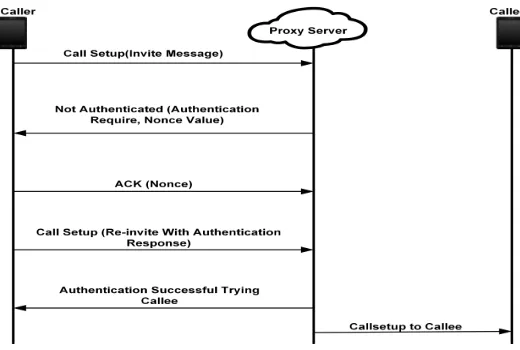
[image:3.612.315.575.54.229.2]In this paper, we aim to explore a lightweight cryptographic solution to authenticate the client in a next-generation telecom-munication network without requiring any PKI. The new authentication scheme allows the proxy server to authenticate the SIP client based on a shared low-entropy password and the authentication process remains consistent within the message structure of SIP RFC-3261 [3].
Fig. 1: Authentication Mechanism in NGN
A. Authentication In Next-Generation Networks
Authentication process provides a mechanism to verify that a caller or the callee possess the credentials he claims. In NGN, SIP protocol uses a challenge-response based authen-tication process for authenticating the end-user. It is similar to the digest authentication as used in the HTTP protocol and employs an MD5 hash algorithm to encode the user credentials (username, realm, password, digest URI). The building block of the SIP authentication process is shown in Figure 1. The proxy server or the call processing engine on receiving the call request or registration request initiates a challenge to the caller, which he has to solve correctly in-order to authenticate and associate himself with the proxy server.
Table I: Notations & abbreviations
G Group of prime order g Random generator ofG OFF-ADA Offline active dictionary attack OFF-PDA Offline passive dictionary attack FOR-SEC Forward secrecy
ON-DA Online dictionary attack REP Replay attack
D Dictionary of passwords p, q Prime numbers
H Hash function
s The shared password between the SIP client and proxy server
DHg(A, B) The Diffie-Hellman ofAandBwith respect
tog
Z Zero knowledge proof of knowledge
B. Overview of Self-enforcing Authentication Scheme
[image:3.612.327.544.450.612.2](a) Successful Authentication (b) Failed Authentication
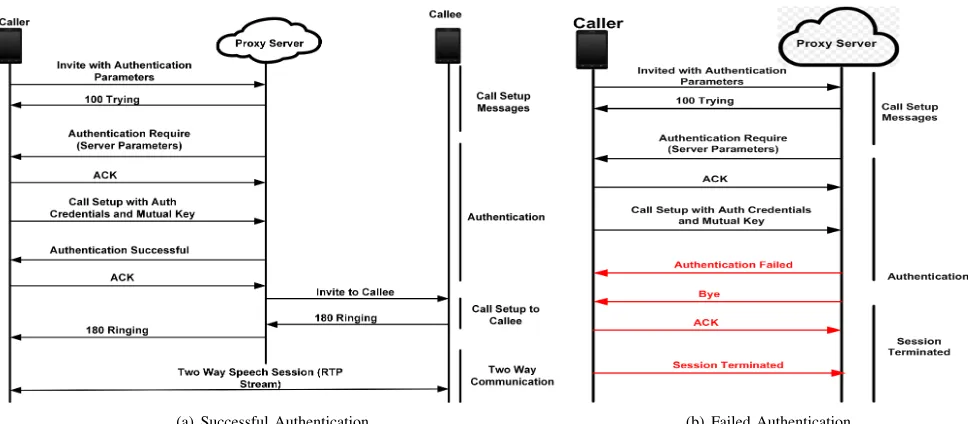
Fig. 2: Call Flow Sequence for the authenticated and non-authenticated caller.
authentication and also could not guess the password. Our scheme is based on the Password Authenticated Key Exchange by Juggling protocol (or J-PAKE) [17]. Table I gives all the notations that are used in this paper. The J-PAKE protocol allows two parties to establish a secure and authenticated communication based on their low-entropy shared password without requiring a PKI. The J-PAKE protocol uses the Zero-Knowledge Proofs (ZKP) (i.e., Schnorr’s signature [18]) to prove that parties are honestly following the protocol specifi-cation. J-PAKE consists of two rounds and it works as follows.
LetGdenote a subgroup ofZ∗Pof prime orderqin which the Decision Diffie-Hellman problem (DDH) is intractable. Herep
andqare large primes, satisfyingq|p−1. Letgbe a generator inG. The parties i.e. client and the proxy server, both agree on
(G, g). Letsbe their shared password, ands6= 0for any non-empty password.Clientselects two secret valuesx1andx2at random i.e.x1∈R
1, q−1
andx2∈R
1, q−1
. Similarly, proxy server selects x3 ∈R
1, q−1
and x4 ∈R
1, q−1 . Note that x2, x4 6= 0. Figure 2 represents the flow sequence of our authentication protocol for the authenticated and non-authenticated client. We describe working of the protocol below.
In SIP authentication, the authentication process begins immediately after the caller sends the call initiation request to the proxy server. The home operator allows the client to use the network resources after the authentication is successful. We assume that the SIP client and the proxy server have agreed on the group G. We assume that the client has set a password on the system in a secure way. In this case, the client and a proxy server share a secret i.e., a low entropy password that can be remembered by the client. The caller initiates the invite message along with the authentication credentials i.e., [caller-ID, gx1,gx2,Z(x
1, x2)]. As the proxy server receives the call request from the client, it generates the authentication required message to the client with the following information
[gx3,gx4, g(x1+x2+x3)·x4·s, Z(x
3, x4)and Z(x4·s)]. Upon receiving the call authentication requests, the client generates a new invite message with the authentication credentials. The authentication message from the client to proxy server contains the following [g(x1+x3+x4)·x2·s,Z(x
2·s)] andH(H(k))where
k = H(g(x1+x3)x2x4s). The H is a secure hash function.
The proxy server upon receiving the new call setup mes-sage with the hash value and other authentication creden-tials would also compute its hash value as H(H(k) where
k=H(g(x1+x3)x2x4s)and compare it with the received hash
value. The proxy server authenticates the caller if both hash values are the same and sends backH(k)as confirmation that the authentication is successful; otherwise, the proxy sends authentication failure to the client and disconnects the call request. The derived key k will serve as the mutual key between the client and the proxy server.
C. Construction of SIP Authentication Messages
The signaling messages to perform the authentication pro-cess are shown in Figure 2. With all of this self-enforcing authentication without PKI, the proposed scheme is compatible with the SIP RFC 3261 messages and it can be easily adaptable to any future change in the protocol by only embedding authentication parameters in the core SIP messages. The construction of SIP messages is explained below.
INVITE sip:[email protected] SIP/2.0 Via: SIP/2.0/TCP client.example1.com:5060 ;branch=z9hG4bK74b03, Max-Forwards: 70
From Alice: sip:[email protected];tag=9fxced76sl,
Authentication Credentials:gx1, gx2, Z(x
1, x2) To Bob: sip:[email protected]
Call-ID: [email protected] CSeq: 2 INVITE
Content-Type: application/sdp session description mes-sage (Continued· · · )
Step 2. Proxy Server → Client:The proxy server replies client with the 407 Proxy Authorization required. The proxy server also presents its credentials to the client within the message. The modified authentication message is constructed as follows.
SIP/2.0 407 Proxy Authorization Required Via: SIP/2.0/UDP client.example1.com:5060; branch=z9hG4bK74b03 ;received=192.0.2.101 From Alice: sip:[email protected];tag=9fxced76sl To Bob: sip:[email protected];tag=876321 Call-ID: [email protected] CSeq: 1 IN-VITE
Proxy-Authenticate:gx3, gx4,g(x1+x2+x3)·x4·s, Z(x3, x4),Z(x4·s)
Content-Length: 0
Step 3. Client → Proxy Server: The client sends ACK message for the 407 message, together withg(x1+x3+x4)·x2·s, Z(x2·s), H(H(k)) wherek =H(g(x1+x3)x2x4s) and other SIP signaling related information to the proxy server.
INVITE sip:[email protected] SIP/2.0 Via: SIP/2.0/TCP client.example1.com:5060; branch=z9hG4bf9, Max-Forwards: 70
From Alice: sip:[email protected];tag=9fxced76sl To Bob: sip:[email protected]
Call-ID: [email protected] CSeq: 2 INVITE
Proxy-Authorization:g(x1+x3+x4)x2·s,Z(x
2·s),
H(H(k))
Content-Type: application/sdp session description mes-sage (Continued· · · )
Step 4. Proxy Server → Client: The proxy server also computes the key k=H(g(x1+x3)x2x4s). If the hash received
from the client is the same as the hash computed by the proxy server, then the client is authenticated to the proxy server, and proxy server sends the ‘100’ ringing message to client withH(k)for explicit key confirmation and the ‘invite’ message to the callee. If the hash values of client and proxy server are different then the proxy server replies client with authentication failed message.
III. SECURITYANALYSIS
In this section, we discuss the security properties of the proposed scheme. Table II presents security features of the
proposed scheme along with other PAKE-based and digest authentication systems.
A. Off-Line Dictionary Attack
We show that our protocol is resistant against offline dictio-nary attack by both passive and active adversaries. First, we consider the scenario where Alice is honest and Bob is the active adversary trying to attack the protocol. Bob does not possess the password. He intends to gain some information about the password that would help him to perform an off-line exhaustive search for the password. We show that he would not be able to accomplish this.
LetDbe the dictionary andB= (B0,B1)be an active off-line dictionary attacker against the protocol. Let K1 be the following probability. P r
g←−$ G, X1 $
←−G, X2 $
←−G
s←−$ D
(x3, x4, τ)← BG,D0 (g, X1, X2)
T = (DHg(X1, X2)∗X2x3∗X
x4
2 )
s
s0 ← B1(T, τ)
s0=s
(1)
Note that we use DHg(A, B) to denote the Diffie Hellman of AandB with respect to g. As such, the advantage of the attackerB is given byAdvG
B,OF F−ADA1(λ) =K1−|D1|. Let C = (C0,C1) be another off-line dictionary attacker against the protocol. LetK2 be the following probability.
P r
g←−$ G, X1 $
←−G, X2 $
←−G
s0, s1 $
←−D
ifs0=s1 Abort
(x3, x4, τ)← C
D,G
0 (g, X1, X2)
T0= (DHg(X1, X2)∗X2x3∗X
x4
2 )
s0
T1= (DHg(X1, X2)∗X2x3∗X
x4
2 )
s1
b←− {$ 0,1} b0 ← CD,G1 (s0, s1, Tb, τ)
b=b0
(2)
The distinguishing advantage of C is given by
AdvG
C,OF F−ADA2(λ) =K2−12.
Lemma 1: AdvGB,OF F−ADA1(λ) ≤ 21− 1
|D|
∗ AdvG
C,OF F−ADA2(λ).
Proof 1: We show that if there exists an adversary B = (B0,B1) against the ExpB,OF F−ADA1(λ) of equation 1, it could be used in the construction of another adversary C
against the security experimentExpG
C,OF F−ADA2(λ)of equa-tion 2.C works as follows. It receives as inputg, X1, X2∈R
G. It invokes B0(g, X1, X2). B0 outputs x3, x4 ∈ Zp and
the trapdoor τ. C0 also returns the same arguments returned by B0. Then C1 receives as input s0, s1, Tb and τ, where
Tb = (DHg(X1, X2)∗X2x3∗X
x4
2 )
sb. As such, C
1 invokes
BD
1(Tb, τ).Bwill returns∈D. Ifs=s0,Creturns 0, else if
s=s1,C returns 1. Ifs /∈ {s0, s1},C returns a random bit. Let us now calculate the distinguishing advantage of C.
P r[(CD
sb, s = s1−b)S(C1D() = sb, s /∈ {s0, s1})] = P r[CD1() =
sb, s = sb)] +P r[C1D() = sb, s = s1−b)] +P r[C1D() =
sb, s /∈ {s0, s1})] = P r[C1D(λ) = sb
s = sb] ∗P r[s = sb] +P r[CD
1 () =sb
s=s1−b]∗P r[s=s1−b] +P r[C1D() =
sbs /∈ {s0, s1}] ∗ P r[s /∈ {s0, s1}]. Now, P r[C1D() =
sbs = sb] = 1 and P r[C1D() = sb
s = s1−b] = 0. Also, P r[CD
1 () = sb
s /∈ {s0, s1}] = 12. Again, P r[s = sb] = 1
|D| +AdvGB,OF F−ADA1(λ). P r[s /∈ {s0, s1}] = P r[s /∈
{sb, s1−b}] = P r[(s 6= sb)T(s 6= s1−b)] = P r[s 6= sb]∗P r[s 6= s1−b
s 6= sb] = (1−P r[s = sb])∗P r[s 6=
s1−b
s 6= sb] =
1− 1
|D|−Adv
G
B,OF F−ADA1(λ)
∗ ||DD|−|−21.
Thus, P r[(CD
1 () = sb] = |D1| +AdvGB,OF F−ADA1(λ) + 1
2
1− 1
|D|−Adv
G
B,OF F−ADA1(λ)
∗||DD|−|−21 = 1 2 +
|D|
2(|D|−1)Adv
G
B,OF F−ADA1(λ). However,
AdvGC,OF F−ADA2(λ) ≥ P r[(CD
1 () = sb] − 12 =
|D|
2(|D|−1)Adv
G
B,OF F−ADA1(λ). Hence, the lemma holds. Assumption 1: The Decisional Diffie Hellman Assump-tion AdvG
A,DDH(λ) = M −
1
2 ≤ negl(λ). where M is the below probability: P r
g←−$ G, A←−$ G, B←−$ G T0=DHg(A, B)
T1 $
←−G
b←− {$ 0,1} b0 ← A(g, Tb, A, B)
(b=b0)
(3) Assumption 2:
AdvGA,SDDH(λ) =L−1
2, whereLis the below probability.
P r
g←−$ G, A←−$ G, B←−$ G
(r, x, τ)← A0(g, A, B) ifx= 0∨x= 1
Abort
Ω0=DHg(A, B)∗Br
Ω1= (DHg(A, B)∗Br)x
b←− {$ 0,1} b0← A1(Ωb, τ, x)
b=b0
(4)
Lemma 2:AdvG
A,SDDH(λ)≤AdvGA,DDH(λ).
Proof 2: If x 6= 0, then DHg(A, B)x is a
non-identity element of G. Now according to Assumption 1, (g, A, B, DHg(A, B) ∗ Br)
c
≈ (g, A, B, R ∗ Br) ≈c
(g, A, B, R) ≈c (g, A, B, R ∗ (DHg(A, B) ∗ Br)x) ≈c
(g, A, B, DHg(A, B) ∗ Br ∗ (DHg(A, B) ∗ Br)x) c ≈
(g, A, B,(DHg(A, B)∗Br)1+x).
Lemma 3:AdvGC,OF F−ADA2(λ)≤AdvAG,SDDH(λ).
Proof 3: We show that if there exists an adversary C = (C0,C1)against the security experimentExpC,OF F−ADA2(λ), it could be used to construct another adversary A against Assumption 2.A works as follows:
It receives as input g, A, B ∈R Zp. Then it invokes C0 with the inputs g, X1 = A, X2 = B. C0 returns (x3, x4, τ). A0 computes r = x3 +x4, x = s1/s0−1, where s1 and s0 are randomly chosen by A0 from D. It returns r, x and τ.
Since, s0 6= s1, x 6= 0. Now, A1 will receive the challenge
Ωb ∈ {Ω0,Ω1}. Here, Ω0 = DHg(A, B) ∗X2x3+x4, and
Ω1 = (DHg(A, B)∗X2x3+x4)1+x. A computes Tb = Ωs0b .
Note that if b = 0, then Ω0 = DHg(A, B) ∗ X2x3+x4 and Tb = DHg(A, B)∗ Xx3
2 ∗X
x4
2 = T0. Alternatively, if b = 1, then Ω1 = (DHg(A, B) ∗ X2x3+x4)1+x and
Tb = (DHg(A, B)∗Xx3
2 ∗X
x4
2 )s1 =T1. Now, A1 invokes
C1(s0, s1, Tb, τ). It will return a bitb0.Awill return the same bit. It is easy to see that the success probability of A is at least that ofC. Hence, the result holds.
Now, we consider a passive adversary who intercepts the messages being passed between the participants and tries to infer information about the password through off-line exhaus-tive search.
Let, the distinguishing advantage of the passive off-line attacker be AdvG
B,OF F−P DA1(λ) =
P r[ExpGB,OF F−P DA1(λ)] − 1
|D|, where
P r[ExpG
B,OF F−P DA1(λ)]is the below probability.
P r
g←−, X$ 1 $
←−G, X2 $
←−G, X3 $
←−G, X4 $
←−G
s←−$ D
T1= (DHg(X1, X2)∗DHg(X2, X3)∗DHg(X2, X4))s
T2= (DHg(X3, X4)∗DHg(X1, X4)∗DHg(X2, X4))s
C= (T1, T2)
s0← BG,D(C, g, X
1, X2, X3, X4)
s=s0
(5) Let C be a passive adversary against the protocol of equation 6. The advantage of the adversary C is given by
AdvBG,D,OF F−P DA2(λ) =P r[ExpG,DB,OF F−P DA2(λ)]−1 2, where
P r[ExpG,DB,OF F−P DA2(λ)]is the following probability:
P r
g←−, X$ 1 $
←−G, X2 $
←−G, X3 $
←−G, X4 $
←−G
(s0, s1) $
←−D
ifs0=s1 Abort
T1= (DHg(X1, X2)∗DHg(X2, X3)∗DHg(X2, X4))
s0
T2= (DHg(X3, X4)∗DHg(X1, X4)∗DHg(X2, X4))
s0
T3= (DHg(X1, X2)∗DHg(X2, X3)∗DHg(X2, X4))
s1
T4= (DHg(X3, X4)∗DHg(X1, X4)∗DHg(X2, X4))s1
C0= (T1, T2), C1= (T3, T4)
b←− {$ 0,1} b0← CG,D(C
b, s0, s1, g, X1, X2, X3, X4)
b=b0
(6) Lemma 4: AdvG
B,OF F−P DA1(λ) ≤ 2(1 − 1
|D|)Adv
G
C,OF F−P DA2(λ).
Proof 4:The proof is same as the proof of Lemma 1
B. On-line Dictionary Attack
In this section, we show that our scheme is secure against an online dictionary attack. Consider the following security experiment.
The advantage of the adversaryB in computing the secret key is given byAdvBG,D,ON−DA(λ) =P rhExpG,DB,ON−DA(λ)i−
1
B,ON−DA
g, X1, X2,←−$ G
(x3, x4, τ) =B0G,D(g, X1, X2)
s←−$ D
T = DHg(X1, X2)∗X2x3∗X x4
2
s
L= (DHg(X1, X2)∗X2x3)x4s
L0=BG,D1 (T , τ)
ReturnL=L0
Lemma 5:AdvG,DB,ON−DA(λ)≤AdvG,DA,OF F−ADA1(λ). Proof 5: We show that if there exists an on-line dictionary attacker B = (B0,B1), then it could be used to construct an adversary A = (A0,A1) against the security experi-ment ExpG
A,OF F−ADA1(λ). A works as follows. When A0 receives g, X1, X2, it invokes B0G,D(g, X1, X2). It returns
x3, x4, τ0 = τS{x3, x4}. A0 returns the same arguments. ThenA1receives as inputT, τ0, whereT = (DHg(X1, X2)∗
X2x3 ∗ X2x4)s for some s ∈ D. A
1 invokes B
G,D
1 (T, τ).
B1 will return L = (DHg(X1, X2)∗ X2x3)x4s. Now, A1 computes Xs
2 = (Tx4/L)1/x
2
4. Now, A can find s using
brute force search over all the elements in D. This search will be feasible since |D| ∈ poly(λ). Now, A1 can output
s. P r[ExpG,DA,OF F−ADA1(λ) = 1] = P r[A0(T, τ0) = s] ≥
P r[B1(T, τ) = L] = P r[ExpG,DB,ON−DA(λ) = 1]. Hence, AdvG,DA,OF F−ADA1(λ)≥AdvBG,D,ON−DA(λ).
Thus, the attacker would not be able to establish the correct secret key if it chooses a wrong password.
C. Forward Secrecy
In this section, we show that our scheme provides forward secrecy. Hence, if an attacker gets to learn the shared password between the two parties, she will be able to compromise the secret keys of previous sessions with negligible probability. Let, B be an attacker against the forward secrecy property of our scheme. As such, the advantage of the adversary to compromised a previously computed shared key is given by
AdvG,DB,F OR−SEC(λ) = P rhExpG,DB,F OR−SEC(λ) = 1i. Our scheme is forward-secure if the following holds.
AdvBG,D,F OR−SEC(λ)≤negl(λ)
ExpG,DB,F OR−SEC(λ)
g←$−, X1 $
←−G, X2
$
←−G, X3
$
←−G, X4
$
←−G
s←−$ D
L1= (DHg(X1, X2)∗DHg(X2, X3)∗DHg(X2, X4))s
L2= (DHg(X3, X4)∗DHg(X1, X4)∗DHg(X2, X4))s
B=DHg(X1∗X3, X2, X4)s
B0=BG,D(g, X
1, X2, X3, X4, L1, L2, s)
Return B=B’
Assumption 3:
According to the Computation Diffie Hellman as-sumption, for all PPT adversary A, AdvG
A,CDH(λ) = P r[ExpG
A,CDH(λ) = 1]≤negl(λ).
Lemma 6:AdvG,DB,F OR−SEC(λ)≤AdvG
A,CDH(λ).
B,CDH
g←−$, A←−$ G, B←−$ G, C←−$ G
E1=DHg(A, B), E2=DHg(B, C), E3=DHg(A, C)
T =DHg(A, B, C)
T0=BG(g, A, B, C, E
1, E2, E3)
Return T=T’
Proof 6: We show that if there exists a probabilistic polynomial-time (PPT) adversary B against the security ex-periment ExpG
B,F OR−SEC(λ), it could be used to construct
another PPT adversary A against the security experiment
ExpG
A,CDH(λ). A works as follows. It receives as inputs g, A, B, C ∈R G and E1, E2, E3. It selects a ∈R Zp
and computes X1 = ga. It sets X2 = B, X4 = C and
X3 = A/X1. It also selects random s ∈ D, and computes
(L1 = E1 ∗ E2)s = (DHg(A, B)∗ DHg(B, C))s, and
L2 = (E3 ∗ E2)s = (DHg(A, C)∗ DHg(B, C))s. Now,
A invokes BG,D(g, X
1, X2, X3, X4, L1, L2, s). B will return
B0 = DHg(X1∗X3, X2, X4)s = DHg(A, B, C)s. A can compute DHg(A, B, C) = (B0)1/s. Thus, AdvGA,CDH(λ) ≥ AdvBG,D,F OR−SEC(λ).
D. Replay Attack
In replay attack, the adversary can use an older key and he can then replay the messages. Let B be an adversary who launches replay attack on our scheme. Her intention is to obtain the secret password shared by Alice and Bob. The advantage of B in obtaining the password is given by
AdvBG,D,REP1(λ) =P r[ExpG,DB,REP1(λ) = 1]− 1
|D|.
ExpG,DB,REP1(λ)
g, X1, X2, X10, X20, X3, X4←−$ G
s←−$ D
T1= (DHg(X1, X2)∗DHg(X2, X3)∗DHg(X2, X4))s
T2= (DHg(X3, X4)∗DHg(X1, X4)∗DHg(X2, X4))s
T3= DHg(X10, X
0
2)∗DHg(X20, X3)∗DHg(X20, X4)
s
s0=BG,D(g, X
1, X2, X10, X20, X3, X4, T1, T2, T3)
Returns=s0
Lemma 7:AdvBG,D,REP1(λ)≤AdvG,DA,OF F−P DA1(λ). Proof 7: We show that if there exists an adversary B
against the security experimentExpG,DB,REP1(λ), then it could be used in the construction of A, an adversary against the security experiment ExpG,DA,OF F−P DA1(λ). A works as fol-lows. It receives as inputsg, X1, X2, X3, X4, and a challenge
C= (T1, T2), where
T1= (DHg(X1, X2)∗DHg(X2, X3)∗DHg(X2, X4))
s
T2= (DHg(X3, X4)∗DHg(X1, X4)∗DHg(X2, X4))s
A computes X10 = Xa
1(X3 ∗ X4)a−1, and X20 =
Xb
2 for some random a, b ∈R Zp. Now, A sets T3 = T1ab and C0 = (T1, T2, T3). Then A in-vokesBG,D(C0, g, X
1, X2, X10, X20, X3, X4)and returns what
B returns. It is easy to see that AdvG,DB,REP1(λ) ≤ AdvAG,D,OF F−P DA1(λ).
the messages between Alice and Bob in a particular session. Then she uses those messages to launch replay attack with the intention to establish a shared key with Alice. We consider the following security experimentExpG,DB,REP2(λ). The advantage of the adversary B in being able to establish a secret key is given byAdvG,DB,REP2(λ) =P r[ExpG,DB,REP2(λ) = 1].
ExpG,DB,REP2(λ)
g, X1, X2, X10, X
0
2, X3, X4 $
←−G
s←−$ D
L1= (DHg(X1, X2)∗DHg(X2, X3)∗DHg(X2, X4))s
L2= (DHg(X3, X4)∗DHg(X1, X4)∗DHg(X2, X4))s
L3= DHg(X10, X20)∗DHg(X20, X3)∗DHg(X20, X4)s
B=DHg(X10∗X3, X20, X4)s
B0=BG,D(g, X
1, X2, X3, X4, X10, X20, L1, L2, L3)
Return B=B’
Lemma 8:AdvG,DB,REP2(λ)≤AdvAG,D,F OR−SEC(λ)
Proof 8: We show that if there exists an adversary B
against the security experiment ExpG,DB,REP2(λ), it could be used in the construction of another adversary A against the security experimentExpG,DA,F OR−SEC(λ).Areceives as inputs
g, X1, X2, X3, X4, L1, L2, s, where
L1= (DHg(X1, X2)∗DHg(X2, X3)∗DHg(X2, X4))
s
L2= (DHg(X3, X4)∗DHg(X1, X4)∗DHg(X2, X4))
s
A selects X10 = X1, and X20 = X2b for some random
b ∈R Zp. It computes L3 = (L1)b. Then it invokes
BG,D(g, X
1, X2, X3, X4, X10, X20, L1, L2, L3). B will return
B =DHg(X10∗X3, X20, X4)s= (DHg(X1∗X3, X2, X4)s)b.
Awill returnB1/b. It is easy to see that the success probability of Ais at least that ofB. Hence, the lemma holds.
IV. COMPUTATION ANDBANDWIDTHOVERHEADS
In this section, we analyze the computation and bandwidth overheads of the proposed scheme for its cryptographic op-erations. The client needs to perform around 14 exponenti-ation during the authenticexponenti-ation process. 4 exponentiexponenti-ation for
gx1, gx2 and Z(x
1, x2), 4 exponentiation to prove the ZKPs of x3, x4 from the server, 2 exponentiation to verify the ZKP of x4·s, 2 exponentiation for computing g(x1+x3+x4)·(x2·s) and the ZKP for x2 · s and 2 exponentiation to compute the value of final key k. The proxy server also performs 14 exponentiation to prove the variables from the client, generating the authentication credentials and mutual keyk. We computed time for generating the authentication parameters with the single-core of Intel i-7 CPU (3.4 GHz) system, having 8 GB memory on a Windows 10 operating system. We implemented the protocol in the Java using NIST curve P-256 and bouncy-castle elliptical curve library for the cryptography. The client and server take around 30 msec to generate the authentication credentials in the first round, and 25 msec in the second round.
In terms of bandwidth, the client and the proxy server exchanged information to each other in two rounds. In the first invite message, the client exchanges gx1, gx2 theZ(x
1, z2)to the proxy server. This exchange requires around 692 bytes.
The proxy server initiates authentication required message withgx3, gx4,g(x1+x2+x3)·x4·s,Z(x
4·s), andZ(x3, z4)to the client. This exchange requires 1 kb. Finally, the client sends
g(x1+x3+x4)·x2·s, Z(x
2·s) which requires around 350 bytes of data. In summary, the client requires to exchange around 1 kb of data to proxy and receive 1 kb of data from the proxy server for the authentication.
V. RELATEDWORK
The simplest method to achieve the authentication in the SIP-based VoIP or next-generation network is to utilize the challenge-response mechanism (IETF RFC 2617) [26]. In this mechanism, the SIP call processing engine or the proxy server on receiving the call request message from the SIP user initi-ates the challenge to the user to prove his identity. The client responds to the proxy server with authentication messages. This authentication mechanism has some security problems: for instances it is vulnerable to off-line password guessing attack, server spoofing, falsifying the identity of the server to obtain the secret information of user, etc. Table II presents a comparison of our scheme with other proposed systems for a number of security requirements. It can be seen from Table II that digest-based schemes are vulnerable to different types of security attacks i.e., offline password guessing attacks, server spoofing, replay attack, etc. It can also be seen that many of the proposed schemes only provide resistance against a few features. However, the proposed scheme not only provides resistance against the listed attacks but also incurs substantially small overheads.
Schemes / Security-Attacks
[19] [20] [21] [22] [14] [16] [15] [23] [24]
Digest-Auth [25] Ours Resist Off-line Dictionary No Yes No Yes Yes Yes No No No No Yes Yes Resist Sever Spoofing No No No No Yes No Yes Yes Yes No Yes Yes
Resist Replay No No Yes Yes Yes No Yes No No No No Yes
Forward Secrecy Yes Yes No Yes No Yes No Yes No Yes Yes Yes Resist On-line Dictionary Yes Yes No Yes Yes Yes No Yes No Yes Yes Yes
keys are generated through the Identity of the client and the proxy server.
Jia et al. [30] use random nonces for authenticating the SIP client with the server. However, the scheme is vulnerable to the Denning-Sacco attack, the stolen-verifier attack, and the off-line password guessing attack. Eun-Jun and Kee-Young im-proved the basic scheme of Aytunc and Ibrahim [31] by using the random number for the public key which is not happening in the Aytunc and Ibrahim scheme. Tien-ho et al. [12] proposed an ECC-based authentication mechanism that protects the user from the server spoofing attack and session hijacking attack. The scheme is based on using a smart card to minimize the computation load, however, it is vulnerable to password guessing attack. Eun-Jun and Kee-Young adopted an elliptic curve discrete logarithm problem to address the problem of off-line password guessing attacks, Denning-Sacco attack and stolen-verifier attacks of SIP authentication. Zhang et al. [32] proposed an authentication scheme based on the elliptic curve with the inherent property of anonymity for the SIP client. However, the scheme does not support mutual authentication and is vulnerable to insider attack [22]. Recently, Shuming et al. [33] proposed the scheme on the top of Zhang et al. [32] that provide resistance against off-line password guessing and insider attacks. Hsiu-Lien [34] proposed a scheme that uses a smart card along with elliptic curve cryptography for the SIP authentication. However, the scheme is vulnerable to the off-line password guessing attack, user impersonation attack and server impersonation attack [35]. Hang et al. [20] proposed modifications in [32] to overcome the issue of a server spoofing attack. Chaudhry et al. [36] proposed the privacy-preserving version for [32], [35] based on the Elliptic curve cryptography.
The successful authentication can also solve the problem of identity spoofing that causes the loss of millions every year. Cybercriminals can easily modify identity and pretend to be a legitimate entity to fool the user at the other end. Typically, with the spoofed identity, criminals fool people into thinking that they are interacting with the legitimate entity e.g., their bank, or the police. Currently, the Internet Engineering Task Force (IETF) is favoring a PKI-based approach to solve the caller ID spoofing problem. In 2018, it published a new tech-nical standard [37] that defines a telephone certificate based on X.509. This is regarded as the first step towards a full PKI deployment in telephony systems. A certificate authority based solution is proposed in [38] where the originating operators present the certificate of ownership through the call routing mechanism. Bradley et al. [39] propose to adopt SSL/TLS for the caller ID authentication. The schemes assume a trusted
server, with which the caller can register its identity through an SSL/TLS connection. In general, solutions in this category require a PKI to bind the caller ID with a telephone using a public key certificate.
VI. CONCLUSION
In this paper, we proposed a new authentication scheme for authenticating clients/end-users in the SIP-based next-generation networks. The proposed scheme enables the proxy server and the SIP clients to exchange the authentication messages over an open and insecure network. We adopted the password-based authentication mechanism along with zero-knowledge proofs to perform the authentication process. The scheme does not require PKI or the smart card for the cryptographic parameters and has inherent properties of self-enforcement. The proposed authentication scheme provides effective security against different types of attacks and does not incur substantial computational overheads. The scheme can also provide a way for the parameters to be used for the end-to-end encryption of speech content between the communicating parties. As part of the future work, we are developing a working prototype that involves the real SIP server and the SIP clients.
ACKNOWLEDGMENT
Feng Hao and Samiran Bag are partly funded by the ERC starting grant No. 306994 and the Royal Society grant, ICA/R1/180226.
REFERENCES
[1] C. Perera, M. Barhamgi, S. De, T. Baarslag, M. Vecchio, and K. R. Choo, “Designing the sensing as a service ecosystem for the internet of things,”IEEE Internet of Things Magazine, vol. 1, no. 2, pp. 18–23, December 2018.
[2] M. Barhamgi, C. Perera, C. Ghedira, and D. Benslimane, “User-centric privacy engineering for the internet of things,”IEEE Cloud Computing, vol. 5, no. 5, pp. 47–57, Sep. 2018.
[3] J. Rosenberg, H. Schulzrinne, G. Camarillo, A. Johnston, J. Peterson, R. Sparks, M. Handley, and E. Schooler, “Sip: Session initiation proto-col,” United States, 2002.
[4] S. Ehlert, D. Geneiatakis, and T. Magedanz, “Survey of network security systems to counter sip-based denial-of-service attacks,” Computers & Security, vol. 29, no. 2, pp. 225 – 243, 2010.
[5] M. A. Azad and R. Morla, “Caller-rep: Detecting unwanted calls with caller social strength,” Comput. Secur., vol. 39, pp. 219–236, Nov. 2013. [Online]. Available: http://dx.doi.org/10.1016/j.cose.2013.07.006 [6] M. Ajmal, S. Bag, S. Tabassum, and F. Hao, “privy: Privacy preserving
collaboration across multiple service providers to combat telecoms spam,”IEEE Transactions on Emerging Topics in Computing, pp. 1– 1, 2017.
[image:9.612.107.509.73.146.2][8] I. Dacosta and P. Traynor, “Proxychain: Developing a robust and efficient authentication infrastructure for carrier-scale voip networks,” inProceedings of the 2010 USENIX Conference, 2010, pp. 10–10. [9] T. Maitra, D. Giri, and R. N. Mohapatra, “Sas-sip: A secure
authentication scheme based on ecc and a fuzzy extractor for session initiation protocol,”Cryptologia, vol. 43, no. 3, pp. 212–232, 2019. [Online]. Available: https://doi.org/10.1080/01611194.2018.1548391 [10] R. Srinivasan, V. Vaidehi, K. Harish, K. LakshmiNarasimhan, S.
Lokesh-werBabu, and V. Srikanth, “Authentication of signaling in voip applica-tions,” in2005 Asia-Pacific Conference on Communications, Oct 2005, pp. 530–533.
[11] A. Mohammadi-nodooshan, Y. Darmani, R. Jalili, and M. Nourani, “A robust and efficient sip authentication scheme,” inAdvances in Computer Science and Engineering. Springer Berlin Heidelberg, 2009, pp. 551– 558.
[12] T.-h. Chen, H.-l. Yeh, P.-c. Liu, H.-c. Hsiang, and W.-k. Shih, “A secured authentication protocol for sip using elliptic curves cryptography,” in
Communication and Networking, T.-h. Kim, A. C.-C. Chang, M. Li, C. Rong, C. Z. Patrikakis, and D. ´Sl˛ezak, Eds. Springer Berlin Heidelberg, 2010, pp. 46–55.
[13] Y.-P. Liao and S.-S. Wang, “A new secure password authenticated key agreement scheme for sip using self-certified public keys on elliptic curves,”Computer Communications, vol. 33, no. 3, pp. 372 – 380, 2010. [14] C.-C. Yang, R.-C. Wang, and W.-T. Liu, “Secure authentication scheme for session initiation protocol,”Computers & Security, vol. 24, no. 5, pp. 381 – 386, 2005.
[15] L. Wu, Y. Zhang, and F. Wang, “A new provably secure authentication and key agreement protocol for sip using ecc,”Computer Standards & Interfaces, vol. 31, no. 2, pp. 286 – 291, 2009.
[16] E. Yoon and K. Yoo, “Cryptanalysis of ds-sip authentication scheme using ecdh,” in 2009 International Conference on New Trends in Information and Service Science, June 2009, pp. 642–647.
[17] F. Hao and P. Ryan,J-PAKE: Authenticated Key Exchange without PKI. Berlin, Heidelberg: Springer Berlin Heidelberg, 2010, pp. 192–206. [18] C. P. Schnorr, “Efficient signature generation by smart cards,”Journal
of Cryptology, vol. 4, no. 3, pp. 161–174, Jan 1991.
[19] L. Ni, G. Chen, and J. Li, “A pairing-free identity-based authenticated key agreement mechanism for sip,” in2011 International Conference on Network Computing and Information Security, vol. 1, May 2011, pp. 209–217.
[20] H. Tu, N. Kumar, N. Chilamkurti, and S. Rho, “An improved authenti-cation protocol for session initiation protocol using smart card,” Peer-to-Peer Networking and Applications, vol. 8, no. 5, pp. 903–910, Sep 2015.
[21] E. Yoon and K. Yoo, “A new authentication scheme for session initiation protocol,” in2009 International Conference on Complex, Intelligent and Software Intensive Systems, March 2009, pp. 549–554.
[22] Y. Lu, L. Li, H. Peng, and Y. Yang, “A secure and efficient mutual authentication scheme for session initiation protocol,” Peer-to-Peer Networking and Applications, vol. 9, no. 2, pp. 449–459, Mar 2016. [Online]. Available: https://doi.org/10.1007/s12083-015-0363-x [23] L. Zhang, S. Tang, and Z. Cai, “Efficient and flexible password
authen-ticated key agreement for voice over internet protocol session initiation protocol using smart card,” International Journal of Communication Systems, vol. 27, no. 11, pp. 2691–2702.
[24] Q. Jiang, J. Ma, and Y. Tian, “Cryptanalysis of smart-card-based password authenticated key agreement protocol for session initiation protocol of zhang et al.”Int. J. Commun. Syst., vol. 28, no. 7, pp. 1340– 1351, May 2015.
[25] L. Zhang, S. Tang, and S. Zhu, “An energy efficient authenticated key agreement protocol for sip-based green voip networks,” Journal of Network and Computer Applications, vol. 59, pp. 126 – 133, 2016. [Online]. Available: http://www.sciencedirect.com/science/article/ pii/S1084804515001666
[26] P. J. Franks, P. Hallam-Baker, L. C. Stewart, J. L. Hostetler, S. Lawrence, P. J. Leach, and A. Luotonen, “HTTP Authentication: Basic and Digest Access Authentication,” RFC 2617, Jun. 1999. [Online]. Available: https://rfc-editor.org/rfc/rfc2617.txt
[27] W. Diffie and M. Hellman, “New directions in cryptography,” IEEE Trans. Inf. Theor., vol. 22, no. 6, pp. 644–654, Sep. 2006.
[28] H. Jo, Y. Lee, M. Kim, S. Kim, and D. Won, “Off-line password-guessing attack to yang’s and huang’s authentication schemes for session initiation protocol,” in2009 Fifth International Joint Conference on INC, IMS and IDC, Aug 2009, pp. 618–621.
[29] H. H. Kilinc and T. Yanik, “A survey of sip authentication and key agreement schemes,”IEEE Communications Surveys Tutorials, vol. 16, no. 2, pp. 1005–1023, Second 2014.
[30] J. L. Tsai, “Efficient nonce-based authentication scheme for session initiation protocol,”I. J. Network Security, vol. 9, pp. 12–16, 2009. [31] A. Durlanik and I. Sogukpinar, “Sip authentication scheme using ecdh,”
International Journal of Computer, Electrical, Automation, Control and Information Engineering, vol. 1, no. 8, pp. 2672 – 2675, 2007. [32] Z. Zhang, Q. Qi, N. Kumar, N. Chilamkurti, and H.-Y. Jeong, “A secure
authentication scheme with anonymity for session initiation protocol using elliptic curve cryptography,”Multimedia Tools and Applications, vol. 74, no. 10, pp. 3477–3488, May 2015.
[33] S. Qiu, G. Xu, Y. Guo, and M. Zhang, “Cryptanalysis and improvement of 2 mutual authentication schemes for session initiation protocol,”
International Journal of Communication Systems, vol. 31, no. 10, p. e3568.
[34] H.-L. Yeh, T.-H. Chen, and W.-K. Shih, “Robust smart card secured au-thentication scheme on sip using elliptic curve cryptography,”Computer Standards & Interfaces, vol. 36, no. 2, pp. 397 – 402, 2014.
[35] M. S. Farash, S. Kumari, and M. Bakhtiari, “Cryptanalysis and improve-ment of a robust smart card secured authentication scheme on sip using elliptic curve cryptography,”Multimedia Tools and Applications, vol. 75, no. 8, pp. 4485–4504, Apr 2016.
[36] S. A. Chaudhry, H. Naqvi, M. Sher, M. S. Farash, and M. U. Hassan, “An improved and provably secure privacy preserving authentication protocol for sip,”Peer-to-Peer Networking and Applications, vol. 10, no. 1, pp. 1–15, Jan 2017.
[37] J. Peterson and S. Turner, “Secure Telephone Identity Credentials: Certificates,” RFC 8226, Feb. 2018.
[38] H. Tu, A. Doupé, Z. Zhao, and G. Ahn, “Toward authenticated caller id transmission: The need for a standardized authentication scheme in q.731.3 calling line identification presentation,” in 2016 ITU Kaleido-scope: ICTs for a Sustainable World (ITU WT), 2016, pp. 1–8. [39] B. Reaves, L. Blue, and P. Traynor, “Authloop: End-to-end cryptographic
authentication for telephony over voice channels,” in 25th USENIX Security Symposium (USENIX Security 16), Austin, TX, 2016, pp. 963– 978.
Muhammad Ajmal Azad is a lecturer in Cybersecurity in Department of Computer Science and Mathematics at University of Derby, United Kingdom.His research interests include data-driven network security, identity linking, network data analysis, and applying machine learning for detecting cybercrimes and spams.
Samiran Bagreceived the M.Tech degree in computer science from the Indian Statistical Institute, and the Ph.D. degree from the Indian Statistical Institute. He is currently a Research fellow with the Department of Computing Science, The University of Warwick, UK. His primary research areas are electronic voting, cryptocurrency and secure multiparty computation.
Charith Perera is a lecturer at Cardiff University’s School of Computer Science and Informatics. His research focuses on security and privacy in the Internet of Things. Perera received a PhD in computer science from the Australian National University.
Mahmoud Barhamgiis an associate professor of computer science at Claude Bernard University Lyon 1. His research focuses on privacy preservation in service-oriented architecture, web, and cloud environments. Barhamgi received a PhD in information and communication technology from Claude Bernard University Lyon 1.