© 2019, IRJET | Impact Factor value: 7.211 | ISO 9001:2008 Certified Journal | Page 6631
Utilization of Construction & Demolition Waste in Making Bricks
Tanmay Swami
1, Mohd. Aamir
2, Rajat Sharma
3, Dushant Anthal
4, Vipul Maheshwari
5,
Vikas Kataria
61,2,3,4,5Student, B.Tech, Dept. of Civil Engineering, Dr. Akhilesh Das Gupta Institute of Technology & Management
6Assistant Professor, Dept. of Civil Engineering, Dr. Akhilesh Das Gupta Institute of Technology & Management,
Affiliated to GGSIPU, FC-26, Shastri Park, New Delhi - 110053, India
---***---Abstract-
Our report highlights the drawbacks ofimproper disposal of waste, which causes harm not only to the environment but is also not financially feasible. As the demand for a better livelihood increases the old and worn out living conditions has become obsolete therefore the increasing construction and demolition waste is of great concern & its dumping is not an option anymore as it renders land uncultivable & polluted.
The waste from construction and demolition site contains various materials of which brick, deteriorated mortar, natural aggregates are major contributors, which we will utilize in making brick.
Keywords: Construction & Demolition waste (C&D), Environment, Brick.
1.INTRODUCTION
Every year in India several metric tons of waste is generated and disposed in landfills and since this waste is not regulated in an effective manner; immense amount of un-disposed waste can be witnessed at several parts of the nation. Therefore, the need for effective waste management and quaint methods to recycle, reuse & reduce has become paramount so that a bright future is assured for the generations to come.
Thereby, imparting an important knowledge about the environment & our salvation upon it.
In recent years, initiatives have been taken on a global and national level to regulate waste management. Regulations have become increasingly rigorous and consequently, options which are rarely used such as minimizing or recycling waste are becoming economically attractive.
In this project we will study the paramount importance of effective C&D waste management. How C&D waste can be utilized to make bricks for practical usage and what methods as well as materials are to be adopted for the same, physical and mechanical aspects of these bricks and experiments which are to be conducted prior to utilizing recycled bricks to ensure its effectiveness.
2. OBJECTIVE & METHODOLOGY
Our research is going to reduce the dependency of our construction industry on conventional bricks and hence will help in preventing the environment from adverse effects of waste generation.
This research will help in providing better alternatives in utilizing the annually generated C&D waste. The investigation is directed towards obtaining strength and durability data for bricks incorporating C&D waste materials.
The result of this research will be used to establish material specifications for bricks containing C&D waste material for building & construction practices.
In our research, we are going to use C&D waste aggregates of which we are going to separate the different kinds of coarse aggregates from the mixture and then carry out some material tests on it and then form such bricks which have a ratio of C&D processed waste.
3.
TEST RESULTS AND ANALYSIS
3.1Water absorption test of aggregates
© 2019, IRJET | Impact Factor value: 7.211 | ISO 9001:2008 Certified Journal | Page 6632 absorption are more porous in nature and are
generally considered unsuitable.
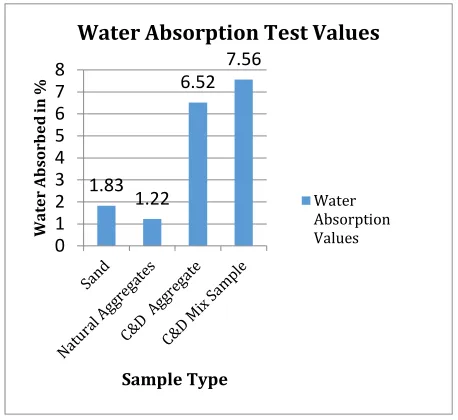
The water absorption value of C&D sand was found out to be 1.83%, for Natural aggregate it was 1.22%, for C&D mortar it was 6.52% and for C&D mixed sample it was 7.56%.
Water absorption values among various segregated aggregate samples
3.2 Sieve analysis
Sieve analysis of aggregates is a process of dividing a sample of aggregate into various fractions, each consisting of particles of same nominal size. The resultant particle distribution is called the graduation. Standard sizes of the sieve we used to test our C&D mix sample are; 80, 40, 20, 16, 12.5, 10, 4.75, 2.36, 1.18, 600 microns, 300 microns, 150 microns.
The fineness modulus of C&D sand was found out to be 2.61 and the sand lies in zone 2. The fineness modulus of natural stones, C&D mortar, C&D brick aggregate and C&D mix aggregates sample was found out to be 7.45, 7.63, 7.02 and 8.04 respectively
3.3 Specific Gravity Test
Specific Gravity is the ratio of the weight of a given volume of aggregate to the weight of an equal volume of water. It is the measure of strength or quality of the specific material.
Aggregates having low specific gravity are generally weaker than those with higher specific gravity values. Specific Gravity of C&D waste sand was found out to be 2.34 and for coarse aggregate it was 1.84
[image:2.612.47.276.188.398.2]3.3.1 For C&D Fine Aggregate
Table -5: SPECIFIC GRAVITY TEST FOR FINE AGGREGATE
S.No Particulars Sample
1
1. Weight of sample taken 2kg
2. Weight of saturated, surface dry aggregate with Pycnometer(M2)
1.105kg
3. Weight of Pycnometer (M1) 0.605kg
4. Weight of Pycnometer with sample and water (M3)
1.741kg
5. Weight of Pycnometer with water (M4)
1.455kg
6. Specific Gravity = [M2-M1/(M2-M1)-(M3-M4)]
2.34 1.83
1.22 6.52
7.56
0 1 2 3 4 5 6 7 8
W
at
er
A
b
sorb
ed
in
%
Sample Type
Water Absorption Test Values
Water Absorption Values
0.00 10.00 20.00 30.00 40.00 50.00 60.00 70.00 80.00 90.00 100.00 110.00
80 63 40 20 16
12.5 10 4.75 2.36 1.18 0.6 0.3 0.15
%
Pa
ss
ed
Sieve Size mm
Sieve Analysis Graph
C&D Brick C&D Mortar
© 2019, IRJET | Impact Factor value: 7.211 | ISO 9001:2008 Certified Journal | Page 6633 3.3.2 For Coarse Aggregate
Table -6: SPECIFIC GRAVITY TEST FOR COARSE AGGREGATE
S.No Particulars Sample 1
1. Weight of sample taken 1kg 2. Weight of saturated, surface dry
aggregate with Gas Jar (M2)
1.68kg
3. Weight of Gas Jar (M1) 0.433kg
4. Weight of Gas Jar with sample and water (M3)
2.106kg
5. Weight of Gas Jar with water (M4)
1.537kg
6. Specific Gravity = [M2-M1/(M2-M1)-(M3-M4)]
1.84
4 Los Angeles Abrasion Test
Los Angeles Abrasion test is carried out to test the hardness property of aggregates. The principle of Los Angeles abrasion test is to find the percentage wear due to relative rubbing action between the aggregate and steel balls used as abrasive charge. The abrasion value was found out to be 25.13 for natural aggregates, 50.58 for C&D mortar, 41.85 for brick aggregates and 38.85 for C&D mixed sample.
Los Angeles Abrasion values among various segregated aggregate sample
5 Impact Value Test
The aggregate impact test is carried out to evaluate the resistance to impact of aggregates. The crushed aggregate is allowed to pass through 2.36 mm IS sieve.
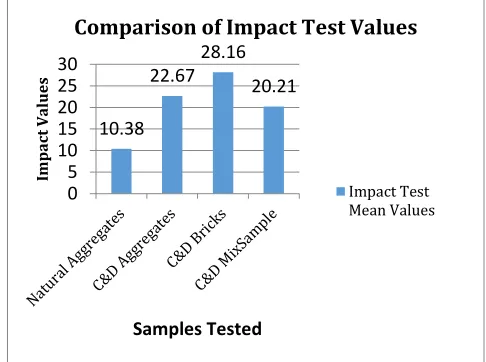
The impact value is measured as percentage of aggregates passing through sieve to the total weight of the sample. The Impact values were found out to be 10.38 for Natural aggregates, 22.67 for C&D Mortar, 28.16 for brick aggregates and 20.21 for C&D mixed sample.
Impact values among various segregated aggregate sample
6 Crushing Value Test
The strength of coarse aggregates is assessed by aggregates crushing test. The aggregate crushing value provides a relative measure of resistance to crushing under a gradually applied compressive load. To achieve a high quality of pavement, aggregate possessing low aggregate crushing value should be preferred. The values were found to be 19.5 for Natural aggregates, 37.12 for C&D Mortar, 43.5 for brick aggregates and 27.35 for C&D mixed sample. 25.13
50.58
41.85 38.85
0 10 20 30 40 50 60
A
br
asi
on
V
alu
es
Samples Tested
Comparison of Abrasion Test Values
Abrasion Test Values
10.38 22.67
28.16
20.21
0 5 10 15 20 25 30
Im
pac
t V
al
ue
s
Samples Tested
Comparison of Impact Test Values
© 2019, IRJET | Impact Factor value: 7.211 | ISO 9001:2008 Certified Journal | Page 6634
Crushing values among various segregated aggregate sample
[image:4.612.330.571.329.648.2]7 Impact Value Test on the different proportions of Coarse aggregates mixed sample
Table -7: IMPACT VALUES TEST
S. no.
Brick Percentage (Bricks:Mortar:NA)
Impact Value (in %)
1 B 1.1 10:10:80 15.49
2 B 1.2 20:20:60 18.92
3 B 1.3 30:30:40 20.81
4 B 2.1 80:10:10 27.29
5 B 2.2 60:20:20 25.31
6 B 2.3 40:30:30 21.21
7 B 3.1 10:80:10 22.69
8 B 3.2 20:60:20 23.49
9 B 3.3 30:40:30 21.86
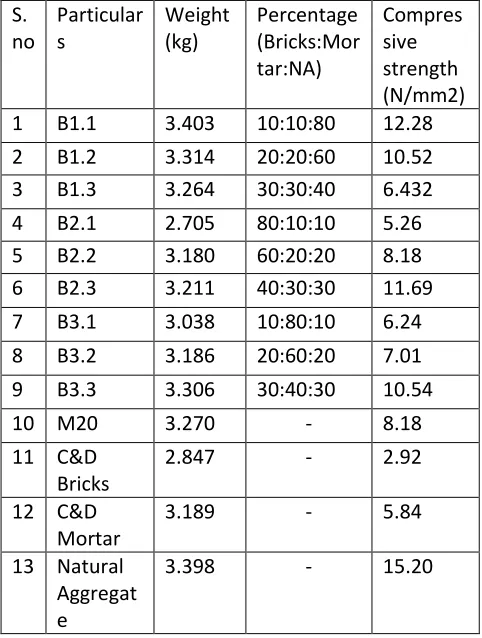
8 Compressive Strength Test on different brick samples
Compressive strength is the capacity of a material or structure to withstand loads tending to reduce size, as opposed to tensile strength, which withstands loads tending to elongate.
CTM values of various brick samples
Table -8: CTM VALUES OF DIFFERENT BRICKS
S. no Particular s Weight (kg) Percentage (Bricks:Mor tar:NA) Compres sive strength (N/mm2) 1 B1.1 3.403 10:10:80 12.28 2 B1.2 3.314 20:20:60 10.52 3 B1.3 3.264 30:30:40 6.432 4 B2.1 2.705 80:10:10 5.26 5 B2.2 3.180 60:20:20 8.18 6 B2.3 3.211 40:30:30 11.69 7 B3.1 3.038 10:80:10 6.24 8 B3.2 3.186 20:60:20 7.01 9 B3.3 3.306 30:40:30 10.54
10 M20 3.270 - 8.18
11 C&D Bricks
2.847 - 2.92
12 C&D Mortar
3.189 - 5.84
13 Natural Aggregat e
3.398 - 15.20
19.5
37.12 43.5
27.35 0 10 20 30 40 50 Cr u sh in g Value s Samples Tested
Comparison of Crushing Test Mean Values Crushing Test Mean Values 12.28 10.52 6.43 5.26 8.18 11.69
6.24 7.01 10.54 8.18 2.92 5.84 15.2 0 2 4 6 8 10 12 14 16 B 1. 1 B 1. 2 B 1. 3 B 2. 1 B 2. 2 B 2. 3 B 3. 1 B 3. 2 B 3. 3 M 20 C&D B ric ks C&D M ort ar NA C o mp re ssi o n V al u e s in N /mm2 Samples Tested
CTM Values of Various Bricks
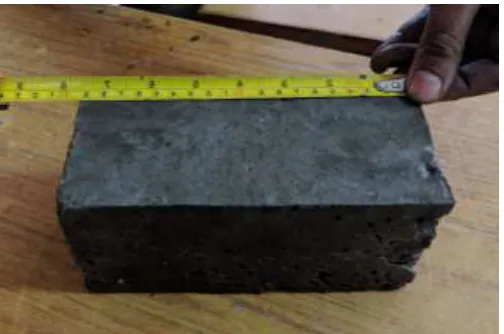
[image:4.612.49.276.401.573.2]© 2019, IRJET | Impact Factor value: 7.211 | ISO 9001:2008 Certified Journal | Page 6635 Fig -1: C&D Waste Brick
3. CONCLUSIONS
By the above results we can deduce that the C&D Bricks has more load bearing capacity than the traditionally used bricks.
With increased compressive strength less C&D Bricks are required to bear the required load which in turn will help in saving overall cost of the construction.
Using such bricks helps in reducing the exploitation of the natural resources which will help in achieving the sustainable development goals in construction industry. Employing C&D Bricks abstain the disposal of
waste on the otherwise usable lands which is beneficial both ecologically and economically. One major drawback which is faced in the
usage of C&D waste bricks is the lack of knowledge among people due to social stigma.
REFERENCES
[1] Harish. P. Gayakwad, Neha. B. Sasane, “Construction
and Demolition Waste Management in India”, RMD-SSOE, Warje, Pune, Maharashtra, INDIA
BIOGRAPHIES
Tanmay Swami, B.Tech,
Department of Civil Engineering, Dr. Akhilesh Das Gupta Institute of Technology & Management, Shastri Park, Delhi, India.
Mohd. Aamir, B.Tech, Department of Civil Engineering, Dr. Akhilesh Das Gupta Institute of Technology & Management, Shastri Park, Delhi, India.
Rajat Sharma, B.Tech, Department of Civil Engineering, Dr. Akhilesh Das Gupta Institute of Technology & Management, Shastri Park, Delhi, India.
Dushant Anthal, B.Tech, Department of Civil Engineering, Dr. Akhilesh Das Gupta Institute of Technology & Management, Shastri Park, Delhi, India.
[image:5.612.44.296.91.258.2]