© 2019, IRJET | Impact Factor value: 7.211 | ISO 9001:2008 Certified Journal
| Page 6376
Power Generation with the Application of Vortex Wind Turbine
Prof. V.K. Kurkute
1, Mr. Chaitanya M. Asre
21
Professor, Dept. of Mechanical Engineering , B.V.D.U.C.O.E ,Pune, Maharashtra, India.
2B.E (Mechanical), Dept. of Mechanical Engineering, B.V.D.U.C.O.E ,Pune, Maharashtra, India.
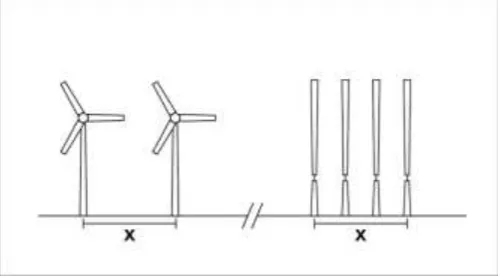
---***---Abstract - Bladeless Wind Generation uses a radically [image:1.595.37.288.400.539.2]approach to capturing wind energy. The device captures the energy of vortices, an aerodynamic effect that has plagued structural engineers and architects for ages As the wind bypasses a fixed structure, it’s flow changes and generates a cyclical pattern of vortices. Once these forces are strong then enough, the fixed structure get oscillating. Instead of avoiding these aerodynamic instabilities our design maximizes the resulting oscillation and captures that energy. Naturally, the design of such device is different from a other turbine. Instead of the usual tower, nacelle and blades, the device has a mast, a power generator and a hollow, lightweight and semi rigid fiberglass cylinder top. This puts the technology at the very low range of capital intensity it also makes it highly competitive not only against generations of alternative or renewable energy, but even compared to technologies.
Fig 1 Different Wind Turbine.
1.INTRODUCTION
Today, India is stepping towards a global super power. This implies that, it is leading the list of developing countries in terms of economic development. Requirement is going to increase manifold in the coming decades. To meet Energy requirement, coal cannot be source of energy. Estimated that within few year coals will get exhausted. The next choice of energy is solar power, but due to its lower concentration per unit area, it is costly. India is having fifth largest wind power capacity in the world. The regions with high wind speed are limited, the installation of conventional limited. The Bladeless is such a concept which works on the phenomenon of vortex shedding to capture the energy. Structures are designed to minimize vortex vibrations in order to minimize mechanical failures. Here, we try to increase the vibrations in order to convert vortex vibrations into electricity. The
© 2019, IRJET | Impact Factor value: 7.211 | ISO 9001:2008 Certified Journal
| Page 6377
conical cylinder vertically with an elastic rod. The cylinderoscillates in the wind, then generates electricity through a system of coils and magnets.
Objective:- To increase the efficiency of wind power generation. To produce clean energy to meet the increasing demands. To make the wind energy economical and efficient. Rural electrification. To reduce pollution and global warming. Development of the project so that it can be used on domestic purposes. To reduce the manufacturing cost of the turbine. It aims to be a ‘Greener’ Wind alternative leaving less carbon footprint on the environment
Problem Definition :-Utilization of wind energy with the help of windmills is costly. Huge investment is the big problem for erection of windmills. Conventional windmill requires more places where wind speed is high. places are limited. Cost of manufacturing different parts of is very high. The transportation of parts is very costly and risky. During transportation components damaged then cost increases. Designing of blades is also a big task. Size of the assembled is also very large. Windmills occupy lots of space. Installation is in 60 acres per megawatt of capacity. Also Produce low frequency sound which is not good for human health. Scope :- The objective of this work is to develop a New Windmill.This concept allows us to achieve our goal as well as better space management.The new model takes into account all the real time conveying system and provide solution over their short coming.The New model will get good efficiency compare to old method.
Literaturereview
This study focuses on identifying the effect of governing parameters on the energy extraction efficiency by VIV. The main parameters investigated were the mass ratio, the mechanical damping coefficient, and the Reynolds number. Some key characteristics of performance can be outlined, like the maximum efficiency t]M attainable for fixed values of m* andtherange of flow velocities (reduced velocity) where efficiency is significant. The analysis carried out shows that: (i) t]M is mainly influenced by the mass-damping parameter m*( and there is an optimum value of m*( where t]M presents a maximum; (ii)the range of reduced velocities with significant efficiency is mainly governed by m*; (iii) it seems that encouraging high efficiencyvalues can be achieved for high Reynolds numbers. Finally, it must be noted, however, that the analysis herein presented should be seen only as an approximation to the real problem. For example, it is clear that the real VIV situation(a complete fluid-structure interaction problem) is more complex than that of a forced vibrations one, where the body is oscillating at a fixed amplitude and frequency. This point has been largely discussed in the literature, and the question of whether forced vibration tests can be used to predict VIV behavior has been addressed by several important investigators being still open. Nevertheless, recently, Morse and Williamson
have demonstrated that under carefully controlled conditions there is very close correspondence between free and forced vibration experiments. With this idea in mind, we believe that results presented in this paper can be representative and, from an engineering point of view, the parametric analysis of the present study can help to efficiently design a device to extract useful energy from VIV. Extracting energy from Vortex-Induced Vibrations: A parametric study Antonio Barrero-Gila*, Santiago Pindadob, Sergio AvilabaAerospace Propulsion and Fluid Mechanics Department, School of Aeronautics, UniversidadPolitecnica de Madrid, Plaza
CardenalCisneros 3, E-28040 Madrid,
SpainbInstitutoUniversitario 'Isnacio Da Riva', Universidad Politecnica de Madrid, Plaza Cardenal
Here, Vortex-Induced Vibrations (VIVs) of a circular cylinder are analyzed as a potentialsource for energy harvesting. To this end, VIV is described by a one-degree-of-freedommodel where fluid forces are introduced from experimental data from forced vibrationtests. The influence of some influencing parameters, like the mass ratio m* or the mechanicaldamping C in the energy conversion factor is investigated. The analysis reveals that:(i) the maximum efficiency r\M is principally influenced by the mass-damping parameterm*C and there is an optimum value of m*C where r\M presents a maximum; (ii) the rangeof reduced velocities with significant efficiency is mainly governed by nf, and (iii) it seemsthat encouraging high efficiency values can be achieved for high Reynolds numbers.
Writing in Treehugger, Derek Markham, commented : "The Vortex wind generator represents a fairly radical break with conventional wind turbine design, in that it has no spinning blades (or any moving parts to wear out at all), and looks like nothing more than a gaintstraw that oscillates in the wind. It works not by spinning in the wind, but by taking advantage of a phenomenon called vorticity, or the Kármán vortexstreet, which is a 'repeating pattern of swirling vortices.'" Raul Martin, Vortex Bladeless co-founder, said, "Compare our invention to a conventional wind turbine with similar energy generation—ours would cost significantly less," around 50 percent or 47 percent less. The company site said that Vortex saves 53 percent in manufacturing costs and 51 percent in operating costs compared to conventional wind turbines.
© 2019, IRJET | Impact Factor value: 7.211 | ISO 9001:2008 Certified Journal
| Page 6378
power capacity in the world. As theregions with high windspeed are limited, the installation of conventional windmill is limited. Windmills that would provide safe,quite, simple, affordable and work on lesser wind speeds are need of the hour. The Bladeless Windmill is such a concept whichworks on the phenomenon of vortex shedding to capture the energy produced. Generally, structures are designed to minimizevortex induced vibrations in order to minimize mechanical failures. But here, we try to increase the vibrations in order to convertvortex induced vibrations into electricity. The paper studies the scope and feasibility of the bladeless windmill.Keywords: Bladeless Windmill, Vortex Induced Vibrations, Vortex Shedding, Renewable Energy Sources.
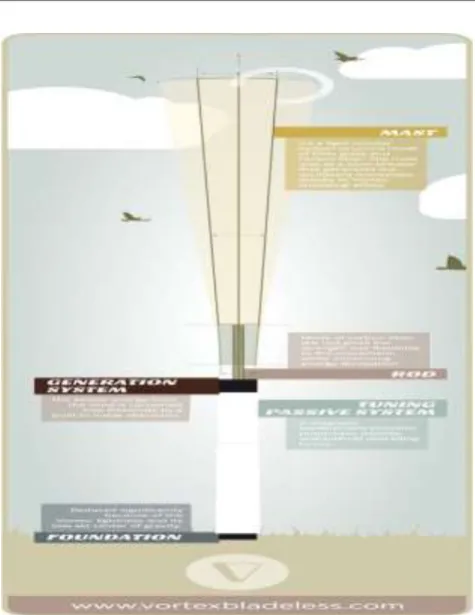
[image:3.595.315.553.83.391.2]Vortex-Bladeless is a Spanish SME whose objective is to develop a new concept of winturbine without blades called Vortex or vorticity wind turbine. This design represents a new paradigm in wind energy and aims to eliminate or reduce many of the existing problems in conventional generators. Due to the significant difference in the project concept, its scope is different from conventional wind turbines. It is particularly suitable for offshore configuration and it could be exploited in wind farms and in environments usually closed to existing ones due to the presence of high intensity winds. The device is composed of a single structural component, and given its morphological simplicity, its manufacturing, transport, storage and installation has advantages. The new wind turbine design has no bearings, gears, etcetera, so the maintenance requirements could be drastically reduced and their lifespan is expected to be higher than traditional turbines. It is clear that the proposed device is of prime interest, and that scientific investigation of the response of this wind energy generator under different operation scenarios is highly desirable. Thus, the objective of this SHAPE project is to develop the needed tools to simulate Fluid-Structure Interaction (FSI) problems and to reproduce the experimental results for scaled models of the Vortex-Bladeless device. In order to do so the Alya code, developed at the Barcelona Supercomputing Center, is adapted to perform the Fluid-Structure Interaction (FSI) problem simulation.
Fig 2 Vortex Bladeless Wind Turbine
Working Our project works on principle of vibration. In which electricity is generated by WIND energy. The wind strike on the mast , it begin to oscillate. When the frequency of air is equal to the natural frequency of mast , the resonance is created. Due to which vibration is created. This vibration is transferred to the rod due to which rod also start to vibration. This vibratory motion is further transmitted to the base. The base piezoelectric transducer due to vibratory motion of rod electricity is generated in that alternator.
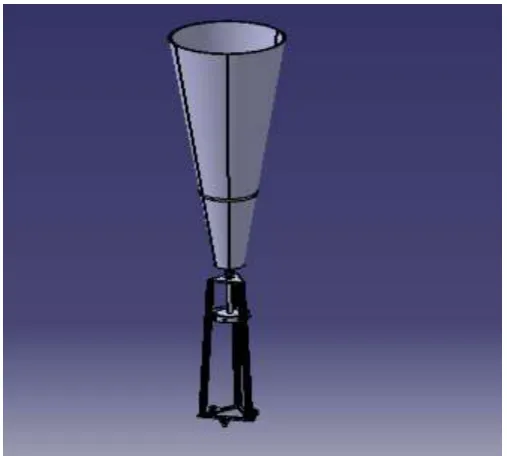
CATIA Model
Computer-aided design (CAD) is the use of computer systems (or workstations) to aid in the creation, modification, analysis, or optimization of a design. CAD software is used to increase the productivity of the designer, improve the quality of design, improve communications through documentation, and to create a database for manufacturing. CAD output is often in the form of electronic files for print, machining, or other manufacturing operations. The term CADD (for Computer Aided Design and Drafting) is also used.
© 2019, IRJET | Impact Factor value: 7.211 | ISO 9001:2008 Certified Journal
| Page 6379
Fig. 3 CATIA ModelANSYS:- The finite element method (FEM), is a numerical method for solving problems of engineering and mathematical physics. Typical problem areas of interest include structural analysis, heat transfer, fluid flow, mass transport, and electromagnetic potential. The analytical solution of these problems generally require the solution to boundary value problems for partial differential equations. The finite element method formulation of the problem results in a system of algebraic equations. The method yields approximate values of the unknowns at discrete number of points over the domain. To solve the problem, it subdivides a large problem into smaller, simpler parts that are called finite elements. The simple equations that model these finite elements are then assembled into a larger system of equations that models the entire problem. FEM then uses variational methods from the calculus of variations to approximate a solution by minimizing an associated error function.
Table 1:- Material Properties of Propylene
MESH
ANSYS Meshing is a general-purpose, intelligent, automated high - performance product. It produces the most appropriate mesh for accurate, efficient Multiphysics solutions. A mesh well suited for a specific analysis can be generated with a single mouse click for all parts in a model.
[image:4.595.358.558.155.361.2]Full controls over the options used to generate the mesh are available for the expert user who wants to fine-tune it. The power of parallel processing is automatically used to reduce the time you have to wait for mesh generation.
Fig. 4 Meshing
Boundary Condition
[image:4.595.37.288.580.658.2]A boundary condition for the model is the setting of a known value for a displacement or an associated load. For a particular node you can set either the load or the displacement but not both.
© 2019, IRJET | Impact Factor value: 7.211 | ISO 9001:2008 Certified Journal
| Page 6380
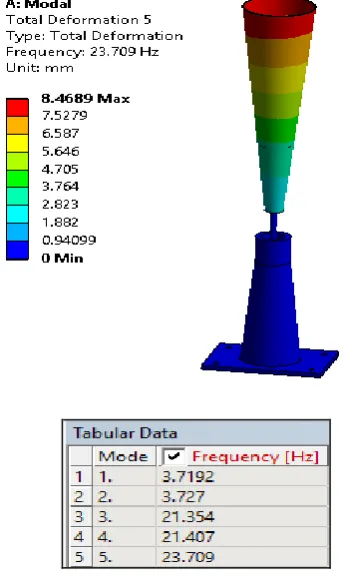
Results [image:5.595.63.235.337.629.2]Fig. 4 Total Deformation
Fig. 5 Modal Analysis
References
1.Extracting energy from Vortex-Induced Vibrations: A parametric study Antonio Barrero-Gila*, Santiago Pindadob, Sergio Avilab a Aerospace Propulsion and Fluid Mechanics Department, School of Aeronautics, Universidad Politecnica de Madrid, Plaza Cardenal Cisneros 3, E-28040 Madrid, SpainbInstitutoUniversitario 'Isnacio Da Riva', Universidad Politecnica de Madrid, Plaza Cardenal
2. Vortex Bladeless aims for lower-cost windenergy approach 18 May 2015, by Nancy Owano.
3.IJIRST –International Journal for Innovative Research in Science & Technology| Volume 2| Study of Vortex Induced Vibrations for Harvesting Energy GauraoGohate Saurabh Bobde Student Professer Department of Mechanical Engineering Department of Mechanical Engineering DBACER,
Nagpur, India DBACER, Nagpur, India AbhilashKhairkar
Sameer Jadhav Student Student Department of Mechanical Engineering Department of Mechanical Engineering DBACER, Nagpur, India DBACER, Nagpur, India