International Research Journal of Engineering and Technology
(IRJET)
e-ISSN: 2395-0056Volume: 06 Issue: 04 | Apr 2019 www.irjet.net p-ISSN: 2395-0072
© 2019, IRJET | Impact Factor value: 7.211 | ISO 9001:2008 Certified Journal | Page 3661
EXPERIMENTAL STUDY ON ENGINEERED CEMENTITIOUS COMPOSITE
PRASHIL U. SUDDHAWAR
1, KETAK V. BAKHADE
2, RUSHABH S. DHOLE
3, VAIBHAV A.
PATURKAR
4, MANISH R. BHATKAR
51234Civil Engineering Department, Jagadambha College of Engineering & Technology, Yavatmal, Maharashtra, India,445-001.
5Assistant Professor in Jagadambha College of Engineering & Technology, Yavatmal, Maharashtra, India,445-001 ---
Abstract:-
Engineered Cementitious Composite(ECC) is also called as Bendable concrete. It is made by adding some special ingredient which are use to increase its flexibility and workability. The main ingredient which is use to increase its flexibility is PVA Fibre .
Conventional concrete may collapse when strain in concrete increase by application of load, on other hand ECC can sustain very high amount of strain without getting collapse. Conventional concrete fractures and may not carry a load at 0.01% tensile Strain but ECC remains intact and safe to use at tensile strain up to 5%. Polyvinyl alcohol fibre as high ultimate tensile strength, relatively high modulus of elasticity, good chemical compatibility with OPC in this project we studied about the various properties of ECC i.e. Compressive Strength and flexural Strength of cubes and slabs (Of different thickness)is determine and also the bendability characteristics of the concrete are checked during flexural strain test.
Key Words:-Flexibility, Workability, PVA fibre, Compressive strain, Flexural Strain
1.INTRODUCTION:-
Conventional concretes are almost unbendable and have a strain capacity of only 0.1% making them highly brittle and rigid.This lack of bendability is a major cause of failure under strain and has been a pushing factor in the development of an elegant material namely, bendable concrete. This material is capable to exhibit considerably enhanced flexibility. A
bendable concrete is reinforced with
micromechanically designed polymer fibers. ECC is made from the same basic ingredients as conventional concrete but with the addition of High-Range Water Reducing (HRWR) agent is required to impart good workability.
© 2019, IRJET | Impact Factor value: 7.211 | ISO 9001:2008 Certified Journal | Page 3662 loading and it can be seen that the beam can
deform sufficiently without direct failure. ECC has proved to be 50 % more flexible than traditional concrete, and 40% lighter, which could even influence design choices in skyscrapers. Additionally, the excellent energy absorbing properties of ECC make it especially suitable for critical elements in seismic zones.
The challenge in making a lightweight concrete is decreasing the density while maintaining strength and without adversely affecting cost. Introducing new aggregates into the mix design is a common way to lower density of concrete. Normal concrete contains four components, cement, crushed stone, river sand and water. The crushed stone and sand are the components that are usually replaced with lightweight aggregates.
2. METHODOLOGY :-
2.1 Materials Required:-
Cement (OPC53Grade), Sand, FlyAsh, Water,
Super-Plasticizer(PCE), Fiber(Polyvinyl Alcohol fibre). Cement , sand and fly ash these are very common ingredients used in preparation of concrete. To make ECC we have to add some special ingredients such as PVA fibre and PCE super plasticizer .
2.1.1 PVA Fibre (Poly Vinyl
Alcohol):-PVA fibre (Poly Vinyl Alcohol) are high performance reinforcement fibre for concrete and mortar. PVA fibre are well suited for wide variety of application because of superior crack fighting properties, high modulus of elasticity, excellent
tensile and molecular bond strength, and high resistance to alkali. PVA fibre are unique in there ability to create a molecular bond with mortar and concrete that is 300 % greater than other fibre.
2.1.2 PCE Super Plasticizier :-
Super plasticizers are mainly composed by potassium and sulphur in ratio of 2. This reveals that PCE interacts with these ionic species in solution, and when the sample was dried they precipitates in salts of K2SO4. The strong interaction between PCE and sulphate, reduces the actual amount of sulphate ions available in the pore solution.• To improve the rheological properties of cement paste and to reduce the water necessary for its blending, PCE are usually applied to the fresh concrete mixtures
• Poly carboxylate-ether based super
plasticizers (PCEs) are used in different industrial sectors to generally increase the workability of granular material
2.2 Tests On Materials:-
2.2.1 Test On Cement
Table no. 1: Test On Cement:-
SR. NO. NAME OF TEST READING
1 Fineness of cement 1%
2 Consistency of
cement 34%
3 Initial setting tim
e of cement 30min
4 4 Final setting time
International Research Journal of Engineering and Technology
(IRJET)
e-ISSN: 2395-0056Volume: 06 Issue: 04 | Apr 2019 www.irjet.net p-ISSN: 2395-0072
© 2019, IRJET | Impact Factor value: 7.211 | ISO 9001:2008 Certified Journal | Page 3663
5 Soundness of
cement 3mm
[image:3.595.28.573.49.392.2]2.2.2 Test on fine aggregate
Table no. 2: Test On Fine Aggregate
2.3 MIX PROPORTION :-
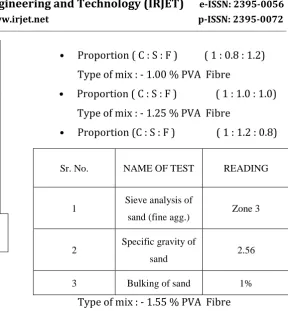
The mix design of grade M25 is use. The mix design for ECC concrete is basically base on micromechanics design basis . Micromechanics are a branch of mechanics applied at the material constituent level that capture the mechanical interaction among the fibre , morter matrix ,and fiber matrix interface. Typically ,fibres are of the order of millimeters in a length and tens of microns in diameter, and they may have a surface coating on the nanometer scale. Matrix heterogeneities in ECC,including defects, sands particales, cement grains ,and mineral at mixture particals, have a size ranges from nano to millimeters scale.Hence the ideal mix proportion given in the literature of ECC.ECC concrete is use as the guide line to determine the proportion of various constituents in the concrete.The volume fraction of using jute and PVA fibre is varied as 0%,0.5%,1%,1.5% added in total volume of concrete mix . The ideal mix proportion are as follows.
• Proportion ( C : S : F ) ( 1 : 0.8 : 1.2) Type of mix : - 1.00 % PVA Fibre
• Proportion ( C : S : F ) ( 1 : 1.0 : 1.0) Type of mix : - 1.25 % PVA Fibre
• Proportion (C : S : F ) ( 1 : 1.2 : 0.8)
Type of mix : - 1.55 % PVA Fibre Table no. 3 : Testing Specimens
3. TESTS AND RESULT :
3.1 Workability By Slump Cone Test:
The slump test is a means of assessing the
consistency of fresh concrete. It is performed to
check the workability of freshly made concrete, and therefore the ease with which concrete flows. It can also be used as an indicator of an improperly mixed batch. The test is popular due to the simplicity of apparatus used and simple procedure.
RESULT:
The slump test indicates decreasing trend as the fibre percentage increases. Table 6.1.1 shows the slump height recorded during the test and the difference in percentage dropped for all mix batches compared to control batch.
Table no. 4 : Slump cone test
Type of mix Slump
(mm)
Percentage difference (%)
Sr. No. NAME OF TEST READING
1 Sieve analysis of
sand (fine agg.) Zone 3
2 Specific gravity of
sand 2.56
3 Bulking of sand 1%
Sr.no Specimen Numbers Dimensions
1. Cubes 9 150mm x 150mm x
150mm
2.
Slabs
a. Type 1 03 700 mm x 150mm x
20mm
b. Type 2 03 700 mm x 150mm x
30mm
c. Type 3 03 700 mm x 150mm x
[image:3.595.274.563.52.364.2]© 2019, IRJET | Impact Factor value: 7.211 | ISO 9001:2008 Certified Journal | Page 3664
Plane (0%) 130 -
1.00% Fibre 66 49
1.25% Fibre 52 60
1.55% Fibre 44 66
Fig. no. 1: Slump cone test
3.2Compressive Strength Test: -
Compressive strength of a concrete is a measure of its ability to resist static load, which tends to crush it. Most common test on hardened concrete is compressive strength test. It is because the test is
easy to perform.
[image:4.595.30.565.42.633.2]
RESULT:-The result of compression test shows that the strength decreases as cement/sand ratio decreases. Table 4.3 shows the average compressive strength recorded during test. Average strength of three tested specimens of each ratio was taken.
Table no. 5 :
Compressive Strength Test
Fig. no. 2: Compressive Strength Test 20
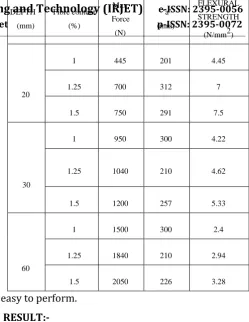
1 445 201 4.45
1.25 700 312 7
1.5 750 291 7.5
30
1 950 300 4.22
1.25 1040 210 4.62
1.5 1200 257 5.33
60
1 1500 300 2.4
1.25 1840 210 2.94
1.5 2050 226 3.28
Cement/Sand ratio
Compressive strength (MPa) Average compressiv
e strength (MPa) Cube 1 Cube 2 Cube 3
1:0.8 29.82 30.75 32.22 30.93
1:1 28.93 27.11 30.62 28.88
[image:4.595.315.565.47.370.2] [image:4.595.315.565.528.720.2]International Research Journal of Engineering and Technology
(IRJET)
e-ISSN: 2395-0056Volume: 06 Issue: 04 | Apr 2019 www.irjet.net p-ISSN: 2395-0072
© 2019, IRJET | Impact Factor value: 7.211 | ISO 9001:2008 Certified Journal | Page 3665
3 .3 Flexural Strength Test
:-Individual Test Conducted on Slab of varying depth of various Fibre content.
[image:5.595.328.575.381.696.2]Table no. 6 :Flexural Strength Test
Fig. no. 3: Flexural Strength Test
4.
CONCLUSION:-1. The flexure strength of concrete is found to be maximum at small depth of slab i.e. for 20 mm slab depth the flexural strength will be more as compare to 30mm slab.
2. Flexural strength will be more at 1.55% of PVA Fibre.
3. From the compressive strength data we found that as the sand content increase compressive strength decrease.
4. The slump value decreases rapidly with the increase in percentage of PVA fibres.
5. REFERENCE: -
1) Victor C. Li (2007), “Engineered Cementitious Composites (ECC)- Material, Structural and Durability Performance”.
2) Victor C. Li (2009), “Damage Tolerant ECC for Integrity of Structures Under Extreme Loads”.
3) Sagar Gadhiya,T N Patel , Dinesh Shah (2015),“Bendable Concrete: A Review”, international journal of structural and civil engineering research.”
4) M. Sahmaran, V.C. Li (2008), “Durability of Mechanically Loaded Engineered Cementitious
Composites Under Highly Alkaline
Environment”, ASCE.
5) Prof T N Patel, SVIT; Sagar Gadhiya M , Dr. Dinesh Shah, SVIT, Parametric Study On ECC 6) Srinivasa C. H. Parametric Study on Bendable
Concrete.
6.BIOGRAPHIES : -
Sno Photograph Description
1
PRASHIL UTTAM SUDDHAWARJagadambha College of Engg. & Technology , Yavatmal,Maharashtra,Ind ia
445001.
2
KETAK VINAYAKBAKHADEJagadambha College of Engg. & Technology ,
Yavatmal,Maharashtra,Ind ia
445001.
3
RUSHABH SANJAY DHOLE JagadambhaCollege of Engg. & Technology ,
Yavatmal,Maharashtra,Ind ia
© 2019, IRJET | Impact Factor value: 7.211 | ISO 9001:2008 Certified Journal | Page 3666
Sno Photograph Description
4
VAIBHAV ANILRAOPATURKAR Jagadambha College of Engg. &
Technology ,
Yavatmal,Maharashtra,India 445001.
5
MANISH RAMESHRAOBHATKAR (Asst. Prof. Dept. of civil engg.) Jagadambha College of Engg. & Technology ,