© 2019, IRJET | Impact Factor value: 7.211 | ISO 9001:2008 Certified Journal
| Page 235
A STUDY ON QUANTIFICATION OF FACTORS AFFECTING THE QUALITY
OF CONSTRUCTION PROJECTS IN INDIA
S. Ramesh Kumar
1, S. Arun Kumar
2, T. Bhavanesh
3, V. Kavinkumar
41
Assistant Professor, Department of Civil Engineering, Velalar College of Engineering Technology,
Thindal, Erode, Tamil Nadu.
2, 3,4
Final Year Student, Department of Civil Engineering, Velalar College of Engineering Technology,
Thindal, Erode, Tamil Nadu.
---***---Abstract -Projects are organized to accomplish complex tasks that cannot be handled by alone individuals but by multidisciplinary teams in the construction industry. The level of success in carrying out construction project development activities will depend heavily on the quality of the managerial, financial, technical and organizational performance. So the performance is one of the main points to decide project success. The factors which affect the construction project performance are to be identified from literature survey and using those factors the questionnaire survey is carried out among the site engineers and owners in various companies. The ranking of the factors will be done by using Statistical Package of Social Sciences (SPSS). Using that data’s the major factors that affecting the performance have to be identified. From the results suitable suggestions will be given to the companies for improving their project performance. Thus the study aims on identifying the factors which affecting the construction project performance.
Key Words: Factors, Management, questionnaire, SPSS.
1. INTRODUCTION
1.1 General
Projects are organized to accomplish complex tasks that cannot be handled by alone individuals but by multidisciplinary teams in the construction industry. Construction project development involves numerous parties, various processes, different phases and stages of work and a great deal of input from both the public and private sectors, with the major aim being to bring the project to a successful conclusion. The level of success in carrying out construction project development activities will depend heavily on the quality of the managerial, financial, technical and organizational performance of the respective parties, while taking into consideration the associated risk management, the business environment, and economic stability.
Project success depends upon how well the personnel can work effectively to accomplish objectives within scope, cost and quality constraints. In past, many researches have been done to frame an effective performance management system for construction industry based on the flaws in the existing systems adopted globally.
The study aims to identify and evaluate the main factors affecting the performance of construction projects and also give possible recommendations to improve performance of construction projects.
1.1.1 Definition of Performance Management
Performance management is a continuous process of identifying, measuring and developing performance in organizations by linking each individual’s performance and objectives to the organization’s overall mission and goals.
Performance management is about directing and supporting employees to work as effectively and efficiently as possible in line with the needs of the organization. The central aim of performance management is to,
Develop the potential of staff and improve their performance
Linking an employee individual objectives to business strategies and hence improve company’s performance
Project manager must have the skills required to build effective project teams to achieve the targeted performance. An effective performance management process enables managers to evaluate and measure individual performance and optimize productivity by:
Aligning individual employee's day-to-day actions with strategic business objectives
Providing visibility and clarifying accountability related to performance expectations
Documenting individual performance to support compensation and career planning decisions
Establishing focus for skill development and learning activity choice
1.1.2 Performance Measures
© 2019, IRJET | Impact Factor value: 7.211 | ISO 9001:2008 Certified Journal
| Page 236
Performance Ownership and Responsibility Performance management involves the identification of those responsible (agency, team, individual, etc) for achieving the desired level of performance.
Performance Reviews
A rigorous performance monitoring and review process should be in place to ensure that the desired level of performance is achieved.
Performance Incentives
Incentives are payments, benefits or concessions to reward staff or organizations (including those working jointly) for meeting desirable standards of work-related performance and/or to encourage improved performance. The term can also be used to embrace sanctions or penalties for substandard performance.
1.1.3 Performance management in construction industry
Within every organization, Performance Management is a critical issue influencing all the other components of Human Resources management. It contributes to the identification, development and retention of high-potential employees and key contributors.
The construction industry's core business is undertaking projects in generating new buildings or refurbishing existing ones for a variety of clients. Therefore, it is not a surprise to find that traditionally performance measurement in construction is approached in two ways:
a) in relation to the product as a facility
b) in relation to the creation of the product
Therefore, it is clear to see that the traditional measures of the performance of construction projects are not enough to assess their ‘true’ performance. It can be argued that the methods used to measure performance in construction industry fall into the three main categories of the BSC:
1. Financial Perspective: how do the project’s financial stakeholders view the project? For example cash flow forecasting and cost benefit analysis.
2. The Internal Business Process Perspective: how are we performing in our key process activities? For example critical path analysis
3. The Customer Perspective: how do our existing and potential customers see us? For example quality assurance.
Recently the UK best practice programme has launched the ‘Key Performance Indicators’ (KPIs) for construction .These KPIs give information on the range of performance being achieved on all construction activity and they comprise of:
1. Client satisfaction – product 2. Client satisfaction – service 3. Defects
4. Predictability – cost 5. Predictability - time 6. Profitability
7. Productivity 8. Safety
9. Construction cost 10. Construction time
These KPIs are intended for use as benchmarking indicators for the whole industry whereby an organisation can benchmark itself against the national performance of the industry and identify areas for improvement. The following are some examples:
1. The predictability of design and construction cost seems to be quite accurate since the means of the cumulative values represent zero and one percent respectively. However, the productivity value is very low. Does this mean that the predicted costs are over estimated to cover low productivity or the measures used to derive the figures are wrong.
2. The client satisfaction in terms of the product and service is quite high (eight out of ten) but the productivity is very low which raises the issue of do the clients really know what the productivity levels of their projects are.
The above illustrate the importance of not only using the ‘right measures’ to measure the ‘right things’ but the relationship between the different measures is important and a source of identifying potential collective improvements. Another area that is generally poorly covered in the construction industry is the performance of the suppliers in projects.
1.1.4 Necessity of performance management
© 2019, IRJET | Impact Factor value: 7.211 | ISO 9001:2008 Certified Journal
| Page 237
1.1.5 Objectives of Performance Management
To enable the employees towards achievement of superior standards of work performance.
To help the employees in identifying the knowledge and skills required for performing the job efficiently.
Promoting a two way system of communication between the supervisors and the employees for clarifying expectations about the roles and accountabilities, communicating the functional and organizational goals. The performance of a successful project team is measured by three factors:
Technical success according to agreed project objectives
Performance on project schedule (finish on time)
Performance on budget (finished within financial constraints)
There are many advantages associated with the implementation of a performance management system. A performance management system can make the following important contributions:
Motivation to perform is increased Self-esteem is increased
Managers gain insight about subordinates Self-insight and development are enhanced Personnel actions are more fair and appropriate Organizational goals are made clear
Employees become more competent There is better protection from lawsuits
2. METHODOLOGY
3. IDENTIFICATION OF FACTORS
There are numerous factors affecting the performance of construction project. The following factors are selected from literature study and broadly classified in this project
Time factors
Cost factors
Productivity factors
Quality factors
Human/personnel factors
Client satisfaction factors
Environmental factors
Health and safety factors
3.1 Time factors
"Time" or "Schedule" as one of the most important project success criteria for any project. Time has been addressed as a criterion by which to evaluate a project's degree of success. It has also been mentioned as a factor, which can help the other factors/criteria be met. It is found that the definition of “Time” is of great importance. Factors affecting the construction time are,
Delays in site preparation works
Delays in giving approval
Delays due to shortage of resources (manpower, material, money. etc.)
Tight project schedule to fulfill the owner requirements
Literature review
Study of performance management
Identification of performance factors
Questionnaire preparation
Questionnaire survey
Questionnaire analysis using SPSS
© 2019, IRJET | Impact Factor value: 7.211 | ISO 9001:2008 Certified Journal
| Page 238
Unexpected accident due to improper material and equipment handling
Time needed to find out the causes of defects and their rectification
3.2 Cost factors
Without a doubt, every project is dependent on its cost or budget. Various cost factors which affects the construction are,
Frequent design variations
Variation in project labour cost according to market demands
Variation in equipment and material cost
Rework due to errors in construction
Project overtime cost due to shortage of resources (manpower, material, money, management, machinery)
Poor management and site supervision of the respondents
Variation in currency price
Waste rate of material due improper planning
3.3 Productivity factors
Productivity means “how much and how good we produce from the resources used, Productivity can be measured at different levels. The following factors which affect the productivity are,
Site restricted access by the management
Lack of experienced or specialized labours
Complexity of project
Number of new projects / year
Absenteeism rate through project
Lack of co-ordination between management and labour
Work force according to schedule
3.4 Quality factors
A quality specification is an important performance measure of any construction project. Based on customer needs the quality plays major role in the construction. Quality affecting factors are,
Unsuitable construction for the project management
Uses of low quality materials and equipments during construction
Financial issues faced by the management
Inadequate motivation to the labour through the management
3.5 Client satisfaction factors
Clients, whether they are directly or indirectly involved in projects and have different views about success, play crucial roles in every project. Factors which affect the client satisfaction are given below,
Number of rework incidents
Number of disputes between owner and project parties.
3.6 Human/personnel factors
The human/personnel factors are important factors to deciding quality project. The human factors highly depend upon the individuals. The followings factors to affecting the human/personnel’s,
Age of the labour
Attitudes of the employee
Improper coordination between team members
3.7 Environmental factors
In construction projects most of the people are affected by the environment. The environmental factor which affects the construction performance are,
Amount of wastes around the construction site
Frequent variations in air quality due to material handling and working procedure
Change in noise level around the work area due to machinery operation and material handling
Change in climatic condition
3.8 Health and safety factors
Health and safety is important to everyone working in a construction projects. Every project should ensure the worker safety by using proper safety programs and precautions. The following factors which affects the health and safety,
© 2019, IRJET | Impact Factor value: 7.211 | ISO 9001:2008 Certified Journal
| Page 239
Rate of reportable accidents in project
Application of health and safety factors (safety meeting, program, training, etc.,) in organization.
4. QUESTIONNAIRE PREPARATION
4.1 General
Based on the literatures, a questionnaire was framed relating to factors affecting performance of construction project and survey was carried out.
4.2 Questionnaire outline
The questionnaires are all classified into 2 sections:
SECTION A: Company and respondent profile
SECTION B:Factors affecting construction project performance management
4.3 Rating scale
(1) => Strongly Agree
(2) => Agree
(3) => Neutral
(4) => Disagree
(5) => Strongly Disagree
5. DATA ANALYSIS
5.1 General
The collected data was analyzed by using SPSS software and RII method. From this analysis Frequency, Percentage, Cumulative Percentage, Mean Value & Standard Deviation was founded, based on the obtained mean value the factors are ranked.
5.1.1 Statistical package for social sciences (SPSS)
SPSS is a widely used program for statistical analysis in social science. SPSS can take data from almost any type of file and use them to generate tabulated reports, charts, and plots of distributions and trends, descriptive statistics, and conduct complex statistical analyses.
SPSS trends provide the power and flexibility required by experienced time series analysts, while at the same time being easy enough for those not familiar with time series techniques to use and master quickly
5.1.2 Importance of SPSS software
Producing descriptive and summary statistics, frequency tables and cross tabulations, for example, a Figure
counting the number of visits made to an exhibition by the age group of the visitors.
Modeling different sets of data, for example, regression analysis to determine the strength of the relationship between two or more variables such as staffing levels and workload, this is useful technique for testing efficiency.
5.2 Analysis by using SPSS (Descriptive Statistics)
The collected data was analyzed by using SPSS software. From this analysis mean value was founded. Based on the obtained mean value the factors are ranked.
Description Numbers Number of questionnaire distributed 65
Number of questionnaire received 43
Response rate (%) 66
The collected data was analyzed by using SPSS software. From this analysis mean value was founded. Based on the obtained mean value the factors are ranked.
6. THE TOP 10 SIGNIFICANT FACTORS AFFECTING THE PERFORMANCE OF CONSTRUCTION PROJECT (DESCRIPTIVE STATISTICS)
Performance Factors Mean Deviation Std. Rank
Rate of reportable
accidents 4.08 0.829 1
Project overtime cost 3.97 0.974 2
Material waste 3.97 1.025 2
Changes in noise level 3.93 1.087 3 Lack of co-ordination
between management
and labour 3.88 0.958 4
Lack of experienced
labour 3.85 1.055 5
Uses of low quality materials and
equipments 3.85 1.117 5
Complexity of project 3.83 0.942 6 Unexpected accident 3.75 1.083 7
Leadership skills of
project manager 3.75 0.985 7
Time needed for defect
© 2019, IRJET | Impact Factor value: 7.211 | ISO 9001:2008 Certified Journal
| Page 240
Rework due to error 3.70 0.979 8Variations in air quality 3.70 1.013 8 Poor management and
supervision 3.68 1.017 9
Age of labour 3.67 1.020 10
6.1 Factors affecting the performance of construction projects according to each category
Factors Mean
Rank (fact
or)
Rank (over
all) 1.Time factors
Unexpected accident 3.83 1 7
Time needed for defects
rectification 3.70 2 8
Delays in site preparation 3.52 3 16
Tight project schedule 3.38 4 21 Delays in giving approval 3.22 5 25 Shortage of resources 3.13 6 27
2.Cost factors
Project overtime cost 3.97 1 2 Variation in currency price 3.97 1 2
Material waste 3.93 2 2
Rework due to errors 3.70 3 8
Poor management and site
supervision 3.67 4 9
Variation in labour cost 3.50 5 17 Variation in equipment and
material cost 3.37 6 22
Design variations 3.17 7 26
3.Productivity factors Lack of co-ordination
between management and
labour 3.88 1 4
Lack of experienced labours 3.85 2 5 Complexity of project 3.75 3 6
Work force 3.60 4 13
Number of projects / year 3.42 5 20 Absenteeism rate of labour 3.42 5 20 Site restricted access 3.02 6 29
4.Quality factors Uses of low quality materials
and equipments 3.85 1 5
Inadequate motivation to the
labour 3.65 2 11
Unsuitable construction 3.53 3 15
Financial issues 3.32 4 23
5.Human/personnel factors
Age of the labour 3.68 1 10
Attitudes of the employee 3.57 2 14 Improper coordination
between team members 3.45 3 19
6.Client satisfaction factors Leadership skills for project
manager 3.75 1 8
Number of disputes between
owner and project parties 3.65 2 11 Speed and reliability of
service to owner 3.65 2 11
Number of rework incidents 3.42 3 20 7.Environmental factors
Changes in noise level 3.97 1 3 variations in air quality 3.70 2 8
Changes in climatic
condition 3.62 3 12
Amount of wastes 3.48 4 18
8.Health and safety factors
Rate of reportable accidents
in project 4.08 1 1
Lack of project safety
assurance 3.30 2 24
Application of health and
safety factors 3.03 3 28
6.2 Reliability Statistics
© 2019, IRJET | Impact Factor value: 7.211 | ISO 9001:2008 Certified Journal
| Page 241
Table 6.2.1 Cronbach Alpha ConsistencyCronbach's alpha Internal consistency α ≥ 0.9 Excellent (High-Stakes testing) 0.7 ≤ α < 0.9 Good (Low-Stakes testing) 0.6 ≤ α < 0.7 Acceptable
0.5 ≤ α < 0.6 Poor
[image:7.595.279.554.52.242.2]α < 0.5 Unacceptable
Table 6.2.2 Reliability Statistics Output from SPSS
Reliability Statistics Cronbach's
Alpha Cronbach's Alpha Based on Standardized Items
No of Items
0.921 0.920 39
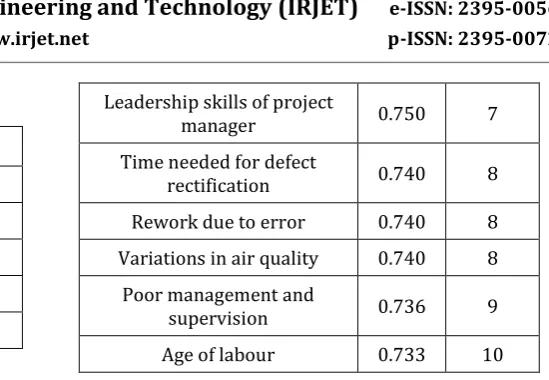
6.3 ANALYSIS BY USING RELATIVE IMPORTANCE INDEX METHOD (RII)
The relative importance index method (RII) is used to determine owners, consultants and contractors perceptions of the relative importance of the key performance factors.
Relative Importance Index Method (RII) = ∑ W/A x N
Where: W is the weight given to each factor by the respondents and ranges from 1to 5,
A = The highest weight = 5
N = The total number of respondents
Performance Factors RII Rank Rate of reportable accidents 0.820 1
Project overtime cost 0.800 2 Changes in noise level 0.793 2
Material waste 0.786 3
Lack of co-ordination between management and
labour 0.776 4
Lack of experienced labour 0.770 5 Uses of low quality materials
and equipments 0.770 5
Complexity of project 0.766 6 Unexpected accident 0.750 7
Leadership skills of project
manager 0.750 7
Time needed for defect
rectification 0.740 8
Rework due to error 0.740 8 Variations in air quality 0.740 8
Poor management and
supervision 0.736 9
Age of labour 0.733 10
7. CONCLUSION
A questionnaire-based survey was conducted from owners, site engineer and contractors from various companies through direct survey from that,60 response were collected and analyzed by using SPSS, based on the results the factors are ranked as Rate of reportable accidents, Project overtime cost, Material waste, Lack of co-ordination between management and labour, Uses of low quality materials and equipments, Unexpected accident, Complexity of project, Rework due to error , Age of the labour, Poor management and supervision are the major factors which affecting the construction project performance.
8. SUGGESTIONS
The following suggestions are used to improve the performance of construction project and it will be based on the literatures and respondents feedbacks. The suggestions are given up to 3.75 of mean value.
1. Rate of reportable accidents
Maintain proper safety culture
Conducting awareness program
Proper motivation and safety systems should be established for improving the performance of construction projects
2. Project overtime cost
Try to minimize the schedule variation
Try to minimize errors and defects
3. Changes in noise level
Use earplugs during heavy machine operation
© 2019, IRJET | Impact Factor value: 7.211 | ISO 9001:2008 Certified Journal
| Page 242
Shutting down noisy equipment when it is not needed
4. Material waste
Making proper pre- planning for material ordering/purchasing
Try to reduce material usage through optimistic plan and design
Protecting materials from damage on site
5. Lack of co-ordination between management and labour
Making interaction between management and labour through meetings& discussions
To motivate or award best achievers/labours
Try to consider each individuals suggestion and recommendations
6. Lack of experienced labour
Try to provide experienced labour during selection process and work allocation process for a particular work
Provide special training program
7. Uses of low quality materials and equipments
Use standard materials and equipment for all projects (ex. Company name)
To eliminate the low quality materials and equipment through knowledge and tests
8. Complexity of project
Use specialized team and labours for the complex works
Making proper planning before going to start a differed project
9. Unexpected accident
No smoking & drinking while working
Use personal protective equipments
Conducting awareness program
Child labours should not to be allowed
Everyone should properly know how to use the equipment or machines
10. Leadership skills of project manager
A good leader should have the following qualities,
A good communicator
Integrity
Enthusiasm
Empathy
Competence
Ability to delegate tasks
Cool under pressure
Team building skills and
Problem solving skills
8.1 SUGGESTIONS FOR RESPONDENTS
It is recommended that proper and continuous training programs on construction projects performance should be organized to develop human resources in the construction industry. These programs can assist participants' to be more familiar with project management techniques and can update participants' knowledge. Greater applications of health and safety factors are necessary to overcome problems of safety performance and improving the productivity performance of construction projects.
Owners: In order to overcome delay, disputes, and claims, owners/client are advised to facilitate payment to contractors. All professional should participate in sensitive and vital decision-making. Continuous coordination and relationship between project participants are required throughout the project life cycle for solving problems and developing project performance.
Consultants: In order to improve performance and to increase owners' satisfaction consultants should be more interested in design cost by choosing the most economical criteria. In addition, consultants are advised to accelerate and facilitate orders delivered to contractors to obtain better time performance and to minimize disputes and claims.
© 2019, IRJET | Impact Factor value: 7.211 | ISO 9001:2008 Certified Journal
| Page 243
REFERENCES
1. AbuHassan A.B.,(2012),‘Key Factors Contributing to Growth of Construction Companies: A Malaysian Experience’, World Applied Sciences Journal 19 (9): 1295-1304.
2. Adenuga K. and Afolarin O.,(2013), ‘Factors Affecting Quality in the Delivery of Public Housing Projects in Lagos State, Nigeria’, International Journal of Engineering and Technology, Volume 3 No. 3.
3. Adnan E.,Mohamed S., and Abushaban S.,(2009),‘Factors Affecting the Performance of Construction Projects in the Gaza Strip’, Journal of Civil Engineering and Management,15(3): 269–280. 4. Ahmed S. and Kangari R.,(1995),‘Analysis of
Client-Satisfaction Factors in Construction Industry”. 5. Aki Pekuri andHarriH.,(2011),‘Productivity and
Performance Management – Managerial Practices in the Construction Industry’, International Journal of Performance Measurement, Vol. 1, 39-58.
6. AlinaitweH.M., Mwakali J.A., and Hansson B.,(2007), ‘Factors Affecting the Productivity of Building Craftsmen-Studies of Uganda’, Journal of Civil Engineering and Management, XIII(3), 169-176. 7. Alum J. and Lim E. C.,(1995), ‘Construction
productivity: Issues encountered by contractors in Singapore’,International Journal of Project Management, 13(1), 51-58.
8. Arpita G.,(2009), ‘Factors Affecting the Performance of Construction Project’,Project Management Practice ,Vol 15,Issue 3.
BIOGRAPHIES
Ramesh Kumar.S M.E., MISTE, Assistant Professor,
Department of Civil Engineering, Velalar College of Engineering and Technology, Erode.
Arun kumar.S Final Year Student,
Department of Civil Engineering, Velalar College of Engineering and Technology, Erode..
Bhavanesh.T Final Year Student,
Department of Civil Engineering, Velalar College of Engineering and Technology, Erode.
Kavinkumar .V Final Year Student,