warwick.ac.uk/lib-publications
Original citation:Rathelot, Roland and van Rens, Thijs. (2017) Rethinking the skills gap. IZA World of Labor, 2017. 391.
Permanent WRAP URL:
http://wrap.warwick.ac.uk/98557 Copyright and reuse:
The Warwick Research Archive Portal (WRAP) makes this work by researchers of the University of Warwick available open access under the following conditions. Copyright © and all moral rights to the version of the paper presented here belong to the individual author(s) and/or other copyright owners. To the extent reasonable and practicable the material made available in WRAP has been checked for eligibility before being made available.
Copies of full items can be used for personal research or study, educational, or not-for-profit purposes without prior permission or charge. Provided that the authors, title and full
bibliographic details are credited, a hyperlink and/or URL is given for the original metadata page and the content is not changed in any way.
A note on versions:
The version presented here may differ from the published version or, version of record, if you wish to cite this item you are advised to consult the publisher’s version. Please see the ‘permanent WRAP URL’ above for details on accessing the published version and note that access may require a subscription.
Title: Rethinking the Skills Gap
Roland Rathelot and Thijs van Rens
Keywords: skills mismatch, misallocation, productivity, unemployment, wage setting
Teaser:
Better understanding of skills mismatch is essential to finding effective policy options.
Elevator pitch:
Evidence suggests that productivity would be much higher and unemployment much lower if the supply of and demand for skills were better matched. As a result, skills mismatch between workers (supply) and jobs (demand) commands the ongoing attention of policymakers in many countries. Policies intended to address the persistence of skills mismatch focus on the supply side of the issue by emphasizing worker education and training. However, the role of the demand side, i.e. employers’ wage-setting practices, garners comparatively little policy attention.
Source: Adapted from
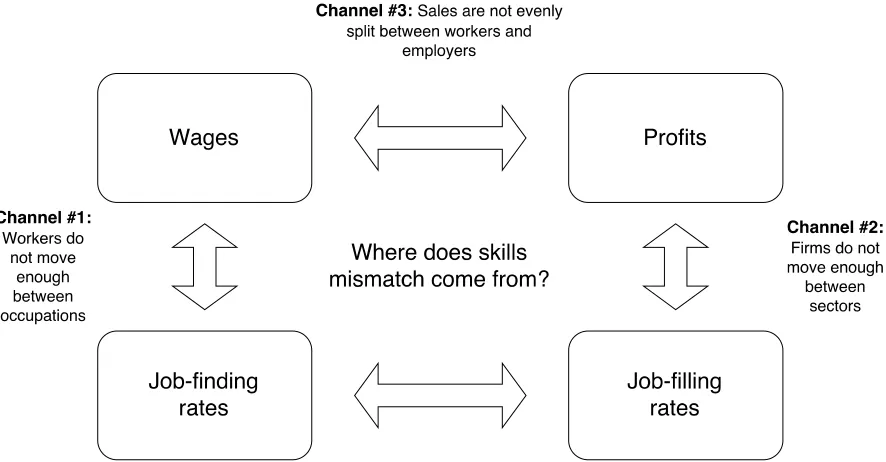
Note: It is often assumed that mismatch results from limited worker mobility (Channel 1). But mismatch can also result from a lack of mobility of firms (Channel 2), or the co-existence of high-wage low-profit and low-wage high-profit labor-market segments (Channel 3.
Pros:
- Analysis shows that 4% of workers are under-skilled, and 10% are over-skilled for their jobs.
- Mismatch is an important determinant of productivity and wages.
- The harmful effect on wages of being mismatched early in one’s is large and persistent.
[image:3.612.89.532.89.320.2]- Joblessness in an economic downturn would affect one-third fewer people if the mismatch problem were resolved.
Figure 1: A decomposition of the potential sources of skills mismatch Source: Adapted from Herz and van Rens (2014)
This then raises the question: If workers adjust to changes in skill demand, and employers adjust to changes in the supply, how can mismatch persist? The answer lies in the way wages are set. If wages reflect the relative abundance or the relative shortage of skilled workers, then workers’ and employers’ capacity to adjust would lead to the elimination of mismatch. However, jobs in industries that generate high profits (retail trade, educational services, mining and forestry) tend to pay low wages, and are therefore unattractive to workers, while jobs in industries that pay higher wages (finance, computer and electronics manufacturing, paper and printing) are not profitable to firms.
Other researchers, based on very different approaches, have emphasized the role of wage setting as well. Among the forces that they suggest may be at work are: automated
Cons:
- Though reliable estimates show that skills mismatch negatively affects individual workers’ productivity, estimates about the effect on aggregate productivity remain largely speculative.
- Estimates of the effect of skills mismatch on unemployment suffer from serious measurement issues.
- Recent literature indicates that a focus on education and training to boost worker skills may be misguided; rather, firms’ actions (e.g. failure to adjust wages to reflect relative skill shortages) may be a key determinant of skill mismatch.
- Evidence from the US shows that geographic mismatch has a negligible effect on unemployment and productivity
Authors’ main message:
Skills mismatch has large effects on productivity and unemployment, it is therefore an
important concern to economic policymakers. Almost all proposed policy interventions suggest reforms of education and training as solutions to perceived shortages of skills, while little attention is paid to wage setting. This is problematic because such reforms, which are often expensive, will be ineffective if wages do not reflect relative skill shortages. In this case, if mismatch instead reflects an unresponsiveness of wages, then workers will “sell” their skills where they fetch the best price, rather than where they are most needed.
Motivation
The idea that the labor market suffers from severe imbalances in terms of skills offered by workers and those required by employers is a pervasive one. Skills mismatch is viewed as a structural issue – that is, an issue that is present whether the economy is in good shape or in crisis. However, its salience re-emerges during recessions. During the recent Great Recession, for example, questions arose about whether increased mismatch was the reason that
Three possible reasons could explain why a skills gap persists: workers do not adjust to changes in skills demand by acquiring the new skills needed to find a job; firms do not adjust to changes in skills supply by creating jobs that utilize the skills available in the labor market; or, wages do not reflect skills shortages by creating incentives for workers to acquire scarce skills, or to abandon other occupations.
An important component of the EU’s strategic framework for education policy, for example, aims “to better identify and manage the availability of required skills, competences, and qualifications, and to help prevent skills gaps and mismatches.” European countries and other advanced economies worry about the “growing gulf between the skills workers possess today and the skills businesses say they need,” as stressed in the 2014 report of the European Intelligence Unit. Concerns often focus on shortages of workers with skills in the science, technology, engineering, and maths (STEM) subjects, but, increasingly, concerns also extend to “soft skills,” such as communications, team work, and problem solving.
At the same time, many academic economists remain unconvinced of the existence of a skills gap. Accustomed to the idea of the “invisible hand” equating supply and demand, they are naturally skeptical about the idea that large segments of the labor market would persistently be in disequilibrium; that is, they find it hard to believe that employers would not be able to convince workers who have, or could acquire, needed skills to work for them, perhaps in return for a higher wage than they might earn elsewhere.
Discussion of pros and cons
Recently, researchers have begun to examine issues related to skills mismatch in greater detail and in new ways. The availability of large datasets containing information about workers and firms has made it possible to gauge the effect of skills mismatch on workers’ productivity and aggregate unemployment. The literature has also started to explore the causes of mismatch, suggesting policies that may or may not be effective in addressing the issue.
Workers and jobs: Skills mismatch and productivity
The most immediate problem associated with mismatch concerns its effect on productivity. The literature studying this effect looks at existing matches of workers and jobs and tries to
have the right types of skills, but too much or not enough. Think of, in the over-skilled category, a linguist teaching Spanish class, or, in the under-skilled one, a mechanic working as an
engineer. Horizontal mismatch (also called field-of-study mismatch) occurs when workers do not have the type of skills required by the job, but they have other skills at a similar level – such as a biology teacher taking over physics classes in a school that does not manage to recruit a physics teacher.
The early literature on mismatch used self-reported data generated from workers’ responses to questions about whether they felt under- or over-qualified for the job. A limitation of the approach is that self-reported questions capture workers’ under- or over-confidence at the same time as potential mismatch. Beginning in 2011, the OECD’s Programme for the
International Assessment of Adult Competencies (PIAAC) began its Survey of Adult Skills, an assessment designed to provide representative data on workers’ skills. The survey delivered an innovation by producing data involving skill proficiencies that are assessed, rather than self-declared. Thus far, the data include skill measurements of 250,000 individuals in 33 countries.
The official OECD measure was introduced by a group of researchers in 2013 [1]. The approach combines declarative measures of job qualification with objective measures of skill proficiency. For each occupation and country included in the PIAAC data, the authors determine a range of skill proficiencies based on the minimum and maximum proficiencies of workers who have defined themselves as being well-matched to their positions. A worker is defined as over-skilled if her skill proficiency is higher than this maximum. Under-skilled status is similarly defined. The authors find that 86% of workers are well-matched, 4% are under-skilled, and 10% are over-skilled. Another study using PIAAC data shows that there is a negative correlation between this measure of mismatch and labor productivity at the industry level: industries where there are more under-qualified or over-skilled workers exhibit lower levels of labor productivity [2].
Two papers offer evidence beyond developed countries. The first provides a review of worldwide mismatch research [3]. It finds that over-education affects 30% of workers, and under-education affects 26% of workers, with some variation surfacing across continents. The second study applies the OECD method to measure mismatch in developing countries, using the World Bank’s STEP Household Skills Survey. They find that over-education is the most prevalent form of mismatch.
mismatched early in one’s career harms a worker’s wages in a large and persistent manner.
Quantifying the effect of the overall level of labor market mismatch is much more difficult than measuring the effect of being mismatched on the productivity of individual workers. For
example, given the skills workers have and the skills jobs require at some point in time, how much would production increase if it were possible to reallocate mismatched workers to different jobs where their skills are better matched to the requirements, so that production could be maximized? Answering this question convincingly is difficult because it requires assumptions about the functions that link production inputs to output. Considering both labor and physical capital, very large effects are shown from misallocation across firms [5]. The
analysis claims that mismatch is responsible for a productivity gap of 40-60% between India and the US, and 30-50% between China and the US. These results show that the mismatch of
production inputs (labor and capital) is a substantial source of inefficiencies and a large contributor to the differences between developing and developed countries.
Job seekers and vacancies: Skills mismatch and unemployment
If the skills that firms require, and the skills that workers possess are sufficiently far apart, then at least some workers will not be hired. Therefore, skills mismatch generates not only a
productivity loss, but unemployment as well. Unemployment carries with it huge economic and personal costs. Hence, understanding the effect of skills mismatch on unemployment is
important for crafting effective policy.
Labor market mismatch generates unemployment if the unemployed workers looking for jobs, and firms with vacant positions looking for workers, cannot form a match because the worker and vacancies are “not right” for each other. This idea can be formalized by modeling the labor market as being divided into segments, with workers (and vacancies) unable to move from one labor market segment to another. If there are deviations between the distributions of workers and jobs among the various segments of the labor market, then some workers will remain unemployed, while, at the same time, some firms will not be able to fill all positions.
If unemployment is caused by mismatch, then there is a tight link between the dispersion in labor market conditions across labor market segments and the aggregate unemployment rate. The idea is that, if there are jobs in occupations with certain skill sets while unemployed
unemployment. The challenge is to measure how much lower the unemployment rate would be if – hypothetically, of course – it were possible to reallocate unemployed workers to those occupations where they are most likely to find jobs.
Despite severe measurement issues (see section on limitations and gaps below), there is a remarkable amount of consensus in the literature on some basic facts about unemployment due to labor market mismatch. This literature consensus can be summarized around three main findings:
Geographic mismatch is negligibly small.
A study from 2014 finds that mismatch across US counties and Metropolitan Statistical Areas contributed less than half a percentage point to unemployment - and that this contribution did not go up notably in the Great Recession [6]. They thus conclude that “geographic mismatch plays no apparent role [for the unemployment rate].” This finding is confirmed in a subsequent analysis, which accounts for the fact that workers are not stuck in their counties or states; they look for jobs not only where they live but also in surrounding areas [7]. This is also consistent with evidence showing that geographic (inter-state) mobility did not decrease during the Great Recession. Therefore, mismatch is unlikely to have contributed much to the very large increase in unemployment during this recession.
A recent study investigates this phenomenon in greater detail by measuring the impact of local fiscal policy and transport improvements on neighboring areas to assesses “how local” a given labor market is [8]. Specifically, the authors investigate how far a local stimulus propagates thanks to worker mobility. They estimate the extent to which job seekers tend to apply for further-away jobs by combining data on flows into and out of unemployment in England and Wales at the Census-ward level, and a structural model of job searching and matching. Overall, they find little mobility and modest ripple effects of local policies.
Another recent study applies a similar approach to measure mismatch in the US [9]. Instead of specifying ad hoc the level of analysis (states might be too coarse and ZIP Codes too fine), the researchers allow job seekers to apply everywhere, with different probabilities. They use data from the website CareerBuilder.com to observe the locations (at the ZIP Code level) of job seekers, vacancies, and applications. They estimate a measure of “distaste for distance,” which captures the reluctance of job seekers to apply for far-away vacancies. They inject this
vacancy. They find that 10 more miles decreases the probability of applying for a job by around 35%. This information is then used to predict how many matches will result from a given allocation of job seekers across ZIP Codes, and the authors draw conclusions about the gulf between a “perfect” situation – one that would maximize the number of hires – and the situation that occurs when taking into account these geographical and competitive realities. They find the share of unemployment that is due to geographic mismatch is only around 5%. In other words, reassigning workers over space to maximize hiring would only increase the
number of hires by only 5%.
Skills mismatch, as measured by mismatch across occupations or industries, is an important contributor to unemployment.
Using Standard Occupational Codes (SOC) to categorize the nature of certain kinds of work, a 2014 study finds that increased mismatch across three-digit occupations accounted for around 1.5 percentage points (or about one-third) of the increase in unemployment in the US during the Great Recession [6]. Related research shows similar results for the US and the UK.
Background Information Box: Understanding Standard Occupational Codes
The Standard Occupational Classification (SOC) System is a US government system of classifying occupations. Two-digit level separates 23 occupations, Three-digit level 97 occupations, five-digit 460 occupations and six-five-digit 840 occupations. For instance, 25-0000 stand for Education occupations, 25-1000 for post-secondary teachers, 25-1050 for Physical Science teachers in the post-secondary, and 25-1052 for Chemistry teachers in the post-secondary.
Skills mismatch is countercyclical; that is, it is not a new phenomenon, but a recurrent problem that surfaces in recessions.
The causes of skills mismatch and how to address them
Unexpected events or phenomena may affect occupations in different ways. For instance, a 2003 study illustrates that the emergence of computers and information technologies (IT) reduced the demand for routine jobs, which were to some degree made obsolete by computers, and increased the demand for non-routine jobs, which proved to be relatively complementary to the computer [11]. For example, bank tellers and bank managers have likely been affected in opposite ways by the IT revolution in general, and by automated teller
machines (ATMs) in particular. Like technological changes, recessions also change the relative demand of different goods. Sectoral shocks may translate into asymmetric occupational shocks; for example, bakers may be less sensitive to recessions due to the relative inelasticity of baked goods, while the jobs of restaurant waiters may be more sensitive because people eat out less during hard times. Because of these shocks, the fact that mismatch exists is not in itself
surprising. The relevant question is: why does it seem to be so persistent?
Workers who work (or look for a job) in an occupation where the number of workers exceeds the number of positions have ways to adjust. They can apply to other higher- demand
occupations that require similar skills, or they can acquire new skills through training.
Alternatively, employers could adjust to workforce shortages by changing the skill content of occupations, or by training up workers from similar occupations to fit new skill requirements. Some recent empirical literature documents that employers adjust the task and skill content of jobs (for the same occupation) with the business cycle, “upskilling” when workers are more abundant in a recession [12]).
Adjustment, whether by workers or employers, may be difficult and costly to achieve in the short run, especially when confronting large skill differences between origin and target occupations. Most policy interventions are based on the implicit assumption that this is the reason for the skills gap. The European Commission, for instance, believes that “Europe needs a radical rethink on how education and training systems can deliver the skills needed by the labor market.” As a result, it set up the Rethinking Education initiative “to reform education systems across the EU so as to meet growing demand for higher skills levels and reduce
unemployment.”
hard time finding jobs, but where they earn high wages if they do; and there are other
industries where jobs are plentiful, but wages are low. This is what one would expect to see if workers operate along a “no arbitrage” condition. That is, they can move between industries, but will only do so if they are given the right incentives. If, on the other hand, there are many industries where both job-finding rates and wages are high, and others where both are low, the logical conclusion would be that mismatch persists because workers lack the skills required to move into better jobs. Using data for the US over the 1979-2010 period, the study finds that mismatch cannot be fully explained by barriers faced by workers and firms in adjusting to changing skill demand and supply, respectively.
This then raises the question: If workers adjust to changes in skill demand, and employers adjust to changes in supply, how can mismatch persist? The answer lies in the way how wages are set. If wages reflect the relative abundance or the relative shortage of skilled workers, then workers’ and employers’ capacity to adjust would lead to the elimination of mismatch.
However, jobs in industries that generate high profits (such as retail trade, educational services, mining, and forestry) tend to pay low wages, and are therefore unattractive to workers, while jobs in industries that pay higher wages (like finance, computer and electronics manufacturing, paper and printing) are not profitable to firms. The illustration on page 1 provides a visual overview of the various channels through which mismatch can occur in the labor market.
Limitations and gaps
While the literature has progressed in the last decade when it comes to measuring the extent of mismatch and how it affects unemployment and productivity, many measurement related issues still raise concerns. Potentially, these issues are large enough to affect the qualitative conclusions drawn in this article.
The concept of skills is multi-dimensional, including the amount and quality of education, field of study, and experience in current and previous jobs. Additionally, there are many sorts of skills: technical skills, cognitive skills, soft skills such as communications, problem solving, the ability to work well in teams, and perhaps even having certain personality traits. Moreover, the extent to which skills are transferable varies. Some skills are general; others are entirely job specific. An ideal dataset would account for this broad range of factors and detail the precise set of skill requirements for the job, as well as the precise skill set of the worker. However, most data sources, particularly the ones that cover a representative sample of the labor force, rely on responses to just a few questions that generate a description of a worker’s skill set. A related issue stems from the difficulty in gathering symmetric information about workers’ skill sets and jobs’ skill requirements.
The studies described in this article differ in the ways they address this measurement issue. As a result, it is difficult to pinpoint a “consensus estimate” of the effect of skills mismatch on productivity. The measurement problem is made even more difficult if one tries to estimate the effect of overall mismatch on aggregate productivity, rather than just the effect of being
mismatched on an individual worker’s productivity. Moreover, a substantial amount of uncertainty shrouds the few results discussed here.
In the literature on mismatch and unemployment, the measurement issue takes a different form. Here, researchers think of the labor market as being segmented into submarkets, and the primary difficulty with measuring the effects of mismatch lies in finding the correct partitioning of the labor market. Ideally, the partition satisfies two properties. First, submarkets must be closed: No job seeker should end up finding a vacancy in a different submarket than her own. This means that the empirical definition of a submarket should be coarse enough to
the labor market? This question first arose in the literature on geographic mismatch, where the submarkets are geographic areas. As discussed previously, accounting for the interconnection between geographic areas is crucial to correctly estimating the aggregate effect of mismatch.
Measuring skills mismatch suffers from the same dilemma as geographic mismatch in terms of the difficulty in defining sensible submarkets. The SOC, although a detailed and systematic categorization of the nature of different kinds of work, is an imperfect vessel for this analysis. For instance, one might surmise that workers in the same four-digit occupation codes can move to and from the same positions with relative ease. But, should this be taken to mean that former post-secondary English teachers can fill post-secondary physics teachers’ positions? By contrast, workers slotted into different two-digit occupation codes might seem “unmovable.” Yet, could tax examiners and tax preparers logically segue to and from positions in their
differently coded jobs? Ideally, a measure of skills mismatch should account for the fact that job seekers move, to some extent, across occupations.
An impressive dataset created recently by the US Department of Labor may help alleviate some of the above issues. It is called O*NET OnLine, and provides a detailed mapping between six-digit SOC occupations and the usual tasks and skill requirements associated with jobs in this occupation. A 2013 study motivates this effort by showing that tasks explain a substantial amount of wage heterogeneity within occupations [14]. However, research using these data is just beginning.
Most studies on mismatch use three- or four-digit occupations, or even industries, to
operationalize the concept of a skill-based labor market segment. The results of these studies are likely to be revisited, and may very well be overthrown as researchers find ways to use the opportunities provided by the O*Net data.
online job vacancies in the US; these are collated into counts of vacancies by occupations. These two sources (JOLTS/HWOL) provide the most straightforward measure of the vacancy-unemployment ratio across industries and occupations. Many papers use these sources at the price of working on a relatively short time window [6], [8]. Other papers have to rely on
assumptions about the matching technology to compute the vacancy-unemployment ratio from the job- finding probabilities measured in the CPS [9]. This technique results in a much longer time series. Luckily, findings look very similar in research relying on these different sources, lending additional credibility to the results.
Finally, when it comes to the causes of mismatch, the evidence is very thin indeed. It should be expected that the thinking on this issue will progress substantially as further research sheds light onto the mechanisms and trade-offs behind wage determination.
Summary and policy advice
Skills mismatch is an important cause of productivity loss and unemployment. Thus,
policymaking tools that diminish its presence and persistence can benefit economies, firms, and people who are unemployed or underemployed.
However, in the context of the European Commission’s proposed “radical rethink on how education and training systems can deliver the skills needed by the labor market,” a reform of education and training systems may be neither needed nor desired. The most striking
conclusion from current research is that worker mobility frictions may not be the main
contributor to labor market mismatch. Yet, almost all proposed solutions to the skills gap treat the phenomenon as a problem of the education system. Such interventions in education and training are likely to be expensive, and, at the same time, may not be as effective as expected.
Why would increasing the emphasis on “scarce” skills in schools and universities fail to
problem if these graduates look for – and find – better-paying jobs with investment banks.
These questions underline the need for additional research to understand the forces that foster and perpetuate mismatch. While the message from the current research should not be
interpreted as a call to “do nothing,” greater knowledge is needed to guide policymakers in devising effective solutions.
Acknowledgements
The author thanks an anonymous referee and the IZA World of Labor editors for many helpful suggestions on earlier drafts. Previous work of the authors contains a larger number of
background references for the material presented here and has been used intensively in all major parts of this article [x].
Competing Interests
The IZA World of Labor project is committed to the IZA Guiding Principles of Research Integrity. The authors declare to have observed these principles.
References
Further reading:
Herz, Benedikt and Thijs van Rens (2015), “Accounting for Mismatch Unemployment,” The Warwick Economics Research Paper Series (TWERPS) 1061.
Key references:
[1] Fichen, Anne and Michele Pellizzari (2017), “A New Measure of Skills Mismatch: Theory and Evidence from the Survey of Adult Skills (PIAAC),” IZA Journal of Labour Economics,
forthcoming.
[2] Adalet McGowan, Müge and Dan Andrews (2015), “Labour Market Mismatch and Labour Productivity: Evidence from PIAAC Data,” OECD Economics Department Working Paper 1209.
326. Philadelphia: Elsevier Science.
[4] Guvenen, Fatih, Burhan Kuruscu, Satoshi Tanaka, and David Wiczer (2015), “Multidimensional Skill Mismatch,” mimeo University of Minnesota.
[5] Hsieh, Chang-Tai and Peter J. Klenow (2009), “Misallocation and Manufacturing TFP in China and India,” Quarterly Journal of Economics, 124(4), 1403-1448.
[6] Şahin, Ayşegül, Joseph Song, Giorgio Topa, and Giovanni L. Violante (2014), “Mismatch Unemployment,” American Economic Review, 104 (11): 3529-64.
[7] Marinescu, Ioana and Roland Rathelot (2017), “Mismatch Unemployment and the Geography of Job Search,” American Economic Journal: Macroeconomics (forthcoming).
[8] Manning, Alan and Barbara Petrongolo (2017), “How Local are Labour Markets? Evidence from a Spatial Job Search Model,” American Economic Review (forthcoming).
[9]
[10] Kocherlakota, Narayana (2010), “Inside the FOMC,” Speech in Marquette, MI, on August 17, as president of the U.S. Federal Reserve Bank of Minneapolis.
[11] Autor, David and Levy, Frank and Richard Murnane (2003), “The Skill Content of Recent Technological Change: An Empirical Exploration,” Quarterly Journal of Economics, 118(4), 1279-1333.
[12] Hershbein, Brad and Lisa Kahn (2016), “Do Recessions Accelerate Routine-Biased Technological Change? Evidence from Vacancy Postings,” NBER Working Paper, No. 22762.
[13] Cappelli, Peter (2012), “Why Good People Can’t Get Jobs: The Skills Gap and What Companies Can Do About It,” Wharton Digital Press.
[14] Autor, David and Michael Handel (2013), “Putting Tasks to the Test: Human Capital, Job Tasks and Wages,” Journal of Labor Economics, 31(2), S59-S96.
Additional References:
Altonji, Joseph G., Peter Arcidiacono and Arnaud Maurel (2016), “The Analysis of Field Choice in College and Graduate School: Determinants and Wage Effects,” In Handbook of the Economics of Education, vol. 5, edited by Eric A. Hanushek, Stephen Machin and Ludger Woessmann. Amsterdam : North Holland, 305-396.
Barnichon, Regis and Andrew Figura (2015), “Labor Market Heterogeneity and the Aggregate Matching Function,” American Economic Journal: Macroeconomics, 7 (4): 222- 249.
Chevalier, Arnaud (2017), “To Be or Not to Be a Scientist,” in Solomon W. Polachek,
Konstantinos Pouliakas , Giovanni Russo , Konstantinos Tatsiramos (ed.) Skill Mismatch in Labor Markets (Research in Labor Economics, Volume 45) Emerald Publishing Limited, pp.1-39
Deming, David and Lisa B. Kahn (2017), “Skill Requirements across Firms and Labor Markets: Evidence from Job Postings for Professionals,” Journal of Labor Economics, forthcoming.
Desjardins, Richard and Kjell Rubenson (2011), “An Analysis of Skill Mismatch Using Direct Measures of Skills,” OECD Education Working Papers, No. 63.
Diamond, Peter (2011), “Unemployment, Vacancies, Wages,” American Economic Review 101 (4), 1045-72.
Elsby, Michael W. L., Bart Hobijn, and Ayşegül Şahin (2010), “The Labour Market in the Great Recession,” Brookings Papers on Economic Activity, 41 (1), 1-69.
Economist Intelligence Unit (2014), “Closing the Skills Gap: Companies and Colleges Collaborating for Change,” The Economist Insights report.
Economist Intelligence Unit (2015), “Driving the Skills Agenda: Preparing Students for the Future,” The Economist Insights report.
Handel, Michael (2003), “Skills Mismatch in the Labor Market,” Annual Review of Sociology, 29, 135-165.
Handel, Michael, Alexandria Valerio, and Maria Laura Sanchez Puerta (2016), “Accounting for Mismatch in Low- and Middle-Income Countries: Measurement, Magnitudes, and
Explanations,” World Bank Group.
Lazear, Edward P. and James R. Spletzer (2012), “The United States labor market: status quo or a new normal?”, Proceedings - Economic Policy Symposium - Jackson Hole: 405-451.
Montt, Guillermo (2015), “The causes and consequences of field-of-study mismatch: An analysis using PIAAC,” OECD Social, Employment and Migration Working Papers, No. 167.
Patterson, Christina, Ayşegül Şahin, Giorgio Topa and Gianluca Violante (2016), “Working Hard in the Wrong Place: A Mismatch-Based Explanation to the UK Productivity Puzzle,” European Economic Review, 84(C), 42-56.