© 2019, IRJET | Impact Factor value: 7.211 | ISO 9001:2008 Certified Journal | Page 6691
SOFTWARE SENSOR FOR POTABLE WATER QUALITY THROUGH
QUALITATIVE AND QUANTITATIVE ANALYSIS USING INTERNET OF
THINGS (IoT)
R. Tharini
1,P. Subhashini
2, S. Saranya
3, T. Umagayathry
4, N. Pritha
51,2,3,4
UG Scholar, Department of ECE, Panimalar Engineering College, Chennai.
5
Associate Professor, Dept. of ECE, Panimalar Engineering college, Chennai, Tamilnadu, India.
---***---Abstract
- One of the most important substances on earth is Water. Now days, people always want something that can make their life smarter and uncomplicated. This paper is used to define water monitoring systems such as Tank and well water level monitoring, observing, water pollution monitoring. An advanced intelligent system embedded with controllers, sensors and actuators is used here to enable systematic and well-planned use of water, emergency response and environmental guarantee. The enormous amount of water is being wasted by unmanageable use of large buildings/offices is circumvented by using wireless sensor technology. The PIC microcontroller-based Water level monitoring is used to point out the level of water in the tank to the user. Sensor Based Water Pollution Detection, it will examine the water quality by using these parameters such as the pH level, Gas are measured in real time by the sensors and it will be supervised by a user.Key Words:Internet of Things (IoT), pollution free, Sensors, Water quality, Webpage
1. INTRODUCTION
For the purpose of keeping planet healthy and comfortable, Water quality monitoring system plays a significant role. Many communicable diseases are water bone such as Amoebiasis. The garbage dumped by the individuals and the release of harmful chemicals from manufacturing/production industries deteriorate most of the fresh water resources located near urban areas.
Chart -1: Water pollution in various countries.
© 2019, IRJET | Impact Factor value: 7.211 | ISO 9001:2008 Certified Journal | Page 6692
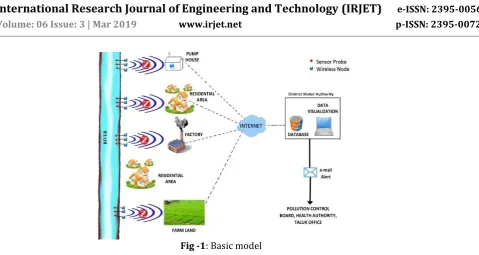
Fig -1: Basic modelWireless Sensor Nodes provide remarkable advantages in distributed intelligence and it is also cost effective. On the other hand, insertion and maintenance expenses are minimized as it does not need any wiring. Wireless sensor network for a water quality monitoring includes a coordinator and many sensor nodes with networking capability. These are positioned at various overhead tanks in an area. A sensor node consists of a microcontroller (PIC), a wireless network connection module and water quality monitoring sensors that are capable of continuously measure the water quality parameters such as pH using pH sensor and gas using gas sensor continuously. The measured data is sent to the base station or data center where the data is logged into central server. For future correspondence, the recorded data can be analyzed using various simulation tools and actions can be taken to evaluate the reliability, feasibility and effectiveness of the proposed monitoring system.
2. EXISTING SYSTEM
Water is a limited resource and is important for agriculture, industry and for creature’s existence on earth including human beings. Nowadays Enormous amount of water is being wasted by many people in uncontrolled ways. The reason behind this problem is quietly related to poor water allotment, inefficacious use of water, and lack of ample and integrated water management. Therefore, efficient use and water monitoring are potential restrictions for home or office water management system. The existing system requires a government on duty staff for regularly monitoring the quality of water, tank maintenance and water level of the storage tank. Therefore, use of man power, time consumption is the major disadvantages of the existing system.
[image:2.595.76.556.47.302.2] [image:2.595.131.467.535.732.2]© 2019, IRJET | Impact Factor value: 7.211 | ISO 9001:2008 Certified Journal | Page 6693
3. PROPOSED SYSTEM
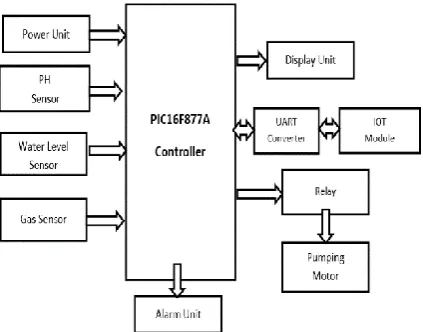
Water pollution monitoring system can help with water pollution identification, ejection of toxic chemicals and contamination in fresh water sources and storage tanks. The quality of water can be checked using several parameters such as gas and pH. The aim of this project is to design and develop a Wireless Sensor Network (WSN) with an IoT Module that helps to monitor the quality of water without the assistance of man power. This system can be achieved with the help of information sensed by the sensors, which are collectively processed by a microcontroller (PIC-16F877A) and the sensed data is displayed in a display device (LCD). The processed information is then transferred to another controller (PIC16F1526) with GSM Module through UART cable. The asynchronous serial communication in which the data format and transmission speeds are configurable is done by using a computer hardware device known as UART (Universal Asynchronous Receiver Transmitter). With the help of GSM module, the measured values reach the IOT networks and base station is interfaced to internet so that users can login and get the real time water quality data.
Fig -3: proposed system
3.1 INPUT MODULE
The input module comprises of three sensors namely water level sensor (Quantitative analysis of water), gas sensor and pH sensor (Qualitative analysis of water). The power supply is provided by the power unit that consists of a transformer, rectifier and a regulator. The sensed values are displayed in an LCD Display which has 16*2 displays.
3.2 PROCESSING MODULE
Fig -4: Block Diagram of proposed system
[image:3.595.189.405.253.420.2] [image:3.595.192.404.516.682.2]© 2019, IRJET | Impact Factor value: 7.211 | ISO 9001:2008 Certified Journal | Page 6694
3.3 IoT MODULE
The IoT module consists of two LEDs, one represents power supply and other represents the tower signal. After inserting the analog SIM, the tower signal is achieved, which is indicated by the LED blinks for every 3 to 4 seconds, when the internet has been activated the LED blinks even faster than the former one. To convert the data UART cable is been used. Here the cable pushes the data to the cloud server.
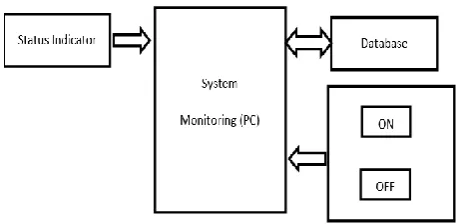
Fig -5: Block Diagram of IoT Module
Initially two logs should be created in the server page. One for controlling the motor and the other log for observing the data. When the level sensor detects the water level in the overhead tank is below the prescribed limit then the notification of this will be viewed through the webpage. The user can switch on the pumping motor and switch it off when the threshold level is reached by using the webpage. The gas sensor and pH sensor detect the chemical composition of water. The values are updated in the webpage for every 3 seconds. The updated values can be recorded in the webpage by the user for healthy maintenance of the water sources.
3.4 PROPOSED SYSTEM ADVANTAGE
Non-requirement of on duty staff Easy to implement, Communication is better Accessible, flexible, low cost.
Network problems are greatly minimized.
4. LITERATURE REVIEW
Nikhil Kedia baptized “Water Quality Monitoring for Rural Areas-A Sensor Cloud Based Economical Project”. It was put out in 1st International Conference on Next Generation Computing Technologies (NGCT-2015) Dehradun, India, in 2015.Theentire water quality monitoring methods, sensors, embedded design, and information dissipation procedure, role of government, network operator and villagers in ensuring proper information dissipation was featured in this paper. The Sensor Cloud domain is also traversed. Water quality and awareness among people can be improved by efficient use of technology and economic practices. [1]
[image:4.595.178.409.194.306.2]© 2019, IRJET | Impact Factor value: 7.211 | ISO 9001:2008 Certified Journal | Page 6695
Jayti Bhatt, Jignesh Patoliya baptized “Real Time Water Quality Monitoring System”. The safe supply of drinking water is achieved by monitoring the quality in real time for that purpose new approach IOT (Internet of Things) based water quality monitoring has been proposed by them. We present the design of IOT based water quality monitoring system that monitor the quality of water in real time, in this paper. The water quality parameter such as pH, turbidity, conductivity, dissolved oxygen, temperature was measured by some sensors, which this system consists in it. The measured values from the sensors are processed by microcontroller. Using Zigbee protocol, the processed values are transmitted remotely to the core controller that is raspberry pi. Finally, using cloud computing, sensors data can be viewed on internet browser application. [3]Sokratis Kartakis, Weiren Yu, Reza Akhavan, and Julie A. McCann authorized “Adaptive Edge Analytics for Distributed Networked Control of Water Systems”. This paper represents the burst detection and localization scheme that incorporates lightweight compression and anomaly recognition with graph topology analytics for water administration networks. We show that our approach not only notably decreases the amount of communications between sensor devices and the back-end servers, but also can successively confine water burst events by using the difference in the advent times of the vibration variations sensed at sensor locations. Our outcomes can save up to 90% communications set side by side with orthodox periodical reporting situations.[4]
Zhanwei Sun, Chi Harold Li, Chatschik Bisdikian, Joel Branch and Bo Yang authorized “QOI-Aware Energy Management in Internet-of-Things Sensory Environments”. In this paper a methodical energy management frame work to provide sufficient QOI experience in IOT sensory environments is studied. Contradictory to past efforts, it is transparent and suitable to lower protocols in use, and conserving energy-efficiency in the long run without forfeiting any attained QOI levels. Particularly, the fresh concept of QOI-aware “sensor-to-task relevancy” to explicitly examine the sensing capabilities provided by a sensor to the IOT sensory environments, and QOI demands required by a task. A novel idea of the “critical covering set” of any given task in choosing the sensors to service a task over time. Energy administration decision is made dynamically at runtime, as the ideal for long-term traffic statistics under the constraint of the service detain. Finally, a boundless case study based on utilizing the sensor networks to execute water level monitoring is given to display the ideas and algorithms suggested in this paper, and a simulation is made to illustrate the performance of the proposed algorithms. [5]
5. HARDWARE REQUIREMENTS
5.1 PIC MICROCONTROLLER (PIC16F877A)
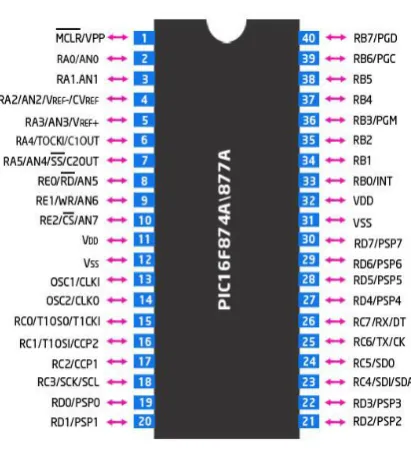
Fig -6: PIC16F877A
[image:5.595.194.400.455.691.2]© 2019, IRJET | Impact Factor value: 7.211 | ISO 9001:2008 Certified Journal | Page 6696
The PIC Microcontroller is a 40 pin IC which has an in-build ADC (Analog to Digital Convertor) and internal UART. It has separate busses for program and data memory and thus it is based on Harvard architecture. It is available as both thin film quad package and dual in line package. The 40 pins make it easier to use the peripherals as the functions are spread out over the pins. One of the main advantages is that each pin is only shared between two or three functions so it’s easier todecide what the pin function.
The PIC is derived from PIC1650 which is been originally developed by General Instrument's Microelectronics Division. The name PIC initially meant as Peripheral Interface Controller, then later it is corrected as Programmable Intelligent Computer. It is a family of microcontrollers which performs wide variety of embedded application.
5.2 UART CABLE
USB UART Cable, generally called USB Serial port cable is a very common debugging tool in embedded system software development. The tool can direct a serial aid to your PC and can control commands through it. UART stands for Universal Asynchronous Receiver Transmitter is usually an individual integrated circuit generally used in computer or peripheral device serial port for serial communication.
Serial communication refers to the process of sending data one bit at a time over computer bus. The external signals used between various items of equipment usually does not directly generated or received by UART. The communication may be simplex, full duplex or half duplex. Applications of UART includes Embedded system distributed with UART and low-cost home computer. Generally, the UART chip can be omitted, conserving money and space which is known as bit banging.
5.3 SENSORS
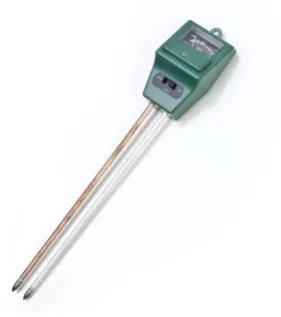
:5.3.1 pH SENSOR
Fig -7: pH SENSOR
[image:6.595.235.376.408.567.2]© 2019, IRJET | Impact Factor value: 7.211 | ISO 9001:2008 Certified Journal | Page 6697
5.3.2 WATER LEVEL SENSOR
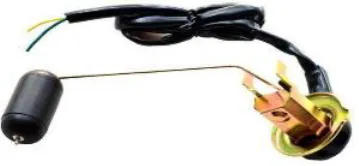
Fig -8: Water Level Sensor
The mensuration of fluid levels is sensed by using level sensor. As its name indicates, they are used to measure the level of free-flowing substances. Such substances symbolize liquids like water, slurries, oil etc. in addition to these solids in powder or granular form are also sensed by a using level sensor. Due to gravity some substance prone to get settled in over head tanks and they remain in rest state. Level sensor measure their level against a threshold reference. It works at 5V voltage which is an analog sensor whose working current is less than 20 mA.
5.3.3 GAS SENSOR
Fig -9: Gas Sensor
The concentration of gas in its vicinity is generally measured or detected by using a gas sensor. They are used in various field ranging from aerospace to medicine. The MQ2 gas sensor is mainly used to detect LPG, methane, butane, alcohol, smoke etc. they are sensitive to burnable and combustible gases. They are highly sensitive with fast response and wide detection range. The MQ2 module is also called as grove gas sensor module. As the concentration of the gas increase the output voltage of the gas sensor will also increase. This is an analog output sensor which operates at 5V. The MQ-2 can detect gas concentrations anywhere from 200 to 10000ppm.liquefied petroleum gas (LPG).
5.4 RELAYS
[image:7.595.210.390.147.230.2] [image:7.595.210.363.370.464.2]© 2019, IRJET | Impact Factor value: 7.211 | ISO 9001:2008 Certified Journal | Page 6698
An electrically operated switch is called as relay. Electromagnet (coil of wire that becomes a temporary magnet when electricity flows through it) is the heart of the relay. When current flows through the coil it turns into an electromagnet. The magnet pushes the switch to the left forcing the spring contacts together, and closing the loop of the circuit they are attached to. Relays act as a kind of electric liver (switch), which can be operated with a tiny current. They bridge the gap, making it possible for the smaller current to activate the larger ones. Therefore, relays operate both as switches (turning things on and off) and amplifiers (converting small currents to large currents). Relays act as the primary protection in most of the control processes and system (circuit breaker). They are classified based upon their functions that include protective, reclosing, regulating, auxiliary and monitoring relays.6. SOFTWARE REQUIREMENTS
[image:8.595.190.407.265.407.2]6.1 MPLAB IDE
Fig -11: MPLAB IDE
A proprietary free ware integrated development environment for the design of embedded systems on PIC and dsPIC microcontrollers developed by microchip technology is MPLAB. The latest edition of MPLAB is MPLABX designed on NetBeans platform. It is a software program that runs on a PC (windows, MacOS, Linux) to develop applications for microchip, microcontrollers. It provides a single integrated environment to create code for embedded microcontrollers, so called as integrated development environment (IDE). It brings out debug experience during the design phase of your project itself. Over 900 different development tools, including an IDE (Integrated Development Environment), compilers, debuggers, programmers and software development boards for specific applications are produced by a microchip. MPLABX IDE environment is engineered to be compatible with all of microchip devices. It act as a user friendly environment for various project ideas. MPLAB software supports 8, 16, 32-bit microcontroller.
6.2 EMBEDDED C
© 2019, IRJET | Impact Factor value: 7.211 | ISO 9001:2008 Certified Journal | Page 6699
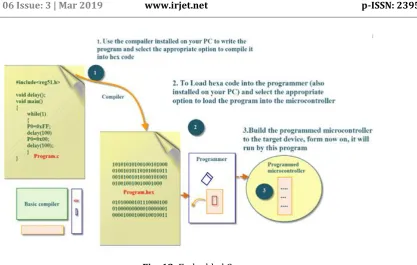
Fig -12: Embedded C7. IoT USING GSM
Global System for Mobile communication (GSM) Technology is a wireless communication module that is used to interact a computer or a processor over the network. The GSM module works based on a variation of TDMA (Time Division Multiple Access) which is most commonly used in wireless telephony technologies like GSM and CDMA. This module requires a sim card to operate through a network range subscribed by the network operators. The convergence of wireless technologies, micro-electromechanical systems (MEMS) and the Internet has produced an evolution resulting in IoT. The module’s UART update feature and webpage control make them perfect for online wireless applications such as biomedical monitoring, environmental sensors, and data from portable battery-operated wireless sensor network devices. GSM has five networks. They are macro, micro, Pico, femto and umbrella cells. Extended coverage GSM IoT is a low power wide area technology. GSM IoT networks will co-exist with conventional cellular networks. It is a high capacity, low range, low energy and low complexity cellular system that support the IoT.
In this proposed system, the IoT module consists of GSM, SIMCON, UART, PIC16F1526 with an LCD display. the data in PIC16F877A has been stored in PIC16F1526 which in IoT module these data's will be permanently stored in EEPROM of SIMCON. The IoT module has two LED's, one for indicating power supply control and the other one will be indicating the internet connection. The data from the IoT module will be transmitted to the cloud via GSM.
© 2019, IRJET | Impact Factor value: 7.211 | ISO 9001:2008 Certified Journal | Page 6700
Initially two logs should be created in the server page. One for controlling the motor and the other log for observing the data. When the level sensor detects the water level in the overhead tank is below the prescribed limit then the notification of this will be viewed through the webpage. The user can switch on the pumping motor and switch it off when the threshold level is reached by using the webpage. The gas sensor and pH sensor detect the chemical composition of water. The values are updated in the webpage for every 3 seconds.8. CONCLUSION AND FUTURE WORK
In this paper an efficient, real time water quality monitoring system based on IOT is presented. Central base station and nodes are connected through IOT networks and base station is interfaced to internet so that users can login and get the real time water quality data. Future works include the using of more efficient routing algorithms to extend the network to wide area. A future work also lies on Integration of turbidity sensor, dissolved oxygen sensor and color sensor to the sensors used in this work.
ACKNOWLEDGEMENT
The research was carried out with the help of Bharath Sanchar Nigam Limited and Panimalar Engineering College.
REFERENCES
[1] Nikhil Kedia (2015). Water quality monitoring for rural areas- a Sensor Cloud based economical project, IEEE 10.1109/NGCT.2015.7375081
[2] Michal lom, ondrej priby & miroslav svitek, Internet 4.0 as a part of smart cities, IEEE, 978-1-5090-1116-2/16/$31.00
©2016
[3] Jayti Bhatt, Jignesh Patoliya, Iot Based Water Quality Monitoring System, IRFIC, 21feb,2016.
[4] Sokratis Kartakis , Weiren Yu , Reza Akhavan , Julie A. McCann , IEEE, 978-1-4673-9948-7,
2016 IEEE First International Conference on Internet-of-Things Design and Implementation (IoTDI),
[5] Zhanwei Sun , Chi Harold Liu , Chatschik Bisdikian , Joel W. Branch , Bo Yang ,IEEE, 10.1109/SECON.2012.6275777,