https://doi.org/10.1007/s11263-019-01271-4
Pixelated Semantic Colorization
Jiaojiao Zhao1·Jungong Han2·Ling Shao3·Cees G. M. Snoek1
Received: 20 January 2019 / Accepted: 25 November 2019 © The Author(s) 2019
Abstract
While many image colorization algorithms have recently shown the capability of producing plausible color versions from gray-scale photographs, they still suffer from limited semantic understanding. To address this shortcoming, we propose to exploit pixelated object semantics to guide image colorization. The rationale is that human beings perceive and distinguish colors based on the semantic categories of objects. Starting from an autoregressive model, we generate image color distributions, from which diverse colored results are sampled. We propose two ways to incorporate object semantics into the colorization model: through a pixelated semantic embedding and a pixelated semantic generator. Specifically, the proposed network includes two branches. One branch learns what the object is, while the other branch learns the object colors. The network jointly optimizes a color embedding loss, a semantic segmentation loss and a color generation loss, in an end-to-end fashion. Experiments on Pascal VOC2012 and COCO-stuff reveal that our network, when trained with semantic segmentation labels, produces more realistic and finer results compared to the colorization state-of-the-art.
Keywords Image colorization·Semantic segmentation·Pixelated semantics
1 Introduction
Color has been at the center stage of computer vision for decades (e.g., Swain and Ballard1991; Comaniciu and Meer 1997; Pérez et al.2002; Khan et al.2009; van de Sande et al. 2010; Lou et al.2015; Vondrick et al.2018). Many vision challenges, including object detection and visual tracking, benefit from color (Khan et al.2009, 2012; Danelljan et al. 2014; Vondrick et al.2018). Consequently, color constancy (Gijsenij et al. 2010) and color correction (Sanchez and Binefa2000) methods may further enhance visual
recog-Communicated by Ling Shao, Hubert P. H. Shum, Timothy Hospedales.
B
Jiaojiao Zhao [email protected]Jungong Han
Ling Shao [email protected]
Cees G. M. Snoek [email protected]
1 Universiteit van Amsterdam, Amsterdam, The Netherlands
2 University of Warwick, Coventry, UK
3 Inception Institute of Artificial Intelligence, Abu Dhabi, UAE
nition. Likewise, color is commonly added to gray-scale images to increase their visual appeal and perceptually enhance their visual content (e.g., Welsh et al.2002; Iizuka et al.2016; Zhang et al.2016; Royer et al.2017; Deshpande et al.2017). This paper is about image colorization.
Human beings excel in assigning colors to gray-scale images since they can easily recognize the objects and have gained knowledge about their colors. No one doubts the sea is typically blue and a dog is never naturally green. Although many objects have diverse colors, which makes their predic-tion quite subjective, humans can get around this by simply applying a bit of creativity. However, it remains a significant challenge for machines to acquire both the world knowledge and “imagination” that humans possess.
(a) (b) without
semantics
with semantics
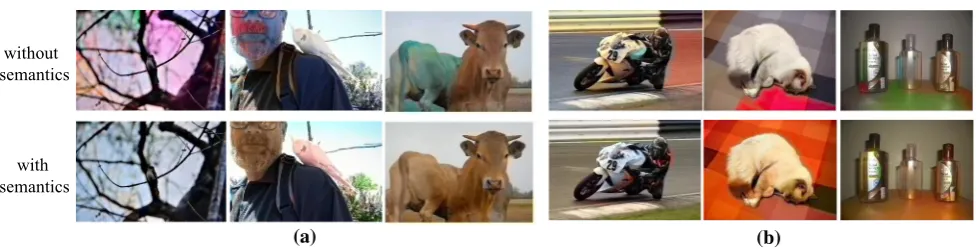
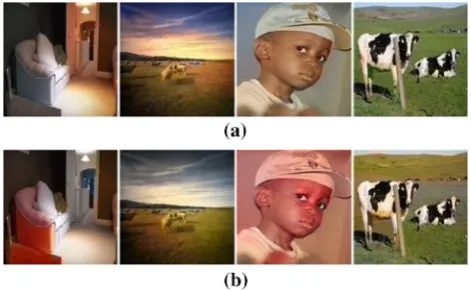
Fig. 1 Colorization without and with semantics generated using the network from this paper. We rescale all output images to their original proportions.aThe method without semantics assigns unreasonable col-ors to objects, such as the colorful sky and the blue cow. The method
with semantics generates realistic colors for the sky (first column), the man (second column) and the cow (third column).bThe method with-out semantics fails to capture long-range pixel interactions (Royer et al. 2017). With semantics, the model performs better
assigned a blue color. The cases in (b) without semantics suffer from color pollution. Our objective is to effectively address both problems to generate better colorized images with high quality.
Both traditional (Chia et al.2011; Ironi et al.2005) and recent colorization solutions (Larsson et al.2016; Iizuka et al. 2016; He et al. 2016; Zhang et al.2016, 2017) have high-lighted the importance of semantics. However, they only explore image-level class semantics for colorization. As stated by Dai et al. (2016), image-level classification favors translation invariance. Obviously, colorization requires rep-resentations that are, to a certain extent, translation-variant. From this perspective, semantic segmentation (Long et al. 2015; Chen et al.2018; Noh et al.2015), which also requires translation-variant representations, provides more reason-able semantic guidance for colorization. It predicts a class label for each pixel. Similarly, according to Zhang et al. (2016) and Larsson et al. (2016), colorization assigns each pixel a color distribution. Both challenges can be viewed as an image-to-image prediction problem and formulated as a pixel-wise prediction task. We show several colorized examples after using pixelated semantic-guidance in Fig.1a, b. Besides providing sharp boundaries which helps to pre-vent color bleeding, the color distributions of specific object types enforce additional constraints, which helps to alleviate the ambiguity in color recovery. Together, the fine-grained semantic information helps to precisely colorize specific objects.
In this paper, we study the relationship between coloriza-tion and semantic segmentacoloriza-tion. Our proposed network is able to be harmoniously trained for semantic segmenta-tion and colorizasegmenta-tion. By using such multi-task learning, we explore how pixelated semantics affects colorization. Dif-fering from the preliminary conference version of this work (Zhao et al.2018), we view colorization here as a sequential pixel-wise color distribution generation task, rather than a
pixel-wise classification task. We design two ways to exploit pixelated semantics for colorization, one by guiding a color embedding function and the other by guiding a color gen-erator. Using these strategies, our methods produce diverse vibrant images on two datasets, Pascal VOC2012 (Evering-ham et al.2015) and COCO-stuff (Caesar et al.2018). We further study how colorization can help semantic segmenta-tion and demonstrate that the two tasks benefit each other. We also propose a new quantitative evaluation method using semantic segmentation accuracy.
The rest of the paper is organized as follows. In Sect.2, we introduce related work. Following, in Sect.3, we describe the details of our colorization network using pixelated semantic guidance. Experiments and results are presented in Sect.4. We conclude our work in Sect.5.
2 Related Work
2.1 Colorization by Reference
[image:2.595.54.544.52.177.2]learning has supplied more automatic methods in Cheng et al. (2015) and He et al. (2018). In our approach, we use a deep network to learn the semantics from data, rather than relying on a reference with similar semantics.
2.2 Colorization by Scribble
Another interactive way to colorize a gray-scale image is by placing scribbles. This was first proposed by Levin et al. (2004). The authors assumed that pixels nearby in space-time, which have similar gray levels, should have similar colors as well. Hence, they solved an optimization problem to propagate sparse scribble colors. To reduce color bleeding over object boundaries, Huang et al. (2005) adopted an adap-tive edge detection to extract reliable edge information. Qu et al. (2006) colorized manga images by propagating scrib-ble colors within the pattern-continuous regions. Yatziv and Sapiro (2006) developed a fast method to propagate scribble colors based on color blending. Luan et al. (2007), further extended (Levin et al.2004) by grouping not only neighbor-ing pixels with similar intensity but also remote pixels with similar texture. Several more current works (Zhang et al. 2017; Sangkloy et al.2017) used deep neural networks with scribbles trained on a large dataset and achieved impressive colorization results. In all these methods, which use hints like strokes or points, provide an important means for segmenting an image into different color regions. We prefer to learn the segmentation rather than manually labelling it.
2.3 Colorization by Deep Learning
The earliest work applying a deep neural network was pro-posed by Cheng et al. (2015). They first grouped images from a reference database into different clusters and then learned deep neural networks for each cluster. Later, Iizuka et al. (2016) pre-trained a network on ImageNet for a classifica-tion task, which provided global semantic supervision. The authors leveraged a large-scale scene classification database to train a model, exploiting the class-labels of the dataset to learn the global priors. Both of these works treated col-orization as a regression problem. In order to generate more saturated results, Larsson et al. (2016) and Zhang et al. (2016) modeled colorization as a classification problem. Zhang et al. (2016) applied cross-channel encoding as self-supervised feature learning with semantic interpretability. Larsson et al. (2016) claimed that interpreting the semantic composition of the scene and localizing objects were key to colorizing arbitrary images. Nevertheless, these works only explored image-level classification semantics. Our method takes the semantics one step further and utilizes finer pixelated seman-tics from segmentation.
Further, generative models have more recently been applied to produce diverse colorization results. Currently,
several works (Cao et al.2017; Isola et al.2017; Frans2017) have applied a generative adversarial network (GAN) (Rad-ford et al.2016). They were able to produce sharp results but were not as good as the approach proposed by Zhang et al. (2016). Variational autoencoders (VAE) (Kingma and Welling2014) have also been used to learn a color embed-ding (Deshpande et al.2017). This method produced results with large-scale spatial co-ordination but tonelessness. Royer et al. (2017) and Guadarrama et al. (2017) applied PixelCNN (van den Oord et al.2016; Salimans et al.2017) to gener-ate better results. We use PixelCNN as the backbone in this paper.
3 Methodology
In this section, we will detail how pixelated semantics improves colorization. We will first introduce our basic col-orization backbone. Then, we will present two ways to exploit object semantics for colorization. Our network structure is summarized in Fig.2.
3.1 Pixelated Colorization
To arrive at image colorization with pixelated semantics, we start from an autoregressive model. It colorizes each pixel conditioned on the input gray image and previously colored pixels. Specifically, a conditional PixelCNN (van den Oord et al. 2016) is utilized to generate per-pixel color distribu-tions, from which we sample diverse colorization results.
We rely on the CIELabcolor space to perform the col-orization, since it was designed to be perceptually uniform with respect to human color vision and only two channels
a and b need to be learned. An image with a height H and a width W is defined as X ∈ RH×W×3. X contains n (= H ×W) pixels. In raster scan order: row by row and pixel by pixel within every row, the value of the ith pixel is denoted as Xi. The input gray-scale image, repre-sented by light channelL, is defined asXL ∈ RH×W×1. The objective of colorization is to predict theaandbchannels
ˆ
Y ∈ RH×W×2. Different from theRGB color space,Lab has the range[0;100] × [−127;128] × [−127;128].
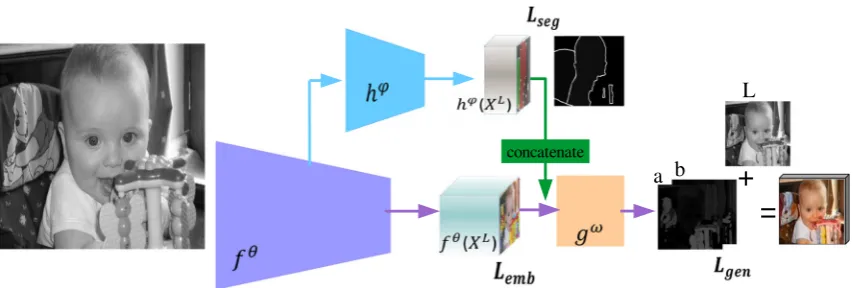
Fig. 2 Pixelated semantic colorization. The three colored flows (arrows) represent three variations of our proposal. The purple flow illustrates the basic pixelated colorization backbone (Sect.3.1). The pur-ple flow combined with the blue flow obtains a better color embedding with more semantics (Sect.3.2.1). The purple flow, blue flow and green
flow together define our final model, a pixelated colorization model con-ditioned on gray-scale image and semantic labels (Sect.3.2.2). Here, fθis a color embedding function,hϕis a semantic segmentation head and gω is the autoregressive generation model. There are three loss functionsLseg,LembandLgen(Sect.3.3)
By adopting PixelCNN for image colorization, a joint dis-tribution with condition is modelled as van den Oord et al. (2016):
p(Yˆ|XL)= n
i=1
p(Yiˆ| ˆY1, . . . ,Yiˆ−1,XL). (1)
All the elementary per-pixel conditional distributions are modelled using a shared convolutional neural network. As all variables in the factors are observed, training can be exe-cuted in parallel.
Furthermore, XL can be replaced by a good embedding learned from a neural network. Takinggω as the generator function and fθas the embedding function, each distribution in Eq. (1) can be rewritten as:
p(Yiˆ| ˆY1, . . . ,Yiˆ−1,XL)=gωi (Yˆ1, . . . ,Yiˆ−1, fθ(XL)). (2)
As the purple flow in Fig.2shows, there are two com-ponents included in our model. A deep convolutional neural network (fθ) produces a good embedding of the input gray-scale image. Then an autoregressive model uses the embed-ding to generate a color distribution for each pixel. The final colorized results are sampled from the distributions using a pixel-level sequential procedure. We first sampleYˆ1from p(Yˆ1|XL), then sampleYiˆ fromp(Yiˆ| ˆY1, . . . ,Yiˆ−1,XL)for
alliin{2, . . .n}.
3.2 Pixelated Semantic Colorization
Intuitively, semantics is the key to colorizing objects and scenes. We will discuss how to embed pixelated seman-tics in our colorization model for generating diverse colored images.
3.2.1 Pixelated Semantic Embedding
Considering the conditional pixelCNN model introduced above, a good embedding of the gray-scale image fθ(XL) greatly helps to generate the precise color distribution of each pixel. We first incorporate semantic segmentation to improve the color embedding. We useXS to denote the correspond-ing segmentation map. Then, we learn an embeddcorrespond-ing of the gray-scale image conditioned on XS. We replace fθ(XL) with fθ(XL|XS). Thus, the new model learns the distribu-tion in Eq. (2) as:
p(Yˆi| ˆY1, . . . ,Yˆi−1,XL,XS)=giω(Yˆ1, . . . ,Yˆi−1, fθ(XL|XS)).
(3)
Here the semantics only directly affects the color embedding generated from the gray-scale image, but not the autoregres-sive model.
Incorporating semantic segmentation can be straightfor-ward, i.e., using segmentation masks to guide the colorization learning procedure. Such a way enables the training phase to directly obtain guidance from the segmentation masks, which clearly and correctly contain semantic information. However, it is not suitable for the test phase as segmentation masks are needed. Naturally, we can rely on an off-the-shelf segmentation model to gain segmentation masks for all the test images, but it is not elegant. Instead, we believe it is best to simultaneously learn the semantic segmentation and the colorization, making the two tasks benefit each other, as we originally proposed in Zhao et al. (2018).
[image:4.595.85.512.54.198.2]we adopt the semantic segmentation strategies from Chen et al. (2018). At the top layer, we apply atrous spatial pyramid pooling, which expoits multiple scale features by employ-ing multiple parallel filters with different dilation rates. The final prediction (hϕ(XL)) is the fusion of the features from the different scales, which helps to improve segmentation. The two tasks have different top layers for learning the high-level features. In this way, semantics is injected into the color embedding function. By doing so, a better color embedding with more semantic awareness is learned as input to the gen-erator. This is illustrated in Fig.2, by combining the purple flow and the blue flow.
3.2.2 Pixelated Semantic Generator
A good color embedding with semantics aids the genera-tor to produce more correct color distributions. Furthermore, the generator is likely to be further improved with semantic labels. Here, we propose to learn a distribution conditioned on previously colorized pixels, a color embedding of gray-scale images with semantics (fθ(XL|XS)), and pixel-level semantic labels. We rewrite Eq. (3) as:
p(Yiˆ| ˆY1, . . . ,Yiˆ−1,XL,XS)
=gωi (Yˆ1, . . . ,Yiˆ−1,fθ(XL|XS),hϕ(XL)). (4)
Intuitively, this method is capable of using semantics to produce more correct colors of objects and more continuous colors within one object. It is designed to address the two issues mentioned in Fig.1. The whole idea is illustrated in Fig.2by combining the purple flow with the blue and green flows.
We consider two different ways to use pixelated semantic information to guide the generator. The first way is to simply concatenate the color embedding fθ(XL)and the segmenta-tion predicsegmenta-tionhϕ(XL)along the channels and then input the fusion to the generator. The second way is to apply a feature transformation introduced by Perez et al. (2018) and Wang et al. (2018). Specifically, we use convolutional layers to learn a pair of transformation parameters from the segmentation predictions. Then, a transformation is applied to the color embedding using these learned parameters. We find the first way works better. Results will be shown in the Experiment section.
3.3 Networks
In this section, we provide the details of the network structure and the optimization procedure.
Network StructureFollowing the scheme in Fig.2, three components are included: the color embedding function fθ, the semantic segmentation headhϕ and the autoregressive
modelgω. Correspondingly, three loss functions are jointly learned, which will be introduced later. The three flows repre-sent the three different methods introduced above. The purple flow illustrates the basic pixelated colorization. The purple flow combined with the blue flow results in the pixelated semantic embedding. The purple flow combined with the blue and green flows, results in the pixelated semantic gen-erator.
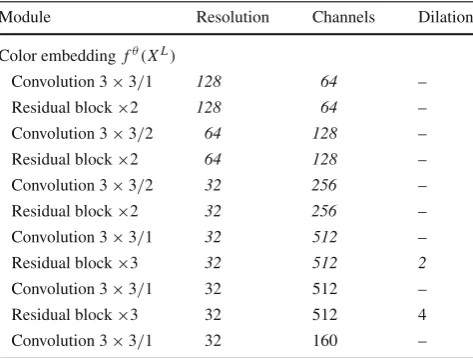
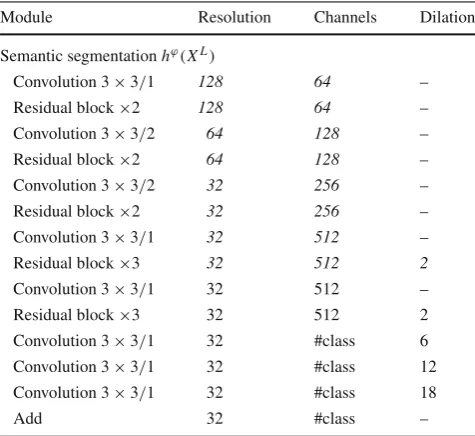
Inspired by the success of the residual block (He et al. 2016; Chen et al.2018) and following Royer et al. (2017), we apply gated residual blocks (van den Oord et al.2016; Salimans et al.2017), each of which has two convolutions with 3×3 kernels, a skip connection and a gating mecha-nism. We apply atrous (dilated) convolutions to several layers to increase the network’s field-of-view without reducing its spatial resolution. Tables1and2list the details of the color embedding branch and the semantic segmentation branch, respectively. The gray rows are shared by the two branches. Loss Functions During the training phase, we train the colorization and segmentation simultaneously. We try to min-imize the negative log-likelihood of the probabilities:
arg min θ,ϕ,ω
−logp(Yˆ|fθ(XL),hϕ(XL)). (5)
Specifically, we have three loss functions Lemb, Lseg and Lgento train the color embedding, the semantic segmentation and the generator, respectively. The final loss functionLsum is the weighted sum of these loss functions:
Lsum=λ1∗Lemb+λ2∗Lseg+λ3∗Lgen. (6)
[image:5.595.307.544.503.682.2]Following Salimans et al. (2017), we use discretized mix-ture logistic distributions to approximate the distribution in
Table 1 Color embedding branch structure
Module Resolution Channels Dilation
Color embedding fθ(XL)
Convolution 3×3/1 128 64 –
Residual block×2 128 64 –
Convolution 3×3/2 64 128 –
Residual block×2 64 128 –
Convolution 3×3/2 32 256 –
Residual block×2 32 256 –
Convolution 3×3/1 32 512 –
Residual block×3 32 512 2
Convolution 3×3/1 32 512 –
Residual block×3 32 512 4
Convolution 3×3/1 32 160 –
Table 2 Semantic segmentation branch structure
Module Resolution Channels Dilation
Semantic segmentationhϕ(XL)
Convolution 3×3/1 128 64 –
Residual block×2 128 64 –
Convolution 3×3/2 64 128 –
Residual block×2 64 128 –
Convolution 3×3/2 32 256 –
Residual block×2 32 256 –
Convolution 3×3/1 32 512 –
Residual block×3 32 512 2
Convolution 3×3/1 32 512 –
Residual block×3 32 512 2
Convolution 3×3/1 32 #class 6
Convolution 3×3/1 32 #class 12
Convolution 3×3/1 32 #class 18
Add 32 #class –
Feature spatial resolution, number of channels and dilation rate are listed for each module. #class means the number of semantic categories. The italic rows indicate the bottom layers are shared with the color embedding branch (detailed in Table1)
Eqs. (3) and (4). A mixture of 10 logistic distributions is applied. Thus, both Lemb andLgen are discretized mixture logistic losses.
As for semantic segmentation, generally it should be per-formed in the RGB image domain as colors are important for semantic understanding. However, the input of our network is a gray-scale image which is more difficult to segment. Fortunately, the network incorporating colorization learn-ing supplies color information which in turn strengthens the semantic segmentation for gray-scale images. The mutual benefit among the three learning parts is the core of our network. It is also important to realize that semantic seg-mentation, as a supplementary means for colorization, is not required to be very precise. We use the cross entropy loss with the standard softmax function for semantic segmenta-tion (Chen et al.2018).
4 Experiments
4.1 Experimental Settings
Datesets We report our experiments on Pascal VOC2012 (Everingham et al. 2015) and COCO-stuff (Caesar et al. 2018). The former is a common semantic segmentation dataset with 20 object classes and one background class. Our experiments are performed on the 10,582 images for training and the 1449 images in the validation set for
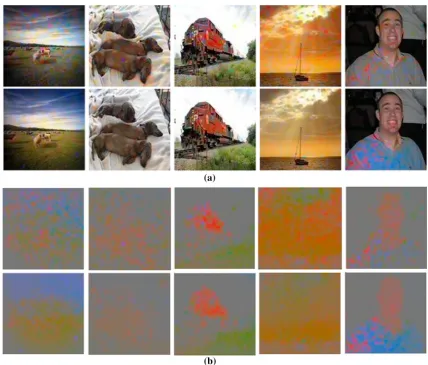
test-Fig. 3 Color images, gray-scale images and segmentation maps from aPascal VOC andbCOCO-stuff. COCO-stuff has more semantic cat-egories than Pascal VOC
[image:6.595.51.289.71.289.2]Fig. 4 Colorizations from the embedding functions fθ using the purple flow and the purple-blue flow.aColorization without semantic-guidance (first row) and with semantic-semantic-guidance (second row). With semantics, better colorizations are produced.bVisualization of the
pre-dictedaandbcolor channels of the colorizations. The top row shows the results without guidance and the bottom row with semantic-guidance. With semantics, the predicted colors have less noise and look more consistent
with natural scenes, objects and artificial objects from the datasets.
ImplementationCommonly available pixel-level annota-tions intended for semantic segmentation are sufficient for our colorization method. We do not need new pixel-level annotations for colorization. We train our network with joint color embedding loss, semantic segmentation loss and gen-erating loss with the weightsλ1:λ2:λ3=1:100:1, so that the
three losses are similar in magnitude. Our multi-task learn-ing for simultaneously optimizlearn-ing colorization and semantic segmentation effectively avoids overfitting. The Adam opti-mizer (Kingma and Ba2015) is adopted. We set an initial learning rate equal to 0.001, momentum to 0.95 and second momentum to 0.9995. We apply Polyak parameter averaging (Polyak and Juditsky1992).
4.2 Effect of Segmentation on the Embedding
Function
f
[image:7.595.82.511.51.416.2]Fig. 5 Colorization from the generatorsgω, when relying on the pur-ple flow and the purpur-ple-blue flow. Exampur-ples fromaPascal VOC and bCOCO-stuff are shown. For both datasets, the top row shows results
from the model without semantic-guidance and the bottom row shows the ones with semantic-guidance. The results with semantic-guidance have more reasonable colors and better object consistency
Further, in order to more clearly show the predicted color channels of the color embeddings, we remove the light chan-nelLand only visualize the chrominancesaandbin Fig.4b. Interestingly, without semantic-guidance, the predicted col-ors are more noisy, as shown in the top row. However, with semantic-guidance, the colors are more consistent and echo the objects well. From these results, one clearly sees that colorization profits from semantic information. These comparisons support our idea and illustrate that pixelated semantics is able to enhance semantic understanding, lead-ing to more consistent colorization.
In theory, we should obtain better colorization when a better color embedding is input into the generator. In Fig.5, we show some final colorizations produced by the generator gω. Our method using pixelated semantics works well on the two datasets. The results look more realistic. For instance, the fifth example in the Pascal VOC dataset is a very chal-lenging case. The proposed method generates consistent and reasonable color for the earth even with an occluded object. For the last example in Pascal VOC, it is surprising that the horse bit is assigned a red color although it is very tiny. The proposed method processes details well. We also show
vari-Fig. 6 Incorporating pixelated semantics. Result comparisons between usingaconcatenation andbfeature transformation to incorporate pix-elated semantics. Concatenation generates more natural color images
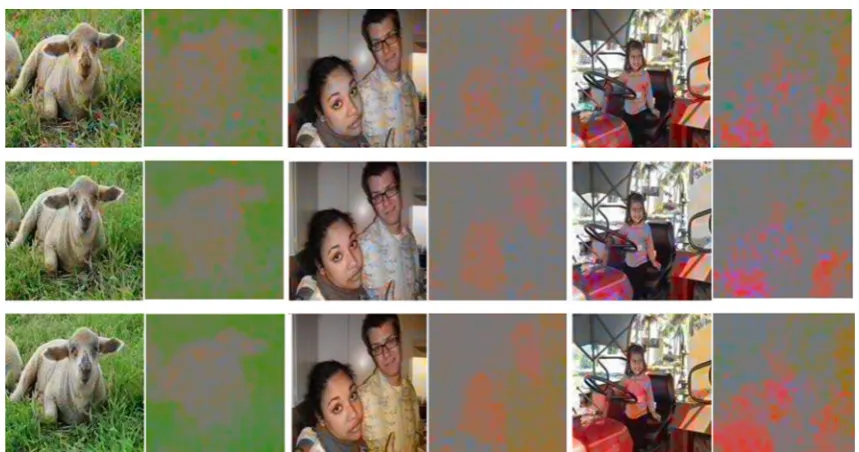
[image:8.595.55.543.50.375.2] [image:8.595.307.543.433.578.2]Fig. 7 Colorizations generated by the embedding functions fθ, using three variants of our network. The top row shows the results of the purple flow. The second row shows the results of the purple-blue flow.
The bottom row shows the results of the purple-blue–green flow. Each colorization is followed by the corresponding predicted chrominances. The purple-blue–green flow produces the best colorization
4.3 Effect of Segmentation on the Generator
g
!In the next experiment, we add semantics to the generator as described in Sect.3.2.2(combining the purple flow with the blue and green flows). This means the generator produces a current pixel color distribution conditioned not only on the previous colorized pixels and the color embeddings from the gray image, but also on the semantic labels. We apply two different ways to incorporate semantics as introduced in Sect.3.2.2. Using concatenation generates more natural col-orful images than using feature transformation. Qualitative results are shown in Fig.6. We prefer concatenation for the following experiments.
As we train the three loss functions Lemb, Lseg and Lgen simultaneously, we want to know whether the color embeddings produced by the embedding function are further improved. In Fig.7, we compare the color embeddings gener-ated by the embedding functions of the purple flow (shown in the top row), the purple-blue flow (shown in the second row) and the purple-blue–green flow (shown in the bottom row). Visualizations of color embeddings followed by the corre-sponding predicted chrominances are given. As can be seen, the addition of the green flow further improves the embed-ding function. From the predictedaandbvisualizations, we observe better cohesion of colors for the objects. Clearly, the colorization benefits from the multi-task learning by jointly training the three different losses.
Indeed, using semantic labels as condition to train the generator results in better color embeddings. Moreover, the
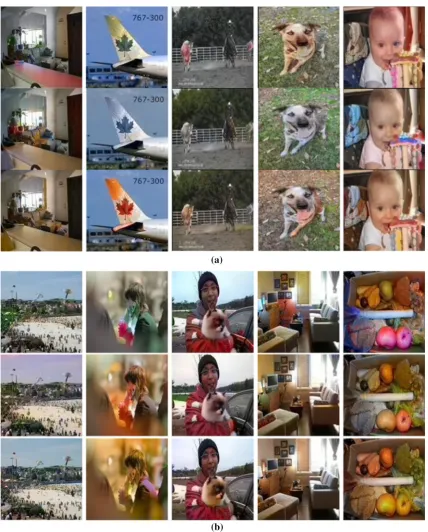
final generated colorized results will also be better. In Fig.8, we compare the results from the three methods: pixelated colorization without semantic guidance (the purple flow), pixelated semantic color embedding (the purple-blue flow), and pixelated semantic color embedding and generator (the purple-blue–green flow). The purple flow does not always understand the object semantic well, sometimes assigning unreasonable colors to objects, such as the cow in the third example of Pascal VOC, the hands in the second example and the apples in the last example of COCO-stuff. In addition, it also suffers from inconsistency and noise on objects. Using pixelated semantics to guide the color embedding function reduces the color noise and somewhat improves the results. Adding semantic labels to guide the generator improves the results further. As shown in Fig. 8, the purple-blue–green flow produces the most realistic and plausible results. Note that it is particularly apt at processing the details and tiny objects. For instance, the tongue of the dog is red and the lip and skin of the baby have very natural colors.
To conclude, these experiments demonstrate our strategies using pixelated semantics for colorization are effective.
4.4 Effect of Colorization on the Segmentation
[image:9.595.82.512.52.278.2]Fig. 8 Colorizations produced by the generatorsgω, using three vari-ants of our network onaPascal VOC andbCOCO-stuff: the purple flow (first row), the purple-blue flow (second row) and the purple-blue–green
flow (third row). Using pixel-level semantics to guide the generator in addition to the color embedding function achieves the most realistic results
learnings could benefit each other. Thus, we study whether colorization is able to improve semantic segmentation.
Color is Important for Semantic Segmentation As we observed in Zhao et al. (2018), color is quite critical for semantic segmentation since it captures some semantics. A
[image:10.595.84.513.50.583.2]gray-Fig. 9 Segmentation results in terms of mean-IoU on gray-scale images, proposed colorized images and original color images, on the Pascal VOC2012 validation dataset. Color aids semantic segmentation
scale images, original color images and our colorized images. The mean intersection over union (mean-IoU) is adopted to evaluate the segmentation results. As seen in Fig.9, with the original color information, the accuracy of 72.1% is much better than the 66.9% accuracy of the gray images. The accu-racy obtained using our proposed colorized images is only 1.8% lower than using the original RGB images. This again demonstrates that our colorized images are realistic. More importantly, the proposed colorized images outperform the gray-scale images by 3.4%, which further supports the impor-tance of color for semantic understanding.
Colorization Helps Semantic Segmentation In order to illustrate how colorization influences semantic segmentation, we train three semantic segmentation models on gray-scale images using our network structure: (1) we jointly train semantic segmentation and colorization; (2) we only train semantic segmentation from a pre-trained colorization model; (3) we only train semantic segmentation from scratch. We train all models on the training set of Pascal VOC 2012 and test them on the validation set. As validating loss reflects the semantic segmentation accuracy on the validation set, we compare the validating loss of the three models.
[image:11.595.309.542.53.228.2]As seen in Fig. 10, the model trained on a pre-trained colorization model converges first. The loss is stable from the 18th epoch and the stable loss value is about 0.043. The model trained from scratch has the lowest starting loss but converges very slowly. Starting from the 55th epoch, the loss plateaus at 0.060. As expected, the pre-trained colorization model makes semantic segmentation achieve better accuracy. We believe the colorization model has already learned some semantic information from the colors, as also observed by Zhang et al. (2016). Further, our multi-task model jointly trained with semantic segmentation and colorization obtains the lowest validating loss of 0.030, around the 25th epoch. This supports our statement that the two tasks with the three loss functions are able to be learned harmoniously and benefit each other.
Fig. 10 Semantic segmentation validating loss comparisons. Three models are trained for 50 epochs. Training from a pre-trained coloriza-tion model is better than training from scratch. Jointly training obtains the lowest validating loss, which demonstrates colorization helps to improve semantic segmentation
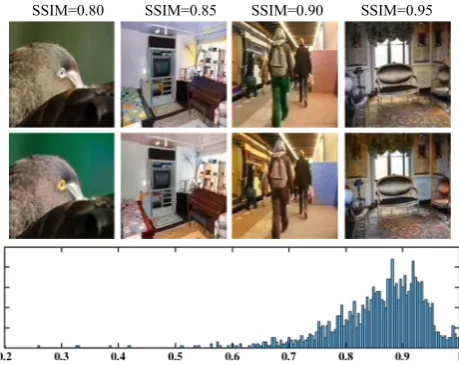
SSIM=0.95 SSIM=0.90
[image:11.595.71.274.53.173.2]SSIM=0.85 SSIM=0.80
Fig. 11 Samples diversity. Histogram of SSIM scores on the Pascal VOC validation dataset shows the diversity of the multiple colorized results. Some examples with their specific SSIM scores are also shown. Our model is able to produce appealing and diverse colorizations
4.5 Sample Diversity
[image:11.595.310.540.302.485.2]such as the eyes of the bird and the pants of the lady. Usu-ally, the large backgrounds or objects with different colors in a pair of outputs cause lower SSIM scores. For instance, the backgrounds and birds in the first example. We believe pixelated semantics does not destroy the sample diversity. We will show more diverse colorization results in the next section.
4.6 Comparisons with State-of-the-Art
Generally, we want to produce visually compelling coloriza-tion results, which can fool a human observer, rather than recover the ground-truth. As discussed previously, coloriza-tion is a subjective challenge. Thus, both qualitative and quantitative evaluations are difficult. As for quantitative eval-uation, some papers (Zhang et al.2016; Iizuka et al.2016) applyTop-5and/orTop-1classification accuracies after col-orization to assess the performance of the methods. Other papers (He et al.2018; Larsson et al.2016) use the peak signal-to-noise ratio (PSNR), although it is not a suitable cri-teria for colorization, especially not for a method like ours, which produces multiple results. Also, color fidelity is suit-able to be used for evaluating methods generating a single colorization result, which share a common goal to provide a color image closer to the original one. In Deshpande et al. (2015) and Larsson et al. (2016), the authors apply root mean squared error (RMSE) of the 2-channel images compared to the ground-truth to evaluate color fidelity. For qualitative evaluation, human observation is mostly used (Zhang et al. 2016; Iizuka et al.2016; He et al.2018; Royer et al.2017; Cao et al.2017).
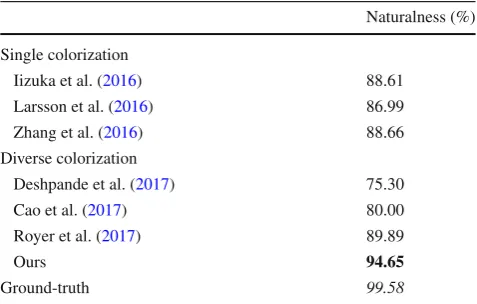
In this paper, we propose a new evaluation method. We use semantic segmentation accuracy to assess the performance of each method, since we know semantics is key to colorization. This is more strict than classification accuracies. Specifically, we calculate the mean-IoU for semantic segmentation results from the colorized images. We use this procedure to compare our method with single colorization methods. For qualitative evaluation, we use the method from our previous work (Zhao et al.2018). We ask 20 human observers, including research students and people without any image processing knowl-edge, to do a test on a combined dataset including the Pascal VOC2012 validation and the COCO-stuff subset. Given a colorized image or the real ground-truth image, the observers should decide whether it looks natural or not.
4.6.1 Single Colorization State-of-the-Art
[image:12.595.308.544.72.159.2]We compare the proposed method with the single coloriza-tion state-of-the-art (Zhang et al.2016; Iizuka et al. 2016; Larsson et al.2016). In addition to the proposed semantic segmentation accuracy evaluation, we also report PSNR. We report RMSE of the 2 color channelsaandbcompared to the
Table 3 Quantitative evaluation
Mean-IoU (%) PSNR (dB) RMSE
Iizuka et al. (2016) 67.6 24.20 10.66
Larsson et al. (2016) 68.8 24.56 10.26
Zhang et al. (2016) 68.1 22.81 12.37
Ours 70.3 23.15 11.43
Ground-truth (color) 72.1 NA NA
Comparisons of semantic segmentation accuracies, and PSNRs and RMSEs between colorized results and the ground-truth, on the Pas-cal VOC validation set. Our method performs better according to the mean-IoU value
Bold values indicate the best performance in the comparisons Italic values indicate the results achieved using ground-truth
Table 4 Qualitative evaluation
Naturalness (%)
Single colorization
Iizuka et al. (2016) 88.61
Larsson et al. (2016) 86.99
Zhang et al. (2016) 88.66
Diverse colorization
Deshpande et al. (2017) 75.30
Cao et al. (2017) 80.00
Royer et al. (2017) 89.89
Ours 94.65
Ground-truth 99.58
Comparisons of the naturalness. Our colorizations are more natural than others
Bold values indicate the best performance in the comparisons Italic values indicate the results achieved using ground-truth
ground truth. We use the Deeplab-ResNet101 model again for semantic segmentation. In this case, we only sample one result for each input, using our method.
Result comparisons are shown in Table 3. Our method has a lower PSNR than Iizuka et al. (2016) and Larsson et al. (2016). The comparisons of RMSE are similar with that of PSNR. Both depend on the ground-truth and over-penalize semantically plausible results with a colorization that dif-fers from the ground-truth (He et al. 2018). Both Iizuka et al. (2016) and Larsson et al. (2016) obtain lower RMSEs because their objective is to minimize the distance between their outputs and ground-truth. However, our method out-performs all the others in semantic segmentation accuracy. This demonstrates that our colorizations are more realistic and contain more perceptual semantics.
[image:12.595.306.545.250.402.2]pro-Gray-scale
Iizuka et al.
Larsson et al.
Zhang et al.
Ours
Original
Fig. 12 Comparisons with single colorization state-of-the-art. Our results look more saturated and realistic
duces good results, but sometimes assigns unsuitable colors to objects, like the earth in the fourth example. The results from Larsson et al. (2016) look somewhat grayish. Zhang et al. (2016)’s method can generate saturated results but suffers from color pollution. Compared to these, our col-orizations are spatially coherent and visually appealing. For instance, the color of the bird in the third example and the skin of the human in the last example, both look very natural.
4.6.2 Diverse Colorization State-of-the-Art
We also compare our method with the diverse colorization state-of-the art (Royer et al.2017; Cao et al.2017; Deshpande et al.2017). All of these are based on a generative model. We only qualitatively compare these by human observation. We use each model to produce three colorized samples. We report
the results in Table4. Royer et al. (2017) apply PixelCNN to get natural images. Our results are even more natural. Several examples are shown in Fig. 13. Deshpande et al. (2017), using a VAE, generate sepia toned results. Cao et al. (2017), applying a GAN, output plausible results but with mixed colors. Royer et al. (2017) also produces saturated results but with color pollution. Our generated colored images have fine-grained and vibrant colors and look realistic.
4.6.3 Results on Legacy Black and White Photographs
Deshpande et al.
Royer et al. Cao et al.
Ours
Deshpande et al.
Royer et al.
[image:14.595.56.544.52.608.2]Ours Cao et al.
Fig. 13 Comparisons with diverse colorization state-of-the-art. The diverse results generated by our method look fairly good
4.7 Result Analysis
To further analyze the effect of object semantics on col-orization, we quantify the colorization performance for each object class in the Pascal VOC validation set. We report
illus-Thylacine Henri Cartier-Bresson Ansel Adams
Fig. 14 Results on legacy black and white photos. The model also works well on old black and white photos
Fig. 15 Colorization results of per object class on the Pascal VOC validation set using RMSE. Without considering background, the model performs worse for persons as the clothing has too much diversity in color. The RMSEs are lower for all other objects. Our model helps to assign reasonable colors to objects
trate that incorporating semantics helps to precisely assign reasonable colors to objects.
4.8 Failure Cases
[image:15.595.306.542.269.386.2]Our method is able to output realistic colorized images but it is not perfect. There are still some failure cases encoun-tered by the proposed approach as well as other automatic systems. We provide a few failure cases in Fig.16. Usu-ally, it is highly challenging to colorize different kinds of food. They are artificial and variable. It is also difficult to learn the semantics of images containing several tiny and occluded objects. Moreover, our method cannot handle the
Fig. 16 Failure cases. Food, tiny objects and artificial objects are still very challenging
objects with unclear semantics. Although we exploit seman-tics for improving colorization, we do not have very many categories. We believe a finer semantic segmentation with more class labels will further enhance the results.
5 Conclusion
[image:15.595.53.288.269.473.2]or tiny objects. More learning examples and finer semantic segmentation may further improve the colorization results in the future.
Open Access This article is distributed under the terms of the Creative Commons Attribution 4.0 International License (http://creativecomm ons.org/licenses/by/4.0/), which permits unrestricted use, distribution, and reproduction in any medium, provided you give appropriate credit to the original author(s) and the source, provide a link to the Creative Commons license, and indicate if changes were made.
References
Bugeau, A., Ta, V. T., & Papadakis, N. (2014). Variational exemplar-based image colorization.IEEE Transactions on Image Process-ing,23(1), 298–307.
Caesar, H., Uijlings, J., & Ferrari, V. (2018). COCO-stuff: Thing and stuff classes in context. InCVPR.
Cao, Y., Zhou, Z., Zhang, W., & Yu, Y. (2017). Unsupervised diverse colorization via generative adversarial networks. InJoint Euro-pean conference on machine learning and knowledge discovery in databases.
Charpiat, G., Hofmann, M., & Schölkopf, B. (2008). Automatic image colorization via multimodal predictions. InECCV.
Cheng, Z., Yang, Q., & Sheng, B. (2015). Deep colorization. InICCV. Chen, L. C., Papandreou, G., Kokkinos, I., Murphy, K., & Yuille, A. L. (2018). Deeplab: Semantic image segmentation with deep convo-lutional nets, atrous convolution, and fully connected CRFs.IEEE Transactions on Pattern Analysis and Machine Intelligence,40(4), 834–848.
Chia, A. Y. S., Zhuo, S., Gupta, R. K., Tai, Y. W., Cho, S. Y., Tan, P., et al. (2011). Semantic colorization with internet images.ACM Transactions on Graphics,30(6), 156.
Comaniciu, D., & Meer, P. (1997). Robust analysis of feature spaces: Color image segmentation. InCVPR.
Dai, J., Li, Y., He, K., & Sun, J. (2016). R-FCN: Object detection via region-based fully convolutional networks. InNIPS.
Danelljan, M., Shahbaz Khan, F., Felsberg, M., & Van de Weijer, J. (2014). Adaptive color attributes for real-time visual tracking. In CVPR.
Deshpande, A., Lu, J., Yeh, M. C., Chong, M. J., & Forsyth, D. (2017). Learning diverse image colorization. InCVPR.
Deshpande, A., Rock, J., & Forsyth, D. (2015). Learning large-scale automatic image colorization. InICCV.
Everingham, M., Eslami, S. A., Van Gool, L., Williams, C. K., Winn, J., & Zisserman, A. (2015). The Pascal visual object classes chal-lenge: A retrospective.International Journal of Computer Vision, 111(1), 98–136.
Frans, K. (2017).Outline colorization through tandem adversarial net-works.arXiv:1704.08834.
Gijsenij, A., Gevers, T., & van de Weijer, J. (2010). Generalized gamut mapping using image derivative structures for color constancy. International Journal of Computer Vision,86(2–3), 127–139. Guadarrama, S., Dahl, R., Bieber, D., Norouzi, M., Shlens, J., &
Mur-phy, K. (2017). Pixcolor: Pixel recursive colorization. InBMVC. Gupta, R. K., Chia, A. Y. S., Rajan, D., Ng, E. S., & Zhiyong, H. (2012).
Image colorization using similar images. InMultimedia. He, K., Zhang, X., Ren, S., & Sun, J. (2016). Deep residual learning for
image recognition. InCVPR.
He, M., Chen, D., Liao, J., Sander, P. V., & Yuan, L. (2018). Deep exemplar-based colorization. ACM Transactions on Graphics, 37(4), 47.
Huang, Y. C., Tung, Y. S., Chen, J. C., Wang, S. W., & Wu, J. L. (2005). An adaptive edge detection based colorization algorithm and its applications. InMultimedia.
Iizuka, S., Simo-Serra, E., & Ishikawa, H. (2016). Let there be color!: Joint end-to-end learning of global and local image priors for auto-matic image colorization with simultaneous classification.ACM Transactions on Graphics,35(4), 110.
Ironi, R., Cohen-Or, D., & Lischinski, D. (2005). Colorization by exam-ple. InRendering techniques.
Isola, P., Zhu, J. Y., Zhou, T., & Efros, A. A. (2017). Image-to-image translation with conditional adversarial networks. InCVPR. Khan, F. S., Anwer, R. M., Van de Weijer, J., Bagdanov, A. D., Vanrell,
M., & Lopez, A. M. (2012). Color attributes for object detection. InCVPR.
Khan, F. S., Van De Weijer, J., & Vanrell, M. (2009). Top-down color attention for object recognition. InICCV.
Kingma, D. P., & Ba, J. (2015). Adam: A method for stochastic opti-mization. InICLR.
Kingma, D. P., & Welling, M. (2014). Auto-encoding variational bayes. InICLR.
Larsson, G., Maire, M., & Shakhnarovich, G. (2016). Learning repre-sentations for automatic colorization. InECCV.
Levin, A., Lischinski, D., & Weiss, Y. (2004). Colorization using opti-mization.ACM Transactions on Graphics,23(3), 689–694. Lin, T. Y., Maire, M., Belongie, S., Hays, J., Perona, P., Ramanan, D.,
et al. (2014). Microsoft COCO: Common objects in context. In ECCV.
Liu, X., Wan, L., Qu, Y., Wong, T. T., Lin, S., Leung, C. S., et al. (2008). Intrinsic colorization.ACM Transactions on Graphics,27(5), 152. Long, J., Shelhamer, E., & Darrell, T. (2015). Fully convolutional
net-works for semantic segmentation. InCVPR.
Lou, Z., Gevers, T., Hu, N., Lucassen, M. P., et al. (2015). Color con-stancy by deep learning. InBMVC.
Luan, Q., Wen, F., Cohen-Or, D., Liang, L., Xu, Y. Q., & Shum, H. Y. (2007). Natural image colorization. InProceedings of the 18th eurographics conference on rendering techniques.
Noh, H., Hong, S., & Han, B. (2015). Learning deconvolution network for semantic segmentation. InICCV.
Pérez, P., Hue, C., Vermaak, J., & Gangnet, M. (2002). Color-based probabilistic tracking. InECCV.
Perez, E., Strub, F., De Vries, H., Dumoulin, V., & Courville, A. (2018). Film: Visual reasoning with a general conditioning layer. InAAAI. Polyak, B. T., & Juditsky, A. B. (1992). Acceleration of stochastic approximation by averaging.SIAM Journal on Control and Opti-mization,30(4), 838–855.
Qu, Y., Wong, T. T., & Heng, P. A. (2006). Manga colorization.ACM Transactions on Graphics,25(3), 1214–1220.
Radford, A., Metz, L., & Chintala, S. (2016). Unsupervised repre-sentation learning with deep convolutional generative adversarial networks. InICLR.
Royer, A., Kolesnikov, A., & Lampert, C. H. (2017). Probabilistic image colorization. InBMVC.
Salimans, T., Karpathy, A., Chen, X., Kingma, D. P., & Bulatov, Y. (2017). PixelCNN++: A PixelCNN implementation with dis-cretized logistic mixture likelihood and other modifications. In ICLR.
Sanchez, J. M., & Binefa, X. (2000). Improving visual recognition using color normalization in digital video applications. InICME. Sangkloy, P., Lu, J., Fang, C., Yu, F., & Hays, J. (2017). Scribbler:
Controlling deep image synthesis with sketch and color. InCVPR. Swain, M. J., & Ballard, D. H. (1991). Color indexing.International
Journal of Computer Vision,7(1), 11–32.
Tai, Y. W., Jia, J. Y., & Tang, C. K. (2005). Local color transfer via prob-abilistic segmentation by expectation–maximization. InCVPR. van de Sande, K. E. A., Gevers, T., & Snoek, C. G. M. (2010).
Transactions on Pattern Analysis and Machine Intelligence,32(9), 1582–1596.
Van der Horst, G. J., & Bouman, M. A. (1969). Spatiotemporal chro-maticity discrimination.Journal of the Optical Society of America, 59(11), 1482–1488.
van den Oord, A., Kalchbrenner, N., Espeholt, L., Vinyals, O., Graves, A., et al. (2016). Conditional image generation with PixelCNN decoders. InNIPS.
Vondrick, C., Shrivastava, A., Fathi, A., Guadarrama, S., & Murphy, K. (2018). Tracking emerges by colorizing videos. InECCV. Wang, Z., Simoncelli, E. P., & Bovik, A. C. (2003). Multiscale
struc-tural similarity for image quality assessment. InThe 37th Asilomar conference on signals, systems & computers.
Wang, X., Yu, K., Dong, C., & Loy, C. C. (2018). Recovering realistic texture in image super-resolution by deep spatial feature transform. InCVPR.
Welsh, T., Ashikhmin, M., & Mueller, K. (2002). Transferring color to greyscale images.ACM Transactions on Graphics,21(3), 277– 280.
Yatziv, L., & Sapiro, G. (2006). Fast image and video colorization using chrominance blending.IEEE Transactions on Image Processing, 15(5), 1120–1129.
Zhang, R., Isola, P., & Efros, A. A. (2016). Colorful image colorization. InECCV.
Zhang, R., Zhu, J. Y., Isola, P., Geng, X., Lin, A. S., Yu, T., et al. (2017). Real-time user-guided image colorization with learned deep priors. InSIGGRAPH.
Zhao, J., Liu, L., Snoek, C. G. M., Han, J., & Shao, L. (2018). Pixel-level semantics guided image colorization. InBMVC.