warwick.ac.uk/lib-publications Manuscript version: Author’s Accepted Manuscript
The version presented in WRAP is the author’s accepted manuscript and may differ from the published version or Version of Record.
Persistent WRAP URL:
http://wrap.warwick.ac.uk/123724
How to cite:
Please refer to published version for the most recent bibliographic citation information. If a published version is known of, the repository item page linked to above, will contain details on accessing it.
Copyright and reuse:
The Warwick Research Archive Portal (WRAP) makes this work by researchers of the University of Warwick available open access under the following conditions.
Copyright © and all moral rights to the version of the paper presented here belong to the individual author(s) and/or other copyright owners. To the extent reasonable and
practicable the material made available in WRAP has been checked for eligibility before being made available.
Copies of full items can be used for personal research or study, educational, or not-for-profit purposes without prior permission or charge. Provided that the authors, title and full
bibliographic details are credited, a hyperlink and/or URL is given for the original metadata page and the content is not changed in any way.
Publisher’s statement:
Please refer to the repository item page, publisher’s statement section, for further information.
Streaming Algorithms for Bin Packing and Vector Scheduling
Graham Cormode and Pavel Vesel´y
Department of Computer Science, University of Warwick, Coventry, UK.
{G.Cormode,Pavel.Vesely}@warwick.ac.uk.
Abstract
Problems involving the efficient arrangement of simple objects, as captured by bin packing and makespan scheduling, are fundamental tasks in combinatorial optimization. These are well understood in the traditional online and offline cases, but have been less well-studied when the volume of the input is truly massive, and cannot even be read into memory. This is captured by the streaming model of com-putation, where the aim is to approximate the cost of the solution in one pass over the data, using small space. As a result, streaming algorithms produce concise input summaries that approximately preserve the optimum value.
We design the first efficient streaming algorithms for these fundamental problems in combinatorial optimization. For BINPACKING, we provide a streaming asymptotic1 +ε-approximation withOe 1ε
memory, whereOehides logarithmic factors. Moreover, such a space bound is essentially optimal. Our
algorithm implies a streamingd+ε-approximation for VECTORBINPACKINGinddimensions, running in spaceOe dε
. For the related VECTOR SCHEDULINGproblem, we show how to construct an input summary in spaceO(e d2·m/ε2)that preserves the optimum value up to a factor of2−m1 +ε, wherem
is the number of identical machines.
1
Introduction
The streaming model captures many scenarios when we must process very large volumes of data, which cannot fit into the working memory. The algorithm makes one or more passes over the data with a limited memory, but does not have random access to the data. Thus, it needs to extract a concise summary of the huge input, which can be used to approximately answer the problem under consideration. The main aim is to provide a good trade-off between the space used for processing the input stream (and hence, the summary size) and the accuracy of the (best possible) answer computed from the summary. Other relevant parameters are the time and space needed to make the estimate, and the number of passes, ideally equal to one.
While there have been many effective streaming algorithms designed for a range of problems in statistics, optimization, and graph algorithms (see surveys by Muthukrishnan [38] and McGregor [37]), there has been little attention paid to the core problems of packing and scheduling. These are fundamental abstractions, which form the basis of many generalizations and extensions [14, 13]. In this work, we present the first efficient algorithms for packing and scheduling that work in the streaming model.
A second issue is that the problems we consider, even in their simplest form, are NP-hard. The addi-tional constraints of streaming computation do not erase the computaaddi-tional challenge. In some cases, our algorithms proceed by adopting and extending known polynomial-time approximation schemes for the off-line versions of the problems, while in other cases, we come up with new approaches. The streaming model effectively emphasizes the question of how compactly can the input be summarized to allow subsequent approximation of the problem of interest. Our main results show that in fact the inputs for many of our problems of interest can be “compressed” to very small intermediate descriptions which suffice to extract near-optimal solutions for the original input. This implies that they can be solved in scenarios which are storage or communication constrained.
We proceed by formalizing the streaming model, after which we summarize our results. We continue by presenting related work, and contrast with the online setting.
1.1 Problems and Streaming Model
Bin packing. The BINPACKING problem is defined as follows: The input consists ofN items with sizes
s1, . . . , sN (each between 0 and 1), which need to be packed into bins of unit capacity. That is, we seek a partition of the set of items {1, . . . , N} into subsetsB1, . . . , Bm, called bins, such that for any binBi, it holds thatP
j∈Bisj ≤1. The goal is to minimize the numbermof bins used.
We also consider the natural generalization to VECTOR BIN PACKING, where the input consists ofd
-dimensional vectors, with the value of each coordinate between 0 and 1 (i.e., the scalar itemssiare replaced with vectorsvi). The vectors need to be packed intod-dimensional bins with unit capacity in each dimension, we thus require thatkP
v∈Bivk∞≤1(where the infinity normkvk∞= maxivi).
Scheduling. The MAKESPAN SCHEDULING problem is closely related to BINPACKING but, instead of filling bins with bounded capacity, we try to balance the loads assigned to a fixed number of bins. Now we refer to the input as comprising a set ofjobs, with each jobj defined by its processing timepj. Our goal is to assign each job on one ofmidentical machines to minimize themakespan, which is the maximum load over all machines.
In VECTORSCHEDULING, a job is described not only by its processing time, but also by, say, memory or bandwidth requirements. The input is thus a set of jobs, each jobjcharacterized by a vectorvj. The goal is to assign each job into one of midentical machines such that the maximum load over all machines and dimensions is minimized.
Streaming model. In the streaming scenario, the algorithm receives the input as a sequence of items, called the input stream. We do not assume that the stream is ordered in any particular way (e.g., randomly or by item sizes), so our algorithms must work for arbitrarily ordered streams. The items arrive one by one and upon receiving each item, the algorithm updates its memory state. A streaming algorithm is required to use space sublinear in the length of the stream, ideally justpolylog(N), while it processes the stream. After the last item arrives, the algorithm computes its estimate of the optimal value, and the space or time used during this final computation is not restricted.
1.2 Our Results
Bin packing. In Section 3, we present a streaming algorithm for BINPACKING, which outputs an asymp-totic1 +ε-approximation ofOPT, the optimal number of bins, usingO1
ε ·log
1
ε·logOPT
memory.1This means that the algorithm uses at most(1+ε)·OPT+o(OPT)bins, and in our case, the additiveo(OPT)term is bounded by the space used. The novelty of our contribution is to combine a data structure that approxim-ately tracks all quantiles in a numeric stream [26] with techniques for approximation schemes [18, 33]. We show that we can improve upon thelogOPTfactor in the space complexity if randomization is allowed or if item sizes are drawn from a bounded-size set of real numbers. On the other hand, we argue that our result is close to optimal, up to a factor ofOlog1ε, if item sizes are accessed only by comparisons (including comparisons with some fixed constants). Thus, one cannot get an estimate with at mostOPT+o(OPT)bins by a streaming algorithm, unlike in the offline setting [28]. The hardness emerges from the space complexity of the quantiles problem in the streaming model.
For VECTORBINPACKING, we design a streaming asymptoticd+ε-approximation algorithm running in space Od
ε·log d
ε·logOPT
; see Appendix B. We remark that if vectors are rounded into a sublinear number of types, then better thand-approximation is not possible [7].
Scheduling. For MAKESPAN SCHEDULING, one can obtain a straightforward streaming1 +ε
-approxi-mation2 with space of onlyO(1ε ·log1ε) by rounding sizes of suitably large jobs to powers of 1 +εand counting the total size of small jobs. In a higher dimension, it is also possible to get a streaming 1 +ε -approximation, by the rounding introduced by Bansal et al.[8]. However, the memory required for this
algorithm is exponential in d, precisely of size O
1
εlog d ε
d
, and thus only practical whendis a very
small constant. Moreover, such a huge amount of memory is needed even if the number m of machines (and hence, of big jobs) is small as the algorithm rounds small jobs into exponentially many types. See Appendix D for more details.
In case m and d make this feasible, we design a new streaming 2− 1
m +ε
-approximation with
O1
ε2 ·d2·m·logdε
memory, which implies a 2-approximation streaming algorithm running in space O(d2·m3·logdm). We thus obtain a much better approximation than for VECTORBINPACKING with a reasonable amount of memory (although to compute the actual makespan from our input summary, it takes time doubly exponential in d [8]). Our algorithm is not based on rounding, as in the aforementioned al-gorithms, but on combining small jobs into containers, and the approximation guarantee of this approach is at least2− 1
m, which we demonstrate by an example. We describe the algorithm in Section 4.
2
Related Work
We give an overview of related work in offline, online, and sublinear algorithms, and highlight the differences between online and streaming algorithms. Recent surveys of Christensenet al.[13] and Coffmanet al.[14] have a more comprehensive overview.
2.1 Bin Packing
Offline approximation algorithms. BIN PACKING is an NP-complete problem and indeed it is NP-hard even to decide whether two bins are sufficient or at least three bins are necessary. This follows by a simple
1
We remark that some online algorithms can be implemented in the streaming model, as described in Section 2.1, but they give worse approximation guarantees.
2
reduction from the PARTITIONproblem and presents the strongest inapproximability to date. Most work in the offline model focused on providingasymptotic R-approximation algorithms, which use at mostR· OPT+o(OPT)bins. In the following, when we refer to an approximation for BINPACKINGwe implicitly
mean the asymptotic approximation. The first polynomial-time approximation scheme (PTAS), that is, a
1 +ε-approximation for anyε > 0, was given by Fernandez de la Vega and Lueker [18]. Karmarkar and Karp [33] provided an algorithm which returns a solution withOPT+O(log2OPT)bins. Recently, Hoberg and Rothvoß [28] proved it is possible to find a solution withOPT+O(logOPT)bins in polynomial time. The input for BIN PACKING can be described by N numbers, corresponding to item sizes. While in general these sizes may be distinct, in some cases the input description can be compressed significantly by specifying the number of items of each size in the input. Namely, in the HIGH-MULTIPLICITY BIN
PACKINGproblem, the input is a set of pairs(a1, s1), . . . ,(aσ, sσ), where fori= 1, . . . , σ,aiis the number of items of sizesi(and allsi’s are distinct). Thus,σencodes the number of item sizes, and hence the size of the description. The goal is again to pack these items into bins, using as few bins as possible. For constant number of sizes,σ, Goemans and Rothvoß [24] recently gave an exact algorithm for the case of rational item sizes running in time(log ∆)2O(σ), where∆is the largest multiplicity of an item or the largest denominator of an item size, whichever is the greater.
While these algorithms provide satisfying theoretical guarantees, simple heuristics are often adopted in practice to provide a “good-enough” performance. FIRST FIT [32], which puts each incoming item into the first bin where it fits and opens a new bin only when the item does not fit anywhere else achieves1.7 -approximation [16]. For the high-multiplicity variant, using an LP-based Gilmore-Gomory cutting stock heuristic [22, 23] gives a good running time in practice [2] and produces a solution with at mostOPT+σ
bins. However, neither of these algorithms adapts well to the streaming setting with possibly distinct item sizes. For example, FIRSTFIThas to remember the remaining capacity of each open bin, which in general can require space proportional toOPT.
VECTORBINPACKINGproves to be substantially harder to approximate, even in a constant dimension. For fixedd, Bansal, Eli´aˇs, and Khan [7] showed an approximation factor of≈0.807 + ln(d+ 1) +ε. For generald, a relatively simple algorithm based on an LP relaxation, due to Chekuri and Khanna [11], remains the best known, with an approximation guarantee of 1 +εd+O(log1ε). The problem is APX-hard even ford = 2[40], and cannot be approximated within a factor better thand1−εfor any fixedε > 0[13] ifd
is arbitrarily large. Hence, our streamingd+ε-approximation for VECTOR BINPACKINGasymptotically
achieves the offline lower bound.
Sampling-based algorithms. Sublinear-time approximation schemes constitute a model related to, but distinct from, streaming algorithms. Batu, Berenbrink, and Sohler [9] provide an algorithm that takes
e
O√N ·poly(1ε) weighted samples, meaning that the probability of sampling an item is proportional to its size. It outputs an asymptotic1 +ε-approximation ofOPT. If uniform samples are also available, then samplingOe
N1/3·poly(1ε)items is sufficient. These results are tight, up to apoly(1ε,logN)factor. Later, Beigel and Fu [10] focused on uniform sampling of items, proving thatΘ(N/SIZE)e samples are sufficient
and necessary, whereSIZEis the total size of all items. Their approach implies a streaming approximation scheme by uniform sampling of the substream of big items. However, the space complexity in terms of
1
ε is not stated in the paper, but we calculate this to beΩ (ε
−c) for a constantc ≥ 10. Moreover,Ω(1
ε2)
samples are clearly needed to estimate the number of items with size close to1. Note that our approach is deterministic and substantially different than taking a random sample from the stream.
Online algorithms. Online and streaming algorithms are similar in the sense that they are required to process items one by one. However, an online algorithm must make all its decisions immediately — it must fix the placement of each incoming item on arrival.3 A streaming algorithm can postpone such decisions to
3
the very end, but is required to keep its memory small, whereas an online algorithm may remember all items that have arrived so far. Hence, online algorithms apply in the streaming setting only when they have small space cost, including the space needed to store the solution constructed so far. The approximation ratio of online algorithms is quantified by thecompetitive ratio.
For BINPACKING, the best possible competitive ratio is substantially worse than what we can achieve offline or even in the streaming setting. Balogh et al. [5] designed an asymptotically1.5783-competitive algorithm, while the current lower bound on the asymptotic competitive ratio is 1.5403 [6]. This (relat-ively complicated) online algorithm is based on the HARMONICalgorithm [35], which for some integerK
classifies items into size groups(0,K1],(K1,K1−1], . . . ,(12,1]. It packs each group separately by NEXTFIT, keeping just one bin open, which is closed whenever the next item does not fit. Thus HARMONICcan run in memory of sizeKand be implemented in the streaming model, unlike most other online algorithms which require maintaining the levels of all bins opened so far. Its competitive ratio tends to approximately1.691as
K goes to infinity. Surprisingly, this is also the best possible ratio if only a bounded number of bins is al-lowed to be open for an online algorithm [35], which can be seen as the intersection of online and streaming models.
For VECTOR BIN PACKING, the best known competitive ratio ofd+ 0.7 [20] is achieved by FIRST
FIT. A lower bound ofΩ(d1−ε)on the competitive ratio was shown by Azar et al.[3]. It is thus currently unknown whether or not online algorithms outperform streaming algorithms in the vector setting.
2.2 Scheduling
Offline approximation algorithms. MAKESPAN SCHEDULINGis strongly NP-complete [21], which in
particular rules out the possibility of a PTAS with time complexitypoly(1ε, n). After a sequence of
improve-ments, Jansen, Klein, and Verschae [31] gave a PTAS with time complexity2Oe(1/ε)+O(nlogn), which is
essentially tight under the Exponential Time Hypothesis (ETH) [12].
For constant dimension d, VECTOR SCHEDULING also admits a PTAS, as shown by Chekuri and
Khanna [11]. However, the running time is of order n(1/ε)Oe(d). The approximation scheme for a fixed d
was improved to an efficient PTAS, namely to an algorithm running in time2(1/ε)Oe(d)+O(dn), by Bansalet
al. [8], who also showed that the running time cannot be significantly improved under ETH. In contrast our streamingpoly(d, m)-space algorithm computes an input summary maintaining2-approximation of the original input. This respects the lower bound, since to compute the actual makespan from the summary, we still need to execute an offline algorithm, with running time doubly exponential in d. The best known approximation ratio for large disO(logd/(log logd))[27, 30], while α-approximation is not possible in polynomial time for any constantα >1and arbitraryd, unless NP = ZPP.
Online algorithms. For the scalar problem, the optimal competitive ratio is known to lie in the interval
(1.88,1.9201)[1, 25, 29, 19], which is substantially worse than what can be done by a simple streaming
1 +ε-approximation in spaceO(1ε·log1ε). Interestingly, for VECTORSCHEDULING, the algorithm by Imet al.[30] with ratioO(logd/(log logd))actually works in the online setting as well and needs spaceO(d·m)
only during its execution (if the solution itself is not stored), which makes it possible to implement it in the streaming setting. This online ratio cannot be improved as there is a lower bound ofΩ(logd/(log logd))[30, 4], whereas in the streaming setting we can achieve a2-approximation with a reasonable memory (or even
3
Bin Packing
Notation. For an instanceI, letN(I)be the number of items inI, letSIZE(I)be the total size of all items inI, and letOPT(I)be the number of bins used in an optimal solution forI. Clearly,SIZE(I)≤OPT(I). For a binB, lets(B) be the total size of items inB. For a givenε > 0, we useOe(f(1
ε))to hide factors logarithmic in 1ε andOPT(I), i.e., to denoteO f(1ε)·polylog1ε ·polylogOPT(I)
.
Overview. We first briefly describe the approximation scheme of Fernandez de la Vega and Lueker [18], whose structure we follow in outline. LetI be an instance of BINPACKING. Given a precision requirement
ε > 0, we say that an item issmallif its size is at mostε; otherwise, it isbig. Note that there are at most
1
εSIZE(I)big items. The rounding scheme in [18], called “linear grouping”, works as follows: We sort the big items by size non-increasingly and divide them into groups ofk=bε·SIZE(I)citems (the first group thus contains thekbiggest items). In each group, we round up the sizes of all items to the size of the biggest item in that group. It follows that the number of groups and thus the number of distinct item sizes (after rounding) is bounded bydε12e. LetIR be the instance of HIGH-MULTIPLICITYBINPACKINGconsisting of
the big items with rounded sizes. It can be shown thatOPT(IB)≤OPT(IR)≤(1 +ε)·OPT(IB), where
IB is the set of big items inI (we detail a similar argument in Section 3.1). Due to the bounded number of
distinct item sizes, we can find a close-to-optimal solution forIRefficiently. We then translate this solution
into a packing forIBin the natural way. Finally, small items are filled greedily (e.g., by First Fit) and it can
be shown that the resulting complete solution forI is a1 +O(ε)-approximation.
Karmarkar and Karp [33] proposed an improved rounding scheme, called “geometric grouping”. It is based on the observation that item sizes close to 1 should be approximated substantially better than item sizes close toε. We present a version of such a rounding scheme in Section 3.1.
Our algorithm follows a similar outline with two stages (rounding and finding a solution for the rounded instance), but working in the streaming model brings two challenges: First, in the rounding stage, we need to process the stream of items and output a rounded high-multiplicity instance with few item sizes that are not too small, while keeping only a small number of items in the memory. Second, the rounding of big items needs to be done carefully so that not much space is “wasted”, since in the case when the total size of small items is relatively large, we argue that our solution is close to optimal by showing that the bins are nearly full on average.
Input summary properties. More precisely, we fix someε >0that is used to control the approximation guarantee. During the first stage, our algorithm has one variable which accumulates the total size of all small items in the input stream, i.e., those of size at mostε. LetIB be the substream consisting of all big items.
We processIBand output a rounded high-multiplicity instanceIRwith the following properties:
(P1) There are at mostσitem sizes inIR, all of them larger thanε, and the memory required for processing
IBisO(σ).
(P2) Thei-th biggest item inIR is at least as large as thei-th biggest item inIB (and the number of items
inIR is the same as inIB). This immediately implies that any packing ofIR can be used as a packing
ofIB(in the same number of bins), soOPT(IB)≤OPT(IR), and moreover,SIZE(IB)≤SIZE(IR).
(P3) OPT(IR)≤(1 +ε)·OPT(IB) +O(log1ε).
(P4) SIZE(IR)≤(1 +ε)·SIZE(IB).
In words, (P2) means that we are rounding item sizes up and, together with (P3), it implies that the optimal solution for the rounded instance approximates OPT(IB) well. The last property is used in the
case when the total size of small items constitutes a large fraction of the total size of all items. Note that
SIZE(IR)−SIZE(IB)can be thought of as bin space “wasted” by rounding.
Observe that the succinctness of the rounded instance depends onσ. First, we show a streaming algorithm for rounding with σ = Oe(1
ε2). Then we improve upon it and give an algorithm withσ = Oe(1ε), which is
on in Section 3.2). More precisely, we show the following:
Lemma 1. Given a steamIBof big items, there is a deterministic streaming algorithm that outputs aHIGH
-MULTIPLICITYBINPACKINGinstance satisfying (P1)-(P4) withσ=O1ε·log1ε·logOPT(IB)
.
Before describing the rounding itself and proving Lemma 1, we explain how to use it to calculate an accurate estimate of the number of bins.
Calculating a bound on the number of bins after rounding. First, we obtain a solutionSof the rounded instance IR. For instance, we may round the solution of the linear program introduced by Gilmore and
Gomory [22, 23], and get a solution with at mostOPT(IR) +σbins. Or, if item sizes are rational numbers,
we may compute an optimal solution forIR by the algorithm of Goemans and Rothvoß [24]; however, the
former approach appears to be more efficient and more general. In the following, we thus assume thatSuses at mostOPT(IR) +σbins.
We now calculate a bound on the number of bins in the original instance. LetW be the total free space in the bins ofS that can be used for small items. To be precise,W equals the sum over all binsB inS of
max(0,1−ε−s(B)). Note that the capacity of bins is capped at1−ε, because it may happen that all small items are of size εwhile the packing leaves space of just underεin any bin. Then we would not be able to pack small items into these bins. Reducing the capacity byεremoves this issue. On the other hand, if a small item does not fit into a bin, then the remaining space in the bin is smaller thanε.
Letsbe the total size of all small items in the input stream. Ifs≤W, then all small items surely fit into the free space of bins inS (and can be assigned there greedily by FIRSTFIT). Consequently, we output that the number of bins needed for the stream of items is at most|S|, i.e., the number of bins in solutionS for
IR. Otherwise, we need to place small items of total size at mosts0 =s−W into new bins and it is easy to
see that opening at mostds0/(1−ε)e ≤(1 +O(ε))·s0+ 1bins for these small items suffices. Hence, in the cases > W, we output that|S|+ds0/(1−ε)ebins are sufficient to pack all items in the stream.
We prove that the number of bins that we output in either case is a good approximation of the optimal number of bins, provided thatSis a good solution forIR(proof deferred to Appendix A.2).
Lemma 2. LetI be given as a stream of items. Suppose that0 < ε ≤ 1
3, that the rounded instanceIR, created fromI, satisfies properties (P1)-(P4), and that the solutionSofIR uses at mostOPT(IR) +σbins. LetALG(I)be the number of bins that our algorithm outputs. Then, it holds thatOPT(I) ≤ ALG(I) ≤ (1 + 3ε)·OPT(I) +σ+Olog1ε.
3.1 Processing the Stream and Rounding
The streaming algorithm of the rounding stage makes use of the deterministic quantile summary of Green-wald and Khanna [26]. Given a precisionδ >0and an input stream of numberss1, . . . , sN, their algorithm computes a data structureQ(δ)which is able to answer a quantile query with precisionδN. Namely, for any
0≤φ≤1, it returns an elementsof the input stream such that the rank ofsis[(φ−δ)N,(φ+δ)N], where the rank ofsis the position ofsin the non-increasing ordering of the input stream.4 The data structure stores an ordered sequence of tuples, each consisting of an input numbersiand valid lower and upper bounds on the true rank of si in the input sequence.5 The first and last stored items correspond to the maximum and minimum numbers in the stream, respectively. Note that the lower and upper bounds on the rank of any stored number differ by at mostb2δNcand upper (or lower) bounds on the rank of two consecutive stored numbers differ by at most b2δNc as well. The space requirement ofQ(δ) isO(1δ ·logδN), however, in
4
Note that ifsappears more times in the stream, its rank is an interval rather than a single number. Also, unlike in [26], we order numbers non-increasingly, which is more convenient for BINPACKING.
1
u1 ε
u11=NB
}
b2δNBc u2
IR0
u3 u4 u5 u6 u7 u8 u9 u10 IR
a2
a3
a4
a5
a6
a7 a
8
a9
a10 a11
[image:9.612.171.444.70.177.2]a1
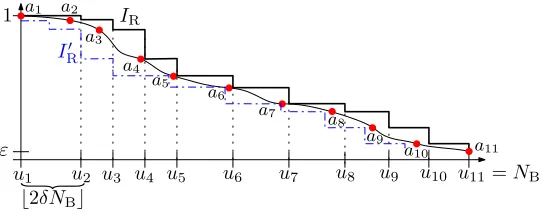
Figure 1: An illustration of the original distribution of sizes of big items inIB, depicted by a smooth curve,
and the distribution of item sizes in the rounded instanceIR, depicted by a bold “staircase” function. The
distribution of IR0 (which is IR without the b4δNBc biggest items) is depicted a (blue) dash dotted line.
Selected itemsai, . . . , aq, withq= 11, are illustrated by (red) dots, and the upper boundsu1, . . . , uqon the ranks appear on thexaxis.
practice the space used is observed to scale linearly with 1δ [36]. (Note that an offline optimal data structure
forδ-approximate quantiles uses spaceO1
δ
.) We use data structure Q(δ)to construct our algorithm for processing the streamIBof big items.
Simple rounding algorithm. We begin by describing a simpler solution with δ = 14ε2, resulting in a rounded instance withOe(1
ε2)item sizes. Subsequently, we introduce a more involved solution with smaller
space cost. The algorithm uses a quantile summary structure to determine the rounding scheme. Given a (big) item si from the input, we insert it intoQ(δ). After processing all items, we extract fromQ(δ) the set of stored input items (i.e., their sizes) together with upper bounds on their rank (where the largest size has highest rank 1, and the smallest size has least rankN). Note that the number NB of big items in IB
is less than 1εSIZE(IB) ≤ ε1OPT(IB) as each is of size more than ε. Let q be the number of items (or
tuples) extracted fromQ(δ); we get thatq =O(1δ ·logδNB) = O ε12 ·log(ε·OPT(IB)). Let(a1, u1 =
1),(a2, u2), . . . ,(aq, uq =NB)be the output pairs of an item size and the bound on its rank, sorted so that
a1 ≥a2 ≥ · · · ≥aq. We define the rounded instanceIR with at mostqitem sizes as follows: IR contains
(uj+1−uj)items of sizeajfor eachj= 1, . . . , q−1, plus one item of sizeaq. (See Figure 1.)
We show that the desired properties (P1)-(P4) hold withσ = q. Property (P1) follows easily from the definition ofIR and the design of data structureQ(δ). Note that the number of items is preserved. To show
(P2), suppose for a contradiction that thei-th biggest item inIBis bigger than thei-th biggest item inIR,
whose size isaj forj = 1, . . . , q−1, i.e.,i ∈[uj, uj+1) (note thatj < q asaq is the smallest item inIB
and is present only once inIR). We get that the rank of itemaj inIBis strictly more thani, and asi≥uj, we get a contradiction with the fact thatuj is a valid upper bound on the rank ofaj inIB.
Next, we give bounds forOPT(IR) and SIZE(IR), which are required by properties (P3) and (P4).
We pack the b4δNBc biggest items inIR separately into “extra” bins. Using the choice of δ = 14ε2 and
NB ≤ 1εSIZE(IB), we bound the number of these items and thus extra bins by4δNB ≤ ε·SIZE(IB) ≤
ε·OPT(IB). LetIR0 be the remaining items inIR. We claim that that thei-th biggest itembiinIBis bigger
than thei-th biggest item inIR0 with size equal toaj forj = 1, . . . , q. For a contradiction, suppose that bi < aj, which implies that the rankrj ofajinIBis less thani. Note thatj < qasaqis the smallest item in IB. Since we packed theb4δNBcbiggest items fromIRseparately, one of the positions ofaj in the ordering ofIRisi+b4δNBcand so we havei+b4δNBc < uj+1 ≤uj +b2δNBc, where the first inequality holds
by the construction ofIR and the second inequality is by the design of data structureQ(δ). It follows that
i < uj− b2δNBc. Combining this withrj < i, we obtain that the rank ofajinIBis less thanuj− b2δNBc,
which contradicts thatuj− b2δNBcis a valid lower bound on the rank ofaj.
OPT(IR0 )+b4δNBc ≤OPT(IB)+ε·OPT(IB), proving property (P3). Similarly,SIZE(IR)≤SIZE(IR0 )+
b4δNBc ≤SIZE(IB) +ε·SIZE(IB), showing (P4).
Better rounding algorithm. Our improved rounding algorithm reduces the number of sizes in the rounded instance (and also the memory requirement) from Oe(1
ε2)to Oe(1
ε). It is based on the observation that the number of items of sizes close toεcan be approximated with much lower accuracy than the number of items with sizes close to 1, without affecting the quality of the overall approximation. This was observed already by Karmarkar and Karp [33].
The rounding and its analysis is fully described in Appendix A.1 which also gives the proof of Lemma 1. Here, we give a brief overview. Big items are split into groups based on size such that for an integerj ≥1, thej-th group contains items with sizes in(2−j−1,2−j]. Thus, there aredlog2 1εegroups. For each groupj, we use a separate data structureQj :=Q(δ)withδ= 18ε.
After all items arrive, we extract stored items from each data structureQjand create the rounded instance for each group as in the previous section. Then, the input summary is just the union of the rounded instances over all groups. We show that properties (P1)-(P4) hold for the input summary in a similar way as for the simple rounding algorithm, also using the following observation: LetNj be the number of big items in group j. ThenSIZE(IB)>P
jNj·2−j−1. This holds as any item in groupjhas size exceeding2−j−1.
3.2 Bin Packing and Quantile Summaries
In the previous section, the deterministic quantile summary data structure from [26] allows us to obtain a streaming approximation scheme for BINPACKING. We argue that this connection runs deeper.
We start with different scenarios for which there exist better quantile summaries. First, if all big item sizes belong to a universe U ⊂ (ε,1], then it can be better to use the quantile summary of Shrivastava et al. [39], which provides a guarantee of O(1δ ·log|U|) on the space complexity, where δ is the precision requirement. Thus, by usingkcopies of this quantile summary in a similar way as in Section 3.1, we get a streaming1 +ε-approximation algorithm for BINPACKINGthat runs in spaceO(ε1·log1ε ·log|U|).
Second, if we allow the algorithm to use randomization and fail with probability γ, we can employ the optimal randomized quantile summary of Karnin, Lang, and Liberty [34], which, for a given preci-sionδ and failure probabilityη, uses spaceO(δ1 ·log logη1)and does not provide aδ-approximate quantile for some quantile query with probability at most η. In particular, using k copies of their data structure with precision δ = Θ(ε) and failure probabilityη = γ/k, similarly as in Section 3.1, gives a streaming
1 +ε-approximation algorithm for BINPACKINGwhich fails with probability at mostγ and runs in space O1ε ·log1ε ·log log(log1ε/γ).
More intriguingly, the connection between quantile summaries and BINPACKINGalso goes in the other direction. Namely, we show that a streaming1 +ε-approximation algorithm for BINPACKING with space bounded byS(ε,OPT)(orS(ε, N)) implies a data structure of sizeS(ε, N)for the following ESTIMATING
RANKproblem: Create a summary of a stream ofN numbers which is able to provide aδ-approximate rank of any query q, i.e., the number of items in the stream which are larger thanq, up to an additive error of ±δN. A summary for ESTIMATINGRANKis essentially a quantile summary and we can actually use it to
find an approximate quantile by doing a binary search over possible item names. However, this approach doesnotguarantee that the item name returned will correspond to one of the items present in the stream.
The reduction from ESTIMATINGRANKto BINPACKINGgoes as follows: Suppose that all numbers in
same bin, so we must open at least2N bins, two for each ofa1, . . . , aN. Since 12 >(1−q)> 13, andai> 12, we can place at most one of the2N items of size(1−q)in a bin withaiin it, provided thatai+ (1−q)≤1, i.e.ai≤q. Thus, we can pack a number of the(1−q)-sized items, equivalent to2(N−rank(q)), in the first 2N bins. This leaves2 rank(q)items, all of size(1−q). We pack these optimally intorank(q)additional bins, for a total of2N + rank(q)bins.
We claim that a1 +ε-approximation of the optimum number of bins provides a4ε-approximate rank of
q. Indeed, letm be the number of bins returned by the algorithm and letr = m−2N be the estimate of
rank(q). We have that the optimal number of bins equals 2N + rank(q)and thus2N + rank(q) ≤ m ≤ (1 +ε)·(2N + rank(q)) +o(N). By usingr=m−2N and rearranging, we get
rank(q)≤r≤rank(q) +εrank(q) + 2εN+o(N).
Since the right-hand side can be upper bounded byrank(q) + 4εN (provided thato(N) < εN),r is a4ε -approximate rank ofq. Hence, the memory state of an algorithm for BINPACKINGafter processing the first
2N items (of sizesa1, . . . , aN) can be used as a data structure for ESTIMATINGRANK.
In [15] we show a space lower bound ofΩ(1ε·logεN)for comparison-based data structures for ESTIM
-ATINGRANK(and for quantile summaries as well).
Theorem 3(Theorem 13 in [15]). For any0 < ε < 161, there is no deterministic comparison-based data
structure forESTIMATINGRANKwhich storeso1ε·logεNitems on any input stream of lengthN.
We conclude that there is no comparison-based streaming algorithm for BIN PACKING which stores
o(1ε·logOPT)items on any input stream (recall thatN =O(OPT)in our reduction). Note that our algorithm is comparison-based if we employ the comparison-based quantile summary of Greenwald and Khanna [26], except that it needs to determine the size group for each item, which can be done by comparisons with2−jfor integer values ofj. Nevertheless, comparisons with a fixed set of constants does not affect the reduction from ESTIMATINGRANK(i.e., the reduction can choose an interval to avoid all constants fixed in the algorithm), thus the lower bound ofΩ1ε·logOPTapplies to our algorithm as well. This yields near optimality of our approach, up to a factor ofOlog1ε. Finally, we remark that the lower bound ofΩ(1ε ·log log1δ) for randomized comparison-based quantile summaries [34] translates to BINPACKINGas well.
4
Vector Scheduling
We provide a novel approach for creating an input summary for VECTORSCHEDULING, based on combining small items into containers. Our streaming algorithm stores all big jobs and all containers, created from small items, that are relatively big as well. Thus, there is a bounded number of big jobs and containers, and the space used is bounded as well. We show that this simple summarization preserves the optimal makespan up to a factor of2− 1
m +εfor any0 < ε ≤ 1. Takem ≥ 2, since form = 1there is a trivial streaming algorithm that just sums up the vectors of all jobs to get the optimal makespan. We assume that the algorithm knows (an upper bound on)min advance.
Algorithm description. For 0 < ε ≤ 1 and m ≥ 2, the algorithms works as follows: For each k = 1, . . . , d, it keeps track of the total load of all jobs in dimension k, denoted Lk. Note that the optimal makespan satisfiesOPT≥maxkm1 ·Lk. Assume for simplicity that when a new job arrives,maxkm1 ·Lk= 1; if not, we rescale every quantity by this maximum. Hence, the optimum makespan for jobs that arrived so far is at least one, whileLk≤mfor anyk= 1, . . . , d(an alternative lower bound onOPTis the maximum `∞norm of a job seen so far, but our algorithm does not use this).
Letγ = Θε2/logdε2; the constant hidden inΘfollows from the analysis below. We also ensure that
γ ≤ 1
4ε. We say that a job with vectorvisbigifkvk∞ > γ; otherwise it issmall. The algorithm stores
store any small job directly. Acontaineris simply a vectorcthat equals the sum of vectors for small jobs assigned to this container, and we ensure thatkck∞≤2γ. Furthermore, containercisclosedifkck∞> γ,
otherwise, it is open. As two open containers can be combined into one (open or closed) container, we maintain only one open container. We execute a variant of the NEXT FITalgorithm to pack the containers, adding the incoming small job into the open container, where it always fits as any small vector vsatisfies kvk∞≤γ. All containers are retained in the memory.
When a new small job arrives or when a big job becomes small, we assign it in the open container. If this container becomes closed, we open a new, empty one. Moreover, it may happen that a previously closed container becomes open again. In this case, we combine open containers as long as we have at least two of them. This completes the description of the algorithm. (We remark that for packing the containers, we may also use another, more efficient algorithm, such as FIRST FIT, which however makes no difference in the approximation guarantee.)
Properties of the input summary. After all jobs are processed, we assume again thatmaxkm1 ·Lk= 1, which implies thatOPT ≥ 1. Since any big job and any closed container, each characterized by a vector v, satisfy kvk∞ > γ, it holds that there are at most 1γ ·d·m big jobs and closed containers. As at most
one container remains open in the end and any job or container is described bydnumbers, the space cost is O1
γ ·d2·m
=O1
ε2 ·d2·m·logdε
.
We now analyze the maximum approximation factor that can be lost by this summarization. LetIR be
the resulting instance formed by big jobs and containers with small items (i.e., the input summary), and let
I be the original instance, consisting of jobs in the input stream. We show thatOPT(IR) andOPT(I)are
close together, up to a factor of2− 1
m+ε, and an example in Appendix C shows that this bound is tight for our approach. Note, however, that we still need to execute an offline algorithm to get (an approximation of)
OPT(IR), which is not an explicit part of the summary.
The crucial part of the proof is to show that containers for small items can be assigned to machines so that the loads of all machines are nearly balanced in every dimension, especially in the case when containers constitute a large fraction of the total load of all jobs. LetLCk be the total load of containers in dimensionk
(equal to the total load of small jobs). LetIC⊆IRbe the instance consisting of all containers inIR.
Lemma 4. Supposing thatmaxk m1 ·Lk = 1, the following holds:
(i) There is a solution for instanceICwith load at mostmax(12,m1 ·LCk) + 2ε+ 4γ in each dimensionk
on every machine. (ii) OPT(I)≤OPT(IR)≤
2− 1
m+ 3ε
·OPT(I).
Proof. (i) We obtain the solution from the randomized online algorithm by Imet al. [30]. Although this algorithm has ratio O(logd/log logd) on general instances, we show that it behaves substantially better when jobs are small enough. In a nutshell, this algorithm works by first assigning each jobjto a uniformly random machine iand if the load of machineiexceeds a certain threshold, then the job is reassigned by GREEDY. The online GREEDYalgorithm works by assigning jobs one by one, each to a machine so that the makespan increases as little as possible (breaking ties arbitrarily).
LetL0k = max(12,m1 ·LCk). We assume that each machine has its capacity ofL0k+ 2ε+ 4γ in each dimensionksplit into two parts: The first part has capacityL0k+ε+ 2γ in dimensionkfor the containers assigned randomly, and the second part has capacityε+ 2γ in all dimensions for the containers assigned by GREEDY. Note that GREEDYcares about the load in the second part only.
The algorithm assigns containers one by one as follows: For each containerc, it first chooses a machine
As each containerc satisfieskck∞ ≤ 2γ, it holds that randomly assigned containers fit into capacity L0k+ε+ 2γin any dimensionkon any machine. We show that the expected amount of containers assigned by GREEDYis small enough so that they fit into machines with capacity ofε+ 2γ, which in turn implies that
there is a choice of random bits for the assignment so that the capacity for GREEDY is not exceeded. The existence of a solution with capacityL0k+ 2ε+ 4γin each dimensionkwill follow.
Consider a containercand letibe the machine chosen randomly forc. We claim that for any dimension
k, the load on machineiin dimensionk, assigned before processingc, exceedsL0k+εwith probability of at most dε2. To show the claim, we use the following Chernoff-Hoeffding bound:
Fact 5. LetX1, . . . , Xnbe independent binary random variables and leta1, . . . , anbe coefficients in[0,1].
LetX =P
iaiXi. Then, for0< δ≤1andµ≥E[X], it holds thatPr[X >(1+δ)·µ]≤exp
−1 3 ·δ
2·µ.
We use this bound with variable Xc0 for each vector c0 assigned randomly before vector c and not reassigned by GREEDY. We have Xc0 = 1if c0 is assigned on machine i. Let ac0 = 1
2γ ·c 0
k ≤ 1. Let
X = P
c0ac0Xc0 be the random variable equal to the load on machineiin dimensionk, scaled by 1
2γ. It holds thatE[X]≤ m1 ·21γ·L0k·m= 21γ·L
0
k, since each containerc
0is assigned to machineiwith probability
1
mandL 0
k·mis the upper bound on the total load of containers in dimensionk. Using the Chernoff-Hoeffding bound withµ= 21γ ·L0kandδ =ε≤1, we get thatPr[X >(1 +ε)· 1
2γ ·L 0
k]≤exp
−1 3 ·ε
2· 1 2γ ·L
0 k
.
Using γ = Oε2/logdε2andL0k ≥ 12, we obtainexp−13 ·ε2·21γ ·L0k ≤ exp−Ωlogdε2 ≤ dε2,
where the last inequality holds for a suitable choice of the multiplicative constant in the definition ofγ. This is sufficient to show the claim asX >(1 +ε)· 1
2γ ·L 0
kif and only if the load on machineiin dimensionk, assigned randomly beforec, exceeds(1 +ε)·L0k.
By the union bound, the claim implies that each containercis reassigned by GREEDYwith probability at most εd. Let Gbe the random variable equal to the sum of the `1 norms (where kck1 = Pdk=1ck) of containers assigned by GREEDY. Using the linearity of expectation and the claim, we have
E[G]≤Pcεd· kck1 ≤ ε
d·m·d=ε·m,
where the second inequality uses that the total load of containers in each dimension is at mostm. LetµGbe
the makespan of the containers created by GREEDY. Observe that each machine has a dimension with load at leastµG−2γ. Indeed, otherwise, if there is a machineiwith load less thanµG−2γ in all coordinates,
the last containercassigned by GREEDYthat caused the increase of the makespan toµGwould be assigned
to machinei, and the makespan after assigningcwould be smaller thanµG(usingkck∞ ≤2γ). It follows
thatµG−2γ ≤ m1 ·Gand, usingE[G]≤ε·m, we get thatE[µG]−2γ ≤ε. Thus (i) holds.
(ii) The first inequality is straightforward as any solution forIR can be used as a solution forI, just
packing small items first in containers and then the containers according to the solution forIR.
We create a solution ofIR of makespan at most
2− m1 + 3ε·OPT(I)as follows: We take an optimal solutionSB for instanceIR\IC, i.e., for big jobs only, and combine it, in an arbitrary way, with solution
SC for containers from (i), to obtain a solutionS forIR. Letµkbe the largest load assigned to a machine in dimension kin solutionSB; we haveµk ≤ OPT(I). Note that LCk ≤ m−µk, since the total load of big jobs and containers together is at mostm. Consider the load on machineiin dimensionkin solution S. If m1 ·LCk ≥ 1
2, then this load is bounded byµk+ 1
m ·L
C
k + 2ε+ 4γ ≤ µk+ m1 ·(m−µk) + 3ε =
1−m1·µk + 1 + 3ε ≤
2−m1 + 3ε·OPT(I), where the first inequality usesLCk ≤ m−µk and γ ≤ 14ε(ensured by the definition ofγ), and the last inequality holds byµk ≤OPT(I)and1 ≤ OPT(I). Otherwise, m1 ·LCk < 12, in which case the load on machineiin dimensionkis at mostµk+12 + 2ε+ 4γ ≤ (1.5+3ε)·OPT(I)≤(2−1
m+3ε)·OPT(I), using similar arguments as in the previous case andm≥2.
References
[1] S. Albers. Better bounds for online scheduling. SIAM Journal on Computing, 29(2):459–473, 1999.
[2] David Applegate, Luciana S Buriol, Bernard L Dillard, David S Johnson, and Peter W Shor. The cutting-stock approach to bin packing: Theory and experiments. InALENEX, volume 3, pages 1–15, 2003.
[3] Yossi Azar, Ilan Reuven Cohen, Seny Kamara, and Bruce Shepherd. Tight bounds for online vector bin packing. InProceedings of the 25th Annual ACM Symposium on Theory of Computing, STOC ’13, pages 961–970. ACM, 2013.
[4] Yossi Azar, Ilan Reuven Cohen, and Debmalya Panigrahi. Randomized algorithms for online vector load balancing. In Proceedings of the 29th Annual ACM-SIAM Symposium on Discrete Algorithms, SODA ’18, pages 980–991. SIAM, 2018.
[5] J´anos Balogh, J´ozsef B´ek´esi, Gy¨orgy D´osa, Leah Epstein, and Asaf Levin. A new and improved algorithm for online bin packing. In 26th Annual European Symposium on Algorithms (ESA 2018), volume 112 ofLIPIcs, pages 5:1–5:14. Schloss Dagstuhl–Leibniz-Zentrum fuer Informatik, 2018.
[6] J´anos Balogh, J´ozsef B´ek´esi, and G´abor Galambos. New lower bounds for certain classes of bin packing algorithms. Theoretical Computer Science, 440-441:1 – 13, 2012.
[7] Nikhil Bansal, Marek Eli´aˇs, and Arindam Khan. Improved approximation for vector bin packing. InProceedings of the 27th annual ACM-SIAM symposium on Discrete algorithms, SODA ’16, pages 1561–1579. SIAM, 2016.
[8] Nikhil Bansal, Tim Oosterwijk, Tjark Vredeveld, and Ruben van der Zwaan. Approximating vector scheduling: Almost matching upper and lower bounds. Algorithmica, 76(4):1077–1096, Dec 2016.
[9] Tugkan Batu, Petra Berenbrink, and Christian Sohler. A sublinear-time approximation scheme for bin packing. Theoretical Computer Science, 410(47-49):5082–5092, 2009.
[10] Richard Beigel and Bin Fu. A dense hierarchy of sublinear time approximation schemes for bin pack-ing. In Frontiers in Algorithmics and Algorithmic Aspects in Information and Management, pages 172–181. Springer, 2012.
[11] Chandra Chekuri and Sanjeev Khanna. On multidimensional packing problems. SIAM journal on computing, 33(4):837–851, 2004.
[12] Lin Chen, Klaus Jansen, and Guochuan Zhang. On the optimality of approximation schemes for the classical scheduling problem. InProceedings of the 25th Annual ACM-SIAM Symposium on Discrete Algorithms, SODA ’14, pages 657–668. SIAM, 2014.
[13] Henrik I Christensen, Arindam Khan, Sebastian Pokutta, and Prasad Tetali. Approximation and online algorithms for multidimensional bin packing: A survey. Computer Science Review, 24:63–79, 2017.
[14] Edward G. Coffman Jr., J´anos Csirik, G´abor Galambos, Silvano Martello, and Daniele Vigo. Bin pack-ing approximation algorithms: Survey and classification. InHandbook of Combinatorial Optimization, pages 455–531. Springer New York, 2013.
[15] Graham Cormode and Pavel Vesel´y. Tight Lower Bound for Comparison-Based Quantile Summaries.
[16] Gy¨orgy D´osa and Jiˇr´ı Sgall. First Fit bin packing: A tight analysis. In30th International Symposium on Theoretical Aspects of Computer Science (STACS 2013), volume 20 ofLIPIcs, pages 538–549. Schloss Dagstuhl–Leibniz-Zentrum fuer Informatik, 2013.
[17] Bj¨orn Feldkord, Matthias Feldotto, Anupam Gupta, Guru Guruganesh, Amit Kumar, S¨oren Riechers, and David Wajc. Fully-dynamic bin packing with little repacking. In45th International Colloquium on Automata, Languages, and Programming (ICALP 2018), volume 107 ofLIPIcs, pages 51:1–51:24. Schloss Dagstuhl–Leibniz-Zentrum fuer Informatik, 2018.
[18] W. Fernandez de la Vega and G.S. Lueker. Bin packing can be solved within 1 + ε in linear time.
Combinatorica, 1(4):349–355, 1981.
[19] Rudolf Fleischer and Michaela Wahl. On-line scheduling revisited. Journal of Scheduling, 3(6):343– 353, 2000.
[20] Michael R Garey, Ronald L Graham, David S Johnson, and Andrew Chi-Chih Yao. Resource con-strained scheduling as generalized bin packing.Journal of Combinatorial Theory, Series A, 21(3):257– 298, 1976.
[21] Michael R Garey and David S Johnson. Computers and intractability: a guide to the theory of NP-completeness. Freeman, 1979.
[22] Paul C Gilmore and Ralph E Gomory. A linear programming approach to the cutting-stock problem.
Operations research, 9(6):849–859, 1961.
[23] Paul C Gilmore and Ralph E Gomory. A linear programming approach to the cutting stock prob-lem—part ii.Operations research, 11(6):863–888, 1963.
[24] Michel X. Goemans and Thomas Rothvoß. Polynomiality for bin packing with a constant number of item types. InProceedings of the 25th Annual ACM-SIAM Symposium on Discrete Algorithms, SODA ’14, pages 830–839. SIAM, 2014.
[25] Todd Gormley, Nicholas Reingold, Eric Torng, and Jeffery Westbrook. Generating adversaries for request-answer games. InProceedings of the 11th ACM-SIAM Symposium on Discrete Algorithms, SODA ’00, pages 564–565. SIAM, 2000.
[26] Michael Greenwald and Sanjeev Khanna. Space-efficient online computation of quantile summaries. InProceedings of the ACM SIGMOD International Conference on Management of Data, SIGMOD ’01, pages 58–66, November 2001.
[27] D. G. Harris and A. Srinivasan. The Moser-Tardos framework with partial resampling. In2013 IEEE 54th Annual Symposium on Foundations of Computer Science, FOCS ’13, pages 469–478, Oct 2013.
[28] Rebecca Hoberg and Thomas Rothvoss. A logarithmic additive integrality gap for bin packing. In
Proceedings of the 28th Annual ACM-SIAM Symposium on Discrete Algorithms, SODA ’17, pages 2616–2625. SIAM, 2017.
[29] J.F. Rudin III. Improved bounds for the on-line scheduling problem. PhD thesis, The University of Texas at Dallas, 2001.
[31] Klaus Jansen, Kim-Manuel Klein, and Jos´e Verschae. Closing the gap for makespan scheduling via sparsification techniques. In43rd International Colloquium on Automata, Languages, and Program-ming (ICALP 2016), volume 55 ofLIPIcs, pages 72:1–72:13. Schloss Dagstuhl–Leibniz-Zentrum fuer Informatik, 2016.
[32] David S. Johnson. Fast algorithms for bin packing. Journal of Computer and System Sciences, 8:272– 314, 1974.
[33] Narendra Karmarkar and Richard M. Karp. An efficient approximation scheme for the one-dimensional bin-packing problem. In23rd Annual Symposium on Foundations of Computer Science, SFCS ’82, pages 312–320, Nov 1982.
[34] Z. Karnin, K. Lang, and E. Liberty. Optimal quantile approximation in streams. In2016 IEEE 57th Annual Symposium on Foundations of Computer Science (FOCS), pages 71–78, Oct 2016.
[35] C. C. Lee and D. T. Lee. A simple on-line bin-packing algorithm. J. ACM, 32:562–572, July 1985.
[36] Ge Luo, Lu Wang, Ke Yi, and Graham Cormode. Quantiles over data streams: Experimental compar-isons, new analyses, and further improvements. The VLDB Journal, 25(4):449–472, August 2016.
[37] Andrew McGregor. Graph stream algorithms: A survey. SIGMOD Rec., 43(1):9–20, May 2014.
[38] Shanmugavelayutham Muthukrishnan. Data streams: Algorithms and applications. Foundations and TrendsR in Theoretical Computer Science, 1(2):117–236, 2005.
[39] Nisheeth Shrivastava, Chiranjeeb Buragohain, Divyakant Agrawal, and Subhash Suri. Medians and beyond: New aggregation techniques for sensor networks. InProceedings of the 2nd International Conference on Embedded Networked Sensor Systems, SenSys ’04, pages 239–249. ACM, 2004.
A
Omitted Proofs from Section 3
A.1 Proof of Lemma 1
Lemma 1. Given a steamIBof big items, there is a deterministic streaming algorithm that outputs aHIGH
-MULTIPLICITYBINPACKINGinstance satisfying (P1)-(P4) withσ=O
1
ε·log
1
ε·logOPT(IB)
.
Proof. Letk=dlog2 1εe. We first group big items inkgroups0, . . . , k−1by size such that in groupjthere are items with sizes in (2−j−1,2−j]. That is, the size intervals for groups are (0.5,1],(0.25,0.5], etc. Let
Nj,j= 0, . . . , k−1, be the number of big items in groupj; clearly,Nj <2j+1SIZE(IB)≤2j+1OPT(IB).
Note that the total size of items in groupjis in(2−j−1·Nj,2−j ·Nj]. Summing over all groups, we get in particular that
SIZE(IB)>
k
X
j=0
Nj
2j+1 . (1)
For each groupj, we use a separate data structureQj :=Q(δ)withδ = 18ε, whereQ(δ)is the quantile summary from [26] with precision δ. So when a big item of size si arrives, we find j such that si ∈ (2−j−1,2−j]and insertsi intoQj. After processing all items, for each groupj, we do the following: We extract fromQj the set of stored input items (i.e., their sizes) together with upper bounds on their rank. Let (aj1, uj1 = 1),(aj2, uj2), . . . ,(ajqj, ujqj = Nj)be the pairs of an item size and the upper bound on its rank in
groupj, ordered as in the simpler algorithm so thataj1 ≥aj2≥ · · · ≥ajqj. We have
qj =O
1
δ ·logδNj
=O
1
ε·log
ε·2j+1OPT(IB)
=O
1
ε·logOPT(IB)
,
sinceε2j ≤ε2k≤1.
An auxiliary instanceIRj is formed by(uji+1−uij)items of sizeaifori= 1, . . . , qj−1plus one item of sizeaqj. To create the rounded instanceIR, we take the union of all auxiliary instancesI
j
R,j= 0, . . . , k−1.
Note that the number of item sizes inIRis
σ ≤
k−1
X
j=0
qj = k−1
X
j=0
O
1
ε·logOPT(IB)
=O
k
ε ·logOPT(IB)
=O
1
ε ·log 1
ε·logOPT(IB)
.
We show that the desired properties (P1)-(P4) are satisfied. Property (P1) follows easily from the defini-tion ofIR as the union of instancesIRj and the design of data structuresQj. To see property (P2), for every groupj, it holds that thei-th biggest item in groupjinIRis at least as large as thei-th biggest item in group
jinIB. Indeed, for anyp= 0, . . . , qj,upj is a valid upper bound on the rank ofajpin groupjinIBand ranks
of items of size ajp in groupj in IR are at least ujp. Moreover, the number of items is preserved in every group. Hence, overall, thei-th biggest item inIR cannot be smaller than thei-th biggest item inIB.
Next, we prove properties (P3) and (P4), i.e., the bounds onOPT(IR)and onSIZE(IR). For each group
j, we pack theb4δNjcbiggest items inIR with size in groupjinto “extra” bins, each containing2j items,
except for at most one extra bin which may contain fewer than2jitems. This is possible as any item in group
jhas size at most2−j. Using the choice ofδ= 18εand (1), we bound the total number of extra bins by
k X j=0 4δN j 2j
≤4·1 8ε·
k
X
j=0
Nj 2j +k≤
1
2ε·2·SIZE(IB) +k≤ε·OPT(IB) +k . (2)
LetIR0 be the remaining items inIR. Consider groupjand letIB(j)andIR0 (j)be the items with sizes
in (2−j−1,2−j]in I
as large as the i-th biggest item in IR0 (j) with size equal to ap for p = 1, . . . , qj. For a contradiction, suppose thatbi < ap, which implies that the rankrp ofap inIB(j)is less than i. Note thatp < qj asaqj is the smallest item inIB(j). Since we packed the largestb4δNjc items fromIR(j) separately, we have
i+b4δNjc < up+1 ≤ up +b2δNjc, where the last inequality is by the design of data structure Qj. It follows thati < up− b2δNjc. Combining it withrp < i, we obtain that the rank ofapinIB(j)is less than
up− b2δNjc, which contradicts thatup− b2δNjcis a valid lower bound on the rank ofap. Hence, the claim holds for any group and it immediately impliesOPT(IR0 )≤OPT(IB)andSIZE(IR0 )≤SIZE(IB).
Combining with (2), we get thatOPT(IR)≤OPT(IR0 ) +ε·OPT(IB) +k≤(1 +ε)·OPT(IB) +k,
thus (P3) holds. Similarly, to bound the total wasted space, observe that the total size of items ofIRthat are
not inIR0 is bounded by
k
X
j=0
4δNj 2j ≤4·
1 8ε·2·
k
X
j=0
Nj
2j+1 ≤ε·SIZE(IB),
where we use (1) in the last inequality. We obtain thatSIZE(IR) ≤SIZE(IR0 ) +ε·SIZE(IB)≤(1 +ε)·
SIZE(IB).We conclude that properties (P1)-(P4) hold for the rounded instanceIR.
A.2 Proof of Lemma 2
Lemma 2. LetI be given as a stream of items. Suppose that0 < ε ≤ 1
3, that the rounded instanceIR, created fromI, satisfies properties (P1)-(P4), and that the solutionSofIR uses at mostOPT(IR) +σbins. LetALG(I)be the number of bins that our algorithm outputs. Then, it holds thatOPT(I) ≤ ALG(I) ≤ (1 + 3ε)·OPT(I) +σ+Olog1ε.
Proof. We analyze the two cases of the algorithm:
Case s ≤ W: In this case, small items fit into the bins of S and ALG(I) = |S|. For the inequality
OPT(I)≤ALG(I), observe that the packingScan be used as a packing of items inIB(in a straightforward
way) with no less free space for small items by property (P2). ThusOPT(I)≤ |S|. To upper boundALG(I), note that
|S| ≤OPT(IR) +σ ≤(1 +ε)·OPT(IB) +O
log1 ε
+σ≤(1 +ε)·OPT(I) +O
log1 ε
+σ ,
where the second inequality follows from property (P3) and the third inequality holds asIBis a subinstance
ofI.
Cases > W: Recall thatALG(I) =|S|+ds0/(1−ε)e. We again have thatS can be used as a packing of
IBwith no less free space for small items. Thus, the total size of small items that do not fit into bins inS is
at mosts0and these items clearly fit intods0/(1−ε)ebins. Hence,OPT(I)≤ |S|+ds0/(1−ε)e.
For the other inequality, consider starting with solutionS forIR, first to (almost) fill up the bins ofS
with small items of total sizeW, then usingds0/(1−ε)eadditional bins for the remaining small items. Note that in each bin, except the last one, the unused space is less thanε, thus the total size of items inIR and
small items is more than(ALG(I)−1)·(1−ε). Finally, we replace items inIRby items inIBand the total
size of items decreases bySIZE(IR)−SIZE(IB)≤ε·SIZE(IB)≤ε·SIZE(I)by property (P4). Hence,
SIZE(I)≥(ALG(I)−1)·(1−ε)−ε·SIZE(I). Rearranging and usingε≤ 13, we get
ALG(I)≤ 1 +ε
1−ε·SIZE(I) + 1≤(1 + 3ε)·OPT(I) + 1.
B
Vector Bin Packing
As already observed by Fernandez de la Vega and Lueker [18], a1 +ε-approximation algorithm for (scalar) BINPACKINGimplies ad·(1 +ε)-approximation algorithm for VECTORBINPACKING, where items are
d-dimensional vectors and bins have capacityd in every dimension. Indeed, we split the vectors into d
groups according to the largest dimension (chosen arbitrarily among dimensions that have the largest value) and in each group we apply the approximation scheme for BIN PACKING, packing just according to the largest dimension. Finally, we take the union of opened bins over all groups. Since the optimum of the BIN
PACKINGinstance for each group is a lower bound on the optimum of VECTORBINPACKING, we get that that the solution is ad·(1 +ε)-approximation.
This can be done in the same way in the streaming model. Hence there is a streaming algorithm for VECTOR BIN PACKING which outputs ad·(1 +ε)-approximation ofOPT, the offline optimal number of bins, usingOdε·log1ε ·logOPTmemory. By scalingε, there is ad+ε-approximation algorithm with
e
O(dε2)memory. We can, however, do better by one factor ofd.
Theorem 6. There is a streaming d+ε-approximation for VECTOR BIN PACKING algorithm that uses
Od ε·log
d
ε ·logOPT
memory.
Proof. Given an input stream I of vectors, we create an input stream I0 for BIN PACKING by replacing
each vectorvby a single (scalar) itemaof sizekvk∞. We use our streaming algorithm for BINPACKING
with precision δ = εd which uses Oδ1·log1δ ·logOPT memory and returns a solution with at most
B = (1 +δ)·OPT(I0) +Oe(1
δ)scalar bins. Clearly,B bins are sufficient for the streamI of vectors, since in the solution forI0we replace each item by the corresponding vector and obtain a valid solution forI.
Finally, we show that(1 +δ)·OPT(I0) +Oδ(1)≤(d+ε)·OPT(I) +Oe(dε)for which it is sufficient to
prove thatOPT(I0)≤d·OPT(I)asδ= dε. Namely, from an optimal solutionSforI, we create a solution forI0 with at mostd·OPT(I)bins. For each binB inS, we split the vectors assigned toB intodgroups according to the largest dimension (chosen arbitrarily among those with the largest value) and for each group
iwe create binBiwith vectors in groupi. Then we just replace each vectorvby an item of sizekvk∞and
obtain a valid solution forI0with at mostd·OPT(I)bins.
Interestingly, a better than d-approximation using sublinear memory, which is rounding-based, is not possible, due to the following result in [7]. (Note that the result requires that the numbers in the input vectors can take arbitrary values in[0,1], i.e., vectors do not belong to a bounded universe.)
Theorem 7 (Implied by the proof of Theorem 2.2 in [7]). Any algorithm for VECTOR BINPACKINGthat rounds up large coordinates of vectors too(N/d)types cannot achieve better thand-approximation, where
N is the number of vectors.
It is an interesting open question whether or not we can design a streamingd+ε-approximation with
o(dε)memory or even withOe
d+1εmemory.
C
Tight Example for the Algorithm for Vector Scheduling
For anym≥2, we present an instanceIind=m+ 1dimensions such thatOPT(I) = 1, butOPT(IR)≥
2−m1, whereIRis the instance created by our algorithm described in Section 4.