1;--1156
VJ
3S~rNVS
May,
1969
69ZTN*
IS
13~VW S OtT
"TOI0
5£969 E921
J3S
SlVJIODI 3d
CD
(AW, COME ON ...
J
ARE YOU USING A
TIME- SHARING COMPUTER?
Would you like to plot out reams and reams
of numerical data quickly and easily? The
C0MPL0~mprovides
meaningful plots of every
kind of data-from engineering designs and
scientific formulas to financial curves and
other business information. The data you are
now receiving on a TTY can be easily and
prof-itably turned into graphic form using the all
new
C0MPLf,!1~mdigitalplotting system. Why not
"Cf,!1MPLf,!1l;mWITH US"?
DO YOU HAVE A SMALL
OR MEDIUM-SIZE COMPUTER?
For fast, direct plotting from a small or
medium-sized computer, you can't do better
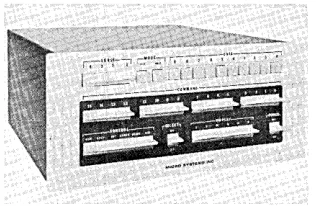
than the C0MPL01;m DP-1 Digital Plotter. It
plots up to 300 increments of data per second
on
II"
x 144' Z-fold chart paper. Used on line,
the DP-1 plugs directly into your existing
com-puter interface without modification.
House-keeping software provided and updated for
five years free of charge.
CAN YOU USE SOME PLOTTING
HELP WITH YOUR
MEDIUM-SIZE OR LARGE COMPUTER?
Here is the off-line digital plotting system for
fast, accurate plots. Designed to accept
8;12"
tape reels directly from your computer, the
MTR-1 is a "load and go" unit using single
capstan drive, that plots quickly on
II"
x 144'
Z-fold chart paper. You eliminate data
inter-pretation when you plot in easy-to-use graphic
form. Housekeeping software is provided for
no additional cost.
"C0MPLflS~mWITHUS."
I
~ ,\
Y·'-
DlJ@(1[]@~@[fiI
I
DIVISION OF BAUSCH&LOMB(i)InSTrument
4950 TERMINAL AVENUE. BE:LLAIRE. TEXAS 77401 (713) 667-7403 CABLE HOINCO
Designate No. 39 on Reader Service Card
4
1
less
than.
meent per bit
Magnafile 9330 Memory System
With ten million bit capacity, this new third generation Magnafile memory system paces the field in both economy and reliability. With its head-per-track system, the Magna-file 9330 gives you an average access time of 8.3 or 16.6 milliseconds and the flexibility to meet your application. Write or call for more information - it's credible.
MAGNAFllE
Magnafile, Inc.
2987 West Fairmount Ave. Phoenix, Arizona 85017 Telephone: (602) 266-4416
Designate No. 32 on Reader Service Card
Vol. 18, No. 5 - May, 1969
Editor
Associate Editor
Edmund C. Berkeley
Sharry Langdale
Assistant Editors Software Editor
Moses M. Berlin Linda Ladd Lovett Neil D. Macdonald
Stewart B. Nelson
Market Research Director I. Prakash
Advertising Director Bernard Lane
Art Directors Ray W. Hass Daniel T. Langdale
Contributing Editors John Bennett
Advisory Committee
Fulfillment Manager
Andrew D. Booth John W. Carr III Ned Chapin Alston S. Householder Peter Kugel Leslie Mezei Rod E. Packer Ted Schoeters
T. E. Cheatham, Jr. James J. Cryan Richard W. Hamming Alston S. Householder Victor Paschkis
William J. McMillan
Advertising Representatives
NEW YORK 10018, Bernard Lane
37 West 39 St., 212·279-7281
CHICAGO 60611, Cole, Mason, and Deming
221 N. LaSalle St., Room 856, 312-641-1253
PASADENA, CALIF. 91105, Douglas C. Lance
562 Bellefontaine St., 213-682-1464
ELSEWHERE, The Publisher Berkeley Enterprises, Inc.
815 Washington St., 617-332-5453 Newtonville, Mass. 02160
Editorial Offices
BERKELEY ENTERPRISES, INC.
815 WASHINGTON STREET, NEWTONVILLE, MASS. 02160
CIRCULATION AUDITED BY AUDIT BUREAU OF CIRCULATIONS
Computers and Automation is published 13 times a year (12 monthly issues plus an annual directory issue published in June) at 815 Washington St., Newtonville, Mass. 02160, by Berkeley Enterprises, Inc. Printed in U.S.A. Subscription rates: United States, $18.50 for 1 year, $36.00 for 2 years, including annual di- ,-"" rectory issue - $9.50 for 1 year, $18.00 for tl""'O years without annual directory; Canada, add , I
a year for postage; Foreign, add $3.50 a year '
l~:t~gn~~rp~~~~~s~n~:~ ~i~' ~ua~hci~gn~n ST.~iIN!~'tO~~!i;i;:
Mass. 02160; address all European subscription I 1ail
to: Box 52, 6354 Vitznau, Switzerland. Second CI.~ss
Postage paid at Boston, Mass. • Postmaster: Please send all forms 3579 to Berkeley Enterprises, Inc., 815 Washington St., Newtonville, Mass. 02160. © Copyright, 1969, by Berkeley Enter-prises, Inc.
Change of address: If your address changes, please send us both your new address and your old address (as it appears on the magazine address imprint), and allow three weeks for the change to be made.
COMPUTERS and AUTOMATION for May, 1969
computers
and automation
Vol. 18, No.5, May, 1969 The magazine of the design, applications, and implications of information processing systems.
Special Feature:
Data Communications
22 COMPUTERS AND COMMUNICATIONS: COMPLEMENTING
TECHNOLOGIES
by Dr. Ervin K. Dorff
A "distributed" computer system is recommended as the best way to get the proper information to the proper place at the proper time.
24 COMMON CREATION AND OWNERSHIP OF MASSIVE DATA BANKS
by William C. Crutcher
How co-operative data banks - privately created, but administered under government agencies - might solve many of the problems inherent in very large data banks.
28 NEW VARIABLES IN THE DATA PROCESSING EQUATION
by C. S. Pedler
How does a company need to change in order to implement a successful communica-tions system?
33 PREPARING FOR DATA COMMUNICATIONS
by George O'Toole
Some new ideas that need to become as much a part of data communication systems as new equipment.
36 A GLIMPSE AT THE FUTURE OF DATA COMMUNICATIONS
by Richard P. Rifenburgh
The current communications market handles three basic types of information: message information, data information, and "hybrid" information. What will the future market be like?
38 THE IMPACT OF STANDARDS
by Gilbert E. Jones, Sr.
Who are the people responsible for standards in data processing - and are they meeting this responsibility?
Regular Features
Editorial
6 The Cult of the Expert, by Edmund C. Berkeley
Computer Market Report
43 IBM's New Generation, by I. and U. Prakash
Jobs and Careers in Data Processing
49 Difficult Fences in the Computer Field, by J. R. Birkle
Ideas : Spotlight
50 Augmenting Man Through Teleoperators
C&
A Worldwide52 Report from Great Britain, by Ted Schoeters
Multi-Access Forum
14
18
19
20
20
20 20
53
"Time-Sharing vs. Instant Batch Processing" - Discussion
Proliferation of Bureaucracy, by Philip H. Abelson
Personal Data in Computers - A Discussion in the British Parliament
Computer Time for Boy Scouts, by Lester Freedman
The Computer: New Handmaiden of Aesthetics, by Lawrence Lerner
Computer Art and Music Festival - Call for Contributions
Halt!, by Marshall Rathbun
Who's Who in the Computer Field, 1968-1969 - Entries
COMPUTERS and AUTOMATION for May, 1969
'Modern technology has ap-parently not yet found a replacement for the abacus -the ancient ingenious instru-ment for performing mathe-matical calculations. On the front cover) Miss Patricia Rupert) fourth grade teacher at the Glade View School .• Lower Burrell) Pa.) is showing two of her students, Megan M assarelli and Daniel Squire) how to use an abacus. The school uses the ancient instru-ment to teach modern math in grades one through four.
For a report on a newly de-vela ped "electronic" abacus) and a calculating contest in l.ohich an ancient abacus coin-jJeted with tlze electronic computer) see page 68.
NOTICE
*D ON YOUR ADDRESS IMPRINT MEANS THAT YOUR SUBSCRIP-TION INCLUDES THE COMPUTER DIRECTORY. *N MEANS THAT YOUR PRESENT SUBSCRIPTION DOES NOT INCLUDE THE COM-PUTER DIRECTORY. SEE PAGE 69.
Departments
57 Across the Editor's Desk - Com-puting and Data Processing Newsletter
78 Advertising Index
8 As We Go To Press
75 Book Reviews
54 Calendar of Coming Events
77 Classified Advertisements
72 Computer Census
10 Letters to the Editor
70 New Contracts
71 New Installations
12 New Patents
by Raymond R. Skolnick
55 Numbles
by Neil Macdona Id
46 Problem Corner
by Walter Penney, CDP
76 Proof Goofs
by Neil Macdonald
EDITORIAL
The Cult of the Expert
It is an old human habit, when you are puzzled and do not know what to do, to ask somebody else to say what he thinks about your problem. Out of this perennial situation grows the notorious conflict between the ordinary man and the expert, and the cult of belief in the expert.
The ordinary man says "Should we have an anti-ballistic missile system-what is it any way?" The expert says, "Yes, of course you should. It will cost you a great deal of money; it may not work, but there is a chance that it will increase your security, and you know how dangerous the world is, and besides I am an expert, and I can give you good advice!" Or the ordinary man says, "Should I have a management information system in my business? - I don't really know anything about computers, but everybody around me seems to be getting computers, and here is a statement by the president of a big business firm that I have just read:
If a business does not have a management information system by 1973-1975, the business will just not be able to compete.
And the expert says, "Yes, of course you should. It will cost you a great deal of money; it may not work well for a while at the start, but there is a good chance that it will increase your ability to compete, and you know how danger-ous the world of competition is, and besides I am an expert, and I can give you good advice!"
These dialogs, though slanted and exaggerated, contain some important and interesting questions:
• What is an expert?
• Should you take his advice? How do you judge him? • When should you use common sense, the specialty of the ordinary man - and when should you use exper-tise, the specialty of the expert?
The adjcctive "expert" means "taught by use, practice, or experience", as in an "expert surgeon". The noun "ex-pert" means "an expert or experienced person; hence, one who has special skill or knowledge in a subject; a specialist". The word "cult" means: "1. A system of worship of a deity. Hence, a: The rites of a religion. b: Great devotion to some person, idea, or thing, especially such devotion viewed as an intellectual fad. c: A sect." And so "the cult of the expert" means devotion to the idea that so many questions are so complicated and so difficult that we should regularly and probably always rely on persons with special knowledge or experience to tell us the answers.
In examining the argument between the ordinary man and the expert, several important factors should be remembered. First, no matter how great the expertness of an expert, he is limited in two ways: ( 1) in the field in which he has become experienced; and (2) in the time duration of his experience. Furthermore, once a man becomes classified as an expert, his duties very often change from actual experience in his field, to some kind of sublimation - supervising or reporting or lecturing or something else - in an office in-stead of a laboratory - and so his experience (his expert-ness) is cut off, and his expertness begins withering on the vine. So common sense should be applied to judging the worth of the expert and the soundness of his advice.
*Note: We shall be glad to send a copy of "Right Answers-A Short Guide for Obtaining Them" to any reader who circles No. 3 on the reader's Service Card.
6
Second, the ordinary man himself eventually has to make his own decisions about his own problems on the basis of common sensc. He is more experienced, and therefore more "expert", in his own problems than anybody else. He and not the outside expert has to suffer the losses in the event of wrong decisions. So what the ordinary man regularly needs to apply is a great deal of common sense, including applying it to what the expert advises.
But how does one learn common sense? particularly "en-lightened" common sense?
Some would say "in the school of hard knocks". A good textbook on common sense would be helpful in getting through this school; I have often searched for such a book, but never found one, and so I have begun to put one to-gether; it is tentatively entitled: Common Sense, Elementary
and Advanced. (The effort so far has produced some 90
pages of manuscript and a two-page publication, "Right An-swers - A Short Guide for Obtaining Them". *)
Third, an expert who is engaged in business as an expert, has to gain acceptance for his consulting services by under-taking promotional or selling behavior. A management ex-pert, a computer exex-pert, an expert in operations research, regularly has to have a sales force in order to stay in busi-ness. Every sales force tends to produce a distorted picture of the world, usually not actively untruthful perhaps, but regularly seriously biased in an optimistic direction. For example, over and over again the success of a management information system for a business will not depend nearly as much on the computer system recommended by the expert as it will on the people in the business who implement it: the systems analysts and the department managers whose knowledge and experience are translated into the computer-ized system. Second rate people plus first rate computers make third rate systems. And the ordinary man is likely to be appalled at the results. The expert for a number of reasons may not draw attention to this crucial factor - nor others. An expert is likely to provide biased advice.
Fourth, before any recommendation from an expert is accepted as a basis for a decision by the ordinary man to go ahead, he should decide in what way and over what time he will test or check the recommendation. He should raise the questions, "What are the bad things that can happen? What are the chances that they will happen?", and examine the answers. A recommendation from an expert, if it is accepted, should in general be accepted tentatively, as a basis for experiment, test, feedback, and correction - because it may not be successful in the situation to which it is applied.
And so finally, we can say:
The ordinary man should NEVER BELIEVE AN EX-PERT without arranging for common sense testing of the expert's recommendation, and should always seek to apply enlightened common sense.
e-~c.~
Editor
\
Because The Computer Exchange is the world's leading source for used third generation computers we can back up what we promise.
If you need a 360 of any configuration, at savings up to 25% of new manufacturer-delivered cost, we can deliver. Matter of fact, if you need any kind of second or third generation machine, the same prob-ably holds true.
Why?
Because The Computer Exchange not only buys and sells computers ... it has the biggest inventory on hand anywhere! Machines with proven technical capability. Machines, in many cases, with existing libraries of programs. Savings on purchase. Savings on lead time. Savings on operation. What more could you want? Other than a guarantee that the computer you buy from CEI will live up to its promise. Well, all the machines we sell come with full manufacturer's service. All of them have been under the watchful eye of the man-ufacturer since they left his assembly line.
8
Want delivery the first of next month? Just give us the word.
~COMPUTER
EXCHANGE~
30 East 42nd Street. New York. New York 10017(212) 661-5870
OFFICES IN PRINCIPAL CITIES
Designate No. 30 on Reader Service Card
AS WE GO TO PRESS
THE ASSOCIATION OF INDEPENDENT SOFTWARE COMPANIES CAISC) DECLARED ITSELF IN FAVOR OF COMPLETELY SEP-ARATE PRICING FOR HARDWARE AND SOFTWARE in a formal vote at a meeting in Washington on April 17.
The Association, which is made up of 12 independent programming and consulting companies, also be-lieves that maintenance and educa-tion services, as well as all soft-ware (both systems programming and application programming) should be priced separately.
Richard C. Jones, group presi-dent and presipresi-dent of Applied Data Research, Inc., Princeton, N.J., says a formal position paper will be ready for distribution in about 4 weeks. It will be sent to the Justice Department and to anyone else interested in AISC's position.
HONEYWELL INC. AND AUERBACH CORP. HAVE FORMED AN INDEPENDENT COMPUT-ER SCOMPUT-ERVICE COMPANY that will de-velop advanced information systems for specific industries and busi-nesses. The new company, to be called Honeywell-Auerbach Computer Services, will be an autonomous and independent enterprise that will seek "a significant share" of
the developing market for "dedica-ted" computer information services.
The announcement was made on April 16 by Charles L. Davis, vice president and group executive of Honeywell's Computer and Communica-tions Group, and Issac L. Auerbach, president of Auerbach. The two firms indicated that the market for dedicated computer services is ex-pected to reach $650 million by 1972, compared with a market of ap-proximately $100 million in 1968 and $30 million in 1967.
Unlike general data processing service bureaus, which handle the batch data processing needs of all kinds of customers in a localized area, dedicated service companies design computer systems to serve specific industries, markets, or applications, usually on a regional or nationwide basis. The first Honeywell-Auerbach dedicated serv-ice center is expected to open in 1970.
Honeywell-Auerbach will report-edly have two major advantages in providing its services: (1) a high-ly flexible organizational struc-ture that will permit investment in, as well as internal development
of, new dedicated service ideas or operations; and (2) more advanced and complete range of data manage-ment services for the industries the firm plans to serve.
President of the new firm is Francis A. Rowe, formerly general manager of the Univac Information Services Division. The company's first endeavor, Rowe said, will be the development of a comprehensive line of Automated Industry Manage-ment Services (AIMS) for the $140 billion savings and loan industry. Only about 4% of the nations 62,000 savings and loan ass~ciations are presently automated, according to Rowe.
The new company will be based in Philadelphia. Temporary headquar-ters are at Auerbach's offices at 121 N. Broad St.
THE FULL TEXT OF ALL THE LAWS OF ALL 50 STATES AND THE UNITED STATES CODE have been stored in an infor-mation retrieval system developed by Aspen Systems Corp., PittSburgh, Pa.
The system, called Aspen System 50, works on the basis of key words, rather than indices. Any word or group of words describing a speci-fic law will generate a printout of laws relating to that subj ect. . Printouts can include any or all of the states on any individual question.
John F. Horty, president of As-pen Systems, expects the primary users of the Aspen System 50 will be legislative bodies and govern-ment agencies which are trying to draft new laws, set up guidelines for operating under existing laws, or achieve more uniformity in laws.
THE QUESTION OF WHETHER SICSIC (The Special Interest Committee on the Social Implications of Com-puting Machinery) SHOULD OR COULD HAVE BEEN SUSPENDED has apparently not yet been satisfactorily ans-wered. There will be a meeting for those interested in keeping SICSIC alive (or resurrecting it) in Boston in connection with the Spring Joint Computer Conference. The meeting is to be held on May 14 in Room 204 in the War Me-morial Auditorium where SJCC will be held.
T2018
T103F
T202C
SANGAMODEMS ...
the most complete line
of Bell compatible data sets'
Have you been purchasing data sets here and there? You don't have to! SANGAMO can supply 93% of your data set requirements with guaranteed 8ell compatible units
now.
Check this listing:
103A1
201A1
103A2
201A2
103F2
201A3
20181
201A4
20182
20201
20183
20202
20184
20203
20204
202C1
202C2
202C3
202C4
202C5
202C6
202C7
202C8
401E2
401E3
401E4
401E5
401H1
We can also supply customized variations of these standard sets, with obvious economies for unlimited applications.
Field Service Contracts available on request.
Need Oata Sets? Let's communicate! T69-05
Designate No. 38 on Reader Service Card
T201A
T401E
T2020
T401H
Communication Systems
SANGAMO
Electric Company Springfield, Illinois 62705
DATA COMMUNICATIONS
a new book on the "Principles of Data Communications for Professional Programmers and Systems Analysts" by Ernest Heau & Donald McNelis published by COMPUTER METHODS CORPORATION 866 Third Ave., New York, N.Y. 10022
Hard cover edition with 190 pages,
7" x 10" with glossary and bibliography $10.00 plus small shipping charge (N.Y. residents include appropriate sales tax)
o
Check enclosed (CMC pays shipping)o
Bill meName __________________________ _ Address ________________________ _
___________________ Zip Code ____ _
Designate No. 29 on Reader Service Card
10
Letters To The
E,ditor
Automated Retrieval of
Legal Information
I read Mr. Ratliff's letter on page 10 of the March issue [reprinted below] concerning Mr. Furth's article ("Auto-mated Retrieval of Legal Information: State of the Art") in the December, 1968 issue. For your information, I enclose a release from Mr. Ratliff that was distributed ·at the Annual Meeting of the American Bar Association in August of 1968, describing "a computer program to aid lawyers by indexing legal documents and information" available from his company.
I have no knowledge of whether Mr. Ratliff's system of indexing legal docu-ments is good, bad, or indifferent. How-ever, I feel your readers should be aware that Mr. Ratliff is the proprietor of a commercial package for lawyers, and also that Mr. Furth has been in-timately involved in the development of legal retrieval systems for ten years, particularly the development of the sys-tem now being used by the Federal Government and at least ten states.
ROBERT P. BIGELOW
Hennessy, McCluskey, Earle & Kilburn 28 State St.
Boston, Mass. 02109
Tunnel Vision
I found your editorial, "Tunnel Vi-sion" (January, 1969 issue), extremely interesting. It really tugged at the cul-tural shroud that has been covering my eyes for a long time.
You implied that you knew of several good books that deal with fallacies, and then went on to mention one of these titled Applied Logic.
Vvould you list the other books that you were referring to in the article? I am extremely interested in following through with your idea.
R. C. COTHES
3265 Cuesta Dr. San Jose, Calif. 95122
Ed. Note --I appreciate your kind re-marks very much. Among the books that I would recommend are: (1) Plants, Man and Life by Edgar Ander-son, Univ. of Calif. Press, Berkeley, Calif., 1967, 251 pp. Although this author is writing about botany, actually he is very often talking about science and knowledge in general; I have read the book four times and found it ex-tremely interesting. (2) The Step to Man by John R. Platt, John Wiley &
FIELD
SUPPORT
SERVICES
*
*
*
A Unique Service
To
Manufacturers
Distributors
Users
Providing
Manuals
Test Fixtures
Spare Parts
Analysis
and
COAST
to
COAST
24 Hr. SERVICE
Ie
KEEN
ELECTRDNIC.
For Information:
Contact: Mr. Street Brewer KEEN ELECTRONICS Corp. P.O. Box 9901
292 Commerce Dr. Rochester, N. Y. 14623 (716) 359-1800
Designate No. 28 on Reader Service Card
,"
Sons, New York, N.Y., 1966, 216 pp. A physicist here looks at many im-/Jortant problems outside of physics.
(3) Language, Thought, and Reality
by Benjamin Lee Whorf, John Wiley &
Sons, New York, N.Y., 1956, 278 pp. In this book, the author discusses often whether the language man uses condi-tions, confines, or distorts the thoughts man is able to think.
If I may, I would also like to refer you to one of my own books: A Guide to Mathematics for the Intelligent
Non-mathematician, published by Simon
and Schuster, 1967, 352 pp. In this book, I try to talk about the relation of mathematics to the real world, m which it is found as an activity.
Blind Computer Scientist
Your periodical gave me the first in-spiration several years ago to start on my way to becoming a programmer in spite of the fact that I am blind. When
Computers and Automation published my letter (May, 1966, page 52), a lot of people from all over the world wrote me about their favorable experiences with blind programmers.
At that time computer technology in Hungary was just beginning. Now it is used widely in all branches of indus-try. So I am faced with the next diffi-culty: How to be a blind systems analyst in the area of process control. The help you gave me before en-courages me to ask the following: (1)
\Vhat kinds of experiences have blind system analysts had? How do they work? (2) What kind of bibliography \voldd you advise for me about opera-tion control in the primary metals in-dustry? (3) If possible, could you send me descriptions about process control systems like IBM's OCS (Operation Control System)?
I will be thankful for the needed answers.
GEORGE HOD I
Mechanical Engineer Karpat utca 71a Budapest XIII, Hungary
Ed. Note - We are, of course, replying to Mr. Hodi. And we cordially invite any of our readers who feel they might be helpful to him to write him as well.
A Paid Subscription
When I asked to be put on your subscription list, I asked to be put on your controlled or qualified subscrip-tion list.
I was quite surprised when I received a bill for a one-year subscription, and I delayed payment, thinking you would realize I had wanted to be on a con-trolled subscription list.
When I read the February, 1969
COMPUTERS and AUTOMATION for May, 1969
TELEMATE 300 was designed and developed to specifica·
tions of DACC, a time-sharing computer company that
knows the needs of users.
That's why Telemate 300 is more
compact, more reliable and elegantly
styled.
Top Quality. Competitively Priced
• Easily portable • Data Rate: 300 Baud • Carrier and on/off lights • Highly selective tuned
oscillator circuit • Half/full Duplex • Triple tuned circuitry • AGC circuit
•
• Acoustic isolation min. 20 db • Teletype or EIA
Interface
• Optional: Carrying case, originate/answer, cable interface, loud speaker and RS 232 B
WRITE FOR BROCHURE
Payroll Systems go on-line
faster
with
ALLTAxnl
the software package
available
in
basic
COBOL
for all compilers.
ALL T AX calculates payroll W ri te today for full information:
withholding taxes with one
standard formula and a table of
r
-variables for each state and city.
It eliminates programming of
individual formulas and
substan-tially reduces program
mainte-nance and memory requirements.
ALL T AX is approved by all
states. It's easy to install,
com-pletely tested and documented.
ALLTAX is always
up-to-date. Automatic program
main-tenance for existing withholding
taxes and new taxes is available
a t minimal cost.
Management Infonnation Service P.O. Box 252, Stony Point, N.Y.l0980
Gentlemen:
Please send full details on your ALL TAX software package.
Name _ _ _ _ _ _ _ _ _ _ _
Title _ _ _ _
Company _ _ _ _ _ _ _ _ _ _ _
Address
City _ _ _ _ _ _ _ _ _ _ _ _ _
Find out why more than 100
State Zipcompanies from coast-to-coast
-are using this low-cost package.
L _ _ _ _ _ _ _ _ _ _ _ _ _ _~_'
Management Information Service
Stony Point, N.Y. 109RO • (914) 942-1880
ALLTA.X is available only from Management Information Service and Pro-Data Computer Services.
your best
and fastest
service In
optical
scanning
Our organization is young,
aggressive and manned by
thoroughly experienced data
processing experts. We are
centrally located in Chicago.
Send your source documents
to us by jet aircraft ... they
will be processed and optically
scanned by Control Data 915
... and your fully loaded reels
of tape and source material will
be on their way back to you.
Call us. We are responsive and
completely mobile. We offer
the optimum solution to the
ever-recurring problem of
office overload.
New!
Descriptive
Brochure on
Optical Scanning
---h
A DIVISION OF=
KEY SYSTEMS, INC. 5 SOUTH WABASH AVE.5Giln
CHICAGO, ILL. 60603 PHONE: 312 346-6430YES, we're interested in your optical scanning service. Please send your new descriptive brochure.
NAME COMPANY ADDRESS CITY
STATE ZIP
L _ _ _ _ _ _ _ _ _ _ _ _ _ _ _ _ ~
Designate No. 35 on Reader Service Card
12
Talk to the IBM-360-the
NCR-G. E. - RCA - Etc. with
THE UNIVERSAL LANGUAGE OF COMPUTERS
Secure a higher future for yourself in Data Processing with a complete Home Study Course in COBOL - Set your own time; pace and place. In a short time you can master COBOL. Write for information .about our NEW accredited: home study course.
i:lti
\t~oiliilig i:H.Jt[]moti[]1iili~.
Write Automation Training, Inc. Dept. 14 5701 Waterman' St. Louis, Mo. 63112
Division of Technical Education Corp.
~An itccredlted membf'r National Home Study COllllcil
Designate No, lOon Reader Service Card
"Letters to the Editor" section, I learned that Computers and Automa-tion is a paid subscripAutoma-tion magazine
only. I didn't realize this before that time,
Your magazine is the most educa-tional trade magazine I have read. I'm enclosing remittance for my one-year paid subscription. Please keep my issues ('oming,
STANLEY R. FOSTER
3410 Gunston Rd. Alexandria, Va. 22302
C&A at Sea
I am sending my subscription pay-ment, which I know is late. I am sorry it has taken me so long to attend to this. The mail service for magazines to the Far East is very slow, and it took a long time for me to receive my first issue.
Your publication has been a good morale factor to us in the computer field aboard ship; it keeps us abreast of new developments stateside. I will have the Navy renew the subscription for next year.
DPC JOHN L. GRAFT
U.S.S. Coral Sea CV A-43 CPO Mess
FPO, San Francisco, Calif. 96601
NEW PATENTS
Raymond R. Skolnick Patent Manager Ford Instrument Co. Div. of Sperry Rand Corp. Long Island City, N.Y. 11101
The following is a compilation of patents pertaining to computers and as-sociated equipment from the "Official Gazette of the U. S. Patent Office," dates of issue as indicated. Each entry consists of: patent number / inventor (s) / assignee / invention. Printed copies
I of patents may be obtained from the
U.S. Commissioner of Patents, Wash-ington, D.C. 20231, at a cost of 50 cents each.
January 21, 1969
3,423,736 / William W. Ash, Ithaca, Kurt M. Kosanke, Wappingers Falls, and Glenn T. Sincerbox, Poughkeep-sie, N. Y. / International Business Ma-chines Corporation, New York, N. Y., a corporation of New York / Appara-tus for reading information selectively from storage devices.
3,423,737 / Leonard Roy Harper, San Jose, Calif. / International Business Machines Corporation, Armonk, N. Y., a corporation of New York / Non-destructive read transistor memory cell. 3,423,738 / Raymond H. James, Bloom-ington, and Charles W. Lundberg, St. Paul, Minn. / Sperry Rand Corpora-tion, New York, N. Y., a corporation of Delaware / Magnetic memory com-parator.
3,423,739 / James H. Scheuneman, St. Paul, Minn. / Sperry Rand Corpora-tion, New York, N. Y., a corporation' of Delaware / Nondestructive read memory selection system.
3,423,740 / Euvanl S. Barrekette and Eric Donath, New York, N. Y., and Harold H. Herd, Pacific Grove, Calif. / International Business Machines Corporation, New York, N. Y., a cor-poration of New York / Information handling device.
3,423,741 / Rodger L. Gamblin and Philip A. Lord, Vestal, N. Y. / Inter-national Business Machines Corpora-tion, Armonk, N. Y., a corporation of N ew York / Memory addresser in a microwave readout system.
3,423,744 / Richard K. Gerlach, Gar-dena, Robert A. Melnick, Los Angeles, and Noboru Kimura, Gardena, Calif. / The National Cash Register Company, Dayton, Ohio, a corporation of Mary-land / Binary magnetic recording system.
January 28, 1-969
3,425,041 / Alain Gayet, Paris, France / Societe Industrielle Bull-General Elec-tric (Societe Anonyme), Paris, France / Data storage device.
Three readable
alternatives to
unreadable printout.
If
you're involved in inputting,
editing and updating text material and
formatting it for publication, chances
are you're using a specialized system
such as Datatext, Text 360 or ATS.
This being the case, you're aware of the
basic limitation that exists in all of
these systems ... the inability to
produce output of consistently high
quality on line printers and typewriter
terminals.
TMTEXTRAN is one way you can be
sure of readable output every time.
Quickly. Economically. And with the
degree of graphic arts quality you
desire. All of these things are made
possible through the resolution and
electronic speed of our Cathode Ray
Tube Printer.
There are three ways you can use
TEXTRAN:
1.
Monospace type. It's produced
line-for-line directly from your output
tape without requiring any additional
codes.
2. Proportional space type. It's
produced line-for-line from your output
tape with no additional codes. The
result: up to 50% more characters per
line and fewer pages using proportional
space type.
3. RegularTEXTRAN. You insert
our codes for type size and style and for
format in your output tape. In return
you gain the benefits that varied type
styles can give to printed text.
To learn all about TEXTRAN,
contact Alphanumeric. You have the
best reason in the world for doing it.
More people will read what you print.
Alphanumeric Textran
A Service of Alphanumeric, Inc.
10 Nevada Drive, Lake Success, N.Y. 11040, (516) 437-9000
A POUNDA'1'IOH POR SPECIALIZBD TYPEWRITBR TBRMINAL APPLICATIONS
A'1'S/J60 can provide lIlany of tbe functiona required in IIIlOst. speciali.ed t.ypewriter applJ.cat.ions. '1'be . function. provided I>y ATS/360 (wbicb the user does not need t.o proO'raa' are:
Saooth input procedure. wit.b .asy corrections
Bfficient addit.ions, deletions. and chanO'es to t.he f11e
Disk actions # which include coaplete .aintenance
of an active (workinO') storaO'e and a le •• active (permanent) storage
the A'1'8/360 software provide • • any of the tyinJ.ost online terminal systems. A
1
,.\ FOUNDATION FOlt SP
APPlICAlIONS' EC'AlIZliD TYPEWRITER TERMINAL
:"I'S/,360 I.'an provide many ~lf the ftu\('"1ion$ u' . . . . .
appJ!\:atwlh. The fuo\.'tiuO\ rruvided bv A TS/~ 1t'Cd( ...
!!
~t spctutllCd typewriter program) arc: • - .. ",n b~ u~r d{!Cs not ~'\."d tlISmouth input pnll.1:dure wilh ca-.}' wl'nX'lion)
Etlkient addilion~. delctinm, and t'hangcs to the tile f}i\k actj(Jn~. whK.-h indude (;omptctc .' .
~torage and a Ic~\ at:tiYe In.'rm ma)tntenallC¢ of an actwc (Working)
'1'"
anent slora8('to ~hort the AlSI.l60 ~ftwarc pro\'id¢s
on/me terminal l>y~tcm). A U$C('S in most
:JVSlCtl11/1tlO Auem bJy
A FOUNDATION FOR SPECIAtJUD TYPEWRITER TERMINAL APJlLlCA TlONS
Smoolh input pnx:tdul'f! wilh t'aS)' CQfN('liom
,fEJlic-if!m odiJitiOcIU. at/etiOllS. and cliatfgf!S to l#w Jill!
Dis/( actions. which iMh«ie (~f!U maintenance of an actille (werking) tlQl'Ugt'
and a leu actiw (fJf!I'fM~lfI) slcro~
In ~h()rl. d~ A TS/3€AJ softw~ provides many of the fuooions tl«C!O$3ry in most ooline tcrmln~r s}'JlCm. A user! PfOB1'ammer. ¢xperi¢m:ed in SyslCm/.l6O A"CmbJy
La.nguaF wd1r\8: need o'!'y!'"te these special funetitms, (application pro8rams) re-quited by the \uttquc applatwns. A TS/ll10 4ppIication proarams ate normally rc!Oi-dent 00 disk and calJcd into an (lIen-byte Wf¢ l\r¢a as needed by the control program.
ATS/360,is ~tten to utilize u~r·written programs 1$ welt 1$ its own. In some cases: a
new aoPtlCatlon PrOaram ('an be creJltl!d bv MlIlkin# Ml'Idt&,. ... tk. .. c tn ... ct ... _.
MULTI-ACCESS FORUM
"TIME-SHARING
vs.
INSTANT BATCH PROCESSING" - DISCUSSION
I. From George
w.
Perrett, Jr. Asst. to the PresidentCom-Share Inc.
1919 West Stadium Blvd. Ann Arbor, Mich. 48106
After reading the article, "Time-Sharing vs. Instant Batch Processing: An Experiment in Programmer Training," by Jeanne Adams and Leonard Cohen in the March 1969 issue of Computers and Automation, I am compelled to criticize the article and the study described in it.
One's impression after completing the article is that pro-grammers have a preference for instant batch processing as opposed to time-sharing, even though the authors occasionally allude to the fact that that was not a statistical conclusion:
The number of students participating in the NCAR case study (only eight) might be considered too small a group from which to draw valid conclusions. But a statistical analysis of numbers of events was not the purpose of this study. What the study did emphasize was the personal evaluation by the students of their work, and the aver-ages and the figures showing how the students spent their time on any given day.
Not only was the number of participants just eight, but those eight people were broken into two groups. In addition, the two groups were broken into four different classifications of programming levels. It is further stated in the article that the groups switched computer equipment after one week:
In any future experiment, we would probably not switch computers midstream. Although the change did not seem critical for the experienced participants, it did seem to produce a certain amount of confusion for the rank be-ginners. [All two of them.]
In addition to the sample being as described above, the equipment used was a General Electric 265 computer located in Dallas, Texas, for time-sharing, and a Control Data 6600 computer located at the test center for batch processing. An interesting quote about the equipment being used is:
The batch processing computer went 'down' at times, and the students had to wait for keypunches at peak periods. The time-sharing computer also went 'down' at times, and at peak periods the terminal sent back a busy signal. In both modes the students suffered all the ordi-nary frustrations encountered at any computer facility.
At this point I think it is necessary to comment that the number of times that the batch processing wstem went down and the number of times that the students had to wait for keypunches at "peak periods," the number of times that the time-sharing system went down and the number of times that a busy signal was obtained, arc all meaningful statistics that would directly affect the students' choices of a computing system.
14
In addition, the article alluded to the fact that the students had no preference for the editing features, etc., available in time-sharing. It should be pointed out that the General Elec-tric 265 system mayor may not have had good editing fea-tures at that time, and that the General Electric 265 is not, in fact, representative of all time-sharing systems at the present time for G.E. or for its competitors.
My letter of criticism could go on and on with regard to the number of programs, the various general conclusions drawn, the heavy reliance On statistics although statistics in the study were disavowed, and questioning whether or not those programmers who had experience had experience in time-sharing computers or in batch processing computers, etc., etc.
In general, I do not feel that this article is up to the usual level of Computers and Automation. I also feel that if the authors are truly trying to answer the questions as they indi-cate in the article, they should do a more thorough study.
II. From Allen F. Goldenson, Manager, Technical Services Computer Sharing of Canada 4214 Dundas St. W.
Toronto 18, Ontario
The article "Time-Sharing vs. Instant Batch Processing" in the March, 1969 issue of Computers and Automation was a disgraceful exercise in fallacious extension of maliciously unfair comparisons to the obvious end of discrediting an entire industry.
The "objective measures" utilized in the experiment in-cluded running a CDC 6600, one of the fastest machines available for remote batch processing, against a GE 265, which is, .next to Quiktran's 7044, the slowest time-sharing
computer available.
Further objectivity was ensured by providing a CRT display for the 6600 while retaining a teletype for time-sharing I/O. Even more objective was the use of CDC's Extended FOR-TRAN (IV) as a standard of comparison against GE's rather gross form of FORTRAN II.
And, as if all of that were inadequate, a price comparison at $300 per hour of 6600 time; a rate far from commercially available, against the standard GE rates.
The "results" were indeed predictable.
Since the GE 265 is virtually obsolete; since a vast multi-tude of faster, more versatile time-sharing services exist; and
since the authors, given even a modicum of common sense, could have realized the total futility of this exercise - one can but conclude malicious intent to discredit the time-sharing industry to those (hopefully) few people ignorant enough to accept the article at face value.
It is amazing that the editorial board of Computers and
Automation, by publishing the article, falls into one of the above two categories.
At the very least, a public apology is due.
If you have to service time-sharers
while running batch .
. Get one Sigma.
Most machines can't handle both. A few fake it by
treating batch like a time-sharing terminal, so it
gets worked ona few milliseconds at a time.
Sigma 5 and 7 handle both, concurrently. Our
new BTM software allocates core memory and
time for effective batch time-sharing. But if all
your 38 time-sharers aren't time-sharing, BTM
automatically takes up the slack to speed batch
processing.
As a result, batch runs smoothly at central site,
or from remote batch terminals. BTM even lets
time-sharers have access to the batch job stream
for greater computing power and flexibility.
If batch isn't running fast enough for you,
ter-minal users can be gracefully dismissed from the
system so all available time and memory can be
given to batch. Without stopping the system or
dumping files just to change modes.
But just because Sigma uses half its mind for
batch and half for time-sharing, don't expect
half-witted programs. There's a long list of
conver-sational languages and services such as SDS
Basic, Fortran IV H, and Symbol, which are
com-patible for batch operations. Plus powerful batch
processors like SDS Fortran IV, SDS Cobol 65,
FMPS, SL-l, Manage and others.
i
III
J
Iii
This sounds like a promise of
things to come. It isn't. We'll
come to your office and demon-
Scientific Data Systems,strate it. Now.
EI Segundo, Californiac
- 1
THE BIGGEST BARGAIN EVER IN
A
MULTI-CONSOLE GRAPHIC DISPLAY
-
-<
_=L"vocB(5cS"E"'-~e
~'VAJ...ly'C::JTT,o<rl'a$;2!'fw
lIT
~
II#
~
%
&
I ( )*
+ ) _ . /
0123456789 :.,<=>7
IlRBCD"EFGH I JKLMN
PQRSTUVWXYZ[\J1'~
fabcdefgh
l
j
k I m.no
pqrstuvwxyz{
I
}.J,~
8.5 Microseconds/character 25 Characters per line (10") 33 Strokes in an average character
2.5 Microseconds/character 85 Characters per line (10") 33 Strokes in an average character
CHARACTER GENERATOR
2.5 MICROSECONDS FOR AN AVERAGE CHARACTER (smaller sizes)
64 SIZES STANDARD (from 8 to 128 per line)
96 CHARACTERS STANDARD (up to 256 characters optional). CHARACTERS MAY BE CUSTOM DESIGNED ON A 20 x 28 GRID AT NO EXTRA CHARGE.
8 REFLECTIONS/ROTATIONS ABOUT THE X AND Y AXES, STANDARD. FOR EXAMPLE, THE LETTER "F" CAN BE DISPLAYED AS:
F"T1.:1LL.1..ul:rr
400,000 CHARACTER PER SECOND PLOTTING RATE (13,000 flicker free characters)
VECTOR GENERATOR
ALL VECTOR PLOTTING TIMES ARE PROPORTIONAL TO THE LENGTH.
1/2" VECTORS CAN BE DRAWN IN 3.5 MICROSECONDS, INCLUDING ALL OVERHEAD (285,000 per sec.).
VECTORS GUARANTEED TO HAVE NO OVERSHOOT OR VISIBLE CURVATURE AND THE END POINTS OF ADJOINING VECTORS ALWAYS MEET (regard-less of the length).
~--_=LAVcx8()CE""~e
6
~
AJ-J
yC=>TTper
r a
<II
;Z:~('aJ
IT!
II u$
%
&
I. ( )*
+> _ • /
SYSTEMS CONCE·PTS, INC.
s
t.
02142
0123456789:
;<=>7
~RBCDEFGHIJKLMNO'
PORSTUVWXYZ[\]t~
Jabcdefghi jklmno
pqrstuvwxyz{
I
}-l-~200
s e c
0
n
call1bridge, :m.ass.
d
617 864-4423
See our display at Computers and Automation's Booth No. 503 at the Spring Joint Computer Conference.
III. A letter to Mrs. Jeanne Adams from Prof. Melvin Klerer
New York Univ.
School of Engineering Science University Heights
Bronx, N.Y. 10453
Your article (co-authored by L. Cohen) comparing Time-Sharing and Instant Batch Processing (Computers and
Auto-mation, March, 1969) was very interesting. I would like to avail myself of your offer to send the test problems on request. Also, I would be interested in seeing preprints of your further studies in this area.
IV. From Darrell L. Vines, Asst. Prof. Dept. of Electrical Engineering Texas Technological College Lubbock, Tex. 79409
I have just finished reading the excellent article in your March 1969 issue: "Time-Sharing vs. Instant Batch Process-ing: An Experiment in Programmer Training" by
J.
Adams and L. Cohen. I believe that their experiment was a valid one and the results are very interesting. However, experi-ence has been that "instant turn around" is a very elusive con-cept! In real life it just does not exist. I suggest that the next experiment be entitled, "Time-Sharing vs. Normal Batch Processing" .V. A letter to Mr. Leonard Cohen from Arthur B. Woolsey
Otis Elevator Co. 260 11 th Ave.
New York, N.Y. 10001
Your article, "Time-Sharing vs. Instant Batch Processing" was appreciated. I would like to have a copy of the
prob-lems referred to, as well as any available back-up data.
VI. From Mrs. Jeanne Adams and Leonard Cohen Computing Facility
National Center for Atmosphe~ic Research P.O. Box 1470
Boulder, Colo. 80302
We would like to respond to the letters we have received concerning the article on "Time-Sharing vs. Instant Batch Processing" which we wrote for the March, 1969 issue of
Computers and Automation.
Approximately 75 people a year learn to program in FOR-TRAN at NCAR, and we are always looking for better ways for them to learn. We conducted a pilot study with a regular class of eight students to see if the interactive aspects of time-sharing would increase the effectiveness of our method. The purpose of the study was to get the students' responses as a guide to future planning for our training programs. We made no attempt to draw definitive conclusions from this small sample; it was conducted as a pilot project. The intent of the article was to present what we did at NCAR as a case study.
Since the study was done at NCAR, we were limited to our batch processing computer (CDC 6600) and to the time-sharing services available in this area. The GE 265 service was chosen as being most representative in terms of system availability and cost at the time of the study, after considera-tion of all those to which we had access. The GE 265 may not be the best time-sharing system, but for our purposes in a training program (we purposely kept the problems simple) it was more than adequate. The GE staff was most cooperative and helpful.
COMPUTERS and AUTOMATION for May, 1969
For the first two weeks of training, which was the period of the study, we taught only FORTRAN II statements, so that the limitations of the GE 265 FORTRAN were not a factor. The display unit on the 6600 was used only to display job status and not as an interactive or input/output device. The DD80 microfilm recorder was not used for these two weeks, since no plotting was introduced. The main difference be-tween the two systems was the interactive characteristics of time-sharing in contrast to the rapid turnaround of our batch processing system.
No statistical measures were applied to the daily logs of the student participants; these logs were merely tabulated and summarized. No measures of central tendency were used, only counting techniques. What these numbers showed was that individual differences among students far outweighed any differences between the two systems or between two students of similar experience.
Since the study described in the March 1969 issue, we have introduced our professional programming staff to time-sharing on an SDS 940. They were introduced to BASIC and CAL, QED (a text editing subsystem rather than a language), conversational FORTRAN IV and SNOBOL. At the end of this introductory period (2-3 weeks) they were invited to use the time-sharing if they wished. Since that time, however, none of the programmers have used the time-sharing system though it has been, and still is, available. At the end of the introductory period, they were asked to make comments on the advantages and disadvantages of time-sharing. They liked the simplicity of BASIC for learning and for programming small jobs, but preferred the flexibility and power of CDC 6600 FORTRAN for medium to large prob-lems. They also felt that time-sharing would be more effec-tive in an environment where access to the batch computer is limited or difficult and/or turnaround time is slow (> 1 hour). The consensus of opinion was that time-sharing does have a place in the computer industry, but that because of the easy access, rapid turnaround and flexibility of the 6600 at NCAR, a time-sharing system here is superfluous and would probably go unused. This is an opinion shared by the eight students who participated in last summer's training program. Our article stands. It is what happened here at NCAR to a small class. Our measures of performance showed no noticeable differences whether the students used time-sharing or batch. The students themselves preferred the batch com-puter, although they said they would prefer time-sharing if batch turnaround were slow.
The goal in our training programs is to encourage the stu-dents to learn. When a "responsive environment" is provided, the student "explores" new ideas, using the equipment that best satisfies his needs to learn more about what he is study-ing. This case study shows that further experimentation is required in this field. There is a wealth of equipment avail-able, and what best suits a need will not be the same for all organizations. We are not endorsing or criticizing any prod-uct; we are trying, as computer users, to make intelligent choices with regard to our equipment needs.
We feel that sharing ideas among industrial and scientific computer users is important. There is a need to know how other users fare in coping with specific needs: Computers and
Automation has an excellent record of presenting just this kind of information, whether or not they agree with the pre-sentation. More experimentation is needed to discover how computers may be best used; this includes the social and psychological implications of their use.
VII. From the Editor
\Ve are glad to have comments from all our readers in re-gard to any of the articles which we publish.
In regard to the article's comparison of time-shared access
17
to one computer system and instant batch access to another computer system, even though only eight students were in-volved, this article, we believe, presented some interesting, useful, and factual information, and so was worth some con-sideration . from our readers. The limitation of observations and experience to eight persons, to one time-shared system, and to one instant batch system, of course limits the applica-bility of the article. On the other hand, if the article raises ideas, questions and possibilities in the minds of some of our readers, it will have fulfilled most of its purpose.
In regard to the charge of biased attack on the time-sharing computer industry, this was clearly not the intention of the authors, and it certainly was not our intention in publishing the article. It does seem to me personally that the time-shar-ing industry does suffer from some basic technological disad-vantages, which may in the long run outweigh the evident current advantages, which have led to the recent great growth of time sharing and suppliers of time-sharing services:
1. Line Cost. Distant computers require long communica-tion lines. Long communicacommunica-tion lines require money. This is an undesirable expense.
2. System Overhead. Multiple users require complicated software and complicated systems to supervise the computer and to apportion slices of seconds to different users. This is an undesirable expense.
3. Minicomputers. The cost of an entire, powerful, small
PROLIFERATION OF BURE.AUCRACY
Philip H. Abelson, Editor Science*
1515 Mass. Ave. N.W. Washington, D.C. 20005
Federally operated programs providing assistance to the American public 'number more than 1000 and cost more than $20 billion annually. In the field of education alone, there are at least 490 programs sponsored by 20 agencies. Representative Roth (R-Delaware) has listed 211 programs for college or graduate students; he states that no one knows precisely how many government assistance programs exist. In keeping with the increase in number of programs during the 1960's, there has necessarily been a growth of bureaucracy in Washington. What is worse, there has been a corresponding proliferation of bureaucratic activity in thousands of insti-tutions and local government units.
This proliferation has occurred for three reasons. First, the local unit must have the means of becoming aware of federal programs. Second, there is a massive amount of paper work involved in applying for grants. Finally, there is the problem of accountability.
Numerically, the most extensive bureaucratization is in local government, where nearly 100,000 units compete for federal funds. However, the colleges and universities have also been affected. The smaller colleges and universities find it particularly difficult to compete for funds. At the large universities problems are not so great. These institutions can afford to support the needed staffs. Moreover, many of their faculty members serve on various federal panels and are a valuable source of information f.or their universities. Some universities operate what might be called an intelligence network. Faculty members returning from Washington
pre-*Editorial from Science, Vol. 163, Feb. 28, 1969, No. 3870, reprinted with permission from and copyright 1969 by the American Association for the Advancement of Science.
18
computer is going rapidly downward from $20,000 to $10,000 and much lower. In a few years, a powerful central processor is likely to be the size of a football, and to be pluggable into an electric typewriter. Such a computer will probably per-form 95% of nearly all computing tasks; and a half minute telephone connection to a large file system will probably fill up the disc file associated with the small computer with enough data so that the user of the minicomputer can work several hours. In fact, many of the advocates of time-shared systems seem to give the game away when they talk of the expansion of the terminal or console to include a small computer!
4. Pressure from Many Users. Every time-sharing system becomes sluggish as the number of users increases. There is a continual conflict between keeping cost down and keeping service up.
5. Direct Access. The biggest appeal of the time-shared computer to a user is direct access. But for a great many problems, much greater direct access can probably be gained by (1) steady access to an entire small computer, or (2) in-stant batch processing, and this feature can be much more satisfactory to the user for many problems than access to a large time-shared computer.
Perhaps these very features cause some of the impassioned defense of the time-sharing industry by some of its advocates.
D
pare written reports on information they have gleaned. Be-cause of their superior connections, the large "have" universi-ties are in an excellent position to exploit changing oppor-tunities. The amount of staff effort need not be large relative to the funds obtained. In contrast, the smaller in-stitutions having poor contacts with Washington find it dif-ficult to operate there very well, and must devote a dispro-portionately large effort to the study of federal programs.
To those not well versed in preparing grant requests, the great variety of requirements is irritating and frustrating. The man who becomes accustomed to furnishing information to one agency finds that another has totally different forms. Even within some agencies different programs have different req uirements.
Other sources of irritation are the variable practices with respect to accountability and to changes in plans for pro-curing equipment. There are differences in the definition of what constitutes equipment and in rules concerning its ownership. The rules of the various agencies as to what is allowable as an expense are at times inconsistent. Indeed, auditors from the same 'agency have at times been inconsistent. The bureaucracy that has been forced on universities is costly in three major ways. There is, of course, the cost in money to support it, which ultimately must be paid by Washington. A second cost is a deterioration in the intel-lectual atmosphere of the university. A third cost is the fact that university irritation at the time-wasting inefficiency of some aspects of the grants system destroys respect for the federal government.
Few scientists feel that a single Federal Department of Science is the answer to these problems, but most agree that greater uniformity of procedures among agencies is highly desirable and would save a great deal of money and friction. A thorough review leading to consolidation of some programs and an effort to produce more uniform regulations should be given a high priority by the new administration.