On Interdisciplinary Comparative Study of Analogical
Feedback/Assessment Models Applied in Blended
Learning Versus Computer Aided Learning using
Artificial Neural Networks
Hassan M. H. Mustafa
Staff Mem./Dept. of Ed Tech Faculty of Specified Ed., Banha University, Egypt
Hany S. Ramzy
Staff Mem./Dept. of Ed Tech Faculty of Specified Ed., Banha University, Egypt
Satish Gajawada
Alumnus, Indian Institute of Technology Roorkee Founder, Artificial Human
Optimization Field
ABSTRACT
This paper provides educationalists as well as researchers in computer science and engineering with a study of an interdisciplinary challenging pedagogical issue. More specifically, that presented study resulting in a set of interesting findings originated from adopted realistic Artificial Neural Network's (ANNs) modeling, which associated to two educational analogical feedback / assessment processes. This piece of research considers comparative analysis and evaluation study of an educational phenomenon issue for two diverse teaching/learning methodologies namely:{Blended Learning (BL), and Computer Aided Learning (CAL)}. More precisely, introduced issue of this work addresses the two summative and formative assessment processes applied in educational field practice. Accordingly, this issue concerned mainly with modeling of two practical field case studies considering the two items of educational feedback/assessment. In other words, assessment is used in many ways in education, a great deal of attention is now given to its use in helping teaching and learning, described as the two performance assessment items (summative and formative). These both are classified as: assessment for learning (A f L), or formative assessment. and assessment of learning (A O L), or summative assessment. It is noticed that (A f L), did predict a substantial amount of course outcome and its validity observed to pave the way for diagnostic use and remedial teaching. However, (A O L) is focused on summarizing what students know or can do at certain times in order to report their academic progress, and achievement. Herein, two parametric factor values of ANN (gain, and learning rate factors), have been considered for the two suggested instructional methodologies. That is considered in order to compare, analyze, and evaluate dynamically two items of academic performance namely: (Academic achievement outcome & Learning convergence time) for both methodologies. Interestingly, after running of realistic ANN computer modeling for different numbers of neurons -that are contributing to learning process- results in a investigative, comprehensive, and innovative systematic analysis of individual students' differences. Finally, after performing perceptive evaluation comparing between two case studies of obtained experimental field results, two interesting findings have been concluded. Firstly, while comparing computed sets of statistical parameters, associated to the presented instructional methodologies (BL&CAL). that resulted in the observed analogy between both sets. Secondly, in the context of Feedback/Assessment performance, regarding both (BL&
CAL) ; either Formative, or Summative feedback /assessments, have been observed to be well analogous to each other.
Keywords
Blended learning; Brain based learning; Computer Aided Learning; Neural Networks Modeling; Formative, and summative feedback /assessments.
1.
INTRODUCTION
relationships between mathematicians and engineers, and for connecting their respective bridging between mathematics and engineering knowledge domains in new ways [9]. More specifically, in the context of teaching, and learning a selected mathematical topic titled: Long Division process [10][11]. That topic has been applied at classroom regarding two diversified multisensory models of Computer Aided Learning (CAL), given at [5][12][13][14]. Recently, by referring to the paper published online on: 8/29/2018 for, furthering educational methodology, it could be asked the challenging question: (Can you imagine modern education without computer software or the internet?).Whether you’re taking a class online, researching for a paper or sharing work via the cloud, computer science pros have helped make this possible. E-learning platforms and applications give students new tools to problem-solve and study, which has changed the academic world [15] The ability to take classes online is also a huge benefit for the world—as it creates access to education for students whose locations, abilities or finances were a barrier [16]. Moreover, It is announced that: “Online education can provide mid-career training without forcing individuals to quit their jobs or move to locations with appropriate educational institutions.” [17]. Recently, some innovative developed methodologies of instructional technology have been adopted and introduced for practical application in the educational field such as Virtual reality(VR), Massively Open Online Courses (MOOCs), and Blended Learning (BL). VR, is also being explored as a tool to increase immersive learning .According to Erica Orange, member of Devry University’s Career Advisory Board, “The next generation of MOOCs will be sensorial immersive, leveraging virtual reality to put students in the world they’re studying.” [18] There are many examples of corporate research being done into this subject . An interesting research work concerned with MOOCs is presented under the question title". "What according to you is the future of MOOCs?"[19]. Therein, declared that The future of MOOCs is the future of education itself. The World of Comenius project employed a Leap Motion controller and specially adapted Oculus Rift DK2 headsets to teach biology at a school in the Czech Republic in 2016 (Sharma, 2016)[20]. Google launched Pioneer Expeditions in September 2015, where classrooms can access a library of hundreds of virtual “trips” (Moynihan, 2016)[21]. Virtual reality platforms such as Altspace VR and Lecture VR allow students to make avatars in order to collaborate with other players (Reede, 2016) [22] In fall 2015, Harvard began streaming its most popular class, CS50, in virtual reality on edX (Fahs, 2016) [23]. As teaching and learning today are not limited to the walls of the classroom and most universities and schools provide learning opportunities for their students through online and blended learning environments, assessment practices also gain much more importance (Stein & Graham, 2014) [24].Within the recent 10 years the introduction of the new technological innovations such as Blended Learning (BL) filled the gap between traditional face-to-face learning and distributed learning environments. Regarding extended deep analysis of (BL) literature, it is stated that BL would have a great role in the future and it would be dominated by the distributed learning environments [25]. In 2017, Jennifer Hofmann made the argument that Blended Learning represents a true shift in the profession. Since then, BL has cemented itself as so much more than a passing fad. But now that blended learning is here to stay, how do we prove its value to our organizations? [26] Accordingly, the expansion of online and blended learning environments allows students to enjoy a potentially better teaching and learning experience. It is, therefore, vital that
researchers as well as teachers that have online and blended learning classes adopt appropriate assessment. [27]. Recent literature review of BL research area in addition to suggesting key implications for tutor development, student retention and student progression have been introduced at [28]. More recently, Claire Johnson stated that:"The idea of blended learning arose as a flexible and easy way to incorporate technology into any classroom without adding too much to the already packed curriculums"[29]. Furthermore, this research work argues for standardizing early intervention via feedback to allow students to access specialist support where necessary, so as to address difficulties earlier in the course of studies so as to allow more students to reach their academic potential. Accordingly, in order to develop advanced skills of students in critical thinking and analysis congruent with degree-level qualifications, meaningful feedback and ‘feed-forward’ must be offered in order to facilitate such improvement. Research findings were encouraging. A statistical model incorporating feed-forward was developed which accounted for a large effect in the improvement of results for the summative item. Importantly, there was improvement across student ability levels. [30]. In the context of learning and feedback in Artificial Neural Networks ANN [31]., the back propagation algorithm, in combination with a supervised error-correction learning rule, is one of the most popular and robust tools in the training of ANN. Back propagation passes error signals backwards through the network during training to update the weights of the network [32]. Error-Correction Learning, used with supervised learning, is the ANN technique of comparing the system output to the desired output value, and using that error to direct the training. In the most direct route, the error values can be used to directly adjust the tap weights, using an algorithm such as the back-propagation algorithm. If the system output isy, and the desired system output is known to be d, the error signal can be defined as :
(e = d-y) . Error correction learning algorithms attempt to minimize this error signal at each training iteration. The most popular learning algorithm for use with error-correction learning is the back-propagation algorithm, discussed below [33]. Obviously, in the context of educational technology, the optimality of academic achievement (best learning outcome) for any instructional teaching/learning system could be attained (if and only if the value of error signal (e) approaches to have its value equals to zero).That obvious learning concept is deduced by details in below, and given by equation (8) based on synaptic connectivity as:{
0 ) (
kj
W n }. The rest of this paper is organized as follows. At the next section, two folds of this research's motivation have been presented. Generalized model of interactive blended learning is introduced at the third section. At the fourth section simulation results are presented. Finally, some conclusive comments are given at the end of this paper.
2.
RESEARCH MOTIVATIONS
This research work has investigated systematically via two motivations briefly given at the next two subsections as follow.
suggests that huge number of neurons in addition to their synaptic interconnectivities constituting the central nervous system for performing dominant roles for learning processes in mammals besides human [35]. More specifically, this motivation is supported by what revealed by National Institutes of Health (NIH) in USA that children in elementary school, may be qualified to learn "basic building blocks" of cognition and that after about 11 years of age, children take these building blocks and use them [36][37]. The extremely composite biological structure of human brain results in everyday behavioral learning brain functions. At the educational field, it is observable that learning process performed by the human brain is affected by the simple neuronal performance mechanism [38]. In this context, neurological researchers have recently revealed their findings about increasingly common and sophisticated role of Artificial neural networks (ANNs). Mainly, this role has been
applied for systematic and realistic modeling of essential brain functions (learning and memory) [39]. Accordingly, neural network theorists as well as neurobiologists and educationalists have focused their attention on making interdisciplinary contributions to investigate observed educational phenomena associated with brain functional performance such as optimality of learning processes [6][[40][41][42].
Second Motivation: This motivation consider mainly the question :What Does The Brain Have To Do With Learning Process?. Referring to (Ned Herrmann, 2014), “The brain is involved in all aspects of the learning process. It is the single bodily organ that is the central processor of all learning activities.” Blended learning is a blending of different learning methods, techniques and resources and applying them in an interactively meaningful learning environment. Interestingly, it is announced therein: ultimate aim of blended learning being to provide realistic practical opportunities for learners and teachers to make learning independent, useful, sustainable and ever growing. Current research shows that in order to achieve good blended learning results, there are three essential questions to answer when building a blended learning educational process is characterized by three main features as follows; 1. Learners: What is the best method for the target audience? 2. Learning Design: What is the best instructional model and delivery method for the content? 3. Learning Environment: What is the best method to meet your organizational constraints and requirements?. Furthermore, some recently published papers which have announced developed findings of the considered future of BL is presented. These findings have been introduced at the four very recent published research papers : [44],[45],[46], and [47]. (Kintu et al.,2017)&(Katherine Gotovsky, Cindy Lee, Jawad Bhimani, Kevin Ding, Marium Vahed, Rakeeb Hossain, Ryan Min, Ryan Yu, Sartaj Javed, and Tanya Nguyen,2017)&(Rasheed F.,Wahid A.(2019)), and (Susan Mengel and others,2017). Therein, Blended learning is defined as the usage of various programs and applications in the provincial learning management system (LMS). It serves to supplement and teach learning in classes, equipping students with online tools to supplements face-to face lessons and web-based coursework. Also, these reference considered the application of realistic ANN modeling of e-learning and BL systems.
2.1
A Block Diagram of Interactive
Learning Processes Modeling
This Block Diagram is based on a Neural Network model which composed of a set of biological neurons (nodes) represented as circles that depicted as circles (4-3-2) in Figure
1. Accordingly, that network's activity function is given by the Feed Forward Artificial Neural Networks (FFANN) structure presented schematically as follows:
1) The activity of the input comprises four nodes, represents the raw information that is fed into the network.
2) The activity for each node of the hidden layer is determined by the activities provided by the four input layer's nodes and the synaptic weights' connections between the input nodes and the hidden layer's nodes. 3) The behavioral activity of the output nodes depends on
the activity of the hidden nodes and the weights between the hidden and output nodes.
20
CogNova Technologies
From Biological to Artificial Neurons
Hidden Nodes Output Nodes
Input Nodes
I1 I2 I3 I4
O1 O2
[image:3.595.316.539.126.362.2]3-Layer Network has 2 active layers
Figure 1. A simplified schematic diagram for a (FFANN) model (adapted from, [48] ).
A simplified block diagram for Artificial Neural Network model which simulating the Face to face interactive tuition process is presented at Figure 2. Inputs to the ANN learning / teaching model are provided by linking signals from the environmental in addition to correction signals provided by environmental stimuli in case of (unsupervised learning). However, in the case of learning using a teacher's guidance, the correction signal (s) is /are given as output response (s) of the model..That is evaluated under supervision of a teacher considering (supervised learning). Additionally, any tutor plays a role of improvement input data (stimulating learning pattern) by reducing the noise and redundancy of model pattern input. That is motivated by the tutor’s experience while performing conventional (classical) learning. Consequently, the tutor provides the learning model with cleared data via maximizing of the signal to noise ratio [49]. Conversely, in the case of unsupervised/self-organized learning, which is based upon Hebbian learning rule [50] it is mathematically formulated by equation (7) presented at the next subsection (C).
[image:3.595.317.553.612.721.2] Mathematical Formulation of Interactive Learning
Figure 3. Generalized ANN block diagram simulating two diverse learning paradigms adapted from [52].
At Figure 3, an interactive learning model, that becomes in close similarity with a three layers FFANN given at figure 1. That adopts correction feedback stimulating well qualified signals to perform realistic simulation for evaluating learner’s performance. At Figure 2, illustrates inputs to the neural network learning model which provided by stimuli unsupervised by either learning environment or instructors' guiding correction signal [51]. The correction signal for the case of learning with a teacher is given by responses outputs of the model will be evaluated by either the environmental conditions (unsupervised learning) [53] or by the instructor. The instructor plays a role in improving the input data (stimulating learning pattern), by reducing noise and redundancy of learning model pattern input .In accordance with instructor’s experience, he provides illustrated model with clear data by maximizing learning environmental signal to noise ratio [54]
By more details, referring to above Figure 4; the error vector
)
(
n
e
at any time instant (n) observed during learning processes is given by:)
(
-)
(
)
(
n
y
n
d
n
e
(1) Wheree
(
n
)
is the error correcting signal vector that isy
(
n
)
-
d
(
n
)
controlling adaptively the learning process outcome,
)
(
n
y
is the obtained outcome (output) signal developed by ANN model, and …… is the desired vector or numerical value(s). Moreover, the following four equations are deduced:)
(
)
(
)
(
k
n
X
n
W
n
V
j kjT(2)
)
e
(1
)
e
(1-))
(
(
)
(
k( ) k( )k
k
n
V
n
V n V nY
/
(3)
)
(
-)
(
)
(
k kk
n
d
n
y
n
e
(4))
(
)
(
)
(
kj kjkj
n
W
n
W
n
W
1
(5)Where X is input vector and W is the weight vector. is the activation function. Y is the output. ek is the error value and dk
is the desired output. Note that Wkj (n) is the dynamical
change of weight vector value. Above four equations are commonly applied for both learning paradigms: supervised
(interactive learning with a tutor), and unsupervised (learning though student’s self-study). The dynamical changes of weight vector value specifically for supervised phase is given by:
)
(
)
(
)
(
kkj
n
e
n
X
n
W
j
(6)Where is the learning rate value during the learning process for both learning paradigms. At this case of supervised learning, instructor shapes child’s behavior by positive/ negative reinforcement Also, Teacher presents the information and then students demonstrate that they understand the material. At the end of this learning paradigm, assessment of students’ achievement is obtained primarily through testing results. However, for unsupervised paradigm, dynamical change of weight vector value is given by:
)
(
)
(
)
(
kkj
n
Y
n
X
n
W
j
(7)Noting that ek(n) equation (6) is substituted by yk(n) at any
arbitrary time instant (n) during the interactive learning process. Referring to Figure 2, the correction signal which provided by a tutor should take into consideration the noisy environmental level inside classrooms (such as noisy crowdedness) .In other words, that level is quantitatively measured as signal to noise (S/N) ratio or equivalently the additive noise power (
) to the ideally sensory clear signal. Consequently, the response time response measured by number of training cycles (n) { as defined at the subsection in the above (B) by the two equations (6) & (7)}. Noting value of (n) should have been increased until reaching learning convergence instant ,when:0
)
(
kj
W
n
(8)That above condition given by equation (8), could be fulfilled only if the desired output learning has been obtained after some number of training cycles learning convergence (response time) in fulfillment of the above two equations (6) & (7).
3.
REVISING OF TWO
FEEDBACK/ASSESSMENT CONCEPTS
In this section, a brief presentation for educational assessment phenomenon basics have been introduced. It is well known that assessment issue has a broad and rapidly growing field, with a strong theoretical and empirical base [55]. However, an assessment expert couldn't be found who is capable to employ sound practices to guide any teaching process. That for obtaining more systematical investigation towards planning as well as implementation for programming of observed learning assessment phenomenon [56].The basic concepts needed to more systematic investigation of suggested assessment analysis and evaluation are presented at [57]. Formative: Given throughout the learning process, formative assessments seek to determine how students are progressing through a certain learning goal. Summative: Given at the end of the year or unit, summative assessments assess a student's mastery of a topic after instruction. The next two subsections (A, and B) introduce a brief revising for formative assessment, summative assessment, and student's self-assessment respectively: Firstly, formative assessment which includes formal and informal processes teachers and students use together evidence for the purpose of improving learning. Secondly, summative assessment that provide evidence of student achievement for the purpose of making a judgment aboutHidden Layer
Out. Neuron
Environment
ANN
Stimulus
Vector
)
(
n
e
)
(
n
y
d
(
n
)
student competence or program effectiveness. In their widely read article “Inside the Black Box,” Mr. Black and Mr. Wiliam demonstrated that improving formative assessment raises student achievement. Now they and their colleagues report on a follow-up project that has helped teachers change their practice, and students change their behavior so that everyone shares responsibility for the students’ learning [58]. Additionally, this work interestingly motivated by formative assessment and learning regulation for different mathematical conceptions published at [59]. Assessment is used in many ways in education. a good deal of attention is now given to its use in helping teaching, and learning, described as assessment for learning (A f L), or formative assessment. Here the focus is on assessment of learning, or summative assessment describe as assessment of learning (A O L), which is used to summarize what students know or can do at certain times in order to report achievement and progress [60][61].
3.1
Formative Assessment
Formative assessment is also known as Assessment for Learning that is defined as the process of seeking and interpreting evidence for use by learners and their teachers to decide where the learners are in their learning, where they need to go and how best to get there". It do not result in an evaluation. Information about what a student knows, understands and is able to do is used by both the teacher and the learner to determine where learners are in their learning and how to achieve learning goals. In more details, this kind of assessment refers to the gathering of information or data about student learning during a course or program that is used to guide improvements in teaching and learning. Furthermore, Formative assessment activities are usually low-stakes or no-low-stakes; they do not contribute substantially to the final evaluation or grade of the student or may not even be assessed at the individual student level. For example, posing a question in class and asking for a show of hands in support of different response options would be a formative assessment at the class level. Observing how many students responded incorrectly would be used to guide further teaching [62]. Therefore, this paper adopts that model capable for learning assessment via online testing for a virtual group of 500 students. These students have been subjected to twenty Multiple Choice Questions (MCQs), which concerned with some computer science curriculum. Herein, attention paid to search for optimal estimated penalty value in case of erroneous (incorrect) selected answers. These selected answers have been assigned freely (with randomized probability value) by any arbitrary virtual student member out of 500. Furthermore, By using suggested ANN model, a fairly unbiased estimated penalty values have been obtained after measuring simulated outcomes of proceeded MCQs virtual testing sessions. During examination sessions, fixed number of MCQs have been submitted to the student. Interestingly, examined students have provided with their ability to skip (freely at his request) all provided answers for any submitted question.
3.2
Summative Assessment
Conversely, to the above concept presenting formative assessment at subsection A , summative assessment is known as Assessment of Learning (AOL)results in an evaluation of student achievement. Referring to [63], Summative assessment aims to evaluate student learning and academic achievement at the end of a term, year or semester by comparing it against a universal standard or school benchmark. Summative assessments often have a high point value, take place under controlled conditions, and therefore
have more visibility. Four types of summative assessment: End-of-term or midterm exams& Cumulative work over an extended period such as a final project or creative portfolio& End-of-unit or chapter tests, and Standardized tests that demonstrate school accountability are used. The goal of summative assessment is to evaluate student learning at the end of an instructional unit by comparing it against some standard or benchmark. Furthermore, unlike formative assessments' activities which usually have low-or no-stakes; often summative assessments have high stakes, which means that they have a high point value. They are usually include as examples : a midterm exam, a final project, a paper, and a senior recital. Interestingly, information from summative assessments can be used formatively when students or faculty use it to guide their efforts and activities in subsequent courses. Therein, at that reference, exploration for the extent to which assessment information can be used for both summative and formative purposes, without the use for one purpose endangering the effectiveness of use for the other.
3.3
A Briefing Review of Interactive
Blended Learning
should include digital materials to their learning environments so that more sharing and accessibility will be possible with the Z-generation students, who has new skills and interests in different instructional materials.
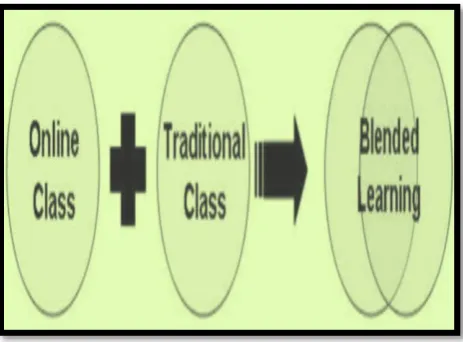
Figure 4. A Schematic Drawing that presents the construction of Blended Learning Environment.
{Adapted From [Tayebinik, M., 2012]}
4.
PRACTICAL FIELD
EXPERIMENTAL RESULTS
The obtained practical field results after experimental educational processes have been presented at this section by four tabulated numerical results as follows. At the two tables numbered as (1 & 2), obtained practical results after performing experimental work by Computer Aided Learning (C A L) using different software packages. However at tables numbered as (3&4) presents results after some Blended
Learning experimental work. Both educational methodologies are subjected to FB / Assessment processes compared with the classical Face to Face (F 2 F) teaching/learning and the details explanations are introduced in the two following paragraphs. Referring to the following two tables : (Table.1 & Table.2), given in below, they have been adapted from [12] (H. M. Mustafa, and Ayoub Al-Hamadi,2009). Both tables illustrated the obtained practical field results after performing pre-assigned three different learning experiments. At Table.1, illustrated results are classified in accordance with individual students' difference learning styles after the application of three teaching/learning experimental methodologies, as following. Firstly, the classical learning style is carried out by students/teacher interactive Face to Face (F 2 F) inside the classroom presenting the control group (15 students). Secondly, learning is taken place using a suggested software learning package without association of teacher’s voice, i.e. by using only the computer Visual Display Unit (V D U). The last educational experimental methodology is carried out using (C A L) package that is associated with teacher's voice, i.e. simultaneously visual and audible signals . This table gives students' academic achievements represented by (obtained outcome marks). The tabulated marks are normalized w. r .t. the maximum virtual mark be 100. At the Table.2, shown in below, the detailed statistical analysis and comparison among the three obtained experimental outcomes resulting marks, is given. It is noticed that the two suggested corrective feedbacks / assessments are presented at the second and third rows at Table 1. They are presenting two experimental groups(each composed of 15 students), they are respectively in correspondence with the Summative and Formative Feedback/Assessment w. r. t. the Face to Face (F 2 F)outcome given at the first row(Control group).
Table1. Illustrates students’ marks after performing three educational experiments associated to CAL
Classical
Learning 35 43 29 50 37 17 10 60 20 48 15 55 40 8 20
CAL without
Voice 39 29 52 60 50 68 62 30 55 42 40 59 48 70 2
[image:6.595.96.501.565.700.2]CAL with Voice 65 70 50 75 45 50 62 90 85 50 80 90 58 55 60
Table 2. Illustrates statistical analysis of the above (Table 1.) obtained students' Academic Achievements (outcome marks)
Educational Experimental
Methodology Students'
average Achievement
score
Variance
Standard deviation
Coefficient of variation
Improvement
of Academic Achievements
[%]
Classical 32.46 265.32 16.28 0.50 -
CAL(without
tutor's voice) 46.80 297.49 17.24 0.36 44.1%
CAL(with
tutor's voice) 64.33 283.42 16.83 0.26 98.2%
Table 3. Illustrates students’ marks after performing three educational experiments associated to BL.
Classical
(F2F) 54 43 55 53 45 62 55 44 45 61 56 45 54 47 43
Summative
FB/Assessment 52 80 82 73 64 65 61 53 80 64 65 55 71 70 72
Formative
[image:7.595.272.548.197.520.2]FB /Assessment 83 73 79 81 80 82 62 73 71 63 72 83 72 80 62
Table 4. Illustrates statistical analysis of the above obtained (Table 3.) students' Academic Achievements (outcome marks).
Educational Experimental
Methodology
Students' Average Academic Achievements
(M)
Variance
Standard
deviation
Coefficient of variation
=
/ MImprovement
of academic Achievements
[%]
Classical (F2F) 50.8 40.02 6.32 0.124 -
Summative
FB/Assessment 67.13 85.04 9.22 0.137 32.14 %
Formative
FB /Assessment 75.2 42.29 6.5 0.086 48.03%
5.
SIMULATION RESULTS AND
INTERPRETATIONS
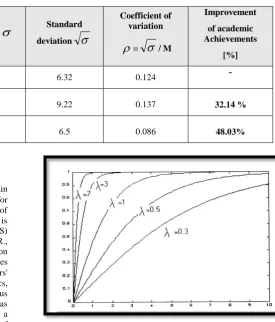
Herein, one of ANN models' design parameters namely gain factor value (i) has been adopted for explicit simulation for measuring the learners' individual differences, as an Index of learners' Learning Styles. That adopted parameter is motivated by Felder-Soloman Index of Learning Style (ILS) measures learners’ styles [73][Felder, R. M., and Brent, R., 2005]. Variances on students’ blended learning perception according to learning style preferences. The gain factor values (i) could be considered relevantly to represent learners' individual differences including their intrinsic characteristics, preferences, and personalities. That is simulated by various gain factor (slope) values and different neurons' number as well, contributing to the learning process. In Figure 5, a general normalized ANN learning model is shown as a set of performance curves. It represents various gain factor values (denoted by λ design parameter). This set of i values are
originated from the odd sigmoid activation function given by:
t t
e
e
t
y
1
1
)
(
(9)For
0
t
By changing values of this parameter, results in various response time (speeds)in reaching optimum (desired) achievements in accordance with the following equation:.
Y(n)=(1-exp(-i(n-1)))/(1+exp(-i(n-1)))
(10)
Where λi represents one of gain factors (slopes) for odd
sigmoid function given by equation (8) and (n), represents the learning convergence (response) time expressed in number of training cycles (epochs).
Figure 5. A set of personalized intrinsic learners' performance curves of model with various learning styles'
values that corresponded to gain factor (λ) values.
Referring to some recently findings announced at [74][Chang, 2014]. These findings illustrated that: (a) There were no significant differences in academic achievement test scores between blended e-learning and traditional (face to face) learning; (b) students in the experimental group obtained significantly higher scores on self-assessment than students in the supervised control experimental group; (c) students' academic achievement test scores on self-assessment were significantly higher after studying through blended e-learning than before.
6.
EFFECT OF NEURON'S NUMBER ON
LEARNERS' SCORES
Figure 6 introduces the flowchart for simulation program which applied for performance evaluation of behavioral learning processes. That Figure presents a simplified macro-level flowchart which briefly describes the algorithmic steps for realistic simulation program of adopted Artificial Neural Networks’ model for different number of neurons. The
obtained depicted three graphs at Figures 7 and the other tree graphs shown at Figure 8 have been derived after running of simulation program for different neurons' number following feedbacks/assessments that simulated by different learningrate values (0.05, 0.1, and 0.3). Noting, these values
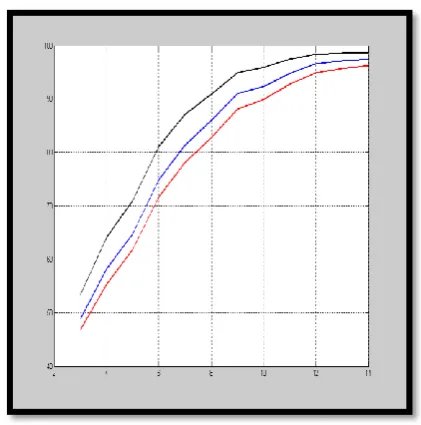
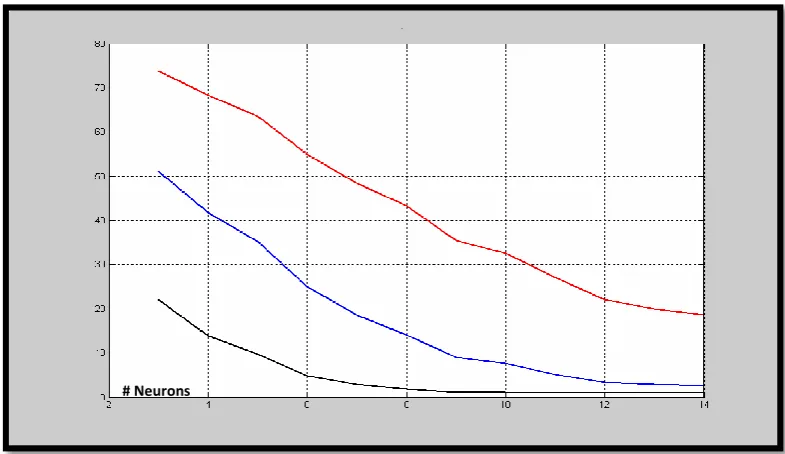
simulate respectivel the three educational methodologies (F2F & Summative, and Formative) FB/Assessments. Interestingly, both figures consider the individual differences of learners as each of them characterized by his own fixed intrinsic Gain Factor Value (λ).Similarly, the three obtained graphs depicted at Figures 9 (representing the academic achievement outcome) and the other three graphs given at Figure 10 (representing the learning convergence time). Both have been derived after running of simulation program for different Gain Factor (λ) values which correspond to intrinsic individual learners' differences, and different number of neurons contributing to learning process. Interestingly, both figures consider the individual differences of learners as each of them characterized by his own intrinsic graph (Gain Factor (λ) value), for fixed learning rate value
= 0.3. [image:8.595.55.294.290.673.2]Figure 6. A simplified macro level flowchart that describing algorithmic steps for Artificial Neural Networks modeling considering various neurons' number.
Figure 7. Illustrates learning by using error correction algorithm based on time response (learning convergence)parameter that is measured by No. of training cycle for three different learning rate values
(0.05,0.1, and 0.3) considering the fixed value of gain factor = 0.5
Figure 8. Illustrates simulated academic achievements (learning outcomes) presented as normalized degree versus # Neurons for different learning rate values
(0.3, 0.1, and 0.05) and constant gain factor = 1. These values of learning rate parameter
values are observedto be inversely proportion to the corresponding educational noisy environment.
Start Input numbers for
neuron’s input value
Plot the output graph
End Input random numbers for
Neurons weight
Enter learning rate, gain factor and #cycles
Is I < = # cycles?
Calculate random numbers for neurons weight
Is v < = 2?
Calculate Input value
Calculate Output value by activation function
Weights adjustment
v=v+1
i=i+1
in
i i i x
w net
1
net net
e e
y
1 1
no
yes
[image:8.595.320.531.369.582.2]Figure 9. Illustrate students' academic achievement for versus different gain factor values(0.5,1, and 2) when fixed # training cycles = 300, and learning rate value = 0.3.
Figure 10. Illustrates time response (learning convergence time)parameter that measured by No. of training cycle for three different gain factor values (0.5,1, and 2) by fixed learning rate value = 0.3.
7.
CONCLUSIONS
This research work adopted the novel interdisciplinary and challenging research approach tightly coupled to the application of realistically ANN modeling of the BL, E-learning, individual learners' differences , such as that introduced by six papers [76]&[77]&[78]&[79]&[80], and [81]. More precisely, analysis and evaluation of Formative, or Summative feedback/assessments for e-learning systems, BL, and CAL packages have been adopted by using realistic ANN modeling . In other words, it is motivated by pieces of research integrating three fields of : education, cognitive science, and psychology with computer science and neurobiology to searching for optimality of the ways to learn. Noting that "By Understanding how we learn we can increase the ability to learn" as has been stated by Professor Lili
Saghafi at [75](Saghafi, 2015). Specifically, the introduced work inspired by a strong belief that interdisciplinary combining of realistic Artificial Neural Networks (ANNS) modeling with observed challenging phenomenal educational issues such as e-learning, and Blended Learning for introducing its investigational study, analysis, and evaluation. Accordingly, neural networks' theorists as well as educationalists have recently working together focusing their attention on searching for optimal realistic simulation and modeling of some selected critical educational issues. That's results in an ANN model contributing to optimal investigation of teaching/learning performance functions such as distinct assessment procedures formative (A f L), and summative(A O L)}. Interestingly, it is revised that (A f L), did predict a substantial amount of course outcome and its validity
Le
ar
n
in
g c
o
n
ve
rg
e
n
ce
ti
me
(
N
u
mb
e
r o
f Tr
ai
n
in
g C
yc
le
s)
[image:9.595.114.507.341.568.2]observed to pave the way for diagnostic use and remedial teaching. However, (A O L) is focused on summarizing what students know or can do at certain times in order to report their academic progress, and achievement. Specifically, this piece of research considers the modeling of importance of summative assessment procedures in harmony with procedures of formative assessment by implementation of a relevant software computer assessment package in
addition
to considering the different number of neurons contributing to learning process.8.
REFERENCES
[1] "What is Technology-Mediated Learning (TML)?" Availableonlineat:https://www.igiglobal.com/dictionary/ why-studying-individual-differences-in-call/49265 [2] Balderas "The influence of information technology in the
daily work of mathematics teachers" . Available online at: http://math.unipa.it/~grim/EBalderas.PDF
[3] M. D. Roblyer, and Aaron H. Doering "Integrating Educational Technology into Teaching (6th Edition)". Publication Date: January 6, 2012 | ISBN-10: 0132612259 | ISBN-13: 978-0132612258 | Edition: 6 Available online at: http://www.amazon.com/Integrating-Educational-Technology-into- Teaching/dp/0132612259 [4] Hunsader, Patricia D.; Thompson, Denisse R.; Zorin,
“Engaging Elementary Students with Mathematical Processes During Assessment: What Opportunities Exist in Tests Accompanying Published Curricula? Source: International Journal for Mathematics Teaching & Learning. 2013, p1-25. 25 p.
[5] Hassan M. H. Mustafa ,et.al." On Optimality of Teaching Quality for a Mathematical Topic Using Neural Networks (With a Case Study)" .Published at EDUCON 13 conference which held in Berlin, Germany from 13-15 March 2013.
[6] H. M. Mustafa, Ayoub Al-Hamadi, and Mohammed H. Kortam "On Assessment of Teaching a Mathematical Topic Using Neural Networks Models (With a case study)" Published at COMPUTER SCIENCE AND APPLICATION, VOL. 1, NO. 2, FEBRUARY, 2012, pp.12-19. The paper is also available online at : http://researchpub.org/journal/csa/number/vol1-no2-2.pdf
[7] HORGAN J. (1993), The death of proof. Scientific American, n. 10, 74-82.
[8] (Aragón, 96) "The influence of information technology in the daily work of mathematics Teachers" Angel Balderas Puga. Available online at: http://math.unipa.it/~grim/EBalderas.PDF
[9] KENT P. & NOSS R. (1998), The Visibility of Models: Using technology as a bridge between mathematics and engineering, Proceedings of the ICMI Study Conference “On the teaching and Learning of Mathematics at University Level”, Singapore. This conference paper has been published on January 1998, at the International Journal of Mathematical Education 31(1) DOI 10.1080/002073900287390. Available online at: https://www.researchgate.net/publication/229023022_Th e_visibility_of_models_Using_technology_as_a_bridge_ between_mathematics_and_engineering.
[10] Interactive practice with long division with no decimals: Daisy Maths - Long Division http//Argyll.epsb.ca /jreed/ extras / longdiv
[11] Long Division: A Touch-Stone for a Few Teaching Principles. Available on line at: www.math.technion.ac.il/~ra/englongdivision.doc [12] H. M. Mustafa, and Ayoub Al-Hamadi "On Teaching
Quality Improvement of A Mathematical Topic Using Artificial Neural Networks Modeling" (With A Case Study)". Published at 10th (Anniversary!) International Conference Models in Developing Mathematics Education”. Hold in Dresden, Saxony, Germany on September 11-17, 2009.
[13] Hassan M. H. Mustafa et al. “On Improvement of Teaching Quality for a Selected Mathematical Topic Using Artificial Neural Networks Modeling (With a Case Study)” Journal of Literature and Art Studies Volume 7, Number 2, Feb. 2017 (Serial Number 63) David Publishing Company, USA. 2159-5836 (Print), ISSN 2159-5836 (Print), ISSN 2159-5844 (Online), pp. 239-246.
[14] Al-Zahrani, F.A., Mustafa, H.M., and Al-Hamadi, A. (2010) "On Analysis And Evaluation of Multi-Sensory Cognitive Learning Of A Mathematical Topic Using Artificial Neural Networks", Journal of Telecommunications, 1(1), 99-104.
[15] Brianna Flavin "8 Surprising Ways Computer Science Benefits Society [2018 & Beyond]-“Why is computer science important?” This article was originally published in December 2015. It has since been updated to include information relevant to 2018. Retrieved on 08/29/2018onlineat:https://www.rasmussen.edu/degrees/t echnology/blog/ways-computer-science-benefits-society/ [16] " online courses increase access to education? ".
Published on Jan 24, 2017 11:34 AM EST by NBER Digest.AvailableOnlineat:https://www.pbs.org/newshour /economy/only courses-increase-access-education. [17] Levit, Alexandra. (2015). The Future of Education
According to Generation Z. Time. Retrieved from http://time.com/3764545/future-of-education/?scrlybrkr. [18] "The Future Of Massively Open Online Courses
(MOOCs)" Available online at: https://www.forbes.com/sites/quora/2017/03/23/the-
future-of-massively-open-online-courses-moocs/#4236df526b83
[19] Aditya Mohan "What according to you is the future of MOOCs?".Retrieved on:https://www.quora.com/What-according-to-you-is-the-future-of-MOOCs.
[20] Sharma, Pramod. (2016). World of Comenius. Tech
Crunch. Retrieved from:
https://techcrunch.com/tag/world-of-comenius/.
[21] Moynihan, Tim. (2016). Google is bringing its VR field trips to even more schools.Wired.Retrievedfrom https://www.wired.com/2016/01/google-brings-itsvr-field-trips-to-more-schools/.
[23]Fahs, C. (2016). CS50 Moves Away from Traditional Lectures, Toward Virtual Reality. The Harvard Crimson. Retrievedfromhttp://www.thecrimson.com/article/2016/8 /31/CS50-moves-fromlectures/.
[24]Stein, J., & Graham, C. R. (2014). Essentials for Blended Learning: A Standards-Based Guide. New York: Routledge.
[25]Bayram Güzer, and Hamit Caner "The past, present and future of blended learning: an in depth analysis of literature" Published at the proceeding of the 5th World Conference on Educational Sciences - WCES 2013. [26]Jennifer Hofmann "Proving the Value of Blended
Learning" Posted on Feb 6, 2017 12:05:00 PM. Availableonlineat:https://blog.insynctraining.com/26-proving-the-value-of-blended-learning
[27]Journal Teaching English with Technology. Year. 2016. Volume. 16. Issue. 3 , pp.103-107, Available online at: http://www.tewtjournal.org
[28]Higgs, Alison (2015). Effective Feedback in Blended learning. In: Conference Proceedings: The Future of Education, libreiauniversitaria.it, Padova.
[29]Claire Johnson "Blended learning: What is it and why should you try it? Learning enthusiast and biology nerd April 23, 2018. Available online at : https://blog.labster.com/what-is-blended-learning [30](Wimshurst & Manning 2013). "Feed-forward
assessment, exemplars and peer marking: evidence of efficacy" Pages 451-465 | Published online: 18 Jan 2012 at: https://doi.org/10.1080/02602938.2011.646236 [31]Wesolowski M, Suchacz B. Artificial neural networks:
theoretical background and pharmaceutical applications: a review. J AOAC Int. 2012 May-Jun;95(3):652-68. [32]https://www.google.com.sa/search?q=error+correction+l
earning+in+neural+network&sa=X&ved=2ahUKEwiiieL W28DfAhUCixoKHamMDk4Q1QIoAHoECAIQAQ&bi w=1366&bih=608
[33]Error correction learning in Artificial neural networks.
Available online at:
https://en.wikibooks.org/wiki/Artificial_Neural_Network s/Error-Correction_Learning
[34]White House OSTP Issues Decade of the Brain Report, Maximizing Human Potential: 1990-2000.
[35]Douglas, R. J., & Martin, K. A. C. (1991). Opening the gray box. Trends in Neurosciences, 14, 286–293. [36]Swaminathan, N 2007 " Cognitive Ability Mostly
Developed Before Adolescence, NIH Study Says. NIH announces preliminary findings from an effort to create a database that charts healthy brain growth and behavior ―Scientific American letter, May 18, 2007.
[37]Swaminathan, N "How The Brain Maps Symbols To Numbers" Scientific American letter, October 31, 2007. [38]Borzenko "Neuron mechanism of human languages"
Published in IJCNN'09 Proceedings of the 2009 international joint conference on Neural Networks IEEE Press Piscataway, NJ, USA ©2009 ISBN: 978-1-4244-3549-4.
[39]H.M. Hassan ,A. Al-Hamadi, B. Michaelis" Evaluation of Memorization Brain Function Using a Spatio-temporal
Artificial Neural Network (ANN) Model" Published at CCCT 2007 conference held on July12-15 ,2007– Orlando, Florida, USA.
[40] Mustafa, et. al. ―On Assessment of Brain Function Adaptability in Open Learning Systems Using Neural Networks Modeling (Cognitive Styles Approach)‖ published at The IEEE International Conference on Communications and Information Technology ICCIT-2011, held on Mar 29, 2011 - Mar 31, ICCIT-2011, Aqaba, Jordan. Published also at Journal of American Science, 2011: 7(4), http://www.americanscience.org.
[41] H.M. Mustafa ―Building up bridges for natural inspired computational models across behavioral brain functional phenomena; and open learning systems‖ A tutorial presented at the International Conference on Digital Information and Communication Technology and its Applications (DICTAP2011) held from June 21-23, 2011 , at University de Bourgogne, Dijon, France.
[42] Kristin L. McGraner, "Preparation of Effective Teachers in Mathematics", ATQ Connection Issue Paper on Applying the Innovation Configuration to Mathematics Teacher Preparation‖ January 2011. Available online at: http://www.tqsource.org/pdfs/TQ_IssuePaper_Math.pdf. [43] Ned Herrmann (2014) "The What and Why of the Blend Trend " The Whole Brain Business Book- Updated version! McGraw Hill 14 may 2014. Available online at:http://www.herrmannsolutions.com/the-whole-brain-business-book/
[44] Kintu et al."Blended learning effectiveness: the relationship between student characteristics, design features and outcomes" International Journal of Educational Technology in Higher Education (2017) 14:7,DOI 10.1186/s41239-017-0043-4
[45] Katherine Gotovsky, Cindy Lee, Jawad Bhimani, Kevin Ding, Marium Vahed, Rakeeb Hossain, Ryan Min, Ryan Yu, Sartaj Javed, and Tanya Nguyen "FUTURE OF BLENDED LEARNING IN EDUCATION:A REPORT FOR STUDENTS AND POLICY MAKERS" © 2017 Federation of Canadian Secondary Students. Available onlineat:.https://static1.squarespace.com/static/53c2060a e4b0db3d3fa5937f/t/591ca78f6a49632377fa8fd5/149505 0128097/F uture+of+Blended+Learning.pdf.
[46] Rasheed F., Wahid A. (2019) Learning Style Recognition: A Neural Network Approach. In: Bapi R., Rao K., Prasad M. (eds) First International Conference on Artificial Intelligence and Cognitive Computing. Advances in Intelligent Systems and Computing, vol 815. Springer, Singapore. First Online: 05 November 2018 Available online at:First International Conference on Artificial Intelligence and Cognitive Computing [47] Susan Mengel, and others : "On the use of neural
networks in intelligent tutoring systems." This article in International Journal of Artificial Intelligence in Education · February 1991. All content following this page was uploaded by Susan Mengel on 16 March 2017. Available on Aug. 1, 2018 from: https://www.researchgate.net/publication/262280236_On _the_use_of_neural_networks_in_intelligent_tutoring_sy stems
[49]H.M. Hassan" On Simulation of Adaptive Learner Control Considering Students' Cognitive Styles Using Artificial Neural Networks (ANNs)" Published at CIMCA , Austria. 28-30 Nov.2005.
[50]D.O. Hebb, “The organization of behaviour”, Wiley, New York (1949).
[51]Hassan. M. Mustafa and Ayoub Al-Hamadi "On Comparative Analogy of Academic Performance Quality Regarding Noisy Learning Environment versus Non-properly Prepared Teachers Using Neural Networks' Modeling" .Published in International Journal of Information and Education Technology, Vol. 6, No. 12, December 2016.
[52] Haykin S., Neural Networks, Englewood Cliffs, NJ: Prentice-Hall, 1999.Nov.28. doi: 10.1098/rsif.2006.0177 [53] M.Fukaya, et.al ”Two level Neural Networks: Learning
by Interaction with Environment”, 1st ICNN, San Diego, (1988).
[54] Ghonaimy M.A., Al – Bassiouni, A.M. and Hassan, H.M “Leaning Of Neural Networks Using Noisy Data”. Second International Conference on Artificial Intelligence Applications, Cairo, Egypt, Jan 22-24, 1994. PP. 387-399.
[55] Dylan Wiliam "Keeping learning on track: Formative assessment and the regulation of learning" MAKING MATHEMATICS VITAL: PROCEEDINGS OF THE TWENTIETH BIENNIAL CONFERENCE OF THE AUSTRALIAN ASSOCIATION OF MATHEMATICS TEACHERS Learning and Teaching Research Centre, Educational Testing Service, pp.20-34. Available on line at:http://www.google.com.sa/url?sa=t&rct=j&q=&esrc=s &frm=1&source=web&cd=1&ved=0CCsQFjAA&url=ht tp%3A%2F%2Fassessment.tki.org.nz%2Fcontent%2Fdo wnload%2F3713%2F26542%2Fversion%2F1%2Ffile%2 FWilliam%2C%2BD.%2C%2BKeeping%2BLearning% 2Bon%2BTrack%2BFormative%2Bassessment%2Band %2Bthe%2Bregulation%2Bof%2Blearning.pdf&ei=n7ic UsugFsPwhQfY3oHYBQ&usg=AFQjCNGxlZ44vne1fY zTL69ZnzUg6I6ibg
[56]Hassan M. H. Mustafa et. al ―On Assessment of Brain Function Adaptability in Open Learning Systems Using Neural Networks Modeling (Cognitive Styles Approach)‖ published at The IEEE International Conference on Communications and Information Technology ICCIT-2011, held on Mar 29, 2011 - Mar 31, ICCIT-2011, Aqaba, Jordan. Published also at Journal of American Science, 2011: 7(4), http://www.americanscience.org.
[57]Hassan M. H. Mustafa "Modeling of Computer-Aided Assessment for a Selected Mathematical Topic Using Neural Networks". Published at ID.WCEECS-2014-ICETC-Edas-1569926197-1 Tunisia 13-15 Jun. 2014. Published also at the International Journal of Engineering Science and Innovative Technology (IJESIT) Volume 3, Issue 3, May 2014-ISSN: 2319-5967 ISO 9001:2008 Certified.
[58]PAUL BLACK, CHRISTINE HARRISON, CLARE LEE, BETHAN MARSHALL, AND DYLAN WILIAM Working “Inside the Black Box: Assessment for Learning in the Classroom , Phi, Delta, Kappa, Vol. 86 # 1,pp.821,2004http://web.uvic.ca/~gtreloar/Assessment/P eriodical%20Items/Working%20Inside%20the%20Black
%20BoxAssessment%20for%20Learning%20in%20the %20Classroom.
[59] The role of teachers in the assessment of learning (English).Availableonlineat:http://webarchive.nationalarc hives.gov.uk/20110809101133/http:/assessment-reform-group.org/ASF%20booklet%20English.pdf
[60] Question Mark for Assessment Management, Create, Deliver, and Deliver. Available online at: https://www.questionmark.com/us/Pages/default.aspx [61] S. G. Millard "Computer aided learning (CAL) and
computer aided assessment (CAA) in civil engineering". Published at Proceedings of the 3rd International CDIO Conference, MIT, Cambridge, Massachusetts, USA, June 11-14, 2007.
[62] Hassan M. H. Mustafa et al "Optimal Estimation of Penalty Value for on Line Multiple Choice Questions Using Simulation of Neural Networks and Virtual Students' Testing" Published at International Journal of Engineering Science and Innovative Technology (IJESIT) Volume 3, Issue 2, March 2014.
[63] Types of summative assessment and formative assessment Available online on : 09/01/18 at: https://resourced.prometheanworld.com/types-of-summative-formative-assessment/
[64] Finn, A., & Bucceri, M. (2004). A case study approach to blended learning, retrieved January 15, 2008 from http://www.centra.com/download/whitepapers/CaseStud y_BlendedLearning.pdf.
[65] Ayala, J. (2009). Blended Learning As A New Approach To Social Work Education. Journal of Social Work Education Volume 45, Issue 2
[66] Young, J.R. (2002). Hybrid Teaching Seeks To End The Divide Between Traditional And Online Instruction. The Chronicles Of Higher Education, A33. 19.05.2015, http://chronicle.com/article/Hybrid-Taching-Seeks-to/18487
[67] Valiathan, P. (2002). Blended Learning Models.Learning Circuits.18.02.2015.www.learningcircuits.org/2002/aug2 002/valiathan.html
[68] Tayebinik, M., & Puteh, M. (2012) "Blended Learning or E-learning?" published at International Magazine on Advances in Computer Science and Telecommunications (IMACST), 3(1), 103-110.
[69] Ceylan, V. K., & Elitok Kesici, A. (2017). Effect of blended learning to academic achievement. Journal ofHumanSciences,14(1),308320.doi:10.14687/jhs.v14i1. 4141.thispublicationisavailableonlineat:https://www.rese archgate.net/publication/313683225
[70] Washington, D.C., 2009 US Dept of Education, 2010, U.S. Department of Education, Office of Planning, Evaluation, and Policy Development, Evaluation of Evidence-Based Practices in Online Learning: A Meta-Analysis and Review of Online Learning Studies, [71] Çobanoğlu, A. ve Altun, E. (2015). Geleneksel
öğretimden Harmanlanmış Öğrenme Temelli Öğretime, Eğitim Teknolojileri Okumaları s.89-107, Ankara. [72] Prensky, M. (2001). Digital natives, digital immigrants.
[73]Felder, R. M., and Brent, R. (2005). Understanding student differences. Journal of Engineering Education, 94(1),5772.Retrievedfrom:http://www4ncsu.edu/unity/lo ckers/users/f/felder/public/Papers/UnderstandinDifferenc es.pdf
[74]Chi-Cheng Chang; Kuen-Ming Shu; Chaoyun Liang; Ju-Shih Tseng; Yu-Sheng Hsu (2014) "Is Blended e-Learning as Measured by an Achievement Test and Self-Assessment Better than Traditional Classroom Learning for Vocational High School Students?" Published at // International Review of Research in Open & Distance Learning; Apr 2014, Vol. 15 Issue 2, p213.
[75]Lili Saghafi (2015) "The Way We Learn". Available onlineat:https://www.slideshare.net/featured/category/ed ucation , Published on Jan 28, 2015
[76]Mohamed Sayed, and Faris Baker "E-Learning Optimization Using Supervised Artificial Neural-Network" Journal of Software Engineering and Applications, 2015, 8, 26-34 Published Online January 2015 in SciRes. http://www.scirp.org/journal/jsea http://dx.doi.org/10.4236/jsea.2015.81004 .
[77]Hassan M. H. Mustafa "On Brain Based Modeling of Blended Learning Performance Regarding learners' Self-assessment Scores Using Neural Networks (Brain Based Approach)". Published at IABL-2016 the IABL conference International Association for Blended Learning (IABL) will be held in Kavala Greece on 22-24 April 2016.
[78]Nick Z. Zacharis"PREDICTING TUDENT ACADEMIC PERFORMANCE IN BLENDED LEARNING USING ARTIFICIAL NEURALNETWORKS'. Published at .
International Journal of Artificial Intelligence and Applications (IJAIA), Vol. 7, No. 5, September 2016. [79] Hassan M. H. Mustafa et al "An Overview on Evaluation
of E-Learning/Training Response Time Considering Artificial Neural Networks Modeling." Paper Published in Journal of Education and e-Learning Research Vol. 4, No. 2, 46-62, 2017ISSN(E) 2410-9991 / ISSN(P)
2518-0169 DOI:
10.20448/journal.509.2017.42.46.62Received: 10 May 2017. Revised: 6 July 2017.Accepted: 7 August 2017.Published: 18 August 2017.Licensed: This work is licensed under a Creative Commons Attribution 3.0 License Publisher: Asian Online Journal Publishing Group.
[80] Hassan M. H. Mustafa et. al. "Application of Artificial Neural Networks Modeling for Evaluation of E-Learning/ Training Convergence Time." Paper Published in American Journal of Education and Learning, 2(2): 159-179. Funding: This study received no specific financial support. This work is licensed under a Creative Commons Attribution 3.0 License Competing Interests: History: Received: 7 March 2017/ Revised: 22 September 2017/ Accepted: 4 October 2017. Publisher: Online Science Publishing On 19th October 2017. [81] Hassan M. H. Mustafa, Satish Gajawada (2018)
![Figure 2. Simplified view for interactive learning process {Adapted from [51]}.](https://thumb-us.123doks.com/thumbv2/123dok_us/9293918.426309/3.595.316.539.126.362/figure-simplified-view-interactive-learning-process-adapted.webp)
![Figure 3. Generalized ANN block diagram simulating two diverse learning paradigms adapted from [52]](https://thumb-us.123doks.com/thumbv2/123dok_us/9293918.426309/4.595.55.291.74.203/figure-generalized-diagram-simulating-diverse-learning-paradigms-adapted.webp)