ISSN Online: 2327-4379 ISSN Print: 2327-4352
DOI: 10.4236/jamp.2018.65089 May 28, 2018 1017 Journal of Applied Mathematics and Physics
Alternating Segment Explicit-Implicit and
Implicit-Explicit Parallel Difference Method for
Time Fractional Sub-Diffusion Equation
Lifei Wu, Yadi Zhao, Xiaozhong Yang
*Mathematics and Physics Department, North China Electric Power University, Beijing, China
Abstract
The fractional diffusion equations can accurately describe the migration process of anomalous diffusion, which are widely applied in the field of natu-ral science and engineering calculations. This paper proposed a kind of nu-merical methods with parallel nature which were the alternating segment ex-plicit-implicit (ASE-I) and implicit-explicit (ASI-E) difference method for the time fractional sub-diffusion equation. It is based on the combination of the explicit scheme, implicit scheme, improved Saul’yev asymmetric scheme and the alternating segment technique. Theoretical analyses have shown that the solution of ASE-I (ASI-E) scheme is uniquely solvable. At the same time the stability and convergence of the two schemes were proved by the mathemati-cal induction. The theoretimathemati-cal analyses are verified by numerimathemati-cal experiments. Meanwhile the ASE-I (ASI-E) scheme has the higher computational efficiency compared with the implicit scheme. Therefore it is feasible to use the parallel difference schemes for solving the time fractional diffusion equation.
Keywords
Time Fractional Diffusion Equation, ASE-I, ASI-E, Stability, Parallel Computing
1. Introduction
Fractional differential equations arise from some anomalous diffusion models and can be very useful in describing the memory and heritability of various complex substances. Because of its deep physical background and rich theoreti-cal significance, it has been widely used in various fields such as fluid mechanics, signal processing and information recognition [1][2][3]. Due to the success in the analysis of a discrete non-Markovian Random Walk Approximation for the
How to cite this paper: Wu, L.F., Zhao, Y.D. and Yang, X.Z. (2018) Alternating Segment Explicit-Implicit and Impli-cit-Explicit Parallel Difference Method for Time Fractional Sub-Diffusion Equation. Journal of Applied Mathematics and Phys-ics, 6, 1017-1033.
https://doi.org/10.4236/jamp.2018.65089
Received: April 12, 2018 Accepted: May 25, 2018 Published: May 28, 2018
Copyright © 2018 by authors and Scientific Research Publishing Inc. This work is licensed under the Creative Commons Attribution International License (CC BY 4.0).
http://creativecommons.org/licenses/by/4.0/
DOI: 10.4236/jamp.2018.65089 1018 Journal of Applied Mathematics and Physics anomalous diffusion and its close connection with fractional calculation, the anomalous diffusion has become a more interesting research direction in the field of complex systems [4]. The time fractional diffusion equation is a class of diffusion equations where the first-order time derivative is replaced by the time fractional order derivative α. Due to the numerical calculation and storage ca-pacity of the analytic solution of such equations are very large, the studying on numerical algorithm for solving the models has become one of the main subjects in anomalous diffusion [5][6][7][8].
In recent years, there have been many research achievements on the numeri-cal algorithm of fractional diffusion equations. Xu Chuanju et al. applied the spectral method directly to the solution of time fractional derivatives, and proved the convergence by providing a priori error estimate [9]. Liu Fawang et al. proposed the implicit RBF method for solving the time fractional diffusion equation. Since no grid meshing is consistent with the definition of fractional derivatives, it has been regarded as a promising research direction [10]. However in the existing numerical algorithms, the finite difference method is still domi-nant. A class of unconditionally stable and convergent implicit difference ap-proximate method for fractional diffusion equation was constructed by Zhuang Pinghui et al., which was second-order in space and 2−α order in time [11]. Yuste established the forward Euler difference scheme and put forward the weighted average finite difference scheme by G-L (Grunwald-Letnikov) ap-proximation method for the time fractional sub-diffusion model, as well as proved the stability of the scheme [12]. Pu Hai et al. examined a C-N (Crank-Nicolson) difference method to solve a class of sub-diffusion equations with variable coefficients [13]. The approach was proved unconditionally stable by the energy method and convergent to temporally min 2
{
−α 2,1+α}
order and spatially second order. Gao Guanghua et al. derived a compact finite differ-ence scheme for the sub-diffusion equation, which is fourth-order accuracy ap-proximation for the space derivative [14].However the computational complexity of existing serial algorithms is rela-tively high and the computation efficiency is low. With the rapid development of multi core and cluster technology, the parallel algorithm of diffusion equation has also widely used in numerical calculations [15] [16]. Zhang Baolin et al.
proposed the idea of using Saul’yev asymmetric scheme to construct segment implicit scheme, and using the alternative technique to establish a variety of ex-plicit-implicit and implicit alternative parallel methods [17]. Yuan Guangwei et al. put forward an efficient parallel method which not only keeps the conserva-tion of the implicit scheme, but also maintains the required accuracy and un-conditional stability by taking the prediction correction method [18]. In this pa-per, we will study the application of the parallel difference method which was used in the integer-order equations for solving the time fractional order diffu-sion equation [19][20][21].
DOI: 10.4236/jamp.2018.65089 1019 Journal of Applied Mathematics and Physics unconditional stability and convergence are analyzed. In Section 3, we give the alternating segment implicit-explicit (ASI-E) parallel difference method. In Sec-tion 4, numerical experiments are presented to support our theoretical analysis and indicate that the ASE-I (ASI-E) scheme is effective for solving time fraction-al sub-diffusion equation.
2. ASE-I Parallel Difference Method
2.1. Time Fractional Sub-Diffusion Equation
The fractional sub-diffusion equation is considered as follows
( )
2( ) (
)
2
, ,
0 ,0 ,0 1
α
α α
∂ ∂
= ≤ ≤ ≤ ≤ < <
∂ ∂
u x t u x t
x L t T
t x (1)
Initial boundary conditions:
( ) ( )
0, = , =0,( )
,0 =( )
.u t u L t u x f x
( )
,u x t indicates the diffusion concentration in point x at time t, fractional order derivative α in Equation(1) is Caputo fractional derivative defined by
( )
(
)
0( )
(
)
, 1 , d , 0 1
1 α
α α
ξ ξ α
α ξ ξ
∂ ∂
= < <
Γ − ∂
∂
∫
−t
u x t u x
t t (2)
By taking the finite sine transform and Laplace transform, the exact solution for the Equation (1) with the boundary conditions as above is obtained as Equa-tion (3)
( )
(
2 2)
(
)
( ) (
)
0 1
2
, α sin sin d
α
∞
=
=
∑
−∫
tn
u x t E a n t anx f r anr r
L (3)
where E zα
( )
is Mittag-Leffler function,( )
(
)
0
π
, 1
α α
∞
=
= =
Γ +
∑
k kz
E z a
k L.
2.2. Construction of ASE-I Scheme
Define tk =k kτ, =0,1, , n, x ih ii = , =0,1, , m where τ =T,h= L
n m are the
grid sizes in time and space respectively. Let k i
u be the numerical approxima-tion to u x t
(
i k,)
, the L1 interpolation approximation of the time fractionalde-rivative is defined as follows
(
)
(
)
( )
(
)
( )
(
)
(
) (
)
(
)
1 1
0 1
1
1 1 1
0
, 1 , d
1
, ,
1 2
k j i k
j
j k
k i k j i k j
j
u x t u x
t t
u x t u x t
j j
α
τ
α τ α
α
α α
ξ ξ
α ξ ξ
τ
α τ
+ +
= +
−
+ − − − −
=
∂ ∂
=
Γ − ∂
∂ −
−
= + −
Γ −
∑∫
∑
Let =
(
+1)
1−α− 1−α, =0,1,2, ,j
b j j j n, the approximate form can be rewritten as
(
)
(
)
(
) (
)
, 1 1
0
, , ,
2 α α
τ
τ α
−
+ + − −
=
= −
Γ −
∑
k
h i k j i k j i k j
j
DOI: 10.4236/jamp.2018.65089 1020 Journal of Applied Mathematics and Physics Moreover the spatial derivative can be discretized in the following four schemes: first, the classical implicit scheme is
(
)
(
1 1 1)
, 1 2 1 1
1
, 2
α
τ + = k++ − k+ + k−+
h i k i i i
L u x t u u u
h , (5)
Second, the classical explicit scheme is
(
)
(
)
, 1 2 1 1
1
, 2
α
τ + = k+ − k+ k−
h i k i i i
L u x t u u u
h , (6)
At last, we present the two improved Saul’yev asymmetric schemes
(
)
(
1 1)
, 1 2 1 1
1 ,
α
τ + = k++ − k+ − k+ k−
h i k i i i i
L u x t u u u u
h , (7)
(
)
(
1 1)
, 1 2 1 1
1 ,
α
τ + = k+ − k− k+ + k−+
h i k i i i i
L u x t u u u u
h . (8)
Substituting Equation (4-8) into Equation (1), let
µ τ
= α h r2, = Γ −µ
(
2α
)
, we can respectively derive the four schemes of Equation (1):
When k=0,
(
)
(
)
(
)
(
)
(
)
(
)
1 1 1 0
1 1
1 0 0 0
1 1
1 1 0 0
1 1
1 1 0 0
1 1
1 2 ,
1 2 ,
1 1 ,
1 1 .
+ −
+ −
+ −
− +
− + + − =
= + − +
− + + = − +
+ − = + −
i i i i
i i i i
i i i i
i i i i
ru r u ru u
u ru r u ru
ru r u r u ru
r u ru ru r u
When k>0,
(
)
(
)
1(
)
1 1 1 0
1 1 1 1
1
1 2 1 − ,
+ + + −
+ − +
=
− k + + k − k = − k+
∑
k − k j+i i i i j j i k i
j
ru r u ru b u b b u b u (9)
(
)
1(
)
1 0
1 1 1 1
1
1 2 − ,
+ −
+ − +
=
= + − − + +
∑
k − +k k k k k j
i i i i j j i k i
j
u ru r b u ru b b u b u (10)
(
)
(
)
1(
)
1 1 0
1 1 1 1
1
1 1 − .
+ + −
+ − +
=
− k + + k = k + − − k+
∑
k − k j+i i i i j j i k i
j
ru r u ru r b u b b u b u (11)
(
)
1 1(
)
1(
)
01 1 1 1
1
1 + + 1 − − ,
− + +
=
+ k − k = k + − − k+
∑
k − k j+i i i i j j i k i
j
r u ru ru r b u b b u b u (12) As the scheme we constructed above, the classical implicit scheme (5) is abso-lutely stable but it is inconvenience to efficiently obtain the results because of needing to solve three diagonal matrixes. The classical explicit scheme (6) has ideal parallelism but it is conditionally stable. The improved Saul’yev asymme-tric schemes (7) and (8) are convenient to parallel computing, but are condition-ally stable. So the ASE-I scheme which we constructed is combined with the ad-vantages of the above schemes and the design is as follows
Let m− =1 Bl, here B is a positive odd number, w is a positive integer,
3, 3
B≥ l≥ . We divide the points on each time level into B sections, order as
1, , ,2 B
DOI: 10.4236/jamp.2018.65089 1021 Journal of Applied Mathematics and Physics explicit segment doing alternatively at different time level. In this format, for
(
)
0 0,0 ,2 , , 2
i ≥ i =l l B− l, we consider the calculation of the implicit segment
point
(
i i k l i0+ , +)
, =1,2, , l. The left boundary point(
i0+1,k+1)
of theimplicit segment is calculated with the improved Saul’yev scheme (7), the right boundary point
(
i l k0+ , +1)
is calculated with the improved Saul’yev scheme(8), and the “interior point”
(
i i k0+ , +1 ,)
i=2,3, , 1 l− are calculated with theclassical implicit scheme (5). See Figure 1, indicates the classical implicit scheme, indicates the improved Saul’yev schemes, thus we get the following im-plicit segment Equation (13).
(
)
(
)
(
)
(
)
(
)
0 0 0 0 0 0 0 0 0 0 0 1 1 1 2 1 1 1 1 1 1 1 1 1 2 1 1 1 1 1 1 2 1 2 1 1 1 1 1 + + + + + + − + + − + + = + + + − + + + + − − + − − + − − + − − − + − = + − − − + k i k i k i l k i l k k j j j i j k k i i k i k i l k ki l i l
u
r r
u
r r r
r r r u
r r u
b b u
r b u ru
b u
b u
r b u ru
(
)
(
)
(
)
0 0 0 0 0 0 0 1 0 1 1 0 1 2 2 11
0
1 1 1
1 1 0 1 1 . − + − − + + + = − − + + − + − = − − + + + = + − + − + − +
∑
∑
∑
∑
k i k k j j j i k i jk
k j
j j i l k i l j
k
k j j j i l k i l j
b u
b b u b u
b b u b u
b b u b u
(13)
In order to improve the calculation accuracy, the left and right boundary point of implicit segment will be replaced by the implicit scheme when i0 =0
and i0=
(
B−1)
l.At the same time the explicit segment scheme is
(
)
0 0 0 0 0 0 0 0 0 0 0 11 1 1
1
2 1 2
1 1 1 1 1 1 1 1 1 2 1 2 1 2 1 2 0 0 + + + + + + + + − + − + + + + + + + − − − − = − − − − − + + k k i i k k i i k k
i l i l
k k
i l i l
j j i
k i
k i l
u r b r u
u r r b r u
r r b r
u u
r r b
u u
b b u
ru ru
(
)
(
)
(
)
0 0 0 0 0 0 0 1 0 1 1 1 1 0 1 2 2 11
0
1 1 1
1 1 0 1 1 . − − + = − − + + + = − − + + − + − = − − + + + = + − + − + − +
∑
∑
∑
∑
k k j k i j k k j j j i k i jk
k j
j j i l k i l j
k
k j j j i l k i l j
b u
b b u b u
b b u b u
b b u b u
DOI: 10.4236/jamp.2018.65089 1022 Journal of Applied Mathematics and Physics
Figure 1. Schematic of segment implicit.
We use ○ to denote the classical explicit scheme, ● to denote the classical im-plicit scheme, the remainder are two improved asymmetric formats.
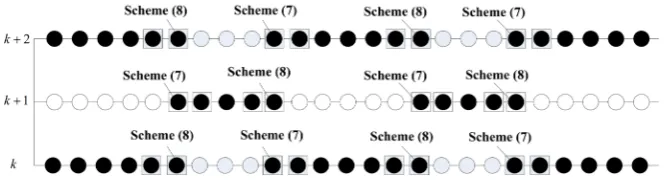
Let m=26,l=5,B=5 and give the schematic of the ASE-I scheme (see
Fig-ure 2).
Thus the ASE-I scheme can be written as follows
(
)
(
)
(
)
(
)
1 1 0
1 1 2
2 1
2 1 2 2 0
2 1 1 1
2 , 0,2, + − + = + + + + − + + = + = − + + + = + = − + + +
∑
∑
kk k k k j
j k
j k
k k k k j
j k
j
I rG U c I rG U b c U b U
k
I rG U c I rG U b c U b U
(15)
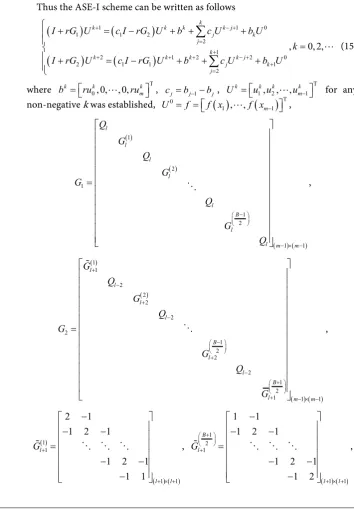
where bk = ru0k,0, ,0, rukmT, cj=bj−1−bj,
T 1, , ,2 −1
=
k k k k
m
U u u u for any
non-negative k was established, 0
( )
(
)
T 1 , , −1
= = m
U f f x f x ,
( ) ( ) ( ) ( ) 1 2 1 1 2 1 1 l l l l l B l
l m m
Q G Q G G Q G Q − − × − = , ( ) ( ) ( ) ( ) 1 1 2 2 2 2 2 1 2 2 2 1 2
1 1 1
+ − + − − + − + + − × − = l l l l B l l B
l m m
G Q G Q G G Q G , ( ) ( ) ( ) 1 1 1 1 2 1 1 2 1
1 2 1 1 1 + + × + − − − = − − −
l
l l G , ( ) ( ) 1 2 1 1 1 1 1 1 2 1
1 2 1 1 2 + + + × + − − − = − − −
lB
l l
DOI: 10.4236/jamp.2018.65089 1023 Journal of Applied Mathematics and Physics
Figure 2. Schematic diagram of the ASE-I scheme.
( ) *
* *
*
1 1 1 2 1
1 or 2, 1,2, , ,
2 1 2 1
1 1 ×
−
− −
−
= = + =
− −
−
i l
l l
B
G l l l i
′′
l
Q is a zero matrix with l l′′ ′′× order (l l′′ = or l−2).
Using the properties of the function g x
( )
=x1−α(
x≥1)
, a set of conclusionscan be obtained:
0 1
1 1
1 2 1
1 0, 1
1,1 2 2 α 0
= ∞
− =
= > > → = −
= > − = > > →
∑
∑
k
j k
j
j j
b b c b
c c c
(16)
2.3. Existence and Uniqueness of ASE-I Scheme Solution
Lemma 1. [17] Set ρ >0, if matrix A is a non-negative real matrix, the matrix
(
+ρ)
−1I A exists, and
(
)
1 2 1ρ −
+ ≤
I A .
Lemma 2. The matrix G1 and G2 of ASE-I scheme are non-negative real
matrix.
Proof. We only need to prove T 1+ 1
G G and T 2+ 2
G G are non-negative ma-trices. Obviously,
( )
( )
( )(
)
* *
* *
T *
2 2 2 4 2
or 2 2 4 2
2 2 ×
−
− −
+ = = +
− −
−
i i
l l
l l
G G l l l
are diagonally dominant matrices and their diagonal elements are non-negative real numbers, therefore ( )*
( )
( )*T +
i i
l l
G G are non-negative matrices. Similarly we
can get ( )1
( )
( )1 T 1 1 + + +l l
G G and
T
1 1
2 2
1 1
+ +
+ +
+
lB lB
G G are also non-negative matrices.
According to Equation (15),
(
)
1 1−
+
I rG and
(
)
12 −
+
I rG exists combing with Lemma 1 and Lemma 2. Then we can get
DOI: 10.4236/jamp.2018.65089 1024 Journal of Applied Mathematics and Physics sub-diffusion equation is uniquely solvable.
2.4. Stability of ASE-I Scheme
Lemma 3. Set ∀σ ρ, >0, if A matrix is non-negative real matrix, we can get
(
)(
)
12 1
ρ σ σ −
− + ≤
I A I A .
Proof. Because of
(
)(
)
(
)(
)
(
)(
)
(
)
(
)
( )(
(
) (
)
)
(
) (
)
(
)
(
)
(
)
(
)
(
)
(
)
(
)
1 2 1 2 1 1 , 0 , 0 2 2 2 , 0 , max , , max ,, 2 , ,
max 1,
, 2 , ,
n n n R I A R R
I A I A
I A I A I A I A
I A I A
I A I A
A A A
A A A
ϕ ϕ
ψ σ ϕ
ψ ψ
ψ ψ
ρ σ σ
ρ σ σ ϕ ρ σ σ ϕ
ϕ ϕ
ρ σ ψ ρ σ ψ
σ ψ σ ψ
ρ ψ ψ σρ ψ ψ σ ψ ψ
ψ ψ σ ψ ψ σ ψ ψ
− − − − ∈ ≠ = + ∈ ≠ ∈ ≠ − + − + − + = − − = + + − + = ≤ + +
thus
(
)(
)
12 1
ρ σ σ −
− + ≤
I A I A .
The growth matrix of ASE-I scheme for time fractional sub-diffusion equation
is
(
) (
1)(
) (
1)
2 1 1 1 1 2
− −
= + − + −
T I rG c I rG I rG c I rG . Let
(
) (
)
1(
)(
) (
1)(
)
12 2 1 1 1 1 2 2 ,
− − −
= + + = − + − +
T I rG T I rG c I rG I rG c I rG I rG
we can easily obtain T 2= T 2≤1 by Lemma 3. Suppose that k
i
u is the solution of ASE-I scheme,uik is the approximate solution of the scheme,the error
ε
k =k− ki ui ui satisfies
(
)
(
)
(
)
(
)
(
)
(
)
1 0
1 2
1 1 1 0
2 1 1 2
2 1 1 0
1 1 2 2 1 1
, 1,3, + − + + + + + = − + = − + + + + = + = − + + + +
k k k
k k
k k k
k k
I rG E I rG E
I rG E c I rG E c E c E b E k
I rG E c I rG E c E c E b E
(17)
in which Ek =
(
ε ε1k, , ,2k εmk−1)
. Let λ λ1, 2 are the eigenvalues of rG rG1, 2re-spectively and the two matrices have the same eigenvalues. Hence 2 1 2 2 1 max 1 1 λ λ − = ≤ + c
T , 1 2
(
)
1 2 1
max 1 , 0
1
λ λ λ
λ − ≤ ≥ +
c , we can get
1 1 2 2
2 1 1
1 1 1 1
1 1 1
0 1 , , max 1.
1 1 1 1
λ λ λ
λ λ
λ λ λ λ
+ − − ≤ ≤ + + − ≤ ≤ ≤ + + + + c c
For n=1, 1
(
) (
1)
0 2 0 01 2
2 2 1 2 2
1 max 1 λ λ − − = + − ≤ ≤ +
E I rG I rG E E E .
For n=2,c1≥λ2,
(
I rG E+ 2)
2=(
c I rG E b E1 − 1)
1+ 1 0,(
)
1(
)
2 1 0
2 1 1 1
2 2 2
1 2 1 0 2 0 0
2 2 2
1 1
1
max max ;
1 1
E I rG c I rG E b E
c b
E E E
DOI: 10.4236/jamp.2018.65089 1025 Journal of Applied Mathematics and Physics
1<λ2
c , 2 2 1 1 0 2 1 0 0
2 2 2 2
1 1
2 1
max max .
1 1
λ
λ
λ
λ
− + + − ≤ = ≤ + + c b b
E E E E
Suppose that 0
2≤ 2
n
E E when n≤2k, then we also have
(
)
1(
)
2 1 2 2 1 1 0
1 1 2 2 2 2
2 2 2
1 2 2 2 2 0 2 1
1 2 1 0 0 2 2 1 max 1 max ; 1
k k k
k k
k k
E I rG c I rG E c E c E b E
c c c b
E c b E E λ λ λ λ − + ≤ + − + − + + + − + + + + ≤ + − + = ≤ +
(
)
1(
)
2 2 2 1 2 1 0
2 1 1 2 2 1 2 1
2 2 2
1 2 2 2 1 2 1 0 2 1
1 2 1 0 0 2 2 1 max 1 max . 1
k k k
k k
k k
E I rG c I rG E c E c E b E
c c c b
E c b E E λ λ λ λ − + + + + + + ≤ + − + + + + − + + + + ≤ + − + = + ≤
Summing up we have 0
2≤ 2, =1,2,3, n
E E n . Hence, the following theo-rem is obtained.
Theorem 2. The ASE-I scheme for time fractional sub-diffusion equation is unconditionally stable.
2.5. Convergence of ASE-I Scheme
Because of
( )
( )
(
)
( )
(
)
( ) 1 2 1, 1 2 1
0 1
, , , d
2 2 1
α α
τ α
τ α α τ α
ξ
τ τ ξ
α ξ ξ
+ + + = + ∂ ∂ ∂ = − + + Γ − ∂ ∂
∑∫
∂ − k j h j j ku x t u x t u x
L R
t t t
where
( )
2 1= τ −αR O ,
(
)
( )( )
(
)
(
)
{ }
(
)
( )(
) (
)
(
)
(
)
( )
0 1 2 1 2 0 1 1 0 1 11 1 1
0
,
1 d
1
1 max d
1 1 , 1 1 k k j j j k k j tt j t t t j
k k u j u x t u t
c k j k j O
τ α τ τ α τ α
α α α
ξ ξ
α ξ ξ
ξ α ξ τ τ α α + + = + + ≤ ≤ = + − − − − = ∂
Γ − ∂ −
≤
Γ − −
= + − − − =
− Γ −
∑∫
∑∫
∑
hence we can get
(
)
( )
1( )
( )
2, 1 1 2 2
, ,
, , .
2
α α
α α
τ α α
τ + τ
−
+ +
∂ ∂
= − + =
∂ ∂
h i k
u x t u x t
L u x t R R O
t t
At the same time the truncation error of improved Saul’yev asymmetric schemes used in spatial discretization is
2 3 2 2
,
2 6 2 4 6 12
τ τ τ τ τ τ
− utx+ uxtt− uxttt+ uxxt− uxxtt−h uxxxt −h uxxxx
DOI: 10.4236/jamp.2018.65089 1026 Journal of Applied Mathematics and Physics
2 6 2 4 6 12
τ −τ +τ +τ −τ + τ −
tx xtt xttt xxt xxtt h xxxt h xxxx
u u u u u u u
h h h , respectively.
When the two schemes are constructed alternatively on different time layers, the truncation error is 1
2 2 1 2 6 τ τ + = − − k
xxt xxtt xxxx i
h
T u u u . In the same way, the truncation error of the explicit-implicit scheme (5-6) is
2 2 2 1 2 6 τ τ + = − − k
xxt xxtt xxxx i
h
T u u u as well. Due to the first term of Ti1k+1 and Ti2k+1
can be cut off by the error term of temporal discretization 1
( )
1,2 α α τ + + ∂ − ∂
u x t t ,
therefore the truncation error of ASE-I scheme is O
(
τ2−α+h2)
. Define k = k− ki i i
e u u in which k i
u is exact solution of the Equation (1) and
(
1, , ,2 −1)
=
k k k k
m
e e e e . Using e0=0 to substitute into the Equation (15), we can
get
(
)
(
)
(
)
(
)
(
)
1 1 11 1 1 1
2 1 1 2
2 1 1 2
1 1 2 2 1
, , , 1,3,5, + − + + + + + + = + = − + + + + + = − + + + + =
k k k k
k
k k k k
k
I rG e R
I rG e c I rG e c e c e R
I rG e c I rG e c e c e R k
in which
(
2)
(
2 2)
(
2 2)
, 1,2,3,α α α
τ
α
τ
−τ
τ
∞= Γ − + ≤ ⋅ + =
n
R O h C O h n , C is a constant.
Lemma 4. 1
(
2 2)
1 1
τ
τ
α , 1,2, ,− −
∞ ≤ + =
k k
e b C h k n, ∞ 1max1
≤ ≤ −
=
k k
i i m
e e , C1 is a
positive constant.
Proof . Lemma 4 can be proved using mathematical induction. When n=1, 1
(
)
1 1 1(
2 2)
1 1 0 τ τα
− −
∞= + ∞ ≤ +
e I rG R C b O h .
When n=2,
(
) (
)
(
)
(
)
(
)
(
)
(
)
(
(
)
)
(
)
1
2 1 2
2 1 1
1 1 2 2 1 2 2
2 1 1 0 2
1
1 2 2 1 2 2
1 1 2 1 1 1 1 1
e I rG c I rG e R
I rG c I rG Cb O h I rG O h C b O h I rG c I rG b C b O h
α α
α α
τ τ τ τ
τ τ τ τ
− ∞ ∞ − − − ∞ ∞ ∞ − − − ∞ ∞ = + − + ≤ + − + + + + ≤ + + − + ≤ +
Suppose that 1
(
2 2)
1
τ
τ
α , 2− −
∞≤ + ≤
n n
e b O h n k, then we also have
(
) (
)
(
)
(
)
(
)
(
)
(
)
1
2 1 2 2 1 1 2 1
1 1 2 2 2
1
1 2 1
2 1 1 2 2 2 2
1
1 2 1 1 2 2
2 1 1 2 1 1 2 ,
k k k k
k
k
k k k
k
k k
e I rG c I rG e c e c e R
b I rG c I rG c c b R
b I rG c I rG b R C b O τ ταh
− + − + ∞ ∞ − − + ∞ ∞ ∞ − − + − ∞ ∞ ∞ = + − + + + + ≤ + − + + + + = + − + ≤ +
(
) (
)
(
)
(
)
(
)
(
)
(
)
12 2 2 1 2 1 2 2
2 1 1 2 2 1
1
1 2 2
2 1 2 1 1 2 2 1 2 1 1
1 2 2 1 2 2
2 1 2 1 1 1 1 2 1 τ τα . − + + + + ∞ ∞ − − + + ∞ ∞ + + ∞ − − + − + ∞ ∞ ∞ + = + − + + + + ≤ + − + + + + = + − + ≤ +
k k k k
k
k
k k k
k
k k
e I rG c I rG e c e c e R
b I rG c I rG c c b R
DOI: 10.4236/jamp.2018.65089 1027 Journal of Applied Mathematics and Physics In summary, we have 1
(
2 2)
1 1
τ
τ
α , 1,2, ,− −
∞ ≤ + =
k k
e b C h k n.
Due to
(
)
1 1
1 1 1
1
lim lim lim
1
1 1 1 1
α
α α α α α
− − −
− − −
→+∞ = →+∞ + − = →+∞ = −
+ −
k
k k k
b k k
k k k
k
, thus
(
2 2)
(
2 2)
1
1 1
α ατ τ α α τ α
α
− −
∞ ≤ − + ≤ +
k
e k C h CT h where C and T is a positive
constant.
Theorem 3. The ASE-I scheme for time fractional sub-diffusion equation is unconditionally convergent and there is a positive A satisfies
(
2 2)
, 1,2, ,k
e A
τ
−α h k n∞ ≤ + = .
3. ASI-E Parallel Difference Method
Imitating the method constructed ASE-I scheme, we give the ASI-E scheme for solving the time fractional sub-diffusion equation. The difference between the ASE-I and ASI-E scheme is that the use of implicit segment and explicit segment is different.
On the odd level, we arrange the computation according to the rule of “the implicit segment-the explicit segment-the implicit segment”, when it turns to the even level, the rule changes into “the explicit segment-the implicit segment-the explicit segment”. Thus we get the ASI-E difference scheme
(
)
(
)
(
)
(
)
1 1 1 0
2 1 1
2 1
2 1 1 2 0
1 1 2 1
2
, 0,2,
+ + − +
= +
+ + + − +
+ =
+ = − + + +
=
+ = − + + +
∑
∑
k
k k k k j
j k
j k
k k k k j
j k
j
I rG U c I rG U b c U b U
k
I rG U c I rG U b c U b U (17)
in which the definition of C C1, 2 and bk are the same as above. Due to the
implicit scheme on the first layer is unconditionally stable and convergent, we imitate the analytical and proved method of the ASE-I scheme (15) from the second time layer, and get the following theorem.
Theorem 4. The ASI-E scheme for time fractional sub-diffusion equation is unconditionally stable and convergent, meanwhile there is a positive A satisfies
(
τ
2−α 2)
, 1,2, ,∞ ≤ + =
k
e A h k n.
4. Numerical Examples
In this section, we present numerical examples to demonstrate that the ASE-I scheme is a computational effective numerical method for time fractional sub-diffusion equation compared with the implicit scheme as well as give the convergence rate of the ASE-I scheme. Numerical experiments will be done in MatlabR2015b, based on the Intel Core i5-2400 [email protected].
Considering the following time fractional sub-diffusion equation
( )
( )
( ) ( )
( )
( )
2 2
, , ,
0, 2, 0, ,0 .
α
α
∂ ∂
=
∂ ∂
= = =
u x t u x t
t x
DOI: 10.4236/jamp.2018.65089 1028 Journal of Applied Mathematics and Physics The initial condition is
( )
2 ,4 2 , 0.50 0.5,2. 3
x x
f x x
x
≤ ≤
= − ≤ ≤
At t=0.4,
α
=0.5, we compare the solution of ASE-I scheme with the exact solution and the numerical solution using the implicit scheme. For the exact so-lution, the series in Equation (3) is truncated after 20 terms. We take n=1000,80
[image:12.595.244.494.341.560.2]m= when calculating numerical solutions, the computed results are listed in Table 1.
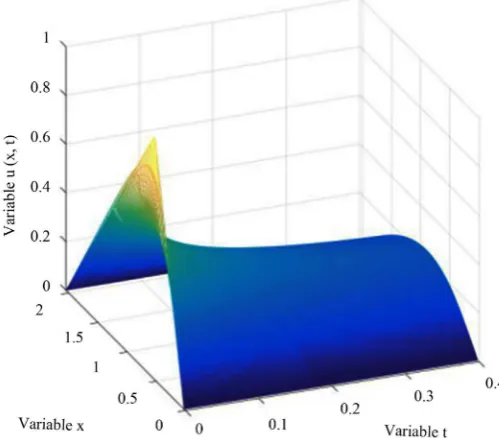
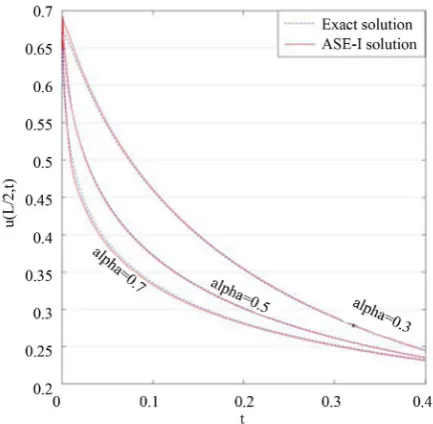
As these can be seen from Table 1, the numerical solutions of ASE-I and ASI-E scheme are better close to the exact solution compared with the implicit numerical solution, and the result of ASE-I scheme is obviously better, thus we mainly focus on ASE-I scheme. The surface of ASE-I numerical solution shown in Figure 3 describes the complete diffusion process which instructs the varia-tions in concentration at different times and spaces. In particular, we consider the decay process curve of fractional diffusion model at the space point x L= 2
under the case of α taking different values. From Figure 4, it can be seen that the speed of diffusion is getting faster as α approaches to the number “1”, and the
[image:12.595.208.539.616.726.2]Figure 3. Numerical solution surface of ASE-I scheme.
Table 1. Comparison of exact solution and numerical solutions.
x
0.25 0.5 0.75 1 1.25 1.5 1.75
DOI: 10.4236/jamp.2018.65089 1029 Journal of Applied Mathematics and Physics Figure 4. Decay process curve of diffusion model.
diffusion velocity of solute becomes more and more slow with the reduction of the diffusion concentrations, this is consistent with measurements of some ac-tual diffusion processes.
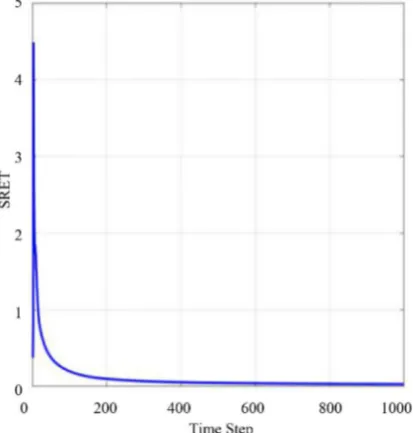
Next, to better validate the stability and compare the accuracy of the ASE-I, we will analyze the change cure of the sum of relative error with time steps (SRET) and the distribution of the difference total energy (DTE) at space grid points. Taking the exact solution j
i
u as the control solution, we let the numer-ical solution j
i
u of the scheme as the perturbation solutions. The definition of SRET and DTE are as follows:
( )
( )
(
)
21 1
1
SRET , DTE .
2
= =
−
=
∑
=∑
−j j
m i i n
j j
i i
j
i i j
u u
j i u u
u
From Figure 5, the SRET of ASE-I scheme is less than 5. The relative error is a little big in the first few steps, and decreases rapidly with the time step, thus we can know that the ASE-I scheme of the time fractional sub-diffusion equation is stable.
DOI: 10.4236/jamp.2018.65089 1030 Journal of Applied Mathematics and Physics
Figure 5. Change curve of SRET.
Figure 6. Distribution of DTE at space points.
scheme. As shown in Figure 6, there is not much difference between the two schemes and the error of the ASE-I scheme is slightly smaller than the other one. Comprehensively considering the ASE-I scheme can be more effective to solve the time fractional sub-diffusion equation.
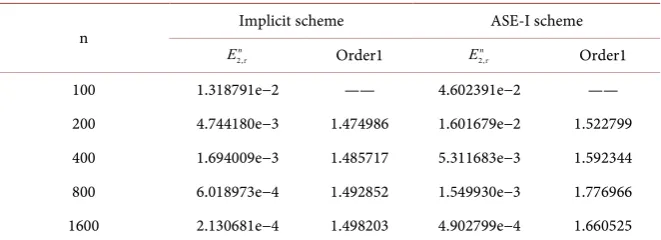
A test example will be performed to illustrate the convergence order of the ASE-I scheme. Denote [22]
(
)
2 12 2, 2, 21 ,
m
n n j n j n
h i i i i
i
E τ E u u u u
=
= = − = −
∑
(
)
(
)
2 2, 2, 2 2 2, 2, 2
Order 1 log n n , Order 2 log n n .
h h
E τ E τ E E
[image:14.595.267.479.335.526.2]DOI: 10.4236/jamp.2018.65089 1031 Journal of Applied Mathematics and Physics Thus the numerical results are presented as follows.
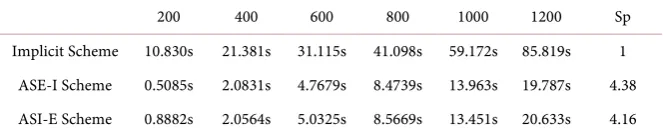
Table 2 gives the computational errors with different temporal step sizes us-ing the fractional order α =0.5. We can see that the numerical accuracy in temporal direction is approximately 2−α order and compared with the impli-cit scheme, it has the higher accuracy. At the same time, we compute the nu-merical accuracy in spatial direction. Taking m=20,40,80,160,320 for
Impli-cit and ASE-I scheme and let N M= 210
(
τ=h2)
. From Table 3, we can see that the numerical accuracy in spatial direction is second-order for Implicit and ASE-I scheme, therefore the experimental results are basically consistent with the theoretical analysis.At last we select m=1000 and n=200,400,600,800,1000,1200 as the spa-tial grid number and the temporal grid number. In terms of computation time in Table 4, the computational efficiency (CPU time) of the ASE-I (ASI-E) scheme has big advantage compared with implicit scheme. With the increase of the grid number, the computation times of the implicit scheme rapidly grow up, and which the ASE-I (ASI-E) scheme’s has a lower growth rate by comparison. The computation time of the ASE-I (ASI-E) scheme can save nearly 75% compared with the implicit scheme and the Sp (Speedup) is approximately 4.38 and 4.16 respectively. Comprehensively considering the computing efficiency and the computing accuracy, the ASE-I scheme can be more effective to solve the time fractional sub-diffusion equation. When the long time course is calculated, the parallel computing advantages of ASE-I scheme will be more obvious.
Table 2. Numerical errors and convergence of ASE-I scheme in temporal direction (h = 0.02).
n Implicit scheme ASE-I scheme
2,nτ
E Order1 E2,nτ Order1
100 1.318791e−2 —— 4.602391e−2 ——
200 4.744180e−3 1.474986 1.601679e−2 1.522799
400 1.694009e−3 1.485717 5.311683e−3 1.592344
800 6.018973e−4 1.492852 1.549930e−3 1.776966
[image:15.595.207.539.601.721.2]1600 2.130681e−4 1.498203 4.902799e−4 1.660525
Table 3. Numerical errors and convergence of ASE-I scheme in spatial direction (τ=h2).
m Implicit scheme ASE-I scheme
2,nh
E Order2 E2,nh Order2
20 2.593343e−3 —— 4.309022e−3 ——
40 6.548375e−4 1.985604 1.096470e−3 1.974494
80 1.667856e−4 1.973142 2.386357e−4 2.199984
160 4.221036e−5 1.982326 3.733635e−5 2.676157
DOI: 10.4236/jamp.2018.65089 1032 Journal of Applied Mathematics and Physics
Table 4. Comparison of the three difference schemes’ CPU time.
200 400 600 800 1000 1200 Sp
Implicit Scheme 10.830s 21.381s 31.115s 41.098s 59.172s 85.819s 1 ASE-I Scheme 0.5085s 2.0831s 4.7679s 8.4739s 13.963s 19.787s 4.38 ASI-E Scheme 0.8882s 2.0564s 5.0325s 8.5669s 13.451s 20.633s 4.16
5. Conclusion
For the time fractional sub-diffusion equation, this paper constructs the ASE-I and ASI-E difference schemes with unconditional stability and convergence. Numerical experiments verify the theoretical analyses and show that the pro-posed scheme is of excellent computational accuracy and obvious parallel prop-erties. The ASE-I (ASI-E) scheme given by this paper can be extended to solve other fractional diffusion models and the parallel computing advantages of the ASE-I (ASI-E) scheme will be more obvious for the long time course and the high dimensional fractional diffusion equation. But the application of the ASE-I (ASI-E) scheme in multidimensional fractional differential equations remains to be further studied.
Acknowledgements
The research is supported by the National Natural Science Foundation of China (Grant No. 11371135) and the Fundamental Research Funds of the Central Uni-versities (Grant No. 2018MS168).
References
[1] Chen, W., Sun, H.G. and Li, X.C. (2010) Fractional Derivative Modeling of Me-chanics and Engineering Problems. Science Press, Beijing. (In Chinese)
[2] Uchaikin, V.V. (2013) Fractional Derivatives for Physicist and Engineers, Volume
Ⅱ: Applications. Springer, New York.
[3] Kai, D. (2010) The Analysis of Fractional Differential Equations. Journal of Mathe-matical Analysis and Applications, 265, 229-248.
[4] Fulger, D.., Scalas, E. and Germano, G. (2008) Efficient Monte Carlo Simulation of Uncoupled Continuous-Time Random Walks and Approximate Solution of the Fractional Diffusion Equation. Physical Review E, 77, Article ID: 021122.
[5] Guo, B.L., Pu, X.K. and Huang, F.H. (2015) Fractional Partial Differential Equations and their Numerical Solutions. Science Press, Beijing.
[6] Sun, Z.Z. and Gao, G.H. (2015) Finite Difference Method for Fractional Differential Equations. Science Press, Beijing. (In Chinese)
[7] Chen, W. and Sun, H.G. (2017) Fractional Differential Equations and Statistical Models for Anomalous Diffusion. Science Press, Beijing. (In Chinese)
[8] Sweilam, N.H., Moharram, H., Moniem, N.K.A. and Ahmed, S. (2014) A Parallel
Crank-Nicolson Finite Difference Method for Time-Fractional Parabolic Equation.
Journal of Numerical Mathematics, 22, 363-382.
https://doi.org/10.1515/jnma-2014-0016
DOI: 10.4236/jamp.2018.65089 1033 Journal of Applied Mathematics and Physics
Diffusion Equation. Siam Journal on Numerical Analysis, 47, 2108-2131.
https://doi.org/10.1137/080718942
[10] Liu, Q.X., Gu, Y.T., Liu, F.W. and Zhuang, P.H. (2011) An Implicit RBF Meshless Approach for Time Fractional Diffusion Equations. Computational Mechanics, 48, 1-12. https://doi.org/10.1007/s00466-011-0573-x
[11] Liu, F.W. and Zhuang, P.H. (2006) Implicit Difference Approximation for the Time Fractional Diffusion Equation. Journal of Applied Mathematics and Computing, 22, 87-99. https://doi.org/10.1007/BF02832039
[12] Yuste, S.B. (2004) Weighted Average Finite Difference Methods for Fractional Dif-fusion Equations. Journal of Computational Physics, 216, 264-274.
https://doi.org/10.1016/j.jcp.2005.12.006
[13] Zhang, P. and Pu, H. (2017) The Error Analysis of Crank-Nicolson-Type Difference Scheme for Fractional Sub-Diffusion Equation with Spatially Variable Coefficient.
Boundary Value Problems, 15, 1-19.
[14] Gao, G.H. and Sun, Z.Z. (2011) A Compact Finite Difference Scheme for the Frac-tional Sub-Diffusion Equations. Journal of Computational Physics, 230, 586-595.
https://doi.org/10.1016/j.jcp.2010.10.007
[15] Chi, X.B., Wang, Y.W. and Wang, Y. (2015) Parallel Computing and
Implementa-tion Technology. Science Press, Beijing. (In Chinese)
[16] Bjorstad, P. and Luskin, M. (2015) Parallel Solution of Partial Differential Equa-tions. Science Press, Beijing.
[17] Zhang, B., Yuan, G., Liu, X. and Chen, J. (1994) Parallel Finite Difference Methods for Partial Differential Equations. Science Press, Beijing. (In Chinese)
[18] Yuan, G. and Hang, X. (2010) Conservative Parallel Schemes for Diffusion Equa-tions. ChineseJournal of Computational Physics, 27, 475-491.
[19] Liu, W. (2012) Actual Combat Matlab Parallel Programming. Beihang University Press, Beijing. (In Chinese)
[20] Kai, D. (2011) An Efficient Parallel Algorithm for the Numerical Solution of Frac-tional Differential Equations. Fractional Calculus and Applied Analysis, 14, 475-490.https://doi.org/10.2478/s13540-011-0029-1
[21] Gong, C., Bao, W. and Tang, G. (2014) An Efficient Parallel Solution for Caputo Fractional Reaction-Diffusion Equation. The Journal of Supercomputing, 68, 1521-1537.https://doi.org/10.1007/s11227-014-1123-z