A Largest Empty Hypersphere
Metaheuristic for Robust
Optimisation with Implementation
Uncertainty
∗
Martin Hughes
† 1, Marc Goerigk
2, and Michael Wright
11Department of Management Science, Lancaster University, United Kingdom 2University of Siegen, Germany
We consider box-constrained robust optimisation problems with im-plementation uncertainty. In this setting, the solution that a decision maker wants to implement may become perturbed. The aim is to find a solution that optimises the worst possible performance over all possible perturbances.
Previously, only few generic search methods have been developed for this setting. We introduce a new approach for a global search, based on placing a largest empty hypersphere. We do not assume any knowledge on the structure of the original objective function, making this approach also viable for simulation-optimisation settings. In com-putational experiments we demonstrate a strong performance of our approach in comparison with state-of-the-art methods, which makes it possible to solve even high-dimensional problems.
Keywords: robust optimisation; implementation uncertainty; meta-heuristics; global optimisation
1. Introduction
The use of models to support informed decision making is ubiquitous. However, the size and nature of the decision variable solution space, and the model runtime, may make a comprehensive – exhaustive or simply extensive – evaluation of the problem space computationally infeasible. In such cases an efficient approach is required to search for global optima.
Mathematical programs are one form of model that are explicitly formulated as optimisation problems, where the model representation imposes assumptions on the structure of the decision variable space and objective function. Such models are well suited to efficient solu-tion, and identification of global optima may be theoretically guaran-teed when feasible solutions exist. However many real-world problems are not suited to expression as a mathematical program (e.g., a solu-tion is evaluated by using a simulasolu-tion tool). From an optimisasolu-tion perspective models where no assumptions are made about the model structure can be thought of as a black-box, where decision variables val-ues are input and outputs generated for interpretation as an objective. In this case optimisation search techniques such as metaheuristics are required, i.e., general rule-based search techniques that can be applied to any model.
An additional widespread feature of many real-world problems is the consideration of uncertainty which may impact on model outputs, and so on corresponding objective function values. One strategy is to sim-ply ignore any uncertainty and perform a standard search, possibly assessing and reporting on the sensitivity of the optimum after it has been identified. However it has been established that optimal solu-tions which are sensitive to parameter variasolu-tions within known bounds of uncertainty may substantially degrade the optimum objective func-tion value, meaning that solufunc-tions sought without explicitly taking account of uncertainty are susceptible to significant sub-optimality, see [BTGN09, GS16]. In the face of uncertainty the focus of attention for an optimisation analysis shifts from the identification of a solution that just performs well in the expected case, to a solution that performs well over a range of scenarios.
method is based on an exploration technique that uses largest empty hyperspheres (LEHs) to identify regions that can still contain improv-ing robust solutions. In a computational study we compare our method with a local search approach from the literature (see [BNT10b]) and a standard particle swarm approach. We find that our approach con-siderably outperforms these methods, especially for higher-dimensional problems.
Structure of this paper. We begin with a review of the literature on metaheuristics for robust optimisation in Section 2 before outlin-ing the formal description of robust min max problems in Section 3. We also consider some of the details of the established local robust search technique due to [BNT10b]. In Section 4 we introduce a novel approach, an exploration-focused movement through the search space identifying areas that are free of previously identified poor points. We include a discussion and descriptions of the algorithms used to identify empty regions of the decision variable search space. The approach is then tested against alternative heuristics in Section 5, on test problems of varying dimension. The experimental set up is described and the results of this analysis presented. Finally we summarise and consider further extensions of this work in Section 6.
2. Literature review
2.1. Robust optimisation
Different approaches to model uncertainty in decision making prob-lems have been explored in the literature. Within robust optimisa-tion, a frequent distinction is made between parameter uncertainty (where the problem data is not known exactly) and implementation uncertainty (where a decision cannot be put into practice with full accuracy). Implementation uncertainty is also known as decision un-certainty [BTGN09, Tal09, BNT10b].
[PBJ06, dMB14].
An alternative to a stochastic approach is robust optimisation, whose modern form was first developed in [KY97] and [BTN98]. Whereas with stochastic optimisation a knowledge of probability distributions over all possible scenarios is typically assumed, in robust optimisation it is only assumed that some set is identified containing all possible uncertainty scenarios (potentially infinite in number). A classic robust approach is then to find a solution across all scenarios that is always feasible (strictly robust) and optimises its performance in the worst case. This is known as min max. For a given point in the decision variable space there is an ‘inner’ objective to identify the maximal (worst case) function value in the local uncertainty neighbourhood, and an overall ‘outer’ objective to identify the minimum such maximal value.
The field of robust optimisation has been primarily aligned with
mathematical programming approaches. There the methodology is
based around the definition of reasonable uncertainty sets and the re-formulation of computationally tractable mathematical programming
problems. For specific forms of convex optimisation problems, the
problem incorporating uncertainty can be re-formulated to another tractable, convex problem, see [BNT07, GS10]. To overcome concerns that the strictly robust worst case approach may be overly conserva-tive, the concept of robustness can be expanded in terms of both the uncertainty set considered and the robustness measure [GS16]. On the assumption that it is overly pessimistic to assume that all implemen-tation errors take their worst value simultaneously [BS04] consider an approach where the uncertainty set is reduced, and a robust model defined where the optimal solution is required to remain feasible for uncertainty applied to only a subset of the decision variables at any given time. Min max regret, see [ABV09], is an alternative to min max, seeking to minimise the maximum deviation between the value of the solution and the optimal value of a scenario, over all scenarios. [BTBB10] considers soft robustness, which utilises a nested family of uncertainty sets. The distributionally robust optimisation approach, see [GS10], attempts to bridge robust and stochastic techniques by utilizing uncertainty defined as a family of probability distributions, seeking optimal solutions for the worst case probability distribution. [CG16] use a bi-objective approach to balance average and worst case performance by simultaneously optimising both.
been application-driven, so considerable work has been undertaken in applying robustness techniques to specific problems or formulations, see [BS07, GS16]. There has also been some cross-over into the ap-plication of specific heuristics, for example see [GLT97, VMdCM11]. However application to general problems has been less well addressed
[GS16]. Furthermore robust approaches applied to black-box
mod-els are much less widely considered than approaches for mathematical programming problems, see [MWPL13, GS16, MWPL16]. Recently, robust optimisation with implementation uncertainty has also been extended to multi-objective optimisation, see [EKS17].
2.2. Metaheuristic for robust optimisation
The min max approach has been tackled with standard metaheuris-tic techniques applied to both the inner maximisation and outer min-imisation problems. In co-evolutionary approaches two populations (or swarms) evolve separately but are linked. The fitness of individu-als in one group is informed by the performance of individuindividu-als in the other, see [CSZ09]. [Her99, Jen04] use such a two-population genetic algorithm (GA) approach, whilst [SK02, MKA11] consider two-swarm co-evolutionary particle swarm optimisation (PSO) techniques for min max problems. A brute force co-evolutionary approach is to employ complete inner maximisation searches to generate robust values for each individual in each generation of the outer minimisation, however this is expensive in terms of model runs (i.e., function evaluations), see [MWPL16]. More practical co-evolutionary approaches, for example using only small numbers of populations for the outer search and the inner (uncertainty) search which share information between popula-tions from generation to generation, or following several generapopula-tions, require the application of additional simplifications and assumptions, see [CSZ09, MKA11].
minimum. The relaxation involves iteratively performing the outer minimisation on a limited inner uncertainty neighbourhood followed by an extensive inner maximisation search in the region of the identi-fied outer minimum. This continues whilst the inner search sufficiently deteriorates the outer solution, with the inner maximum point being added to the limited inner uncertainty set with each iteration.
A second approach due to [uRLvK14, uRL17] also uses Kriging and an EI metric, building on a meta-model of the expensive nominal prob-lem by applying a robust analysis directly to the Kriging model and exploiting the fact that many more inexpensive function evaluations can be performed on this meta-model. A modified EI metric is cal-culated for the worst case cost function of the meta-model, to effi-ciently guide the search in the nominal expensive function space. In [uRL17] the approach is applied to a constrained non-convex 2 di-mensional problem due [BNT10b, BNT10a], the unconstrained ver-sion of which is also considered here. The Kriging-based approach is shown to significantly outperform the approaches outlined here, in terms of the number of expensive function evaluations required to con-verge towards the robust optimum. In general we would expect the approach from [uRLvK14, uRL17] to outperform the approaches con-sidered here, in terms of efficiency when applied to low dimensional non-convex problems. However the primary challenge with meta-model based approaches is their application to higher dimensional problems. The test cases considered in [MWPL13, MWPL16, uRLvK14, uRL17] have either been restricted to low dimensional non-convex problems, or simpler convex and convex-concave problems of up to 10 dimensions.
One local black-box min max approach is due to [BNT07, BNT10b, BNT10a]. Here a search is undertaken by iteratively moving along ’descent directions’. Uncertainty around individual points is assessed using local gradient ascents, based on which undesirable ’high cost points’ (hcps) are identified. Steps are taken in directions which point away from these hcps, until no direction can be found.
3. Notation and previous results
3.1. Problem description
We consider a general optimisation problem of the form
min f(xxx) s.t. xxx∈ X
where xxx = (x1, x2, . . . , xn)T denotes the n-dimensional vector of
deci-sion variables, f : Rn → R is the objective function, and X ⊆ Rn is
the set of feasible solutions. We write [n] :={1, . . . , n}. In this paper,
we assume box constraints X =Q
i∈[n][li, ui]. Any other potential fea-sibility constraints are assumed to be ensured through a penalty in the objective.
In implementation uncertainty, we assume that a desired solutionxxx
might not be possible to put into practice with full accuracy. Instead, a ”close” solution ˜xxx = xxx+ ∆xxx may be realised. The aim is to find a robustxxx such that for any such solution ˜xxx from the neighbourhood of
x
xx, the worst case performance is optimised.
More formally, we follow the setting of [BNT10b] and consider the so-called uncertainty set
U :={∆xxx∈Rn| k∆xxxk ≤Γ}
where Γ>0 defines the magnitude of the uncertainty, and k · k refers to the Euclidean norm. The worst case costs of a solutionxxx ∈ X are then given as
g(xxx) := max
∆xxx∈Uf(xxx+ ∆xxx)
and so the robust optimisation problem is given by:
min x x
x∈X g(xxx) = minxxx∈X∆maxxxx∈Uf(xxx+ ∆xxx) (ROP)
We therefore have an inner maximisation and outer minimisation prob-lem, such that the identification of the robust global optimum is based on finding the (outer) minimum worst case cost objective function value in the decision variable space, and that objective is determined by the (inner) maximisation of the nominal objective function in the uncer-tainty neighbourhood around each point in the decision variable space. This type of problem is also known as min max.
x
xx+ ∆xxx∈ X for all ∆xxx∈ U, then this can be ensured by reducing the size of the feasible search space by Γ.
As an example for our problem setting, consider the 2-dimensional polynomial function due to [BNT10b]:
f(x, y) =2x6−12.2x5+ 21.2x4+ 6.2x−6.4x3−4.7x2−y6
−11y5+ 43.3y4−10y−74.8y3+ 56.9y2−4.1xy
−0.1y2x2+ 0.4y2x+ 0.4x2y (poly2D)
For a feasible solution space within bounds [−1,4] in each dimension,
and uncertainty defined by a Γ-radius value of 0.5, the nominal and
worst case plots for (poly2D) are shown in Figure 1. In min max the problem is one of finding the global minimum for the worst case cost function. If uncertainty is ignored the problem is just one of finding the global minimum of the (nominal) objective as shown in Figure 1a, whereas including uncertainty the problem becomes one of finding the (worst case cost) objective as shown in Figure 1b. In both cases the search proceeds based on generating nominal objective values but for the worst case cost we must further undertake some assessment of the impact of uncertainty on those objective outputs.
[image:8.595.117.480.413.609.2](a) Nominal problem (b) Worst case problem with Γ=0.5
Figure 1: Nominal and worst case cost for (poly2D) from [BNT10b]. Marked in purple are the respective optima.
large numbers of points in the Γ-uncertainty neighbourhood around each plotted point. The worst case cost at each point is then approxi-mated as the highest value off(x) identified within each Γ-uncertainty neighbourhood. The global optimum for the worst case problem is ap-proximately 4.3 at (-0.18, 0.29). The significant shift in the nominal versus robust optima, both in terms of its location and the optimum objective, emphasises the potential impact of considering uncertainty in decision variable values. The difference between the nominal and robust optimal objective function values is the ‘price of robustness’, see [BS04].
3.2. Local robust search using descent directions
We briefly summarise the local search approach for (ROP) that was developed in [BNT10b]. Here, (ROP) is solved using a local robust op-timisation heuristic illustrated by Figure 2. An initial decision variable vector ˆxxxis randomly sampled. Then a series of gradient ascent searches are undertaken within the Γ-uncertainty neighbourhood of this candi-date solution to identify hcps, see Figure 2a. This approximates the inner maximisation problem max∆xxxf(ˆxxx+∆xxx). Using a threshold value that is dynamically adjusted during the algorithm, a subset H(ˆxxx) of all evaluated points is identified, see Figure 2b.
In the next step, a descent direction is identified that points away from the set H(ˆxxx), see Figure 2c. To this end, a mathematical pro-gramming approach is used, minimising the angle between the hcps and the candidate solution. This leads to the following second order cone problem.
min d d
d,β β (1)
s.t. kdddk ≤1 (2)
d
ddThhh≤β ∀hhh∈H(ˆxxx) (3)
β ≤ −ε (4)
Here,dddis the descent direction, which is normalised by Constraint (2). Constraints (3) ensure thatβ is the maximum angle betweenddd and all high cost points hhh. Through Constraint (4), we require a feasible de-scent direction to point away from all points inH(ˆxxx). When an optimal direction cannot be found, the algorithm stops – a robust minimum has been reached.
x
(a) Candidate point xxx (centre), and points evaluated for the inner max-imisation problem (blue).
x
(b) Subset H(xxx) of critical high cost points.
x
(c) A descent direction is identified by solving a second order cone prob-lem.
x
[image:10.595.346.477.401.559.2](d) The step size is determined.
of the Γ-uncertainty neighbourhood of the next candidate solution is used. Using the identified descent direction and step size the algorithm moves to a new candidate point, and so the heuristic repeats iteratively until a robust minimum has been identified.
4. A new largest empty hypersphere
approach
4.1. Algorithm overview
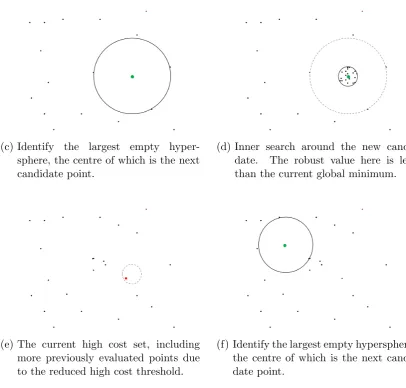
Building on the notion of a search that progresses locally by moving away from already identified poor (high cost) points, we develop a global approach that iteratively moves to the region of the decision variable solution space furthest away from recognised hcps. This is an exploration-focused approach, although rather than concentrating on examining unvisited regions the intention here is to identify and visit regions devoid of hcps. Assuming uncertainty as considered previously in terms of a single value Γ that defines a radius of uncertainty in all decision variables, we associate the idea of the largest empty region (empty of hcps) with the idea of the largest empty hypersphere (LEH), or largest empty circle in 2D. The approach is then to locate the next point in the search at the centre of the identified LEH, and to itera-tively repeat this as more regions are visited and hcps identified. The approach is described in Figure 3.
We start by randomly sampling one or more points and evaluating
the objective function f at each. From these start points a candidate
point is selected and an inner analysis undertaken in the candidate’s Γ-uncertainty neighbourhood with a view to identifying the local maxi-mum, Figure 3a. This local worst case cost for the candidate is the first estimate of a robust global minimum, that is a global min max, and is located at the candidate point. The aim is now to move to a point whose uncertainty neighbourhood has a lower worst case cost than the current global value. We seek to achieve this by identifying the largest hypersphere of radius at least Γ within the defined feasibility bounds which is completely empty of hcps, and moving to the centre of that LEH, see Figures 3b - 3c.
current estimate of the robust global minimum. Both the history set and the high cost set are updated as more points are visited and the high cost threshold reduces, see Figures 3d - 3e. On performing all inner searches after the first candidate, a candidate’s robust value may be no better than the current estimate of the robust global minimum (and therefore the current high cost threshold), in which case at least one point will be added to the high cost set. Alternatively if a candidate’s robust value is better than the current estimate of the robust global minimum, this current recorded optimum is overwritten and the high cost threshold reduced accordingly. Again this introduces at least one high cost point to the high cost set, but the reducing threshold may also introduce additional points from the history set; this is suggested in Figure 3e.
(a) The decision variable space is seeded randomly. Perform an inner search around one candidate point.
(b) The current high cost set, includ-ing one point from the previous inner search and some of the seed points.
(c) Identify the largest empty hyper-sphere, the centre of which is the next candidate point.
(d) Inner search around the new candi-date. The robust value here is less than the current global minimum.
(e) The current high cost set, including more previously evaluated points due to the reduced high cost threshold.
[image:13.595.89.496.300.688.2](f) Identify the largest empty hypersphere, the centre of which is the next candi-date point.
The critical feature of such an approach is the identification of regions of the solution space that are currently empty of, and furthest from, the undesirable hcps. As defined here this corresponds to identifying the largest hypersphere devoid of all hcps.
Given a discrete history set H of all points evaluated so far, high
cost points are those members of H with objective value which is at
least the current high cost thresholdτ, i.e.,
Hτ :={hhh ∈H |f(hhh)≥τ}
We denote Nτ = |Hτ| as the cardinality of Hτ, and write Hτ =
{hhh1, . . . , hhhNτ}. The identification of a point ppp ∈ X which is furthest
from all Nτ high cost points in Hτ is a max min problem:
max p p
p∈X imin∈[Nτ]
d(ppp, hhhi), (LEHP)
whered(ppp, qqq) is the Euclidean distance between two pointspppandqqq, see [OS97].
In the following, we specify this general LEH approach by considering
two aspects in more detail: Theouter search is concerned with placing
the next candidate pointxxx by solving (LEHP). The inner search then evaluates this candidate by calculating g(xxx) approximately.
4.2. Outer search methods
Here we will introduce different approaches to identifying the largest
empty hypersphere, given a set of high cost points Hτ. It should be
noted that none of these approaches requires additional function eval-uations, which is usually considered the limiting resource in black-box settings.
4.2.1. Randomly sampled LEH algorithm
A very simple approach is to generate potential candidates randomly within the feasible region, then determine whether they are more than
Γ away from all hcps. If so they are a valid candidate, if not
4.2.2. Genetic Algorithm for LEH
The solution of (LEHP) is an optimisation problem. Furthermore,
given a point ppp which is a potential candidate for the centre of the largest empty hypersphere, the inner minimisation calculation in (LEHP)
involves just an enumeration over the Nτ Euclidean distance
calcula-tions between each hcp andpppto identify the minimum distanced(ppp, hhhk), where hhhk is the closest hcp. Therefore the focus for the solution of (LEHP) is the outer maximisation, for which we may consider an ap-proximate heuristic approach. We employ a genetic algorithm (GA), a commonly cited evolutionary algorithm (EA) [Tal09]. Here each in-dividual represents a point ppp in the decision variable space, and the objective functionfLEH(ppp) := minhhh∈Hτd(ppp, hhh) is the minimum distance
between a given pointpppand all hcps in Hτ. We seek to maximise this minimal distance by evolving a population of points starting from
ran-domly selected feasible points in the decision variable space X. The
best point generated by the GA is the next candidate point – that is estimated centre of the LEH, for the currentH, τ and Hτ.
4.2.3. Voronoi based LEH
Within the literature a widely referenced approach for tackling low dimensional LEH problems is due to [Tou83], and is based on the ge-ometric Voronoi diagram approach, see [Cha93, OS97]. The Voronoi approach partitions a space into regions (cells). For a given set of points each cell corresponds to a single point such that no point in the cell is closer to any other point in the set. Points on the edges between cells are equidistant between the set points which lie on either side of that
edge. For our LEH problem the set of points is Hτ, and the Voronoi
diagram approach corresponds to segmenting the feasible spaceX into
Nτ separate cells, one for each hcp. The (Voronoi) vertices that lie at the intersection of these cell (Voronoi) edges maximise the minimum distance to the nearby set points, see [Cha93, OS97]. So for a given
Hτ if we can determine the Voronoi diagram we can use the
identi-fied Voronoi vertices as potential candidate points ppp. The solution of (LEHP) is then simply a matter of enumeration, for eachpppcalculating the (inner) minimum Euclidean distance to all hcps, and then selecting the (outer) maximum such minimal distance.
To deal with this edges that cross feasibility boundaries are identified
and the associated vertices which are outside of X are relocated to an
appropriate point on the boundary of X. Here any coordinate i∈ [n]
of such an external vertex that is either less than li or greater than ui is re-set to li orui as appropriate.
However the Voronoi approach has exponential dependence onn, as
constructing the Voronoi diagram of Nτ points requires O(NτlogNτ+
Nτdn/2e) time [Cha93]. This suggests that such an approach in not com-putationally viable for anything other than low dimensional problems. On the basis that a Voronoi diagram based approach is the primary recognised heuristic for identifying the largest emptycirclewe will con-sider a Voronoi based robust LEH heuristic here only in the context that for 2D problems in our experimental analysis this approach will serve as a good direct comparator for our other robust LEH heuristics.
4.3. Inner search methods
Discussions of the LEH approach have so far focussed on the outer minimisation search, assuming some form of inner search that provides the inner robust maximum for each candidate point in the minimisa-tion search. In [BNT10b] a two-stage gradient ascent search is recom-mended for each inner search around a candidate point. This assumes gradient information is available and proposes (n+ 1) individual two-stage gradient ascents for each candidate. For a 100-dimensional prob-lem this would require several thousand function evaluations around each candidate point. In practical terms both the number of function evaluations required to undertake a global search and the requirement for gradient information may make such extensive inner searches pro-hibitive. Given, for example, budgetary restrictions on the number of function evaluations, some trade-off must be achieved between the extent of each inner Γ-radius uncertainty neighbourhood search and globally exploring the search space. But this trade-off between robust-ness in terms of the extent of the inner searches, and performance in terms of the outer global search, is complex, see [MLM15, DHX17]. For example the determination of an appropriate inner approach – type of search, extent of search and parameter settings – may be both instance (problem and dimension) dependent and dependent on the outer ap-proach.
provided by some oracle. From an experimental point of view in the algorithm testing and comparisons below we assume the same basic inner Γ-radius uncertainty neighbourhood analysis for all heuristics, to ensure a consistency when comparing results for alternative search approaches.
There is, however, an aspect of our LEH approach that enables an additional feature, the forcing of an early end to an inner search. The LEH approach is exploration-led, the objective being to locate and move to the candidate point in the decision variable space furthest from all hcps. Hcps are designated based on the determination of a high cost threshold τ, set here as the current estimate of the robust global min-imum (min max) value. The nature of this approach enables (inner) uncertainty neighbourhood searches around each candidate point to be restricted when appropriate. If an inner search identifies a local point
with objective function value above τ the inner search can be
immedi-ately curtailed on the basis that the candidate is not distant from hcps. This equates to the recognition that the candidate point is not an im-provement on the current estimated robust optima. Such regulating of inner searches has the potential to significantly reduce the number of function evaluations expended on local neighbourhood analysis. In the case of budgetary limitations on numbers of function evaluations this further enables more exploration of the decision variable space.
4.4. Algorithm summary
Given one of our three approaches to identifying the LEH devoid of hcps, random, GA or Voronoi, the overarching algorithm for the
ro-bust exploratory LEH heuristic is given in Algorithm 1. Here one
of these three approaches to the outer search is applied in line 16 as
LEH Calculator(Hτ), for a defined high cost set Hτ. It is assumed that this routine will return a candidate pointxxxLEH and an associated radiusrLEH, that is the minimal distance betweenxxxLEH and all points inHτ. The heuristic will halt ifrLEH is not greater than Γ.
For a defined number of initialisation points, random points in X are
selected and the function f evaluated at these points. The points and
this minimum is updated and the associated global minimum pointxxxOp replaced byxxxc, see lines 11 - 14.
Next the high cost set Hτ is established as all members of H with
corresponding function values in FH that are greater than or equal to
the current high cost threshold τ, see line 15. Based on Hτ, the next candidate point is identified via one of the outer search approaches, see line 16. If the heuristic is halted at this stage due to an inability to identify a valid LEH or at any stage due to the budget being exceeded, the extant estimate for the robust global minimumxxxOp is returned.
Algorithm 1 Robust global exploration using Largest Empty Hyperspheres
Input: f, X, Γ
Parameters: N um Initial, Budget, M ax Search
1: for all i in [N um Initial] do
2: Choose random point xxxi ∈ X
3: Calculate f(xxxi) and store in FH 4: Budget←Budget−1
5: H ←H∪ {xxxi}
6: end for
7: Select random pointxxxc∈H
8: rLEH ← ∞; τ ← ∞
9: while rLEH >Γ do
10: g˜(xxxc)← CALL Algorithm 2
11: if ˜g(xxxc)< τ then
12: xxxOp ←xxxc 13: τ ←g˜(xxxc)
14: end if
15: Hτ ← {xxx∈H :FH(xxx)≥τ}
16: Find (xxxLEH, rLEH) by calling LEH Calculator(Hτ)
17: xxxc←xxxLEH
18: end while
19: return A robust solutionxxxOp and robust objective estimate τ
Algorithm 2, the Γ-uncertainty neighbourhood inner maximisation
called in line 10 of Algorithm 1, requires several inputs: Budget the
current count of function evaluations completed,M ax Searchthe
Algorithm 2 Γ-uncertainty neighbourhood inner maximisation
Input: Budget, M ax Search,xxxc, Γ,τ
1: if τ <∞ then
2: Calculate f(xxxc) and store in FH 3: H ←H∪ {xxxc}
4: Budget←Budget−1
5: if Budget== 0 then
6: GOTO line 19 of Algorithm 1
7: end if
8: end if
9: Set Local Robust←f(xxxccc)
10: for all i in [M ax Search]do
11: Choose ∆xxxic∈ U, setxxxi ←xxxc+ ∆xxxic 12: Calculate f(xxxi
c) and store in FH 13: H ←H∪ {xxxic}
14: Budget←Budget−1 15: if Budget== 0 then
16: GOTO line line 19 of Algorithm 1
17: end if
18: Local Robust←max{Local Robust, f(xxxi c)} 19: if Local Robust > τ then
20: GOTO line 23
21: end if
22: end for
23: ˜g(xxxc)←Local Robust
of xxxc, and τ the high cost threshold for stopping the inner search if appropriate.
Algorithm 2 proceeds by looping through up to M ax Search inner
search points, identifying a point in the Γ-uncertainty neighbourhood of xxxc and evaluating the function at each point visited, lines 10 - 22. Here the point to be evaluated is determined by random sampling in the Γ-radius hypersphere centred on xxxc, line 11. Under other inner maximisation rules this would be determined by some explicit max-imisation search heuristic. As the function is evaluated at the inner
search points the local robust value (inner maximum)Local Robust is
updated as appropriate, line 18. IfLocal Robustexceeds the high cost
thresholdτ the inner maximisation is immediately terminated, lines 19
- 21. Algorithm 2 ends by returning an estimate for the worst case cost value atxxxc, ˜g(xxxc) into Algorithm 1.
4.5. Example LEH application
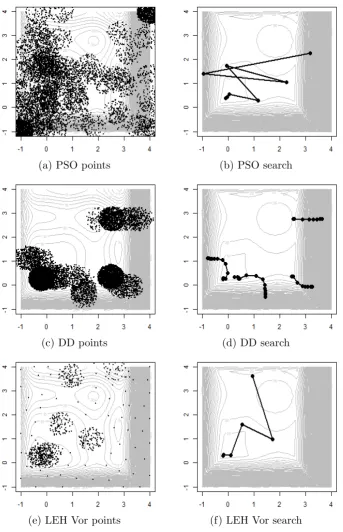
In order to give some indication of the nature of our LEH search we have applied it to the 2-dimensional problem (poly2D) and plotted the points evaluated and associated search path of the current estimate of the robust global minimum in Figures 4e and 4f. Here the LEH Voronoi algorithm is used. For comparison we have also plotted corre-sponding results for two alternative heuristics, a robust Particle Swarm Optimisation (PSO) approach shown in Figures 4a and 4b, and the lo-cal descent directions approach from Section 3.2 shown in Figures 4c and 4d. Here the robust PSO is used as a proxy to a brute force or co-evolutionary approach. The basic global PSO formulations have been used, as described in [SE98]. The descent directions approach has been extended by using random re-starts, as a proxy to extend-ing it to a global approach. In all cases inner random samplextend-ing in a hypersphere of 100 Γ-uncertainty neighbourhood points is used, and a maximum budget of 10,000 function evaluations employed.
example less than 1,000 function evaluations have been required before the LEH heuristic has stopped because an LEH of radius greater than Γ cannot be found, but for larger (dimensional) problems such stop-ping prior to reaching the budgetary limit will not apply. One striking feature of Figure 4e is how many of the inner searches stop immediately on the evaluation of a candidate point. This is because the objective value at these candidate points exceeds the current threshold τ.
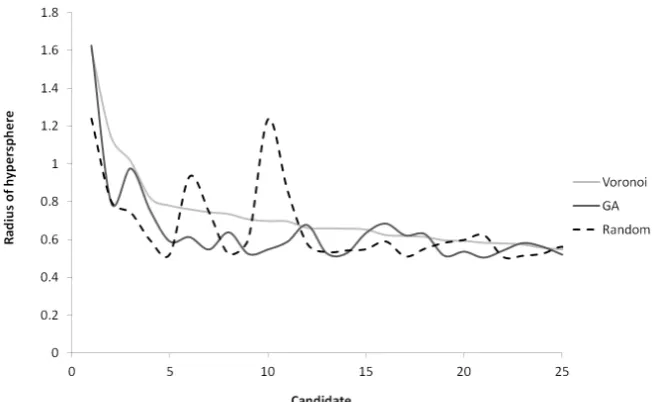
The Voronoi based search exemplified by Figures 4e and 4f is a good indicator of the nature of the searches due to all three LEH approaches, random, GA and Voronoi. However the radii of the LEH identified for each candidate will vary with the use of each of these algorithms. Figure 9 in Appendix B gives some indication of how the radii of the hyperspheres generated by each of these LEH heuristics progress as the exploration proceeds.
5. Computational experiments
5.1. Set up
In order to assess the effectiveness of the LEH approach the heuristic has been applied to eight test problems, and results compared against the two alternative search heuristics described in Section 5.2. Exper-iments have been performed on 2D, 4D, 7D, 10D and 100D instances of these test problems; results have also been generated for (poly2D). Both the genetic algorithm and random forms of the LEH heuristic have been assessed for all instances. The LEH Voronoi has addition-ally been applied to the 2D instances, with the intention of giving some indication of the differences due to a ‘best’ LEH identifier algorithm (Voronoi) versus the alternatives. All LEH approaches are initialised
by randomly sampling a single point in X. Assuming that for most
real-world problems the optimisation analysis will be limited by re-sources, a fixed budget of 10,000 function evaluations (model runs) is assumed. The same inner approach is employed for all heuristics. A simple random sampling in a hypersphere of 100 points in a point’s lo-cal Γ-uncertainty neighbourhood is used for all instances, and the lolo-cal robust maximum is estimated as the maximum due to this sampling. For the LEH approaches this inner sampling is curtailed if a point is identified in the uncertainty neighbourhood that has objective value exceeding the current high cost threshold τ.
(a) PSO points (b) PSO search
(c) DD points (d) DD search
[image:22.595.132.476.105.638.2](e) LEH Vor points (f) LEH Vor search
Pavilion 15 Notebook laptop computer, with 64 bit operating sys-tem, an Intel Core i3-5010U, 2.10GHz processor, and 8GB RAM. Each heuristic search has been applied to each test problem-dimension
in-stance 50 times to reduce variability. For the solution of the
Sec-ond Order Cone Problem as part of the descent directions algorithm [BNT10b], the IBM ILOG CPLEX Optimization Studio V12.6.3 pack-age is called from Java.
5.2. Comparator heuristics
Our experiments have been conducted on LEH, a re-starting descent directions, and robust PSO metaheuristics. We have applied param-eter tuning to 3 of the 5 comparator heuristics – LEH Voronoi and LEH Random do no have tunable parameters – employing an evolu-tionary tuning approach using a genetic algorithm to generate a single set of parameters for each heuristic, for all test problems. For each of the 3 tuned heuristics the same subset of the test instances was used, running each member of an evolving population on each of these in-stances multiple times to generate mean result for each member of a population on each test instance. The performance of each individual in a population was ranked separately for each test instance, across the members of the population, leading to mean overall ranks which were used as the utility measure in tournament selection; see e.g. [ES12].
The effectiveness of the local descent directions approach [BNT10b] suggests that extending this to a global search by using random re-starts will provide a reasonable comparator. A local descent directions search is undertaken from a random start point, and when this is com-plete it is repeated from another random start point. This is repeated
until the function evaluations budget is reached. In descent
direc-tions a set of high cost points leads to the identification of an optimal stepping direction and step size, if a valid direction exists. However the algorithm includes a number of dynamically changing parameters which adapt the high cost set and enforce a minimum step size. Here we have tuned 5 parameters relating to these stages of the heuristic; see [BNT10b] for further information. Labelled ‘d.d. Re’ in the results section.
As a proxy to a brute force or co-evolutionary approach an outer particle swarm search is considered. The basic formulations for the global PSO approach have been used as described in [SE98] and 5 parameters have been tuned: swarm size, number of iterations, and
inertia weight parameter ω. The combined swarm size times number of iterations was limited to 100 in order to align with the budget of 10,000 function evaluations and the level of inner sampling. Labelled ‘PSO’ in the results section.
Our robust LEH metaheuristic is considered for the three alternative ways of identifying the largest hypersphere that is empty of hcps:
• Randomly sampled valid empty hypersphere, see Section 4.2.1. This
includes re-sampling up to 1,000 potential candidates in an attempt to identify a valid empty hypersphere, otherwise it is assumed that a valid point cannot be found and a robust global minimum has been reached. Labelled ‘LEH Rnd’ in the results section.
• Genetic algorithm LEH, see Section 4.2.2. Here we have tuned 6
parameters: the size of the population, number of generations, num-ber of elites, tournament size, and mutation probability and size; we have fixed the use of tournament selection and the choice of mid-point crossover. The combined population size times number of gen-erations was limited to 100, which is somewhat based on runtime considerations associated with the large value of Nτ, the number of candidate points visited with a budget of 10,000 function evaluations. Labelled ‘LEH GA’ in the results section.
• Voronoi based [Tou83] LEH, see Section 4.2.3. Here the construction
of the Voronoi diagram for the input pointsHτis performed using the Java library due to [Nah17]. This generates geometric data, Voronoi vertices and edges, which are used to determine a set of potential candidate points – Voronoi vertices, including those originally
out-side of X relocated to the boundary of X – for the centre of the
LEH. Labelled ‘LEH Vor’ in the results section.
5.3. Test functions
A large number of test functions are available for benchmarking optimi-sation algorithms, and posing a variety of difficulties, see [Kru12, JY13]. Here eight are considered, plus (poly2D) as outlined in Section 3.1. In each case a single Γ-uncertainty value is used:
• Ackleys: feasible region [-32.768, 32.768]; Γ=3.0.
• Multipeak F1: feasible region [0, 1]; Γ=0.0625.
• Multipeak F2: feasible region [0, 10]; Γ=0.5.
• Rosenbrock: feasible region [-2.048, 2.048]; Γ=0.25.
• Sawtooth: feasible region [-1, 1]; Γ=0.2.
• Sphere: feasible region [-5, 5]; Γ=1.0.
• Volcano: feasible region [-10, 10]; Γ=1.5.
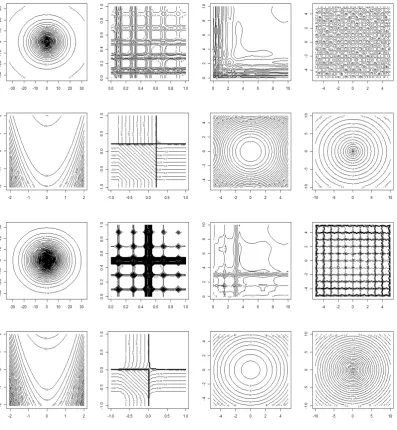
The full description of these eight test functions is given in Ap-pendix A. To give some indication of the nature of these functions contour plots of the 2D instances are shown in Figure 5, for both the nominal and worst cases.
5.4. Results
Results of the 50 samples runs for each heuristic applied to each test problem-dimension instance are presented here. In each run the best solution as identified by the heuristic is used. However the points in the decision variable space that have been identified as best have robust values generated using the simple inner random sampling approach, with a budget of up to 100 sample points. To better approximate the true robust values at these points their robust values have been re-estimated based on randomly sampling a large number of points (nominally 1,000,000) in the Γ-uncertainty neighbourhood of the iden-tified robust point. This is a post processing exercise and does not affect the min max search.
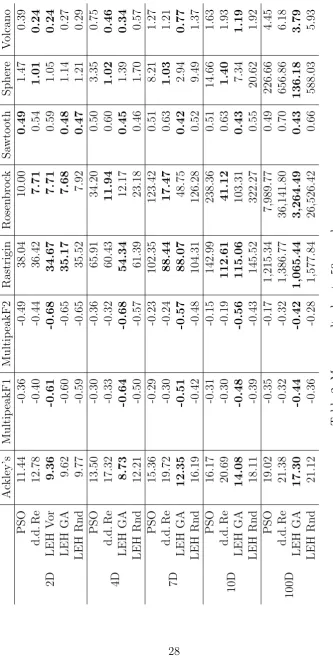
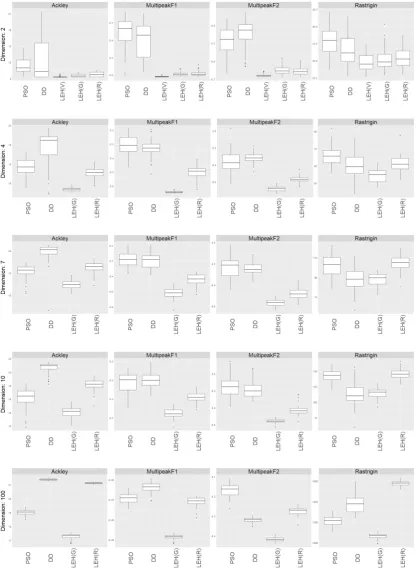
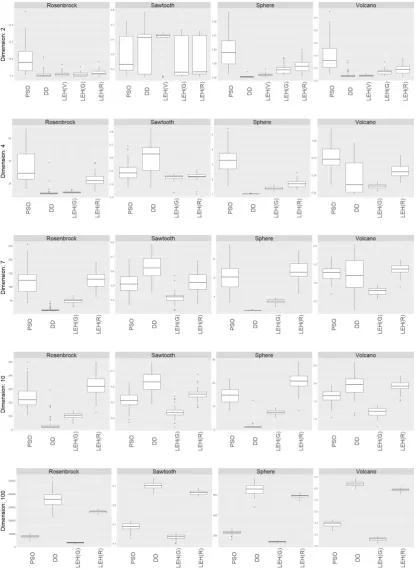
Mean results due to each set of 50 sample runs are shown in Ta-bles 1 and 2. We have applied the Wilcoxon rank-sum test with 95% confidence to identify the statistically best approaches. Results high-lighted in bold indicate the approaches that are statistically equiva-lent to the best one observed, for a given problem-dimension instance. Corresponding box plots, giving some indication of how the results are distributed across the 50 samples, are shown in Figures 6, 7 and 8. Additional results, the standard deviations due to each set of 50 sam-ple runs, the average number of candidate points visited and average number of function evaluations undertaken, are given in Appendix C.
From Table 2 we see that for 100D instances the LEH GA approach is best for all test problems, and in several cases the mean LEH GA result is substantially better than all of the alternative heuristics. From Tables 1 and 2 the LEH approach is among the best in at least 6 of the instances for all other dimensions.
(poly2D)
2D
PSO 5.57
d.d. Re 5.11
LEH Vor 5.52
LEH GA 5.50
[image:27.595.225.369.165.255.2]LEH Rnd 5.26
Table 1: Mean results due to 50 sample runs for the 2-dimensional polynomial function (poly2D) due to [BNT10b].
[image:27.595.194.400.449.585.2]the best results for 3 and 2 problems respectively. It should also be noted that in 5 of the 7 instances where LEH Voronoi is among the best, LEH GA is either statistically equivalent or the mean value is second best. For the 2D Sphere instance d.d. Re is marginally better than LEH Voronoi, whilst d.d. Re and LEH heuristics are statistically equivalent for the (poly2D) and 2D Volcano and Rosenbrock instances. The robust PSO approach is statistically equivalent to LEH heuristics for the 2D Sawtooth instance.
For the 4D – 10D instances d.d. Re is statistically equivalent to LEH GA in the 4D Volcano problem and the 7D and 10D instances of the Rastrigin problem, and better than LEH GA for the Rosenbrock and Sphere problems. For the 4D Rosenbrock and Sphere problems the differences between d.d. Re and LEH GA are reasonably small, however in the 7D and 10D instances d.d. Re is substantially better. Considering the shape of the Rosenbrock and Sphere functions it can be expected that a local search will perform particularly well for these problems.
LEH GA is better than LEH Rnd for all instances excluding (poly2D). In a number of instances LEH GA is substantially better than LEH Rnd. The number of candidate points that LEH can visit is substan-tially increased by the early stopping of inner searches as soon as the high cost threshold is exceeded, see Tables 3 and 5 in Appendix C. Although this feature must unquestionably play a role in the success of the LEH GA approach, the fact that LEH Rnd visits a comparable number of candidate points indicates that the additional pro active seeking of the largest hypersphere devoid of high cost points is also a significant factor in the success of LEH GA.
6. Conclusions and further work
We have introduced a new metaheuristic for box-constrained robust optimisation problems with implementation uncertainty. We do not assume any knowledge on the structure of the original objective func-tion, making the approach applicable to black-box and simulation-optimisation problems. We do assume that the solution is affected by uncertainty, and the aim is to find a solution that optimises the worst possible performance in this setting. This is the min max prob-lem. Previously, few generic search methods have been developed for this setting.
identifying the largest hypersphere in the decision variable space that is completely devoid of hcps, and exploring the decision variable space by stepping between the centres of these largest empty hyperspheres.
We demonstrated the effectiveness of the approach using a series of test problems, considering instances of varying dimension, and com-paring our LEH approach against one metaheuristic that employs an outer particle swarm optimisation and one from the literature that uses multiple re-starts of the local descent directions approach. For low and moderate dimensional instances the approach shows compet-itive performance; for high-dimensional problems the LEH approach significantly outperforms the comparator heuristics for all problems.
There are several ways in which this work can be developed. Further consideration can be given to the inner maximisation search approach in order to better understand the trade-off between expending function evaluations on the local Γ-radius uncertainty neighbourhood search versus globally exploring the search space, in the context of our LEH approach.
The repeated calculation of large numbers of Euclidean distances each time a new LEH needs to be identified within the LEH GA heuris-tic is computationally expensive. Rather than only calculating a single next candidate point each time the GA is performed, identifying multi-ple points could speed up computation or alternatively enable the use of larger population-generation sizes to improve the estimation of the largest empty hypersphere.
Results of the mid-dimension experiments on the Rosenbrock and Sphere test problems suggest that an exploitation based approach works well in these instances, indicating a direction for extending our explo-ration focussed LEH approach.
It is clear that within the LEH algorithm the early stopping of the in-ner searches when it is established that the current robust global value cannot be improved upon has significant advantages. It is worth con-sidering whether alternative search approaches could take advantage of this feature.
Appendices
A. Test functions
Ackleys
f(xxx) = −20 exp −0.2 v u u t 1
n
n X
i=1
x2
i !
−exp 1
n
n X
i=1
cos(2πxi) !
+20+exp(1)
The feasible region is the hypercubexi ∈ [-32.768, 32.768].
MultipeakF1
f(xxx) = −1
n
n X
i=1
g(xi), g(xi) = (
exp(2 ln 2(xi−0.1
0.8 ) 2)p
|sin(5πxi)| if 0.4< xi ≤0.6 , exp(2 ln 2(xi−0.1
0.8 )
2) sin6(5πx
i) otherwise
The feasible region is the hypercubexi ∈ [0, 1].
MultipeakF2
f(xxx) = 1
n
n X
i=1
g(xi) , g(xi) = 2 sin(10 exp(−0.2xi)xi) exp(−0.25xi)
The feasible region is the hypercubexi ∈ [0, 10].
Rastrigin
f(xxx) = 10n+ n X
i=1
[x2i −10 cos(2πxi)]
The feasible region is the hypercubexi ∈ [-5.12, 5.12].
Rosenbrock
f(xxx) = n−1
X
i=1
[100(xi+1−x2i)
2+ (x
The feasible region is the hypercubexi ∈ [-2.048, 2.048].
Sawtooth
f(xxx) = 1− 1
n
n X
i=1
g(xi) , g(xi) = (
xi+ 0.8 if −0.8≤xi <0.2 ,
0 otherwise
The feasible region is the hypercubexi ∈ [-1, 1].
Sphere
f(xxx) = n X
i=1
x2i
The feasible region is the hypercubexi ∈ [-5, 5].
Volcano
f(xxx) = (p
kxxxk −1 if kxxxk>1 ,
0 otherwise
The feasible region is the hypercubexi ∈ [-10, 10].
B. Radii due to alternative LEH algorithms
Whilst the Voronoi based search exemplified by Figures 4e and 4f in Section 4.5 is a good indicator of the nature of the searches due to all three alternative LEH approaches, random, GA and Voronoi, the radii of the LEH identified for each candidate will vary across these approaches. Here Figure 9 gives some indication of how the radii of the hyperspheres generated by each these three LEH heuristics progress as the exploration proceeds. The three curves represent separate runs of the LEH algorithm when applied to (poly2D),and should be considered indicative.
Figure 9: Alternative LEH approaches applied to the same problem: variation in empty hypersphere radius with numbers of candidates evaluated for robustness.
the indicative patterns due to the alternative heuristics. For the ran-dom algorithm the size of the LEH is quite variable, whilst for Voronoi the curve is smooth. The GA algorithm sits somewhere between the two.
C. Additional results
The standard deviations due to each set of 50 sample runs, the aver-age number of candidate points visited and averaver-age number of function evaluations undertaken, are shown in Tables 3, 4, 5 and 6 here respec-tively. Labelling of comparator heuristics in the tables is as follows:
• PSO: particle swarm optimisation.
• d.d. Re: Multi re-start descent directions.
• LEH Vor: LEH using a Voronoi [Tou83] approach; applied to 2D
problems only.
• LEH GA: LEH using a genetic algorithm.
Std. dev. Candidates Evaluations
poly2D
PSO 0.83 100 10,000
d.d. Re 1.27 100 10,000
LEH Vor 1.60 35 995
LEH GA 0.56 30 727
[image:36.595.144.454.320.405.2]LEH Rnd 1.07 35 1,037
References
[ABV09] H. Aissi, C. Bazgan, and D. Vanderpooten. Minmax
and minmax regret versions of combinatorial
optimiza-tion problems: A survey. European Journal of
Opera-tional Research, 197(2):427 – 438, 2009.
[BNT07] D. Bertsimas, O. Nohadani, and K. M. Teo. Robust
opti-mization in electromagnetic scattering problems. Journal
of Applied Physics, 101(7):074507, 2007.
[BNT10a] D. Bertsimas, O. Nohadani, and K. M. Teo. Nonconvex
robust optimization for problems with constraints.
IN-FORMS journal on computing, 22(1):44–58, 2010. [BNT10b] D. Bertsimas, O. Nohadani, and K. M. Teo. Robust
op-timization for unconstrained simulation-based problems.
Operations Research, 58(1):161–178, 2010.
[BS04] D. Bertsimas and M. Sim. The price of robustness.
Op-erations Research, 52(1):35–53, 2004.
[BS07] H-G. Beyer and B. Sendhoff. Robust optimization–a
com-prehensive survey.Computer methods in applied
mechan-ics and engineering, 196(33):3190–3218, 2007.
[BTBB10] A. Ben-Tal, D. Bertsimas, and D. Brown. A soft robust
model for optimization under ambiguity. Operations
re-search, 58(4-part-2):1220–1234, 2010.
[BTGN09] A. Ben-Tal, L. El Ghaoui, and A. Nemirovski. Robust
Optimization. Princeton University Press, Princeton and Oxford, 2009.
[BTN98] A. Ben-Tal and A. Nemirovski. Robust convex
optimiza-tion. Mathematics of Operations Research, 23(4):769–
805, 1998.
[CG16] A. Chassein and M. Goerigk. A bicriteria approach to robust optimization. Computers & Operations Research, 66:181 – 189, 2016.
[Cha93] B. Chazelle. An optimal convex hull algorithm in any
fixed dimension. Discrete & Computational Geometry,
10(4):377–409, Dec 1993.
[CSZ09] A. M. Cramer, S. D. Sudhoff, and E. L. Zivi. Evolutionary
algorithms for minimax problems in robust design. IEEE
Transactions on Evolutionary Computation, 13(2):444– 453, 2009.
between number of objectives, sample size and choice of
robustness measure. Computers & Operations Research,
79:266 – 278, 2017.
[dMB14] T. Homem de Mello and G. Bayraksan. Monte carlo
sampling-based methods for stochastic optimization.
Sur-veys in Operations Research and Management Science, 19(1):56 – 85, 2014.
[EKS17] G. Eichfelder, C. Kr¨uger, and A. Sch¨obel. Decision
uncer-tainty in multiobjective optimization. Journal of Global
Optimization, 69(2):485–510, 2017.
[ES12] A. E. Eiben and S. K. Smit. Evolutionary Algorithm
Parameters and Methods to Tune Them, pages 15–36. Springer Berlin Heidelberg, Berlin, Heidelberg, 2012. [GLT97] B. L. Golden, G. Laporte, and . D. Taillard. An adaptive
memory heuristic for a class of vehicle routing problems
with minmax objective. Computers & Operations
Re-search, 24(5):445 – 452, 1997.
[GS10] J. Goh and M. Sim. Distributionally robust optimization
and its tractable approximations. Operations Research,
58(4-part-1):902–917, 2010.
[GS16] M. Goerigk and A. Sch¨obel. Algorithm engineering in
robust optimization. In L. Kliemann and P. Sanders,
edi-tors, Algorithm Engineering: Selected Results and
Sur-veys, volume 9220 of LNCS State of the Art of
Lec-ture Notes in Computer Science, pages 245–279. Springer Berlin / Heidelberg, 2016.
[Her99] J. W. Herrmann. A genetic algorithm for minimax
opti-mization problems. In Evolutionary Computation, 1999.
CEC 99. Proceedings of the 1999 Congress on, volume 2, pages 1099–1103. IEEE, 1999.
[Jen04] M. T. Jensen. A New Look at Solving Minimax Problems
with Coevolutionary Genetic Algorithms, pages 369–384. Springer US, Boston, MA, 2004.
[JSW98] D. R. Jones, M. Schonlau, and W. J. Welch. Efficient
global optimization of expensive black-box functions. J.
of Global Optimization, 13(4):455–492, December 1998. [JY13] M. Jamil and X-S. Yang. A literature survey of
bench-mark functions for global optimization problems.
[Kru12] J. W. Kruisselbrink. Evolution strategies for robust op-timization. PhD thesis, Leiden Institute of Advanced Computer Science (LIACS), Faculty of Science, Leiden university, 2012.
[KY97] P. Kouvelis and G. Yu.Robust Discrete Optimization and
Its Applications. Kluwer Academic Publishers, 1997. [MKA11] K. Masuda, K. Kurihara, and E. Aiyoshi. A novel method
for solving min-max problems by using a modified
par-ticle swarm optimization. In Systems, Man, and
Cyber-netics (SMC), 2011 IEEE International Conference on, pages 2113–2120. IEEE, 2011.
[MLM15] S. Mirjalili, A. Lewis, and S. Mostaghim. Confidence
measure: A novel metric for robust meta-heuristic
op-timisation algorithms. Information Sciences, 317:114 –
142, 2015.
[MWPL13] J. Marzat, E. Walter, and H. Piet-Lahanier.
Worst-case global optimization of black-box functions through
kriging and relaxation. Journal of Global Optimization,
55(4):707–727, Apr 2013.
[MWPL16] J. Marzat, E. Walter, and H. Piet-Lahanier. A new
expected-improvement algorithm for continuous minimax
optimization. Journal of Global Optimization, 64(4):785–
802, 2016.
[Nah17] C. Nahr. Tektosyne library for java, 2017. Available at http://www.kynosarges.org.
[OS97] A. Okabe and A. Suzuki. Locational optimization
prob-lems solved through voronoi diagrams. European Journal
of Operational Research, 98(3):445 – 456, 1997.
[PBJ06] I. Paenke, J. Branke, and Y. Jin. Efficient search for ro-bust solutions by means of evolutionary algorithms and
fitness approximation. IEEE Transactions on
Evolution-ary Computation, 10(4):405–420, 2006.
[SE98] Y. Shi and R. Eberhart. A modified particle swarm
opti-mizer. In1998 IEEE International Conference on
Evolu-tionary Computation Proceedings. IEEE World Congress on Computational Intelligence (Cat. No.98TH8360), pages 69–73, 1998.
[SK02] Y. Shi and R. Krohling. Co-evolutionary particle swarm
optimization to solve min-max problems. In
Congress on, volume 2, pages 1682–1687. IEEE, 2002.
[Tal09] E-G. Talbi. Metaheuristics: From Design to
Implemen-tation. Wiley Publishing, 2009.
[Tou83] G. T. Toussaint. Computing largest empty circles with
location constraints. International Journal of Computer
& Information Sciences, 12(5):347–358, 1983.
[uRL17] S. ur Rehman and M. Langelaar. Expected
improve-ment based infill sampling for global robust optimization
of constrained problems. Optimization and Engineering,
18(3):723–753, Sep 2017.
[uRLvK14] S. ur Rehman, M. Langelaar, and F. van Keulen. Effi-cient kriging-based robust optimization of unconstrained
problems. Journal of Computational Science, 5(6):872 –
881, 2014.
[VDYL16] K. Khac Vu, C. D’Ambrosio, Y.Hamadi, and L.
Lib-erti. Surrogatebased methods for blackbox
optimiza-tion.International Transactions in Operational Research, 24(3):393–424, 2016.
[VMdCM11] C. Arbex Valle, L. Conegundes Martinez, A. Salles da Cunha, and G. R. Mateus. Heuristic and exact algo-rithms for a minmax selective vehicle routing problem.
Computers & Operations Research, 38(7):1054 – 1065, 2011.
[ZZ10] A. Zhou and Q. Zhang. A surrogate-assisted evolutionary
algorithm for minimax optimization. In IEEE Congress
![Figure 1: Nominal and worst case cost for (poly2D) from [BNT10b]. Marked inpurple are the respective optima.](https://thumb-us.123doks.com/thumbv2/123dok_us/9303446.430929/8.595.117.480.413.609/figure-nominal-worst-case-marked-inpurple-respective-optima.webp)
![Figure 2: Description of the descent direction robust local search approach[BNT10b].](https://thumb-us.123doks.com/thumbv2/123dok_us/9303446.430929/10.595.346.477.401.559/figure-description-descent-direction-robust-local-search-approach.webp)
![Figure 6: Box plots of robust objective values due to multiple sample runs for the2-dimensional polynomial function (poly2D) due to [BNT10b].](https://thumb-us.123doks.com/thumbv2/123dok_us/9303446.430929/27.595.225.369.165.255/figure-robust-objective-values-multiple-dimensional-polynomial-function.webp)