, TEX
THE FIRST POST-KEPLER BRIGHTNESS DIPS OF KIC 8462852
TABETHA. S. BOYAJIAN,1R
OIALONSO,2, 3A
LEXAMMERMAN,4, 5D
AVIDARMSTRONG,6, 7A. A
SENSIORAMOS,2, 3K. B
ARKAOUI,8, 9
THOMASG. BEATTY,10, 11Z. BENKHALDOUN,9PAULBENNI,12, 4RORYBENTLEY,1ANDREIBERDYUGIN,13
SVETLANABERDYUGINA,14SERGEBERGERON,4, 15ALLYSONBIERYLA,16MICHAELAG. BLAIN,17ALICIACAPETILLOBLANCO,18 EVAH. L. BODMAN,19, 20ANNEBOUCHER,21MARKBRADLEY,4 STEPHENM. BRINCAT,4THOMASG. BRINK,22JOHNBRIOL,4
DAVIDJ. A. BROWN,6, 7J.BUDAJ,23A. BURDANOV,8B. CALE,24MIGUELAZNARCARBO,25R. CASTILLOGARCÍA,26, 4, 27 WENDYJ CLARK,4G
EOFFREYC. CLAYTON,1J
AMESL. CLEM,28P
HILLIPH COKER,4E
VANM. COOK,17C
HRISM. COPPERWHEAT,29
J. CURTIS,30R. M. CUTRI,31 B. CSEH,32 C. H. CYNAMON,4, 33ALEXJ. DANIELS,28JAMESR. A. DAVENPORT,34, 35HANSJ. DEEG,2, 3 ROBERTODELORENZO,36T
HOMAS DEJAEGER,22J
EAN-BRUNODESROSIERS,4 J
OHNDOLAN,6, 7D. J. D
OWHOS,37, 4
FRANKYDUBOIS,38 R. DURKEE,39SHAWNDVORAK,4LYNNEASLEY,4N. EDWARDS,40TYLERG. ELLIS,1EMERYERDELYI,4 STEVEERTEL,41R
AFAEL. G. FARFÁN,42J. F
ARIHI,43A
LEXEIV. FILIPPENKO,22, 44 E
MMAFOXELL,6, 7D
AVIDEGANDOLFI,45
FAUSTINOGARCIA,46, 47F. GIDDENS,48M. GILLON,8JUAN-LUISGONZÁLEZ-CARBALLO,49, 4C. GONZÁLEZ-FERNÁNDEZ,50 J. I. GONZÁLEZHERNÁNDEZ,51, 3KEITHA. GRAHAM,4KENTONA. GREENE,17J. GREGORIO,52NA’AMAHALLAKOUN,53 OTTÓHANYECZ,54, 32G. R. HARP,55GREGORYW. HENRY,56 E. HERRERO,57CALEBF. HILDBOLD,28D. HINZEL,4G. HOLGADO,2, 3
BERNADETTIGNÁCZ,54, 32VALENTIND. IVANOV,58, 59E. JEHIN,60HELENE. JERMAK,29STEVEJOHNSTON,4S. KAFKA,4 CSILLAKALUP,54, 32E
MMANUELKARDASIS,61S
HAIKASPI,53G
RANTM. KENNEDY,6F. K
IEFER,62C. L. K IELTY,63
DENNISKESSLER,64H. KIISKINEN,65T. L. KILLESTEIN,66, 4RONALDA. KING,4V. KOLLAR,23 H. KORHONEN,67C. KOTNIK,4 RÉKAKÖNYVES-TÓTH,54, 32L
EVENTEKRISKOVICS,32N
ATHANKRUMM,4V
ADIMKRUSHINSKY,68E. K
UNDRA,23
FRANCOIS-RENELACHAPELLE,21D. LACOURSE,69P. LAKE,4, 70, 71KRISTINELAM,6, 7GAVINP. LAMB,29DAVELANE,72 MARIEWINGYEELAU,73P
ABLOLEWIN,4, 74C
HRISLINTOTT,75C
AREYLISSE,76L
UDWIGLOGIE,77N
ICOLASLONGEARD,78
M. LOPEZVILLANUEVA,79E. WHITLUDINGTON,4, 80A. MAINZER,81LISONMALO,82, 83CHRISMALONEY,4A. MANN,84 A.MANTERO,4MASSIMOMARENGO,85JONMARCHANT,29M. J. MARTÍNEZGONZÁLEZ,2, 3JOSEPHR. MASIERO,86
JONC. MAUERHAN,22J
AMESMCCORMAC,6, 7A
ARONMCNEELY,4, 5H
UANY. A. MENG,41M
IKEMILLER,4, 87 LAWRENCEA. MOLNAR,17 J. C. MORALES,88BRETTM. MORRIS,89 MATTHEWW. MUTERSPAUGH,56, 90DAVIDNESPRAL,2, 3
C. R. NUGENT,91K
ATHERINEM. NUGENT,1A. O
DASSO,37, 4D
EREKO’KEEFFE,92A. O
KSANEN,65J
OHNM. O’MEARA,93
ANDRÁSORDASI,32HUGHOSBORN,94, 6, 7JOHNJ. OTT,4J. R. PARKS,95DIEGORODRIGUEZPEREZ,18VANCEPETRIEW,4, 15 R PICKARD,96A
NDRÁSPÁL,32P. P
LAVCHAN,97C. W
ESTENDORPPLAZA,2, 3D
ONPOLLACCO,6, 7F. P
OZONUÑEZ,98, 99
F. J. POZUELOS,100STEVERAU,101SETHREDFIELD,102HOWARDRELLES,16I. RIBAS,88JONRICHARDS,103, 104
JOONASL. O. SAARIO,105, 106EMILYJ. SAFRON,1J. MARTINSALLAI,32, 54KRISZTIÁNSÁRNECZKY,32BRADLEYE. SCHAEFER,1 CLEAF. SCHUMER,16MADISONSCHWARTZENDRUBER,4, 5MICHAELH. SIEGEL,107ANDREWP. V. SIEMION,108, 109, 110 BROOKED. SIMMONS,111, 112JOSHUAD. SIMON,113S. SIMÓN-DÍAZ,2, 3MICHAELL. SITKO,114, 115HECTORSOCAS-NAVARRO,2, 3
Á. SÓDOR,32D
ONNSTARKEY,116I
AINA. STEELE,29G
EOFFSTONE,117, 4R.A. S
TREET,118T
RICIASULLIVAN,29J. S
UOMELA,119
J. J. SWIFT,40GYULAM. SZABÓ,120RÓBERTSZABÓ,32RÓBERTSZAKÁTS,32TAMÁSSZALAI,121ANGELLEM. TANNER,122 B. TOLEDO-PADRÓN,2, 3T
AMÁSTORDAI,123A
MAURYH.M.J. TRIAUD,124J
AKED. TURNER,125J
OSEPHH. ULOWETZ,4
MARIANURBANIK,4, 126SIEGFRIEDVANAVERBEKE,77, 127ANDREWVANDERBURG,128KRISZTIÁNVIDA,32BRADP. VIETJE,4 JÓZSEFVINKÓ,32K.
VONBRAUN,129E
LIZABETHO. WAAGEN,4D
ANWALSH,4, 5C
HRISTOPHERA. WATSON,130R.C. W EIR,4
KLAUSWENZEL,131MICHAELW. WILLIAMSON,56JASONT. WRIGHT,10, 11, 132M. C. WYATT,133WEIKANGZHENG,22AND
GABRIELLAZSIDI54, 32
1Department of Physics and Astronomy, Louisiana State University, Baton Rouge, LA 70803 USA
2Instituto de Astrofísica de Canarias, 38205 La Laguna, Tenerife, Spain
3Departamento de Astrofísica, Universidad de La Laguna, 38206 La Laguna, Tenerife, Spain
4American Association of Variable Star Observers
5University of Notre Dame QuarkNet Center
6Department of Physics, University of Warwick, Gibbet Hill Road, Coventry, CV4 7AL, UK
7Centre for Exoplanets and Habitability, University of Warwick, Gibbet Hill Road, Coventry, CV4 7AL, UK
Corresponding author: Tabetha Boyajian [email protected]
8Space sciences, Technologies and Astrophysics Research (STAR) Institute, Université de Liège, Belgium
9Laboratoire LPHEA, Oukaimeden Observatory, Cadi Ayyad University/FSSM, BP 2390, Marrakesh, Morocco
10Department of Astronomy & Astrophysics, The Pennsylvania State University, 525 Davey Lab, University Park, PA 16802, USA
11Center for Exoplanets and Habitable Worlds, The Pennsylvania State University, 525 Davey Lab, University Park, PA 16802, USA
12Acton Sky Portal, Acton, MA 01720, USA
13Tuorla Observatory, University of Turku, Finland
14Kiepenheuer Institut fÃijr Sonnenphysik, Freiburg, Germany
15The Royal Astronomical Society of Canada
16Harvard-Smithsonian Center for Astrophysics, 60 Garden St, Cambridge, MA 02138, USA
17Department of Physics and Astronomy, Calvin College, Grand Rapids, MI 49546, USA
18American Association of Variable Star Observer
19School of Earth and Space Exploration, Arizona State University, Tempe, AZ 85287-1404, USA
20NASA Postdoctoral Program Fellow, Nexus for Exoplanet System Science
21Institute for Research on Exoplanets, Département de physique, Université de Montréal, Montréal, QC H3C 3J7, Canada
22Department of Astronomy, University of California, Berkeley, CA 94720-3411.
23Astronomical Institute, Slovak Academy of Sciences, The Slovak Republic
24George Mason University, 4400 University Drive, MSN 3F3, Fairfax, VA 22030
25American Association of Variable Star Observers, Blesa, Spain
26Asociación Astronómica Cruz del Norte, Alcobendas, Madrid, Spain
27MPC Z83 Chicharronian Tres Cantos Observatory, Tres Cantos, Madrid, Spain
28Department of Physics, Grove City College, 100 Campus Dr., Grove City, PA 16127, USA
29Astrophysics Research Institute, Liverpool John Moores University, 146 Brownlow Hill, L3 5RF, UK
30Center for Exoplanets and Habitable Worlds, Department of Astronomy & Astrophysics, The Pennsylvania State University, 525 Davey Laboratory, University
Park, PA 16802, USA
31IPAC, Mail Code 100-22, California Institute of Technology, 1200 E. California Blvd., Pasadena, CA 91125, USA
32MTA CSFK, Konkoly Observatory, Budapest, Hungary
33Howard Astronomical League
34Department of Physics & Astronomy, Western Washington University, 516 High St., Bellingham, WA 98225, USA
35NSF Astronomy and Astrophysics Postdoctoral Fellow
36Alphard Observatory, Ostuni, Italy, MPC Code K82
37Sierra Stars Observatory Network
38Astrolab IRIS, Verbrandemolenstraat, Ypres, Belgium and Vereniging voor Sterrenkunde, Werkgroep Veranderlijke Sterren, Belgium
39Shed of Science Observatory, 5213 Washburn Ave. S. Minneapolis, MN, , 55410, USA
40The Thacher School, 5025 Thacher Rd., Ojai, CA 93023, USA
41Steward Observatory, Department of Astronomy, University of Arizona, 933 North Cherry Avenue, Tucson, AZ 85721, USA
42Observatorio Astronómico URANIBORG; 41400 Écija, Sevilla, Spain
43Physics & Astronomy, University College London, London WC1E 6BT, UK
44Miller Senior Fellow, Miller Institute for Basic Research in Science, University of California, Berkeley, CA 94720-3411.
45Dipartimento di Fisica, Universitá di Torino, via P. Giuria 1, 10125 Torino, Italy
46M1 Group, Spain
47La Vara, Valdés Observatory- MPC J38, Spain
48Missouri State University, 901 S National Ave, Springfield, MO 65897
49MPC I84 Observatorio Cerro del Viento, Badajoz, Spain
50Institute of Astronomy, University of Cambridge, Madingley Road, CB3 0HA, UK
51Instituto de Astrofísica de Canarias, 38205 La Laguna, Tenerife, Spain
52Atalaia Group & CROW Observatory Portalegre, Portugal
53School of Physics and Astronomy and Wise Observatory, Raymond and Beverly Sackler Faculty of Exact Sciences, Tel Aviv University, Tel Aviv 69978, Israel
54Loránd Eötvös University, Budapest, Hungary
55SETI Institute, 189 Bernardo, Ste. 200, Mountain View, CA 94043
56Center of Excellence in Information Systems, Tennessee State University, Nashville, TN 37209, USA
57Montsec Astronomical Observatory (OAdM), Institut dÉstudis Espacials de Catalunya (IEEC), Barcelona, Spain
58European Southern Observatory, Ave. Alonso de Córdova 3107, Vitacura, Santiago, Chile
59European Southern Observatory, Karl-Schwarzschild-Str. 2, 85748, Garching bei München, Germany
61Hellenic Amateur Astronomy Association
62Institut d’Astrophysique de Paris, UMR7095 CNRS, Université Pierre & Marie Curie, 98 bis boulevard Arago, 75014 Paris, France
63Department of Physics and Astronomy, University of Victoria, Victoria, BC, V8W 3P2, Canada
64Ott Observatory, Nederland, CO 80466, USA
65Hankasalmi Observatory, Hankasalmi, Finland
66British Astronomical Association, Variable Star Section
67Dark Cosmology Centre, University of Copenhagen, Juliane Maries Vej 30, DK-2100 Copenhagen Ø, Denmark
68Kourovka observatory, Ural Federal University, Russia
69Amateur Astronomer
70Astronomy Society Victoria, Australia
71iTelescope.net, Siding Spring, Australia
72Saint Mary’s University, The Royal Astronomical Society of Canada
73Department of Astronomy and Astrophysics, UCO/Lick Observatory, University of California, 1156 High Street, Santa Cruz, CA 95064, USA
74The Maury Lewin Memorial Astronomical Observatory,Glendora,California,USA
75Dept. Of Physics, University of Oxford, Denys Wilkinson Building, Keble Road, Oxford, OX1 3RH, UK
76Space Exploration Sector, JHU-APL, 11100 Johns Hopkins Road, Laurel, MD 20723, USA
77Astrolab IRIS, Verbrandemolenstraat, Ypres, Belgium and Vereniging voor Sterrenkunde, Werkgroep Veranderlijke Sterren, Belgium
78Observatoire de Strasbourg, 11, rue de l’Université, F-67000, Strasbourg, France
79Alain-American Association of Variable Star Observers, Le Cannet, France
80Caliche Observatory, Pontotoc, TX
81NASA Jet Propulsion Laboratory, California Institute of Technology, 4800 Oak Grove Dr, Pasadena, CA 91109, USA
82Département de physique and Observatoire du Mont-Mégantic, Université de Montréal, Montréal, QC H3C 3J7, Canada
83Institute for Research on Exoplanets, Université de Montréal, Montréal, QC H3C 3J7, Canada
84Department of Astronomy, Columbia University, 550 West 120th Street, New York, NY 10027, USA
85Department of Physics and Astronomy, 12 Physics Hall, Iowa State University, Ames, IA 50011, USA
86NASA Jet Propulsion Laboratory, California Institute of Technology, 4800 Oak Grove Dr, MS 183-301, Pasadena, CA 91109, USA
87Society of Astronomical Sciences
88Institut de Ciències de l’Espai (IEEC-CSIC), Carrer de Can Magrans s/n, E-08193 Barcelona, Spain
89Astronomy Department, University of Washington, Seattle, WA 98195, USA
90College of Life and Physical Sciences, Tennessee State University, Nashville, TN 37209
91Caltech/IPAC, Pasadena, CA, 91125, USA
92American Association of Variable Star Observers and Ballyhoura Observatory, IE
93Department of Physics, Saint Michael’s College, One Winooski Park, Colchester, VT, 05439
94Aix Marseille Univ, CNRS, LAM, Laboratoire d’Astrophysique de Marseille, Marseille, France
95Department of Physics and Astronomy, Louisiana State University, Baton Rouge, LA 70803, USA
96BAA Variable Star Section
97George Mason University, 4400 University Drive, MSN 3F3, Fairfax, VA 22030, USA
98Department of Physics, Faculty of Natural Sciences, University of Haifa, Haifa 31905, Israel.
99Haifa Research Center for Theoretical Physics and Astrophysics, Haifa 31905, Israel.
100Space sciences, Technologies and Astrophysics Research (STAR) Institute, UniversitÃl’ de Liôlge, Belgium
101Astrolab IRIS, Verbrandemolenstraat, Ypres, Belgium and Vereniging voor Sterrenkunde, Werkgroep Veranderlijke Sterren, Belgium
102Astronomy Department and Van Vleck Observatory, Wesleyan University, Middletown, CT 06459, USA
103Allen Telescope Array, Hat Creek Radio Observatory, 43321 Bidwell Road, Hat Creek, CA 96040
104SETI Institute, 189 Bernardo, Mountain View, CA 94043
105Koninklijke Sterrenwacht van België, Ringlaan 3, 1180 Brussels, Belgium
106Institute of Astronomy, KU Leuven, Celestijnenlaan 200D, 3001 Leuven, Belgium
107The Pennsylvania State University, 525 Davey Lab, University Park, PA 16801 USA
108University of California, Berkeley
109Radboud University, Netherlands
110SETI Institute, Mountain View, California
111Center for Astrophysics and Space Sciences (CASS), Department of Physics, University of California, San Diego, CA 92093, USA
112Einstein Fellow
113Observatories of the Carnegie Institution for Science, 813 Santa Barbara St., Pasadena, CA 91101
115Center for Extrasolar Planetary Systems, Space Science Institute, 4750 Walnut St, Suite 205, Boulder, CO 80301, USA
116DeKalb Observatory, MPC H63, Auburn, IN, 46706, USA
117Sierra Remote Observatories, 44325 Alder Heights Road, Auberry, CA 93602, USA
118Las Cumbres Observatory, Suite 102, 6740 Cortona Drive, Goleta, CA 93117, USA
119Clayhole Observatory, Jokela, Finland
120ELTE Eötvös Loránd University, Gothard Astrophysical Observatory, Szombathely, Hungary
121Department of Optics and Quantum Electronics, University of Szeged, H-6720 Szeged, Dom ter 9, Hungary
122Mississippi State University, Department of Physics & Astronomy, Hilbun Hall, Starkville, MS, 39762, USA
123Hungarian Astronomical Association, Budapest, Hungary
124School of Physics & Astronomy, University of Birmingham, Edgbaston, Birmingham B15 2TT, UK
125Department of Astronomy, University of Virginia, Charlottesville, VA 22904, USA
126Kysuce Observatory, Slovak Republic
127Center for Mathematical Plasma Astrophysics, University of Leuven, Belgium
128Department of Astronomy, The University of Texas at Austin, 2515 Speedway, Stop C1400, Austin, TX 78712
129Lowell Observatory, Flagstaff, AZ 86001, USA
130Astrophysics Research Centre, School of Mathematics and Physics, Queen’s University Belfast, BT7 1NN, Belfast, UK
131Bundesdeutsche Arbeitsgemeinschaft für veränderliche Sterne
132PI, Nexus for Exoplanet System Science
133Institute of Astronomy, University of Cambridge, Madingley Road, Cambridge CB3 0HA, UK
ABSTRACT
We present a photometric detection of the first brightness dips of the unique variable star KIC 8462852 since the end of the Kepler space mission in 2013 May. Our regular photometric surveillance started in October 2015, and a sequence of dipping began in 2017 May continuing on through the end of 2017, when the star was no longer visible from Earth. We distinguish four main 1–2.5% dips, named“Elsie,” “Celeste,” “Skara Brae,”and“Angkor”, which persist on timescales from several days to weeks. Our main results so far are: (i) there are no apparent changes of the stellar spectrum or polarization during the dips; (ii) the multiband photometry of the dips shows differential reddening favoring non-grey extinction. Therefore, our data are inconsistent with dip models that invoke optically thick material, but rather they are in-line with predictions for an occulter consisting primarily of ordinary dust, where much of the material must be optically thin with a size scale1µm, and may also be consistent with models invoking variations intrinsic to the stellar photosphere. Notably, our data do not place constraints on the color of the longer-term “secular” dimming, which may be caused by independent processes, or probe different regimes of a single process.
1. INTRODUCTION
The Planet Hunters citizen science project announced the serendipitous discovery of KIC 8462852, a peculiar vari-able star observed by the NASA Kepler mission (Borucki et al. 2010) from 2009 to 2013 (Boyajian et al. 2016). KIC 8462852’s variability manifests itself as asymmetric drops in brightness of up to 22%, many of which last several days (the “dips”). There is little or no sign of periodic-ity in the four years ofKepler observations (but seeKiefer et al. 2017). Additionally, the duty cycle of the dips is low, occurring for less than 5% of the four-year periodKepler ob-served it. Subsequent ground-based follow-up observations to better characterize the star revealed nothing other than KIC 8462852 being an ordinary, main-sequence F3 star: no peculiar spectral lines, Doppler shifts indicative of orbiting companions, or signs of youth such as an infrared excess (Lisse et al. 2015;Marengo et al. 2015;Boyajian et al. 2016;
Thompson et al. 2016).
In addition to the short-term variability seen in the Ke-pler long-cadence data,Schaefer (2016) discovered a vari-able secular decline averaging 0.164±0.013 magnitudes per century in archival data taken from 1890 to 1989. While
Hippke et al.(2016) claim the dimming found bySchaefer
(2016) is spurious1, the unique longer-term variability was again identified with the Kepler full-frame images, which show that KIC 8462852 underwent secular dimming by a to-tal of 3% during the four-year (2009–2013)Keplertime base-line (Montet & Simon 2016). More recently, Meng et al.
(2017) present over 15 months of space- and ground-based photometry fromSwift,Spitzer, andAstroLAB IRIS, showing this variability continues even today. Further results from ground-based data over 27 months withASAS-SNdata, and from 2006 to 2017 withASAS data also confirm such dim-mings, with possible signs of periodic behavior (Simon et al. 2017). Thus, KIC 8462852 is known to display complex dip-like variations with a continuum of duration timescales rang-ing from a day to a week to a month to a year to a decade to a century.
Wright & Sigurðsson(2016) re-evaluated the landscape of families of possible solutions that would be consistent with not only the complex dipping patterns, but also the long-term secular dimming. These included broad categories of solu-tions such as those invoking occulting material in the Solar System, material in the interstellar medium or orbiting an in-tervening compact object, circumstellar material, and varia-tions intrinsic to the star. Specific models for the brightness variations have been explored byKatz(2017), who modeled
1 Claims to the contrary byHippke et al.(2016) are refuted as being due to multiple technical errors: https://www.centauri-dreams. org/?p=35666
a circumstellar ring; Makarov & Goldin (2016), who sug-gested interstellar “comets”; giant circumstellar exocomets, suggested byBoyajian et al.(2016) and modeled byBodman & Quillen(2016);Neslušan & Budaj(2017), who modeled dust clouds associated with a smaller number of more mas-sive bodies;Ballesteros et al.(2017), who suggested a ringed planet and associated Trojan asteroid swarms;Sheikh et al.
(2016), who find the statistics of the dips to be consistent with intrinsic processes;Metzger et al.(2017), who model the consumption of a secondary body; andFoukal (2017), who invoke intrinsic variations perhaps related to magneto-covection.
Recently, Wyatt et al. (2017) showed that both the dips and dimming could be compatible with circumstellar mate-rial distributed unevenly along an elliptical orbit. These re-sults advocate for additional tests with the various proposed circumstellar scenarios in order to resolve whether the dy-namical history of such material could produce the shapes of the dips.
After the end of theKeplerprime mission, we initiated a ground-based monitoring program in order to catch a dim-ming event in nearly real time. This paper focuses on the first dip in theElsiefamily, and future papers will focus on the dips that follow. In Section2, we describe the observa-tions of the first ground-based detection of a dimming event in KIC 8462852. We present several first results from the photometric, spectroscopic, and spectropolarmetric analysis in Sections3and4, and conclude by describing future work.
2. OBSERVATIONS
2.1. Time-Series Photometry
KIC 8462852 is a northern hemisphere target (δ=+44◦) withV= 11.7 mag. From May to September, the star is typ-ically available above airmass 2 for∼4 to 8 hr at northern hemisphere observatories, with a decreasing window of visi-bility until the end of December. In this paper, we present photometric data from several observatories, as described briefly here and in the Appendix.
Regular photometric monitoring in multiple filters of KIC 8462852 started in 2016 March with the Las Cumbres Observatory (LCOGT) 0.4 m telescope network, which con-sists of telescopes at two northern hemisphere sites: TFN (Canary Islands, Spain) and OGG (Hawaii, USA)2. On JD 2,457,892 (UT 2017 May 18; UT dates are used throughout this paper), a drop in brightness was claimed as significant from both TFN and OGG measurements. Observations ac-quired at Fairborn Observatory corroborated this drop in
brightness, and an alert for triggered observations was im-mediately executed.
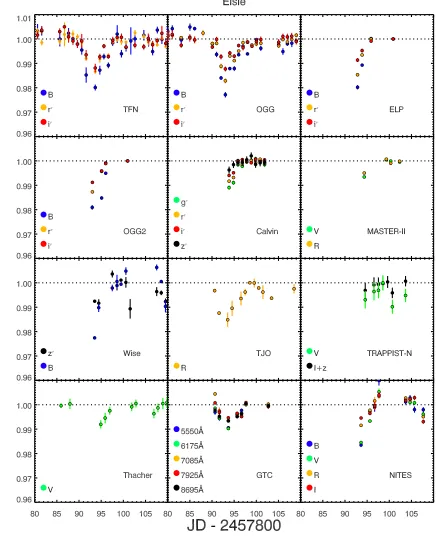
In response to the alert, we acquired additional photomet-ric observations from the Calvin, Master-II, Wise, Joan Oró (TJO), Trappist-N, Thatcher, NITES, and Gran Telescopio Canarias (GTC) telescopes. We showcase this first event ob-served in 2017 May (“Elsie”; Section 2.1.1) observed by each observatory in Figure1, each point of the time series being a nightly average of the differential magnitude in the specified band. Since most observatories did not have moni-toring before the event, we normalize each data set assuming that the stellar flux was at the “true” stellar level just after the first event (JD 2,457,900) to ensure consistency. Note that the analysis carried out in Section3.1to determine colors of the dip uses the LCOGT data sets. These data are normalized using before dip data where the longer baseline improves the normalization (details in Section3.1).
2.1.1. The Elsie Dip Family
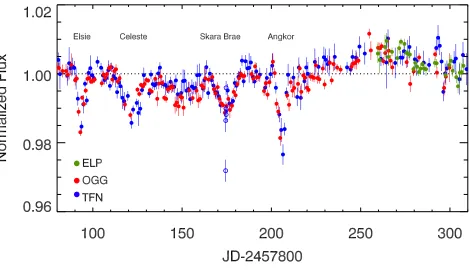
In Figure 2, we show the full LCOGT 0.4 m time se-ries from 2017 May through December in ther0 band. The LCOGT observations are a product of a successful crowd-funding effort through Kickstarter3. As a part of the cam-paign’s design, those who supported the project were eligi-ble to nominate and then vote on the name of the dips. Four major dipping events happened over this time period. The first, which we named“Elsie,”4 reaches a minimum around UT 2017 May 19 (JD 2,457,893). Its full duration spans the course of∼5 days. The temporal gradient of the dip ingress is much sharper than the egress, where the recovery appears to hesitate, making an asymmetric profile overall. Hereafter, we refer to the full period of variability observed in 2017 as
theElsiedip family.
A few weeks after the end ofElsie, the second event,
“Ce-leste,”5 began to make an appearance, reaching its deepest
point around UT 2017 June 18 (JD 2,457,922).Celestelasted for a couple of weeks, having a slow decline to its mini-mum, but then a much more rapid post-minimum rise up. The rapid egress was stunted about two-thirds of the way up, however, and the flux remained∼0.5% below normal brightness levels. This 30-day-long depression afterCeleste
was never given a name, since it was unsubstantial compared to the first two events. We do however identify this region to
3 https://www.kickstarter.com/projects/608159144/
the-most-mysterious-star-in-the-galaxy
4The nameElsieis a play on words with “L + C,” short for “light curve,” and is also a wink and a nod to the “L”as “C”umbres Observatory, for making the project happen.
5This dip [first] appeared to have a slow decline with a quick rise, which is close to a mirror image ofElsie, which had a quick decline with a slow rise. Elsie(or “L C”) in reverse is “C L” or “ciel,” which means “sky” or “heavenly” in French. “Celeste”is the original Latin name from which “ciel” is derived.
be a statistically significant detection of a∼0.5% decrease in brightness, which was also independently observed at several other observatories (Bodman et al., in prep.).
The third event,“Skara Brae,”6began to appear just when the month-long depression after Celeste showed possible signs of recovery. Skara Braebehaved very similarly to
Ce-lestein a mirror-image profile, with a∼1% depth inr0-band
lasting on the order of two weeks. In the middle ofSkara Brae(on UT 2017 August 8; JD 2,457,974) there was an ad-ditional narrow (few hour)∼2% dip. We did not observe the ingress of this dip (which could have lasted up to 7 hr) be-cause this region fell within a gap between observatories, but observations from both LCOGT and TJO caught the rapid re-turn to the level of the broad dip over a 4 hr period. This event was the first and only significant short-timescale (<1 d) vari-ability observed in the 2017Elsiefamily of dips (Figure2, open circles). We show a close-up of this feature in Figure3. While this is a seemingly drastic change in brightness within
theElsiefamily, we find that the dip gradient here (∼0.2%
hr−1, or∼5% day−1) is not extreme compared to the dip
gra-dients observed byKepler, which can be up to a factor of 10 steeper (Boyajian et al. 2016).
This smaller gradient could indicate that the current dips are less optically thick than those with steeper gradients
byKepler, which would be consistent with the smaller dip
depths, although other geometric factors may also play a role. In any case, the Kepler observations still provide the most stringent constraint on the orbit of the parent body (or bod-ies) from consideration of the light-curve gradient (Boyajian et al. 2016). We also find the duration of this event is no shorter than the shortest seen byKepler, which was 0.4 d. Finally, we note thatSkara Brae’s full contour – a symmet-rical broad shallow dip containing a brief deep dip within – is unique7. This allows us to compare its appearance with the dips observed byKepler, where only a couple were at a similar level of 1–2%. We find theKeplerdip at D1540 ( Boy-ajian et al. 2016) being remarkably similar in depth, shape, and duration (see Figure3for a direct comparison).
“Angkor,”8 the fourth significant dip in the complex,
ap-peared two weeks after Skara Brae, reaching its deepest depth around UT 2017 September 9 (∼JD 2,458,006). The
6The brightness variations for KIC 8462852 share some of the same traits as this lost city located in the far north of Scotland. They’re ancient; we are watching things that happened more than 1000 yr ago. They’re almost certainly caused by something ordinary, at least on a cosmic scale. And yet that makes them more interesting, not less. But most of all, they’re mysterious. What the heck was going on there, all those centuries ago?
Figure 2. LCOGT time-series photometry of KIC 8462852 in ther0 band from 2017 May through December showing theElsiedip family. Each point is a daily average from the LCOGT 0.4 m stations indicated in the legend. Near the midpoint ofSkara Brae, short-term variability seen over a few hours is indicated as open blue points (see also Figure3). For details, see Section2.1and2.1.1.
Angkoringress exhibited the most rapid, sustained (∼4 days
long) flux gradient observed for the star from the ground to date, and the egress was similarly rapid, though it remained at a depth of∼0.5% below normal for about a week before brightening to slightly above normal levels. The post-Angkor
monitoring data rose up∼0.5% compared to pre-Elsielevels (dotted line, Figure2). Around the end of 2017 October (JD 2,458,050) this brightening trend reversed, returning back to unity by mid-December (∼JD 2,458,100).
2.2. Spectroscopy
Over a six month period beginning 2017 May 20, we ac-quired low-resolution spectra with the Kast Double Spec-trograph mounted on the 3 m Shane telescope (Miller & Stone 2013) at Lick Observatory, as well as from the DEep Imaging Multi-Object Spectrograph (DEIMOS;Faber et al. 2003) and the Low Resolution Imaging Spectrometer using the Keck telescopes. All of the Lick and Keck low-resolution spectra are broadly consistent with the object being a main-sequence F star; a future paper will present them in greater detail (Martínez González, in prep).
A total of eight high-resolution spectra were acquired with the HIRES spectrograph on Keck I. Five of the eight were
taken prior (circa 2015, 2016), and the other three were taken during theElsieevent. First, we checked for radial velocity (RV) variations. We fine-tuned the wavelength solution us-ing the numerous telluric lines in the vicinity of NaID using the telluric spectrum from theWallace et al.(2011) solar at-las, applied barycentric velocity corrections calculated with the IDL codeBARYCORR(Wright & Eastman 2014), veri-fied that the interstellar medium (ISM) lines remained fixed, and measured RV offsets between each out-of-dip spectrum along with their coadded average and the three in-dip spec-tra, resulting in∆RV = 0.38±0.35 km s−1. We are unable to
discern RV variability with the present quality of the wave-length solutions during these epochs, limiting the presence of anything larger than a gas giant within 0.1 au.
compo-Figure 3.TheSkara Braeevent showing daily averages (circles) of ground-based measurements. The solid gray line depicts theKepler
long-cadence data from D1540 shifted in time to illustrate the simi-larity between the events. Near the midpoint ofSkara Braewe show the hourly averages (squares) from LCOGT and TJO to illustrate the short-term variability seen over a span of a few hours. The plot in-set is a close-up view of this midpoint region. See Section2.1.1for details.
nent). We find no significant variations in the depths of these ISM lines (i.e., differences in equivalent widths of the ISM lines are<1%), following the procedures outlined byWright & Sigurðsson (2016) andCurtis(2017). The amplitude of the residuals at these ISM lines is on par with variability due to the S/N, and it will be challenging to discern real changes in interstellar absorption at or below this level during future events without higher-quality spectra (or larger dips).
2.3. Infrared Photometry
NEOWISE observations of KIC 8462852 in the W1 (3.4 µm) and W2 (4.6 µm) bands were acquired a week before Elsie, and serendipitously on JD 2,457,892 (around the time of the largest optical flux decrease forElsie) with the spacecraft’s occasional toggle to avoid the Moon. All NEO-WISE observations of KIC 8462852 were extracted without any cuts on flag parameters. Inspecting each detection, we see that all observations had ph_qual ratings of “A” in both bands, and none of the detections was affected by latent images, other persistence features, or diffraction spikes as would be indicated by the “ccflags” parameter (Cutri et al. 2015). We show this temporal series in Figure5. We find no detectable change in brightness with the observations taken duringElsiecompared to the week prior in either of the NE-OWISE bands. Work is currently underway analyzing near-IR measurements (Clemens et al., in prep.) and additional mid-IR measurements (Meng et al., in prep.) taken
through-out theElsiefamily of dips to put additional constraints on variability after this first event.
2.4. Polarimetry
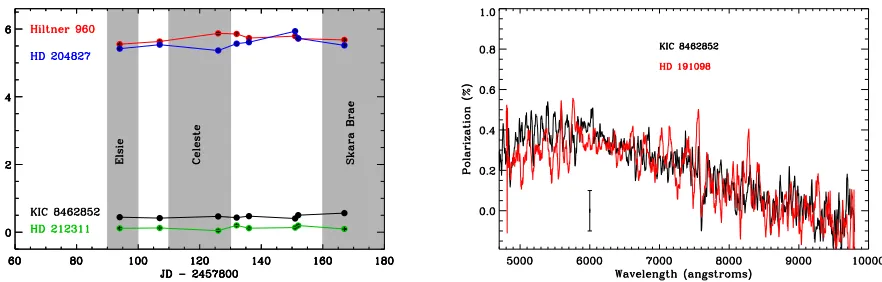
Evidence for the scattering of stellar light by circumstellar dust can be probed with polarimetry. Spectropolarimetry of KIC 8462852 was obtained with the Kast spectropolarimeter on the 3 m Shane reflector at Lick Observatory (see Mauer-han et al. 2014for a description of the Kast instrument) at eight epochs: 2017 May 20.4; June 2.3, 21.4, 27.4; July 1.4, 16.4, 17.4; and August 1.4. On each night, the source was observed 18 minutes for each Stokes parameterQandU, for a total of 36 minutes on-source integration time. The polar-izationPand position angleθwere derived according to the methodology described byMauerhan et al.(2014). On ev-ery night, two strongly polarized standard stars (Hiltner 960 and HD 204827) and one weakly polarized star (HD 212311) were observed for calibration purposes. HD 204827, in par-ticular, was used to calibrate the position angle on the sky.
Over the course of our eight epochs KIC 8462852 ex-hibited an average (standard deviation) polarization ofP= 0.46(0.05)% and position angle θ = 91.0◦(2.6◦) in the V
band (5050–5950 Å). The statistical uncertainty inPwas typ-ically 0.01% on a given epoch, but in our experience with Kast the systematic uncertainties are usually at least 0.1– 0.15%. Over the same period the average (standard devi-ation)V-band polarization of our polarized standard Hilt-ner 960 isP= 5.58(0.18)%,θ= 54.9◦(0.7◦), consistent with published values (Schmidt et al. 1992). The weakly polar-ized star HD 212311 exhibitedP= 0.13(0.05)%, within 2σ of theSchmidt et al.(1992) value. The results are illustrated in Figure6, and indicate that KIC 8462852 did not vary sig-nificantly in polarization, relative to our calibration stars.
The polarization characteristics of KIC 8462852 appear to be consistent with interstellar polarization, presumably induced by the dichroic absorption of light by nonspheri-cal dust grains oriented along the Galactic magnetic field. Figure6illustrates the polarization and position-angle spec-tra of the source, along with the F5 V star HD 191098 (V = 10.09 mag; 0.2◦from KIC 8462852 on the sky), which we used as a probe of the approximate interstellar polariza-tion on 2017 June 2; the spectroscopic parallax distance of this star (MV= 3.5 mag) is∼201 pc, which is not ideal, since
[image:9.612.58.285.66.243.2]polariza-3932.5 3933.0 3933.5 3934.0 3934.5 3935.0 Wavelength (Angstroms)
0.0 0.2 0.4 0.6 0.8
Normalized Flux
5893 5894 5895 5896 5897 5898 5899
Wavelength (Angstroms) 0.0
0.2 0.4 0.6 0.8 1.0
[image:10.612.98.531.66.232.2]Normalized Flux
Figure 4. HIRES spectra of KIC 8462852 at the CaIIK (left) and NaID1 (right) lines prior to (black dots) and during (red line) theElsie
event, along with residuals (prior minus during). Error bars are smaller than the black symbols. We measure no significant variation in stellar RV (∆<0.4 km s−1
) or equivalent width of the ISM lines (<1%), as evidenced by the residuals. See Section2.2for details.
Figure 5.NEOWISE time series photometry of KIC 8462852 in the
W1 (3.4µm) and W2 (4.6µm) bands according to the legend at the bottom right. Measurements with PSF-fitting quality metricχ2
PSF<
2 are shown as filled points with their associated 1σuncertainties; otherwise the point is unfilled and without uncertainties for clarity. The approximate timing ofElsieidentified in optical data is marked on the graph. See Section2.3for details.
tion of P≈0.40%, θ≈78◦, only slightly lower than that of KIC 8462852 in magnitude and offset by∼14◦ in posi-tion angle. Moreover, we examined the polarizaposi-tion of three stars from the catalog of Heiles (2000) that lie within 2◦ of KIC 8462852 on the sky: HD 190149, HD 191423, and HD 191546. The average (standard deviation) polarization and position angle exhibited by these stars isP= 0.47(0.36)% and 113◦(18◦). This is also comparable to our measurements of KIC 8462852.
The polarization we measure appears to be significantly lower than the broad-band imaging polarimetry values that
Steele et al.(2018) have reported with the RINGO3
instru-ment (Słowikowska et al. 2016) over a similar time period. For example, over May through August 2017, they reported a non-variable source (<0.2% fluctuation) with average polar-ization and position angle ofP= 1.2%(0.2%),θ= 72◦(6◦) for theb∗band (3500–6400 Å);P= 0.6%(0.1%),θ= 74◦(6◦) for theg∗band (6500–7600 Å); andP= 0.6%(0.1%),θ= 73◦(6◦) for ther∗band (7700–10,000 Å). However, the level of dis-crepancy between these measurements and ours is not par-ticularly surprising, given the large systematic uncertainties associated with the RINGO3 instrument (Słowikowska et al. 2016). Regardless of systematics, we reiterate that the re-sults here and those fromSteele et al.(2018) both show the object has polarization properties typical of its location on the sky, and limit any change in optical polarization between in and out of dip epochs of<0.05% (Kast) and<0.1−0.2%
(RINGO3). Finally, we note that analysis of near-IR po-larimetry taken during theCelesteevent are underway, and should be able to provide additional constraints for the sys-tem and its environment (Clemens et al., in prep.).
2.5. Radio SETI
The Allen Telescope (SETI Institute) performed a series of KIC 8462852 radio observations during theElsie dimming event. These were subsequent to the observations in 2015 (Harp et al. 2016). From 2017 July 8 through 2017 August 8, 1022 separate 92-s observations were performed which re-sulted in scanning 1419 MHz to 4303 MHz for radio sig-nals. No narrow-band radio signals were found at a level of 180–300 Jy in a 1 Hz channel, or medium-band signals above 10 Jy in a 100 kHz channel, which would correspond to transmitters at the distance of KIC 8462852 having effec-tive isotropic radiated power (EIRP) of (4–7)×1015 W and
[image:10.612.65.278.293.446.2]Figure 6.Left:Polarization over time for KIC 8462852 (black), Hiltner 960 (red), HD 204827 (blue), and HD 212311 (green). The statistical uncertainties appear smaller than the data points.Right:Polarization and position-angle spectra of KIC 8462852 (black curve). The data are the average of all seven epochs of observations performed in 2017 May–August. The red curve represents data for a nearby star HD 191098, which was used as a probe of interstellar polarization. The noise fluctuations of KIC 8462852 reflect the total statistical and systematic measurement uncertainty, which we estimate at±0.10% (graphically represented near bottom center). See Section2.4for details.
radar transmitter at Arecibo Observatory, 2×10¹³ W EIRP,
the actual power requirements would be greatly reduced if emissions were beamed directly at Earth.
3. ANALYSIS
3.1. Size, Shape, and Wavelength Dependence of Elsie
In the discussion presented here, we limit the range of our analysis to the first event,Elsie; the analysis of the
remain-ingElsiedip family will be presented by Bodman et al. (in
prep.). We also assume that the differential fluxes found in each filter are measures of the additional opacity causing the dips, not the total color of all the material along the line of sight (i.e., we apply no correction in the baseline flux for the longer-term brightness variations). For the following discus-sion, we define depth ratios,B/i0andr0/i0, as the ratio of the dip depths measured in normalized flux in theBtoi0 filters andr0toi0filters, respectively.
Continuous time-series coverage throughout the Elsie
event shows the largest depth of 2.5% in the B-band on JD 2,557,893. With monitoring across the many observa-tories, we obtained a nearly continuous cadence time series duringElsie, and thus can rule out a missed detection of a deep, short-lived dip, with the longest data gap occurring daily from 15 to 19 UT (a duration of∼0.2 days). We fit the LCOGT multiband light curve with an N+8 parameter
model, whereNis the number of days over which the fitted data are taken. The unbinned data for each site are used for the fit.
A single depth ratio for each filter set (B/i0 andr0/i0) is assumed for the entire dip. We include normalizations (n) of each telescope in each filter as free parameters, resulting in a total of six normalizations, to ensure that the different sites are normalized in a consistent manner. Each day has a depth (di) in thei0 filter fit to the data binned in that day.
Whendi is fit, it is compared to thei0 band for each
appli-cable site with normalization, and to the B andr0 data af-ter multiplied by the depth ratio (R) and normalization, e.g.,
FFilter=nFilter(1−di×RFilter). This allows for the color ratios,
the normalizations, and the depths to be fit simultaneously. In order to prevent the normalizations from wandering too far from 1.0, we include ten days of pre-Elsie data where the depths are set to 0. To overcome degeneracies in the fit, we explored the parameter space with the Markov Chain Monte Carlo method using the “emcee” package ( Foreman-Mackey et al. 2013). We used flat priors over ranges 0.5– 5, 0.99–1.01, and 0–0.2 for the depth ratios, normalizations, and depths (respectively), with the results of a least-squares fit as the starting point. The results of the Bayesian fit are shown in Figure7, and the depth ratios areB/i0= 1.94±0.06 andr0/i0= 1.31±0.04. Ther0/i0 ratio measured at Calvin Observatory (1.29) is in agreement with the LCOGT value. The extinction due to optically thin dust is typically charac-terized by a higher extinction at bluer wavelengths such as is observed for KIC 8462852 during theElsiedip. The colors observed indicate dust grain sizes larger than are seen for in-terstellar dust and are more likely to arise from circumstellar dust (Savage & Mathis 1979;Meng et al. 2017).
3.2. Particle Size and Chemical Composition
Under the assumption that the dimming is caused by inter-vening dust, the multicolor observations taken duringElsie
80
85
90
95
100
105
110
JD-2457800
0.96
0.97
0.98
0.99
1.00
1.01
Normalizaed Flux
B
r'
i'
[image:12.612.56.265.62.253.2]OGG
TFN
Figure 7.Plot of theElsiedip withN+8 model fit. Red, yellow, and
blue indicatei0,r0, andBfilters (respectively) for the data points and fit lines. The different observatory sites are indicated by different marker shapes as depicted in the legend, and each data point is the average daily value. Our fit results in the colors ofElsieto beB/i0= 1.94±0.06 andr0/i0= 1.31±0.04. See Section3.1for details. The black vertical lines indicate when Keck/HIRES spectra were taken (see Section2.2).
opacities assume homogeneous spherical dust grains with a relatively narrow Deirmendjian particle size distribution (FWHM≈0.4 dex;Deirmendjian 1964), as well as effective wavelengths of B,r0, andi0 of 0.4361, 0.6215, 0.7545µm, respectively.
We explore the signatures of a few refractory dust species and water ice. Silicates are perhaps the most important re-fractory species. They are divided into the family of pyrox-enes and olivines. Optical properties of silicates are quite sensitive to the amount of iron in the mineral and that is why we explore iron free and iron rich cases. Namely, for pyrox-enes (MgxFe1−xSiO3) we consider the two cases: a mineral
with zero iron content (x= 1) which is called enstatite and a pyroxene with 60/40 iron/magnesium ratio. The refractive indexes of these pyroxenes are taken fromDorschner et al.
(1995). Olivines (Mg2yFe2−2ySiO4) may also have different
iron content. Again we consider the mineral with zero iron content (y= 1) called forsterite, and use its refractive index fromJäger et al. (2003). We also consider an olivine with 50/50 iron to magnesium ratio, taking its index of refraction fromDorschner et al.(1995). Alumina (Al2O3) is one of the
most refractory species which might be present in such en-vironments and we take the complex refractive index for γ alumina from Koike et al.(1995). The refractive index for iron is taken fromJohnson & Christy(1974). Those of car-bon are fromJager et al.(1998), and they assume carbon at high temperature (1000◦C). Lastly, the complex index of re-fraction for water ice is taken fromWarren & Brandt(2008).
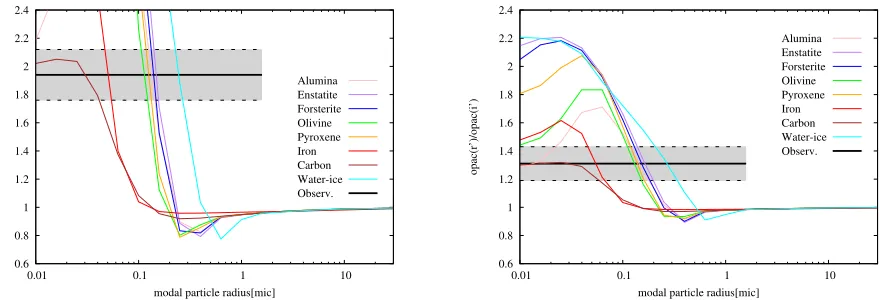
The comparison between the observed and theoretical opacity ratios for different modal size (i.e., radius) of the grains and their chemical composition is shown in Figure8. We find that most of the silicates and alumina should have particle size of about 0.1–0.2µm. If the dust were composed solely from iron, it would have significantly smaller particles of about 0.04–0.06µm. Carbon would require even smaller particles, <0.06µm. On the other hand, water ice would require 0.2–0.3µm particles. We conclude that regardless of composition, the dust is1µm in size and optically thin, which is consistent with the predictions in Figure 3 of Wy-att et al.(2017). Circumstellar dust that is this small would be strongly affected by radiation forces, putting it on an unbound orbit as soon as it was created. Thus, if it is circum-stellar, the dust causing these short-duration dips must have been created recently, since radiation forces would cause it to spread from its point of origin.
4. DISCUSSION
The detection of dips from the ground extends the duration of dip activity in KIC 8462852 from the 4 yr of theKepler
mission, to 8 yr since the beginning of theKepler mission. The complexity and duration of theElsiedip family is rem-iniscent of the Quarter 16 (Q16) dip complex during the Ke-plermission (see Figure 1 ofBoyajian et al. 2016), and sug-gests that additional dip complexes may be seen in the future. While the similarity ofSkara Braeto theKeplerD1540 event (Figure 3) suggests a potential periodicity for this particu-lar event, the broader differences between the Elsiefamily of dips and the Q16 complex suggest a significant stochas-tic component to the dip mechanism, if it is periodic. The detection of dips from multiple independent observatories as illustrated in Figure1also demonstrates they are real (i.e., as-trophysical in origin), firmly ruling out an instrumental/data-reduction artifact as the source of theKeplerdips.
While they are far more precise, theKepler observations were in a single wide bandpass, so the color dependence of the dips could be inferred only with multiwavelength obser-vations such as those presented here. These colors provide important new constraints; in a scenario where the dips are caused by material passing between us and the star, the col-ors measured in Section3are consistent with extinction by optically thin submicron-sized dust (Figure8; see also Fig-ure 3 ofWyatt et al. 2017). This conclusion is in contrast to longer-term observations that suggest that the wavelength dependence of the secular dimming is less pronounced, and therefore that intervening dust should be larger (Meng et al. 2017). Thus, the current evidence suggests that the short-term and long-short-term dimming are caused by dust of different sizes.
0.6 0.8 1 1.2 1.4 1.6 1.8 2 2.2 2.4
0.01 0.1 1 10
opac(B)/opac(i’)
modal particle radius[mic] Alumina Enstatite Forsterite Olivine Pyroxene Iron Carbon Water-ice Observ. 0.6 0.8 1 1.2 1.4 1.6 1.8 2 2.2 2.4
0.01 0.1 1 10
opac(r’)/opac(i’)
[image:13.612.88.528.64.214.2]modal particle radius[mic] Alumina Enstatite Forsterite Olivine Pyroxene Iron Carbon Water-ice Observ.
Figure 8. Opacity ratio inB/i0 (left) and r0/i0 as a function of modal particle radius for several dust species as indicated in the legend.
Observations with 3σlimits are plotted as horizontal lines. See Section3.2for details.
dust concentrations that cause the short dips were created re-cently, and are richer in small, but short-lived, dust that is quickly ejected by radiation forces. Larger dust that is cre-ated survives and remains on a circumstellar orbit spreading from its point of origin in a manner similar to comet dust tails, causing the secular dimming. In such a scenario, we also would not expect to see the same dust causing the short-duration dips in Figure2to return one orbit later, although the source of the dust may return one orbit later, creating fresh dust.
If we further assume that the material is in a highly ellip-tical, circumstellar orbit,Wyatt et al.(2017) provide predic-tions to the infrared component of the dip based on several possible orbital configurations. In Section 2.3, our results show that the NEOWISE W1 and W2 measurements taken coincident with Elsiewould rule out orbits with pericenter distancesq<0.03 au andq>0.3 au. IfElsiewere a deeper dip, the constraints from the mid-infrared observations would have been stronger. However, in this case, theWyatt et al.
(2017) models show that to better constrain the location of material during a 2% dip, observations taken at 10–30µm with a future space telescope would be necessary.
Elsie’s dip depth wavelength dependence constrains and
challenges many proffered models for the dips. For instance, intervening opaque material (e.g., a planet or megastructure) should produce wavelength-dependent dips only to the de-gree that there is nonuniformity across the stellar disk, such as from limb darkening or gravity darkening. Using aMandel & Agol(2002) model assuming a central transit and Claret & Bloemen (2011) limb-darkening coefficients appropriate for KIC 8462852 (and assuming negligible gravity darken-ing, appropriate given the star’svsinivalue), we find a differ-ence of 10% between transit depths in notional filters around 4400 Å (approximately B) and 7600 Å (approximately i0), implying aB/i0depth ratio of∼1.1, in strong disagreement with our observed values of∼2 (Section3.1; Figure7).
To explore whether the observed colors are consistent with the appearance of cool spots, we have used both blackbody andCastelli & Kurucz(2004) model spectra to compute the brightness of a star in theBandi0bands as functions of tem-peratureT, whereT0is the nominal effective temperature of
KIC 8462852, 6720 K.9 We calculate the depth of a dip in bandXdue to the temporary appearance of a spot of temper-atureT occupying a fractionAof the stellar surface as
δX =
X(T0)−((1−A)X(T0)+AX(T))
X(T0)
=A
1− X(T) X(T0)
(1)
where (as with the data presented here) we normalize the brightness of the star against the pre-dip brightness. The ra-tio of the dip depths in theBandi0bands in these models is then
δB
δi0
= 1−B(T)/B(T0) 1−i0(T)/i0(T0)
, (2)
independent of spot size (this model thus includes the case of the entire photosphere changing temperature at constant radius, which is more consistent with the lack of rotational modulation of any surface features). We find that this func-tion yields dip depth ratios of 1.86 in the case of Kurucz model atmospheres and 1.65 with a blackbody approxima-tion. The former value is formally 1.3σfrom our measured value ofB/i0= 1.94±0.06, however only 7% of our posterior samples hadB/i0<1.86. OurElsiemultiband photometry thus may be consistent with models in which transient cool surface regions explain the dips.10 Note that this simple anal-ysis does not address models invoking thedisappearance of
9 We use the B filter curve from Bessell (1990) and the i0 filter curve from http://www.aip.de/en/research/facilities/ stella/instruments/data/sloanugriz-filter-curves.
regions much hotter thanT0, or those that invoke a changing
stellar radius.
Invoking dust still challenges our creativity in developing a unified theory to explain all the observations; however, the models of Wyatt et al.(2017) give hope to a swarm of yet unspecified objects in an eccentric orbit (in this case, exocomets, with an alternative being dust-enshrouded plan-etesimals as proposed by Neslušan & Budaj 2017) causing the brightness fluctuations. Continued monitoring to detect events in the future will help narrow down any periodicity within the dip occurrence, which would strengthen the ar-gument that the source of the obscuring material was in orbit around the star, as opposed to density fluctuations in the ISM, etc.
In fact, if the two deepest events in theKeplerdata were caused by a recent planet-planet collision, Boyajian et al.
(2016) predicted 2017 May to be the next event – and this was precisely whenElsie appeared. However, this predic-tion was based solely on the two large events taking place roughly two years apart (in 2011 and again in 2013), and came with several caveats. The obvious issue discussed was the low probability of witnessing such an event, given the lifetime of the Kepler mission, geometry, system age, and lack of any IR excess based on the timing of the WISE ob-servations (circa 2010). Another issue with this prediction, however, is that it would not explain theKeplerdips that hap-pened between the large events. Moreover, even though the
Elsiefamily appeared timely in this prediction, the other
pre-dicted 2015 April event went undetected because no moni-toring was ongoing at the time11. This gap in time cover-age hinders any truly periodic interpretation based on the oc-currence andnonoccurrence of the dips12. Furthermore, as previously mentioned, each of the dips lack resemblance to one another, and while nonstatic shape and orientation would be expected if the material is continuously being pulverized as it orbits the star, and/or if the newly formed small-dust particle concentrations get ejected quickly due to radiation pressure as discussed above, this quality makes matching the
Elsiefamily and theKeplerQ16 complex a challenging task.
To that end,Sacco et al.(2017) point out that theElsie fam-ily dips (Figure2) occur in an interval perhaps reminiscent of the 48.4 day putative period discussed byBoyajian et al.
(2016) for theKepler dip times, leading to a prediction of a 1574 day period (or a semimajor axis of 2.6 au), roughly double the period proposed byBoyajian et al. (2016).
Ob-11There was no concerted monitoring effort of the star from 2013 May (whenKeplerdiscontinued observations) to 2015 October.
12Monitoring from 2016 March up untilElsieby LCOGT showed no events at the>1% level. Monitoring from 2015 October up untilElsieby the American Association of Variable Star Observers (AAVSO) showed no events at the>2% level. These observations will be presented in a forth-coming paper.
servations in June 2019 (750 days from 2017 May) will be critical to determine whether theKeplerD800 event ( Boya-jian et al. 2016) repeats.
5. CONCLUSIONS
Given theKeplerdata alone, it proved difficult to study this star because ground-based follow-up observations were not taken contemporaneously with the dipping events. In this pa-per, we show that we are able to successfully trigger a world-wide request for observations using a variety of telescopes and instruments, with different techniques, sensitivities, res-olutions, and wavelengths. The main results within this paper include:
• The photometric monitoring of KIC 8462852 is the first successful effort via crowd-funding to study an as-tronomical object.
• We present theElsiefamily of dips, a series of 1–2.5% dips that began in 2017 May and carried on through the end of December, at the time of this paper’s writing.
TheElsiefamily consists of four main dipping events,
“Elsie,” “Celeste,” “Skara Brae,”, and“Angkor” all
which last for several days to weeks.
• Our observations mark the first real-time detection of a dip in brightness for KIC 8462852. Triggered spectro-scopic and polarmetric observations taken during the dips reveal no large, obvious changes compared to out of dip observations.
• Multiband photometry taken duringElsieshow its am-plitude is chromatic, with depth ratios that are consis-tent with occultation by optically thin dust with size scales1µm, and perhaps with variations intrinsic to the star.
KIC 8462852 has captured the imagination of both sci-entists and the public. To that end, our team strives to make the steps taken to learn more about the star as trans-parent as possible. Additional constraints on the system will come from the triggered observations taken during the
Elsie family of dips and beyond, which will in turn
We emphasize the importance that continued monitoring will bring to our understanding of the physical processes re-sponsible for the light curve features. In general, precise, long-term photometric monitoring to detect future dips is a level-zero requirement. These data also provide the means of informing planned triggered observations such as high-resolution spectroscopy to study the events in more detail. Furthermore, extended photometric monitoring will enable us to characterize the star’s long-term variability (Schaefer 2016;Montet & Simon 2016;Meng et al. 2017;Simon et al. 2017), which is thought to be linked to the dips in some way. All-in-all, the apparent low duty cycle of the dips, un-clear predictions on when they will recur, and fairly uncon-strained multiyear timescales of the long-term variability will require a committed, intensive monitoring program spanning the next decade and beyond.
The LCOGT observations used in this project were made possible by the collective effort of 1,762 supporters as part of the Kickstarter campaign “The Most Mysterious Star in the Galaxy”13. The authors gratefully acknowledge and humbly extend a special thanks for substantial support from Las Cumbres Observatory, Glenn Klakring, Fred Boyajian & Bobbie Staley, Alex Mazingue, The Bible Family, Claudio Bottaccini, Joachim De Lombaert, Amity & Brigid Williams, Kevin Fischer, William Hopkins, Milton Bosch, Zipeng Wang, TJ, DR, and CC. The authors thank Peter Foukal for helpful conversations. A. Tanner wishes to acknowledge her mother, Celeste, for all her love and efforts to help her become an astronomer. A. Tanner also wishes to thank the Boyajian’s Star Kickstarter team for electing to name dip
“Celeste” after her mom who passed away in June 2017.
Mom would have been pleased and would have “got it.” H.D. acknowledges support from grant ESP2015-65712-C5-4-R of the Spanish Secretary of State for R&D&i (MINECO). This research made use of data acquired with the Gran Telescopio Canarias (GTC), installed at the Spanish Observatorio del Roque de los Muchachos of the Instituto de Astrofísica de Canarias, in the island of La Palma. JB acknowledges the support from the VEGA 2/0031/18 and APVV 15-0458 grants. The Center for Exoplanets and Hab-itable Worlds is supported by the Pennsylvania State Uni-versity, the Eberly College of Science, and the Pennsylvania Space Grant Consortium. E.H.L.B.’s research was supported by an appointment to the NASA Postdoctoral Program with the Nexus for Exoplanet System Science, administered by Universities Space Research Association under contract with NASA. A.V.F.’s group is grateful for financial assistance
13https://www.kickstarter.com/projects/608159144/
the-most-mysterious-star-in-the-galaxy/
from the TABASGO Foundation, the Christopher R. Redlich Fund, Gary and Cynthia Bengier (T.d.J. is a Bengier Post-doctoral fellow), and the Miller Institute for Basic Research in Science (U.C. Berkeley). This project was supported by the National Research, Development and Innovation Fund of Hungary, financed under the K_16 funding scheme (project No. NKFIH K-115709). The research leading to these re-sults has received funding from the ARC grant for Concerted Research Actions, financed by the Wallonia-Brussels Feder-ation. M. Gillon is Research Associate at the Belgian Fonds de la Recherche Scientifique (F.R.S.-FNRS).
A major upgrade of the Kast spectrograph on the Shane 3 m telescope at Lick Observatory was made possible through generous gifts from William and Marina Kast as well as the Heising-Simons Foundation. Research at Lick Observatory is partially supported by a generous gift from Google. Some of the data presented herein were obtained at the W. M. Keck Observatory, which is operated as a scientific partnership among the California Institute of Technology, the University of California, and the National Aeronautics and Space Administration (NASA); the observatory was made possible by the generous financial support of the W. M. Keck Foundation. This publication makes use of data prod-ucts from the Wide-field Infrared Survey Explorer, which is a joint project of the University of California, Los Ange-les, and the Jet Propulsion Laboratory/California Institute of Technology, funded by NASA. This publication also makes use of data products from NEOWISE, which is a project of the Jet Propulsion Laboratory/California Institute of Tech-nology, funded by the Planetary Science Division of NASA.
REFERENCES
Ballesteros, F. J., Arnalte-Mur, P., Fernandez-Soto, A., & Martinez, V. J. 2017, ArXiv e-prints
Barbary, K. 2016, SEP: Source Extractor as a library Bertin, E. & Arnouts, S. 1996, A&AS, 117, 393 Bessell, M. S. 1990, PASP, 102, 1181
Bodman, E. H. L. & Quillen, A. 2016, ApJL, 819, L34 Borucki, W. J., Koch, D., Basri, G., Batalha, N., Brown, T.,
Caldwell, D., Caldwell, J., Christensen-Dalsgaard, J., Cochran, W. D., DeVore, E., Dunham, E. W., Dupree, A. K., Gautier, T. N., Geary, J. C., Gilliland, R., Gould, A., Howell, S. B., Jenkins, J. M., Kondo, Y., Latham, D. W., Marcy, G. W., Meibom, S., Kjeldsen, H., Lissauer, J. J., Monet, D. G., Morrison, D., Sasselov, D., Tarter, J., Boss, A., Brownlee, D., Owen, T., Buzasi, D., Charbonneau, D., Doyle, L., Fortney, J., Ford, E. B., Holman, M. J., Seager, S., Steffen, J. H., Welsh, W. F., Rowe, J., Anderson, H., Buchhave, L., Ciardi, D., Walkowicz, L., Sherry, W., Horch, E., Isaacson, H., Everett, M. E., Fischer, D., Torres, G., Johnson, J. A., Endl, M., MacQueen, P., Bryson, S. T., Dotson, J., Haas, M.,
Kolodziejczak, J., Van Cleve, J., Chandrasekaran, H., Twicken, J. D., Quintana, E. V., Clarke, B. D., Allen, C., Li, J., Wu, H., Tenenbaum, P., Verner, E., Bruhweiler, F., Barnes, J., & Prsa, A. 2010, Science, 327, 977
Boyajian, T. S., LaCourse, D. M., Rappaport, S. A., Fabrycky, D., Fischer, D. A., Gandolfi, D., Kennedy, G. M., Korhonen, H., Liu, M. C., Moor, A., Olah, K., Vida, K., Wyatt, M. C., Best, W. M. J., Brewer, J., Ciesla, F., Csák, B., Deeg, H. J., Dupuy, T. J., Handler, G., Heng, K., Howell, S. B., Ishikawa, S. T., Kovács, J., Kozakis, T., Kriskovics, L., Lehtinen, J., Lintott, C., Lynn, S., Nespral, D., Nikbakhsh, S., Schawinski, K., Schmitt, J. R., Smith, A. M., Szabo, G., Szabo, R., Viuho, J., Wang, J., Weiksnar, A., Bosch, M., Connors, J. L., Goodman, S., Green, G., Hoekstra, A. J., Jebson, T., Jek, K. J., Omohundro, M. R., Schwengeler, H. M., & Szewczyk, A. 2016, MNRAS, 457, 3988 Brown, T. M., Baliber, N., Bianco, F. B., Bowman, M., Burleson,
B., Conway, P., Crellin, M., Depagne, É., De Vera, J., Dilday, B., Dragomir, D., Dubberley, M., Eastman, J. D., Elphick, M., Falarski, M., Foale, S., Ford, M., Fulton, B. J., Garza, J., Gomez, E. L., Graham, M., Greene, R., Haldeman, B., Hawkins, E., Haworth, B., Haynes, R., Hidas, M., Hjelstrom, A. E., Howell, D. A., Hygelund, J., Lister, T. A., Lobdill, R., Martinez, J., Mullins, D. S., Norbury, M., Parrent, J., Paulson, R., Petry, D. L., Pickles, A., Posner, V., Rosing, W. E., Ross, R., Sand, D. J., Saunders, E. S., Shobbrook, J., Shporer, A., Street, R. A., Thomas, D., Tsapras, Y., Tufts, J. R., Valenti, S., Vander Horst, K., Walker, Z., White, G., & Willis, M. 2013, PASP, 125, 1031 Budaj, J., Kocifaj, M., Salmeron, R., & Hubeny, I. 2015, MNRAS,
454, 2
Castelli, F. & Kurucz, R. L. 2004, arxiv:astro-ph/0405087
Claret, A. & Bloemen, S. 2011, A&A, 529, A75
Collins, K. A., Kielkopf, J. F., Stassun, K. G., & Hessman, F. V. 2017, AJ, 153, 77
Colome, J. & Ribas, I. 2006, IAU Special Session, 6
Craig, M. W., Crawford, S. M., Deil, C., Gomez, C., Günther, H. M., Heidt, N., Horton, A., Karr, J., Nelson, S., Ninan, J. P., Pattnaik, P., Rol, E., Schoenell, W., Seifert, M., Singh, S., Sipocz, B., Stotts, C., Streicher, O., Tollerud, E., Walker, N., & ccdproc Contributors. 2015, ccdproc: CCD data reduction software, Astrophysics Source Code Library
Curtis, J. L. 2017, AJ, 153, 275
Cutri, R. M., Mainzer, A., Conrow, T., Masci, F., Bauer, J., Dailey, J., Kirkpatrick, J. D., Fajardo-Acosta, S., Gelino, C., Grillmair, C., Wheelock, S. L., Yan, L., Harbut, M., Beck, R., Wittman, M., Wright, E. L., Masiero, J., Grav, T., Sonnett, S., Nugent, C., Kramer, E., Stevenson, R., Eisenhardt, P. R. M., Fabinsky, B., Tholen, D., Papin, M., Fowler, J., & McCallon, H. 2015, Explanatory Supplement to the NEOWISE Data Release Products, Tech. rep.
Deirmendjian, D. 1964, ApOpt, 3, 187
Dorschner, J., Begemann, B., Henning, T., Jaeger, C., & Mutschke, H. 1995, A&A, 300, 503
Faber, S. M., Phillips, A. C., Kibrick, R. I., Alcott, B., Allen, S. L., Burrous, J., Cantrall, T., Clarke, D., Coil, A. L., Cowley, D. J., Davis, M., Deich, W. T. S., Dietsch, K., Gilmore, D. K., Harper, C. A., Hilyard, D. F., Lewis, J. P., McVeigh, M., Newman, J., Osborne, J., Schiavon, R., Stover, R. J., Tucker, D., Wallace, V., Wei, M., Wirth, G., & Wright, C. A. 2003, in Proc. SPIE, Vol. 4841, Instrument Design and Performance for Optical/Infrared Ground-based Telescopes, ed. M. Iye & A. F. M. Moorwood, 1657–1669
Filippenko, A. V. 1982, PASP, 94, 715
Foreman-Mackey, D., Hogg, D. W., Lang, D., & Goodman, J. 2013, PASP, 125, 306
Foukal, P. 2017, ApJL, 842, L3
Foukal, P. 2017, Research Notes of the AAS, 1, 52
Gillon, M., Jehin, E., Magain, P., Chantry, V., Hutsemékers, D., Manfroid, J., Queloz, D., & Udry, S. 2011, in European Physical Journal Web of Conferences, Vol. 11, European Physical Journal Web of Conferences, 06002
Harp, G. R., Richards, J., Shostak, S., Tarter, J. C., Vakoch, D. A., & Munson, C. 2016, ApJ, 825, 155
Heiles, C. 2000, AJ, 119, 923
Hippke, M., Angerhausen, D., Lund, M. B., Pepper, J., & Stassun, K. G. 2016, ApJ, 825, 73
Jäger, C., Dorschner, J., Mutschke, H., Posch, T., & Henning, T. 2003, A&A, 408, 193
Jehin, E., Gillon, M., Queloz, D., Magain, P., Manfroid, J., Chantry, V., Lendl, M., Hutsemékers, D., & Udry, S. 2011, The Messenger, 145, 2
Johnson, P. B. & Christy, R. W. 1974, PhRvB, 9, 5056 Katz, J. I. 2017, MNRAS, 471, 3680
Kiefer, F., Lecavelier des Etangs, A., Vidal-Madjar, A., Hébrard, G., Bourrier, V., & Wilson, P.-A. 2017, ArXiv e-prints Koike, C., Kaito, C., Yamamoto, T., Shibai, H., Kimura, S., &
Suto, H. 1995, Icarus, 114, 203
Lisse, C. M., Sitko, M. L., & Marengo, M. 2015, ApJL, 815, L27 Makarov, V. V. & Goldin, A. 2016, ApJ, 833, 78
Mandel, K. & Agol, E. 2002, ApJL, 580, L171
Marengo, M., Hulsebus, A., & Willis, S. 2015, ApJL, 814, L15 Mauerhan, J., Williams, G. G., Smith, N., Smith, P. S., Filippenko,
A. V., Hoffman, J. L., Milne, P., Leonard, D. C., Clubb, K. I., Fox, O. D., & Kelly, P. L. 2014, MNRAS, 442, 1166 McCormac, J., Skillen, I., Pollacco, D., Faedi, F., Ramsay, G.,
Dhillon, V. S., Todd, I., & Gonzalez, A. 2014, MNRAS, 438, 3383
Meng, H. Y. A., Rieke, G., Dubois, F., Kennedy, G., Marengo, M., Siegel, M., Su, K., Trueba, N., Wyatt, M., Boyajian, T., Lisse, C. M., Logie, L., Rau, S., & Vanaverbeke, S. 2017, ApJ, 847, 131
Metzger, B. D., Shen, K. J., & Stone, N. 2017, MNRAS, 468, 4399 Miller, J. S. & Stone, R. P. S. 2013, Lick Obs. Tech. Rep., 66 Molnar, L. A., Van Noord, D. M., Kinemuchi, K., Smolinski, J. P.,
Alexander, C. E., Cook, E. M., Jang, B., Kobulnicky, H. A., Spedden, C. J., & Steenwyk, S. D. 2017, ApJ, 840, 1 Montet, B. T. & Simon, J. D. 2016, ApJL, 830, L39 Neslušan, L. & Budaj, J. 2017, A&A, 600, A86
Oke, J. B., Cohen, J. G., Carr, M., Cromer, J., Dingizian, A., Harris, F. H., Labrecque, S., Lucinio, R., Schaal, W., Epps, H., & Miller, J. 1995, PASP, 107, 375
Pecaut, M. J. & Mamajek, E. E. 2013, ApJS, 208, 9
Pecaut, M. J., Mamajek, E. E., & Bubar, E. J. 2012, ApJ, 746, 154 Rockosi, C., Stover, R., Kibrick, R., Lockwood, C., Peck, M.,
Cowley, D., Bolte, M., Adkins, S., Alcott, B., Allen, S. L., Brown, B., Cabak, G., Deich, W., Hilyard, D., Kassis, M., Lanclos, K., Lewis, J., Pfister, T., Phillips, A., Robinson, L., Saylor, M., Thompson, M., Ward, J., Wei, M., & Wright, C. 2010, in Proc. SPIE, Vol. 7735, Ground-based and Airborne Instrumentation for Astronomy III, 77350R
Sacco, G., Ngo, L., & Modolo, J. 2017, ArXiv e-prints Savage, B. D. & Mathis, J. S. 1979, ARA&A, 17, 73 Schaefer, B. E. 2016, ApJL, 822, L34
Schmidt, G. D., Elston, R., & Lupie, O. L. 1992, AJ, 104, 1563
Serkowski, K., Mathewson, D. S., & Ford, V. L. 1975, ApJ, 196, 261
Sheikh, M. A., Weaver, R. L., & Dahmen, K. A. 2016, Physical Review Letters, 117, 261101
Silverman, J. M., Foley, R. J., Filippenko, A. V., Ganeshalingam, M., Barth, A. J., Chornock, R., Griffith, C. V., Kong, J. J., Lee, N., Leonard, D. C., Matheson, T., Miller, E. G., Steele, T. N., Barris, B. J., Bloom, J. S., Cobb, B. E., Coil, A. L., Desroches, L.-B., Gates, E. L., Ho, L. C., Jha, S. W., Kandrashoff, M. T., Li, W., Mandel, K. S., Modjaz, M., Moore, M. R., Mostardi, R. E., Papenkova, M. S., Park, S., Perley, D. A., Poznanski, D., Reuter, C. A., Scala, J., Serduke, F. J. D., Shields, J. C., Swift, B. J., Tonry, J. L., Van Dyk, S. D., Wang, X., & Wong, D. S. 2012, MNRAS, 425, 1789
Simon, J. D., Shappee, B. J., Pojmanski, G., Montet, B. T., Kochanek, C. S., van Saders, J., Holoien, T. W.-S., & Henden, A. A. 2017, ArXiv e-prints
Sing, D. K., Wakeford, H. R., Showman, A. P., Nikolov, N., Fortney, J. J., Burrows, A. S., Ballester, G. E., Deming, D., Aigrain, S., Désert, J.-M., Gibson, N. P., Henry, G. W., Knutson, H., Lecavelier des Etangs, A., Pont, F., Vidal-Madjar, A., Williamson, M. W., & Wilson, P. A. 2015, MNRAS, 446, 2428 Słowikowska, A., Krzeszowski, K., ˙Zejmo, M., Reig, P., & Steele,
I. 2016, MNRAS, 458, 759
Steele, I. A., Copperwheat, C. M., Jermak, H. E., Kennedy, G. M., & Lamb, G. P. 2018, MNRAS, 473, L26
Stetson, P. B. 1987, PASP, 99, 191
Thompson, M. A., Scicluna, P., Kemper, F., Geach, J. E., Dunham, M. M., Morata, O., Ertel, S., Ho, P. T. P., Dempsey, J., Coulson, I., Petitpas, G., & Kristensen, L. E. 2016, MNRAS, 458, L39 Vogt, S. S., Allen, S. L., Bigelow, B. C., Bresee, L., Brown, B.,
Cantrall, T., Conrad, A., Couture, M., Delaney, C., Epps, H. W., Hilyard, D., Hilyard, D. F., Horn, E., Jern, N., Kanto, D., Keane, M. J., Kibrick, R. I., Lewis, J. W., Osborne, J., Pardeilhan, G. H., Pfister, T., Ricketts, T., Robinson, L. B., Stover, R. J., Tucker, D., Ward, J., & Wei, M. Z. 1994, in Proc. SPIE, Vol. 2198, Instrumentation in Astronomy VIII, ed. D. L. Crawford & E. R. Craine, 362
Wallace, L., Hinkle, K. H., Livingston, W. C., & Davis, S. P. 2011, ApJS, 195, 6
Warren, S. G. & Brandt, R. E. 2008, Journal of Geophysical Research (Atmospheres), 113, D14220
Wright, J. T. & Eastman, J. D. 2014, PASP, 126, 838 Wright, J. T. & Sigurðsson, S. 2016, ApJL, 829, L3