Development of a cervical cancer screening program in a
slum setting using visual inspection with acetic acid:
Analysis of feasibility and cost
Leslie S. Bradford1, Bimalangshu R. Dey2, Syed Md Akram Hussain3, Sultana Razia Begum3, Farhat Hussain3, Sharmina Hoque3, Annekathryn Goodman1*
1
Division of Gynecologic Oncology, Massachusetts General Hospital, Boston, USA
2
Division of Hematologic Oncology, Massachusetts General Hospital, Boston, USA
3
AK Khan Healthcare Trust, Dhaka, Bangladesh Email: *[email protected]
Received 22 April 2012; revised 19 May 2012; accepted 28 May 2012
ABSTRACT
Objective: In Bangladesh, cervical cancer is the sec- ond most common cause of cancer deaths in women. Annually, over 50 million women are at risk for cer- vical cancer, with 17,686 cases diagnosed and 10,362 deaths each year. Visual inspection with acetic acid (VIA) is a well validated tool in low resource areas for identifying cervical lesions. In this pilot study, AK Khan Health Care Trust (AKKHCT), in collabora- tion with oncologists at Massachusetts General Hos- pital (LB, BD, AG), launched a VIA cervical cancer- screening program. Methods: A clinic was established in the Korail Slum of Dhaka, a 90-acre slum with over 70,000 inhabitants, in the summer of 2011. From September 17, 2011 to November 1, 2011, ten women living in the Korail Slum were recruited and com- pleted the three-month training program to learn how to do a pelvic examination and to evaluate the cervix using VIA. Three of the ten women performed VIA screening during the study period. Results: 44 patients were recruited and 8 women were identified to have VIA-positive results for a screen-positive rate of 18.2%. Two of the eight women underwent treat- ment. One woman underwent an excisional procedure for pre-invasive disease in the slum clinic. The other woman had an early invasive cervical cancer and was successfully treated in a local hospital. Conclusion: Our pilot project demonstrates some important fac- tors in developing and implementing a successful screening program. Involving laywomen as health- care workers provides a strong tie to community, as well as education, economic independence, and em- powerment for women who would otherwise occupy a lower social standing in their community. VIA is fea-
sible in the complicated environment of an inner city slum. It was feasible to perform minor excisional procedures to treat pre-invasive cervical disease in the slum clinic.
Keywords: Visual Inspection Acetic Acid; VIA; Cervical Cancer; Bangladesh; Dhaka Slum Korail Slum
1. INTRODUCTION
Cervical cancer is a disease of poverty and inequity. In- fection with high-risk Human Papilloma Virus (HPV) is the major cause of cervical cancer. While HPV infec- tion is common worldwide, the risk of dying from cervi- cal cancer is disproportionately higher among women in low- and middle-income countries [1]. In Bangladesh, cervical cancer is the second most common cause of cancer deaths in women. Annually, over 50 million women are at risk for cervical cancer, with 17,686 cases diag- nosed and 10,362 deaths each year. It is projected that by 2025, these numbers will increase to over 31,000 new cases each year and over 18,000 deaths [2]. These deaths often occur in relatively young women, who are raising children, caring for their families, and contributing to the communities.
Cervical cancer is a preventable disease and in deve- loped countries, routine effective screening with cyto- logy (Pap smears) followed by colposcopy for the eva- luation of abnormal results, detects the disease at its pre-invasive stage and has reduced the incidence of cer- vical cancer by almost 80% [3]. Based on the available data, there are two major challenges facing Bangladesh in regard to the successful prevention of invasive cervi- cal cancer. First, Bangladesh lacks the health care deliv- ery infrastructure to successfully launch large-scale screen- ing programs via cytological approaches. To surmount *
this challenge, alternative screening methods have been recommended for resource-poor women, including visual inspection of the vagina and cervix with acetic acid (VIA) or Lugol’s iodine or HPV DNA testing. VIA allows for inspection for suspicious cancerous areas that look “white” after application of dilute acetic acid. Women with a positive VIA can then be triaged directly for col- poscopy to establish a conclusive diagnosis and to de- termine appropriate treatment of pre-invasive disease. Such an approach was recently undertaken in a study in Bangladesh sponsored by United Nations Population Fund (UNFPA), which served to identify the second ma- jor challenge that centered on patient noncompliance. In this study, where the model was to screen and then to refer to the designated centers for colposcopy and treat- ment, there was no effective mechanism to ensure the compliance of the VIA positive women to diagnostic evaluation and management [4].
The current project is a pilot trial targeting the women in the Korail Slum of Dhaka City, Bangladesh, using screening by VIA with immediate colposcopy and treat- ment, based on a screen-and-treat, rather than screen- and-refer approach. The primary goals of this project are to assess the feasibility, safety, and sustainability of such an approach.
2. MATERIALS AND METHODS
In this pilot study, AK Khan Health Care Trust (AKK- HCT), in collaboration with oncologists at Massachusetts General Hospital (LB, BD, AG), launched a cervical cancer-screening program. Permission to work in Bang- ladesh was obtained from the Bangladesh Medical and Dental Council. A clinic was established in the Korail Slum of Dhaka, a 90-acre slum with over 70,000 inha- bitants, in the summer of 2011. The clinic is equipped with one private examination room for performing VIA, colposcopy and minor procedures (Figure 1).
Electrical outlets, a functioning sink, and an autoclave allow for procedures, such as LEEP (loop electrosurgi- cal excision procedure) and cryotherapy, to be performed in a private setting. All patient data is stored in an elec- tronic health record.
[image:2.595.310.538.86.238.2]The first step in this program was to recruit local women to undergo a three-week training program in VIA. These women were slum dwellers and had to have, at least, an eight-grade education to ensure literacy. Ten women underwent the training program under the supervision of two senior physicians (SMAH, SRB), which consisted of didactic lectures, practical training, and a final examination (Figure 2). Simultaneously, a general healthcare assessment of the slum was under- taken, using a household survey. Women were invited to partake in cervical cancer screening using VIA through
[image:2.595.352.495.267.457.2]Figure 1. Korial slum clinic, colposcopy, and autoclave.
Figure 2. Teaching of VIA to lay health- care worker in Korail slum clinic.
this project. Specifically, woman ages 20 to 45 years old were recruited. Each patient was offered one screening visit to include medical history, pelvic exam, and VIA.
After counseling and verbal informed consent, VIA was performed beginning with a speculum exam to identify anatomy. Five percent dilute acetic acid was then applied for one minute. VIA positivity was defined by a definite, well-defined acetowhite change noted within the transformation zone in close proximity to the squamo- columnar junction (SCJ). Patients with an unremarkable medical history, exam, and no lesions seen on VIA, were discharged after receiving general health counseling regarding the signs and symptoms of gynecologic cancers (Table 1).
Table 1. After a normal pelvic examination (negative VIA), women are counseled about the signs of cervical cancer.
SYMPTOMS OF CERVICAL CANCER
ABNORMAL BLEEDING
POST COITAL BLEEDING
ABNORMAL DISCHARGE
PELVIC PAIN
Neoplasia (CIN) 1 or cervicitis were advised to return for repeat examination in 6 months. Women with colpos- copic findings of CIN 2 or 3 were offered definitive treatment with LEEP at the time of colposcopy. Speci- mens were sent for cytology through a local pathology lab at a nearby hospital. Women with findings suggestive of invasive cancer, or who were not deemed safe for treatment in the slum clinic, were referred to a nearby hospital where appropriate treatment, either by LEEP or cold-knife conization, could be performed in an ambula- tory surgery setting. A summary of the triage algorithm is summarized in Table 2.
3. RESULTS
The project was initiated in June 2011, with preliminary results and costs assessed from the initiation of VIA screening on September 17, 2011 to November 1, 2011. For training laywomen to become healthcare workers and perform VIA, ten women were recruited and com- pleted the three-month training program. Three of the ten women performed VIA screening during the study period. They recruited 44 patients and identified 8 VIA-positive women, for a screen-positive rate of 18.2%. These women were referred for colposcopy where VIA positivity was confirmed by experienced colposcopists.
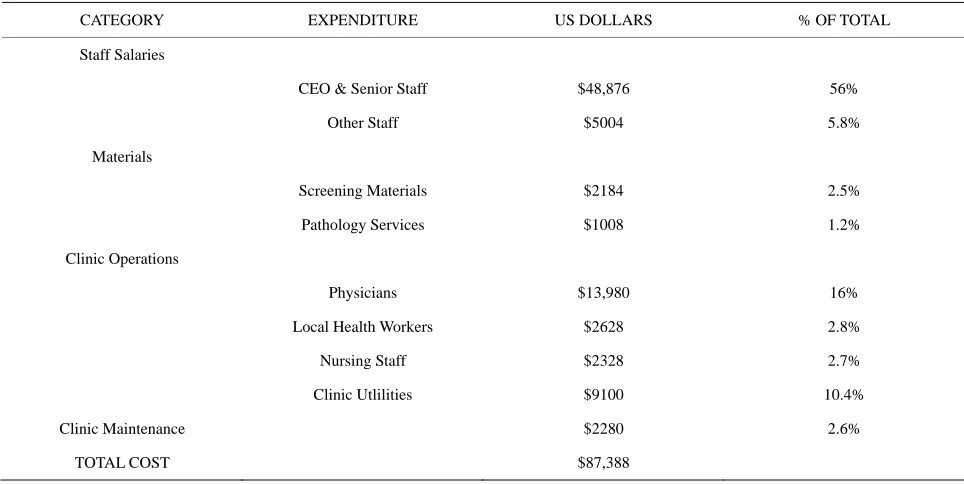
[image:3.595.99.254.123.195.2]Of the 8 women undergoing colposcopy, 3 patients were identified as having probable CIN 2 - 3. These women were offered LEEP as part of the see-and-treat program. One woman deferred treatment at the time of diagnosis and was scheduled to return at a later date. Another patient underwent a LEEP, successfully per- formed in the slum clinic. Final histology confirmed CIN 2 - 3. One patient had a lesion suspicious for carcinoma in situ (CIS) versus invasive carcinoma and was offered cold-knife conization (CKC) at the local hospital. She was subsequently diagnosed with an invasive squamous cell carcinoma of the cervix, Stage IB1. She underwent definitive treatment with a radical hysterectomy and bilateral pelvic lymphadenectomy and has done well postoperatively. These results are summarized in Table 3. The annual projected costs of a full time screening program were projected to be $87,388 US dollars. The breakdown of expenses is summarized in Table 4.
Table 2. Treatment algorithm.
WOMEN AGED 20 - 45 RECRUITED
VIA EXAM
IF VIA NEGATIVE THEN GENERAL HEALTH COUNSELING
IF VIA POSITIVE THEN COLPOSCOPY
IF COLPOSCOPY SHOWS CIN 1/CERVICITIS THEN TREAT WITH ANITBIOTIC AND RETURN IN SIX MONTHS
IF COLPOSCOPY SHOWS CIN 1 OR CIN 2 THAEN OFFER LEEP AT THE TIME OF COLPOSCOPY
IF COLPOSCOPY SHOWS CIS OR CANCER THEN REFERRAL TO HOSPITAL FOR CONE BIOPSY OR HYSTERECTOMY
VIA—visual inspection with acteic acid; CIN 1—cervical intraepithelial neoplasia one or mild dysplaisa; CIN 2—cervical intraepithelial neoplasia two or moderate dysplaisa; CIN 3—cervical intraepithelial neoplasia three or severe dysplaisa; CIS—carcinoma-in-situ.
4. DISCUSSION
Cervical cancer is a preventable disease because it has a long pre-invasive phase, and there is an effective screen- ing test, the Pap smear. Developed countries have seen a 75% decrease in incidence and mortality of cervical cancer in the past 50 years because of such screening. In contrast, for low- and middle-income countries, cervical cancer is the second most common cause of cancer-re- lated morbidity and mortality in women: 371,200 new cases annually with a 50% mortality rate [7,8]. These disparities reflect the vast differences between countries and highlight the impact of lack of resources for screen- ing and intervention in low-income countries. In Bang- ladesh, cervical cancer is the second most common can- cer among women of all ages and is leading cause of cancer-related mortality among women [2]. The lack of healthcare infrastructure makes screening with cytology an unattractive model. VIA, on the other hand, is an ideal, low-cost tool for screening in such a resource-poor setting.
COLPOSCOPY
Table 3. Results.
PATIENTS VIA LEEP CONE RADICAL HYSTERECTOMY
44 44 36 1 1 1
Breakdown of patients
VIA negative 36
VIA positive 8
CIN 1 4
CIN 2/3 3 1
INVASIVE CANCER 1 1
VIA—visual inspection with acteic acid; CIN 1—cervical intraepithelial neoplasia one or mild dysplaisa; CIN 2—cervical intraepithelial neoplasia two or moderate dysplaisa; CIN 3—cervical intraepithelial neoplasia three or severe dysplaisa.
Table 4. Projected annual costs of screening program.
CATEGORY EXPENDITURE US DOLLARS % OF TOTAL
Staff Salaries
CEO & Senior Staff $48,876 56%
Other Staff $5004 5.8%
Materials
Screening Materials $2184 2.5%
Pathology Services $1008 1.2%
Clinic Operations
Physicians $13,980 16%
Local Health Workers $2628 2.8%
Nursing Staff $2328 2.7%
Clinic Utlilities $9100 10.4%
Clinic Maintenance $2280 2.6%
TOTAL COST $87,388
obstacles [9]. VIA screening had been provided for 104,098 women across 44 districts in Bangladesh. 5013 (4.8%) women tested positive and 4371 (87.2%) under- went colposcopy with sensitivity and specificity of VIA for identifying CIN 2 - 3 were 93.6% and 58.3%, respec- tively. The positive-predictive value was 15.6%. The au- thors, again, noted the program was unlikely to succeed given the large target population and inadequate infra- structures and organization [4].
While VIA is a well-validated screening tool in re- source-poor settings with excellent sensitivity and speci- ficity, the sensitivity of cytology much lower, with re- ports ranging between 47% and 62% [10,11]. Cytology, however, does provide higher specificity compared to VIA. Like cytology, one of the limitations of VIA is that the accuracy of results varies depending on individual
interpretation. Initial training and quality control are of utmost importance. This pilot project demonstrates, how- ever, that quality training of lay women can be achieved in a short period of time. Because VIA requires fewer specialized personnel and less infrastructure, training, and equipment, it can be used in more remote or rural locations, as well as less-equipped settings, such as an urban slum.
with the single-visit approach, compared to 44% of women who were lost to treatment using a multi-visit model [12]. In South Africa, VIA-positive women were randomized to immediate treatment with cyrotherapy versus delayed evaluation. The screen-and-treat approach resulted in a lower prevalence of high-grade cervical cancer precur- sors [13]. Overall, VIA as part of a see-and-treat ap- proach is effective and is also well-accepted by patients [6,14].
Decreased visits also reduces costs for patients (time away from work, transportation costs, etc.), but can also contribute to improved cost efficacy depending on the screening modality. One study used statistical models to estimate the clinical benefits and cost-effectiveness of various screening tools, including cytology, VIA, and HPV DNA testing [15]. The model suggests that a single lifetime screening visit with testing and immediate treat- ment for women testing positive, translates to a reduction in the incidence of cervical cancer by 26% - 32%. Costs of this approach are less than US $50 per woman. When comparing various strategies, the authors found that women undergoing a single HPV DNA test at age 35 would cost US $14 per year of life saved (YLS) and reduce the inci- dence of cervical cancer by 32 percent, compared to no screening. VIA, in comparison, was the most cost-effec- tive tool and would reduce cervical cancer incidence by 26 percent. Cytology was the least effective and most expensive model [15].
Cryotherapy, a low-cost modality that can be per- formed by appropriately trained lay people, has been the treatment of choice by many cervical cancer screening projects. The procedure is associated with minimal bleed- ing, pain, or other complications. Discharge after the procedure is common, but when patients are appropri- ately counseled, cyrotherapy is generally well-accepted by patients [16,17]. However, while most studies rou- tinely counsel women to abstain from sexual activity for at least 4 weeks after the procedure, only 23% - 49% are able to do so, and condom use is variable, thus placing these women at higher risk for post-procedure infec- tious morbidity [18,19]. Other disadvantages include treating the entire cervix unnecessarily, risk of inade- quate depth of freeze, and risk of long term complica- tions such as cervical stenosis, vaginal scarring or agglu- tination, hematometria, chronic pelvic pain, or masking of an invasive carcinoma underneath scar.
Loop electrosurgical excision procedure (LEEP), is an alternative treatment modality. Limitations to LEEP in- clude requirements for longer periods of training, medi- cal expertise, as well as practical considerations, such as a reliable source of electricity. LEEP, however, has been shown to be more effective with fewer immediate com- plications, namely infection, and higher cure rates [20]. The procedure can be done quickly and without pain if
lidocaine is employed. Also, lesions can be targeted, thus preserving cervical stroma in women of childbearing age. More importantly, tissue is available for histology should carcinoma in situ (CIS) or invasive carcinoma be sus- pected. Cure rates with LEEP range from 93.9 - 96.4 for all grades of CIN and are higher that those reported for cyrotherapy (88.3%) [20-22].
Within Bangladesh, various cervical cancer screening programs have identified some major limitations to im- plementing such projects, including lack of education and awareness among the general population, a high rate of non-compliance, and an inability to assess the ade- quacy of the screening program due to a lack of a cen- tralized data-collection system [4].
Albeit on a much smaller scale, this current pilot pro- ject demonstrates some important factors in developing and implementing a successful screening program. For one, the electronic health record employed in the clinic allows for long-term monitoring and evaluation. Involv- ing laywomen as healthcare workers provides a strong tie to community, as well as education, economic inde- pendence, and empowerment for women who would oth- erwise occupy a lower social standing in their commu- nity. The close proximity of an ambulatory surgical cen- ter ensures that patients will not be subjected to a lower quality of care should invasive cancer suspected and his- tologic diagnosis required. Our experience also demon- strates that excisional procedures using LEEP can be performed safely in a slum setting provided the clinic space is well equipped and providers are well trained.
The screen positive rate of 18.2% is much higher than rates reported in the literature, which range from 4% - 8% in similar patient populations [4,9,23]. This may re- flect the small sample size as well as selection bias, in that women with ongoing gynecologic issues were more likely to present at the time the project was initiated. However such a high screen positive rate may reflect the unique nature of screening in a slum setting and con- comitant health conditions. There may be higher rates of cervicitis in this densely populated community in which rates of sexual violence and sexually transmitted infec- tions are thought to be higher, thus resulting in false- positives with VIA. The small nature of this pilot project has also afforded it with high quality training of the lay healthcare workers. Larger scale programs appear to quickly outgrow their already limited resources, specifi- cally in terms of physician and nursing staff [9,24]. We anticipate that in order to expand the current project to screen a larger area and population of women, a larger workforce will be required in order to maintain quality care.
been conducted in less densely populated areas. Within Bangladesh, findings from studies that have highlighted cultural considerations, such as higher success rates with screening programs that employ female providers, are applicable in our setting as well [14]. Rates of non-com- pliance, however, may be higher due to the itinerant na- ture of slum dwellers and higher rates of other medical, and namely infectious, comorbidities [25]. A screen-and- treat approach may mitigate noncompliance issues with this unique patient population.
This project has required a substantial investment of resources prior to initiation of the screening program. Ob- taining safe clinic space and working with well-trained personnel comprises the largest percentage of cost. Em- ploying lay women to perform VIA greatly reduces op- eration costs while providing a social benefit to those employed by the program.
In conclusion, our preliminary findings suggest that cervical cancer screening with VIA is safe and feasible in a slum setting. Our experience, thus far, confirms find- ings from other studies, that there is a general lack of knowledge among women about cervical cancer, its symptoms, and options for screening. We hypothesize that LEEP will be more effective than published cure rates with cryotherapy, but longer follow-up and addi- tional screening will be needed to further assess this. Our program has several strengths, mainly a safe and secure clinical space and a centralized, electronic medical record. The structure of the program and the employment of laywomen from the community will allow us to better assess community perceptions and the effects of poverty on health screening.
REFERENCES
[1] Sankaranarayanan, R., Bhatla, N., Gravitt, P., Basu, P., Esmy, P.O., Ashrafunnessa, K.S., Ariyaratne, Y., Shah, A. and Nene, B.M. (2008) Human papillomavirus infection and cervical cancer prevention in India, Bangladesh, Sri Lanka, and Nepal. Vaccine, 26S, M43-M52.
doi:10.1016/j.vaccine.2008.05.005
[2] WHO/ICO Information Centre on HPV and Cervical Cancer (HPV Information Centre) (2012) Human papil- lomavirus and related cancers in Kenya. Summary Report 2010. www.who.int/hpvcentre
[3] WHO (1996) Cervical cancer control in developing coun- tries: Memorandum from a WHO meeting. Bulletin—
World Health Organ, 74, 345-351.
[4] Nessa, A., Hussain, M.A., Rahman, J.N., Rashid, M.G., Muwonge, R. and Sankaranarayanan, R. (2010) Screen- ing for cervical neoplasia in Bangladesh using visual in- spection with acetic acid. International Journal of Gy-
naecology & Obstetrics, 111, 115-118.
[5] Sellors, J.W. and Sankaranarayanan, R. (2003) Colpo- scopy and treatment of cervical intraepithelial neoplasia:
A beginner’s manual. IARC Press, Lyon.
[6] Sankaranarayanan, R., Rajkumar, R., Arrossi, S., Theresa, R., Esmy, P.O., Mahé, C., Muwonge, R., Parkin, D.M. and Cherian, J. (2003) Determinants of participation of women in a cervical cancer visual screening trial in rural south India. Cancer Detection and Prevention, 27, 457- 465. doi:10.1016/j.cdp.2003.09.006
[7] Ferlay, J., Shin, H.R., Bray, F., Forman, D., Mathers, C. and Parkin, D.M. (2010). Estimates of worldwide burden of cancer in 2008: GLOBOCAN 2008. International Jour-
nal of Cancer, 127, 2893-2917. doi:10.1002/ijc.25516
[8] Jemal, A., Bray, F., Center, M.M., Ferlay, J., Ward, E. and Forman, D. (2011) Global cancer statistics. CA Cancer
Journal for Clinicians, 61, 69-90.
doi:10.3322/caac.20107
[9] Ahmed, T., Ashrafunnessa and Rahman, J. (2008) De- velopment of a visual inspection programme for cervical cancer prevention in Bangladesh. Reproductive Health
Matters, 16, 78-85. doi:10.1016/S0968-8080(08)32419-7
[10] Sankaranarayanan, R., Gaffikin, L., Jacob, M., Sellors, J. and Robles, S. (2005) A critical assessment of screening methods for cervical neoplasia. International Journal of
Gynaecology and Obstetrics, 89, S4-S12.
doi:10.1016/j.ijgo.2005.01.009
[11] Arbyn, M., Sankaranarayanan, R., Muwonge, R., Keita N., Dolo, A., Mbalawa, C.G., Nouhou, H., Sakande, B., Wesley, R., Somanathan, T., Sharma, A., Shastri, S. and Basu, P. (2008) Pooled analysis of the accuracy of five cervical cancer screening tests assessed in eleven studies in Africa and India. International Journal of Cancer, 123, 153-160. doi:10.1002/ijc.23489
[12] Luciani, S. and Winkler, J. (2006) Cervical cancer pre- vention in Peru: Lessons learned from the TATI demon- stration project. Pan American Health Organization, Wash- ington DC.
[13] Denny, L., Kuhn, L., De Souza, M., Pollack, A.E., Dupree, W. and Wright, T.C. (2005) Screen-and-treat approaches for cervical cancer prevention in low-resource settings: A randomized controlled trial. The Journal of the American
Medical Association, 294, 2173-2181.
doi:10.1001/jama.294.17.2173
[14] Ansink, A.C., Tolhurst, R., Haque, R., Saha, S., Datta, S. and van den Broek, N.R. (2008) Cervical cancer screen- ing in Bangladesh: Community perceptions of cervical cancer and cervical cancer screening. Transactions of the
Royal Society of Tropical Medicine and Hygiene, 102, 499-
505. doi:10.1016/j.trstmh.2008.01.022
[15] Goldie, S.J., Kuhn, L., Denny, L., Pollack, A. and Wright, T.C. (2001) Policy analysis of cervical cancer screening strategies in low-resource settings: Clinical benefits and cost-effectiveness. The Journal of the American Medical
Association, 285, 3107-3115.
doi:10.1001/jama.285.24.3107
[16] Alliance for Cervical Cancer Prevention (ACCP) (2003) Effectiveness, safety, and acceptability of cryotherapy. A
Systematic Literature Review, ACCP, Seattle.
International Journal of Gynaecology & Obstetrics, 89, S13-S20. doi:10.1016/j.ijgo.2005.01.026
[18] Alliance for Cervical Cancer Prevention (2004) Improv- ing screening coverage rates of cervical cancer prevention programs: A focus on communities. ACCP, Seattle. [19] Bingham, A., Bishop, A., Coffey, P., Winkler, J., Bradley,
J., Dzuba, I. and Agurto, I. (2003) Factors affecting utili- zation of cervical cancer prevention services in low-re- source settings. Salud Publica de Mexico, 45, S408-S416.
doi:10.1590/S0036-36342003000900015
[20] Chirenje, Z.M., Rusakaniko, S., Akino, V. and Mlingo, M. (2001) A randomised clinical trial of loop electrosurgical excision procedure (LEEP) versus cryotherapy in the treatment of cervical intraepithelial neoplasia. American
Journal of Obstetrics & Gynaecology, 21, 617-621.
doi:10.1080/01443610120085618
[21] Sankaranarayanan, R., Keshkar, V., Kothari, A., Kane, S., Fayette, J.M. and Shastri, S. (2009) Effectiveness and safety of loop electrosurgical excision procedure for cer- vical neoplasia in rural India. International Journal of
Gynaecology & Obstetrics, 104, 95-99.
doi:10.1016/j.ijgo.2008.09.009
[22] Rema, P., Suchetha, S., Thara, S., Fayette, J.M., Wesley, R. and Sankaranarayanan, R. (2008) Effectiveness and safety of loop electrosurgical excision procedure in a low- resource setting. International Journal of Gynaecology &
Obstetrics, 103, 105-110. doi:10.1016/j.ijgo.2008.06.020
[23] Abdel-Hady, E.S., Emam, M., Al-Gohary, A., Hassan, M., Farag, M.K. and Abo-Elkheir, M. (2006) Screening for cervical carcinoma using visual inspection with acetic acid. International Journal of Gynaecology & Obstetrics,
93, 118-122. doi:10.1016/j.ijgo.2006.01.024
[24] Basu, P., Nessa, A., Majid, M., Rahman, J.N. and Ahmed, T. (2010) Evaluation of the national cervical cancer screening programme of Bangladesh and the formulation of quality assurance guidelines. Journal of Family Plan-
ning and Reproductive Health Care, 36, 131-134.
doi:10.1783/147118910791749218